Translations
American King James Version, Webster Bible
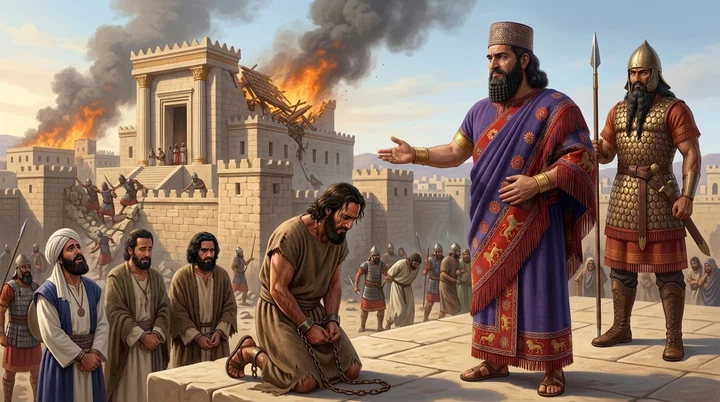
And the city was besieged to the eleventh year of king Zedekiah.
King James Version, KJV Cambridge Paragraph Bible
And the city was besieged unto the eleventh year of king Zedekiah.
Revised Version, American Standard Version
So the city was besieged unto the eleventh year of king Zedekiah.
And the city entereth into siege till the eleventh year of king Zedekiah,
And the city was besieged until the eleventh year of king Zedekiah.
And the city came into the siege,—until the eleventh year of King Zedekiah.
Berean Standard Bible, Majority Standard Bible
And the city was kept under siege until King Zedekiah’s eleventh year.
So the city was besieged until the eleventh year of King Zedekiah.
And the town was shut in by their forces till the eleventh year of King Zedekiah.
So the citie was besieged vnto the eleueth yeere of King Zedekiah.
Douay-Rheims (Challoner revision)
And the city was shut up and besieged till the eleventh year of king Sedecias,
Pictures
Cross-references
- 2 Chronicles 36:17-21
Therefore he brought upon them the king of the Chaldees, who slew their young men with the sword in the house of their sanctuary, and had no compassion upon young man or maiden, old man, or him that stooped for age: he gave them all into his hand.
Retells Jerusalem’s fall, destruction, and the exile that followed Zedekiah’s rebellion.
- Jeremiah 37:5
Then Pharaoh’s army was come forth out of Egypt: and when the Chaldeans that besieged Jerusalem heard tidings of them, they departed from Jerusalem.
Egypt’s advance briefly lifted the siege of Jerusalem.
- Ezekiel 17:15
But he rebelled against him in sending his ambassadors into Egypt, that they might give him horses and much people. Shall he prosper? shall he escape that doeth such things? or shall he break the covenant, and be delivered?
Zedekiah rebelled by appealing to Egypt for military aid.
- 2 Kings 24:10-16
At that time the servants of Nebuchadnezzar king of Babylon came up against Jerusalem, and the city was besieged.
An earlier Babylonian siege of Jerusalem led to Jehoiachin’s captivity and deportations.
- Jeremiah 39:1-10
In the ninth year of Zedekiah king of Judah, in the tenth month, came Nebuchadrezzar king of Babylon and all his army against Jerusalem, and they besieged it.
Describes Jerusalem’s capture and the deportation of its people.
- Jeremiah 32:2
For then the king of Babylon’s army besieged Jerusalem: and Jeremiah the prophet was shut up in the court of the prison, which was in the king of Judah’s house.
Places Jeremiah’s imprisonment during the Babylonian siege of Jerusalem.
- Jeremiah 34:21-22
And Zedekiah king of Judah and his princes will I give into the hand of their enemies, and into the hand of them that seek their life, and into the hand of the king of Babylon’s army, which are gone up from you.
Zedekiah and Jerusalem face Babylon’s returning siege as judgment.
- 2 Kings 24:18-20
Zedekiah was twenty and one years old when he began to reign, and he reigned eleven years in Jerusalem. And his mother’s name was Hamutal, the daughter of Jeremiah of Libnah.
Cited alongside 2 Kings 25 in the comparison with Jeremiah’s conclusion.
- Micah 4:10
Be in pain, and labour to bring forth, O daughter of Zion, like a woman in travail: for now shalt thou go forth out of the city, and thou shalt dwell in the field, and thou shalt go even to Babylon; there shalt thou be delivered; there the LORD shall redeem thee from the hand of thine enemies.
Zion goes into captivity to Babylon.
- Jeremiah 44:30
Thus saith the LORD; Behold, I will give Pharaoh-hophra king of Egypt into the hand of his enemies, and into the hand of them that seek his life; as I gave Zedekiah king of Judah into the hand of Nebuchadrezzar king of Babylon, his enemy, and that sought his life.
Identifies Pharaoh Hophra, the Egyptian king connected with Zedekiah.
- Ezekiel 21:26
Thus saith the Lord GOD; Remove the diadem, and take off the crown: this shall not be the same: exalt him that is low, and abase him that is high.
Prophesies the removal of Zedekiah’s crown.
Commentary
Each commentary is drawn from primary sources: the writings of Ellen G. White and Adventist pioneers and periodicals. Each commentary is separate. Its own words are not a quotation; follow the references to read the source passages.
Pioneers and periodicals
10 sources
The verse stands in the third great division of the history of the kings, the history of the remaining kingdom of Judah after the ten tribes were swept away, covering 2 Kings 18-25 within the whole span from the accession of Solomon to the Babylonian captivity.ST Dec 9, 1897 The two books of Kings form one whole and are counted as one book in the Hebrew canon, the division into two having been introduced in the old versions which reckoned Samuel and Kings as a continuous series called the four books of the Kingdoms or Kings, a title retained in the Authorized Version.ST Dec 9, 1897 The name Kings is fitting because the books relate the history of the kings.ST Dec 9, 1897
It belongs to the close of the history of the kingdom of Judah and the record of its final fall, when Babylon took the people captive, overthrew the kingdom, and scattered them.ST Nov 7, 1906 It records the siege of Jerusalem by Nebuchadnezzar and the rebellion of Zedekiah leading to the final capture of the Jewish nation, with the laying waste of the city, the despoiling of the temple, the slaying of the captives at Riblah, the capture of Zedekiah the last king, and the carrying into captivity of many.ST Jun 10, 1913ST May 12, 1909 Afterward a little company was left in the land under Gedaliah as governor, who was slain through treachery, and the remnant went to Egypt contrary to Jeremiah's counsel, and the account ends with the kind treatment shown to Jehoiachin by the king of Babylon.ST Jun 10, 1913ST May 12, 1909
The siege began in Zedekiah's ninth year after eight years as Nebuchadnezzar's vassal, when Zedekiah revolted and sent ambassadors to Pharaoh Uaphris in Egypt for foot soldiers and horsemen to win independence for Judah between Babylon and Egypt.RH Apr 30, 1908 Nebuchadnezzar came in person with all his hosts against Jerusalem, overcame and pillaged the open country, and built forts and besieged the city.RH Apr 30, 1908 When Uaphris marched out of Egypt to relieve his ally, the Babylonian army raised the siege to go after the Egyptians, who were defeated or retreated without relieving Jerusalem, and the siege was then renewed as a complete blockade until the city fell in Zedekiah's eleventh year, about a year and a half after the second investment.ST Aug 20, 1885RH Apr 30, 1908
The Babylonian army kept Jerusalem under siege until the eleventh year of Zedekiah, when on the ninth day of the fourth month famine prevailed in the city and there was no bread for the people of the land.ST Jan 14, 1886 Then the city was broken up, and all the men of war fled by night by the gate between the two walls by the king's garden while the Chaldeans were around the city, and the king went toward the plain but his army scattered from him and the Chaldeans overtook him in the plains of Jericho.ST Jan 14, 1886 They took him to the king of Babylon at Riblah where judgment was given upon him, slew the sons of Zedekiah before his eyes, put out Zedekiah's eyes, bound him with fetters of brass, and carried him to Babylon where he died in captivity.ST Nov 4, 1897ST Jan 14, 1886 This marks the close of independent government in Judah, after which whatever self-rule Judah had was only as a province subservient to the great world kingdoms, with the diadem removed and the crown taken off to be no more until he come whose right it is.ST Nov 4, 1897
The siege and fall of Jerusalem marks the destruction and captivity of the Israelite state under Nebuchadnezzar, and its setting illustrates the judgment that followed Israel's adoption of slavery and disobedience to laws meant to protect servants' freedom and affirm equality.RH Oct 8, 1861 The siege unto the eleventh year of Zedekiah as part of the Babylonian captivity and final destruction of Jerusalem is typical of events to transpire either under the gospel or at the close of this dispensation.RH Sep 17, 1872 What applied primarily and typically to the Jews was molded to also represent events under the gospel, so those living in the Christian dispensation have a special interest in it and can improve on what emphatically applies in this age.RH Sep 17, 1872
Sources