Acts 6:14
For we have heard him say, that this Jesus of Nazareth shall destroy this place, and shall change the customs which Moses delivered us.
Translations
American King James Version, King James Version
For we have heard him say, that this Jesus of Nazareth shall destroy this place, and shall change the customs which Moses delivered us.
for we have heard him say, that this Jesus of Nazareth shall destroy this place, and shall change the customs which Moses delivered us.
For we have heard him say, that this Jesus of Nazareth will destroy this place, and will change the customs which Moses delivered to us.
Revised Version, American Standard Version
for we have heard him say, that this Jesus of Nazareth shall destroy this place, and shall change the customs which Moses delivered unto us.
for we have heard him saying, That this Jesus the Nazarean shall overthrow this place, and shall change the customs that Moses delivered to us;'
for we have heard him saying, This Jesus the Nazaraean shall destroy this place, and change the customs which Moses taught us.
For we have heard him saying—This Jesus the Nazarene, will overthrow this place, and will change the customs which, Moses, delivered unto us.
Berean Standard Bible, Majority Standard Bible
For we have heard him say that Jesus of Nazareth will destroy this place and change the customs that Moses handed down to us.”
For we have heard him say that this Jesus of Nazareth will destroy this place, and will change the customs which Moses delivered to us.”
For he has said in our hearing that this Jesus of Nazareth will put this place to destruction and make changes in the rules which were handed down to us by Moses.
For we haue heard him say, that this Iesus of Nazareth shall destroy this place, and shall change the ordinances, which Moses gaue vs.
Douay-Rheims (Challoner revision)
For we have heard him say, that this Jesus of Nazareth shall destroy this place, and shall change the traditions which Moses delivered unto us.
Pictures
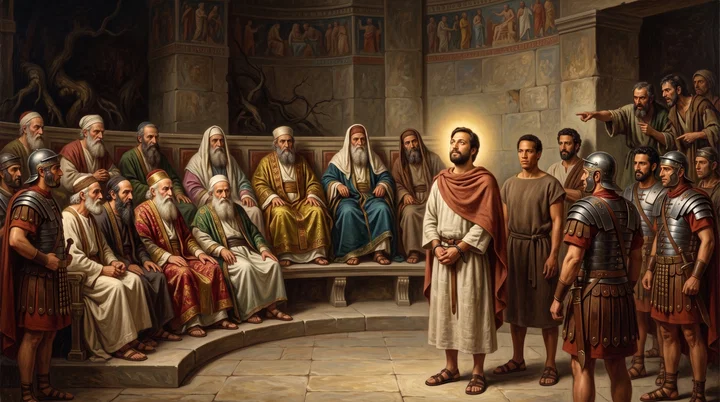
Cross-references 20 of 26
- Acts 7:54-60
When they heard these things, they were cut to the heart, and they gnashed on him with their teeth.
The accusations against Stephen lead to his condemnation and stoning.
- Acts 7:1-53
Then said the high priest, Are these things so?
Stephen answers the charges concerning Moses, the law, and the temple by recounting Israel’s history.
- Matthew 26:61
And said, This fellow said, I am able to destroy the temple of God, and to build it in three days.
False witnesses claim Jesus threatened to destroy the temple.
- John 2:19-21
Jesus answered and said unto them, Destroy this temple, and in three days I will raise it up.
Jesus’ saying about destroying and raising the temple is echoed in the accusation.
- Acts 7:48
Howbeit the most High dwelleth not in temples made with hands; as saith the prophet,
Stephen declares that God does not dwell in temples made with hands.
- Mark 14:58
We heard him say, I will destroy this temple that is made with hands, and within three days I will build another made without hands.
False witnesses accuse Jesus of threatening to destroy the temple.
- Acts 6:8-10
And Stephen, full of faith and power, did great wonders and miracles among the people.
Stephen’s powerful witness leads to the accusation about Jesus changing the customs.
- Mark 15:29
And they that passed by railed on him, wagging their heads, and saying, Ah, thou that destroyest the temple, and buildest it in three days,
Uses the same word in a taunt about destroying the temple.
- Matthew 27:40
And saying, Thou that destroyest the temple, and buildest it in three days, save thyself. If thou be the Son of God, come down from the cross.
Uses the same word in a taunt about destroying the temple.
- Matthew 5:17-18
Think not that I am come to destroy the law, or the prophets: I am not come to destroy, but to fulfil.
Jesus declared that he did not come to destroy the law.
- Mark 13:2
And Jesus answering said unto him, Seest thou these great buildings? there shall not be left one stone upon another, that shall not be thrown down.
Uses the same word for the temple being thrown down.
- Mark 14:62-64
And Jesus said, I am: and ye shall see the Son of man sitting on the right hand of power, and coming in the clouds of heaven.
Cited as evidence that Jesus faced bitter opposition.
- Matthew 24:2
And Jesus said unto them, See ye not all these things? verily I say unto you, There shall not be left here one stone upon another, that shall not be thrown down.
Uses the same word for the temple being thrown down.
- John 4:21-24
Jesus saith unto her, Woman, believe me, the hour cometh, when ye shall neither in this mountain, nor yet at Jerusalem, worship the Father.
Jesus teaches that worship of God is not confined to the temple.
- Acts 21:21
And they are informed of thee, that thou teachest all the Jews which are among the Gentiles to forsake Moses, saying that they ought not to circumcise their children, neither to walk after the customs.
Moses’ customs and circumcision are identified with the ritual law.
- Luke 21:6
As for these things which ye behold, the days will come, in the which there shall not be left one stone upon another, that shall not be thrown down.
Uses the same word for the temple being thrown down.
- Acts 7:51-53
Ye stiffnecked and uncircumcised in heart and ears, ye do always resist the Holy Ghost: as your fathers did, so do ye.
Stephen rebukes their resistance to God and persecution of His messengers.
- Isaiah 66:1
Thus saith the LORD, The heaven is my throne, and the earth is my footstool: where is the house that ye build unto me? and where is the place of my rest?
Heaven is God’s throne, not a human-built house.
- Acts 6:1-7
And in those days, when the number of the disciples was multiplied, there arose a murmuring of the Grecians against the Hebrews, because their widows were neglected in the daily ministration.
Stephen was chosen to serve in the church’s practical ministry.
- Luke 21:15
For I will give you a mouth and wisdom, which all your adversaries shall not be able to gainsay nor resist.
Jesus promises wisdom and speech that Stephen displays before his adversaries.
Commentary
Each commentary is drawn from primary sources: the writings of Ellen G. White and Adventist pioneers and periodicals. Each commentary is separate. Its own words are not a quotation; follow the references to read the source passages.
Ellen G. White
17 sources
Acts 6:14 records the hired false testimony brought against Stephen in his trial before the Sanhedrin, claiming he said Jesus of Nazareth would destroy the holy place and change the customs delivered by Moses.AA 97.1Ms 22, 1900, par. 29–30Ms 11, 1900, par. 1–53SP 295.37RED 31.1–2 The charge was pressed with great force as blasphemy against the temple, the law, Moses, and God, to make Stephen appear dangerous and to frighten others from believing his preaching of the crucified and risen Christ.Ms 22, 1900, par. 29–30Ms 11, 1900, par. 1–53SP 295.3 It is the witnesses' accusation, not a faithful account of what Stephen or Jesus actually said.Ms 11, 1900, par. 1–53SP 295.3AC1 32.1 Stephen had spoken with the wisdom and power of the Holy Spirit that his opponents could not resist, and instead of yielding they were filled with bitter hatred and violent opposition.AA 97.17RED 32.13SP 294.2 The need for false witnesses shows that neither Christ nor Stephen could be charged directly with breaking the Sabbath, for even lesser customs were carefully respected and violation of the Sabbath would have brought severe penalty.ST May 1, 1884SLP 213.1
Charge Against Stephen
This saying belongs to Stephen's public defense of his faith before the Sanhedrin council for trial.AA 97.17RED 31.1–2SLP 16.1 He had been seized and brought there to be silenced despite the evidence he had presented.7RED 31.1–2SLP 16.13SP 294.2 His opponents tried to refute his teaching as dangerous, and the priests and rulers were determined to silence his voice by putting him to death.7RED 31.1–2SLP 16.13SP 294.2 They had on several occasions bribed the Roman authorities to overlook the Jews taking the law into their own hands to try, condemn, and execute prisoners according to their national custom, and they did not doubt they could do the same without danger to themselves.3SP 294.2 Determined to risk the consequences at all events, they seized Stephen and brought him before the council.3SP 294.2
Stephen spoke with the wisdom and power of the Holy Spirit, knowing the prophecies and the law.AA 97.1 A wonderful manifestation of power attended his ministry, and he met his opponents with clear, calm wisdom.7RED 32.13SP 294.2 They could not resist his arguments nor prevail against him.AA 97.17RED 32.1 Instead of yielding to the weight of evidence he presented, they were filled with bitter hatred and with vehement opposition and revengeful hatred.7RED 32.13SP 294.2
What is heard here is hired false witnesses testifying that they heard him say that this Jesus of Nazareth would destroy the temple or holy place and change the customs which Moses delivered.Ms 22, 1900, par. 29–30Ms 11, 1900, par. 1–53SP 295.3SG1 87.17RED 32.1 The charge came from witnesses hired by the priests and rulers to stir opposition.3SP 295.3AC1 32.17RED 32.1 It was pressed in a most imposing manner as blasphemy against the temple and holy place and the law.Ms 22, 1900, par. 29–30Ms 11, 1900, par. 1–53SP 295.3SG1 87.17RED 32.1 It was likewise pressed as blasphemy against Moses and God, to portray his preaching about the crucified and risen Christ as blasphemous and dangerous.Ms 11, 1900, par. 1–5EW 164.1 In this the priests and rulers determined to make an example of him and to keep others from adopting his belief through fear.AC1 32.17RED 32.1RH Feb 23, 1911
The saying is therefore the witnesses' accusation and testimony brought against Stephen, not a faithful or verified account of what Stephen or Jesus actually said.Ms 11, 1900, par. 1–53SP 295.3AC1 32.1RH Feb 23, 1911AA 98.1–3 It does not establish that he made those statements about the temple, the law, Moses, and God.3SP 295.3AA 98.1–3EW 164.1
Influence and Application
Stephen's testimony in the trial and the evidence of God's presence with him troubled Saul.AA 112.2–113.13SP 305.2 His triumphant death greatly stirred Saul and shook his prejudice.AA 112.2–113.13SP 305.2 The priests and rulers pressed the charge that Stephen was a blasphemer for preaching that Jesus of Nazareth would destroy the temple and change the customs Moses delivered, that the Jesus Christ whom Stephen preached was an impostor, and that those ministering in holy offices were right.AA 112.2–113.13SP 305.2 Their opinions and arguments finally convinced Saul that Stephen was a blasphemer and settled him in mind that the priests and scribes were right, and that conviction made him bitter in opposition to Christianity and zealous to persecute believers.AA 112.2–113.13SP 305.2
The accusation that Jesus would destroy the temple and change the customs Moses delivered was fabricated testimony brought against Stephen to provide a pretext for condemnation.ST May 1, 1884SLP 213.1 If Sabbath-breaking could have been charged against Christ or Stephen, their enemies could have accused them directly and would not have needed false witnesses.ST May 1, 1884SLP 213.1 Their care to respect even lesser customs shows that violating the fourth-commandment Sabbath would have brought severe penalties, indeed the severest penalty.ST May 1, 1884SLP 213.1
Sources
Pioneers and periodicals
29 sources
Acts 6:14 does not give Stephen's own words but the claim of false witnesses set up to secure his conviction before the council.ST Feb 12, 1902ST Feb 4, 1897ST Feb 4, 1897 They charged that Jesus of Nazareth would throw down the holy temple and change the customs delivered through Moses, framing it as continual blasphemy against the holy place and the law.ST Feb 12, 1902ST Feb 4, 1897RH Jul 16, 1857RH May 10, 1915 The customs in view are the ceremonial system of ritual service and forms of worship, not the Ten Commandments, which Stephen honored as God's living oracles.RH Sep 17, 1908RH Nov 21, 1871 What he had actually taught was that worship was no longer confined to temples made with hands but is offered throughout the world in spirit and truth, because Christ's death ended the system the temple represented.RH Feb 23, 1911ST Nov 28, 1878ST Sep 19, 1900 Like Naboth, he was condemned for blasphemy on suborned testimony and stoned, showing how lawful forms can be turned to destroy the innocent and how opposition to Christ continued against His followers.RH Jul 25, 1854RH Apr 14, 1874ST Aug 13, 1902ST Jul 14, 1898
The False Accusation
Acts 6:14 does not give Stephen's own words but what false witnesses set up in the council against him claimed they had heard him say.ST Mar 3, 1914ST Feb 12, 1902ST Feb 4, 1897ST Feb 4, 1897ST Aug 12, 1897 These were hired witnesses falsely charging him, and their report is not a true statement by Stephen but an accusation used to portray his preaching as blasphemy against the temple and the law and to intimidate others from accepting his belief.ST Mar 3, 1914RH Feb 23, 1911ST Aug 12, 1897
The charge was that this Jesus of Nazareth would destroy the holy place or temple and change the customs Moses delivered.ST Mar 3, 1914RH Feb 23, 1911ST Feb 12, 1902ST Feb 4, 1897RH May 10, 1915 It was offered as proof that he continually spoke against the holy place and the law, presenting Jesus' teaching as an attack on the temple and the Mosaic customs and distorting Stephen's teaching into blasphemy against Moses.ST Feb 12, 1902ST Feb 4, 1897ST May 24, 1883
The accusation came after he was seized and brought before the council or Sanhedrin because his disputants could not withstand the wisdom and the Spirit by which he spoke.ST Feb 12, 1902 It was a treacherous response after they could not answer his Spirit-given teaching about Christ's resurrection, when the combined wisdom of opposing scholars could not resist him, leading to his arraignment before the council.ST May 24, 1883ST Feb 12, 1902
The witnesses were hired to give prejudicial false testimony in a mock trial before the Sanhedrin to make sure of convicting him and curbing the press of people toward faith in Jesus.ST Feb 12, 1902ST Feb 19, 1902 The charge was the very same story used to condemn Christ to the cross, and the high priest knew the charges were untrue yet feigned impartiality in asking Stephen to answer, while Stephen's condemnation was already assured.ST Feb 19, 1902
The word translated destroy is the Greek kataluo, here having the sense of throwing down or destroying a building.RH Jul 16, 1857
As the witnesses spoke, God's glory shone full in his face before all in the council, revealing that he was a child of the Most High and attesting his true character by a heavenly radiance displayed in his countenance.ST Feb 12, 1902ST Feb 12, 1902 This glory accompanying the Holy Spirit was meant to shine through God's earthly agents and give power to their message, as it later did through Stephen, yet pride of opinion and bigoted folly kept the council from retracing their persecution, and even such testimony could not melt hearts held under supreme control by the spirit of persecution.ST Feb 12, 1902ST Feb 12, 1902ST May 3, 1910 This shows the utter futility of all opposition to the wisdom and power of the Word of God, while his bold stand for Christ brought the Jews' hostility and led to his death, faced with astonishing faith, fervor, and foresight given by the Holy Spirit.ST Mar 11, 1897ST Feb 12, 1902ST Jan 9, 1912
Law, Temple, and Meaning
The law at issue in the charge was the ceremonial law, the ritual service and established forms of worship delivered through Moses, rather than the Ten Commandments.RH Sep 17, 1908 To change the customs Moses delivered was treated as a grave offense punishable by death, and Stephen was martyred on that charge.ST Sep 3, 1912 No one was regarded as having authority to alter laws given through Moses, even though some of those laws were temporary types that would cease when their antitype came.ST Sep 3, 1912
Stephen’s actual teaching was that worship of God was no longer confined to temples made by human hands but could take place throughout the world in spirit and truth.ST Nov 28, 1878 The death of Christ brought the end of the system that the temple and its customs represented.ST Nov 28, 1878 The accusation distorted this teaching into blasphemy against the temple and the law.RH Feb 23, 1911ST Nov 28, 1878 It was framed to turn people against Stephen by appealing to their attachment to the traditional law and their professed zeal for God, and to intimidate others from accepting his belief.RH Feb 23, 1911ST Sep 19, 1900
Stephen’s answer implied that the temple would be destroyed, but it did not imply that the Ten Commandments would be abolished or changed.RH Nov 21, 1871 He spoke of the commandments as God’s lively oracles received through Moses.RH Nov 21, 1871 His preaching about Jesus contained no teaching about a new Sabbath, which shows that this was not the charge on which he had been arrested.RH Nov 21, 1871
The accusation was fabricated to provide a pretext for condemnation.ST May 1, 1884 It is false testimony that he spoke blasphemous words against the law, not proof that he or Paul had violated the law.RH Feb 3, 1852RH Jun 24, 1852 If Sabbath-breaking could have been charged against Christ or Stephen, their enemies would not have needed false witnesses.ST May 1, 1884 Their care to respect lesser customs shows that violating the fourth-commandment Sabbath would have brought severe penalties.ST May 1, 1884
Prophecy, Parallels, and Application
Stephen's condemnation completes old Israel's rejection of Christ in the autumn of A.D. 34, and the elders' official act in condemning him also scattered the church from Jerusalem.ST Jul 17, 1901 The charge that Jesus of Nazareth would destroy the temple and change the customs delivered through Moses reflects that rejection of Jesus which, together with His crucifixion and the later condemnation and persecution of His apostles and followers, filled Jerusalem's cup of iniquity and brought its destruction.RH May 10, 1915
Like Naboth, Stephen was accused of blasphemy on the testimony of two suborned witnesses and was stoned to death, and both cases show how a semblance of lawful procedure can be turned to evil purposes.ST Jul 14, 1898 His death was an act of lawlessness and the condemnation of an innocent person through false witness, not a rightful execution for an offense against God.RH Apr 14, 1874ST Aug 13, 1902 He was falsely accused of blasphemy when his accusers claimed he said Jesus would destroy the temple and change the customs Moses had delivered.ST Aug 13, 1902
The verse is evidence that people opposed the apostles as they had opposed Jesus.RH Jul 25, 1854 Opponents argued against apostolic teaching by appealing to established religious tradition, accusing them of rejecting the customs Moses had delivered.ST Jun 13, 1878 Appeals to what earlier generations believed or practiced have thus been used to resist religious reform.ST Jun 13, 1878
Sources