Matthew 26:61
And said, This fellow said, I am able to destroy the temple of God, and to build it in three days.
Translations
American King James Version, King James Version
And said, This fellow said, I am able to destroy the temple of God, and to build it in three days.
and said, This fellow said, I am able to destroy the temple of God, and to build it in three days.
And said, This man said, I am able to destroy the temple of God, and to build it in three days.
Revised Version, American Standard Version
and said, This man said, I am able to destroy the temple of God, and to build it in three days.
said, 'This one said, I am able to throw down the sanctuary of God, and after three days to build it.'
and said, He said, I am able to destroy the temple of God, and in three days build it.
and said: This, man said—I am able to pull down the shrine of God, and, in three days, to, build, it.
Berean Standard Bible, Majority Standard Bible
and declared, “ This man said, ‘ I am able to destroy the temple of God and rebuild it in three days.’”
and said, “ This man said, ‘ I am able to destroy the temple of God, and to build it in three days.’”
But later there came two who said, This man said, I am able to give the Temple of God to destruction, and to put it up again in three days.
And saide, This man saide, I can destroie the Temple of God, and build it in three daies.
Douay-Rheims (Challoner revision)
And they said: This man said, I am able to destroy the temple of God, and after three days to rebuild it.
Pictures
Cross-references
- John 2:19-21
Jesus answered and said unto them, Destroy this temple, and in three days I will raise it up.
Jesus’ saying about raising the temple in three days referred to his body and was twisted into an accusation.
- Mark 14:58
We heard him say, I will destroy this temple that is made with hands, and within three days I will build another made without hands.
Witnesses accuse Jesus of saying he would destroy the temple and rebuild it in three days.
- Acts 6:14
For we have heard him say, that this Jesus of Nazareth shall destroy this place, and shall change the customs which Moses delivered us.
Stephen faced a false temple-destruction charge like Jesus.
- Matthew 27:40
And saying, Thou that destroyest the temple, and buildest it in three days, save thyself. If thou be the Son of God, come down from the cross.
On the cross, people taunted Jesus by repeating the temple saying.
- Matthew 24:2
And Jesus said unto them, See ye not all these things? verily I say unto you, There shall not be left here one stone upon another, that shall not be thrown down.
Both use the same Greek word for the temple being destroyed.
- John 18:13-24
And led him away to Annas first; for he was father in law to Caiaphas, which was the high priest that same year.
Jesus is questioned before Annas and Caiaphas during his trial.
- Luke 22:66-71
And as soon as it was day, the elders of the people and the chief priests and the scribes came together, and led him into their council, saying,
Parallel account of Jesus’ hearing before the council.
- Mark 15:29
And they that passed by railed on him, wagging their heads, and saying, Ah, thou that destroyest the temple, and buildest it in three days,
Both texts repeat the taunt about destroying the temple and rebuilding it in three days.
- John 2:21
But he spake of the temple of his body.
Jesus meant the temple of His body.
- Matthew 26:65-66
Then the high priest rent his clothes, saying, He hath spoken blasphemy; what further need have we of witnesses? behold, now ye have heard his blasphemy.
His words are treated as blasphemy, and the council declares him guilty of death.
- Matthew 27:63
Saying, Sir, we remember that that deceiver said, while he was yet alive, After three days I will rise again.
cited together as specified period of three days
- Matthew 21:12-13
And Jesus went into the temple of God, and cast out all them that sold and bought in the temple, and overthrew the tables of the moneychangers, and the seats of them that sold doves,
authority Peter hoped Jesus would assert
- Mark 13:2
And Jesus answering said unto him, Seest thou these great buildings? there shall not be left one stone upon another, that shall not be thrown down.
Both speak of the temple being thrown down.
- Matthew 5:17
Think not that I am come to destroy the law, or the prophets: I am not come to destroy, but to fulfil.
Jesus’ words about fulfilling, rather than destroying, were contrasted with the false charge.
- Luke 21:6
As for these things which ye behold, the days will come, in the which there shall not be left one stone upon another, that shall not be thrown down.
Both refer to the temple being thrown down.
- Matthew 27:11-26
And Jesus stood before the governor: and the governor asked him, saying, Art thou the King of the Jews? And Jesus said unto him, Thou sayest.
The trial before Pilate follows Jesus’ examination by Caiaphas.
- John 11:53
Then from that day forth they took counsel together for to put him to death.
The leaders conspire to put Jesus to death, fearing his influence.
Commentary
Each commentary is drawn from primary sources: the writings of Ellen G. White and Adventist pioneers and periodicals. Each commentary is separate. Its own words are not a quotation; follow the references to read the source passages.
Ellen G. White
16 sources
This saying was false and malicious testimony that twisted His figurative prophecy about the temple of His body into a threat to destroy the Jewish temple and rebuild it in three days, when He was foretelling His own death and resurrection and victory.Ms 45, 1897, par. 1–25RED 35.3–36.25RED 36.3–38.2
It came from bribed witnesses whose evidence was vague and contradictory, at last from two men, and it was the only saying of His the priests could turn to use against Him.Ms 45, 1897, par. 1–2ST Jun 27, 18783SP 118.1–23SP 116.3–117.2
Spoken as He uttered it, the words were truth with nothing offensive or worthy of death in them and did not constitute blasphemy, becoming an offense only by misstatement and misapplication.5RED 35.3–36.25RED 36.3–38.2ST Jun 27, 1878
The priests pressed this charge because Romans and Jews, Pharisees and Sadducees all held the temple in great veneration and pride as a work of science and art, so the claim would stir indignation and unite them on common ground.5RED 36.3–38.2ST Jun 27, 18783SP 116.3–117.2
The false testimony was arranged because the chief priests and elders feared He would surpass them in authority and draw the people away, and God overruled their crime for His glory and humanity's good without lessening their guilt, while a charge of Sabbath breaking could not truthfully be made against Him.ST Feb 5, 1880SLP 213.1
Setting and False Charge
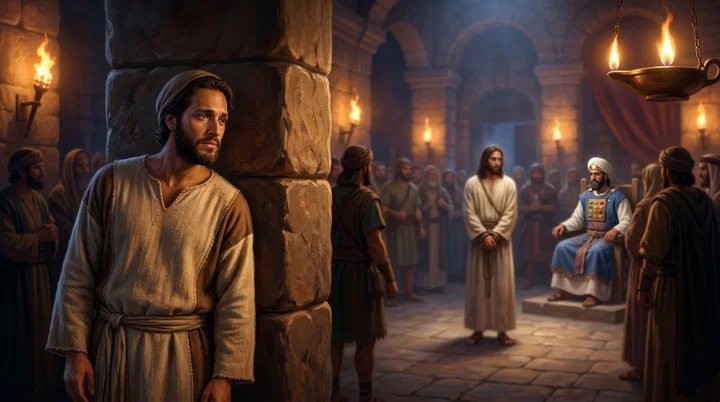
Matthew 26:61 belongs to the night when Jesus, bound and closely guarded, was hurried past midnight over the brook Kedron past gardens and olive groves and through the sleeping city to the palace of Annas for preliminary examination before His formal trial before the Sanhedrim.DA 698.1–700.5 The priests were seeking proof of blasphemy by which to condemn Him before the Jews and of sedition by which to condemn Him before the Romans.DA 698.1–700.5 The saying stands within His appearing before Annas and the court of Caiaphas.DA 698
It was a secret mock trial, kept from the people lest they testify to His mighty works, condemn the Sanhedrim's course, and secure His release with renewed honor.5RED 33.1 The council was fully assembled, with Caiaphas presiding from the throne of judgment, Jesus standing at its foot, judges and those specially interested in the trial on either side, Roman soldiers ranged on the platform below the throne, and the multitude watching with wild excitement.3SP 115.3–116.2 The verse records a charge made against Him during this hostile examination before Caiaphas amid accusation and mockery.5RED 27.1
In that examination He stood calm, serene, dignified and majestic, with a holy influence emanating from Him and pervading the atmosphere.3SP 115.3–116.2 He wore coarse clothing, though He had reigned in the courts of heaven crowned and with garments of brightness attended by holy angels.3SP 115.3–116.2 This was in strong contrast to Caiaphas in gorgeous robe with glittering tiara and costly breastplate, and to the excited, agitated, malignant, sneering and haughty deportment of Annas and Caiaphas and His accusers and judges.3SP 115.3–116.2ST Jun 13, 1878 Caiaphas himself was struck with sudden admiration for Jesus and conviction that He was akin to God, before banishing the thought, and even the hardened multitude compared the two and questioned whether a man of God-like presence should be sentenced as a common criminal, so that Caiaphas perceived the influence and hastened the trial.3SP 115.3–116.2
The verse records false and malicious testimony twisting His words to make them sound like a threat against the Jewish temple.5RED 35.3–36.25RED 36.3–38.2ST Jun 27, 18783SP 118.1–2 He had spoken in figurative prophetic language concerning the temple of His body, foretelling His own death and resurrection after three days, His conflict and victory.5RED 35.3–36.25RED 36.3–38.2ST Jun 27, 18783SP 118.1–2 His hearers mistook the saying for a claim about the Jewish temple, and His enemies misconstrued and misapplied it to suit their purpose.Ms 45, 1897, par. 1–25RED 36.3–38.2ST Jun 27, 18783SP 118.1–2
The testimony came from bribed, corrupt witnesses whose evidence was vague and contradictory, and at last from two witnesses.ST Jun 27, 1878 One was a corrupt man who had sold his honor for money and spoke contemptuously of Christ as on his own low level, as on a level with himself.ST Jun 27, 18783SP 118.1–2
This was the only saying of His the priests could turn to use against Him and the only charge brought against Him.Ms 45, 1897, par. 1–2ST Jun 27, 1878 They could find nothing else to use, since accusations that He denounced priests and scribes as hypocrites and murderers, disregarded traditions and ordinances, or broke the Sabbath would weigh nothing with Romans or Sadducees and would bring His healing miracles to light.ST Jun 27, 18783SP 116.3–117.2
The priests pressed the temple charge because Romans and Jews, Pharisees and Sadducees all held the temple in great veneration.ST Jun 27, 18783SP 116.3–117.2 The Romans had engaged in rebuilding and embellishing it and took great pride in it as a work of science and art.ST Jun 27, 18783SP 116.3–117.2 The claim that a humble man could rebuild it in three days if destroyed would therefore stir Roman and Jewish indignation and unite them on common ground.5RED 36.3–38.2ST Jun 27, 18783SP 116.3–117.2
Reported accurately as uttered, His words were truth and had nothing offensive in them, nothing worthy of death, and did not constitute blasphemy.5RED 35.3–36.25RED 36.3–38.2ST Jun 27, 1878 Even on the assumption that He were a mere man the declaration would only have indicated an unreasonable, boastful spirit and could not have been construed into blasphemy.ST Jun 27, 18783SP 118.1–2 Only by misconstruing the words could the witnesses present them as an offense.5RED 36.3–38.2
His enemies misstated His statement that if this temple were destroyed He would build it again in three days.Ms 45, 1897, par. 1–2 That distorted version was repeated in mockery at the cross, which publicized the saying and made it more impressive while the statement itself was being fulfilled.Ms 45, 1897, par. 1–2
Purpose and Present Lessons
The false testimony to which this saying belongs was arranged by the chief priests and elders because they feared He would surpass them in authority and draw the people away from them.ST Feb 5, 1880 Their murderous opposition brought about the very outcome they meant to prevent, for He became the Redeemer of mankind and Saviour of the world.ST Feb 5, 1880 God overruled their crime for His own glory and for humanity's good, but that overruling providence did not lessen their guilt.ST Feb 5, 1880
The accusation about destroying the temple and rebuilding it served as a pretext for condemning Him, while a charge of Sabbathbreaking could not truthfully be made against Him.SLP 213.1 That inability to accuse Him on that ground shows that He and His followers respected the Sabbath of the fourth commandment.SLP 213.1 The verse shows Him portrayed in the worst possible light through false statements and accusations during His trial, and repeating such accusations stirs up the unsanctified heart and reflects the spirit of those who opposed Him.Lt 50, 1889, par. 6–9Ms 48, 1893, par. 8 That same spirit is repeated when ministers prejudice people by telling them that Seventh-day Adventists do not believe in Christ.Ms 48, 1893, par. 8
Sources
Pioneers and periodicals
43 sources
The verse records the testimony brought against Jesus before the council that He claimed He was able to destroy the temple of God and rebuild it in three days.ST Mar 6, 1901ST Mar 6, 1901RH Feb 16, 1911 The charge was false and malicious, for the witnesses did not agree together and they twisted words He had spoken about the temple of His body into a claim that He Himself would destroy the building.ST Jun 27, 1878ST Mar 27, 1901RH Nov 18, 1862RH Jun 23, 1868ST May 26, 1898 In truth He was foretelling in figurative language His own death and resurrection, His conflict and victory.ST May 27, 1889ST Jun 27, 1878ST May 26, 1898 His silence under that false testimony was no evidence of guilt, and it could not ground condemnation, so the final condemnation rested instead on His own truthful declaration under oath that He is the Son of God.ST Dec 1, 1898ST Feb 20, 1901ST Dec 6, 1883 The whole proceeding was unjust and hostile, condemning One who was blameless and whom the law rightly applied would have acquitted.RH Oct 27, 1874ST Mar 27, 1901RH Oct 27, 1874
Trial Setting Before Council
The saying belongs to the time after the arrest in the garden, when all the disciples forsook him and fled and he was left alone with his enemies.ST Mar 14, 1906 He was bound, though binding was needless, and taken to Annas the former high priest and father-in-law of Caiaphas, who then held the office.ST Mar 14, 1906 The leaders set aside jealousy to unite against him, while Peter followed afar off still hoping he would assert the authority he had shown in cleansing the temple and give opportunity to fight for him with the sword.ST Mar 14, 1906
It falls within the arrest and trials before the Sanhedrin and chief priests and elders, brought first to Annas and then to Caiaphas.ST Feb 3, 1909ST Dec 24, 1912 It belongs to the day of the crucifixion, made exceptionally memorable because Jesus suffered and died for humanity.RH Feb 13, 1872 The council sought testimony to prove against him in order to put him to death.ST Mar 6, 1901 The verse records the testimony of two witnesses, presented as evidence against him before the council, that he claimed he was able to destroy God's temple and rebuild it in three days.ST Mar 6, 1901ST Mar 6, 1901
His case was considered before the celebrated highest court of the Jewish nation for centuries, which condemned him as a malefactor and false prophet.RH Feb 16, 1911 He stood as an accused culprit before Caiaphas as judge and head of that court, condemned at the highest court of his own nation.ST Mar 6, 1901 The trial was not merely an incident of a day in the life of the nation but an event of world-wide and ages-long import, holding vitally important lessons in the name, character, mission, and end of both Jesus and Caiaphas.ST Mar 6, 1901 It was unjust and hostile, a hearing before Caiaphas in which he was condemned without a fair examination of his claims, though he was blameless and the law rightly applied would have acquitted him.RH Oct 27, 1874ST Mar 27, 1901 The high priest and his counsel rejected him, though examination of the Scriptures to which he appealed could have led them to recognize him as the Messiah.RH Oct 27, 1874
Before the high priest he stood calm and dignified while his accusers and judges were agitated.ST Jun 13, 1878 The account shows rejection and mockery, in which hollow homage quickly gives way to open outrage.RH Dec 29, 1863
Words About Destroying
The term rendered to destroy is the Greek kataluo, appearing in the form katalusai, and it denotes throwing down or demolishing a building, in this case the temple.RH Jul 16, 1857RH Apr 13, 1869 More broadly it carries the sense of dissolving, demolishing, overthrowing, rendering void or null, and abrogating.RH Apr 13, 1869RH Sep 29, 1874ST Aug 13, 1874 The same term appears in Matthew 5:17, where to destroy the law is to put an end to it.RH Apr 13, 1869 To destroy there is to abolish the law or to loosen its binding force, so the declaration of not coming to destroy is a declaration of not coming to abolish or annul it, with this accusation about the temple serving as an illustration of that sense.RH Apr 13, 1869RH Sep 29, 1874ST Aug 13, 1874 The word day in the phrase in three days denotes a full day of twenty-four hours including night and day, not the daylight hours alone, marking a specified period of days in which day stands for the entire twenty-four hours.RH Dec 12, 1871
False Testimony Exposed
The charge that this fellow claimed ability to demolish God's temple and rebuild it in three days was false, frivolous and malicious.ST Jun 27, 1878ST Mar 27, 1901RH Nov 18, 1862ST Feb 20, 1901 The testimony brought against him was of doubtful reliability, vague and contradictory, and the witnesses did not agree together.ST Jun 27, 1878ST Jun 19, 1879ST May 27, 1908 It was the only saying of his that the priests could turn to use against him, and even that could ground no condemnation.ST Jun 27, 1878ST Feb 20, 1901
Bearing false witness does not require inventing facts but is done when true actions are reported without their true setting, omitting that the person acted without malice and framing the report to imply evil counsel and conspiracy contrary to the truth.RH Jun 23, 1868 Here his prediction of the temple's destruction and his words about the temple of his body were distorted and applied to the building.ST May 26, 1898RH Nov 20, 1900 What he had spoken in figurative prophetic language of his own death and resurrection, his conflict and victory, was twisted into a claim that he himself would destroy the Jerusalem building.ST May 27, 1889ST May 26, 1898RH Nov 20, 1900 Reported exactly as uttered, the words would have contained nothing offensive and nothing worthy of death, and even if he were merely a man they would have suggested only an unreasonable, boastful spirit, not blasphemy.ST May 27, 1889ST Jun 27, 1878
His accusers misrepresented and misconstrued his words to suit their purpose of proving him an impostor.ST Jun 27, 1878RH Jan 18, 1870RH Apr 14, 1874 The declaration was pressed as grave disrespect and impiety toward the temple, an offense the Jews with their reverence for it could neither forget nor forgive.RH Nov 10, 1863 The charge was calculated to stir indignation and unite Romans and Jews, Pharisees and Sadducees, because all held the temple in great veneration and the Romans took pride in rebuilding and embellishing it as a work of science and art, so that a claim by a humble man to rebuild it in three days if destroyed would provoke them all.ST Jun 27, 1878
The false testimony was arranged by the chief priests and elders, who sought to condemn and kill him because they feared he would surpass them in authority and draw the people away.ST Feb 5, 1880 Condemnation was already determined, and after spying and other witnesses failed because their testimony did not agree, at last the two agreeing witnesses required to condemn to death were found, as with the false witnesses against Naboth.ST Jul 14, 1898ST Dec 1, 1898 One was a corrupt man who had sold his honor for money and spoke contemptuously of Christ as on his own low level, saying he had heard him say that if the temple at Jerusalem were pulled down he could build it up in three days, with others agreeing that something of that sort had been said.ST Jun 27, 1878ST Dec 1, 1898 Their murderous opposition brought about the very outcome they meant to prevent, that he became Redeemer and Saviour of the world, which God overruled for his glory and humanity's good without lessening their guilt.ST Feb 5, 1880
True Meaning Fulfilled
The saying about destroying the temple and raising it in three days was spoken of the temple of his body, not of the stone building at Jerusalem.ST May 27, 1889ST Jun 27, 1878ST May 26, 1898 In figurative prophetic language it foretold his own death and resurrection, his conflict and his victory.ST May 27, 1889ST Jun 27, 1878 At his trial before the high priest the words were distorted and applied to the building, and this became the only saying of his that the priests could turn to use against him.ST Jun 27, 1878ST May 26, 1898 His hearers had taken the saying to refer to the Jewish temple, and his enemies misconstrued it to suit their purpose.ST Jun 27, 1878
The charge was pressed because Romans and Jews, Pharisees and Sadducees alike held the temple in great veneration, and the Romans took pride in rebuilding and embellishing it as a work of science and art, so that for a humble man to claim he could rebuild it in three days if destroyed would stir indignation and unite them.ST Jun 27, 1878 The testimony was brought by bribed and corrupt witnesses whose evidence was vague and contradictory, until at last two were found, one a corrupt man who had sold his honor for money and spoke contemptuously of Christ as on his own low level.ST Jun 27, 1878 His words themselves were truth while the evidence was false and malicious.ST May 27, 1889ST Jun 27, 1878 Reported exactly as uttered, they would have contained nothing offensive and nothing worthy of death, and even if he had been a mere man they would have suggested only an unreasonable, boastful spirit, not blasphemy.ST May 27, 1889ST Jun 27, 1878
The false accusation that he claimed power to destroy God's temple and rebuild it in three days belongs to the rejection and unjust treatment the Messiah was foretold to suffer.RH Nov 18, 1862 Oppressed and afflicted by false accusation in his trial unto death, he opened not his mouth, literally fulfilling being brought as a lamb to the slaughter and as a sheep before her shearers is dumb.ST Oct 12, 1904 That silence under charge by false witnesses showed a meekness excelling even Moses and proved a life without flaw in every virtue, so that even the governor who passed sentence of death upon him could find no fault in him.ST Oct 12, 1904 The testimony was arranged by the chief priests and elders, who sought to condemn and kill him because they feared he would surpass them in authority and draw the people away from them.ST Feb 5, 1880 Their murderous opposition brought about the very outcome they meant to prevent, that he became Redeemer of mankind and Saviour of the world, which God overruled for his own glory and humanity's good without lessening their guilt.ST Feb 5, 1880
Condemnation Despite Innocence
He held His peace under the false charge about the temple, showing that silence is not evidence of guilt, and that testimony could not ground any condemnation against Him.ST Dec 1, 1898ST Feb 20, 1901 Condemnation had already been determined, and after spying and other false witnesses had failed because their testimony did not agree, at last two agreeing witnesses required to condemn Him were found, one saying he had heard Him say that if the temple at Jerusalem were pulled down He could build it up in three days, with others agreeing something of that sort had been said.ST Dec 1, 1898 The high priest therefore put Him under oath before the living God to state whether He claimed to be the Son of the Most High, and silent until that oath He then answered truthfully.ST Dec 1, 1898 On hearing that answer the priest declared no further evidence was needed and moved the case to the Roman tribunal for confirmation.ST Dec 1, 1898
His final condemnation rested instead on His own declaration that He is the Son of God, thereby making Himself equal with God.ST Feb 20, 1901ST Dec 6, 1883 That assertion of His divinity is true and is the very foundation of hope.ST Feb 20, 1901 When arraigned before the high priest in Matthew 26:57-68 no charge of Sabbath-breaking was brought against Him, and He was condemned on one charge only, blasphemy for making Himself equal with God.ST Dec 6, 1883 His silence and denial of neither charge did not make the accusation true.ST Dec 6, 1883
His rejection by the religious leaders on this temple claim illustrates how people can condemn someone as a blasphemer or heretic for reading Scripture differently, without testing the claim against Scripture itself.RH Oct 27, 1874 That handling before the council and Sanhedrim, where false witness about destroying the temple of God and rebuilding it in three days was brought against Him, shows intolerant religious condemnation of Christ by the Jewish council.RH Oct 27, 1874RH Dec 13, 1906 The same treatment is given by the Vatican to those it condemns for heresy, so that if Christ were on earth again He would receive the same handling from Rome.RH Dec 13, 1906
Parallels and Discipleship Lessons
The requirement of two witnesses to condemn a person to death was turned to evil use when false witnesses were brought against Jesus just as false witnesses had been brought against Naboth.ST Jul 14, 1898 The successful conviction of Christ before the Jewish tribunal by hired false witnesses was tried again against Stephen when leaders of the synagogues failed against him in open dispute.ST Feb 12, 1902 Men were hired to swear they had heard Stephen speak blasphemous words against Moses and against God, in order to stir the people to prejudice against him and to seize him and bring him before the Sanhedrin.ST Feb 12, 1902 The priests brought prejudicial false testimony against Christ before the Jewish council in a mock trial to condemn Him to the cross, with the high priest listening with mock gravity to the pitiless falsehood of his own hirelings, and the very same temple story was afterward told against Stephen before the council.ST Feb 19, 1902 The witnesses against Jesus did not agree together, and their disagreement stands as a comparison for the contradictory claims made by opponents of the Sabbath.ST May 27, 1908
The testimony belongs to Christ in the judgment hall, a hard place where followers are tempted to follow afar off and deny the Master.ST Mar 14, 1906 Believers must follow with Him and keep close to Him there just as on the Mount of Transfiguration and in the triumphal entry and in toiling up Calvary, staying with Him in suffering rather than apart from Him.ST Mar 14, 1906 This took place after the arrest in the garden when all the disciples forsook Him and fled, when He was left alone with His enemies and bound though binding was needless and taken to Annas the former high priest and father-in-law of Caiaphas who then held the office, while the leaders set aside jealousy to unite against Him.ST Mar 14, 1906 At that time Peter followed afar off still hoping Jesus would assert the authority He had shown in cleansing the temple and give Peter opportunity to fight for Him with the sword, a carnal means that profits nothing for His kingdom since all who take the sword perish with the sword.ST Mar 14, 1906 The events surrounding Peter's attempt to defend Jesus with a sword and his later denial show that aggressive action may reveal the assertiveness of the human heart rather than the courage and progress of a regenerated life.RH Feb 5, 1914
It took place in the palace of a proud Caiaphas as part of Christ's path of suffering to Calvary.RH Aug 14, 1860 Christian perfection does not consist in uninterrupted praise, joy, ecstasies, or enjoying rare sights as in building a tabernacle on Mount Tabor.RH Aug 14, 1860 It consists in resolutely taking up the cross and following Christ to Caiaphas, to the judgment hall of an unjust Pilate, and to the top of Calvary, not in seeking extraordinary spiritual experiences.RH Aug 14, 1860RH Jul 30, 1867
Sources