Daniel 3:13
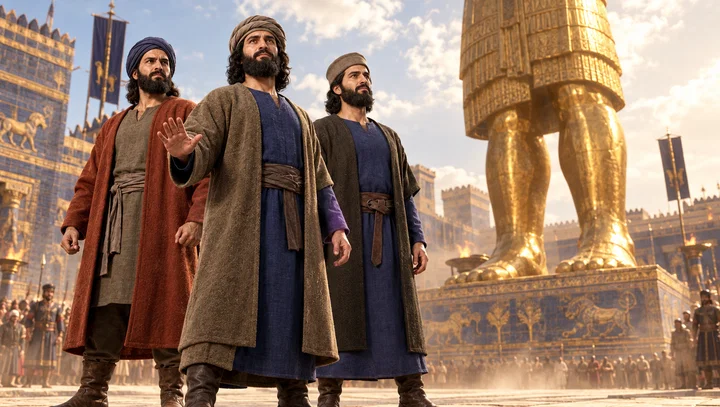
Then Nebuchadnezzar in his rage and fury commanded to bring Shadrach, Meshach, and Abed-nego. Then they brought these men before the king.
Translations
Then Nebuchadnezzar in his rage and fury commanded to bring Shadrach, Meshach, and Abednego. Then they brought these men before the king.
King James Version, KJV Cambridge Paragraph Bible, Webster Bible, Revised Version, American Standard Version
Then Nebuchadnezzar in his rage and fury commanded to bring Shadrach, Meshach, and Abed-nego. Then they brought these men before the king.
Then Nebuchadnezzar, in anger and fury, hath said to bring in Shadrach, Meshach, and Abed-Nego. Then these men have been brought in before the king.
Then Nebuchadnezzar in rage and fury commanded to bring Shadrach, Meshach, and Abed-nego. Then were these men brought before the king.
Then, Nebuchadnezzar—with anger and wrath, gave word to bring Shadrach, Meshach, and Abed-nego, then, these men, brought they before the king.
Berean Standard Bible, Majority Standard Bible
Then Nebuchadnezzar, furious with rage, summoned Shadrach, Meshach, and Abednego. So these men were brought before the king,
Then Nebuchadnezzar in rage and fury commanded that Shadrach, Meshach, and Abednego be brought. Then these men were brought before the king.
Then Nebuchadnezzar in his wrath and passion gave orders for Shadrach, Meshach, and Abed-nego to be sent for. Then they made these men come in before the king.
Then Nebuchad-nezzar in his anger and wrath commanded that they should bring Shadrach, Meshach, and Abednego: so these men were brought before the King.
Douay-Rheims (Challoner revision)
Then Nabuchodonosor in fury, and in wrath, commanded that Sidrach, Misach, and Abdenago should be brought: who immediately were brought before the king.
Pictures
Cross-references
- Daniel 3:25
He answered and said, Lo, I see four men loose, walking in the midst of the fire, and they have no hurt; and the form of the fourth is like the Son of God.
A heavenly figure accompanies the three men, who remain unharmed in the fire.
- Jeremiah 27:6
And now have I given all these lands into the hand of Nebuchadnezzar the king of Babylon, my servant; and the beasts of the field have I given him also to serve him.
God identifies Nebuchadnezzar as his servant and grants him rule.
- Daniel 4:34-37
And at the end of the days I Nebuchadnezzar lifted up mine eyes unto heaven, and mine understanding returned unto me, and I blessed the most High, and I praised and honoured him that liveth for ever, whose dominion is an everlasting dominion, and his kingdom is from generation to generation:
Nebuchadnezzar is humbled and acknowledges God’s rule and power to abase the proud.
- Daniel 3:1-6
Nebuchadnezzar the king made an image of gold, whose height was threescore cubits, and the breadth thereof six cubits: he set it up in the plain of Dura, in the province of Babylon.
Nebuchadnezzar commands worship of the golden image, leading to the men’s arrest.
- Daniel 3:6
And whoso falleth not down and worshippeth shall the same hour be cast into the midst of a burning fiery furnace.
The decree commands worship of the image and threatens punishment for refusal.
- Daniel 3:19-23
Then was Nebuchadnezzar full of fury, and the form of his visage was changed against Shadrach, Meshach, and Abed-nego: therefore he spake, and commanded that they should heat the furnace one seven times more than it was wont to be heated.
Nebuchadnezzar punishes them by casting them into the furnace.
- Exodus 20:4-5
Thou shalt not make unto thee any graven image, or any likeness of any thing that is in heaven above, or that is in the earth beneath, or that is in the water under the earth:
The men refused to bow to the king’s image, obeying God’s command against idols.
- Daniel 2
And in the second year of the reign of Nebuchadnezzar Nebuchadnezzar dreamed dreams, wherewith his spirit was troubled, and his sleep brake from him.
God’s dealings with Nebuchadnezzar span the dream and the golden image.
- Acts 5:29
Then Peter and the other apostles answered and said, We ought to obey God rather than men.
Both affirm obeying God rather than human rulers.
- Daniel 3:29
Therefore I make a decree, That every people, nation, and language, which speak any thing amiss against the God of Shadrach, Meshach, and Abed-nego, shall be cut in pieces, and their houses shall be made a dunghill: because there is no other God that can deliver after this sort.
Nebuchadnezzar publicly honors their God after their deliverance.
- Hebrews 11:34
Quenched the violence of fire, escaped the edge of the sword, out of weakness were made strong, waxed valiant in fight, turned to flight the armies of the aliens.
Their faith is linked to quenching the violence of fire.
- Daniel 3:27
And the princes, governors, and captains, and the king’s counsellors, being gathered together, saw these men, upon whose bodies the fire had no power, nor was an hair of their head singed, neither were their coats changed, nor the smell of fire had passed on them.
The men emerge from the furnace unharmed, without even the smell of smoke on them.
- Daniel 3:28
Then Nebuchadnezzar spake, and said, Blessed be the God of Shadrach, Meshach, and Abed-nego, who hath sent his angel, and delivered his servants that trusted in him, and have changed the king’s word, and yielded their bodies, that they might not serve nor worship any god, except their own God.
the miracle moved the king to acknowledge God's power
- Daniel 3:22
Therefore because the king’s commandment was urgent, and the furnace exceeding hot, the flame of the fire slew those men that took up Shadrach, Meshach, and Abed-nego.
warriors died carrying out the sentence
- Daniel 3:30
Then the king promoted Shadrach, Meshach, and Abed-nego, in the province of Babylon.
promotion after refusing royal mandate
- Daniel 1:5-6
And the king appointed them a daily provision of the king’s meat, and of the wine which he drank: so nourishing them three years, that at the end thereof they might stand before the king.
Daniel and his companions entered the king’s service.
- Jeremiah 25:9
Behold, I will send and take all the families of the north, saith the LORD, and Nebuchadrezzar the king of Babylon, my servant, and will bring them against this land, and against the inhabitants thereof, and against all these nations round about, and will utterly destroy them, and make them an astonishment, and an hissing, and perpetual desolations.
God appoints Nebuchadnezzar to rule, but his worship command exceeds that authority.
- Daniel 6:13
Then answered they and said before the king, That Daniel, which is of the children of the captivity of Judah, regardeth not thee, O king, nor the decree that thou hast signed, but maketh his petition three times a day.
Daniel is accused of disobeying the king’s decree because he obeys God.
- Acts 4:19
But Peter and John answered and said unto them, Whether it be right in the sight of God to hearken unto you more than unto God, judge ye.
Both affirm obeying God over human authority.
- Revelation 13:15
And he had power to give life unto the image of the beast, that the image of the beast should both speak, and cause that as many as would not worship the image of the beast should be killed.
Both describe a death decree for refusing to worship an image.
Commentary
Each commentary is drawn from primary sources: the writings of Ellen G. White and Adventist pioneers and periodicals. Each commentary is separate. Its own words are not a quotation; follow the references to read the source passages.
Ellen G. White
13 sources
Nebuchadnezzar in rage and fury had Shadrach, Meshach, and Abed-nego brought before him because they refused to worship the golden image he had set up.PK 506.25T 453.1–4PK 512.1 The image was a costly and magnificent idol in the plain of Dura, made to exalt Babylon and the king himself as an object of worship after he perverted the light given him in the dream of the great image.Lt 109a, 1898, par. 5–8Ms 168, 1898, par. 1–313MR 60.1–61.2 Their summons brought the fiery trial of their integrity, and when they were cast into the furnace for loyalty to God, Christ Himself walked with them and preserved them from harm.Lt 109a, 1898, par. 5–8Ms 168, 1898, par. 1–313MR 60.1–61.2Ms 47a, 1898, par. 2–5BS 29.1 Their preservation showed an idolatrous nation the power and faithfulness of the true God and convinced the king that their God was the living God above every kingdom.5T 453.1–413MR 60.1–61.2BS 29.1 Their stand is the pattern God's people are to follow when human law commands disobedience to God, as will be repeated at the end when laws demand worship of a Sunday idol sabbath in place of God's holy Sabbath.PK 512.112MR 218.2–220.1Ms 15, 1896, par. 33–34
Historical Setting and Meaning
This verse belongs to the history of the wonderful deliverance of the three Hebrew worthies, showing the working out of God's purpose for the children of obedience and the children of disobedience.Lt 118, 1910, par. 2 It stands in the account of Nebuchadnezzar's renewed idolatry, for although he had acknowledged God's power and was for a time influenced by the fear of God, ambition and desire for self-exaltation remained in him, and pride led him to return to idol worship with greater zeal.PK 503.2
The idol at issue was an exceedingly costly and magnificent golden image set up in the plain of Dura.Lt 109a, 1898, par. 5–8Ms 168, 1898, par. 1–313MR 60.1–61.2 It was made to represent the kingdom of Babylon and more particularly Nebuchadnezzar himself, his glory and the excellence of Babylon, to magnify himself as ruler and to place himself before the people as an object of worship.Lt 109a, 1898, par. 5–8Ms 168, 1898, par. 1–313MR 60.1–61.2Ms 47a, 1898, par. 2–5 It was set up to convert all nations to its worship.Lt 109a, 1898, par. 5–8Ms 168, 1898, par. 1–3
He made it from pride cherished after God honored him with the dream of the great image in which his kingdom was the head of gold as explained by Daniel, and from flattery by heathen counselors.13MR 60.1–61.2 He read Daniel's interpretation through his own idolatrous human understanding instead of reading his dream in the light of the Scriptures and the living Oracles as Daniel had instructed kings and subjects to do.Lt 109a, 1898, par. 5–8Ms 168, 1898, par. 1–3Ms 47a, 1898, par. 2–5 By this he perverted the light given through Daniel by which Jehovah had been exalted as more powerful than earthly kings and more powerful than any other kingdom.Lt 109a, 1898, par. 5–8Ms 47a, 1898, par. 2–5
The furious command was the working of a plot by the king's advisers to ensnare the Hebrew captives and force them to bow to the golden idol by getting the king to decree universal worship of the image.12MR 218.2–220.1 In rage and fury over the reported refusal to worship the golden image, Nebuchadnezzar commanded that Shadrach, Meshach, and Abed-nego be brought before him.PK 506.25T 453.1–4PK 512.112MR 218.2–220.1Lt 109a, 1898, par. 5–8 That summons marked the confrontation between a ruler's command to worship an idol and the Hebrews' loyalty to God, for their refusal was a choice to honor the God of heaven alone as King of kings and Lord of lords.PK 506.25T 453.1–4Lt 109a, 1898, par. 5–8Ms 168, 1898, par. 1–313MR 60.1–61.2
Deliverance and Witness to Babylon
The angry summons brought the fiery trial upon faithfulness to God and tested the integrity of Daniel's three companions who would not bow the knee.Ms 47a, 1898, par. 2–5BS 29.1 That trial came because they refused the idolatrous worship demanded of them, and their steadfastness under threat made their loyalty the issue before the kingdom.Ms 47a, 1898, par. 2–5BS 29.1
When for that loyalty they were cast into the burning fiery furnace, Christ Himself, the Lord Jesus, walked there with His three faithful servants and preserved them from all harm.Lt 109a, 1898, par. 5–8Ms 168, 1898, par. 1–313MR 60.1–61.2Ms 47a, 1898, par. 2–5 He manifested Himself to them as He promises to manifest Himself to those who keep His commandments.13MR 60.1–61.2 Their preservation became a public witness that showed an idolatrous nation the power and faithfulness of Israel's God.5T 453.1–4BS 29.1 The attempt to enforce idolatry thus brought knowledge of the true God before Babylon's rulers and convinced the king that their God was the living God.5T 453.1–413MR 60.1–61.2
The miracle wrought upon Nebuchadnezzar's heart so that he believed in God and acknowledged His superior power over every other kingdom.Lt 109a, 1898, par. 5–8Ms 168, 1898, par. 1–3Ms 47a, 1898, par. 2–5 Yet the fall of Babylon still came at an hour of feasting and revelling.Lt 109a, 1898, par. 5–8Ms 168, 1898, par. 1–3 The lesson is that all men, whether king or subjects, are not to read the Scriptures and God's providences in the light of their dreams and fancies, but are to read their dreams in the light of the living oracles.Lt 109a, 1898, par. 5–8Ms 47a, 1898, par. 2–5 Cherishing self-trusting thoughts and feelings and setting God aside brings danger of passing through a trying experience.13MR 60.1–61.2
End-Time Pattern and Loyalty
The enraged summons to bring the three Hebrews before the king for refusing to worship the golden image sets the rule to follow when human law requires disobedience to God, to stay loyal to God and His commandments even under coercion.Ms 15, 1896, par. 33–34 Their experience shows how those who remain faithful to God may be humiliated and abused by religious bigotry.PK 512.1 It is a pattern for the end time, when human laws will demand worship of a Sunday idol sabbath set where God's holy Sabbath of the fourth commandment should be, in an effort to turn God's people from their allegiance.12MR 218.2–220.1
In that pattern Sabbathkeepers will at last face a universal death decree.PK 512.1 Those who frame cruel enactments to destroy the faithful bring destruction upon themselves, for the men who sought to destroy Shadrach, Meshach, and Abed-nego were themselves destroyed by the recoil of their own actions.12MR 218.2–220.1 The same course of exalting human counsel and idolatry, followed by sudden judgment as when Babylon fell in an hour of feasting and reveling, will be repeated at the end of the world, when only those prepared like the wise virgins will be ready.Ms 168, 1898, par. 1–3
The refusal is also a pattern for a coming period in work among the colored people in the Southern States when believers will have to decide for or against the commandments of God.Lt 35, 1895, par. 1–3 Until that period comes, believers and teachers of truth must not be presumptuous and must not encourage the spirit of defiance and resistance, even if placed in the chain gang.Lt 35, 1895, par. 1–3 To do so would close their own way entirely and make work in many untouched fields more difficult.Lt 35, 1895, par. 1–3
Sources
Pioneers and periodicals
117 sources
The verse records that Nebuchadnezzar, enraged by the report that Shadrach, Meshach and Abed-nego refused to worship his golden image, commanded that they be brought before him for confrontation over conscience and obedience.ST Jan 9, 1912RH Aug 13, 1908RH Apr 13, 1869 Though angry, he did not punish them at once but inquired whether the charge was true and gave them another opportunity to obey when the music sounded, under threat of the same-hour furnace.ST Jan 9, 1912RH Apr 13, 1869ST Jan 29, 1908 The confrontation shows that a ruler's authority has limits and must not usurp conscience or direct worship, so when human law demands disobedience to God His servants must obey God rather than men and accept the penalty.RH Aug 13, 1908ST Jul 24, 1884ST Sep 10, 1885ST Apr 23, 1912RH Mar 1, 1860 Their refusal broke civil law and was therefore crime, but it was not sin, since bowing would have transgressed God's law; when the choice lies between sin and crime it is better to be a criminal.ST Jun 11, 1912ST Jan 23, 1912ST Jan 20, 1898 What they faced will be precisely faced again when the decree goes forth that all shall worship the image of the beast on pain of death, testing the loyalty of God's people in the last days.RH Jul 14, 1904ST Oct 5, 1882RH May 1, 1855ST Nov 1, 1905
Words and Historical Setting
The king in rage and fury ordered Shadrach, Meshach, and Abed-nego brought before him after the report that they had refused to worship his golden image, and that order brought them face to face with him for confrontation over conscience and obedience to God rather than to the king.ST Jan 9, 1912RH Aug 13, 1908ST Oct 11, 1905ST Oct 13, 1909RH Mar 6, 1900 Their refusal was treated as disloyalty even though they served the king faithfully and reserved worship for God alone, and it was deliberate rather than from ignorance, with resolve to obey God even if He did not deliver them.RH Apr 13, 1869RH Mar 6, 1900 They stood firm as representatives of God's truth rather than submit to human authority opposing it, with courage resting on having seen God's greatness and love.ST Oct 13, 1909
Though angry, he did not punish at once but questioned them rather than immediately carrying out his anger, inquiring whether the charge was true and dealing fairly by testing it.RH Apr 24, 1900ST Jan 9, 1912 He showed forbearance because he had favored them and gave them another opportunity to obey when the music sounded, holding before them the certainty of the same-hour furnace penalty and challenging what god could deliver them from his hands.RH Apr 13, 1869ST Jan 29, 1908ST Oct 9, 1901RH Apr 24, 1900ST Jan 9, 1912 He pressed that certainty upon them because he thought it hardly possible they would persist in refusing duly constituted authority, counting himself as king of Babylon to be king of all the earth who had conquered all the Jews and could not now be conquered by only three of them, and doubting the God of the Jews was stronger than he because Jerusalem had not been delivered.RH Apr 24, 1900
The summons belongs to his futile attempt to prove God's revelation through Daniel in the previous chapter untrue and to resist the prophecy that his kingdom would finally be overcome and superseded by another kingdom arising after him.ST Jun 3, 1913ST Dec 3, 1912 He did not wish to admit that succession, so he erected a golden image for his subjects to worship as one grand patriotic demonstration by which he hoped to assure himself that Babylon would remain the universal and eternal kingdom, contrary to God's revealed judgment that earthly kingdoms would decline and pass away.ST Jun 3, 1913ST Dec 3, 1912 That account presents men's idea of the kingdom of men in contrast to God's idea of the kingdoms of men shown by the image in dream and vision.ST Jan 9, 1912
The events stand roughly twenty years after the events in Daniel 2, by which time the kingdom had grown through military conquest, effective administration, and extensive building projects, increasing the king's power and glory.RH Aug 6, 1908 Their confrontation with the king formed part of a public test of whether Babylon's gods or the Creator worshiped by the Hebrews had greater power, illustrating the use of state power to impose religious worship.ST Dec 12, 1911
The verse is part of the inspired historical and descriptive record rather than the book's principal line of prophecy, recording the king's conduct without showing that he himself was inspired or that his words were.ST Jul 16, 1912ST Nov 17, 1914 Its truth about old Babylon belongs to the Word of God now fulfilled and confirmed by Babylonian records brought to light, silencing critics and unbelievers.RH May 13, 1909 The stormy passions of rulers seen in it are held in check until God's work is finished.RH May 2, 1907
Daniel is not mentioned in this episode, suggesting his absence from the city, while the men are identified as Shadrach, Meshach, and Abed-nego summoned and commanded again under penalty.ST Dec 16, 1897 The officials who witnessed the three men's stand carried news of it back to their provinces, spreading its testimony widely.RH Feb 27, 1900
The immediate context is the positive and sweeping command to fall down and worship the golden image when the music is heard, under the terrible penalty of being cast the same hour into the burning fiery furnace for refusing the religious demand.ST Nov 8, 1905RH Apr 24, 1900RH Jul 3, 1900ST Jun 3, 1913 The purpose was the exaltation of man in the place of God, making duty to God secondary and demanding recognition that men need not be servants of God but are gods themselves, wholly contrary to the principles of the gospel of the kingdom of God.RH Jul 3, 1900 The furnace was heated seven times hotter than usual, yet Jesus was with the God-fearing men during the trying hour so the fire produced no effect upon them without even the smell of smoke upon their garments, while the king's warriors and executioners who attempted to execute his sentence died and the servants of God were miraculously preserved.ST Nov 8, 1905ST Jun 3, 1913STST Aug 13, 1896
The episode belongs to Babylon's persecution of the people of God, revealing Babylon's moral character and attitude toward God's people.ST Nov 28, 1895 It displays power, strength, and occasional ferocity combined with soaring pride, the character pictured by a lion with eagle's wings and by the head of gold, a proud kingdom that was forced to succumb and yield to a baser kingdom.ST Nov 28, 1895
God Educates and Delivers
Daniel 3 belongs to the account of Jehovah the Deliverer, setting men's idea of the kingdom of men against God's idea of the kingdoms of men as shown by the image in dream and vision in the previous chapter.ST Jan 9, 1912ST Oct 21, 1908 It shows God's power to deliver His children in contrast to the insecurity of earthly kingdoms and the human attempt to establish a kingdom by human power.ST Jul 16, 1912ST Oct 21, 1908 The great king is forced to acknowledge that the God of the Hebrews is above all other gods.ST Jan 9, 1912ST Jul 16, 1912 He delivers faithful, righteous people even when they stand against powerful foes who worship national patriotism and human ambition.ST Dec 1, 1914ST Aug 9, 1910 The chapter shows God able to deliver and carries lessons about religious liberty applicable in every age.ST Dec 1, 1914ST Aug 9, 1910
The summons in rage and fury is another step in God's education of the great Babylonian king.ST Jan 29, 1908RH Aug 22, 1907 The event teaches the rights of other men, a lesson men have been slow to learn since that time, and stands as a lesson for statesmen in these days.ST Jan 29, 1908 Daniel and his companions proclaimed in Babylon a threefold message of righteousness by faith intended to save people from coming destruction, and through it Nebuchadnezzar was led to recognize that God can humble the proud.RH Aug 22, 1907RH Apr 25, 1912 God used Daniel and his companions to make the true God known beyond Israel, bringing Daniel to prominence near the throne, and the events in Daniel 3 led to a proclamation of God's power.ST Jun 21, 1905RH May 4, 1869 Nebuchadnezzar's experience with the three Hebrew men over the golden image convinced him there was a King higher than himself and led him to acknowledge the supremacy of the true God.RH Apr 25, 1912RH May 4, 1869
The decree is coercive, not an expression of religious liberty, and reveals a heart resisting the Spirit of God.ST Jul 11, 1911RH Oct 22, 1901 After the three Hebrews refuse to worship the golden image, the king in pride angrily orders them brought before him.ST Dec 3, 1896RH Oct 22, 1901 He uses royal power to punish those who would not worship as he commanded, crossing the proper boundary of civil rule when he tries to direct worship and coerce conscience.ST Jul 11, 1911ST Dec 3, 1896 Civil rulers are God's servants only to restrain evil and prevent incivility, not to aid religion or coerce conscience in any way, and they exceed their proper role when they take God's place.ST Dec 3, 1896ST Jul 1, 1903 For aspiring to take God's place by directing and controlling worship and punishing refusal, God humbled him and proud Babylon with him, and whenever the church-and-state principle is made into law it always leads to persecution for conscience' sake.ST Jul 11, 1911ST Jul 1, 1903
God made His truth known through Gentile kings when Israel failed to carry the gospel to the nations.ST Jun 21, 1905RH Nov 11, 1902 Enraged at the three Jews' refusal to worship his golden image, Nebuchadnezzar orders them brought before him, their stand testing loyalty to God and leading to the threat of death in the fiery furnace.ST Jan 9, 1907ST Nov 26, 1912 The crisis becomes an occasion for God to appeal to the Babylonian people through the Hebrews, displaying divine power and offering deliverance to those who serve Him, making His power known throughout the kingdom.ST Jan 9, 1907ST Nov 26, 1912 That deliverance from the furnace was one of the experiences through which God made the gospel of His kingdom known to Nebuchadnezzar, and it was proclaimed to the world by the king, making it as personal to everyone as if they had experienced it themselves.RH May 29, 1900 God wrought wonderful deliverance for His servants who trusted in Him, and He is just as able and willing to deliver today as then, delivering from sins all who trust in Him.RH Aug 15, 1907ST Nov 26, 1912
The events showed Babylon the power of God.ST Aug 13, 1896 Nebuchadnezzar's attempt to force the loyal servants of God to worship the great golden image on the plain of Dura failed utterly, the warriors who attempted to execute his sentence died, and the servants of God were miraculously preserved in the furnace of fire.ST Aug 13, 1896ST Oct 23, 1901 This history was a matter of public record that Belshazzar knew or had opportunity to know, and it should have taught him that the Most High rules in the kingdom of men, but he did not take it to heart.ST Aug 13, 1896 The people later gathered at Belshazzar's feast had seen that demonstration or had opportunity to know it but disregarded its lesson.ST Oct 23, 1901 Belshazzar and the people at his feast ignored it and dishonored the God whose power they had seen.ST Aug 13, 1896ST Oct 23, 1901
Limits of Civil Authority
The summons in rage and fury begins the confrontation in which obedience to God takes precedence over the king's command, showing that a ruler's authority has limits and must not usurp conscience or God.RH Aug 13, 1908ST Apr 23, 1912ST Apr 14, 1898 Civil rulers are God's servants only to restrain evil and prevent incivility, not to direct worship, control faith, aid religion, coerce conscience, or make laws governing relationship with God.ST Mar 6, 1907ST Dec 3, 1896ST Jul 1, 1903 Although Nebuchadnezzar had been chosen as God's servant, he went beyond legitimate civil rule when he aspired to take God's place by directing and controlling worship and punishing those who would not worship as he decreed, and for misusing royal power in this way he and proud Babylon were humbled.ST Mar 6, 1907ST Dec 3, 1896ST Jul 1, 1903 When the church-and-state principle is made into law it always leads to persecution for conscience' sake, and God's servants are not to be blamed for refusing obedience to such a command.ST Apr 14, 1898ST Jul 1, 1903
The case concerned individual faith and the right to worship according to conscience, for the king commanded worship of a false god contrary to established belief and they refused despite the law.ST May 21, 1912ST Jun 18, 1912ST May 21, 1912 Each person is responsible to God in matters of faith and worship and should be free to follow conscience, since a civil ruler may not rightly direct or control people in matters of religion.ST May 21, 1912ST Jun 18, 1912 God upheld the three men in what appeared to be open disobedience to the ruler, approved their disobedience by protecting them in the fiery furnace, and by miraculous deliverance changed the king's command and made this a public lesson to the world.ST May 21, 1912ST Mar 6, 1907ST Jun 18, 1912
Nebuchadnezzar claimed authority over the worship of God's people and used royal and state power against those who would not conform in religious matters, persecuting the Hebrew captives because as an idolater they refused to worship an idol.ST Mar 6, 1907ST Dec 3, 1896ST Nov 5, 1894RH Jun 8, 1916 The furnace punishment was framed as a matter of state authority, not religion alone, showing oppression under the cruel Babylonian persecuting system by compulsory worship of false gods.ST Oct 1, 1896ST Jul 13, 1915 Babylon is the first of the successive powers opposing God's people and the first of the seven heads of beast rule, doing this persecuting work instigated by fallen Lucifer, the king of Babylon, with tyrannical authority aligned with Satan.ST Sep 8, 1914ST Nov 5, 1894ST Mar 30, 1915 Civil rulers cannot decide which day people should observe or require them to observe a day unto the Lord.ST Nov 5, 1894
Calling the decree a civil law made in harmony with the majority for the good of the people and for the maintenance and stability of Babylon does not make it religiously neutral, for the men faced punishment for refusing an order concerning worship.ST Sep 9, 1889ST May 12, 1890 The requirement to bow to the great image left the Hebrews still free to worship their own God, yet it could not be obeyed as a merely civil ordinance without compromising faith, and God vindicated their refusal even with certain death before them.ST Sep 9, 1889ST May 12, 1890 To compel the king's worship while claiming non-interference with worship of God still forbids true worship, because worship of God forbids worship of anything besides Him and no man can serve two masters.ST Dec 10, 1885ST Dec 5, 1895 They could not worship the image and worship the true God at the same time, could not bear the badge of two opposing powers or have the seal of God and receive the mark of the beast at the same time, and could not worship idols and keep the second commandment or observe Sunday and keep the fourth commandment.ST Dec 10, 1885ST Dec 5, 1895
Babylon united religion with the state, and having disconnected from God to follow its own way was left without divine power and tried to supply it by enlisting the state to obtain its hire.ST Dec 24, 1896 The same pride and exaltation of self seen in Lucifer and Nimrod and in Nebuchadnezzar produced a legal creed enforced by civil power, demanding service and obedience to its own law even when contrary to God's law, with death in the fiery furnace for refusal.ST Dec 24, 1896ST Oct 7, 1913 That worship demanded by a church-and-state power belongs to God alone, and that course of religious persecution ends in destruction of the proud city.ST Dec 24, 1896 Persecution always results whenever church and state are united, regardless of what church or state is united, and true Protestantism protests against that union in principle and wherever its workings are found.ST Dec 12, 1895
The example is one of persecuting action, distinguished from government action intended to defend its people, such as a military draft not intended to establish idolatry or oppose God's law.RH Sep 23, 1862RH Oct 21, 1862 The image's required worship was an act establishing idolatry in direct violation of God's law, whether set up by idolatrous policy or aimed specifically at the Hebrews.RH Oct 21, 1862RH Oct 21, 1862 A law need not target God's faithful people personally to put them in conflict with God, for when obeying the law would mean disobeying God's command against idolatry they must stand firm and honor God.RH Oct 21, 1862RH Oct 21, 1862 Here the interference with duty to render service to the true God came not by forbidding worship of the true God but by commanding worship of the golden image to exalt man in God's place, making duty to God secondary and demanding recognition that men need not be servants of God but are gods themselves.RH Jul 3, 1900 The demand was religious coercion, not merely a civil rule they could obey while privately praying to God, and though they held high positions and could have reasoned that the government bore responsibility, they refused even the appearance of obedience and honored God despite the threat, trusting God to honor them if not with deliverance in this life then with eternal life.RH Oct 21, 1862RH Jul 3, 1900ST Jan 22, 1894
Obedience Sin and Crime
When a human law commands what God forbids, God's law takes precedence and must be obeyed rather than men, even under pagan authority and threat of punishment.ST Jul 24, 1884ST Sep 10, 1885RH Mar 1, 1860 Human authority is not to be obeyed when it acts contrary to God's will, and Nebuchadnezzar's demand to bow to the golden image created such a conflict and therefore required no obedience.ST Jul 24, 1884RH Mar 1, 1860ST Oct 3, 1895 The three Hebrews chose obedience to God despite the penalty, accepting it without violent rebellion, and God approved, justified and honored their refusal by protecting them in the furnace.ST Jul 24, 1884ST Sep 10, 1885ST Jun 11, 1912ST Oct 3, 1895
Their refusal was deliberate and informed, not from ignorance, for though summoned in anger they were given another opportunity to obey and remained resolved to obey God even if He did not deliver them.RH Apr 13, 1869ST Sep 10, 1885RH Oct 21, 1862 They acted without knowing they would be delivered, at risk of lives and high positions, refusing even the appearance of obedience though they might have reasoned that the government bore responsibility and that the idolatrous policy was not aimed at them personally.RH Apr 13, 1869ST Sep 10, 1885RH Oct 21, 1862 Obeying would still have made them disobey God's command against idolatry, so they honored God despite the fiery furnace, willing to be treated as fools or madmen rather than abandon truth, and God honored them if not with deliverance in this life then with eternal life.RH Oct 21, 1862RH Oct 6, 1904ST Mar 7, 1878 Their course illustrates the faith required when duty to God brings danger, ridicule, or loss.RH Oct 6, 1904ST Mar 7, 1878
Worship is a matter of conscience and choice which God does not force, and earthly rulers have no authority to interfere when people choose to worship God.RH Aug 13, 1908 Refusal to bow broke civil law and was therefore crime, but it was not sin, since sin is transgression of God's law and departure from eternal principles of right, while civil law can condemn what is good.ST Jun 11, 1912ST Jan 23, 1912ST Jan 20, 1898ST Aug 6, 1896ST Jun 24, 1897 The three were treated as criminals and condemned to death for refusing an evil decree, yet their violation of human law was not sin before God, and God vindicated them.ST Jun 11, 1912ST Jan 23, 1912ST Jan 20, 1898ST Aug 6, 1896ST Jul 23, 1912 Bowing would have been sin by putting human authority above God, so when the choice lies between sin and crime it is better to be a criminal, with guilt resting on the makers and enforcers of the unjust law.ST Jan 23, 1912ST Jan 20, 1898ST Aug 6, 1896ST Jul 23, 1912
Refusing an act that would violate conscience and amount to false worship parallels refusal to take part in religious observances believed idolatrous, including refusal to honor a rival institution set up against God's command about the true Sabbath.ST Aug 29, 1895ST Aug 29, 1895ST Nov 27, 1901 The same principle applies to those who conscientiously keep the Sabbath of the Lord and refuse Sunday laws commanding observance of a false sacred day to the disregard of God's plain commandment.ST Nov 27, 1901 Such disobedience to a human law in direct contravention of God's law is not anarchy but deference to God, though accused of anarchy, while following the multitude to trust in the arm of flesh is.ST Nov 27, 1901 A physical act of homage publicly acknowledges an object's claim to worship even without prayer, and they could not make that acknowledgment and remain faithful to the true God.ST May 20, 1889 Bowing would have violated the second commandment, indeed the first and second commandments together, and denied the significance of their earlier experience of answered prayer when God revealed Nebuchadnezzar's dream to them.ST May 20, 1889RH Jan 15, 1867ST Jun 3, 1913 Their faith and confidence, strengthened by that answer, led them to stand alone rather than violate God's law, and their miraculous protection and deliverance from the furnace by Jesus Christ the Archangel confirms they did right.ST May 20, 1889RH Jan 15, 1867ST Jun 3, 1913
Prophecy for Last Days
The principles of the refusal reach to the last days, when those loyal to God will face conflict with an apostate civil government and their devotion will be tested.RH Jul 14, 1904ST Oct 5, 1882ST Nov 1, 1905 In that conflict God's people will be proved as the three Hebrews were proved in the conflict with the beast and its image, facing the deadly dilemma of later persecution described in Revelation 13.ST Oct 5, 1882ST Nov 1, 1905 Power that commands false worship is not of God but a perversion of His good and therefore evil, so God's people must not consent to the iniquity of the land nor break God's law to keep a human code.ST Oct 28, 1889 Faithfulness requires refusing to worship though the furnace smokes, answering a law contrary to God's with obeying God rather than men and not trembling to disobey it, and in the last apostasy Christ's espoused church must take the same stand against Church-State decrees.ST Oct 28, 1889
The situation when the decree goes forth that all shall worship the image of the beast on pain of death will be precisely that of the three Hebrews brought before the king for refusing the golden image.ST Oct 5, 1882RH May 1, 1855 God saved them by direct interposition, and He will thus interpose for His people, but only after they have been brought to terrible extremity and have cried to Him for help.ST Oct 5, 1882RH May 1, 1855 That deliverance will not come until the time of trouble such as never was has fully opened upon the world.ST Oct 5, 1882RH May 1, 1855
Their faithfulness under that test brought a deliverance proving there is no other god able to deliver after this sort, put on record so all may have confidence in the God of heaven to deliver from the power of darkness and translate into the kingdom of the Son of His love.RH Aug 27, 1908 That deliverance must first be revealed as salvation from sin.RH Aug 27, 1908 The same test will come to believers of this day when another beast causes as many as will not worship the image of the beast to be killed.RH Aug 27, 1908 In the old time those who did not worship were to be consigned to the burning fiery furnace, but the time is drawing near when the whole earth will be a burning fiery furnace reserved for the day of judgment and destruction of ungodly men, and then those who do worship will perish in the fires of the last day.RH Aug 27, 1908 The God of Shadrach, Meshach, and Abednego alone is able to deliver from that universal conflagration, and those who now learn faith and loyalty in continual service will pass safely through the final crisis.ST Dec 1, 1914RH Aug 27, 1908 As faithfulness was rewarded with promotion in the province of Babylon instead of loss of life and position, so every faithful one will receive promotion in the kingdom of heaven.RH Aug 27, 1908
History will be repeated when the image at Babylon is set up again by exalting the first day of the week, a common working day possessing no sanctity whatever, as a spurious sabbath commanded of all nations and tongues and peoples.ST May 6, 1897 This is Satan's plan to make of no account the day instituted by God and given to the world as a memorial of creation.ST May 6, 1897 The decree enforcing worship of this day is to go forth to all the world and in a limited degree has already gone forth where the civil power speaks with the voice of a dragon just as the heathen king spoke to the Hebrew captives.ST May 6, 1897 Trial and persecution will come to all who in obedience to the Word of God refuse to worship this false sabbath, requiring the same spirit with eye single to the glory of God and souls steadfast in allegiance to God in the power of God alone.ST May 6, 1897 Force is the last resort of every false religion; at first it tries attraction as the king of Babylon tried the power of music and outward show, and when those attractions fail the hungry flames of the furnace are ready to consume them, and so the Papacy has exercised her power to compel men to obey her and will continue to do so.ST May 6, 1897
Ancient Babylon claimed universal spiritual jurisdiction and demanded submission under pains and penalties, and the same claim with the same demand is repeated by modern Babylon, the Church of Rome.RH Apr 10, 1916RH Oct 11, 1915 Its persecution of those refusing its worship and laws follows the ancient pattern of bringing faithful people before power to destroy them.RH Apr 10, 1916RH Oct 11, 1915 The same stand belongs to martyrs who refused to submit to the image set up at Rome.RH May 28, 1872 The three children's endurance of the king's fire illustrates that God's people will endure the final test by fire.ST Dec 1, 1914RH Aug 27, 1908
Faithfulness in Daily Life
The summons to stand before the enraged king shows fear of God and a clear conscience keeping men faithful to duty even when disobedience brings severe suffering and death.RH May 9, 1871RH Jul 13, 1916 Their lives were at stake, yet they remembered God's commandment and honored Him by refusing to bow, proving that pressure or convenience never excuses disobedience.RH Jul 13, 1916RH May 17, 1860ST Feb 3, 1881 Their stand means fearing only God and not fearing man, caring whether God approves rather than whether men or kings think well or ill, and holding what is right rather than what is popular as the governing principle of life.RH May 17, 1860 It is better to be hurled into a fiery furnace with the favor of God and a good conscience than to live with the flatteries of kings in a palace, since man at his worst can only destroy the body while God can destroy both body and soul in hell.
They stood alone for God when the majority knelt before the golden image, belonging with those heroic souls who through faith quenched the violence of fire, every one on the unpopular side with no majority with him.ST Mar 6, 1893ST Feb 27, 1901 Numbers, majorities and masses are no standard of right or wrong and signify nothing concerning religious truth, which has ever been in the minority, and majorities are seldom right.ST Jun 25, 1912 One man with the Lord is stronger than all the hosts of Satan, and if God be for His people all rage against them is vain, for right has triumphed, does triumph, and will triumph because God keeps watch above His own.ST Mar 6, 1893ST Jun 25, 1912 The lesson is not to fear being in a minority or standing alone, to fear nobody but God and nothing but sin, and to stand for the right, stand for the true, stand for the Lord.ST Mar 6, 1893 Their refusal was a flash of genuine loyalty to God breaking through general backsliding into worldliness, taking up the customs of sinful nations, and dead worship buried under endless ritualism.ST Feb 27, 1901 God's work is wrought not by army, might, power, or civil law but by My Spirit saith Jehovah of hosts, so the Sunday question must be met by God's way, His Word, Spirit and prayer rather than by state enforcement.ST Jun 25, 1912
No earthly power could compel the three worthies to bow on the plain of Dura, proving that a true Christian lives by principle and moral courage. That courage cannot be compelled by any power on earth to break the Sabbath, any more than they could be compelled to commit idolatry. The same noble stand belongs to everyday Christian living in relation to truth and error, keeping free from the spirit of compromise, the spirit of the world and of the multitude. Seeking Sunday laws and civil law to prop up religion and protect the right to rest exposes a sickly, sentimental Christianity of policy rather than principle, lacking the manhood to live up to what it believes.
Their trust, prayer, and venture in obedience illustrate the faith required when duty brings danger, ridicule, or loss, venturing out in obedience and trusting God to take care of the rest.RH Jan 10, 1871RH Oct 6, 1904ST Mar 7, 1878 They prayed with faith to God, prayer was their shield, and God cared for and protected His faithful servants through severe trials, standing by them even in the furnace and delivering them so that the nation was moved.RH Sep 2, 1862ST Nov 11, 1886 They were willing to risk their lives and positions and be treated as fools or madmen rather than abandon what they believed was true, without knowing beforehand they would be delivered.RH Oct 6, 1904ST Mar 7, 1878 The same earnest consecration and separation exemplified the Advent believers proclaiming the midnight cry in 1844.RH Feb 27, 1900
Enraged threats like Nebuchadnezzar's are met as the three met them: crying to God for support in the trying hour, determining to go on in duty and leave the event to Him.RH Oct 25, 1864 Even threats to cut the throat or heat an oven and throw in a wife on her return for praying and going to church receive sure confidence and love that could lay down a thousand lives for God.RH Oct 25, 1864 Expectation is that God will either take them to heaven if they are burned to death or deliver them even as He delivered His three servants that trusted in Him, even to bringing the enraged threatener to his knees in prayer for forgiveness.RH Oct 25, 1864
The same noble stand belongs to everyday decisions for or against God's commandments, including in the Southern States, where until the future crisis believers should avoid presumptuous defiance and keep opportunities open to share faith.RH Apr 13, 1911 Compelling the schoolchild to salute the flag or the anarchist to kiss it repeats Babylon's coercion when a free government abandons civil and religious liberty, freedom of conscience, and equality.ST Jul 9, 1912 It turns its national symbol from freedom into a fetish and idol to be worshiped under compulsion, making the banner a symbol of tyranny and oppression rather than freedom and leaving it at best a tricolored piece of bunting bringing reproach upon it.ST Jul 9, 1912 This apostasy from basic ideals is urged by soothsayers and by a church-and-state regime and Christian citizenship movement acting in the name of Christ, who stood for individual soul freedom, and their intolerance and persecution deceive others.ST Jul 9, 1912
The crisis brings the duty to worship God despite a king's command into view.RH Feb 20, 1900 The chapter shows God able to deliver and teaches lessons about religious liberty applicable in every age.ST Aug 9, 1910ST Aug 9, 1910 Ancient Babylon made idolatry the national religion, with image worship beginning there in its earliest history, when Nebuchadnezzar erected an idol on the plain of Dura and demanded worship, and the three were cast into the fiery furnace for refusing to bow down to it.ST Jan 18, 1883 Idol worship at Babylon also gathered much gold, as giving money to the god Bel as an offering was supposed to gain mercies for the suppliant worshipers.ST Jan 18, 1883
Sources