Daniel 3:19
Then was Nebuchadnezzar full of fury, and the form of his visage was changed against Shadrach, Meshach, and Abed-nego: therefore he spake, and commanded that they should heat the furnace one seven times more than it was wont to be heated.
Translations
Then was Nebuchadnezzar full of fury, and the form of his visage was changed against Shadrach, Meshach, and Abednego: therefore he spoke, and commanded that they should heat the furnace one seven times more than it was wont to be heated.
Then was Nebuchadnezzar full of fury, and the form of his visage was changed against Shadrach, Meshach, and Abed-nego: therefore he spake, and commanded that they should heat the furnace one seven times more than it was wont to be heated.
Then was Nebuchadnezzar full of fury, and the form of his visage was changed against Shadrach, Meshach, and Abed-nego: therefore he spake, and commanded that they should heat the furnace one seven times more than it was wont to be heat.
Then was Nebuchadnezzar full of fury, and the form of his visage was changed against Shadrach, Meshach, and Abed-nego: therefore he spoke, and commanded that they should heat the furnace seven times more than it was wont to be heated.
Revised Version, American Standard Version
Then was Nebuchadnezzar full of fury, and the form of his visage was changed against Shadrach, Meshach, and Abed-nego: therefore he spake, and commanded that they should heat the furnace seven times more than it was wont to be heated.
Then Nebuchadnezzar hath been full of fury, and the expression of his face hath been changed concerning Shadrach, Meshach, and Abed-Nego; he answered and said to heat the furnace seven times above that which it is seen to be heated;
Then was Nebuchadnezzar full of fury, and the form of his visage was changed against Shadrach, Meshach, and Abed-nego. He spoke, and commanded that they should heat the furnace seven times more than it was wont to be heated.
Then, Nebuchadnezzar, was filled with wrath, and, the likeness of his countenance, was changed, against Shadrach, Meshach, and Abed-nego,—he spake and gave word to heat the furnace seven times hotter than it was ever seen heated;
Berean Standard Bible, Majority Standard Bible
At this, Nebuchadnezzar was filled with rage, and the expression on his face changed toward Shadrach, Meshach, and Abednego. He gave orders to heat the furnace seven times hotter than usual,
Then Nebuchadnezzar was full of fury, and the form of his appearance was changed against Shadrach, Meshach, and Abednego. He spoke, and commanded that they should heat the furnace seven times more than it was usually heated.
Then Nebuchadnezzar was full of wrath, and the form of his face was changed against Shadrach, Meshach, and Abed-nego: and he gave orders that the fire was to be heated up seven times more than it was generally heated.
Then was Nebuchad-nezzar full of rage, and the forme of his visage was changed against Shadrach, Meshach, and Abednego: therefore hee charged and commanded that they should heate the fornace at once seuen times more then it was wont to be heat.
Douay-Rheims (Challoner revision)
Then was Nabuchodonosor filled with fury: and the countenance of his face was changed against Sidrach, Misach, and Abdenago, and he commanded that the furnace should be heated seven times more than it had been accustomed to be heated.
Pictures
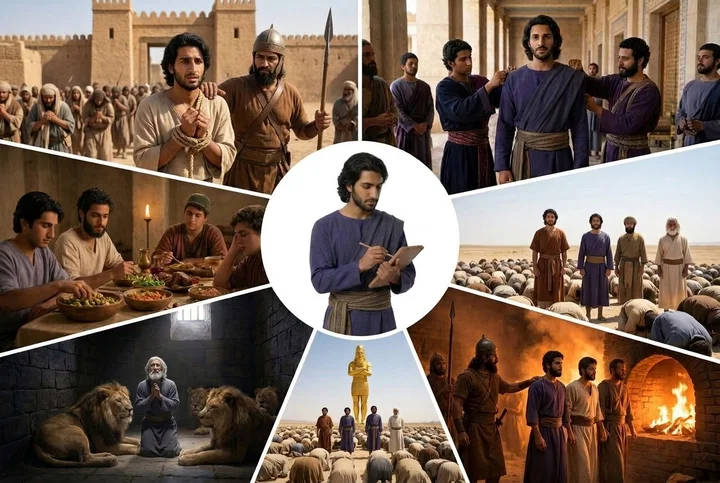
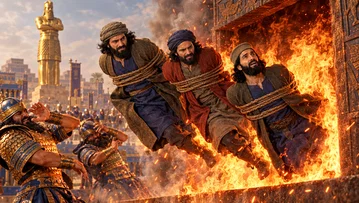
Cross-references 20 of 31
- Daniel 3:24-27
Then Nebuchadnezzar the king was astonied, and rose up in haste, and spake, and said unto his counsellors, Did not we cast three men bound into the midst of the fire? They answered and said unto the king, True, O king.
God is present with the three men in the furnace and delivers them unharmed.
- Daniel 3:28
Then Nebuchadnezzar spake, and said, Blessed be the God of Shadrach, Meshach, and Abed-nego, who hath sent his angel, and delivered his servants that trusted in him, and have changed the king’s word, and yielded their bodies, that they might not serve nor worship any god, except their own God.
The king praises God for delivering the men who refused to worship another god.
- Daniel 3:27
And the princes, governors, and captains, and the king’s counsellors, being gathered together, saw these men, upon whose bodies the fire had no power, nor was an hair of their head singed, neither were their coats changed, nor the smell of fire had passed on them.
The men emerge from the furnace unharmed, without even the smell of fire.
- Daniel 3:1
Nebuchadnezzar the king made an image of gold, whose height was threescore cubits, and the breadth thereof six cubits: he set it up in the plain of Dura, in the province of Babylon.
The golden image was the object they refused to worship.
- Daniel 4:37
Now I Nebuchadnezzar praise and extol and honour the King of heaven, all whose works are truth, and his ways judgment: and those that walk in pride he is able to abase.
Nebuchadnezzar praises God and declares that he can humble those who walk in pride.
- Jeremiah 27:6
And now have I given all these lands into the hand of Nebuchadnezzar the king of Babylon, my servant; and the beasts of the field have I given him also to serve him.
God grants Nebuchadnezzar rule over the nations by his appointment.
- Daniel 6:16-23
Then the king commanded, and they brought Daniel, and cast him into the den of lions. Now the king spake and said unto Daniel, Thy God whom thou servest continually, he will deliver thee.
Daniel is cast into the lions’ den for defying a ruler’s decree and delivered by God, like the furnace trial.
- Exodus 20:4-5
Thou shalt not make unto thee any graven image, or any likeness of any thing that is in heaven above, or that is in the earth beneath, or that is in the water under the earth:
The command forbids making and bowing to images, which the Hebrews refused to do.
- Hebrews 11:34
Quenched the violence of fire, escaped the edge of the sword, out of weakness were made strong, waxed valiant in fight, turned to flight the armies of the aliens.
Faith is shown overcoming the danger of fire.
- Daniel 3:6
And whoso falleth not down and worshippeth shall the same hour be cast into the midst of a burning fiery furnace.
The decree commands image worship under threat of the fiery furnace.
- Acts 5:29
Then Peter and the other apostles answered and said, We ought to obey God rather than men.
God must be obeyed when human commands oppose him.
- Daniel 3:29
Therefore I make a decree, That every people, nation, and language, which speak any thing amiss against the God of Shadrach, Meshach, and Abed-nego, shall be cut in pieces, and their houses shall be made a dunghill: because there is no other God that can deliver after this sort.
The king responds to their deliverance from the furnace by honoring God.
- Daniel 2:31-45
Thou, O king, sawest, and behold a great image. This great image, whose brightness was excellent, stood before thee; and the form thereof was terrible.
The golden image answers the kingdom image revealed to Nebuchadnezzar in his dream.
- Daniel 3:15
Now if ye be ready that at what time ye hear the sound of the cornet, flute, harp, sackbut, psaltery, and dulcimer, and all kinds of musick, ye fall down and worship the image which I have made; well: but if ye worship not, ye shall be cast the same hour into the midst of a burning fiery furnace; and who is that God that shall deliver you out of my hands?
The king threatens death unless they worship his image.
- Daniel 3:26
Then Nebuchadnezzar came near to the mouth of the burning fiery furnace, and spake, and said, Shadrach, Meshach, and Abed-nego, ye servants of the most high God, come forth, and come hither. Then Shadrach, Meshach, and Abed-nego, came forth of the midst of the fire.
The king calls the three men servants of God and summons them from the furnace.
- Daniel 3:8-12
Wherefore at that time certain Chaldeans came near, and accused the Jews.
The accusation explains their refusal of the king’s command and the punishment that followed.
- Isaiah 43:2
When thou passest through the waters, I will be with thee; and through the rivers, they shall not overflow thee: when thou walkest through the fire, thou shalt not be burned; neither shall the flame kindle upon thee.
God promises his presence and protection through fire.
- Daniel 4:30-33
The king spake, and said, Is not this great Babylon, that I have built for the house of the kingdom by the might of my power, and for the honour of my majesty?
The king’s pride is followed by humiliation under God’s sovereign rule.
- Daniel 4:2-3
I thought it good to shew the signs and wonders that the high God hath wrought toward me.
Nebuchadnezzar publicly declares God’s signs, wonders, and everlasting kingdom.
- Daniel 3:12
There are certain Jews whom thou hast set over the affairs of the province of Babylon, Shadrach, Meshach, and Abed-nego; these men, O king, have not regarded thee: they serve not thy gods, nor worship the golden image which thou hast set up.
The three captives refuse the king’s command.
Commentary
Each commentary is drawn from primary sources: the writings of Ellen G. White and Adventist pioneers and periodicals. Each commentary is separate. Its own words are not a quotation; follow the references to read the source passages.
Ellen G. White
59 sources
Nebuchadnezzar was filled with fury against Shadrach, Meshach, and Abed-nego because they refused to worship the golden image he had set up, and he commanded the fiery furnace to be heated seven times hotter than usual.SPBC 160.5–161.1Lt 132, 1901, par. 7–1519MR 119.1–120.25T 42.2–43.2 God did not forsake them in the fire, but Christ Himself walked with them in the flames and brought them forth without harm or even the smell of fire upon them.STBk 121.2STA 121.2LSEGW 329.2 Having purposed beforehand to be true to principle, they stood firm under threat of death and would not yield their loyalty to God for favor, honor, or life itself.STBk 121.2STA 121.2ST2 13.1Ms 201, 1898, par. 11 Their deliverance vindicated their loyalty, spread the knowledge of the true God throughout Babylon, and led even the proud king to praise Jehovah as the living God above all other gods and kings.5T 453.1–4Lt 109a, 1898, par. 5–8Ms 168, 1898, par. 1–3Ms 2b, 1895, par. 25–26 The heated furnace stands as the sharp contest that will be repeated to the close of the controversy, when Sabbath keepers will face abuse and a death decree for refusing false worship, yet the same preserving God will keep His faithful.STA 121.2ST2 13.1PK 512.112MR 218.2–220.1
Historical Setting and Cause
Daniel 3:19 belongs to the trial of Shadrach, Meshach, and Abed-nego in the fiery furnace, where they afterward walked unharmed amid the flames with an angelic presence beside them.PK 503 The account in Daniel 3:19-27 is the history of the Lord's wonderful deliverance of the three Hebrew worthies.Lt 124, 1910, par. 4–9 It teaches important principles regarding the working out of the Lord's purpose for the children of obedience and the children of disobedience.Lt 118, 1910, par. 2
The crisis came when the three refused to worship the great golden image Nebuchadnezzar had set up in the plain of Dura.SPBC 160.5–161.1 Their principles forbade paying homage to an idol rivaling the God of heaven, and even the threat of the fiery furnace could not make them betray God.SPBC 160.5–161.15T 42.2–43.2 They answered that their God was able to deliver them and that they would not serve his gods nor worship his image.SPBC 160.5–161.1
That image had been set up to represent Babylon and its king, and especially Nebuchadnezzar himself and his glory.Lt 109a, 1898, par. 5–8Ms 168, 1898, par. 1–3Ms 47a, 1898, par. 2–5 He had set up the exceedingly costly and magnificent golden image to magnify himself as an object of worship and to turn all nations to its worship.13MR 60.1–61.2Ms 47a, 1898, par. 2–5 He did so after reading his dream by his own idolatrous mind instead of by the living Oracles, and after heathen counselors flattered him that the head of gold was Babylon.Ms 168, 1898, par. 1–313MR 60.1–61.2 Advisers ensnared the Hebrews by leading the king to decree universal worship of the golden image.12MR 218.2–220.1 The three Hebrew captives who cherished the knowledge of the true God refused to bow the knee to that idolatrous image.Ms 15, 1896, par. 4–6
At the height of his power and glory Nebuchadnezzar was defied by representatives of a despised and captive people, an insult his proud spirit and self-exalting pride could not endure.PK 508.1–2BS 33.1–2ST Oct 19, 1882 Their refusal was a matter of conscience and loyalty to the God of heaven, because to worship the image would violate their consciences.Ms 44, 1886, par. 8–10 It included refusal to disregard the Sabbath and to observe heathen festivals, a faithfulness for which not a few exiles lost their lives when idolaters were roused to crush out the truth.DA 28.3 Their stand grew from education to worship and serve God only.Ms 163, 1898, par. 5–11 The determination not to surrender principle or compromise truth, first shown in refusing the king's food, matured into willingness to die rather than prove disloyal to God.Ms 2b, 1895, par. 25–26 Through connection with Daniel they had talked of God and of Christ the representative of God.Ms 163, 1898, par. 5–11
King's Fury and Command
Nebuchadnezzar became full of fury against Shadrach, Meshach, and Abed-nego, the form of his visage was changed against them, and he spoke and commanded that the burning fiery furnace should be heated seven times more than it was wont to be heated.Lt 132, 1901, par. 7–1519MR 119.1–120.2PK 503.2STE 212.2–214.15T 453.1–4 His anger arose because they would not yield to the royal command, would not serve his gods nor worship his golden image, even under threat of death, and he intensified the threat against those who remained loyal to God.Lt 132, 1901, par. 7–1519MR 119.1–120.2STE 212.2–214.15T 453.1–44SP 120.1 His wrath knew no limits and used extreme force as a last resort, for at the height of his power and glory he was defied by representatives of a despised and captive race, an insult his proud and self-exalting spirit could not endure.BS 33.1–2ST Dec 24, 1912ST Oct 19, 1882 In that fury he commanded the Hebrew exiles to be cast in, and the flames burst out with such fury that the men who carried and threw them in were burned to death.PK 508.1–2BS 33.1–2ST Oct 19, 1882
The fiery furnace, even heated seven times hotter than usual, could not intimidate those who trusted God into denying the truth or betraying God for favor, honor, or position.Ms 201, 1898, par. 11 He commanded his mighty men to bind the three God-fearing youths for execution because they would not bow to his golden image, and such haste was made to thrust them in that the flame burst out and burned to death those who put them in.PK 508.1–2Ms 163, 1898, par. 5–11 Their steadfast loyalty brought this severe test, but God later revealed His power by preserving them in the flames and thereby bringing the knowledge of the true God before Babylon's princes and leading men.STE 212.2–214.15T 453.1–44SP 120.1
The changed visage when he took a hostile stand illustrates what happens when any soul places himself on Satan's side of the question.SPBC 162.4–5STE 216.1–2Ms 16, 1896, par. 4019MR 122.1 A change passes over him just as Nebuchadnezzar's countenance was changed against the three faithful Hebrews, in rejecting the working of the Holy Spirit and opening the door of the mind to Satanic attributes that separate from God.SPBC 162.4–5STE 216.1–2Ms 16, 1896, par. 40 He turns against God's faithful messengers and warnings to misapply, misinterpret, falsify, and nullify them, and past history will be repeated in this experience.SPBC 162.4–5STE 216.1–2Ms 16, 1896, par. 4019MR 122.1
Divine Presence and Deliverance
God did not forsake the three in the fire when the furnace was ordered heated seven times hotter than usual for their refusal to turn from allegiance to God.STBk 121.2STA 121.2LSEGW 329.2Ms 61, 1890, par. 41Ms 44, 1886, par. 8–10 Christ Himself, the Son of God, the form of the Fourth, was seen walking with His faithful servants in the flames, present with them in the fire and delivering them completely.STA 121.2LSEGW 329.2Ms 61, 1890, par. 41Ms 40a, 1890, par. 101–102 He preserved them from all harm in the fire, and they came forth without harm to their garments and without even the smell of fire upon their clothing.STBk 121.2LSEGW 329.2Ms 61, 1890, par. 41Ms 44, 1886, par. 8–10Ms 40a, 1890, par. 101–102
The verse shows God's keeping power is greater than the rage of powerful enemies determined to stop the mouth of a fearless advocate of truth and crying for his blood.AA 570.1–2SG4 275.3–276.34SP 445.2–446.1 The Lord keeps the life of His faithful servant under a death sentence from an enraged ruler, and the same God can be trusted for protection when facing death.AA 570.1–2SG4 275.3–276.3 The witness can therefore stand without seeking his own ease, ready to seal his testimony with his blood rather than yield.SG4 275.3–276.3 Their preservation shows God can preserve His people when they face deadly persecution, and the same preserving power kept John alive when he was cast into a cauldron of boiling oil for believing in Jesus Christ of Nazareth.AA 570.1–2GC88 145.1–146.1RH Sep 5, 1912 The account of their deliverance from the furnace serves as a parallel to John's preservation from the boiling oil.AA 570.1–2
They could not be consumed because the Son of God was with them, so the righteous who are united with the Lord will likewise be unharmed by fire at His coming.Ms 159, 1903, par. 15–19 God has not promised exemption from such fiery trials for Christ's sake, but has promised what is far better, strength as the day requires and grace sufficient in weakness, with strength made perfect in weakness. In that furnace Jesus will stand beside the sufferer just as He was with the faithful three in Babylon.AA 570.1–2 Suffering for Christ's sake is an honor following Christ who patiently submitted to humiliation and torture and gave His life to save the world, and those who love their Redeemer will rejoice at every opportunity to share His humiliation and reproach, for love for the Lord makes suffering for His sake sweet.AA 570.1–2
Luther trusted that the God who preserved the three faithful men in the furnace heated seven times hotter could preserve him amid threats from his enemies.GW92 57.2–61.11T 373.2–375.1 Their preservation in the furnace shows that God can protect those who remain faithful when powerful enemies threaten them, and Luther trusted in that same protection while facing danger at Worms.GW92 57.2–61.11T 373.2–375.1
Witness to Nations
The fury that heated the furnace seven times hotter than usual belonged to the persecution suffered by the Jewish exiles in Babylon when idolaters were roused to crush out the truth.DA 28.3 Shadrach, Meshach, and Abed-nego were brought into that trial because they refused to disregard the Sabbath and to observe the heathen festivals, a faithfulness for which not a few exiles lost their lives.DA 28.3 The Lord brought His servants face to face with kings and rulers in such trials that they and their people might receive the light, and time after time the greatest monarchs were led to proclaim the supremacy of the God whom their Hebrew captives worshiped.DA 28.3
The attempt to force worship of the golden image ended with God preserving the Hebrews in the flames, testing their integrity, displaying His power, and vindicating their loyalty.5T 453.1–4BS 29.1Lt 32, 1899, par. 6–11 Their steadfastness spread the knowledge of the true God and the power and faithfulness of the God of Israel before Babylon's princes and leading men and throughout the length and breadth of Babylon.5T 453.1–4Ms 2b, 1895, par. 25–26BS 29.1 In this way God was honored by their faithfulness and accomplished His purpose in permitting their captivity in a heathen land.Ms 2b, 1895, par. 25–26 Their determination not to surrender principle or compromise truth, first shown in refusing the king's food, had matured into willingness to die rather than prove disloyal, and loyalty that required open disregard of the king's command even in the face of death was what brought the rescue that made the God of heaven known to Babylon.Ms 2b, 1895, par. 25–26Lt 32, 1899, par. 6–11
This wonderful miracle of preservation, when Christ Himself walked in the furnace with His three faithful servants, so wrought upon Nebuchadnezzar's heart that he believed in God and His superior power over every other kingdom and earthly kings.Lt 109a, 1898, par. 5–8Ms 168, 1898, par. 1–3Ms 47a, 1898, par. 2–5 He praised and gave thanksgiving to Jehovah and acknowledged the God of the three Hebrews as the living God.Lt 151, 1904, par. 6–8Ms 15, 1896, par. 4–6 He called them to come forth from the flames and cast their accusers into the furnace.Ms 163, 1898, par. 5–11 He could recognize the Fourth as like unto the Son of God because Daniel and the three Hebrews in connection with him had talked of God and of Christ the representative of God.Ms 163, 1898, par. 5–11
Though convinced by what he saw and acknowledging the wonderful miracle that had been wrought, because he did not continue to walk in the light he lost the holy impression made upon his mind.Ms 15, 1896, par. 4–6
Faithful Endurance Under Trial
Making the furnace far hotter than normal did not turn God's faithful servants aside from allegiance to the truth.STBk 121.2STA 121.2ST2 13.1LSEGW 329.2Ms 61, 1890, par. 41 Having purposed beforehand to be true to principle come what may, they stood firm in the time of trial even when cast in for obedience.STA 121.2ST2 13.1LSEGW 329.2Ms 61, 1890, par. 41Ms 40a, 1890, par. 101–102 They were not forsaken by God in the fire, for the form of the Fourth walked with them in the flames.STBk 121.2STA 121.2LSEGW 329.2Ms 61, 1890, par. 41Ms 40a, 1890, par. 101–102 They came forth without harm and without even the smell of fire upon their garments.STBk 121.2STA 121.2LSEGW 329.2Ms 61, 1890, par. 41Ms 40a, 1890, par. 101–102 The increased heat was a sharp, continual contest in the controversy between good and evil lasting to its soon close, demanding that same settled purpose in the last remnant of time.STA 121.2ST2 13.1LSEGW 329.2Ms 61, 1890, par. 41Ms 40a, 1890, par. 101–102
Trusting the word of God and holding fast faith in the triumph of righteousness, though utterly helpless in themselves, they withstood Nebuchadnezzar in the fire.RH Dec 24, 1908ED 254.2–3RH Nov 11, 1915 The power of the whole world and human power and policy on the throne were set in support of evil against them.RH Dec 24, 1908ED 254.2–3RH Nov 11, 1915 Their stand witnesses to the power of God's word against human power and authority.RH Dec 24, 1908ED 254.2–3RH Nov 11, 1915 It marks them as part of the world's true nobility and royal line in which youth today are called to take their places.ED 254.2–3
Their self-denial and self-sacrifice under threat teach that God's people must let inward principle learned from Christ override hereditary and cultivated habits, circumstances, passions, and self-interest.Lt 73, 1896, par. 39–4220MR 113.3–114.1 They must resist every circumstance that conflicts with duty and rule passion by that inward principle.Lt 73, 1896, par. 39–4220MR 113.3–114.1 When human authority compels open disregard of God's commandments and demands disobedience to God, even in the face of death and the fiery furnace, loyalty must remain firm and truth must not be compromised or betrayed.5T 42.2–43.2Ms 2b, 1895, par. 25–26Ms 15, 1896, par. 33–34 The determination not to surrender principle first shown in refusing the king's food matured into willingness to die rather than prove disloyal.Ms 2b, 1895, par. 25–26 God vindicated His servants in that trial, was honored by their faithfulness, and through their steadfastness spread the knowledge of the true God throughout the length and breadth of Babylon, thereby accomplishing His purpose in permitting their captivity in a heathen land.Ms 2b, 1895, par. 25–26
Applied to a believer facing severe opposition as a heated furnace, holding fast to the truth may bring trials.4MR 325.3 The Lord will not leave those who serve Him, and His strength is sufficient to endure.4MR 325.3
End-Time Parallel and Application
The furnace heated seven times hotter than usual is the sharp, continual contest in the controversy between good and evil that lasts to its soon close, demanding in the last remnant of time a settled purpose to be true to principle let come what may.STA 121.2ST2 13.1Ms 40a, 1890, par. 101–102 Making the fire far hotter than normal to force unfaithfulness did not turn God's faithful servants aside from allegiance to the truth, for having purposed beforehand they stood firm in the time of trial even when cast in for obedience.STA 121.2ST2 13.1Ms 40a, 1890, par. 101–102 They were not forsaken, for God was present with them in the fire, the form of the Fourth walked with them in the flames, and they came forth delivered so completely that no trace of fire remained on their clothing, without even the smell of fire upon their garments.STA 121.2ST2 13.1Ms 40a, 1890, par. 101–102 Their experience teaches that God's faithful servants may face abuse and death for refusing to forsake their worship, and in the last days Sabbathkeepers will face a death decree for honoring the fourth commandment.PK 512.1
Nebuchadnezzar's fury broke out in a cruel command to destroy Shadrach, Meshach, and Abed-nego, prompted by advisers who ensnared them by leading the king to decree universal worship of the golden image.12MR 218.2–220.1 Those who make cruel enactments seeking to destroy God's faithful are themselves destroyed by the recoil of their actions, which will repeat when men today strive to turn God's people from allegiance by setting up a Sunday idol in place of God's Sabbath and demanding it be worshiped as sacred.12MR 218.2–220.1 The king's use of royal power to enforce worship shows how civil authority allied with wickedness can seek to destroy those who remain faithful to God.Lt 90, 1897, par. 13–18 The episode warns against laws that compel worship and against turning people from their allegiance to God.Lt 90, 1897, par. 13–18
That same refusal to bow must be made in the Southern States when the period comes to do as the three worthies did, a time presenting decisions for or against the commandments of God.Lt 35, 1895, par. 1–3 Until that period comes believers must not be presumptuous and must not needlessly close their own way into untouched fields.Lt 35, 1895, par. 1–3 They must never encourage defiance and resistance even if threatened with the chain gang, but must be willing to go to other cities or countries.Lt 35, 1895, par. 1–3 They must meet bigotry, prejudice, and suffering for truth with prayer for those who treat them evilly and with nonresistance to evil.Lt 35, 1895, par. 1–3
The test over the golden image set up in the plain of Dura represented the kingdom of Babylon and especially Nebuchadnezzar himself after he read his dream by his own idolatrous mind instead of by the living Oracles.Ms 168, 1898, par. 1–3 Shadrach, Meshach, and Abed-nego would not bow and were cast into the fiery furnace, where Christ Himself walked with them, and the miracle so wrought upon Nebuchadnezzar's heart that he believed in God and His superior power over every other kingdom.Ms 168, 1898, par. 1–3 Their faithful stand and the judgment on Babylon foreshadow the end of the world, when students of God's Word must stand apart from the customs of the world's counselors and be prepared like wise virgins with oil to meet the Bridegroom.Ms 168, 1898, par. 1–3 Faithful obedience can provoke violent threats from rulers, yet the same preserving God who preserved the three young men in the burning fiery furnace still lives and reigns and remains able to save His servants now.GC 146.1 It calls for trusting life and death to the Lord's hands when violence is very probable, counting personal life of little consequence if He wills not to save, refusing flight and recantation, and being willing to shed blood so the gospel is not exposed to the scorn and triumph of the wicked.GC 146.1 Their danger in a furnace heated far beyond its usual heat shows that God does not forget His faithful people when they face persecution and death, for even in prison or other lonely confinement they remain connected to Christ and may receive heavenly light and peace.GC 626.2–627.1
Sources
Pioneers and periodicals
135 sources
Nebuchadnezzar became full of fury against Shadrach, Meshach, and Abed-nego for refusing to worship his image, his countenance was changed against them, and he commanded the furnace to be heated seven times more than usual before they were bound and cast in.RH Aug 20, 1908ST Jun 28, 1899ST Jan 29, 1908 Seven times means heated to its utmost capacity and greatest possible intensity, and the excessive heat only made the deliverance more striking when the flames slew the king's servants while the three fell bound into the fire.ST Jan 29, 1908ST Oct 9, 1901RH Aug 20, 1908RH Jun 11, 1872RH Apr 20, 1869 Their refusal was right because when human law commands image worship contrary to God's law, God's law must be obeyed whether deliverance follows in this life or in eternal life.ST Sep 6, 1899ST Jan 23, 1901ST Jul 27, 1904ST Sep 10, 1885ST Oct 5, 1882 God interposed by direct miraculous power, the Son of God walked with them loose in the fire, and they came forth with bodies, hair, and clothing unharmed without even the smell of fire, the fire consuming only their bonds.RH Jul 14, 1904ST Feb 3, 1904ST Sep 9, 1886RH Mar 2, 1852 The state thereby usurped God's place by enforcing worship by law, but civil power has no jurisdiction over conscience, and the same test will return when a worldwide decree commands worship of the image of the beast and a spurious sabbath on pain of death.ST Nov 8, 1905ST Apr 23, 1912ST Jul 11, 1911ST Oct 1, 1896ST Aug 9, 1910
King's Fury and Command
Nebuchadnezzar became full of fury against Shadrach, Meshach, and Abed-nego when they refused to worship his image, and the form of his visage was changed against them.RH Aug 20, 1908ST Jun 28, 1899ST Jan 29, 1908ST Jan 9, 1912ST Oct 13, 1909 In that anger he spoke and commanded that the furnace should be heated seven times more than it was wont to be heated, before they were bound and cast in.RH Aug 20, 1908ST Jun 28, 1899ST Jan 29, 1908ST Jan 9, 1912ST May 21, 1912 The refusal that provoked him was their standing erect and remaining standing when commanded to bow, and the penalty was ordered as the consequence of their choice to worship according to their faith.ST Oct 13, 1909ST May 21, 1912 His order was rash and intense, matching his fury against those who would not obey his command.ST Jun 28, 1899ST Jan 29, 1908
Seven times more means heated to its utmost capacity and greatest possible intensity, to the highest possible degree.RH Aug 20, 1908RH Jun 11, 1872RH Apr 20, 1869ST Feb 3, 1904 It does not give a particular number of degrees of heat, does not mean seven times hotter in a mathematical sense, and does not mean merely one-seventh more heat added to the usual heat.RH Aug 20, 1908RH Jun 11, 1872 It is one example of the repeated emphasis on seven in Scripture.RH Jan 22, 1857 In the ordinary course such intensified heat would bring the most sudden and therefore most painless death that could be inflicted by fire, not the refinement of cruelty used by later persecutors in slowly roasting victims.RH Aug 20, 1908
The word translated form or visage is tzeh-lem, commonly translated image.RH Jan 5, 1860 Here it denotes human facial appearance and physical form rather than a man-made idol.RH Jan 5, 1860
The king's uncontrolled rage showed that though ruler over others he could not rule his own spirit, becoming a slave to passion.RH Apr 20, 1869RH May 1, 1900 Holding a throne did not make him a true king, for he lacked true kingly character and displayed a lower, slavish and beastlike character.RH Apr 20, 1869RH Jul 1, 1902RH May 1, 1900 The change in the form of his visage meant Satanic attributes made his countenance appear as the countenance of a demon.ST May 6, 1897 He felt insulted and his favor rejected by captives, and with all the force he could command he ordered the furnace heated to match his sevenfold fury.ST May 6, 1897ST Jan 29, 1908RH May 1, 1900 He commanded his most mighty men to bind the unresisting men and cast them in, because he felt it required more than ordinary power to deal with these noble men.ST May 6, 1897ST Jan 29, 1908 His mind was strongly impressed that something unusual would interpose in their behalf, and he sought to prevent any supposed magic or rescue by having them bound.ST May 6, 1897ST Jan 9, 1912
The events occurred about twenty years after Daniel 2, when his kingdom had grown rapidly in power through conquest and building.ST Jun 3, 1913 His all-gold image asserted that Babylon's golden glory should continue forever with no succession.ST Jun 3, 1913ST Feb 3, 1904 This was in defiance of God's revelation that Babylon, the head of gold, would be followed by inferior kingdoms of inferior metals and would decline and pass away, with gold yielding to baser metal.ST Dec 3, 1912ST Nov 28, 1895ST Feb 3, 1904 He refused to admit that his kingdom would finally be overcome and superseded by another kingdom arising after him, though pleased with the dream God gave in reproduction of the dream previously given to him.ST Jun 3, 1913 He erected the golden image as one grand patriotic demonstration to assure himself his kingdom would be perpetuated, to make Babylon universal and eternal, and to show the Lord's word through Daniel false.ST Jun 3, 1913ST Dec 3, 1912 The episode reflects his determination that Babylon should endure forever, contrary to the future God had revealed, expressing faith in human power with patriotism used to oppose God's prophetic word and to nullify the insecurity of earthly kingdoms revealed in Daniel 2.ST Oct 11, 1905ST Jan 9, 1912ST Dec 3, 1912ST Oct 21, 1908 That proud, persecuting power, symbolized by a lion with eagle's wings in its power, strength, occasional ferocity, and soaring pride, illustrated Babylon's moral character and attitude toward the people of God.ST Nov 28, 1895
The account is a contemporary Babylonian record written in Nebuchadnezzar's time at Babylon, not a late writing after the conquest of Palestine by Alexander the Great in B.C. 332.ST Jan 11, 1916 The Greek words in the chapter are names of two or three musical instruments, no stranger than names of Indian animals and of an Indian tree reaching Jerusalem under Solomon.ST Jan 11, 1916 Greek culture and traders were already found in these countries in the eighth century before Christ, in the days of Sargon and Sennacherib.ST Jan 11, 1916 It is a true story, a real miracle recorded in the infallible Bible whose every word is trustworthy, not myth, allegory, or fancy, and an inspired and accurate record of his actions, though Nebuchadnezzar himself and his words and acts were not inspired.ST Jul 16, 1912
The venting of fury and the excessive heat only made the deliverance more striking and evident, for the hotter fire made preservation more evident.RH Aug 20, 1908RH Apr 20, 1869 When the furnace was at its hottest, deliverance was nearest.ST Aug 13, 1896 The heat was so fierce it slew the strong, high-ranking men and warriors who cast them, while the three fell down bound in the midst of the fire.ST Jan 29, 1908ST Oct 9, 1901RH Jul 14, 1904ST Oct 11, 1905ST Aug 13, 1896 The verse thus marks the limit of the king's power with the most destructive agent he could use, which could only put bound free men into fire but could not harm servants of the God whose power is over every element.ST Jan 29, 1908
Faithful Refusal to Worship
The three refused to serve the king's gods or to worship the golden image set up on the plain of Dura when the music sounded, and stood erect when commanded to bow rather than show even outward deference or the appearance of obedience.RH Oct 21, 1862ST Jun 3, 1913ST May 20, 1889 The decree laid a positive and sweeping command upon them under threat of the seething fire heated seven times hotter, yet their disobedience brought no effect of harm upon them because divine presence was with them in that trying hour.ST Jun 3, 1913ST Jan 18, 1883RH May 12, 1868 Their stand was firm although they held favored positions in the government and although the decree was not aimed at them personally, and their refusal was right because bowing would have publicly acknowledged the image's claim to worship even if they had prayed inwardly to the true God.RH Oct 21, 1862ST May 20, 1889 Their earlier trial and this later one belong together, for as before so now refusal under death sentence was followed by deliverance.ST Sep 10, 1885RH May 12, 1868
When human law commands what God's law against image worship forbids, God's law must be obeyed.ST Jan 23, 1901ST Sep 10, 1885RH Mar 1, 1860 Faithfulness in that conflict does not depend on convenience, fear, courtesy, expediency, or knowing beforehand whether deliverance in this life will follow.ST Jul 27, 1904ST Sep 10, 1885RH Oct 21, 1862 To bow would have broken God's commandment and publicly owned a false claim to worship, so refusal was right and obedience to the king would have been sin, even though obedience brought mortal danger and exposure to persecution.ST Jan 23, 1901ST Jul 27, 1904ST Oct 3, 1895ST May 20, 1889 Punishment followed precisely because they chose obedience to God rather than to the conflicting law of the king.ST Jan 23, 1901RH Mar 1, 1860
They were willing to face death in the furnace rather than disobey God, trusting his presence, yielding their bodies, and enduring without shrinking, concealment, or yielding to known sin.ST Sep 6, 1899ST Feb 24, 1881RH Jul 20, 1916 They remained true whether God delivered them in this life or in eternal life, holding principle even when death or deliverance was at stake, confident that God can deliver and that if suffering comes he is with them.ST Sep 6, 1899RH Oct 21, 1862RH Jul 13, 1916 Their stand brought them to a terrible extremity, and deliverance came by direct intervention only after they had faced that trial.ST Oct 5, 1882RH Jan 10, 1871ST Feb 24, 1881 That steadfastness under extreme threat is the faith and consecration required to stand for truth amid danger, ridicule, and coming trials, a devotion that does not shrink from danger.ST Oct 5, 1882RH Jul 20, 1916RH Jul 13, 1916
Choosing the furnace rather than denying the God of Israel required courage, fortitude, patience, and real bravery that puts lower tendencies under higher spiritual ends, for love for God, his law, and the right proved stronger than fear of the king or fear of death.ST Jun 1, 1882RH Jul 2, 1867 That noble moral choice was sublime enough to bring divine companionship into the fire, turning crackling flames into robes for coronation day and sustaining them until they emerged unharmed.ST Jun 1, 1882RH Jul 2, 1867 The account shows principle enduring the fiery furnace unharmed while policy is burned in trying to cast principle into the fire.ST Jun 17, 1903 Greater resoluteness in resistance may bring greater wrath from the world, yet it gives opportunity to triumph in faith and to know one's standing with God.ST Feb 26, 1880ST Jul 8, 1886 In the face of blazing sevenfold heat and despotic power usurping place over mind and conscience, the three maintained individual integrity, proved to be true heroes in the right, and were vindicated and preserved unscathed as a lesson to all rulers and combinations.ST Feb 26, 1880
Deliverance Inside the Furnace
They were bound in their coats, their hosen, their hats, and their other garments and cast into the midst of the burning fiery furnace, where the three fell down bound, and they were put inside the fire itself and not merely placed near it.ST Oct 9, 1901ST Jul 27, 1904RH Jan 10, 1871 The blaze was so fierce that it slew the strong men who carried out the order and cast them in, while the Hebrews themselves remained unharmed.ST Oct 19, 1882ST Oct 9, 1901RH Jul 14, 1904ST Oct 11, 1905ST Jan 9, 1912 The fire consumed only their bonds.ST Oct 9, 1901
With them in the flames appeared a fourth figure, the Angel of Jehovah, the Son of God, seen loose and walking in the fire.ST Aug 13, 1874ST Sep 9, 1886RH Mar 2, 1852 Because they stood as living sacrifices in absolute submission to the will of God, the position that looked most fatal to human view became the most safe and blessed and most for the glory of God.RH Mar 2, 1852 God sent that presence to protect them and to sustain them in danger and isolation, so that clinging more closely to the Father's guiding hand they found what they never knew elsewhere.ST Sep 9, 1886RH Mar 2, 1852
They came forth unscathed, with bodies, hair, and clothing unharmed and without even the smell of fire or smoke upon their garments.RH Jul 14, 1904ST Feb 3, 1904ST Jun 3, 1913RH Oct 29, 1914ST Feb 17, 1909 Jesus was with them during that trying hour, and with Him they could safely go anywhere.ST Jun 3, 1913RH Oct 29, 1914 Afterward they were promoted to positions of usefulness and trust in Babylon.ST Feb 17, 1909
The deliverance was wholly due to the direct interposition of divine power, the angel of His presence manifested to human sight in the fire, and is rightly called a miracle in which natural law was restrained.ST Aug 13, 1874ST Feb 3, 1887RH Aug 20, 1908RH Aug 20, 1908ST Mar 24, 1914 Angels can control the elements, and God can preserve from fire contrary to its ordinary destructive effect.ST Aug 13, 1874ST Feb 3, 1887RH Jul 14, 1904 On the human side they through faith quenched the power of fire, held up as a noteworthy example of living faith, so that the divine and the human co-operate in saving men from the fire which shall never be quenched.RH Aug 20, 1908 It was as miraculous as the preservation of Jonah and authenticated His servants.RH Jul 14, 1904 Making a man is at least as great a marvel as raising a man from the dead, and seed multiplying in the furrow is as marvelous as bread multiplying in hands; a miracle does not hold more of God's will than any other work of God, for God's laws exist only for human reckoning while for God they are a moment-by-moment will of highest wisdom and love, securely counted on from past expressions and therefore rightly called law, so the miracle is not a greater manifestation of power than those ordinary and ever-repeated processes but a different manifestation.RH Aug 20, 1908
Their course was thereby vindicated as righteous, confirming God's idea of empire against the king's idea and changing the king's word and his idea of empire.RH Aug 20, 1908ST Feb 3, 1904 The great king was forced to acknowledge that the God of the Hebrews is a Deliverer above all other gods and that there was a King higher than himself.ST Jul 16, 1912RH Apr 25, 1912 Through Daniel and his companions in actual experience in heathen Babylon the gospel of righteousness by faith was presented, showing that God can humble human pride and bring people to salvation and can abase the proud.RH Aug 22, 1907ST Jun 21, 1905 In this way the knowledge of the true God was proclaimed beyond Israel and spread through the empires by the Babylonian king's response and proclamation, proclaiming His power over every element and His ability to save souls from sin, humbling the monarch to honor God's servants and turning wrath to praise, yet giving lessons later ignored at Belshazzar's feast.RH Aug 22, 1907ST Jun 21, 1905
Civil Power Versus Conscience
The state left its God-given place of restraining evil and regulating outward civil acts and usurped God's place by directing worship, enforcing a false religious system by law, and punishing refusal with the furnace.ST Nov 8, 1905ST Jul 11, 1911ST Apr 14, 1898ST Dec 3, 1896 This union of church and state, whether by Babylon then or by any church and state at any time, always produces persecution, tyranny and religious despotism.ST Jul 11, 1911ST Dec 24, 1896ST Dec 3, 1896 Nebuchadnezzar's pride and exaltation of self in this act was the same pride manifest in Lucifer and Nimrod, supplying by union with the state the power lost by disconnecting from God and aligning with Satan.ST Oct 1, 1896ST Dec 24, 1896 When the three Hebrews would not worship as Babylon demanded, his fury ordered the furnace made seven times hotter than usual, misusing state power to spread false religion by persecution.ST Nov 8, 1905ST Jul 11, 1911ST Dec 3, 1896 That misuse exceeded the government's authority over its subjects' worship, so the three were right to refuse obedience and were free from blame, while the attempt to control worship and coerce conscience was an abuse of earthly authority that God rebuked and humbled.ST Nov 8, 1905ST Apr 14, 1898ST Dec 3, 1896 The sevenfold heating set the stage for proof of the superior power by which Christ carries on His work, for Christ was present in the furnace with His faithful followers, the death decree was thereby reversed, and the fire did not harm them.ST Nov 8, 1905ST Oct 1, 1896
Calling the decree a civil requirement for the good of the people, harmony with the majority, and stability of government did not make it harmless to conscience.ST Sep 9, 1889ST May 12, 1890ST Feb 19, 1894 It was only a civil statute in claim, not forbidding the Hebrews to worship their own God, yet obedience to it as a mere civil ordinance would still have compromised faith.ST Sep 9, 1889ST May 12, 1890 The king's fury and command to heat the furnace seven times hotter illustrate that calling a law civil does not remove its coercive, religious character when enforced with violence against those who will not comply.ST Sep 9, 1889ST May 12, 1890 A government can call its decree righteous law while persecuting obedience to God, as when Shadrach, Meshach and Abed-nego were cast in for disobeying a law claiming authority over their duty to God.ST Sep 9, 1889ST Feb 19, 1894 Therefore the loyal servants of Jehovah would not bow even with certain death before them in the overheated furnace, and God vindicated their refusal.ST May 12, 1890ST Feb 19, 1894
Their disobedience was crime against civil law but not sin, since sin is transgression of God's spiritual law of thought, motive and intent while civil law regulates only the outward act.ST Jan 23, 1912ST Jun 11, 1912ST Jan 20, 1898ST Aug 6, 1896 They were treated as criminals and condemned to death for refusing an evil decree to worship the golden image, though their refusal placed no human authority above God and obeying it would have been sin against God.ST Jan 23, 1912ST Jun 11, 1912ST Jan 20, 1898 Bowing down would have been sin, proving the vast difference between sin and crime.ST Jan 20, 1898ST Aug 6, 1896 When the choice lies between sin and crime it is always better to be a criminal than a sinner.ST Jan 23, 1912ST Aug 6, 1896 Their refusal was not a real crime in God's sight, and the king and those enforcing the unjust law were the guilty parties, though their acts were classed as crimes by civil authorities.ST Aug 6, 1896ST Jun 24, 1897RH Jun 10, 1909
Christians may passively disobey human laws that require disobeying God and meekly accept the penalty without taking up arms in rebellion, leaving vindication to God.ST Jul 24, 1884RH Oct 21, 1862RH Sep 8, 1910 The standing rule for all time is to obey civil government always unless obedience would involve disobedience to God, for God must be obeyed rather than men.ST Jul 24, 1884RH Sep 8, 1910ST Nov 26, 1896 When obedience to earthly law would mean idolatry, not even the appearance of obedience may be offered, even by those holding favored government positions and even when the decree was not aimed at them personally.RH Oct 21, 1862RH Oct 21, 1862 Their refusal in the face of fury and the overheated furnace illustrates that God's command must be obeyed when it conflicts with a human decree, even when obedience means bearing the penalty.RH Sep 8, 1910ST Dec 3, 1896RH Oct 21, 1862 God protected them in the fiery furnace when they disobeyed a human enactment rather than violate conscience toward God, and He honors those who honor His law whether through deliverance in this life or in eternal life.RH Oct 21, 1862ST Nov 26, 1896ST Dec 3, 1896RH Oct 21, 1862
Their deliverance vindicated liberty of conscience as a birthright and established that civil power, though ordained by God and wielding the sword including death, has no authority in the spiritual realm and no jurisdiction over worship and conscience.ST Apr 23, 1912RH Aug 20, 1908ST May 19, 1914 Human rulers must not force people to violate conscience or their duty to God, and coercion and punishment to enforce religious worship are wrong, as God's deliverance of the three confirmed.ST Apr 23, 1912ST Aug 9, 1910 Their punishment was an abuse of national power against freedom of choice, but God defended that freedom, the Son of God stood with them, and the fire burned only the cords that bound them.RH Aug 20, 1908ST May 19, 1914 A state claiming ultimate, final authority admits no rule independent of itself, yet God answered that claim in the furnace itself by the form of the fourth, teaching Babylon that there can be a rule within a rule and a kingdom within a kingdom, the rule of conscience and the kingdom of God set up in the heart of His child.RH Aug 20, 1908RH Sep 14, 1911 The lesson taught Nebuchadnezzar by the furnace, as Darius by the lions' den, is that God holds each soul personally accountable without regard to decrees, a principle of religious liberty remaining in force even though God does not miraculously deliver every faithful person from martyrdom.RH Aug 20, 1908RH Sep 14, 1911 Majorities and numbers do not decide truth or worship, and conscience must be won by appeal to the heart, not by civil law.ST Apr 23, 1912RH Aug 20, 1908RH Sep 14, 1911
Foreshadowing of Final Persecution
The principles of the account belong to the latter days, when loyalty to God brings conflict with apostate civil government and tests devotion to him.RH Jul 14, 1904RH May 1, 1855ST Nov 1, 1905 The refusal to worship the golden image shows the loyalty required, and the outcome shows the privileges and blessings of serving God alone.RH Jul 14, 1904RH May 12, 1868RH Jan 1, 1901 The church will be placed in precisely the same situation when the decree goes forth that all shall worship the image of the beast on pain of death.RH May 1, 1855ST Nov 1, 1905RH May 12, 1868 God saved the three by direct interposition, and he will likewise interpose to save his people and appear to deliver and translate faithful commandment-keepers threatened with death, but not until the time of trouble such as never was has fully opened upon the world, so the saints must meet its full fury first.RH May 1, 1855RH Jan 1, 1901 Their escape was no credit to the king, whose deep guilt lay in attempting to put the righteous to death after neglecting earlier appeals, and they were under death sentence for refusing to conform, yet as in their earlier trial God delivered them.RH May 12, 1868RH Jan 1, 1901 The same test will return in the most literal way and requires learning faith and loyalty in continual service now in order to pass safely through the final crisis to promotion in the kingdom, including pressures and threatened punishment in the Southern States where people will face decisions for or against God's commandments.RH May 1, 1855RH Aug 27, 1908RH Apr 13, 1911
Force is the last resort of every false religion.ST May 6, 1897 At Babylon attraction came first by music and outward show, and when that failed to make men worship the image the furnace heated seven times hotter stood ready to consume them.ST May 6, 1897 History will be repeated when the first day of the week, a common working day with no sanctity, is set up as a spurious sabbath as was the image at Babylon, with a decree going forth to all the world commanding all nations and tongues and peoples to worship it in order to make of no account the day God instituted as a memorial of creation.ST May 6, 1897RH Aug 27, 1908ST Dec 5, 1895 Trial and persecution will come to all who in obedience to God refuse to worship this false sabbath, for the Papacy has compelled obedience and will continue to do so, and only singleness of eye to the glory of God, steadfast souls, and the power of God and of truth will enable loyalty to him as it held the three firm.ST May 6, 1897 Outward compliance was not liberty and was not neutral, because to worship the idol was to break the second commandment.ST Dec 5, 1895 Their case proves no one can keep the sabbaths of two different and opposing powers at the same time or bear the seal of God and the mark of the beast at the same time, just as no one can observe Sunday and keep the fourth commandment.ST Dec 5, 1895 It foreshadows the final issue over Sunday law, when the decree will demand disregard of the Sabbath of the fourth commandment and honor of the first day under pain of death, and when the image to the beast is made and another beast causes as many as will not worship the image of the beast to be killed, believers will face the same test that came to the three captives.RH Aug 27, 1908ST Dec 5, 1895
With this difference: then those who did not worship were consigned to the burning fiery furnace, but in the last day those who do worship will perish in the fires.RH Aug 27, 1908 The whole earth is soon to become a burning fiery furnace, stored up for fire and reserved against the day of judgment and destruction of ungodly men.RH Aug 27, 1908 The God of Shadrach, Meshach, and Abednego alone is able to deliver from that universal conflagration, but that deliverance must first be revealed as salvation from sin, deliverance from the power of darkness and translation into the kingdom of the Son of his love.RH Aug 27, 1908 The sevenfold-heated furnace is a picture of the final day of God's wrath when all wickedness is tested by fire.ST Sep 26, 1911ST Dec 1, 1914RH Oct 22, 1914 Sin and those who have let sin take root and come to maturity in them cannot stand that test but will come to ashes, while those who through the power of God have uprooted sin from their souls and made sin an outcast and taken Christ for their all and in all and are covered with the robe of his righteousness will stand unscathed in the midst of the burnings of that day even as the three stood unscathed in the sevenfold-heated furnace.ST Sep 26, 1911ST Jun 27, 1911RH Oct 22, 1914
As the Son of God was with the three in that furnace, so he will be with the righteous in the final fire when the elements are on fire and the earth is a molten sea, and out of that fire of testing they will pass into the restored Eden and life eternal.ST Sep 26, 1911RH Oct 22, 1914ST Aug 20, 1912 This proves that righteous, holy people can dwell in devouring fire until it has utterly consumed sin and all identified with sin, just as the city of God with all his children will rest unharmed and undisturbed upon the whole earth converted into a lake of fire while the wicked meet the last great fiery test and are destroyed forever.ST Sep 26, 1911ST Dec 1, 1914ST Jun 27, 1911 God's children remain unharmed by the fire of his glory while the wicked perish, and those whose lives and characters are joined to Christ will endure the fire of the last day.ST Dec 1, 1914ST Jun 27, 1911ST Aug 20, 1912
Ancient Babylon is the first of the seven heads of seven-headed beast rule and the beginning of all symbolic prophecy, where the final overthrow of temporal rule at God's earthly center of power began when Jerusalem was utterly overthrown.ST Mar 30, 1915 Babylon's work against God's people was instigated by fallen Lucifer, the king of Babylon.ST Mar 30, 1915 Babylon was the first great organized power to overthrow and persecute God's organized church, and its rulers enforced religious dogmas by law through a decree concerning the image on the plain of Dura.ST Oct 15, 1894 Paganism as the first division of spiritual Babylon operated through empire to compel false worship and persecute true worshipers.ST The fury against the three and the command to heat the furnace beyond custom is proof that paganism persecutes, standing with kingly decrees, the lions' den, the gallows, the prison, the judgment hall, and the cross as its answer to loyalty to God and his law.ST This event forms part of the historical outline of ancient Babylon's attempt to destroy God's people and foreshadows modern Babylon's persecution of those who refuse its religious demands, for the beast constantly demands obedience contrary to God.STRH Oct 11, 1915ST Nov 19, 1896 God intervened and prevented the proposed execution from becoming a destruction of all the faithful.ST Nov 19, 1896
The heated furnace also pictures Satan with his angelic and human agencies pursuing Jesus from the cradle to the tomb, from Bethlehem to Calvary, with intense fiery zeal and hatred.ST Apr 3, 1907 The purpose was to make the divine Son of God fail in revealing the faith of God and the love of God to a lost rebellious world in his obedient life and tragic death.ST Apr 3, 1907 Jesus passed through that crucible and came out unharmed without even the slightest taint upon the Father's faith and love he came to reveal, with his character shining unstained.ST Apr 3, 1907 This demonstrates to all the universe that no power is able to destroy a being filled and led by the faith and love of God shed abroad in the heart by the Holy Spirit.ST Apr 3, 1907 Jesus now has overflowing abundance of that gold tried in the fire to give to every lukewarm professor who repents and opens the heart to him, and his faith and love are offered to his followers so they can overcome as he did.ST Apr 3, 1907 Christ has passed through its suffering, so no path through suffering is unknown to him.
Trial Refinement and Courage
The furnace heated seven times hotter stands as the picture of severe suffering, blinding darkness, fiery temptation, persecution, inner imprisonment, and bitter trial, including reproof of sin, proclamation of truth, missionary danger, hardship over the Sabbath, and social criticism, denunciation, and ostracism.ST Jul 8, 1880ST Nov 25, 1886RH Dec 24, 1901RH Feb 2, 1864RH Dec 31, 1908 Such intensity can feel like being cast into an extraordinarily hot furnace, like damnation and the lowest hell kindled even from a single spark of infidel or impure writing, and like hell's flames made more severe.ST Jul 8, 1880RH Aug 6, 1857RH Feb 2, 1864 Yet that same extreme suffering cannot prevent God from making the sufferer far happier, severe trials coming repeatedly develop character to its best when one remains true through each one, and contentment accepts God's assigned place even in bitterness.RH Dec 24, 1901RH Feb 2, 1864RH Dec 31, 1908 Hardship of this kind guides toward heaven and keeps people close to God, whereas a life of ease can make them wander and rely on sight instead of faith.ST Nov 25, 1886RH Dec 31, 1908
The intense heat is a smelter and a furnace of love meant to prove and purify, separating precious metal from base material as in extreme melting heat.ST Oct 18, 1899STST Mar 3, 1890 At harvest-time little particles of precious metal long scattered through ore and imprisoned in rocky cells run together and embrace into one small stream, while the base substances that dwelt with them for ages run away through a larger outlet.ST Nov 29, 1899 The severe trial consumes only the dross to make a man precious, pure, holy and great as solid gold of Ophir, for faith in adversity removes the world's dross and prepares for greater happiness and usefulness.RH Dec 23, 1858ST Mar 3, 1890 The Refiner himself is in the fire with his gold, knowing and feeling its pain, flame and loss, and in love waits until all dross is burned away, then lifts the purified to shine in his crown on high, so they will be glad for the furnace.ST Mar 3, 1890
Trials test and purify faith, burning away its dross, and trusting God and holding fast to his promises through adversity develops patience, experience, and hope.RH May 12, 1910 God may permit human impossibilities and painful darkness to keep people close, wean affections from the world, subdue the will, crucify self, and lead them to renounce sin, fast, pray, endure chastening with patience and submission, and follow patiently to victory for themselves and others.RH May 12, 1910RH Feb 4, 1858RH Jul 3, 1866 When the furnace was at its hottest, deliverance was nearest, for faith can trust God's presence even in extreme persecution, with the Fourth beside them like the Son of God, and they emerged without even the smell of fire.RH Dec 19, 1871RH Jan 20, 1859ST Mar 20, 1893 God's care does not always exempt from trial but brings his arms, comfort, and power to protect and save his own, prayer quenches the flames, praise can be maintained amid wrath, those in fiery temptation should remain until the Lord calls them out, and when God seems to leave his people without comfort that feeling does not mean he has abandoned them.ST Mar 20, 1893RH May 12, 1910RH Feb 4, 1858
The rage and threats of the heated oven belong personally to every believer threatened with death for obeying conscience in going to church and prayer, calling each to leave the event with God, filled with his love until willing to lay down a thousand lives, nothing doubting that he will either take them to heaven if suffered to be burnt or in some way deliver them even as he delivered his three servants.RH Oct 25, 1864 One who is willing and anxious to honor God will someday have the opportunity, even if it takes a fiery furnace to provide it, and those with such faith do not shrink from danger or conceal their devotion, for the furnace becomes a safe place for the soul God wants there.RH Jul 20, 1916RH Aug 17, 1916 It is better a thousand times to be hurled into the fiery furnace with the favor of God and a good conscience than to compromise truth and live with flatteries and comforts, since man at his worst can only destroy the body while God alone is to be feared, numbers are no standard of right, majorities are seldom right, and refusal to follow a multitude to do evil must be shown in everyday relation to truth and error. Faithfulness may therefore require resisting popular custom and infidel writing, refusing ceremony or rival sabbath and compromise though majorities favor it, holding the Sabbath in the unbroken line from creation through prophets, Jesus, and apostles, serving faithfully in foreign societies, and facing ridicule as fools or madmen, while suffering may turn a threatening persecutor to prayer for forgiveness and diligent seeking, and lead others to glorify God.RH Oct 25, 1864ST Aug 29, 1895RH May 17, 1860
Their preservation in the furnace despite extreme danger parallels John's preservation when cast into boiling oil.ST May 19, 1914 Yet their rescue does not guarantee protection to anyone who deliberately throws himself into a furnace, as shown when three men in Alabama expected to repeat the example and their deaths followed.ST Aug 26, 1889
Sources