Deuteronomy 16:1
Observe the month of Abib, and keep the passover unto the LORD thy God: for in the month of Abib the LORD thy God brought thee forth out of Egypt by night.
Translations
Observe the month of Abib, and keep the passover to the LORD your God: for in the month of Abib the LORD your God brought you forth out of Egypt by night.
King James Version, Revised Version
Observe the month of Abib, and keep the passover unto the LORD thy God: for in the month of Abib the LORD thy God brought thee forth out of Egypt by night.
Observe the month of Abib, and keep the passover unto the Lord thy God: for in the month of Abib the Lord thy God brought thee forth out of Egypt by night.
Observe the month Abib, and keep the passover to the LORD thy God: for in the month of Abib the LORD thy God brought thee forth from Egypt by night.
Observe the month of Abib, and keep the passover unto Jehovah thy God; for in the month of Abib Jehovah thy God brought thee forth out of Egypt by night.
'Observe the month of Abib — and thou hast made a passover to Jehovah thy God, for in the month of Abib hath Jehovah thy God brought thee out of Egypt by night;
Keep the month of Abib, and celebrate the passover to Jehovah thy God; for in the month of Abib Jehovah thy God brought thee forth out of Egypt by night.
Observe the month of Abib, when thou shalt keep a passover unto Yahweh thy God,—for in the month of Abib, did Yahweh thy God bring thee forth out of Egypt by night:
Berean Standard Bible, Majority Standard Bible
Observe the month of Abib and celebrate the Passover to the LORD your God, because in the month of Abib the LORD your God brought you out of Egypt by night.
Observe the month of Abib, and keep the Passover to the LORD your God; for in the month of Abib the LORD your God brought you out of Egypt by night.
Take note of the month of Abib and keep the Passover to the Lord your God: for in the month of Abib the Lord your God took you out of Egypt by night.
Thou shalt keepe the moneth of Abib, and thou shalt celebrate the Passeouer vnto the Lord thy God: for in the moneth of Abib ye Lord thy God brought thee out of Egypt by night.
Douay-Rheims (Challoner revision)
Observe the month of new corn, which is the first of the spring, that thou mayst celebrate the phase to the Lord thy God: because in this month the Lord thy God brought thee out of Egypt by night.
Pictures
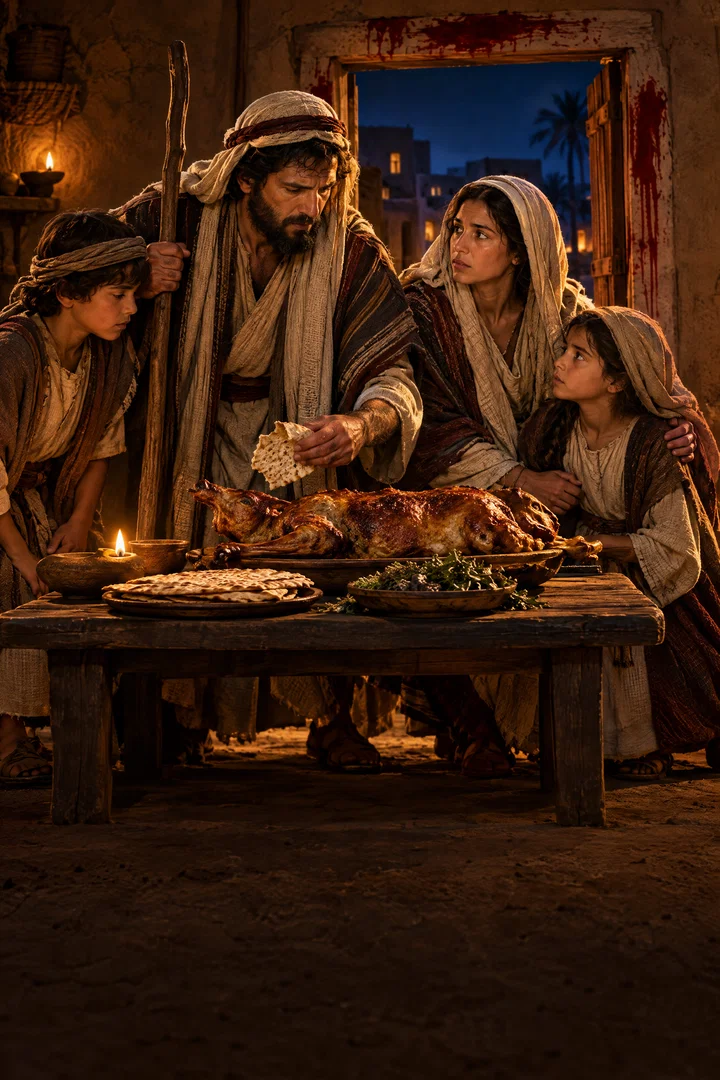
Cross-references 20 of 23
- Exodus 12:2-14
This month shall be unto you the beginning of months: it shall be the first month of the year to you.
Describes the Passover first instituted in Egypt.
- Leviticus 23:5
In the fourteenth day of the first month at even is the LORD’s passover.
Both set the Passover in the first month, marking Israel’s annual feast calendar.
- Joshua 5:10-11
And the children of Israel encamped in Gilgal, and kept the passover on the fourteenth day of the month at even in the plains of Jericho.
Israel kept Passover in Canaan on the fourteenth and ate unleavened cakes the next day.
- Numbers 28:16-25
And in the fourteenth day of the first month is the passover of the LORD.
Gives later instructions for Passover observance and offerings.
- Luke 22:17-20
And he took the cup, and gave thanks, and said, Take this, and divide it among yourselves:
Mentions wine used in a later Passover observance.
- Exodus 12:12-13
For I will pass through the land of Egypt this night, and will smite all the firstborn in the land of Egypt, both man and beast; and against all the gods of Egypt I will execute judgment: I am the LORD.
The Lord passes over and protects Israel during the Exodus.
- Exodus 12:42
It is a night to be much observed unto the LORD for bringing them out from the land of Egypt: this is that night of the LORD to be observed of all the children of Israel in their generations.
The Passover commemorates the night God brought Israel out of Egypt.
- Exodus 13:1-16
And the LORD spake unto Moses, saying,
Sets out further instructions connected with the original deliverance from Egypt.
- Exodus 23:15
Thou shalt keep the feast of unleavened bread: (thou shalt eat unleavened bread seven days, as I commanded thee, in the time appointed of the month Abib; for in it thou camest out from Egypt: and none shall appear before me empty:)
cited together as law for yearly feast
- Exodus 12:6
And ye shall keep it up until the fourteenth day of the same month: and the whole assembly of the congregation of Israel shall kill it in the evening.
Specifies when the Passover lamb was slain.
- Exodus 12:8-10
And they shall eat the flesh in that night, roast with fire, and unleavened bread; and with bitter herbs they shall eat it.
Gives the instructions for roasting the Passover lamb.
- 2 Chronicles 30:1-5
And Hezekiah sent to all Israel and Judah, and wrote letters also to Ephraim and Manasseh, that they should come to the house of the LORD at Jerusalem, to keep the passover unto the LORD God of Israel.
Describes efforts to observe the Passover after it had been neglected.
- Numbers 9:1-5
And the LORD spake unto Moses in the wilderness of Sinai, in the first month of the second year after they were come out of the land of Egypt, saying,
Records the Passover observed in the wilderness after the exodus.
- Numbers 33:3
And they departed from Rameses in the first month, on the fifteenth day of the first month; on the morrow after the passover the children of Israel went out with an high hand in the sight of all the Egyptians.
Israel departed from Egypt the day after Passover.
- 1 Corinthians 5:7
Purge out therefore the old leaven, that ye may be a new lump, as ye are unleavened. For even Christ our passover is sacrificed for us:
Christ is identified as the Passover sacrifice.
- Leviticus 23:6
And on the fifteenth day of the same month is the feast of unleavened bread unto the LORD: seven days ye must eat unleavened bread.
requires eating on fifteenth day
- Deuteronomy 16:6
But at the place which the LORD thy God shall choose to place his name in, there thou shalt sacrifice the passover at even, at the going down of the sun, at the season that thou camest forth out of Egypt.
Gives the Passover observance’s appointed time.
- Luke 2:41
Now his parents went to Jerusalem every year at the feast of the passover.
The yearly Passover custom follows the command to keep the feast.
- Exodus 12:25
And it shall come to pass, when ye be come to the land which the LORD will give you, according as he hath promised, that ye shall keep this service.
Says the Passover was to be observed after entering the land.
- 1 Corinthians 10:16
The cup of blessing which we bless, is it not the communion of the blood of Christ? The bread which we break, is it not the communion of the body of Christ?
Connects the cup used in Christian communion with the Passover cup.
Commentary
Each commentary is drawn from primary sources: the writings of Ellen G. White and Adventist pioneers and periodicals. Each commentary is separate. Its own words are not a quotation; follow the references to read the source passages.
Ellen G. White
1 source
The Passover commemorates the Lord bringing Israel out of slavery in Egypt by night, keeping the month of Abib as the memorial of that deliverance.RH Aug 2, 1870 It belongs among the yearly seasons of worship when the people gathered before God, set apart for assembling in His presence.RH Aug 2, 1870 It was to be remembered with gratitude, not as mere form but with thankful acknowledgment of redemption.RH Aug 2, 1870 God's people were to bring offerings in proportion to the blessings they had received, and their gifts showed whether they valued God's blessings and loved their Benefactor.RH Aug 2, 1870
Sources
Pioneers and periodicals
16 sources
Observe the month of Abib, later called Nisan, the first month of the Jewish religious year, and keep the Passover to the Lord because in that month He brought Israel out of Egypt by night and out of slavery when He passed over them and shielded them from the destroying angel.RH Aug 2, 1870RH Feb 3, 1916RH Mar 1, 1906ST May 12, 1898 It fixes the first of the three Mosaic feasts to a definite annual date, with preparations on the fourteenth and the feast beginning on the fifteenth when each family roasted the lamb on the evening after the fourteenth, coming only once a year when that calendar date arrives and not weekly, and since Hebrew months followed the moon it did not fall on a fixed weekday.RH Jan 7, 1862RH Mar 1, 1906ST Jul 3, 1879 The lamb was to be eaten with unleavened bread and the feast of unleavened bread kept seven days with no leaven seen in all the coast, which governed the Passover meal eaten by Jesus and His disciples so that His use of unleavened bread shows unleavened bread is right for communion. It was to be kept in the promised land in the place God chose and not offered elsewhere, though Israel sometimes neglected it for long periods and kept it only once in the wilderness in the year after leaving Egypt until entering Canaan, and its later form after the temple was built differed materially from the first Passover in Egypt, with some requirements impossible in the wilderness and wine used though the Pentateuch did not require it.ST Oct 7, 1930ST Feb 22, 1899RH Jan 7, 1862ST Feb 22, 1899 It belongs to the laws regulating Israel's assembling and worship as a separate nation and church, which expired as law with the rejection of the Jewish nation and is not legally binding today while its great underlying principle remains binding, to be remembered with gratitude with offerings brought in proportion to blessings received as the measure of valuing God's blessings and loving their Benefactor.RH Aug 2, 1870ST Jan 11, 1899RH Nov 12, 1908
Context and Calendar
Deuteronomy 16:1 stands in the fifth and last book of the Pentateuch, in the second of three addresses given by Moses just before his death.RH Feb 24, 1916 Chapters 1 to 4:40 rehearse God's goodness to Israel, chapters 5 to 26 review the law for the new generation, and chapters 27 to 30 renew the covenant.RH Feb 24, 1916 The book takes its name from that second section, since Deuteronomy means second law, or duplicate of the law.RH Feb 24, 1916 The verse falls among the laws Moses recalled to Israel before they crossed the Jordan, as a reminder of God's acts for His people and of their duty to keep His law, with Israel especially bound to obey because God had redeemed them from Egypt.ST Mar 1, 1910 It is part of the chapter's instructions about the yearly feasts, parallel in subject to Leviticus 23.ST Mar 1, 1910ST Mar 18, 1913
Abib, later called Nisan, was the first month of the Jewish religious year.RH Mar 1, 1906ST May 12, 1898 The verse fixes the first of the three feasts ordained in the law of Moses to a definite point in that first month.RH Mar 1, 1906ST Jul 3, 1879 Preparations were made on the fourteenth, the feast itself began on the fifteenth, and the Passover lamb was roasted by each family on the evening after the fourteenth day.RH Jan 7, 1862RH Mar 1, 1906ST May 12, 1898 By contrast, the feast of Pentecost was not fixed to a calendar date but was left to be determined by the ripening of the barley harvest.ST Jul 3, 1879
The command establishes an annual celebration that comes only once a year when that calendar date arrives, not a weekly celebration.ST Jul 17, 1879 Because Hebrew months followed the moon, its date did not fall on a fixed day of the week.ST May 12, 1898 That annual Passover on the fifteenth of Abib was used as a calendar marker by which the Sabbath was reckoned from the beginning of the year.RH Dec 22, 1859
Memorial, Observance and Obligation
The Passover commemorated the Lord bringing Israel out of Egypt by night and out of slavery, when He passed over Israel and protected them from the destroying angel.RH Feb 3, 1916 It marked the anniversary of Israel's departure from Egypt, with the feast beginning on the fifteenth day after preparations on the fourteenth.ST May 12, 1898 It belonged within the yearly seasons of worship when the people gathered before God.RH Aug 2, 1870
The Passover lamb was to be eaten with unleavened bread, and the feast of unleavened bread was to be kept seven days with no leavened bread seen in all the coast for seven days. This law governed the Passover meal eaten by Jesus and His disciples, so Jesus used unleavened bread as required by law. That proves that those who insist on unleavened bread for communion are right.
The Passover was to be observed in the promised land in the place God chose, and not to be offered elsewhere.ST Oct 7, 1930 Israel sometimes neglected the Passover and other festivals for long periods during times of apostasy.ST Oct 7, 1930 It was observed once in the wilderness in the year after Israel left Egypt, then was not observed again until the people entered Canaan.RH Jan 7, 1862
The instructions here give a later form of Passover observance that differed materially from the original instructions for the first Passover in Egypt.ST Feb 22, 1899ST Feb 22, 1899 After the temple was built the form of celebration changed, and some requirements added in the later instructions could not have been carried out during the wilderness journey.ST Feb 22, 1899ST Feb 22, 1899 Wine was used in later observances, though the Pentateuch did not require it.ST Feb 22, 1899
Since the lamb was roasted by each family on the evening after the fourteenth day of the first month, that date sometimes fell on the Sabbath.RH Jan 7, 1862 This conflict with the prohibition on kindling fires in the wilderness shows that the fire prohibition was a temporary rule for the wilderness rather than a rule for life in the promised land.RH Jan 7, 1862 The verse stands behind the yearly going up of Jesus' parents to Jerusalem for the feast of the Passover.ST Jan 11, 1899
It was to be remembered with gratitude, with offerings brought in proportion to blessings received.RH Aug 2, 1870 Those gifts showed whether the people valued God's blessings and loved their Benefactor.RH Aug 2, 1870 The verse belongs to the laws regulating Israel's assembling and worship, given to Israel as a separate nation and church and growing out of the moral law but limited to that nation as law.RH Nov 12, 1908 With the rejection of the Jewish nation it expired as law and is not legally binding today, while its great underlying principle remains binding.RH Nov 12, 1908
Sources