Luke 22:17
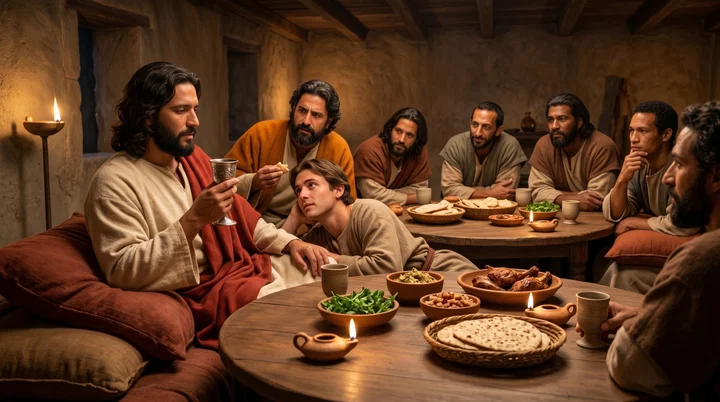
And he took the cup, and gave thanks, and said, Take this, and divide it among yourselves:
Translations
American King James Version, King James Version, KJV Cambridge Paragraph Bible
And he took the cup, and gave thanks, and said, Take this, and divide it among yourselves:
And he took the cup, and gave thanks, and said, Take this, and divide it among yourselves.
Revised Version, American Standard Version
And he received a cup, and when he had given thanks, he said, Take this, and divide it among yourselves:
And having taken a cup, having given thanks, he said, 'Take this and divide to yourselves,
And having received a cup, when he had given thanks he said, Take this and divide it among yourselves.
And, accepting a cup, giving thanks, he said—Take this, and divide among yourselves;
Berean Standard Bible, Majority Standard Bible
After taking the cup, He gave thanks and said, “ Take this and divide it among yourselves.
He received a cup, and when he had given thanks, he said, “ Take this and share it among yourselves,
And he took a cup and, having given praise, he said, Make division of this among yourselves;
And hee tooke the cup, and gaue thankes, and said, Take this, and deuide it among you,
Douay-Rheims (Challoner revision)
And having taken the chalice, he gave thanks, and said: Take, and divide it among you:
Pictures
Cross-references 20 of 23
- 1 Corinthians 11:23-26
For I have received of the Lord that which also I delivered unto you, That the Lord Jesus the same night in which he was betrayed took bread:
The cup is shared in remembrance of Christ’s death, proclaimed until he comes.
- Matthew 26:27-29
And he took the cup, and gave thanks, and gave it to them, saying, Drink ye all of it;
Jesus shares the cup and promises to drink the fruit of the vine anew in his Father’s kingdom.
- Mark 14:23-25
And he took the cup, and when he had given thanks, he gave it to them: and they all drank of it.
Jesus gives the cup to the disciples and connects future drinking with God’s kingdom.
- Exodus 12:1-14
And the LORD spake unto Moses and Aaron in the land of Egypt, saying,
The Lord’s Supper recalls Passover, when the lamb’s blood marked Israel’s deliverance from judgment.
- John 13:18
I speak not of you all: I know whom I have chosen: but that the scripture may be fulfilled, He that eateth bread with me hath lifted up his heel against me.
Judas’s presence at the supper connects the meal with the Scripture about betrayal.
- Matthew 26:27
And he took the cup, and gave thanks, and gave it to them, saying, Drink ye all of it;
Jesus gives the cup as an emblem of his blood.
- 1 Corinthians 11:25
After the same manner also he took the cup, when he had supped, saying, This cup is the new testament in my blood: this do ye, as oft as ye drink it, in remembrance of me.
The cup is identified with the new covenant in Christ’s blood.
- 1 Corinthians 10:16
The cup of blessing which we bless, is it not the communion of the blood of Christ? The bread which we break, is it not the communion of the body of Christ?
The cup shared at the meal is identified with communion in Christ’s blood.
- 1 Corinthians 11:27
Wherefore whosoever shall eat this bread, and drink this cup of the Lord, unworthily, shall be guilty of the body and blood of the Lord.
Both refer to the cup and distinguish it from its contents.
- Exodus 12:13-14
And the blood shall be to you for a token upon the houses where ye are: and when I see the blood, I will pass over you, and the plague shall not be upon you to destroy you, when I smite the land of Egypt.
The Passover meal foreshadowed the meal fulfilled in Christ.
- Deuteronomy 16:6
But at the place which the LORD thy God shall choose to place his name in, there thou shalt sacrifice the passover at even, at the going down of the sun, at the season that thou camest forth out of Egypt.
Both describe Passover observance at evening.
- 1 Corinthians 5:7
Purge out therefore the old leaven, that ye may be a new lump, as ye are unleavened. For even Christ our passover is sacrificed for us:
Christ is identified as the Passover sacrificed for believers.
- 1 Corinthians 11:23
For I have received of the Lord that which also I delivered unto you, That the Lord Jesus the same night in which he was betrayed took bread:
Places Jesus’ supper institution on the night he was betrayed.
- 1 Corinthians 11:28-29
But let a man examine himself, and so let him eat of that bread, and drink of that cup.
Worthy participation in the cup involves self-examination and discerning Christ’s body.
- Mark 14:12-17
And the first day of unleavened bread, when they killed the passover, his disciples said unto him, Where wilt thou that we go and prepare that thou mayest eat the passover?
Both recount the preparation for and beginning of the Passover meal.
- Exodus 12:14
And this day shall be unto you for a memorial; and ye shall keep it a feast to the LORD throughout your generations; ye shall keep it a feast by an ordinance for ever.
The Passover meal is the earlier festival the sacramental service replaces.
- Matthew 26:20
Now when the even was come, he sat down with the twelve.
Both describe Jesus eating the Passover with his disciples.
- Exodus 13:1-16
And the LORD spake unto Moses, saying,
Provides original Passover instructions contrasted with later practice.
- Exodus 12:15
Seven days shall ye eat unleavened bread; even the first day ye shall put away leaven out of your houses: for whosoever eateth leavened bread from the first day until the seventh day, that soul shall be cut off from Israel.
Passover requires unleavened bread throughout the feast.
- Numbers 28:16-25
And in the fourteenth day of the first month is the passover of the LORD.
Gives later Passover ordinances compared with the original instructions.
Commentary
Each commentary is drawn from primary sources: the writings of Ellen G. White and Adventist pioneers and periodicals. Each commentary is separate. Its own words are not a quotation; follow the references to read the source passages.
Ellen G. White
14 sources
At His last Passover supper with His disciples before His suffering, Jesus took the cup, gave thanks over it, and had them divide it among themselves.5RED 4.2–5.1Ms 54, 1897, par. 1–2Ms 19, 1897, par. 30–33Ms 35, 1897, par. 1–2ST May 23, 1878 He declared He would not drink of the fruit of the vine again until the kingdom of God should come.3SP 83.2–84.1Ms 54, 1897, par. 1–2Ms 19, 1897, par. 30–33 The cup held pure, unfermented juice of the grape, given as a symbol of His own blood shed for the forgiveness and life of those who receive Him.Ms 106, 1903, par. 8–11COS 106.1–5SG3 227.1 In that act He closed the Passover service, where type met antitype in His death as the spotless Lamb of God, and instituted in its place the Lord's Supper as a memorial of His sacrifice to be kept through all ages.5RED 4.2–5.13SP 83.2–84.1Ms 35, 1897, par. 1–2DA 652.1–2ST May 23, 1878
Setting and Shared Cup
The words were spoken in the upper chamber at the last Passover supper Jesus ate with His disciples before His suffering and crucifixion.5RED 4.2–5.13SP 83.2–84.1ST May 23, 1878DA 642.3–4SG3 225.1 It was the quiet hours between Him and Gethsemane and His baptism of suffering, spent for the benefit of His disciples.3SP 83.2–84.1ST May 23, 1878 He was troubled in spirit and weighed down by grief over what lay before Him, while the disciples shared the time with Him without knowing the cause.3SP 83.2–84.1ST May 23, 1878 At that Passover meal as they ate, He took the cup, gave thanks to God over it, and told the disciples to take it and divide it among themselves.5RED 4.2–5.1Ms 54, 1897, par. 1–2Ms 19, 1897, par. 30–33Ms 35, 1897, par. 1–2SG3 227.1
At this same meal He declared He would not drink of the fruit of the vine again until the kingdom of God should come.3SP 83.2–84.1Ms 54, 1897, par. 1–2Ms 19, 1897, par. 30–33DA 642.3–4 The cup held pure juice of the grape with no fermentation, sweet and pure, just as the Passover bread had no leaven, showing purity and completeness.Ms 106, 1903, par. 8–11COS 106.1–5SG3 227.1 It was given as a symbol of His own blood.Ms 106, 1903, par. 8–11SG3 227.1 That blood was shed for the forgiveness of those who come to Him and receive Him as Saviour.SG3 227.1
The cup belonged to a sacramental service designed to refresh the soul and give life.Ms 106, 1903, par. 8–11 There was nothing in it that ministers to evil, tempts to indulgence, beclouds reason, or benumbs spiritual perception.Ms 106, 1903, par. 8–11
Passover Ends, Supper Begins
This was virtually the last Passover ever to be celebrated, the final Passover before its type met its fulfillment.5RED 4.2–5.13SP 83.2–84.1ST May 23, 1878SG3 225.1 Type was to meet antitype in the slaying of the Lamb of God for the sins of the world, when Christ the spotless Lamb of God died for humanity's redemption.5RED 4.2–5.13SP 83.2–84.1ST May 23, 1878SG3 225.1 As He ate the Passover He stood at the point of transition between two economies and their two great festivals.DA 652.1–2 As the spotless Lamb of God He was about to present Himself as a sin-offering and thus bring to an end the system of types and ceremonies that for four thousand years had pointed to His death, so that the national festival of the Jews was to pass away forever.DA 652.1–2
In this act He closed the Passover service and instituted in its place the service of the cup and bread, the Lord's Supper.3SP 83.2–84.1DA 652.1–2ST May 23, 1878SG3 225.1 That sacramental service was established to take the place of Passover as a memorial of His great sacrifice, to keep His followers mindful of His betrayal and death.Ms 35, 1897, par. 1–2DA 652.1–2SG3 227.1SG3 225.1 The service Christ established was to be observed by His followers in all lands and through all ages, and to continue through all time.Ms 35, 1897, par. 1–2DA 652.1–2
By connecting the Lord's Supper with the Passover He obediently kept the Jewish law and observed all its divinely appointed ordinances.5RED 48.1ST Jul 4, 1878 By that act He identified Himself with the paschal lamb as its great antitype, declaring Himself the sinless Lamb of God whose merits alone avert the judgment and condemnation of fallen man.5RED 48.1ST Jul 4, 1878 The Passover commemorated the deliverance of the children of Israel from Egypt and typified the great salvation He brought.5RED 48.1ST Jul 4, 1878 The innocent lamb slain in Egypt, whose blood sprinkled on the doorposts caused the destroying angel to pass over the homes of Israel, prefigured Him.5RED 48.1ST Jul 4, 1878
Sources
Pioneers and periodicals
45 sources
The cup here is one of the Passover cups shared during the meal before the separate cup after supper that stands for the new covenant in blood, so it is not itself the Lord's Supper cup.ST Nov 22, 1883ST Jun 14, 1910ST Nov 22, 1883 It was divided among the disciples at his last Passover with them in the upper room on the night he was betrayed, the night before his crucifixion when the Passover lamb had been slain.ST Sep 27, 1910RH Feb 5, 1914ST Apr 2, 1912ST Nov 15, 1883ST May 11, 1915 At the close of that Passover, as type met antitype in the slaying of the Lamb of God, he instituted the Lord's Supper with the ordinance of humility to be celebrated in place of the Passover as a solemn memorial of his suffering and death till he comes.ST May 23, 1878ST Mar 3, 1909ST Mar 3, 1909RH May 27, 1873RH Dec 13, 1870 Its cup holds the pure unfermented fruit of the vine, whose red color represents his spilled blood, and it is to be shared worthily only by obedient followers who discern his body and trust him for pardon, justification, and strength to keep God's law.ST Oct 22, 1894ST Jul 13, 1915ST Oct 8, 1894ST Feb 23, 1915RH Apr 16, 1867 The sharing points forward to drinking it anew with him in God's kingdom at the marriage supper of the Lamb in the New Jerusalem after the saints are made immortal.RH Mar 1, 1870ST Sep 26, 1878ST Apr 5, 1883ST Mar 6, 1879ST Aug 22, 1878
Cup Language and Cups
The cup taken and shared is one of the Passover cups drunk during the meal, the first of the two cups Luke mentions at that supper, not the cup taken after supper that is identified with the new covenant in blood.ST Nov 22, 1883ST Jun 14, 1910ST Nov 22, 1883 It comes before the institution of the Lord's Supper in the following verses, and therefore is not itself the Lord's Supper cup.ST Nov 22, 1883ST Jun 14, 1910 The cup representing blood is the second cup, taken after supper.ST Nov 22, 1883
The cup is a serving vessel rather than a prescribed shape or size, with the emphasis on dividing and sharing what it contains among those present.ST Jun 14, 1910 In the phrase the cup, the vessel stands figuratively for what it contains, the fruit of the vine, without making the vessel identical with its contents.ST Jun 14, 1910ST Jul 13, 1882 Wine was used in this later observance of the Passover, although wine was not commanded in the Pentateuch.ST Feb 22, 1899
Passover Setting and Timing
The sharing of the cup belongs to Jesus' last Passover eaten with his disciples at the appointed day and at the appointed time, just before his apprehension in the garden.ST Sep 27, 1910ST Apr 2, 1912 It took place in the upper chamber in the few quiet hours between Christ and Gethsemane and his full baptism of suffering, hours spent for the benefit of his disciples.ST May 23, 1878 There he was troubled in spirit while the disciples sympathized without knowing the cause, and he took a cup, gave thanks, and had them share it among themselves.ST May 23, 1878 This was virtually the last Passover ever to be celebrated, because type was to meet antitype in the slaying of the Lamb of God for the sins of the world.ST May 23, 1878
It came after they had eaten the Passover on the night he was betrayed, the night following the day the Passover lamb was slain on the fourteenth day of the first month.RH Feb 5, 1914ST Apr 2, 1912 The lamb had been slain on that same day and month for fifteen centuries, and Jesus was taken that night to be crucified.ST Apr 2, 1912 After that meal he instituted a feast to commemorate his own death as the Lamb of God.ST Apr 2, 1912 The sharing therefore occurred on the night before the crucifixion, identified as Thursday night, in an event closely connected with his death on which Christian hope depends.ST Nov 15, 1883ST Jan 25, 1910ST May 11, 1915
The institution to which the cup belongs came as the next event of importance after the triumphal entry into Jerusalem.ST That entry is given most fully in Luke 19 and also in Matthew 21, Mark 11, and John 12, while the same institution of the supper is also recorded in Matthew 26, Mark 14, and John 13.ST It was the farewell meeting of Christ with his disciples out of which the Lord's Supper arose.STST Jul 21, 1898 In that setting the disciples gathered with Jesus and later joined together in a solemn hymn.ST
Supper Institution and Meaning
At the close of the Passover supper type met antitype in the slaying of the Lamb of God for the sins of the world, and at that last Passover ever to be celebrated Jesus instituted the Lord's Supper together with the ordinance of humility.ST May 23, 1878ST Mar 3, 1909ST Mar 3, 1909 It is the Christian ordinance to be celebrated in place of the Passover whose time had ended, and not Easter, which is a heathen institution.ST Mar 3, 1909ST Mar 3, 1909 This took place in the upper chamber in the few quiet hours between Christ and Gethsemane and his full baptism of suffering, spent for the benefit of his disciples.ST May 23, 1878
The Supper is an established ordinance explicitly defined and enforced by command to share the bread and cup in remembrance of him.ST May 27, 1880ST May 13, 1903ST Nov 3, 1909 It is an outward duty plainly enjoined, exemplified by Christ himself partaking at the first Supper to set the example, and it is not to be discarded for inward spirituality.ST May 27, 1880ST Nov 3, 1909 The word joined to the cup that he would drink it no more until he drank it anew in the kingdom was spoken because he was about to leave his disciples without his bodily presence, and it does not set the Supper aside but perpetuates it as a living religious duty to be kept in remembrance of him, showing his death till he comes again.ST Nov 3, 1909
It is a solemn memorial of his suffering and death, of his broken body and shed blood, to bring his death vividly before the mind and to show his death till he come.RH May 27, 1873RH Dec 13, 1870 Its emblems turn the mind to Gethsemane, Calvary, and Christ's suffering for sin, and the ordinances are to be carefully and regularly observed.RH Dec 13, 1870 Shared before his death it was an expression of faith in the Saviour yet to die, and after his death it is observed in memory of him who has already died.ST Mar 3, 1909ST Dec 11, 1879 It is also a memorial of both his crucifixion and his coming.ST Mar 3, 1909
The cup represented the new covenant in his blood, which he gives as the sacrifice for sin and the basis of the new covenant.ST Oct 22, 1894ST Apr 5, 1883ST Mar 6, 1879 Partaking of the cup commemorates the Saviour's death to lead to humble repentance for transgressions of the moral law and to faith for pardon and remission of sins, for justification, for strength to keep God's law, and for salvation.ST Aug 13, 1896 There is no merit in the work itself, and those who partake properly and share worthily discern Christ's body and receive him by faith, declaring themselves unworthy and in perishing need of pardon, justification, divine aid to do the will of God, and final salvation.ST Oct 22, 1894ST Aug 13, 1896
By connecting the Supper with the Passover Jesus identified himself with the paschal lamb as its great antitype and made the feast a sign of the salvation he brings.ST Jul 4, 1878ST Sep 30, 1886 The innocent lamb slain in Egypt whose blood sprinkled on the doorposts and marking homes caused the destroying angel to pass over and delivered from judgment pointed to him as the sinless Lamb of God whose merits alone avert the judgment and condemnation of fallen humanity.ST Jul 4, 1878ST Sep 30, 1886 In observing the Passover he obeyed the Jewish law and all its divinely appointed ordinances, and the Passover commemorated the deliverance of the children of Israel from Egypt while typifying the great salvation he brought.ST Jul 4, 1878
Future Kingdom Promise
The cup given with thanks to be divided among the disciples represented the new covenant in his blood, and it looks forward to his drinking the fruit of the vine anew with his people in the kingdom of God.ST Apr 5, 1883ST Mar 6, 1879ST Aug 22, 1878 He will not drink it again until then, after he has brought the saints to himself and made them immortal.ST Apr 5, 1883ST Mar 6, 1879 That future drinking will be with his immortal saints after they are brought into his Father's presence, at the marriage supper and marriage feast where the gathered family of heaven and earth are guests.ST Mar 6, 1879ST Aug 22, 1878
This eating and drinking again with his people in the kingdom of God is the marriage supper of the Lamb, eaten in the Father's presence near the throne of God in the holy city, the New Jerusalem.RH Mar 1, 1870ST Sep 26, 1878 It takes place immediately after he has made his people immortal and received them into his presence, when he takes them to the Father's house and introduces them to the holy city and to the Father to share Paradise with him as invited guests where the bride is.RH Mar 1, 1870ST Sep 26, 1878 That supper is the grand celebration of his assumption of his own throne and of his royal city as the metropolis of his everlasting kingdom.RH Mar 1, 1870ST Sep 26, 1878 It comes before he and his saints enter upon the judgment of the wicked.RH Mar 1, 1870ST Sep 26, 1878
The cup and his words over it at the last Passover belong to a time when the kingdom was still future and had not yet been set up.RH Sep 22, 1863
Sabbath Day and Testimony
The breaking of bread was kept on Thursday evening, not on the first day of the week, since the Supper was instituted on a week-day night.ST Jan 13, 1881ST May 27, 1875 The disciples at times broke bread every day, so there is no requirement to break bread on Sunday and breaking bread does not make Sunday sacred.ST Jan 13, 1881 There is therefore no commandment and no established precedent fixing communion to Sunday, and to require Sunday communion as a church duty on a scriptural basis is wrong.ST May 27, 1875 It may rightly be celebrated on Saturday or on Sunday or on any day, as soon on one day as on another.ST May 27, 1875
The cup was shared among the disciples as part of the meal on the night of betrayal, identified as Thursday night, and its use does not make the day a Sabbath.ST Jan 25, 1910ST May 11, 1915 The events of that night and the following day, including death for the plan of salvation, did not make Thursday or the sixth day sacred.ST May 11, 1915 Its emblems commemorate death, not resurrection. The New Testament does not restrict communion to a particular weekday and regards the evening after the Sabbath as especially fitting.
The new ordinance came at the close of the Passover supper as the Passover ordinance ended when type met antitype, as a memorial of both crucifixion and coming.ST Mar 3, 1909 It has no stated fixed time for celebration.ST Mar 3, 1909 Its emblems are unleavened bread and unfermented wine representing body and blood.ST Mar 3, 1909 It is a precise factual record of the last supper eaten with the disciples the same night of betrayal, recording the partaking of the cup and the words spoken about it, together with the bread, as part of an ordinance to be kept in remembrance showing forth death till he come.RH Jan 28, 1862 Its testimony agrees precisely with the accounts of Matthew and Mark and with Paul's independent account received directly from the Lord and not copied from the evangelists, proving competent eyewitness knowledge that cannot be explained by coincidence or fabrication.RH Jan 28, 1862
Sharing the Cup Worthily
The contents of the cup, called the fruit of the vine, are unfermented wine, the freshly pressed juice of the cultivated grape, not fermented intoxicating liquor that makes men drunken, and only that pure juice fitly represents the blood of Christ shed for mankind.ST Jul 13, 1915ST Oct 8, 1894ST Feb 23, 1915RH Apr 16, 1867 The word wine is never used, only the cup and the fruit of the vine, and the verse gives no foundation for using fermented wine in the sacrament but authorizes only unfermented wine.ST Jul 13, 1915ST Feb 23, 1915 The Passover rules required this because the Supper was kept at the Passover when all ferment and leaven were removed from the houses and only unleavened bread was used.ST Jul 13, 1915ST Oct 8, 1894 Churches should therefore use only unfermented wine and lead the way in practical temperance, needing no exception for sacramental liquor in laws prohibiting intoxicating drink.ST Feb 23, 1915
Fermentation is always a symbol of corruption, decay and rottenness, and no kind of fermented drink is ever used for sacred purposes, including the marriage feast and private and public oblations and libations.ST Feb 7, 1878 The Supper was a substitute for and immediately followed the Jewish feast of the Passover, from which all fermented things are carefully excluded.ST Feb 7, 1878 Christ did not in any form provide or encourage the drunkard's drink, and drunkenness must be banished from pulpit, pew and communion table.ST Feb 7, 1878 Its red color represents his spilled blood and his death, like garments made red as by treading the winepress.RH Apr 16, 1867
It is to be pure grape juice, obtained and made under the care of the church and secured from the air to keep it from fermenting as much as possible, not wine bought from liquor-sellers that may be diluted, liquored and poisoned, and not water sweetened with molasses.RH Apr 16, 1867 Those conscientious against wetting the lips with a few drops of domestic wine may use pure cold water.RH Apr 16, 1867 The Supper was given alone to his own chosen disciples on a special occasion in a private room apart from the crowd, not as a promiscuous meal for multitudes like the feeding of the five thousand with five loaves and two fishes.RH May 27, 1873 It is therefore designed for true followers and true children of God, for true Christians, and not for worldlings nor for those who have abused their profession and are living in sin and disgracing his name.RH May 27, 1873
The Passover meal to which the cup belongs was shared with Judas even though Jesus knew of his deceit and unfaithfulness, showing that he did not exclude him from the table, while others held that Judas was not present when Christ took the cup and instituted the supper, a question bearing on close communion.RH Jan 8, 1914RH Jul 29, 1873 Luke's account is to be read together with Matthew and Mark to decide whether Judas was present and partook of the memorial of the Lord's death.RH Jul 29, 1873 The decisive question is the relative time when the Passover was eaten and the memorial was instituted in relation to Judas receiving the portion from Christ's hand and going out immediately.RH Jul 29, 1873 The Supper is to be celebrated acceptably only by those living in obedience to God and at peace with the brethren, sharing it worthily by discerning Christ's body and receiving him by faith.ST Oct 22, 1894ST Mar 3, 1909
Partaking of the cup commemorates the Saviour's death, to help partakers humbly repent of their transgressions of the moral law and to help them exercise faith in the Saviour for remission of sins, for justification, for strength to keep God's law, and for salvation.ST Aug 13, 1896 There is no merit in this work itself, and those who partake properly declare themselves unworthy and in perishing need of pardon, justification, divine aid to do the will of God, and final salvation.ST Aug 13, 1896 The cup is part of the Lord's Supper as the sacrifice for sin and the basis of the new covenant, an ordinance to be observed in remembrance of Christ.ST Oct 22, 1894ST Dec 30, 1889 Christ himself partook of the cup at the first Supper and thereby set an example for his followers to observe the ordinance, and the word joined to the cup that he would drink it no more until he drank it anew in the kingdom was spoken because he was about to leave his disciples without his bodily presence and does not set the Supper aside.ST Nov 3, 1909 The command joined to it perpetuates the Supper as a living religious duty to be kept in remembrance of him, showing his death till he comes again, which those who truly love him will obey.ST Nov 3, 1909
Sources