1 Corinthians 5:7
Purge out therefore the old leaven, that ye may be a new lump, as ye are unleavened. For even Christ our passover is sacrificed for us:
Translations
Purge out therefore the old leaven, that you may be a new lump, as you are unleavened. For even Christ our passover is sacrificed for us:
King James Version, KJV Cambridge Paragraph Bible
Purge out therefore the old leaven, that ye may be a new lump, as ye are unleavened. For even Christ our passover is sacrificed for us:
Cleanse out therefore the old leaven, that ye may be a new lump, as ye are unleavened. For even Christ our passover is sacrificed for us:
Revised Version, American Standard Version
Purge out the old leaven, that ye may be a new lump, even as ye are unleavened. For our passover also hath been sacrificed, even Christ:
cleanse out, therefore, the old leaven, that ye may be a new lump, according as ye are unleavened, for also our passover for us was sacrificed — Christ,
Purge out the old leaven, that ye may be a new lump, according as ye are unleavened. For also our passover, Christ, has been sacrificed;
Purge ye out the old leaven, that ye may be a new lump,—even as ye are unleavened; for, our passover, hath even been sacrificed—Christ:
Get rid of the old leaven, that you may be a new unleavened batch, as you really are. For Christ, our Passover lamb, has been sacrificed.
Get rid of the old leaven, that you may be a new unleavened batch, as you really are. For Christ, our Passover lamb, has been sacrificed for us.
Purge out the old yeast, that you may be a new lump, even as you are unleavened. For indeed Christ, our Passover, has been sacrificed in our place.
Take away, then, the old leaven, so that you may be a new mass, even as you are without leaven. For Christ has been put to death as our Passover.
Purge out therefore the olde leauen, that ye may be a newe lumpe, as ye are vnleauened: for Christ our Passeouer is sacrificed for vs.
Douay-Rheims (Challoner revision)
Purge out the old leaven, that you may be a new paste, as you are unleavened. For Christ our pasch is sacrificed.
Pictures
Cross-references 20 of 114
- Exodus 12:5-13
Your lamb shall be without blemish, a male of the first year: ye shall take it out from the sheep, or from the goats:
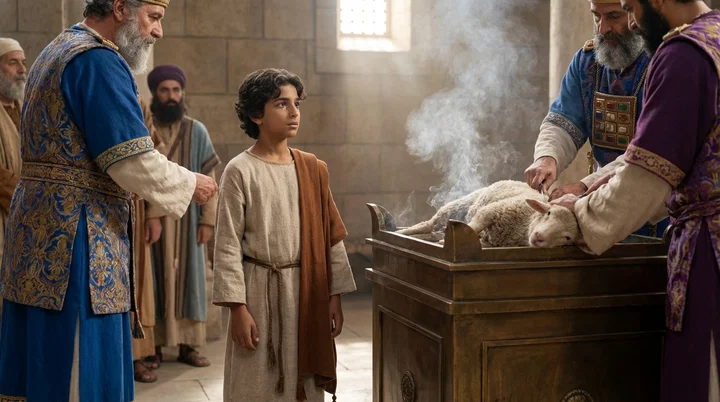
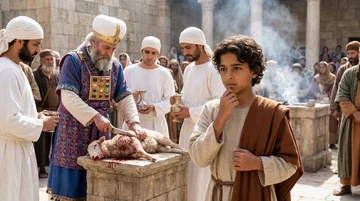
The Passover lamb’s death and blood prefigure Christ’s sacrifice and sheltering blood.
- John 1:29
The next day John seeth Jesus coming unto him, and saith, Behold the Lamb of God, which taketh away the sin of the world.
Jesus is the Lamb of God whose sacrifice takes away sin, fulfilling the Passover image.
- Exodus 12:6
And ye shall keep it up until the fourteenth day of the same month: and the whole assembly of the congregation of Israel shall kill it in the evening.
The lamb’s appointed slaughter is the type fulfilled by Christ’s death.
- Leviticus 23:5
In the fourteenth day of the first month at even is the LORD’s passover.
Passover points to Christ’s sacrifice.
- Luke 22:15-20
And he said unto them, With desire I have desired to eat this passover with you before I suffer:
Jesus connects the Passover meal with the memorial of his coming sacrifice.
- John 18:28
Then led they Jesus from Caiaphas unto the hall of judgment: and it was early; and they themselves went not into the judgment hall, lest they should be defiled; but that they might eat the passover.
Places Christ’s death in the Passover setting.
- 1 Peter 1:19
But with the precious blood of Christ, as of a lamb without blemish and without spot:
Both describe Christ as the spotless sacrificial lamb whose blood redeems.
- Matthew 26:26-28
And as they were eating, Jesus took bread, and blessed it, and brake it, and gave it to the disciples, and said, Take, eat; this is my body.
Jesus connects the Passover meal with the bread and cup commemorating his sacrificial death.
- Colossians 2:16-17
Let no man therefore judge you in meat, or in drink, or in respect of an holyday, or of the new moon, or of the sabbath days:
Passover and other feast observances were shadows fulfilled in Christ.
- 1 Corinthians 11:26
For as often as ye eat this bread, and drink this cup, ye do shew the Lord’s death till he come.
The bread and cup proclaim Christ’s death until he comes.
- Exodus 12:15
Seven days shall ye eat unleavened bread; even the first day ye shall put away leaven out of your houses: for whosoever eateth leavened bread from the first day until the seventh day, that soul shall be cut off from Israel.
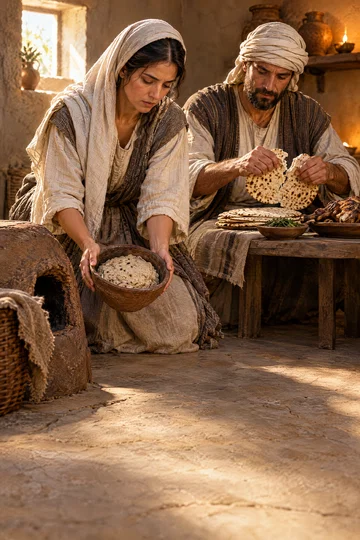
Israel was commanded to remove leaven for Passover, prefiguring Christ our Passover.
- John 19:36
For these things were done, that the scripture should be fulfilled, A bone of him shall not be broken.
Jesus’ unbroken bones fulfill the Passover-lamb pattern.
- John 6:51
I am the living bread which came down from heaven: if any man eat of this bread, he shall live for ever: and the bread that I will give is my flesh, which I will give for the life of the world.
Christ gives his flesh for the life of the world as the living bread believers partake of.
- Galatians 5:9
A little leaven leaveneth the whole lump.
A little leaven spreads through the whole lump, picturing harmful influence.
- Isaiah 53:6
All we like sheep have gone astray; we have turned every one to his own way; and the LORD hath laid on him the iniquity of us all.
The Lord lays human iniquity on Christ, who bears the guilt of others.
- Exodus 12:7
And they shall take of the blood, and strike it on the two side posts and on the upper door post of the houses, wherein they shall eat it.
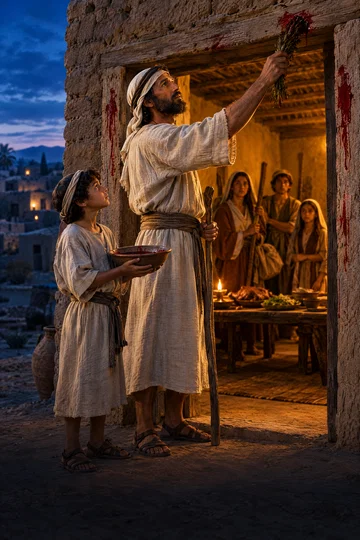
Passover blood on the doorposts marked the houses to be spared, foreshadowing Christ’s sacrifice.
- Exodus 12:46
In one house shall it be eaten; thou shalt not carry forth ought of the flesh abroad out of the house; neither shall ye break a bone thereof.
The Passover lamb’s unbroken bones prefigure Christ’s death.
- 1 Corinthians 5:13
But them that are without God judgeth. Therefore put away from among yourselves that wicked person.
The church is commanded to put the wicked person away.
- Leviticus 23:10-11
Speak unto the children of Israel, and say unto them, When ye be come into the land which I give unto you, and shall reap the harvest thereof, then ye shall bring a sheaf of the firstfruits of your harvest unto the priest:
The waved firstfruits sheaf prefigures Christ’s resurrection.
- Exodus 12:23
For the LORD will pass through to smite the Egyptians; and when he seeth the blood upon the lintel, and on the two side posts, the LORD will pass over the door, and will not suffer the destroyer to come in unto your houses to smite you.
The lamb’s blood spared Israel from judgment, prefiguring Christ our sacrificed Passover.
Commentary part 1 of 2
Each commentary is drawn from primary sources: the writings of Ellen G. White and Adventist pioneers and periodicals. Each commentary is separate. Its own words are not a quotation; follow the references to read the source passages.
Ellen G. White
95 sources
Leaven is corrupting sin that spreads secretly through the whole person until all is defiled, so the old leaven of malice and wickedness must be purged out to become a new pure lump living in sincerity and truth through the new birth.Lt 301, 1905, par. 2–5PP 278.1Lt 182, 1903, par. 5–75MR 419.1–3AA 303.2 The Passover looked back to deliverance from Egypt and forward to the greater deliverance from sin, fulfilled when Christ the sinless Lamb of God was sacrificed and His atoning blood was shed as the only safety from judgment and Satan's power.PP 277.1GC 399.1–41SP 201.1SG3 225.15RED 48.1 He gave His innocent life as substitute and surety for guilty humanity, and His blood cleanses, redeems and preserves all who repent, believe and receive Him, enabling them to stand guiltless and form a righteous character.Ms 29, 1899, par. 16COS 16.2–17.34RED 94.2Ms 72, 1897, par. 8Ms 69a, 1896, par. 33–34 The church must therefore remove even a little corrupting evil — immorality, strife, evil-speaking, selfishness, unbelief and worldliness — before it leavens the whole community.5MR 419.1–3AA 303.2SLP 179.3–180.19T 194.4 Each believer must put impurity and self out of heart, home and church, be cleansed by Christ's blood, and then leaven the world with sanctifying truth and witness rather than being leavened by it.Lt 182, 1903, par. 5–7YGBCOEP 36.37T 168.4Ms 47, 1898, par. 20Ms 105, 1902, par. 1–4
Leaven and Unleavened Meaning
Leaven is sin and corrupting evil that works like leaven in dough until the whole lump is leavened, and even a little of it spreads decay through the entire mass.5MR 419.1–3AA 303.2GC 42.2–43.1SSP 10.1 It often works secretly without being recognized, even among those who know the truth but do not cherish its principles.RH Nov 5, 1903 Glorying is not good for this reason, and in a dispute between brethren the very first duty is to end glorying and worldly methods, remove wrongdoing that dishonors God, and refuse to go to law before unbelievers.5MR 419.1–3 Applied to the church, this requires putting away corrupting wrongdoing such as immoral conduct that violated even the low standards of the surrounding Gentile world, so that it may be a new, pure community.AA 303.2 The same spreading corruption appears as self-seeking that defiles and ruins the soul and must be banished with its self-exaltation and pretense, as idolatry and pagan practices bringing unsound doctrines and idolatrous ceremonies that cause loss of purity and power, as evil principles especially covetousness weakening spirituality and leading to withholding tithes and offerings, and as worldly practices corrupting faith that must be refused by a clear stand for truth and righteousness.GC 42.2–43.1SSP 10.1RH Nov 5, 1903
The old leaven to be purged out is malice and wickedness, and keeping the feast means living not with those but with the unleavened bread of sincerity and truth.Lt 301, 1905, par. 2–5PP 278.1Lt 182, 1903, par. 5–75MR 419.1–3 It includes self interwoven with the work, which is purged when self is hidden with Christ in God through repentance and conversion of heart and mind.Lt 182, 1903, par. 5–7 Unwillingness to make restitution for the robbery of past years, to redeem the time, and to reveal the evidences of a new heart leaves the old leaven in place, keeps God's perfect will from being met, and places work where it is not acceptable to God, while those true to God and free from self would do much good.Lt 182, 1903, par. 5–7 The call is personal, as to Frank, to leave behind malice and wickedness and live with sincerity and truth as a new, unleavened people.Lt 301, 1905, par. 2–5
To become a new lump, as unleavened, is to become a new, pure people through Christ sacrificed as the Passover, whose death makes this cleansing and new life possible.Lt 301, 1905, par. 2–55MR 419.1–3AA 303.2FE 541.4–542.1 The old life is put away and replaced by a new life of righteousness and true holiness.STB 66.3–67.1 This renewal is the new birth and the creation of a new heart, the putting on of the new person created by God in righteousness and true holiness, as people are purified while reaching for a higher standard.STB 66.3–67.1Lt 165, 1904, par. 16
The unleavened bread teaches that those who receive life and nourishment from Christ must put away sin.PP 278.1 The lamb eaten with bitter herbs points to feeding on Christ with contrition for sin.PP 278.1 The lamb, the unleavened bread, and the sheaf of first fruits represented the Saviour, and the deliverance of Israel from Egypt served as an object lesson of redemption that the Passover kept in memory.PP 278.1DA 77.1
Passover Type and Fulfillment
The Passover was both commemorative and typical, looking back to the deliverance of Israel from bondage in Egypt and pointing forward to the greater deliverance Christ accomplishes in freeing His people from the bondage of sin.PP 277.11SP 201.15RED 48.13SP 128.1DA 77.1 The lamb, the unleavened bread, and the sheaf of first fruits represented the Saviour, and the deliverance from Egypt was kept in memory as an object lesson of redemption.1SP 201.1DA 77.1 For fifteen centuries the lamb had been slain, and Israel's deliverance at the Passover pointed to the great salvation Christ brings.GC88 398.4–400.15RED 48.13SP 128.1
The paschal lamb slain without blemish represented Christ as the Lamb of God, the sinless true Passover in whom alone is hope of salvation.PP 277.11SP 201.1SG3 225.15RED 48.13SP 128.1 He is the sinless Passover Lamb slain for the redemption of fallen man, whose death the feast commemorated and in whom Israel's sacrifices found their fulfillment.GC 399.1–4COS 16.2–17.31SP 201.1SG3 225.1 The slain lamb was a symbol of His own death, which gave its observance a mournful interest to Him.1RED 30.1ST Oct 4, 1877
The blood sprinkled on the doorposts prefigured the atoning blood of Christ, on which sinful people continually depend for safety from the power of Satan and for final redemption.PP 277.11SP 201.1SG3 225.1 As the blood caused the destroying angel to pass over the homes of Israel, His merits alone avert judgment and condemnation for fallen humanity.5RED 48.13SP 128.1ST Jul 4, 1878 That blood cleanses the believing sinner from sin and shelters from God's coming wrath upon the impenitent and unbelieving, as God's wrath fell upon the Egyptians, preserving from wrath by action showing faith in God's provision.4RED 94.21RED 30.1ST Oct 4, 1877
Type met antitype when Christ died on the cross.GC88 398.4–400.11SP 201.1SG3 225.1 The supper He ate with His disciples just before His crucifixion was virtually the last Passover, and that same night He instituted the Lord's Supper to commemorate His death and crucifixion.1SP 201.1SG3 225.1DA 642.1 He kept the Jewish law and observed all its divinely appointed ordinances, then identified Himself as the great antitype of the paschal lamb by connecting the Lord's Supper with the Passover, with bread for His body given and the cup for the new covenant in His blood.5RED 48.13SP 128.1ST Jul 4, 1878
The type was fulfilled not only in event but in time.GC88 398.4–400.1LS 110.2 On the fourteenth day of the first Jewish month, the very day and month on which for fifteen long centuries the Passover lamb had been slain, Christ ate the Passover with His disciples, instituted the feast to commemorate His own death as the Lamb of God, and that same night was taken to be crucified and slain, sacrificed on the very day the Passover was eaten.GC88 398.4–400.1DA 642.1Ms 54, 1897, par. 3 The springtime Passover, wave sheaf, and meat offering were thus fulfilled in their appointed order and time through crucifixion, resurrection, and the descent of the Holy Spirit at Pentecost.GC88 398.4–400.1LS 110.2 Because the first-advent types were so fulfilled on time, the types relating to the second advent, the cleansing of the sanctuary on the tenth day of the seventh month, must likewise be fulfilled at the time pointed out in the symbolic service, in the autumn.GC88 398.4–400.1
Christ voluntarily set Himself apart as an offering and gave His life for the sins of the world.ST Jun 8, 1882ST Apr 1, 18894RED 118.1–32SP 385.2–386.2DA 571.2–4 His approaching death was the crowning sacrifice of His mission as the world's Redeemer, and His entry into Jerusalem directed public attention to that sacrifice.ST Jun 8, 1882ST Apr 1, 18894RED 118.1–32SP 385.2–386.2ST Jul 22, 1886 It is to remain a subject of deep thought and careful study in the church through all ages.4RED 118.1–32SP 385.2–386.2DA 571.2–4
The Passover and all Israel's religious services cannot be explained apart from Christ, whom they represented as the key unlocking the Old Testament.COS 106.6–74RED 94.2DA 388.2–389.2 The Passover lamb was slain to teach about Christ's death for the sins of the world, symbolizing His body as the only true propitiation, and once Christ the Lamb of God was slain there was no need to sacrifice lambs to represent His death.COS 106.6–74RED 94.2DA 388.2–389.2 Rejecting the Saviour they foreshadowed left them valueless, so continued observance after He was slain and rejected became a worthless form, hollow ceremony and bitter mockery, with observing the symbol while missing its meaning leaving the truth of His sacrifice unseen.COS 106.6–73SP 128.1COS 136.1–3ST Jul 4, 1878DA 388.2–389.2 The priests and rulers who rejected Him defiled their souls and made their keeping of no value, condemning the spotless Son of God through a Gentile ruler whose threshold they would not cross for fear of ceremonial defilement that would disqualify them from the feast.3SP 128.1
Christ's Sacrifice and Salvation
Christ our Passover gave His precious innocent life as humanity's substitute and surety to save guilty people from eternal ruin, being treated as guilty when the Father's wrath fell upon Him.Ms 29, 1899, par. 16Ms 72, 1897, par. 8 His death opened the way for transgressors of the law to return to loyalty and allegiance to God.Ms 69a, 1896, par. 33–34Ms 105, 1894, par. 22–23 His complete offering is sufficient for all who believe, and through faith He bears away the sins of those who receive Him.Lt 20, 1899, par. 11–13 His sacrifice is the saving power of the atonement, whose meaning must be understood and appreciated as it should be.Lt 377, 1904, par. 9Lt 175, 1904, par. 6–812MR 61.3
Ministers are to bear it as their given message by magnifying and holding up the truth and saying It is written, instead of entering into controversy to unravel Satan's theories.12MR 61.3 Through His righteousness and merits and perfection of character, those who repent, return to allegiance, have faith and receive Him fully can stand guiltless before God's throne.Ms 29, 1899, par. 16 They become obedient children counted righteous through His perfection, consecrate themselves to His service, and form characters like His.Ms 69a, 1896, par. 33–34Ms 105, 1894, par. 22–23
God passes over the repentant sinner because Christ's life was given for the life of the world.Ms 72, 1897, par. 8 As substitute and surety He paid the ransom for redemption by which sin can be put away.Ms 147, 1897, par. 34–35 Those bought by Him are called to give Him their sins and receive His righteousness.Ms 147, 1897, par. 34–35 By His own choice He left the heavenly courts and gave His body to be rent, bruised and wounded for the transgression of the world, dying in the presence of an assembled nation of worshipers.12MR 397.2–398.1Ms 101, 1897, par. 35–36
In that death He combined priest and victim and entered the temple as a place of sacrifice, fulfilling the temple type.12MR 397.2–398.1Ms 101, 1897, par. 35–36 As the Lamb slain from the foundation of the world He was raised from the grave triumphing over death and continues forever as true High Priest after the order of Melchizedek.12MR 397.2–398.1Ms 101, 1897, par. 35–36 As it was not enough for the paschal lamb to be slain but its blood had to be sprinkled on the doorposts, so the merits of Christ's blood must be applied to the soul.PP 277.1 This is done by believing He died not only for the world but individually for each person and by appropriating the virtue of His atoning sacrifice, with acts manifesting faith in God's provision and doing the work left to do; otherwise the saving provision benefits no one.PP 277.11RED 30.1ST Oct 4, 1877LC1 29.2–30.1ST Dec 9, 1880
The slain lamb symbolized His death and His body, and the blood on the doorposts symbolized His blood.4RED 94.21RED 30.1ST Oct 4, 1877 His approaching death was the only true propitiation for humanity's sins, yet the mercy offered by the one the lamb represented was rejected.4RED 94.2 His blood cleanses the believing sinner from sin, redeems those who trust in Him from sin and eternal death, and shelters them from God's coming wrath upon the impenitent and unbelieving world as wrath fell upon the Egyptians.COS 16.2–17.31RED 30.1ST Oct 4, 1877LC1 29.2–30.1ST Dec 9, 1880 It atones for those who repent and recognize their need of pardon, and those who by faith receive Him have hope of resurrection to immortal life.COS 16.2–17.32SP 36.1
Cleansing the Church Community
The church must purge out the old leaven to become a new and pure lump, for even a little corrupting wrongdoing spreads through the whole body until all is leavened.5MR 419.1–3AA 303.2SLP 179.3–180.1 That purging included putting away immoral and lascivious conduct that disgraced the church at Corinth and fell below even Gentile standards, to be dealt with before apostolic visitation.AA 303.2SLP 179.3–180.1 In disputes between brethren this cleansing is the very first duty, for glorying is not good and keeping the feast means living not in malice and wickedness but in sincerity and truth.5MR 419.1–3 It therefore requires an end to boasting and worldly methods, removal of wrongdoing that dishonors God, and refusal to go to law before unbelievers.5MR 419.1–3
The old leaven to be removed includes evil-speaking, hypocrisy, jealousy and malice in the churches, at Oakland and Berkeley and elsewhere, to be replaced by truth in word, spirit and act and by true Christian refinement.RH Feb 14, 1907Lt 386, 1906, par. 10Ms 105, 1906, par. 21–22 It includes suspicion and distrust as evil influences whose removal allows unity to bear witness to the power of truth.9T 194.4Lt 60, 1898, par. 20–22 It includes dissension, alienation and strife, and strife and dissension as evil leaven in those joined to Christ as members of His body who must show His tender love by being helpful and not criticizing or hindering others.Lt 60, 1898, par. 20–22Ms 107, 1903, par. 22–24 Those who create such disputes and introduce that leaven must answer to Christ for the evil results of their course.Ms 107, 1903, par. 22–24
Faultfinding and criticism are evil leaven that spreads to and affects everyone contacted, and division, evil thinking, confusion, jealousy and criticism must be purged from the midst so that abiding love for God can unite hearts in love.Lt 121, 1898, par. 4–6Lt 159, 1895, par. 1–2 Criticism, suspicion and false charging of others with deception and dishonesty are brought in to shake confidence in those entrusted with important parts of the Lord's work, resting on perversion of facts and cruel false representations which the Lord does not endorse, and spreading as evil leaven from place to place.Lt 212, 1902, par. 4 The leaven also includes dissatisfaction, suspicion, jealousy, doubt, suggestions and opposition to God's work, providence and plain testimony and reproof.LJAHS 10.1Lt 7, 1860, par. 13–15 Left uncorrected it works secretly, spreads from place to place, revives past rebellion and gives opportunity for doubters to be united with evil angels and for the field to be possessed, and purging it requires thorough work in the past, frank acknowledgment of God's hand and special providence in moving His people right or left, and firm stand for it even at the tearing of self and self-dignity.LJAHS 10.1
Doubt and disbelief of the testimonies of the Spirit are leavening the churches, and neglect of God's word and the testimonies leaves want of purity, devotion and earnest faith.AAP 1.4 The old leaven is self-seeking that defiles and ruins the soul and must be banished so life is no longer marked by self-exaltation and pretense. Selfish indulgence brought by individual members into the church corrupts it like evil leaven and makes it weak and diseased, mischievous gossip sows seeds of evil and corrupts family influence, and the leaven of envy works within a community spreading its harmful influence.Ms 57, 1898, par. 9Ms 29, 1897, par. 25ST Sep 19, 1878
Evil principles, especially covetousness, leavened believers, weakened spirituality and led many to withhold tithes and offerings.SSP 10.1 Perversion of the canvassing work and raising wages are evil leaven that leavens the whole lump and spreads through workers and leaders when truth is not stiffly stood for and the leaven refused, while being puffed up and leavened with malice destroys spirituality.Lt 182, 1903, par. 11–13 Selfishness and covetousness as evil leaven must be purged from the church and its institutions by separating without delay those who compare themselves with others and seek more money for themselves lest they corrupt the work.Ms 97, 1899, par. 21–23 Workers who demand favor, high wages and their own terms, measuring themselves by themselves, becoming dissatisfied, selling to the highest bidder, practicing double-dealing, becoming wise above what is written, appropriating means and robbing the treasury for needy fields and brethren rob God as the sin of Achan; an atmosphere of unbelief surrounds such a man, God is not with him, his harsh, discourteous, loveless and oppressive spirit spreads, and unless he repents God will remove him and give his place to humble, true and loyal men once thought unqualified through whom He will work remarkably.Ms 142, 1903, par. 109–110
The old leaven of Pharisaism leavening the camp at Battle Creek and affecting the churches is pride and prejudice, bigotry, self-sufficient human judgment, cruelty to the Spirit of God and legal religion of salvation by human merit, bringing spiritual weakness and blindness upon those blessed with great light.11MR 228.3–229.316MR 215.2–216.3Ms 30, 1889, par. 10–14 It must be expelled and replaced by a new leaven which is the grace of Christ, through reformation pressed through the churches with pen and voice and plain testimony and protest against bigotry while keeping unity, by persistent labor and a message from the Lord until the old leaven is gone.11MR 228.3–229.316MR 215.2–216.3Ms 30, 1889, par. 10–14 Idolatry and pagan practices brought into the church are foul leaven spreading corruption through faith and worship by unsound doctrines, superstitious rites and idolatrous ceremonies, causing loss of purity and power.GC 42.2–43.1GC88 43.14SP 42.3–43.2 When professed converts cling to idolatry and Christians lower the standard to unite on partial belief, the baleful work continues and corrupts the religion, so faithfulness requires refusing compromise, maintaining fidelity to truth and worshiping God alone.4SP 42.3–43.2
Philosophy and false science, spiritualism and erroneous sophistical sentiments and deceptive theories destroy faith and make God's messages of no effect, and having been introduced among medical missionary workers at Battle Creek and placed in the meal to leaven many minds by those off the platform of truth, they must be beware of and purged out before the whole mass is leavened.10MR 47.2–48.2 The old leaven of worldly influence must be removed so the church can be a new pure community, for the spirit of the world leavening the church is fellowship with darkness and unbelievers and falling away from the calling to be a peculiar people.TBC1882 58.1 Evil spreads among those who know truth but do not cherish and nurture its principles, often without recognition, corrupting faith, purity and holiness, so the call to purge means refusing worldly practices and principles and falsehood, resisting assimilation to worldly character, and standing firmly for truth and righteousness.RH Nov 5, 1903YGBCOEP 63.3–4Ms 27a, 1900, par. 17–18 Disaffection in one person can leaven others and imperil those under his influence, requiring truth to purify mind, heart, will and purposes.Lt 310, 1906, par. 3
Satan's corrupting work inside the church operates through alliance of evil angels with professedly pious men, fallen men and fallen angels in one confederacy through apostasy united against good, gaining his most successful allies by inducing men as he induced angels to join rebellion under guise of God's servants.18MR 366.1 Under the name of godliness he inspires them with his own accusing spirit, making them trained detectives who create feuds, frame charges that create discord and bitterness among brethren, set tongues in active service for evil, and sow dissension by watching for evil and speaking what creates discord.18MR 366.1 Without corresponding faith and obedience even those with great light and privileges can be leavened by prevailing apostasy and controlled by another spirit, and the evil spreading through the world can be subdued only by the mighty power of the Spirit.Lt 25b, 1892, par. 37 Evil accounts also act like leaven spreading through the mind and corrupting it by leading readers to imitate the crimes they read about.7T 165.1
Personal Renewal and Witness
Purging out the old leaven is putting away self interwoven with the work until self is hidden with Christ in God through repentance and conversion of heart and mind.Lt 182, 1903, par. 5–7 Glorying is not good because a little leaven leavens the whole lump, so becoming a new lump through Christ the Passover sacrificed means keeping the feast with the unleavened bread of sincerity and truth and not with malice and wickedness.Lt 182, 1903, par. 5–7 Unwillingness to make restitution for the robbery of past years, to redeem the time, and to show the evidences of a new heart leaves the old leaven in place, keeps God's perfect will from being unmet, and puts work where God cannot accept it, while those true to God and free from self would do much good.Lt 182, 1903, par. 5–7
Believers are purged from the old leaven by the priceless blood of Christ sacrificed as the Passover for them, which lays the foundation of spiritual life on the sure Rock and keeps the spirit of the truth.1MR 205.2Lt 41, 1890, par. 21–22 Forgetting that cleansing leaves people spiritually undiscerning, putting the sacred and the common on the same level.1MR 205.2Lt 41, 1890, par. 21–22 It reveals itself in selfishness such as thinking much of remuneration for service, in failure to honor the Lord in the heart, and in a cold formal religion in which Christ is not formed within as the hope of glory.1MR 205.2
The call to purge is the removal of unholy impurity and every unholy influence from the soul so that one may be pure and fit for God to honor, with truth sanctifying the life and shaping conduct that honors Him.YGBCOEP 36.3STB 315.3 It means keeping heart, mind, soul, and body free from contamination, free from any pollution of thought or of sight, and maintaining the sacredness of consecration in order to receive the heavenly gift of grace.Ms 7, 1900, par. 10–11 It is the need for truth to purify mind, heart, will, and purposes, since disaffection in one person can leaven others and imperil those under his influence.Lt 310, 1906, par. 3
Evil is to be put out of the heart, out of the home, and out of the church so that God's people may be clean and made new and consecrated to Him.RH Dec 11, 1900Ms 99, 1900, par. 5Lt 141, 1900, par. 5–7 This is done by everyone consecrating himself to God in self-denial and self-sacrifice, with every family and every church, including children, stirred up to do the very utmost of their power and of one mind.RH Dec 11, 1900Ms 99, 1900, par. 5 Those who do this are sanctified soul, body, and spirit as vessels unto honor to whom God can impart His Holy Spirit, united in self-sacrificing effort, placed where they receive the answer to their prayers, and made able to accomplish the work God designs to have done.RH Dec 11, 1900
The old leaven is evil in the nature that must be cast away, including exalting self, chafing, dissatisfaction, criticizing brethren, pulling away from one another, dissension, envy, evil suspicion, and other forbidden traits that spread corruption like leaven.Ms 105, 1902, par. 1–4Lt 187, 1902, par. 1 Purging it means humbling under God, keeping the commandments of God, loving God supremely and neighbor as self, giving preference to brethren, and working united and dependent on God with an eye single to His glory.Ms 105, 1902, par. 1–4 In its place the grace of Christ is received as the working of the new leaven, plainly seen in meekness, teachableness, harmony, crucifying self, loving one another, and being melted over and purified from dross, which prepares for entrance into the holy city.Ms 105, 1902, par. 1–4
Leaven is an influence that spreads, and God's people are not to be influenced by the world's falsehood nor leavened by worldliness through contact with the worldly element.7T 168.4Ms 47, 1898, par. 20Ms 45, 1903, par. 7 They need not withdraw from the world, but as God's agents living under His discipline they are to carry the sanctifying influence of truth and correct principles into the world, leavening it rather than being corrupted by its evil.Ms 47, 1898, par. 20 They are to bear constant witness to His commandments and to righteous character and to spread His truth through the world.7T 168.4Ms 47, 1898, par. 20 In every work, including the food work and supplying temporal food, soul-saving is to be made of first importance, and young men and young women especially must not be put into work where instead of winning souls to Christ they are leavened by worldliness, for the work cannot bear God's approval unless all possible is done to reach those served with the truth.Ms 45, 1903, par. 7
Sources