Exodus 12:6
And ye shall keep it up until the fourteenth day of the same month: and the whole assembly of the congregation of Israel shall kill it in the evening.
Translations
And you shall keep it up until the fourteenth day of the same month: and the whole assembly of the congregation of Israel shall kill it in the evening.
And ye shall keep it up until the fourteenth day of the same month: and the whole assembly of the congregation of Israel shall kill it in the evening.
and ye shall keep it up until the fourteenth day of the same month: and the whole assembly of the congregation of Israel shall kill it in the evening.
And ye shall keep it until the fourteenth day of the same month: and the whole assembly of the congregation of Israel shall kill it in the evening.
and ye shall keep it up until the fourteenth day of the same month: and the whole assembly of the congregation of Israel shall kill it at even.
and ye shall keep it until the fourteenth day of the same month; and the whole assembly of the congregation of Israel shall kill it at even.
'And it hath become a charge to you, until the fourteenth day of this month, and the whole assembly of the company of Israel have slaughtered it between the evenings;
And ye shall keep it until the fourteenth day of this month; and the whole congregation of the assembly of Israel shall kill it between the two evenings.
So shall it be yours, to keep, until the fourteenth day of this month,—then shall all the convocation of the assembly of Israel slay it between the two evenings.
Berean Standard Bible, Majority Standard Bible
You must keep it until the fourteenth day of the month, when the whole assembly of the congregation of Israel will slaughter the animals at twilight.
You shall keep it until the fourteenth day of the same month; and the whole assembly of the congregation of Israel shall kill it at evening.
Keep it till the fourteenth day of the same month, when everyone who is of the children of Israel is to put it to death between sundown and dark.
And yee shall keepe it vntill the fourteenth day of this moneth: then al the multitude of the Congregation of Israel shall kill it at euen.
Douay-Rheims (Challoner revision)
And you shall keep it until the fourteenth day of this month: and the whole multitude of the children of Israel shall sacrifice it in the evening.
Pictures
Cross-references 20 of 74
- 1 Corinthians 5:7
Purge out therefore the old leaven, that ye may be a new lump, as ye are unleavened. For even Christ our passover is sacrificed for us:
Christ is identified as the Passover sacrifice.
- John 1:29
The next day John seeth Jesus coming unto him, and saith, Behold the Lamb of God, which taketh away the sin of the world.
Jesus is identified as the Lamb prefigured by the Passover lamb, who takes away the world’s sin.
- Exodus 12:13
And the blood shall be to you for a token upon the houses where ye are: and when I see the blood, I will pass over you, and the plague shall not be upon you to destroy you, when I smite the land of Egypt.
Blood marked the houses God passed over, sparing them from the plague.
- Leviticus 23:5
In the fourteenth day of the first month at even is the LORD’s passover.
Both set Passover on the fourteenth day of the first month at evening.
- Deuteronomy 16:6
But at the place which the LORD thy God shall choose to place his name in, there thou shalt sacrifice the passover at even, at the going down of the sun, at the season that thou camest forth out of Egypt.
Both place the Passover sacrifice at evening, at the going down of the sun.
- Luke 22:15
And he said unto them, With desire I have desired to eat this passover with you before I suffer:
Jesus desires to eat the Passover with his disciples before suffering.
- Exodus 12:29
And it came to pass, that at midnight the LORD smote all the firstborn in the land of Egypt, from the firstborn of Pharaoh that sat on his throne unto the firstborn of the captive that was in the dungeon; and all the firstborn of cattle.
The firstborn were struck at midnight after the Passover lamb was killed.
- Matthew 26:17-20
Now the first day of the feast of unleavened bread the disciples came to Jesus, saying unto him, Where wilt thou that we prepare for thee to eat the passover?
Jesus prepares and eats the Passover at its appointed time.
- John 19:36
For these things were done, that the scripture should be fulfilled, A bone of him shall not be broken.
Jesus’ unbroken bones fulfill the Passover lamb imagery at his death.
- Exodus 12:18
In the first month, on the fourteenth day of the month at even, ye shall eat unleavened bread, until the one and twentieth day of the month at even.
It gives the dates for eating unleavened bread during the Passover season.
- Exodus 12:11
And thus shall ye eat it; with your loins girded, your shoes on your feet, and your staff in your hand; and ye shall eat it in haste: it is the LORD’s passover.
The lamb is eaten in haste with readiness to depart.
- John 18:28
Then led they Jesus from Caiaphas unto the hall of judgment: and it was early; and they themselves went not into the judgment hall, lest they should be defiled; but that they might eat the passover.
The leaders had not yet eaten the Passover as Jesus stood before them, its antitype.
- Luke 22:7
Then came the day of unleavened bread, when the passover must be killed.
Identifies the appointed day when the Passover had to be killed.
- 1 Peter 1:19
But with the precious blood of Christ, as of a lamb without blemish and without spot:
Christ’s precious blood is likened to the spotless Passover lamb.
- Luke 22:19-20
And he took bread, and gave thanks, and brake it, and gave unto them, saying, This is my body which is given for you: this do in remembrance of me.
Jesus connects the Passover meal with the memorial of his body and blood.
- Mark 14:12
And the first day of unleavened bread, when they killed the passover, his disciples said unto him, Where wilt thou that we go and prepare that thou mayest eat the passover?
Cited alongside Exodus 12:6 in asking when the lamb was killed.
- Exodus 12:14
And this day shall be unto you for a memorial; and ye shall keep it a feast to the LORD throughout your generations; ye shall keep it a feast by an ordinance for ever.
The Passover is kept as a memorial of deliverance from Egypt.
- 1 John 1:7
But if we walk in the light, as he is in the light, we have fellowship one with another, and the blood of Jesus Christ his Son cleanseth us from all sin.
Passover blood points to Jesus’ blood, which cleanses from sin.
- Numbers 28:16-17
And in the fourteenth day of the first month is the passover of the LORD.
The Passover falls on the fourteenth, followed by the feast of unleavened bread on the fifteenth.
- John 6:51
I am the living bread which came down from heaven: if any man eat of this bread, he shall live for ever: and the bread that I will give is my flesh, which I will give for the life of the world.
The Passover lamb eaten symbolizes Christ’s flesh given for the life of the world.
Commentary
Each commentary is drawn from primary sources: the writings of Ellen G. White and Adventist pioneers and periodicals. Each commentary is separate. Its own words are not a quotation; follow the references to read the source passages.
Ellen G. White
34 sources
The verse directs keeping the set-apart, unblemished lamb until the fourteenth day of the month, when the whole assembled congregation of Israel is to kill it in the evening.PP 274.1–2COS 103.1–41SP 199.1–200.1 Its blood was to be struck on the doorposts and lintel as an outward token so the destroying angel passing at midnight to smite the firstborn of man and beast would pass over and spare those houses.PP 274.1–2SG3 222.21SP 199.1–200.1 Inside, the families were to eat the lamb roasted whole with unleavened bread and bitter herbs, gathered together with loins girded, shoes on feet and staff in hand, in haste and readiness for immediate departure from bondage.SG3 222.2COS 103.1–4DA 76.1 The kept and slain lamb was a symbol of Christ's body and death, prefiguring the sinless Lamb of God whose shed blood alone cleanses the believing sinner, averts judgment and gives deliverance from the bondage of sin as the Passover gave deliverance from Egypt.5RED 48.14RED 94.22SP 36.1 Receiving that provision required faith shown in exact obedience by gathering all inside under the sign of blood, for neglect left a household unprotected, while obedient parental faith shielded the children with them, and type met antitype when the Lamb was slain at Calvary, ending the Passover's meaning as a type with the Lord's Supper instituted as its memorial.5RED 48.12SP 36.1LC1 29.2–30.115MR 224.3–225.22MR 147.2–148.1
Passover Night in Egypt
The lamb was to be set apart and kept unblemished until the fourteenth day of the month, when the whole assembled congregation of Israel was to kill it in the evening.PP 274.1–2COS 103.1–41SP 199.1–200.1PP 275PP 539.3 That evening killing belonged to the first Passover supper on the night God freed Israel from slavery in Egypt.COS 103.1–4 The blood from that slaughter was then used to mark the houses so the destroying judgment would pass over them.PP 274.1–21SP 199.1–200.1
That night was the night of the last plague upon Egypt, which was more dreadful and severe than any before it and followed the plagues of locusts and darkness.1SP 217.2SG3 244.2 It was terrible to the Egyptians and glorious to the people of God.1SP 217.2SG3 244.2 It marked the birth of the Hebrew nation on the last night of bondage, when no token of deliverance yet appeared.DA 76.1
Moses declared beforehand to Pharaoh, to the people of Egypt, and to the Israelites the nature and effect of that last plague.1SP 217.2SG3 244.2 At that time the king and his idolatrous priests still opposed letting Israel go to the last.1SP 217.2SG3 244.2 The Egyptian people themselves desired that the Hebrews be permitted to leave.1SP 217.2SG3 244.2
Through Moses God gave special directions to preserve the Israelites and their families from the plague about to be sent and to prepare them for leaving Egypt.SG3 222.2 They were to slay a lamb without blemish and strike its blood upon the doorposts and upon the upper doorposts of their houses as an outward token and sign.PP 274.1–2SG3 222.21SP 199.1–200.1 When the angel of God passed through to slay the firstborn of man and beast, He would pass over the marked houses and spare them.PP 274.1–2SG3 222.21SP 199.1–200.1
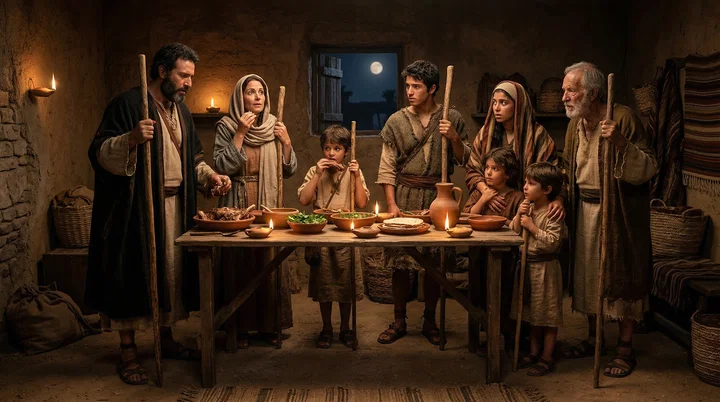
Inside their dwellings the families were to stay gathered together and eat the lamb roasted whole with unleavened bread and bitter herbs.SG3 222.2COS 103.1–4DA 76.1 They were to eat with loins girded, shoes on feet and staff in hand, in haste and readiness for immediate release from slavery.COS 103.1–4DA 76.1 The supper was thus eaten in preparation for departure.SG3 222.2COS 103.1–4
At midnight God smote all the firstborn of the Egyptians in final judgment, as had been warned to Pharaoh.SG3 222.2DA 76.1PP 275 Then Pharaoh ordered Israel to rise up and go serve the Lord.DA 76.1 They went out from Egypt as an independent nation, prepared for leaving.SG3 222.2DA 76.1
The Passover was instituted as a solemn ordinance commanded to be kept yearly, with parents telling children it is the sacrifice of the Lord's passover who passed over the houses of Israel when He smote the Egyptians, so the wonderful deliverance would be repeated from generation to generation.DA 76.1LC1 29.2–30.1 Its design was to call minds from world-loving interests and from cares and anxieties about temporal concerns to review God's miracles, mercies and loving-kindness, so love and reverence for Him would increase and lead to ever looking to Him and trusting Him in all trials.LC1 29.2–30.1 Later it was kept as a night assembly at Jerusalem with the whole congregation eating the lamb in haste, with girded loins, shoes on feet and staff in hand, together with unleavened bread and bitter herbs in solemn silence.ST Nov 2, 1915 That service rehearsed the sprinkled blood, the death-dealing angel, and the grand march from bondage, taught to Hebrew children as they journeyed and witnessed the ceremony, to stir the imagination, impress the heart, and fix the deliverance forever in the memory of child and youth.ED 42.2DA 76.1ST Nov 2, 1915
Lamb Foreshadowing Christ
The lamb kept until the fourteenth day and then killed in the evening and eaten at the feast was a symbol of Christ's body and death, prefiguring the sinless Lamb of God and the slaying of the Son of God.5RED 48.14RED 94.22SP 36.12SP 280.2–281.2 The setting apart of the lamb before its killing was fulfilled when Jesus, while the people were assembling at Jerusalem to celebrate the Passover, voluntarily and publicly set Himself apart as an oblation and presented Himself as the Redeemer.DA 571.2–4 That demonstration directed all eyes to the sacrifice that was to crown His mission to a fallen world, so that all would follow His rapid progress to the cross and the final scene.DA 571.2–4
The blood struck on the doorway represented Christ's blood shed for the sins of the world.4RED 94.22SP 36.13SP 128.1LC1 29.2–30.1ST Dec 9, 1880 It alone cleanses the believing sinner from sin and shelters him from the wrath of a sin-hating God coming upon the impenitent and unbelieving world, as the wrath of God fell upon the Egyptians, and His merits alone avert judgment and condemnation for fallen humanity.5RED 48.14RED 94.22SP 36.13SP 128.1LC1 29.2–30.1 His approaching death is the only true propitiation for the sins of humanity, giving deliverance from the bondage of sin as the Passover gave deliverance from Egypt, and pointing forward to the Lamb slain on the hill of the cross.4RED 94.2LC1 29.2–30.1ST Dec 9, 18802SP 280.2–281.2 Those who celebrated were to associate the slaying of the lamb with the future death of the Son of God.LC1 29.2–30.1ST Dec 9, 1880
Eating the lamb recalled that protection under the blood during the death of Egypt's firstborn.4RED 91.1–2DA 388.2–389.2 It teaches the same truth that life comes only through His death as the means of salvation, by eating His flesh and drinking His blood.DA 388.2–389.2 Faith in Christ, described as eating His flesh and drinking His blood, gives believers hope of resurrection to immortal life.4RED 91.1–2
The Passover was a ceremony revealing Christ that cannot be fully explained apart from Him, since its keeping and killing of the lamb points to the mission, suffering and death of the Messiah revealed in the Old Testament.3SP 388.1–2SLP 82.1–2ST Jul 17, 1879 Christ is the key that unlocks the Old Testament and gives access to its rich treasures.SLP 82.1–2ST Jul 17, 1879 To make the symbol all-important while its significance went unnoticed is to fail to discern the Lord's body, and to reject the Saviour it represented while He stood among the people as Saviour offering mercy leaves all the religious services and ceremonies connected with it valueless.4RED 94.23SP 388.1–2DA 388.2–389.22SP 280.2–281.2SLP 82.1–2
The Passover was instituted by Christ Himself before His incarnation, and He is the foundation of the whole Jewish economy.Ms 104, 1897, par. 8–919MR 163.2–3 Its rites were bound up with His own life and mission, which began to dawn on Him when He observed the paschal service as a twelve-year-old at Jerusalem for the children of Abraham, Isaac and Jacob, heirs of the covenant promises.IRCUP 10.1
Type met antitype when His divinity clothed with humanity stood in the midst of the priests, scribes and rulers at His trial, while they kept exact ceremonial strictness about defilement so they might eat the Passover yet delivered Him to death.Ms 104, 1897, par. 8–919MR 163.2–3 The antitypical Lamb, slain by wicked hands, fulfilled the feast's meaning at Calvary.5RED 48.1ST Aug 8, 1878 When Christ died the Passover's significance as a type ended, and the Lord's Supper was instituted as the memorial of the same saving event connected with the Passover.5RED 48.1PP 539.3
It was necessary for His church in all succeeding ages to make His death for the sins of the world a subject of deep thought and study, with every fact connected with it verified beyond doubt.DA 571.2–4 After His crucifixion many recalling these events in connection with His trial and death would search the prophecies, be convinced that Jesus was the Messiah, and multiply converts to the faith in all lands.DA 571.2–4
Faith Under the Blood
Salvation on that night was not automatic but had to be received by faith shown in exact obedience to the special directions given through Moses to preserve families.2SP 36.1LC1 29.2–30.115MR 224.3–225.2ST Dec 9, 1880Ms 59, 1895, par. 40–44 Each household was required to do what God commanded, gathering everyone inside the dwelling under the sign of blood on the lintel and doorposts and observing the appointed preparations.2SP 36.1LC1 29.2–30.115MR 224.3–225.2ST Dec 9, 1880Ms 59, 1895, par. 40–44 Those acts manifested faith in the salvation provided and brought the obedient under the protection of the angel passing over.2SP 36.1LC1 29.2–30.115MR 224.3–225.2ST Dec 9, 1880Ms 59, 1895, par. 40–44 That judgment also displayed God's power to Pharaoh and proved that the Lord alone is God.Ms 59, 1895, par. 40–44
Neither carelessness nor refusal to obey nor neglect of the directions could protect a household.15MR 224.3–225.2RH Sep 19, 1854Ms 5, 1854, par. 2–3Ms 59, 1895, par. 40–44 Those who failed to follow the instruction were not spared from the judgment striking the firstborn of Egypt.15MR 224.3–225.2RH Sep 19, 1854Ms 5, 1854, par. 2–3Ms 59, 1895, par. 40–44 Even a Hebrew household neglecting the command was left no different from the Egyptians.15MR 224.3–225.2Ms 5, 1854, par. 2–3Ms 59, 1895, par. 40–44
Marking the house with the lamb's blood was acceptance of Christ as the promised Redeemer, and gathering the children inside in obedience showed faith in Jesus the great Sacrifice.2MR 147.2–148.1Ms 26, 1885, par. 28–34 That faith shielded the whole household from the destroyer's power, so the destroying angel passed over every marked house in the judgment on the firstborn.2MR 147.2–148.1Ms 26, 1885, par. 28–34 The faith of believing parents, shown by obeying God's directions, covered themselves and their children gathered with them.2MR 147.2–148.1Ms 26, 1885, par. 28–34 It stands as a symbol that parental faith extends to little children who have had no test of character themselves and covers them from the destroying angel.2MR 147.2–148.1
This protection warns that a destroying angel will soon slay those without the mark.Ms 5, 1854, par. 2–3 Parents must therefore faithfully guide and discipline their children and plead with God for them.Ms 5, 1854, par. 2–3 All are ever to look to God and trust Him in trials and not turn to other gods, calling to mind His miracles, mercies, and loving-kindness.LC1 29.2–30.1 None is benefited by this special provision of God for salvation unless by his acts he manifests faith in the provision made and performs the work the Lord leaves him to do.2SP 36.1LC1 29.2–30.1ST Dec 9, 1880
Sources
Pioneers and periodicals
130 sources
The verse appoints the chosen yearling lamb to be taken on the tenth and kept apart until the fourteenth day of the first month Abib or Nisan, when the whole assembly of Israel kills together in the evening.ST Mar 25, 1880ST May 28, 1894ST Feb 11, 1903RH Sep 3, 1857 That evening is between the two evenings from about the ninth hour or three o'clock in the afternoon until sunset, near the close of the fourteenth, with the lamb eaten that night which begins the fifteenth by evening-to-evening reckoning.RH Feb 19, 1901RH Feb 5, 1914ST Jun 20, 1911ST Dec 23, 1903ST Mar 11, 1886 It is the yearly memorial of the Lord passing over the blood-marked houses and delivering Israel from Egyptian bondage, to be kept with unleavened bread and taught to children in all generations.ST Mar 25, 1880ST Mar 25, 1880RH Apr 28, 1853ST May 22, 1907RH Dec 17, 1857 The kept and slain lamb sets forth Jesus Christ the sinless Passover Lamb, whose blood averts judgment and whose death on that same fourteenth day fulfills the type down to the day.ST May 28, 1894ST Apr 13, 1904ST Jun 11, 1894ST Dec 25, 1901 The sacrifice alone does not shelter unless its blood is applied to the home and its household remains within in trusting obedience, a mark distinguishing God's servants for protection through final judgment.ST Mar 25, 1880ST Dec 25, 1901RH Dec 23, 1851ST May 8, 1879ST
Words and Evening Time
The chosen lamb was to be kept until the fourteenth day of the first month, Abib or Nisan, and then killed in the evening by the whole assembly of the congregation of Israel.ST May 28, 1894ST Feb 11, 1903ST Feb 4, 1889ST Sep 20, 1910 That keeping through to the fourteenth and killing together fixed both the right day and the right time of day for eating the Passover.ST Feb 11, 1903ST Apr 2, 1912 The ordinance belongs to the preparations for the final plague, the death of the firstborn, and to Israel's hurried departure from Egypt, with the blood placed on the houses to mark those inside for protection.ST May 28, 1894ST Feb 11, 1903 These directions governed the preparation of the Passover eaten later, so the lamb had to be slaughtered for that meal, and the killing is the sacrifice fulfilled in Christ the Passover sacrificed for us.ST May 28, 1894ST Sep 20, 1910
In the evening means in Hebrew between the two evenings, from about three o'clock in the afternoon, the ninth hour, until sunset.RH Feb 19, 1901RH Feb 5, 1914RH Jun 24, 1873RH Apr 7, 1851ST Apr 2, 1912 It is variously stated as between three and six in the afternoon, between the ninth and eleventh hour or three to five o'clock, and from 3 P.M. to sunset.RH Feb 19, 1901RH Feb 5, 1914RH Jan 16, 1913RH Jun 24, 1873 The dividing point between the earlier and later evening is placed at about three o'clock, so the verse's evening is taken to mean the afternoon period before evening began rather than nighttime.RH Apr 7, 1851RH Mar 19, 1861 The time was matched by the death of Jesus after the ninth hour when the darkness ended, after three o'clock, on the same date as the Passover Lamb's slaughter.RH Feb 19, 1901RH Feb 5, 1914ST Jun 20, 1911 The lamb was kept until the fourteenth and slain at its appointed season between the two evenings on the last night of the sojourn in Egypt, then its blood was struck on lintel and side posts with hyssop and its flesh eaten that night with bitter herbs while the destroying angel passed over the blood-marked houses.RH Jan 16, 1913RH Jun 24, 1873
The day was reckoned to have two evenings, the first when the sun declines after noon and the second or true evening at sunset closing that day and beginning the next.ST Sep 2, 1886ST Feb 23, 1915RH Mar 19, 1861 The first evening began about three o'clock, about the ninth hour or 3 P.M. when the sun declines, and the second or real evening began at sunset and continued through twilight.ST Sep 2, 1886RH Mar 19, 1861 The interval between them is the portion of the day for killing the paschal lamb and for offering the evening sacrifice, the lamb being regularly killed between the ninth and eleventh hours.RH Mar 19, 1861RH Mar 2, 1876 There are thus two evenings belonging to the same day, one occupying its closing hours and one marking the commencement of the day, so that evening can still be the same day and can denote either the close of one day or the beginning of the next.ST Sep 2, 1886ST Feb 23, 1915RH Mar 19, 1861ST Nov 10, 1914RH Mar 2, 1876 The day began with an evening and ended with an evening, and the evening belonging to that day closes with the day, merging into the evening of the next day.ST Nov 10, 1914RH Mar 2, 1876
On a differing explanation, between the two evenings is the interval from sunset until dark, making the verse consistent with the placing of the Passover sacrifice at sunset at the going down of the sun in Deuteronomy 16:6, and it does not place the killing at 3 p.m.RH Dec 4, 1855RH Jan 17, 1856RH Feb 6, 1879 On that reckoning the lamb was killed at sunset at the close of the fourteenth day and eaten during the following night, which was the fifteenth day.RH Jan 17, 1856RH Feb 6, 1879ST Dec 19, 1900 The lambs were slain then as the sun was setting, and the slaughter stood at the close of that day as the fifteenth began.RH Feb 6, 1879ST Dec 19, 1900
The killing belongs near the close of the fourteenth day rather than before it began or after it ended.ST Dec 23, 1903RH Apr 7, 1868ST Apr 12, 1883 The lamb was slain at the close of the fourteenth day of the first month, which is when the Passover commenced, and was killed on the preparation day then eaten that night.ST Oct 22, 1894ST Apr 12, 1883ST May 12, 1898 That night began Nisan fifteen, since days were reckoned from evening to evening, and Nisan fifteen was the first day of unleavened bread and a yearly Sabbath.ST Dec 23, 1903ST Mar 11, 1886ST May 12, 1898 The lamb was to be killed in the evening of the fourteenth after all leaven was put away, and with the lamb at the beginning of the fifteenth the eating of unleavened bread was to begin, continuing until the twenty-second, so that although the evening of the fourteenth when leaven was put away is sometimes called the first day, the fifteenth was really the first.ST Dec 23, 1903ST Mar 11, 1886 This was the regular Passover time kept afterward.ST Oct 22, 1894ST May 12, 1898
The fourteenth began at sunset on the thirteenth, and the lambs were killed in the afternoon after being examined as families gathered.ST Apr 21, 1881 The evening sacrifice fits the Passover's nighttime observance, which memorialized Israel's deliverance from Egypt when God would pass over Israel and save them from the death of the firstborn.ST Apr 21, 1881ST May 28, 1894 The lamb without blemish and the unleavened bread typified Jesus, the perfect offering and Lamb of God.ST May 28, 1894
Setting in Egypt
Exodus 12:6 stands in the account of the last plague, the death of the firstborn, the Passover ordinance, and the hurried going out of Egypt, belonging to Exodus 5 to 13 and especially chapters 11 to 13 and to the plagues in Exodus 9 to 12.ST Jan 25, 1910ST Feb 11, 1903RH Jan 20, 1916RH Mar 25, 1909 The lamb chosen earlier was to be kept until the fourteenth day of the month, when the whole congregation of Israel killed it in the evening as part of the preparations for the final plague, with the blood placed on the houses to mark those inside for protection.ST Feb 11, 1903 The destruction in Egypt was carried out by an angel commissioned by God, and the Egyptians were punished because they had chosen sin and stood with oppression of Israel, while the blood on Israelite houses kept the destroyer from entering them. The ordinance stands immediately before the first Passover, the leading by fire and by cloud, the passage through the Red Sea, and the song of triumph, and belongs to the record in which Pharaoh's oppression over worship of the true Creator and keeping His commandments came to a crisis broken only by terrible plagues and direct miraculous intervention, ending when the angel of death visited every family so that there was not a house where there was not one dead.RH Jan 20, 1916RH Mar 25, 1909
The verse stands in God's call to the kingdoms of earth when Egypt ruled the world as the greatest of all kingdoms, acknowledged for might and power and skill and wisdom in statecraft.ST Nov 14, 1906 Egypt deified its annually overflowing and fertilizing river as a god and worshiped the sun that joined with the river in producing food, with its kings receiving title as representatives of the sun-god upon the throne of men.ST Nov 14, 1906 The few descendants of the nomadic patriarch Abraham had sought supplies from its granaries after the captive slave Joseph taught Pharaoh to store grain in plenteous years that he might become rich in famine and instituted a just land-law with easy combined rental and taxes.ST Nov 14, 1906 While he was prime minister and as long as his memory lived among the rulers and his laws governed, Egypt prospered and the people living in Egypt knew no oppression.ST Nov 14, 1906
The passage presents God's religious system confronting Egypt's system, with both systems supported by miracles.RH Mar 11, 1915 In that setting Jehovah showed Egypt that its many gods were powerless before the one all-powerful God of Israel.ST Nov 1, 1899 Through Israel's deliverance from Egypt God demonstrated His wisdom, love, power, and right to rule, and Israel's obligation to obey Him.ST Mar 7, 1906
Events in the first fourteen chapters of Exodus are not expected to receive direct mention in Egyptian historical records because public monuments recorded successes and triumphs, not disasters such as the plagues and the Red Sea.RH Apr 23, 1908 The plagues visited upon Egypt were literal, Egypt knew it and Philistia did not doubt it, and the going out of Egypt into Canaan is a type of the deliverance of God's people from the dark Egypt of earth while those plagues are a type of the last plagues in Revelation 16.ST
The oppression is linked to Rameses II, builder of the treasure city Rameses named in Exodus 12 which bore the builder's name, whose reign from 1564 to 1497 B.C. continued to within six years of Israel's exodus from Egypt.ST Aug 9, 1910 At the time Israel was burdened with making bricks, with and without straw, and building the store cities under Meneptah II, Exodus 12 records the slaying of the first-born in Egypt, and the death of Meneptah's son in that plague left the tomb designed for him found unfinished.ST Dec 14, 1915 The killing of the Passover lamb is placed on the evening of the fourteenth day of the first month, and the Israelites left Egypt on the fifteenth day, the next day, with Exodus 12:6-17 cited to place that departure on the fifteenth day of the first month.RH Jan 15, 1914ST Jun 16, 1887 Israel's departure from Egypt is dated to 1491 years before Christ.ST Jan 28, 1886 That fifteenth-day departure fixes the reckoning to the wilderness of Sin on the fifteenth day of the second month and to the wilderness of Sinai on the same fifteenth day of the third month, making sixty days from leaving Egypt to Sinai and three days to the giving of the law, and thirty days from leaving Egypt to the wilderness of Sin.ST Jun 16, 1887
God gave the children of Israel timely notice to prepare to leave Egypt so they would be ready, revealing a divine hand leading God's people step by step and preparing them for the stirring scenes before them.RH Oct 2, 1866 The exodus of Israel took place under Moses' direct supervision, and it is written in no more positive terms than the history of creation and the fall in Genesis 1-3.ST Jul 28, 1881 Israel's deliverance from Egyptian bondage came before the sanctuary's lessons about God's plan of salvation.
Israel in Egypt still worshiped God and kept His ordinances.RH Sep 24, 1872 They kept circumcision, which was necessary to eat the Passover, and they were ready to eat it.RH Sep 24, 1872 This proves they had not forgotten God's past dealings.RH Sep 24, 1872
Passover Procedure Observed
On the tenth day of Abib, at the spring beginning about the vernal equinox when barley is in the ear and flax is bolled, a lamb or goat of the first year without blemish, the fairest yearling, was taken and kept apart from the tenth through the fourteenth.ST Mar 25, 1880RH Sep 3, 1857ST Feb 4, 1889 When the fourteenth came the whole assembly of the congregation killed their lambs together in the evening, between the two evenings from about three o'clock until sunset, variously reckoned as three to five or three to six o'clock.RH Jan 15, 1914RH Sep 3, 1857ST Jun 3, 1897ST Feb 4, 1889 The simultaneous killing marked the start of the Passover observance.ST Jun 3, 1897
Each Israelite killed his own lamb for his family or company, alone or joined with others, and not by the priest.ST Mar 25, 1880RH Jan 15, 1914RH Feb 5, 1914RH Jun 24, 1873 In later temple practice the lambs were brought to the temple and examined by the priests to ensure they were without blemish, and were killed in great numbers at nearly the same time.RH Jan 15, 1914ST Apr 21, 1881 The priests stood in two rows with gold and silver bowls to catch the blood and pass it to the altar to be jerked in one jet at its base after a threefold trumpet blast.RH Jan 15, 1914 The killing belonged to the fourteenth and could be offered in the temple only on the evening of the fourteenth, so the supper could be kept only then and not on the thirteenth or any other day, and the Passover lamb was different from the lamb of the regular daily evening sacrifice killed on the previous afternoon.RH Feb 5, 1914RH Feb 5, 1914
With hyssop the blood was struck on the lintel and two side posts as a token so the destroyer would pass over without entering to smite, and the firstborn inside was safe.ST Mar 25, 1880RH Jan 16, 1913RH Sep 3, 1857 The whole lamb was roasted with fire without breaking a bone and eaten that very night in haste with unleavened bread and bitter herbs, with loins girded, shoes on feet and staff in hand like pilgrims setting out at once on a long journey, none left till morning and no later than midnight.ST Mar 25, 1880RH Jan 16, 1913RH Feb 5, 1914RH Sep 3, 1857 This sacrifice was slain before the people left Egypt and eaten before they were delivered that night when the firstborn were smitten, and in that night Israel left Egypt.ST Oct 7, 1930ST Oct 7, 1930RH Sep 3, 1857 Eating the Passover meant eating the paschal lamb, and preparation of the Passover concerned preparing for that meal.RH Jun 24, 1873
These are the original instructions for Egypt and the wilderness journey, distinct from the materially changed temple form.ST Feb 22, 1899 Later scriptures added injunctions about the Passover that were not in Exodus 12 to 13 and could hardly be carried out in the wilderness.ST Feb 22, 1899 Wine used in later observances and the cups used during the meal and the Hallel song sung at the close were not required by the original instructions, and the verse itself does not mention wine or the cups.ST Feb 22, 1899ST Nov 22, 1883
The institution gives how, when, by whom and for what purpose the Passover was celebrated.RH Mar 14, 1865RH Mar 9, 1905 It belongs to the first giving of its directions as a new observance introduced, in the manner that Genesis 2 gives the origin of the Sabbath.RH Mar 14, 1865 This is in contrast to Exodus 16, which refers to the Sabbath as an existing institution already known and kept.RH Mar 14, 1865
Memorial of Deliverance
The Passover commemorates the Lord passing over Israel's firstborn when He struck Egypt and the deliverance from bondage, its very name memorializing the angel passing by the blood-marked dwellings and sparing the oldest child.RH Apr 28, 1853ST May 22, 1907RH Dec 17, 1857 It was established after that deliverance to keep God's power to rescue His people fresh in their minds, beginning the observance with the lamb killed on the fourteenth day of the first month.RH Jul 28, 1904RH Jan 14, 1862 Kept annually with unleavened bread, it was a type of Christ's greater deliverance of His people from the bondage of sin.ST Jun 11, 1894 The deliverance it memorializes was triumph over earthly foes celebrated in the song of Moses, pointing to the final redemption when the redeemed sing not only the song of Moses but the song of the Lamb, meaning redemption from earthly foes as well as from all sin.ST Jan 30, 1912 That history of deliverance from Egypt illustrates the conflict between good and evil and unfolds the plan of salvation.RH Apr 13, 1905
The Passover kept on the fourteenth of the first month, when Israel rushed out of Egypt, is the appointed and sufficient remembrance of that redemption.RH Dec 17, 1857 It is perfectly fitted to call to mind the flight and deliverance from slavery, preserving in strong remembrance how God brought deliverance nigh through judgment when Egypt's first-born sons were doomed to die and the destroying angel, dark with wrath, passed over their dwellings on his fearful path.ST May 31, 1905ST Sep 13, 1877 Joined with the Feast of Unleavened Bread, which declared how the Egyptians hurried Israel away, it supplied the answer when sons asked what this service means, that with mighty hand Jehovah brought them up from Egypt's land.ST Sep 13, 1877RH Nov 15, 1853 It belongs to a deliverance that could come round but once a year and occupied a night, unlike the Sabbath which occupied a day, and a weekly rest is unfit to keep in memory a yearly day, nor is a rest fit as a memorial of a rush.ST Sep 13, 1877RH Nov 15, 1853ST Apr 7, 1909
The Sabbath was instituted before the fall to commemorate God's rest after six days of labor in creation and to typify future rest, and it cannot also be made a memorial of the deliverance from Egypt.RH Dec 17, 1857 That deliverance has its own memorial in the Passover, so the Sabbath is not a memorial of that flight but is and always has been the memorial of the Creator's rest after making heaven and earth, grounded in creation and not commanded as a memorial of the Exodus.ST May 31, 1905 The Passover was ordained as a memorial of God passing over the Israelites when He struck the Egyptians; it commemorated deliverance from Egypt and did not establish the weekly Sabbath or explain its origin.RH Jan 7, 1862 The night to be observed as the memorial of coming out of Egypt is provided in Exodus 12, not the weekly Sabbath.RH Apr 30, 1872 One memorial does not serve for two unlike events, and there is no fitness in taking the Sabbath from its proper office to join it to the Exodus.RH Dec 17, 1857
The feast is to be kept as a memorial by Israel in all future generations, instituted as a solemn ordinance on the night terrible to the Egyptians and glorious to the people of God to preserve Israel and their families from the plague coming upon Egypt and to prepare them for leaving Egypt.ST Mar 25, 1880 The paschal service was kept as a night assembly with the whole congregation eating the lamb in haste, with girded loins, shoes on feet and staff in hand, together with unleavened bread and bitter herbs in solemn silence.ST Mar 25, 1880ST Nov 2, 1915 It means a rehearsal of the sprinkled blood, the death-dealing angel, and the grand march from the land of bondage, taught to Hebrew children as they journeyed and witnessed the ceremony to stir the imagination, impress the heart, and fix the deliverance forever in memory.ST Nov 2, 1915 As the feast of unleavened bread at the beginning of the year, it is one of three principal feasts whose yearly round reminds of every phase of the Christian life from deliverance from sin to final rest in the kingdom, with Egypt representing sin and conversion and new life as its subject.ST Mar 25, 1880ST Jul 2, 1902 Though described as perpetual or everlasting, that description does not by itself prove the observance must continue, since its appointed period could have expired.RH Apr 15, 1873 Just as Passover fixed to the fourteenth could not be celebrated in the sixth month, the Sabbath memorial of God's rest after creation cannot be commemorated on another day.RH Jun 2, 1851
Type and Death of Christ
The innocent lamb chosen and kept until the fourteenth day and then killed by the whole assembly typifies Christ the sinless Passover Lamb, setting forth His person, work, mission, suffering and death.ST May 28, 1894ST Jun 11, 1894ST Mar 23, 1915ST Jun 3, 1897 The lamb kept apart from the tenth through the fourteenth and killed together between three and six o'clock represented Christ sacrificed, and the slaying of that innocent lamb whose blood on the doorposts turned aside the destroying angel prefigured the great salvation He brought.ST Dec 9, 1880ST Jun 3, 1897ST Sep 30, 1886 Its blood represented His blood cleansing the believing sinner from sin and sheltering from wrath, received only by obedient faith doing what God requires.ST Dec 9, 1880ST Sep 30, 1886 Without Christ the Passover cannot be explained, for He observed its divinely appointed ordinances and connected the Lord's Supper with it as its great antitype, so to keep the feast while rejecting Him defiles the soul and turns the ceremony into valueless bitter mockery.ST Sep 30, 1886
The blood struck on the lintel and side posts typified His freely shed blood by which God passes over transgression, forgives and blots out sin, and spares His people from being cut off.ST Apr 13, 1904ST Dec 25, 1901ST Sep 30, 1886 Safety lay in that blood alone, for only the sinless One could atone, and His merits alone avert judgment and condemnation and bring reconciliation with God.ST Jul 4, 1878ST Sep 30, 1886ST Oct 25, 1905 The sacrifice alone did not protect, but its saving efficacy comes to each person through faith as His blood, or life, is applied to the penitent, as the household had to apply the blood to the doorposts.ST Apr 13, 1904ST Dec 25, 1901 Its unbroken bones also pointed to Christ whose bones were not broken, and as Israel was saved through accepting the command to sprinkle the blood, people are cleansed through accepting His blood.ST Jun 3, 1897
The lamb slain on the fourteenth day of the first month met its antitype when Christ the Lamb of God died on that same day.ST Aug 13, 1874RH Feb 3, 1853 That month and day for the crucifixion, between the two evenings, was foretold by Moses more than fifteen hundred years beforehand and fulfilled in His death, showing God fulfills His word down to the day.RH Jun 17, 1915RH Jun 11, 1857 This exactness of calendar day proves types meet on their days, as the seventh-month cleansing of the sanctuary met its antitype when the twenty-three hundred days ended in the seventh month of 1844.RH Nov 8, 1906 The time between the two evenings, between three and six in the afternoon or in the time of Christ between the ninth and eleventh hour, three to five o'clock, was matched by His death after the ninth hour when darkness ended, after three o'clock.RH Feb 19, 1901RH Feb 5, 1914ST Jun 20, 1911 Four days before Passover He came to Jerusalem to be examined and declared without fault, as the spotless Paschal Lamb, and as one born under the law He slew the paschal lamb at its appointed season from three in the afternoon to sunset.RH Jun 24, 1873ST Jun 3, 1897
Christ and His disciples ate the Passover at the commanded time, the lamb killed in the evening between three o'clock and sunset and roasted and eaten in the night during the night no later than midnight, on the night following the daytime slaying.ST Apr 2, 1912RH Feb 5, 1914 In the year of the crucifixion that fourteenth day of Abib or Nisan fell on Thursday, and on Thursday evening going into the fifteenth He kept it with them the night before He was crucified on Friday, the day before the seventh-day Sabbath, then instituted the feast to commemorate His own death.ST Mar 11, 1886RH Feb 5, 1914 These directions governed the preparation of the Passover He ate, so the lamb had to be slaughtered for that meal, and this was the regular Passover time kept for fifteen long centuries.ST Sep 20, 1910ST Oct 22, 1894RH Feb 5, 1914 Those who held the differing reckoning distinguish the lamb's slaughter on the fourteenth in the afternoon from the crucifixion on the fifteenth, making the fourteenth Thursday and the crucifixion Friday the fifteenth, with Jesus eating the Passover before the Jews ate it and dying at the time the lamb was killed.ST Apr 3, 1907RH Mar 1, 1906RH Jan 29, 1914
The verse fixes the exact appointed time for the Passover sacrifice as a type fulfilled when Christ died in due time in A.D. 31 according to Daniel's time, when the earthly sanctuary services virtually ceased and the veil dividing the holies was rent in the midst.RH Jun 11, 1857RH Feb 21, 1856 His sacrifice brought the system of types and ceremonies to its end, and He established the Lord's Supper as its memorial for His followers in every land and age, while the other Passover services require no later separate fulfillment.RH Feb 21, 1856ST Oct 7, 1930 Moses instituting the Passover stands parallel to Christ instituting the Lord's Supper, proving Christ a prophet like Moses.RH Feb 19, 1861 The exodus must be understood in order to understand the life of Christ, because the true Christ is the Christ of the prophets and the embodiment of the written Word, and no attempt to understand Him apart from the Old Testament can succeed.RH Nov 8, 1906
Sabbaths Calendar and Chronology
The fourteenth was preparation for the seven-day feast of unleavened bread from the fifteenth to the twenty-first, when all leaven was put out of the houses.ST Dec 23, 1903ST Mar 11, 1886RH Jan 15, 1914 The lamb was killed on the fourteenth between the two evenings, in the closing hours of Nisan 14, about three o'clock or a little later, between the ninth and eleventh hours or three and five in the afternoon.ST Dec 23, 1903RH Jan 15, 1914 It was slain in the afternoon, between noon and six, before the evening that began the fifteenth day and the first festival Sabbath.RH Mar 1, 1906ST May 12, 1898 The lamb slain on the fourteenth was eaten the following night roasted with fire, that night which began Nisan 15, since days were reckoned from evening to evening.ST Dec 23, 1903RH Jan 15, 1914ST May 12, 1898 The killing was done on the preparation day by the people themselves, each Israelite for his family or company and not by the priest, while in later practice priests stood in two rows with gold and silver bowls to catch the blood and pass it to the altar to be jerked in one jet at its base after a threefold trumpet blast.RH Jan 15, 1914ST May 12, 1898 With the lamb at the beginning of the fifteenth the eating of unleavened bread began and continued through the feast, with the fifteenth as the first day of the feast and a yearly Sabbath on which no servile work was to be done, although the evening of the fourteenth when leaven was put away and unleavened bread began to be eaten is sometimes called the first day.ST Dec 23, 1903ST Mar 11, 1886 The order was kept by Jesus, eating the Passover that night before being crucified the next day.
The Passover is an annual festival kept on the fourteenth day of the first month, not a weekly festival.RH Apr 9, 1861RH Apr 1, 1862ST May 7, 1885 Its holy days were not necessarily weekly Sabbaths, and the convocation days appointed for particular days of the month had no reference to the weekly Sabbath.RH Apr 9, 1861 The fixed fourteenth affected Sunday only one day in the year.ST May 7, 1885 At most it gives evidence about the arrangement of the calendar in that particular year, and it does not prove that the weekly Sabbath began on a different day each month, that the week began with the year, or that changes in month or year made a week incomplete.
It was claimed that the lamb being always slain on the fourteenth, as the third day before the morrow after the Sabbath, makes the fourteenth always come on the sixth day Friday, the day before the Sabbath, and makes the fifteenth always a weekly Sabbath and always the first day of unleavened bread, breaking the regular succession of Sabbaths yearly. On the contrary, the first month begins with the first new moon after the vernal equinox in April, and the Hebrew word for month means new moon and lunar month beginning with the new moon, so the fourteenth is coincident with the full moon. Because the date is regulated altogether by the moon, it can begin on any day of the week and does not always fall on Friday, and the text does not state the weekday on which that date fell.RH Oct 21, 1858
The Passover sacrifice on the evening of the fourteenth was to be observed regularly after Israel entered the promised land, and its preparation by roasting could fall on the Sabbath.RH Jan 7, 1862RH Mar 21, 1865RH May 27, 1873 Each family was to kill and roast the lamb on the evening following the fourteenth, a date that would occasionally fall on the Sabbath and therefore require fire on the Sabbath.RH Mar 21, 1865RH May 27, 1873 This shows the wilderness prohibition against kindling fires was temporary rather than a rule for life in the land, applying only while Israel was in the wilderness where the warm climate required no fires for comfort and where the Passover was celebrated only once, and not extending to Canaan where winter cold requires fire and where a permanent fire ban would directly conflict with keeping the Passover.RH Jan 7, 1862RH Mar 21, 1865RH May 27, 1873
Abib was made the beginning of months and the first month of the sacred year, retrieving the original spring beginning about the vernal equinox when barley is in the ear and flax is bolled but wheat and rye are not grown up, though it was the seventh month of the civil year reckoned from creation.RH Nov 7, 1871RH Sep 3, 1857 It stands distinct from the sacred sanctuary year whose last day of offerings is the Day of Atonement, and the month is identified as Nisan, or March.ST Jun 18, 1912RH Jul 5, 1864 The lamb of the first year without blemish was taken on the tenth and kept until the fourteenth when the whole assembly killed it between the two evenings, at even at the going down of the sun, the former evening beginning at the ninth hour and the latter at the eleventh hour or sunset.RH Sep 3, 1857 It was to be roasted whole and eaten in haste with bitter herbs and unleavened bread without breaking a bone, with loins girded, shoes on feet and staves in hand, and its blood sprinkled with hyssop on the lintel and side posts as a token, followed by seven days of unleavened bread from the fifteenth, during which a sheaf of firstfruits of barley was waved on the morrow after the Sabbath, so the Passover could never be kept until the barley harvest was ripe nor deferred long after its ripening, since the harvest could not be eaten until the wave sheaf had been offered.RH Sep 3, 1857
The fifteenth-day departure fixes the reckoning to the wilderness of Sin on the fifteenth day of the second month and to Sinai on the same fifteenth day of the third month, making sixty days from leaving Egypt to Sinai and three days to the giving of the law, and thirty days from leaving Egypt to Sin, proving the Sabbath was observed thirty days before the law was given at Sinai.ST Apr 24, 1879ST Jun 16, 1887 The unleavened bread account with its second day serves as the starting point for counting fifty days to fix the weekday of the arrival in Sin, and the Passover beginning at the time of Christ's crucifixion is used as the starting point for counting the fifty days to Pentecost.ST Apr 24, 1879RH Aug 1, 1854 The date is used to work out when Passover and Pentecost occurred, but uncertainty about the year's weekday means Pentecost's weekday cannot be established beyond doubt from this calculation.ST Apr 12, 1883 The wave sheaf presented after the Passover Sabbath typified Christ's resurrection, with Christ rising on the seventeenth with the same interval between His death and resurrection as between the Passover sacrifice and the Sabbath.RH Sep 30, 1858
The fixed fourteenth is contrasted with the later civil fixing of Easter on Sunday.ST May 7, 1885ST After enforcing the day of the sun by edict of A.D. 321, Constantine controlled the church at Nice to establish the church's annual paschal festival upon Sunday, exciting and appealing to prejudice against the Jews, and even this yearly change was a triumph in honoring Sunday and part of suppressing observance of the seventh-day Sabbath.ST May 7, 1885 The Passover commanded by God as a divine appointment full of meaning is not transfigured by Easter, which is of merely human appointment and pagan origin with not one precept of Scripture for its observance, and to lift Easter above the Passover exalts human traditions above God's institutions.ST Dec 9, 1897 The Passover stands in the spring in the same season in which Christ rose, distinct from Easter with its name and worship from Eostre. The Greek Easter custom of each family providing a paschal lamb recalls the lamb killed on the evening of the fourteenth, and the annual Feast of the White Dog among North American Indians is linked to the slaughter of the Passover lamb on the fourteenth in the evening.RH Mar 26, 1861
The Passover was one of three annual national feasts kept in the place the Lord chose, Jerusalem, where the tribes went up to worship, and it lasted seven days.RH Nov 18, 1862 It required long journeys and preparations that took more time than the feast itself.RH Nov 18, 1862 With the weekly Sabbath, the seventh-year rest, and the other feasts, together occupying twenty-two days, it helped take up over one-third of the year with religion, which increased the need for laborers, and all servants were required to observe these feasts and Sabbaths.RH Nov 18, 1862
Protection Through Applied Blood
Killing the lamb on the fourteenth in the evening did not by itself secure a household, for the blood had also to be applied to the doorposts and the household had to remain inside the marked home, and those who failed to follow were not spared.ST Mar 25, 1880RH Sep 19, 1854ST Dec 25, 1901STST Nov 27, 1901 Each family, alone or joined with others, slew a lamb or goat without defect and struck its blood with hyssop on the two side posts and the upper post as a token, so that the destroying angel coming at midnight did not enter that dwelling.ST Mar 25, 1880RH Sep 19, 1854 The flesh was then eaten that night roasted with bitter herbs, with loins girded, shoes on feet and staff in hand, in haste, and the name Passover memorializes the angel passing by the blood-marked dwellings, to be kept as a memorial in all future generations.ST Mar 25, 1880 The lamb points to Christ, whose death is for all but whose saving efficacy reaches each person through faith as His blood, or life, is applied to the penitent, so that the firstborn were delivered in homes that trusted God's mercy while not one escaped the destroyer in homes that rejected it.ST Dec 25, 1901ST Nov 27, 1901
Safety depended on trusting and obeying God's promise without basis in reason, experience or precedent, and the people's obedience showed their faith.ST Dec 9, 1880ST Apr 2, 1894 The slain lamb is to be connected with Christ's future death, and the blood on the doorposts represents Christ's blood, which cleanses the believing sinner from sin and shelters the believer from God's wrath.ST Dec 9, 1880 Benefit from God's provision could come only by doing what He required.ST Dec 9, 1880ST Apr 2, 1894
The houses marked with the blood of the paschal lamb and spared as the destroying angel passed to slay the firstborn mean that God puts a distinguishing mark or religious characteristic upon His servants through which they will be exempted from the judgments that fall on the wicked around them.ST May 8, 1879 Israel's situation during the plagues is a pattern for God's people during the final plagues, for they remain on earth through the time of trouble while God protects them.ST Jul 18, 1878 The Egyptian plagues that came just before Israel's deliverance were literal, known to Egypt and not doubted by Philistia, and the going out of Egypt into Canaan is a type of the deliverance of God's people from the dark Egypt of earth.RH Dec 23, 1851ST Those ten plagues, with the killing of the lamb marking that final plague-judgment before deliverance, foreshadow seven terrible plagues of Revelation 16 that will sweep over the world just before the final deliverance, which will be the wrath of God without mercy when forgiveness of sin will never be granted any more after they begin.RH Dec 23, 1851STST Oct 28, 1930
The lamb was killed in the evening, and the evening darkness pictures the darkest times of sin and bondage when people should look to God for deliverance.ST Mar 29, 1899 As Israel was delivered at midnight, God can free a soul when its bondage seems strongest and deliverance least likely.ST Mar 29, 1899 That evening setting also points to the close of earth's history, when Christ will come and the saints will be gathered home.ST Mar 29, 1899 The solemn Passover which represented Christ calls each person to examine whether sins are washed away if God's decision in the case should come tonight or if death should visit.ST It also teaches parents to keep their children within the protection of the covenant and the sacred influences made possible through Christ's redeeming blood, as the families of Israel gathered together in Goshen in awe to slay the lamb, roast its flesh, prepare unleavened bread and bitter herbs, sprinkle its blood and then watch and pray, with even households whose members were locked in Egypt's dungeons keeping the rite and bowing in prayer for their restoration on the assurance that God would bring the absent ones again.STST Dec 7, 1904
Sources