John 6:9
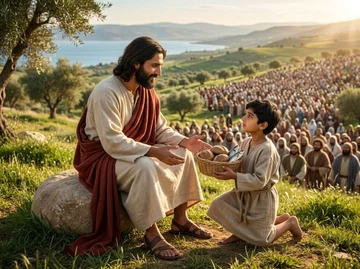
There is a lad here, which hath five barley loaves, and two small fishes: but what are they among so many?
Translations
There is a lad here, which has five barley loaves, and two small fishes: but what are they among so many?
King James Version, KJV Cambridge Paragraph Bible
There is a lad here, which hath five barley loaves, and two small fishes: but what are they among so many?
There is a lad here, who hath five barley-loaves, and two small fishes: but what are they among so many?
There is a lad here, which hath five barley loaves, and two fishes: but what are these among so many?
There is a lad here, who hath five barley loaves, and two fishes: but what are these among so many?
'There is one little lad here who hath five barley loaves, and two fishes, but these — what are they to so many?'
There is a little boy here who has five barley loaves and two small fishes; but this, what is it for so many?
There is a little lad here, that hath five barley loaves, and two small fishes,—but, these,—what are they, for such numbers?
Berean Standard Bible, Majority Standard Bible
“ Here is a boy with five barley loaves and two small fish. But what difference will these make among so many?”
“ There is a boy here who has five barley loaves and two fish, but what are these among so many?”
There is a boy here with five barley cakes and two fishes: but what is that among such a number?
There is a little boy heere, which hath fiue barlie loaues, and two fishes: but what are they among so many?
Douay-Rheims (Challoner revision)
There is a boy here that hath five barley loaves, and two fishes; but what are these among so many?
Pictures
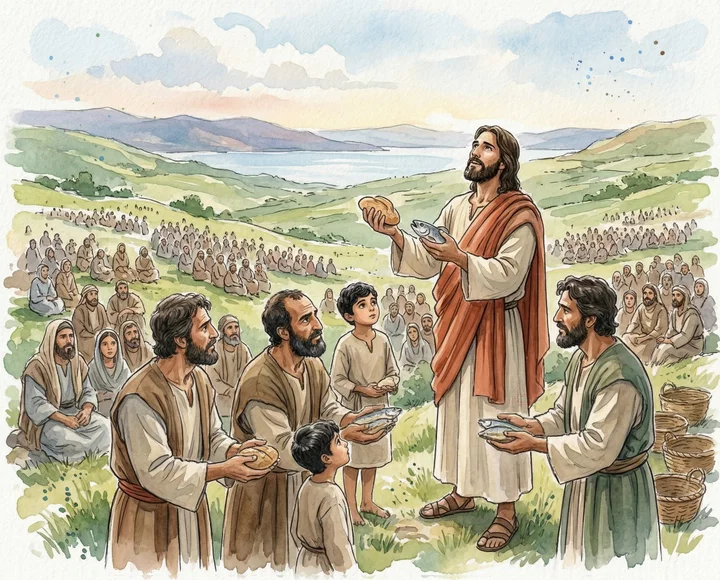
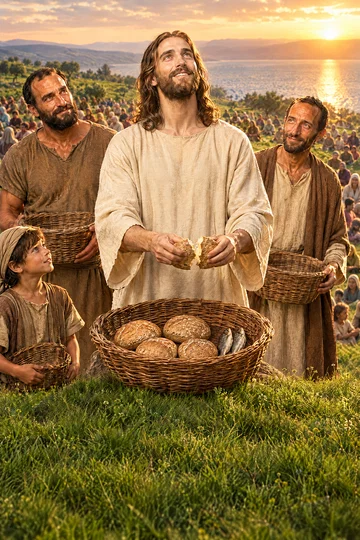
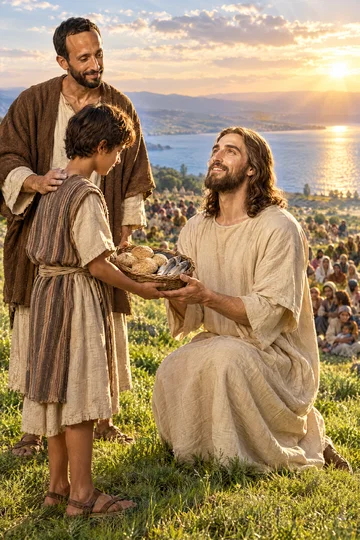


Cross-references 20 of 40
- Matthew 14:17-21
And they say unto him, We have here but five loaves, and two fishes.
Parallel account of Jesus feeding the multitude with a few loaves and fish.
- Mark 6:38-44
He saith unto them, How many loaves have ye? go and see. And when they knew, they say, Five, and two fishes.
Parallel account of Jesus feeding the five thousand with a small food supply.
- Luke 9:13-17
But he said unto them, Give ye them to eat. And they said, We have no more but five loaves and two fishes; except we should go and buy meat for all this people.
Jesus feeds the crowd with five loaves and two fishes.
- John 6:35
And Jesus said unto them, I am the bread of life: he that cometh to me shall never hunger; and he that believeth on me shall never thirst.
The passage contrasts the literal feeding with the spiritual meaning of the bread of life.
- John 6:5
When Jesus then lifted up his eyes, and saw a great company come unto him, he saith unto Philip, Whence shall we buy bread, that these may eat?
Jesus asks where bread can be found for the crowd, testing Philip before Andrew reports the lad's food.
- Mark 6:42-43
And they did all eat, and were filled.
The crowd eats its fill, and twelve baskets of food remain.
- Matthew 14:16-17
But Jesus said unto them, They need not depart; give ye them to eat.
Jesus commands the disciples to feed the crowd despite their few loaves and fish.
- Mark 6:37
He answered and said unto them, Give ye them to eat. And they say unto him, Shall we go and buy two hundred pennyworth of bread, and give them to eat?
Jesus commands the disciples to feed the crowd.
- John 21:9-13
As soon then as they were come to land, they saw a fire of coals there, and fish laid thereon, and bread.
The risen Jesus shares bread and fish, recalling his feeding miracle.
- John 6:51
I am the living bread which came down from heaven: if any man eat of this bread, he shall live for ever: and the bread that I will give is my flesh, which I will give for the life of the world.
Christ identifies himself as the living bread given for the world.
- John 6:26
Jesus answered them and said, Verily, verily, I say unto you, Ye seek me, not because ye saw the miracles, but because ye did eat of the loaves, and were filled.
Jesus says the crowd sought him because they had eaten and been filled.
- Exodus 16:4
Then said the LORD unto Moses, Behold, I will rain bread from heaven for you; and the people shall go out and gather a certain rate every day, that I may prove them, whether they will walk in my law, or no.
Wilderness manna provides the setting for Christ’s provision of bread.
- 2 Kings 4:42-44
And there came a man from Baal-shalisha, and brought the man of God bread of the firstfruits, twenty loaves of barley, and full ears of corn in the husk thereof. And he said, Give unto the people, that they may eat.
Elisha feeds a hundred men with twenty loaves, recalling Jesus’ miraculous feeding.
- John 6:15
When Jesus therefore perceived that they would come and take him by force, to make him a king, he departed again into a mountain himself alone.
After the feeding, the crowd sought to make Jesus king by force.
- Matthew 14:17
And they say unto him, We have here but five loaves, and two fishes.
Both texts report the small supply of loaves and fish.
- Luke 9:16-17
Then he took the five loaves and the two fishes, and looking up to heaven, he blessed them, and brake, and gave to the disciples to set before the multitude.
The parallel account recounts the feeding and gathering of the remaining food.
- John 6:13
Therefore they gathered them together, and filled twelve baskets with the fragments of the five barley loaves, which remained over and above unto them that had eaten.
Twelve baskets of fragments remained from the five loaves.
- John 6:33
For the bread of God is he which cometh down from heaven, and giveth life unto the world.
The physical loaves point to Christ, the bread from heaven who gives life.
- 1 Kings 17:14-16
For thus saith the LORD God of Israel, The barrel of meal shall not waste, neither shall the cruse of oil fail, until the day that the LORD sendeth rain upon the earth.
The widow’s flour and oil do not fail, sustaining her household through famine.
- Exodus 16:14-16
And when the dew that lay was gone up, behold, upon the face of the wilderness there lay a small round thing, as small as the hoar frost on the ground.
Both describe God providing food, with people gathering what is given.
Commentary
Each commentary is drawn from primary sources: the writings of Ellen G. White and Adventist pioneers and periodicals. Each commentary is separate. Its own words are not a quotation; follow the references to read the source passages.
Ellen G. White
135 sources
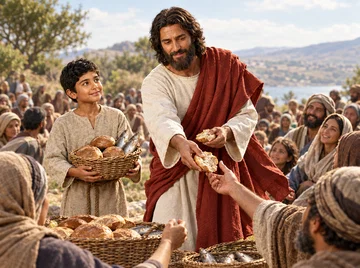
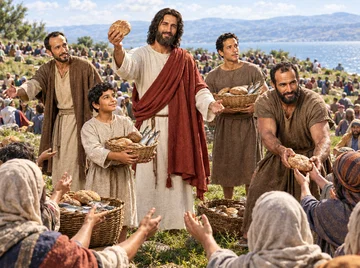
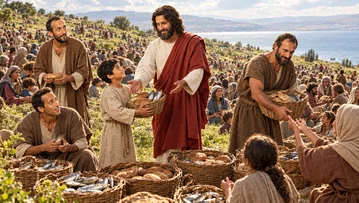
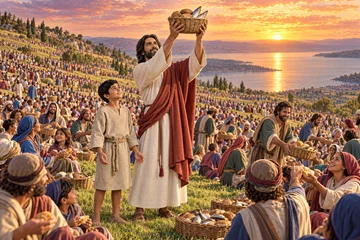
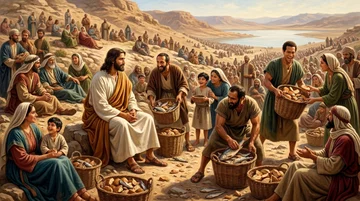
A boy among the crowd on the mountainside had five barley loaves and two small fishes, the plain daily food of fisher folk, which Andrew reported while asking what such a store was among so many thousands.Lt 302, 1907, par. 3–6Ms 156, 1902, par. 1–5ST Aug 15, 1916MH 45.1–4DA 365.3–366.1 Jesus had the people seated in orderly companies, took the loaves, gave thanks and blessed them, and had the disciples distribute them with the fishes to all as much as they would until above ten thousand were satisfied and twelve baskets of fragments were gathered.Lt 9, 1902, par. 1–7Lt 252, 1906, par. 2–6Ms 188, 1907, par. 10Ms 7, 1909, par. 19–20RH Jan 21, 1909 Placed in His hands what seemed hopelessly insufficient became more than enough, teaching that people are to offer the little means, time and ability they have rather than hold back because it looks inadequate.Ms 130, 1909, par. 4–6Lt 139, 1900, par. 21MH 45.1–4MH 49.2–4ST Aug 15, 1916 The temporal supply opened the way for Him to give Himself as the bread of life sent from heaven, to be received and lived by as spiritual nourishment unto everlasting life.FE 455.3–456.121MR 138.2–3CH 400.4–401.1Lt 252, 1906, par. 2–6Lt 17, 1897, par. 6–8 The abundant provision wrought by creative power through His humanity was a sign of His divinity and compassion, showing He understands bodily need and will not send the hungry away fasting.Lt 9, 1902, par. 1–717MR 252.1Ms 19, 1909, par. 7–8ST May 20, 1886ST May 10, 1883
Historical Setting
The saying belongs to the feeding of five thousand men besides women and children, at one reckoning above ten thousand persons, on a mountain by the Sea of Galilee when the Passover was at hand.Ms 156, 1902, par. 1–5DA 364.1DA 809.3 Jesus had withdrawn with His disciples to a secluded place for peaceful quiet, but the multitude missed Him and followed, some noting the direction He had gone, many going by land and others following in boats across the water.Ms 156, 1902, par. 1–5DA 364.1 Bands of pilgrims from far and near on their way to Jerusalem gathered to see Him until the great company was assembled, and the multitude was waiting before He reached the shore, yet He landed unobserved and spent a little time apart with the disciples.Ms 156, 1902, par. 1–5DA 364.1
They had followed because they saw His miracles on the diseased, and His pure and simple teaching had sunk into hearts while His healing of the sick and comforting of sorrow had nearly convinced them.Ms 156, 1902, par. 1–5ST May 20, 1886 After His rest with the disciples was interrupted and broken He was not impatient at being robbed of rest but His heart was stirred with sympathy because He saw a greater necessity demanding His attention.DA 364.1DA 364.2 He was moved with compassion toward them because they were as sheep not having a shepherd, receiving no help from the priests and rulers, and leaving His retreat He found a convenient place where He could minister to them, teaching the multitude the way of salvation as the healing waters of life flowed from Him.Ms 156, 1902, par. 1–5DA 364.2 They had been all day without food in a desert place where no more could be obtained, and about five thousand men besides women and children grew weary and hungry and faint.Ms 124, 1909, par. 21ST May 20, 1886ST Mar 1, 18773RED 54.2
Knowing their need He tested the disciples by asking Philip where bread could be bought and by saying, Give ye them to eat, though He already knew how to provide.Ms 156, 1902, par. 1–5Lt 275, 1903, par. 14–19ST May 10, 18833RED 54.2 Philip answered that two hundred pennyworth of bread would not give each of the crowd even a little, not nearly enough for each to take a little.Ms 156, 1902, par. 1–5Lt 275, 1903, par. 14–19ST May 20, 1886 Andrew then reported that there was a lad present who had five barley loaves and two small fishes, while questioning what so little was among so many.Lt 302, 1907, par. 3–6Ms 156, 1902, par. 1–519MR 360.1–3Lt 275, 1903, par. 14–19
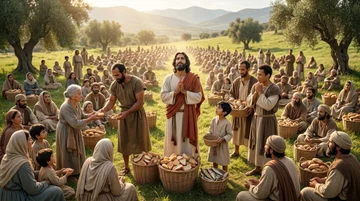
Jesus directed that the meager store be brought to Him.19MR 360.1–3Lt 275, 1903, par. 14–19ST May 20, 1886 He had the men, about five thousand in number, sit down where there was much grass, seating the people on the grass in orderly companies of fifty and a hundred, in parties of fifty or a hundred, to preserve order so all might witness what He was about to do.Ms 156, 1902, par. 1–5Lt 275, 1903, par. 14–19ST May 20, 1886DA 365.3–366.1
Humble Food Available
The only food to be found was a lad's or boy's five barley loaves and two small fishes.ST Aug 15, 1916MH 45.1–4ST Mar 1, 1877DA 365.3–366.1MH 47.1 It was humble fare, the ordinary daily food of the fisher folk about Galilee and the Sea of Galilee.ST Aug 15, 1916MH 45.1–4DA 365.3–366.1MH 47.1 In the Saviour's use of it a humble, everyday offering was honored as the means through which He served others.DA 365.3–366.1ED 217.1–2 When it was brought to Him and placed in His hands it sufficed by divine power to feed the multitude, showing that God can meet human need through what is available.ST Aug 15, 1916MH 45.1–4MH 47.1 Andrew pointed to it in answer to the inquiry what food could be found among the company, after the question to Philip about buying bread had been asked to test faith and Philip had answered that two hundred pennyworth of bread would not give each even a little.Lt 304, 1906, par. 6–13DA 365.3–366.1 Jesus directed that the lad's food be brought to Him and had the people seated on the grass in parties of fifty or a hundred to preserve order so that all might witness what He was about to do.DA 365.3–366.1 The simple food passed round by the hands of the disciples contained a whole treasure of lessons, for He could have spread a rich repast but did not, teaching that God's natural provisions had been perverted and that food prepared merely for gratification of appetite and perverted taste conveys no lesson for good, while rest and simple food far from human habitations bring true enjoyment.DA 365.3–366.1
That store was plainly far too little for the vast assembly in the desert place where no more food could be obtained.ST May 20, 1886STST Mar 1, 1877ST May 10, 1883 It was a slender, meager store belonging to a lad, scarcely enough for twenty people or for a small group, and nothing by ordinary human power among so many thousands of five thousand men besides women and children.3RED 55.2ST May 20, 1886ST Mar 1, 1877ST May 10, 1883ST May 10, 1883 No human power could make that supply feed so many, yet Jesus would not let the crowd go hungry and grow faint on the way home, though He already knew how to provide and asked about the food to test His disciples' faith.ST May 20, 1886STST May 10, 1883 He created from it food sufficient to feed thousands bountifully until all were satisfied, and the food did not diminish as He gave it to the disciples to distribute.3RED 55.2ST May 20, 1886ST Mar 1, 1877ST May 10, 1883 After everyone had eaten the remaining fragments filled twelve baskets.3RED 55.2ST May 10, 1883 His pure and simple teaching had sunk into hearts and His healing of the sick and comforting of sorrow had nearly convinced the people of His divinity, and while eating the food He provided they decided with entire belief that He is indeed the Messiah, since no other one could do so mighty a miracle.ST May 20, 1886
The question, what are they among so many, highlights the apparent insufficiency of the five loaves and two fishes before the great crowd.Lt 302, 1907, par. 3–6Lt 304, 1906, par. 6–13PK 242.1–243.2 It reflects feeble faith that trusts what can be seen rather than God's power to multiply, though Christ could multiply the food.Lt 304, 1906, par. 6–13 It is the same unbelief shown by Elisha's servant when pointing to a small supply as plainly inadequate for feeding the multitude.PK 242.1–243.2 After blessing the food Christ distributed it through the disciples until the crowd had enough, teaching that God supplies temporal needs and that spiritual gifts are freely given, not bought, while directing minds from the food to Himself as the Bread of eternal life.Lt 304, 1906, par. 6–13 What seems insufficient in human hands becomes more than enough in the Lord's hands when people obey His work and trust Him to bless their gifts.PK 242.1–243.2
Miraculous Multiplication
Jesus took the loaves, gave thanks and blessed them, broke the food, and gave it through the disciples to those who were seated, and likewise distributed of the fishes as much as they desired.Lt 252, 1906, par. 2–6Ms 7, 1909, par. 19–20Ms 128, 1905, par. 9–133RED 55.2RH Apr 8, 1909 The food multiplied in the distribution and increased in the hands of those who distributed it, not diminishing as it was broken and passed from hand to hand through the disciples.Lt 252, 1906, par. 2–6Ms 188, 1907, par. 10Ms 7, 1909, par. 19–20Ms 95, 1908, par. 25–263RED 55.2 It remained undiminished until the multitude had eaten and all were satisfied.Lt 252, 1906, par. 2–6Ms 188, 1907, par. 10Ms 7, 1909, par. 19–203RED 55.2ST May 10, 1883 The small store had been brought to Him at His direction after Andrew reported it, and it became the means by which He fed the hungry multitude.Ms 188, 1907, par. 10Ms 128, 1905, par. 9–13Ms 95, 1908, par. 25–26
The miracle fed five thousand men besides women and children.Lt 9, 1902, par. 1–7RH Jan 21, 1909 It is described as above ten thousand persons, and in some accounts as about ten thousand, including five thousand men with women and five thousand children.9MR 31.1–2Lt 9, 1876, par. 1–4DA 809.3 After all had eaten, the remaining fragments were gathered so that nothing would be lost, filling twelve baskets.Ms 188, 1907, par. 103RED 55.2RH Apr 8, 1909ST May 10, 1883RH Jan 21, 1909 One account describes that gathering as five or seven baskets full.Ms 130, 1909, par. 4–6
The feeding was wrought by creative and divine power, the limited supply being increased to sufficiency through His humanity united with divinity.Lt 9, 1902, par. 1–717MR 252.1Ms 19, 1909, par. 7–8 It was done in full reliance on the Father, never wrought to exalt His power or to add glory to the disciples, but wrought intelligently as necessity occurred to satisfy hunger.Lt 252, 1906, par. 2–6 He could have spread a rich repast but used humble fare instead, teaching that God's natural provisions had been perverted and that food prepared merely for gratification of appetite conveys no lesson for good, while rest and simple food bring true enjoyment.DA 365.3–366.1 The actions of the miracle, including the command to gather the fragments, were not only about saving food but were meant to leave a lasting impression on those who witnessed them.Lt 252, 1906, par. 2–6Ms 197, 1907, par. 1–4
Christ the Bread of Life
John 6 stands as the revelation of Christ as the Bread of Life sent down from heaven to give life to the world.FE 455.3–456.18MR 157.3–158.2Lt 88, 1900, par. 2Ms 63, 1890, par. 5–7 It plainly expresses God's will for His people and holds the divine antidote for the sin of the whole world.RH Jun 18, 1901 It defines His righteousness and holds most precious lessons for all educated in schools, an education that endures through time and eternity when its truths are brought into practical life.Ms 68, 1897, par. 9Ms 63, 1890, par. 5–7 The whole chapter is very instructive yet is only faintly understood, and students are to take in Christ's words there to understand their privileges and what He is to them individually and what advantage comes from eating His words.Ms 68, 1897, par. 9 His words are spirit and life, and He Himself is the great center of life.Ms 68, 1897, par. 9
Eating the flesh of the Son of God and drinking His blood means receiving His words, assimilating them, and living by what God has revealed.CH 400.4–401.1Lt 241, 1903, par. 9–10Lt 93, 1901, par. 11 Its truths are to be made part of the soul and part of daily life, obeyed rather than set aside for human suppositions.CH 400.4–401.1Lt 241, 1903, par. 9–10 The Bible contains that bread sent down from heaven, the food from which men and women are built up spiritually.Lt 43, 1905, par. 4 This stands in contrast to the books and magazines flooding the world that lead the mind astray and hinder spiritual growth.Lt 43, 1905, par. 4 Those ministering in word and doctrine must therefore not be dull to understand these important statements but must study them prayerfully, asking God for clearness of understanding.Lt 43, 1905, par. 4
That feeding on Christ must become part of actual experience and not theory.FE 458.2–459.2Ms 68, 1897, par. 19 It is learned as newborn babes desire the sincere milk of the word that they may grow thereby, which is the very education every student needs.FE 458.2–459.2 It is the same as being truly converted and born again and seeing the kingdom of God, obtained by opening the mind to the entrance of God's word with determination to practice it, which gives light and understanding to the simple.FE 458.2–459.2 When it is obtained the frivolous life is changed, the common level is forsaken, the feet are placed upon Christ Jesus as the first round of the ladder, and step by step heavenward Christ is revealed in spirit, words, and actions as lively stones built up a spiritual house.FE 458.2–459.2 The sixth chapter shows how eternal life is gained by cherishing in the heart the truth that works by love and purifies the soul.Lt 95, 1901, par. 18–19
The instruction of the chapter includes education about the law of Jehovah and the penalty for transgression, and that God accepts the ransom made by the Saviour in behalf of those who are obedient to that law.Ms 202, 1898, par. 2 Accepting the righteousness of Christ defined there puts the wedding garment on the believer and joins humanity with divinity in a character fit to remain as a guest at the wedding.Ms 13, 1899, par. 1–2 Without that acceptance there is presumption, measuring character by human ideas, continuing in sin, and loss of the soul.Ms 13, 1899, par. 1–2 The Word of God as the bread of life, representing the body and blood of the Son of God, does not address the understanding alone but aims at the heart, addresses the moral nature, takes possession of the will, casts down imaginations and every high thing exalting itself against the knowledge of God, and brings every thought into captivity to the obedience of Christ.Lt 5, 1898, par. 13–15 Its light reflects back on earlier ages and gives significance to the Jewish system, for Christ's work as substitute for sin was ancient Israel's only hope even before His death, and the New Testament does not replace the Old, whose directions for practical holiness and obedience remain relevant to Christian life.21MR 44.1–2
The small substance of temporal food enlarged by miracle opened the way to place Christ in the chair of instruction as a field preacher on the hill, sitting with authority as teacher to give the people the Word which is the bread of life.21MR 138.2–3Lt 252, 1906, par. 2–6 The miracle lays the foundation for His lesson that the Word must be brought home to the understanding so that mind and soul are filled with its greatness and power, that He is the bread of God come down from heaven to give life to the world.Ms 57, 1898, par. 22–259MR 32.3–5 He made the miracle the occasion for His sermon on the bread of life, setting forth the conditions of eternal life and entrance into the kingdom of God, including death to self and self-denial.Lt 17, 1897, par. 6–8 As temporal bread imparts health and strength to the body, so faith in Christ and obedience to His teachings give spiritual vigor to the soul and life everlasting.2SP 282.1–283.2 That deeper meaning many did not understand, for they sought Him not because they saw the miracles but because they ate and were filled, coming only for temporal advantage.Lt 17, 1897, par. 6–8
Divine Care and Power
The five barley loaves and two small fishes were the only food at hand for five thousand men besides women and children, and Jesus increased them by creative power until all ate and were satisfied.Lt 9, 1902, par. 1–717MR 252.1Ms 19, 1909, par. 7–8 He did so from compassion for a weary, hungry multitude that had followed to hear Him, pitying their physical need as well as their spiritual need and refusing to send them home fasting lest they faint on the way.Lt 9, 1902, par. 1–717MR 252.1Ms 19, 1909, par. 7–8DA 368.2–317MR 252.3 He knew a tired, hungry throng could not receive spiritual benefit without bodily relief, so He provided for the body to open the way for the soul.CH 283.1–2RH May 30, 187117MR 252.3 His benevolent care is not confined to that day, for He still understands bodily need and can give knowledge by which people may obtain food.17MR 252.117MR 252.3
The power that multiplied the loaves is the same divine power that every day multiplies seed into harvest through rain, air, sunshine, and human labor to feed millions and sustain life.ED 107.3ST May 7, 1912ST Aug 12, 1897DA 367.3 The work of growing grain and preparing bread can hide God's agency, leading people to credit only nature or human effort and to misuse His gifts selfishly instead of receiving them as blessings.ED 107.3DA 367.3 People should recognize His hand in daily provision and give Him the glory rather than ascribing sustenance to natural causes alone.ED 107.3ST May 7, 1912DA 367.3 The desert place with no apparent supply teaches dependence on God when need exceeds human resources, while His workers must also use wisdom, avoid recklessly creating difficulty, follow His instructions, and then seek His help with confidence.DA 368.2–3ST Aug 19, 1897
Though able to supply any quantity in a moment, He required the fragments to be gathered so nothing would be lost.17MR 252.2 By the touch of His hand God increases scanty provision and makes it enough for all, able to multiply it a hundredfold and to spread a table in the wilderness for more than a million people.Ms 114, 1899, par. 1–3 When need requires, Jesus can provide food by instantaneous miracle, and He can bless human labor to supply present needs today.MH 200.23MR 352.4Ms 123, 1898, par. 14 He who wrought this wonder walked the earth in lowliness and poverty, yet He is greater than Moses, the Coming One who guided and fed Israel in the wilderness with bread and clear flowing streams and who declared, Before Abraham was, I AM.Ms 114, 1899, par. 1–3
No human power could make that slender store in a desert place feed thousands bountifully until all were satisfied, so the abundant provision was a work of divine power.ST May 20, 1886ST May 10, 1883ST Mar 1, 18773RED 56.12SP 262.3–263.1 His pure and simple teaching had sunk into hearts, and His healing of the sick and comforting of sorrow had nearly convinced the people of His divinity; while eating the food He provided they decided with entire belief that He is indeed the Messiah, since no other could do so mighty a miracle.ST May 20, 18863RED 56.12SP 262.3–263.1 The contrast between the boy's meager supply and the great crowd led them to recognize Him as the prophet foretold by Moses.ST May 10, 1883ST Mar 1, 1877DA 377.1 Seeing the Father's power thus revealed should have helped the disciples recognize the Father in Him and anchored their faith to endure through His suffering and death.DA 368.2–3
Crowd Response and Aftermath
His pure and simple teaching had sunk into hearts, and His healing of the sick and comforting of sorrow had nearly convinced the people of His divinity.ST May 20, 1886 While eating the food He provided from five barley loaves and two small fishes, which no human power could make sufficient for thousands of men besides women and children until all were satisfied, they decided with entire belief that He is indeed the Messiah, since no other one could do so mighty a miracle.ST May 20, 1886ST Mar 1, 18773RED 56.12SP 262.3–263.1 Evidence was heaped upon evidence sufficient to convince any mind open to evidence, and the thoughtful and candid who witnessed it were led to take exalted views of His character and office.Ms 57, 1898, par. 22–25
Many followed because they thought His power would help them in temporal necessities, hoping He would be exalted to David's throne and give them the highest place.ST Jul 21, 1898 They wanted Him to give health, strength and riches to all, to free them from their oppressors and the Roman yoke, and to raise them to earthly power and honor.4RED 97.22SP 283.3–285.1 Their later pursuit was for the loaves that satisfied physical hunger, not because the miracle had convinced them of His divinity, but for material benefit rather than faith in Him.Ms 50, 1898, par. 4–8 They sought Him because they ate and were filled, wanting the meat that perishes and not that which endures to everlasting life, and refusing the meaning that faith in Christ and obedience give spiritual vigor and life everlasting.Lt 17, 1897, par. 6–82SP 283.3–285.1
The feeding became a turning point for Judas, who himself shared in distributing the food to the hungry multitude and saw the relief and joy Christ brought.DA 718.2Ms 106, 1903, par. 46Ms 28, 1897, par. 10–12 He used the crowd's enthusiasm over the miracle to set on foot the project to take Jesus by force and make Him king in Jerusalem, expecting Jesus to be crowned king on David's throne and expecting for himself the first place next to Christ in the new kingdom.Ms 106, 1903, par. 46Ms 28, 1897, par. 10–12 Jesus refused the earthly crown and rebuked the move with greater authority than usual, and after the miracle His popularity began to wane.Ms 9, 1898, par. 31–32Ms 28, 1897, par. 10–12 That rebuke provoked Judas and made him more separated in feeling and love from Jesus, and his worldly hopes ended in bitter disappointment.Ms 106, 1903, par. 46Ms 28, 1897, par. 10–12
Christ made the miracle the occasion for His sermon on the bread of life, setting forth Himself as the Bread of life and the conditions of eternal life and entrance into the kingdom of God.14MR 335.1–39MR 242.1Lt 17, 1897, par. 6–8 When they heard those demands for death to self and self-denial, many who had followed for temporal advantages apostatized almost immediately afterward and walked no more with Him.Lt 17, 1897, par. 6–8 The miracle stands joined to Christ walking on the water and to that declaration after which some of His disciples turned from Him.14MR 335.1–39MR 242.1 Those who later asked for a sign had been among those He fed and had witnessed the feeding of the multitude, yet they closed their eyes to that light, wanted Him to repeat it, hoped to learn how He increased the food, and rejected its call to awaken faith and lead them to accept Him as the Son of God and the Bread of life.Lt 73, 1901, par. 16–1813MR 219.4–220.1ST Jan 11, 1899
News of the miracle spread so widely that people returned to the place the next morning seeking Jesus.ST Dec 29, 18873RED 63.2 The breaking and dividing of bread and fish on the mountainside was later recalled when the risen Jesus shared bread and fish with the disciples and bade them come and dine.6RED 65.3–66.16RED 46.1–2DA 810.4 When He broke the bread and the fish and divided it among the seven on the shore, that former miracle was brought distinctly to their minds with mysterious awe and silence, and seeing it made Him known and acknowledged by all seven.6RED 46.1–2DA 810.4 The later miracle of the draught of fishes was to make the former miracle of the loaves and fishes more impressive, to show that though deprived of the personal companionship of their Master and of sustenance from fishing, a resurrected Saviour had care over them and would provide for them while they were doing His work, and that laboring in connection with Him with His divine power uniting with their human effort would not fail of success.6RED 46.1–2 The earlier miracle thus reminded them that Jesus cared for them and could provide what they needed while they did His work.ST Oct 3, 1878
Giving What You Have
Placed in Christ's hands, the boy's five small barley loaves and two small fishes, ordinary daily food of fisher folk about Galilee and plainly far too little for so many thousands, sufficed to feed the multitude.MH 45.1–4MH 49.2–4ST Aug 15, 1916ED 217.1–2 What seems hopelessly insufficient becomes more than enough in the Lord's hands, for He can bless and multiply a small provision so that it meets great needs.MH 49.2–4ST Aug 15, 19166T 467.1Ms 66a, 1900, par. 30–31 People should therefore offer the means, time and ability they have to meet others' needs rather than hold back because resources seem too small, making the best use of what they have and trusting Him to bless it.MH 49.2–4ST Aug 15, 19166T 467.1 Honest, simple reliance on Him is rewarded, and a meager supply given with an unselfish heart can become a rich feast, honoring a humble everyday offering through which He serves others.ST Aug 15, 1916Ms 66a, 1900, par. 30–31ED 217.1–2
The disciples served as channels between Christ and the people, receiving from Him and passing on to others what He had received from the Father.DA 369.2–4ST Aug 19, 1897ST Jan 22, 1902MH 49.1 Those united to Christ receive the bread of life from Him and share spiritual nourishment with others, for their own resources cannot meet the soul's needs and they can give only what they receive from Christ.DA 369.2–4ST Jan 22, 1902MH 49.1 Their hands were never empty as they reached back to Him, and as they kept imparting they kept receiving, the gift increasing in the distribution.ST Aug 19, 1897ST Jan 22, 1902Lt 7, 1901, par. 1–3 They act as helpers and instruments of His work rather than keeping what they receive for themselves, so its success and glory belong to God, not to them.Lt 7, 1901, par. 1–3ST Apr 24, 1901
Like Andrew, people may lose heart when resources appear inadequate and hesitate to give what they have for others.STMW8 30.2–31.2DA 369.1Ms 47, 1894, par. 10–11 Workers should not be discouraged, measure advance by means at hand, or conclude they can do nothing because what can be seen looks too small beside the great need.Ms 71, 1911, par. 5–8DA 369.1Ms 47, 1894, par. 10–11 Christ's command to feed the hungry stands behind them with the same power that fed the multitude, and being connected with Him calls for doing one's best even when it is not much, then casting the helpless soul on Jesus as Saviour and Redeemer with a faith that works by love and purifies the soul.Ms 130, 1909, par. 4–6Lt 139, 1900, par. 21DA 369.1 He accepts limited abilities and resources put to work, blesses the scant supply, and multiplies what is entrusted to Him until everyone has enough, showing the greatness of the resources God provides for those who serve Him.Lt 139, 1900, par. 21STMW8 30.2–31.2Ms 71, 1911, par. 5–8Ms 47, 1894, par. 10–11
The question, What are these among so many, also applies to temptations that can feel overwhelming.Ms 188, 1907, par. 11 Commercialism is one such danger, diverting attention and time from the daily privilege of coming to Jesus and telling Him what is needed until ambition gains power in the heart.Ms 188, 1907, par. 11
The feeding prepares disciples for work as His representatives to give spiritually hungry people the bread of life.6T 263.1RH Aug 11, 1910COL 140.4–5 Feeling too weak and empty to meet the needs before them, they must seek spiritual food from God, the source of supply, so they will have something to give and will not turn anyone away unfed.RH Aug 11, 1910COL 140.4–5 Its methods can guide practical work, carried out simply and without selfish interests, sharing with the needy of every rank and nation what is received from Him, with temporal and spiritual blessings accompanying that giving.6T 263.1Lt 302, 1906, par. 5ST Apr 24, 1901 Those who work together with God in this way carry out Christ's purpose.Lt 7, 1901, par. 1–3
Small means given with thanksgiving, prayer and unselfish service are multiplied and blessed by the Lord just as the food given to the disciples was multiplied to feed the five thousand men besides women and children until all were satisfied.STB 148.2–3Ms 182, 1907, par. 21–23Ms 180, 1907, par. 27–28STB 119.3–4 Wisely used gifts increase in distribution, and when the best use is made of the means available God enables His workers to feed multitudes starving for the bread of life.STB 148.2–3STB 119.3–4 Even when resources are scant people are to share what they have, show hospitality, consider those who lack the truth, and waste nothing, and such intelligent, self-denying, self-sacrificing gifts for soul-saving work enlarge generosity for His work and provide tact, skill and understanding.6T 345.1–3Ms 182, 1907, par. 21–23Ms 180, 1907, par. 27–28Ms 66a, 1900, par. 30–31
The same Provider gives wisdom, skill, talent and ingenuity to devise means to feed the hungry and to manufacture necessary, wholesome, inexpensive foods to be sold to the poor at as low a rate as possible, a food business that is one of the Lord's own instrumentalities to supply human necessity.Lt 27, 1902, par. 17–19Ms 81, 1902, par. 14 He will not leave His people in ignorance but will teach them how to prepare the best foods for all times and occasions, work more needed in the Southern states than in any other part of America and to be made the subject of earnest prayer.Lt 27, 1902, par. 17–19Ms 81, 1902, par. 14 His gifts, including knowledge about producing food, are not to be restricted to a favored few, and no human being is to be put where God should be or forbid others from work God has given them.Lt 199, 1901, par. 18–20
God's truth multiplies as it is distributed, and those who dedicate themselves to God may receive the Holy Spirit to share with people in need.6T 263.1Ms 186, 1907, par. 8–9Lt 7, 1901, par. 1–3 The disciples also ate from the provision they handed out, with temporal and spiritual blessings accompanying that giving.6T 263.1
Economy Without Waste
After hunger was met from five barley loaves and two small fishes, the remaining food was ordered to be gathered so that nothing would be lost, teaching careful economy and thrift especially in time of need.STB 772.1–2Ms 64, 1910, par. 10–11ST Dec 15, 19092T 292.1CH 283.1–2 Though any quantity could have been supplied in a moment by creative power, every fragment was required to be saved, showing that industry, frugality and faithful use of Providence are required and that bounties are not to be squandered in aimless waste.Ms 64, 1910, par. 10–11ST Dec 15, 19092T 292.1CH 283.1–217MR 252.2 What is provided is to be used as gifts from His hand, valued and preserved as works of help, teaching dependence for life, food, health and breath.STB 772.1–2Ms 64, 1910, par. 10–11ST Dec 15, 1909CH 283.1–217MR 252.2
Food and other useful things and resources are not to be wasted but are to be carefully saved, economically used, and shared with the hungry.Ms 64, 1910, par. 10–11ST Dec 15, 19092T 292.1Ms 182, 1907, par. 21–23Ms 139, 1898, par. 21 Even when one person cannot feed everyone, faithful use of what is entrusted can feed some and help share the bread of life with needy souls.Ms 64, 1910, par. 10–11ST Dec 15, 1909Ms 182, 1907, par. 21–23Ms 139, 1898, par. 21 The fragments gathered illustrate sharing spiritual bread with others, for truth increases as it passes from Christ to receivers, and even a fragment carrying present truth for this time can influence a seeker.ST Dec 15, 1909Ms 127, 1903, par. 10Ms 67, 1903, par. 36–37
The same divine power that fed five thousand men besides women and children with five loaves and two fishes was present in daily labor to support the family, yet it was not used to lessen personal burdens and toil, showing that useful labor is honorable.RP 26.5–6CT 276.3–4 Supplying temporal food to the hungry opened the way to place Christ in the chair of instruction as a field preacher giving the Word which is the bread of life, and prepared the way for Him in many places.21MR 138.2–3Lt 252, 1906, par. 2–6 So deeds of mercy open a door and bring reputation before large numbers for disciples as they break the bread of life to hungry souls, speak the truth in love, repeat the impression made on hearts, and gather all His words without wasting a fragment, since the miracle was wrought not to exalt power or add glory to disciples but intelligently as necessity occurred to satisfy hunger.21MR 138.2–3Lt 252, 1906, par. 2–6
Sources
Pioneers and periodicals
131 sources
Andrew tells Jesus a boy is there with five barley loaves and two small fishes and asks what such a little is among so many, after Philip has said two hundred pennyworth of bread would not give everyone even a little.ST Feb 1, 1899ST Feb 1, 1899ST May 20, 1886 The loaves are a boy's small lunch of coarse barley cakes, the poor people's daily fare, and the fishes are very small, plainly too little to feed the great crowd of about five thousand men besides women and children sitting in order in the grassy wilderness at evening.ST Aug 15, 1916ST Jun 6, 1900ST Jun 6, 1900ST Jul 26, 1905 Brought to Jesus, the little store is blessed, broken and passed through the disciples to the multitude, multiplying by creative power as it is broken and eaten until all are filled and twelve baskets of fragments are gathered.RH Apr 8, 1909ST May 10, 1883RH May 29, 1900ST Mar 14, 1911RH Apr 22, 1915 The provision shows Christ's compassionate care for bodily and spiritual need and his unlimited power to provide, pointing to himself as the Bread of Life come down from heaven whose flesh is given for the life of the world.ST Mar 8, 1899ST Sep 17, 1912ST Nov 3, 1898ST May 12, 1909RH Dec 8, 1859 What seems inadequate becomes more than sufficient when fully placed in his hands, for he makes his disciples channels of blessing and multiplies little yielded in trust, so limited capacity is to be used and not despised and the day of small things is not to be lightly esteemed.ST Mar 15, 1905RH Feb 26, 1901RH Apr 10, 1900RH Oct 28, 1915
Words and Setting
Andrew, Simon Peter's brother, reports to Jesus that a lad is present who has five barley loaves and two fishes, and asks what such a supply is among so many, after Philip has said that two hundred pennyworth of bread would not give everyone even a little.ST May 20, 1886ST Feb 1, 1899ST Feb 1, 1899ST May 20, 1886ST Feb 15, 1905 The remark volunteers the information about the boy and his food while regarding it as inadequate for the great crowd, counting the small store as nothing among so many.ST Feb 1, 1899ST May 20, 1886ST Feb 15, 1905ST Jun 14, 1899 The disciples have only this available when Jesus asks about feeding the crowd, and the question highlights how insufficient it is for so many people.ST May 20, 1886ST Jun 14, 1899
The five barley loaves are a boy's small lunch, the ordinary daily fare of Galilee's fisher folk and poor people's food.ST Aug 15, 1916ST Jun 6, 1900ST Jun 6, 1900RH Jul 28, 1903ST Jul 10, 1893 They are thin, coarse, flat cakes, likely poor people's flat cakes carried in a basket, made through ordinary unnoticed work including humble domestic labor such as a mother's work.ST Jun 6, 1900ST Jun 6, 1900ST May 29, 1884ST Jul 10, 1893 This small provision, made without notice, becomes part of a meal that refreshes many, showing that humble labor can contribute to great blessing.RH Jul 28, 1903ST May 29, 1884ST Jul 10, 1893 The two fishes are very small fish, probably small fish eaten dried or pickled with bread.ST Jun 6, 1900ST Jun 6, 1900
The setting is a deserted wilderness place, a desert place in country away from towns on the east side of the Sea of Galilee, where no more food can be obtained.ST May 20, 1886ST Mar 1, 1877ST May 20, 1886 There is much grass where the people are seated on the grass in orderly companies of fifty and one hundred to witness what is done, as evening approaches after they have spent all day without food.ST May 20, 1886ST Feb 1, 1899ST Oct 12, 1904 About five thousand men besides unnumbered women and children are present, perhaps ten thousand men, women and children in all, with the slender store scarcely sufficient for a score of persons.ST May 20, 1886ST Mar 1, 1877ST May 20, 1886ST Oct 12, 1904 The time belongs to when the Jews have assembled to celebrate the Passover, and the place lies within sight of the shore where the disciples later meet the risen Jesus.ST Sep 1, 1881
In narrative order the small supply is reported, the multitude of about five thousand men is made to sit down on much grass, Jesus gives thanks, distributes loaves and fishes as much as they want until they are filled, and has the disciples gather the broken pieces that remain so nothing is lost, filling twelve baskets from the five loaves.ST May 20, 1886ST Feb 1, 1899 Whereupon the people who see the sign call him the Prophet that comes into the world.ST Feb 1, 1899 The account gives details of time, place and circumstances, making the public miracle specific and open to verification by the many present and their contemporaries.RH Feb 4, 1862 Its importance is shown by its appearance in all four Gospel accounts.
Miracle of Multiplication
The five barley loaves and two small fishes were plainly inadequate for the great crowd by ordinary means, a meager store scarcely enough for a score of people and far too little for thousands gathered in a deserted place.STST May 10, 1883ST Mar 18, 1913ST Jul 26, 1905ST Dec 22, 1887 No human power could make such a boy's small lunch feed so many, and the disciples themselves judged the scant food wholly insufficient for the multitude.STST Jul 26, 1905 Jesus already knew what He would do, yet He asked about food to test the disciples' faith and strengthen it, and He would not let the crowd go hungry and grow faint on the way home.ST May 10, 1883 Their response of anxious calculation, sense of obstacle, and discouragement shows the absolute incompetence and nothingness of human resources beside a great need.RH Dec 23, 1902RH Dec 23, 1902 God brings His people face to face with such almost insuperable difficulty to reduce them to that point, that they may learn to trust Jesus more, that Jesus may have opportunity to reveal Himself and the Father to them, and that the world seeing Christ use such poor childlike resources may gain greater and more adoring conceptions of what Jesus is.RH Dec 23, 1902
The meager store was brought to Jesus, who looked up to heaven, asked God's blessing, broke it, and gave it through the disciples to the multitude.RH Apr 8, 1909RH May 29, 1900ST Dec 22, 1887 Relying fully on God, He put the food into the disciples' hands to distribute, and it multiplied by creative power as He broke it, as the disciples broke what they held, and as the people received and ate.ST Aug 19, 1897RH Jan 7, 1909ST Dec 22, 1887 As Jesus distributed through the disciples it did not diminish, and their hands were never empty as they reached back to Him, for they received from Christ and served as channels through which He supplied the people.ST Aug 19, 1897ST Dec 22, 1887 Placed in His hands and blessed, the small lunch became an immense provision that met their needs, and the food multiplied as it was passed from hand to hand without diminishing until all were satisfied.RH Jan 7, 1909RH May 29, 1900ST Mar 14, 1911RH Apr 22, 1915 This work was one of the works of the Father witnessed through Christ, teaching His followers to depend on Him for supplies and to pass on what they receive.ST Aug 19, 1897RH Jan 7, 1909
Everyone ate enough and was filled, including five thousand men as well as women and children, and twelve baskets of fragments were gathered so that nothing was lost.RH Apr 8, 1909ST May 10, 1883RH Jan 21, 1909ST Oct 28, 1897 What began as a tiny store that would fill only a corner of one basket left twelve baskets bulging with broken pieces, more than was begun with and more than twelve times the original quantity, with the last served as full as the first.ST Mar 30, 1904 How He multiplied it stays hidden like all creative acts, but the meaning stands plain that Christ has inexhaustible supplies for a hungry world, and blessings in His hands increase.ST Mar 30, 1904ST Oct 28, 1897 The crowd was fed by miracle with details of time, place, and circumstances making the public act specific and open to verification by the many present and their contemporaries, and news of it spread so widely that people returned to the place the next morning.ST Dec 29, 1887RH Feb 4, 1862
Christ Revealed in Provision
The small store blessed and multiplied to feed thousands displays unlimited ability to provide, miraculous and creative power, omnipotence and beneficence.RH Dec 8, 1859RH Mar 22, 1906ST Apr 29, 1908RH Jan 4, 1912 That miracle of mercy confirmed the divine mission.RH Dec 8, 1859 The power that fed thousands stands paired with power over death.RH Mar 22, 1906
Compassionate provision for those in need shows care for every need, bodily and spiritual.ST Mar 8, 1899ST Mar 22, 1899RH Jun 22, 1905 The spiritual need of the multitude is met with the bread of life, and physical hunger is met by miracle with food, rather than sending them away to faint on the way home.ST Mar 8, 1899ST Mar 22, 1899 They are pitied as sheep having no shepherd, followed into the wilderness so intent on hearing that comfort is neglected, and not forgotten or left to another hand even when no earthly support is seen.ST Mar 22, 1899ST Nov 24, 1887RH Jun 22, 1905 A tired hungry throng is known to be unable to receive spiritual benefit unfed, so bodily need is considered and practical help is given to make coming easier not harder, while those seeking salvation are treated with compassion and tempted wearied servants are healed, supplied and comforted as by the good Samaritan.RH May 30, 1871ST Aug 12, 1897ST Nov 24, 1887
The loaves point to Jesus come down from heaven as the Bread of Life whose flesh is given for the life of the world.ST Sep 17, 1912ST May 12, 1909RH Aug 6, 1908 Life is not in the mere materials eaten but comes from Christ himself through his living eternal word, for his words are spirit and are life.ST Sep 17, 1912 The soul must feed on him for life as fresh living experience each day, as daily bread, which yesterday's experience cannot replace.ST Nov 3, 1898 That spiritual life comes through believing, bringing life into harmony with God's law and opening the channel between soul and God, and contains great spiritual truth feeding the soul that truly desires to be fed.ST May 12, 1909ST Oct 6, 1909ST May 12, 1909 The broken and blessed meal of ordinary bread shared thus brings receiving of Christ and his truth, freedom from bondage and peace.RH Aug 6, 1908
The supply of five barley loaves and two small fishes could not naturally feed thousands and was plainly insufficient by ordinary human power for even such a crowd.ST May 10, 1883ST Mar 1, 1877ST Dec 22, 1887 Used to provide food for them all, it demonstrated power to provide abundantly.ST May 10, 1883ST Dec 22, 1887 The people were convinced with growing and entire belief that he was indeed the Messiah and Prophet, since no other one and no human power could do so mighty a miracle.ST May 10, 1883ST Mar 1, 1877ST Dec 22, 1887 The good given returned to him in power, influence and beginning belief.
After the feeding the people tried to make him king and to take him by force, acting on expectation of a visible earthly government from the promised King.ST Sep 25, 1893ST Mar 5, 1896 Selfish, patriotic and temporal motives moved them to proclaim him king at Jerusalem, rouse the Jews, and under such a mighty Leader throw off the Roman yoke and become the first kingdom in the world, freed from intolerance and oppression, with one who could supply all needs in the desert and furnish everything.ST Mar 5, 1896 The free gift was counted loss for the bag, reckoned in many shekels that could have been made that day, and estimated as if sold instead of given.ST Nov 22, 1910ST Oct 25, 1910 One who could create such food was argued able to provision an army to go up against the Romans, so the time seemed ripe to go up and take the kingdom, and the movement was labored for until set of sun and headed as a turbulent throng.ST Nov 22, 1910ST Oct 25, 1910 Satan shaped the movement as temptation in another form to avoid Gethsemane and Calvary.ST Mar 5, 1896 The desire was carnal, for loaves and fishes and not for character, so the crown was refused, the intent perceived, and withdrawal made to the mountain.ST Sep 5, 1895 The feeding remained a work of mercy, not a reason to seek praise or accept a crown, but to continue freeing and helping those in need with what had been received from God. The time of the kingdom had not come and subjects were not ready, for reign is only where service is willing and loving and where he is gladly chosen as King in heart and life.ST Sep 5, 1895 Not long after he declared himself the Bread from heaven and turned a whole multitude away, then said the twelve had been chosen and one of them was a devil, with eyes fixed on the betrayer.ST Nov 22, 1910
Humanity and divinity were combined in Christ in this miracle.RH May 20, 1909 The same Jesus who lived among people and shared their human needs performed mighty works with only a few barley loaves and small fishes.ST Apr 15, 1897 The disciples remembered the feeding of the five thousand when he provided for them after his resurrection, as proof that he cared for them and could supply what they needed while they did his work.ST Oct 3, 1878 Followers likewise need faith laying hold of Christ and joining them to him through self-denial and self-sacrifice.RH May 20, 1909
Scripture Links and Doctrine
The feeding follows the wilderness manna and shows the same divine power at work in ordinary growth as in miracle, for the power that multiplied the loaves is the power that makes sown grain multiply into full ears, working through sunshine and rain and seedtime and harvest and the daily growing and preparing of food.ST May 7, 1912ST Aug 12, 1897ST Aug 26, 1880RH Feb 8, 1906 Every loaf is a gift from God even when its production takes time rather than happening instantly, and the daily harvest produced through the farmer's work is still God's gift and provision.RH Jan 9, 1900RH Apr 9, 1901 The miracle was not only a way to feed the hungry but a lasting sign that God is the source of life's ordinary blessings, continually sustaining life with daily food and daily bread, and it reminds people that the gifts of nature come from Christ and should lead them to give God the glory rather than crediting human effort or natural causes alone or merely hoping for another meal.ST May 7, 1912RH Jan 9, 1900RH Apr 9, 1901RH Feb 8, 1906
The account belongs with prayer for daily bread, and the food God gives is not limited by the small amount available.ST Jun 13, 1900ST Dec 24, 1902 In this it illustrates God's yearly provision of food for the world.ST Dec 24, 1902
The chapter plainly expresses God's will concerning His people and contains the divine antidote for the sin of the whole world.RH Jun 18, 1901 Eternal life and resurrection to immortal life are promised there no less than six times, each promise given on condition of eating His flesh and drinking His blood by faith, proving that the promises of life are everywhere conditional and not given to all without condition.RH Jun 13, 1854RH Dec 2, 1858 Those who comply with the conditions will be raised up at the last day, while those who do not comply will not then be raised, proving two distinct resurrections with the blessed and holy raised a thousand years before the rest of the dead.RH Jun 13, 1854
As the small food fed a multitude, so the Bible though small in bulk has fed thousands in every age and will feed multitudes in every land of Christendom until the end of time.RH Jun 21, 1870RH Feb 22, 1870 The miracle of the loaves is repeated wherever the Word of God is truly eaten day by day until it becomes part of the man. He who truly feeds upon Jesus Christ himself becomes a living epistle, a new translation of God's Word, giving it to others so that they feed upon it and live, and thus the food multiplies through men and women regenerated by the power of the word of Jesus Christ.
The feeding pictures heaven as a place where everyone has enough to eat.RH Mar 9, 1916 Yet the miracle drew many because they saw it as an easier way to obtain their daily bread, but it did not replace God's plan for people to earn their bread through work.RH Jun 22, 1916
The account describes a literal feeding of people's bodies with physical food, not merely a symbolic feeding of their souls with the bread of life.ST Jul 25, 1911ST It was a meal served to a crowd, and unlike the Lord's supper it was not a private observance given only to disciples.RH May 27, 1873
Stewardship and Order
After the multitude was fed, the fragments were ordered to be gathered so that nothing would be lost, and twelve baskets remained from the five barley loaves and two small fish that had fed thousands.ST Dec 15, 1909RH Mar 16, 1905RH May 29, 1900RH Oct 13, 1874RH Sep 1, 1868 This gathering teaches careful stewardship of God's gifts and material blessings, saving even small amounts, preserving what is useful, and being faithful in small things rather than wasting food, resources, or opportunities for doing good.ST Dec 15, 1909RH Mar 16, 1905RH May 29, 1900RH Oct 13, 1874RH Sep 1, 1868 The leftover food could be shared with others, just as the spiritual bread received from Christ is to be shared with others.ST Dec 15, 1909 God does for man what man cannot do for himself, yet man must cooperate by doing what he is able, so to ask God to do everything is folly rather than faith.RH Jul 23, 1901
Before the increase, the people were commanded to sit down, and that command stilled clamor and restored order among the great company facing apparent shortage.ST Nov 21, 1911 The lesson is calm and order instead of noisy protest, pausing to think and turning to God in need.ST Nov 21, 1911 Those who work for Christ are to give just as good instruction to five thousand as to one.ST Sep 10, 1896
The meal itself was plain and substantial, barley loaves and fish like the manna in the wilderness, the same fare shared by Jesus and his disciples, with no delicacies to tempt appetite.STRH Dec 3, 1901 Its plainness teaches simplicity, contentment with plain necessities rather than luxury and display, and trust in tender care that supplies ordinary needs even in poverty while promising the better gift of abiding presence rather than worldly luxuries.STRH Dec 3, 1901 By multiplying barley loaves, honor was put upon barley bread just as the miracle at Cana honored wine.ST Jan 12, 1882ST Jan 24, 1878ST Apr 22, 1889 For that reason such honored food may still be set aside, not from dislike or dishonor, but to bear a weaker brother's infirmity and fulfill Christ's law.ST Jan 12, 1882ST Jan 24, 1878ST Apr 22, 1889 Food's value lies not in nourishment alone but in satisfying the mind as well as the body.RH Dec 21, 1905
The miracle was sufficient evidence of power, yet the leaders closed their eyes to the light and still demanded a sign.ST Jan 11, 1899 The crowd itself was more impressed that hunger had been relieved than by the kindness, pity, and power displayed.ST Mar 14, 1911 Christ took the accustomed food they desired and met their immediate need and appetite rather than imposing reform.RH Dec 21, 1905 Lasting reform must grow from conviction and education.RH Dec 21, 1905
Small Gifts Used Greatly
Christ makes His disciples fellow workers who receive from Him and hand to others, so that the small store becomes the means of boundless supply and reveals Him as the living Bread come down from heaven.ST Aug 19, 1897ST Mar 15, 1905ST Apr 11, 1906 What is received is not to be hoarded but shared, for those united to Christ receive the bread of life and temporal supplies from the Father through Him and pass them on.ST Apr 11, 1906ST Apr 25, 1900ST May 13, 1880 His command to give is also a promise backed by the same power that fed the multitude, and the food multiplied as the disciples gave it out, their hands never empty as they reached back to Him.ST Aug 19, 1897ST Apr 25, 1900RH Mar 17, 1903 The work is done not by human might but when men work in harmony with God's purposes and follow His directions, and continued giving brings continued receiving, with success belonging to God.ST Mar 15, 1905ST May 13, 1880RH Mar 17, 1903
What looks wholly inadequate becomes sufficient when fully placed in His hands, blessed and broken by Him.STRH Feb 26, 1901RH May 29, 1900 The five barley loaves and two small fishes seemed far too little for the hungry crowd, scarcely enough to begin with, yet brought to Jesus in simple trust they were multiplied to meet needs far beyond themselves.STRH Apr 10, 1900RH Apr 17, 1900ST Aug 5, 1913 Though He had power to provide in abundance without it, He used what was offered to teach hope, trust, and dependence on the Father in emergency.RH Apr 10, 1900RH May 29, 1900ST Aug 5, 1913 Lives yielded to God, however insignificant, become His starting point, for He calls for human submission rather than replacing it by bare miracle.STRH Feb 26, 1901RH Apr 17, 1900
The lad gave his whole small store rather than keeping it for himself, and thereby fed thousands, going home himself fed and spiritually blessed.RH Nov 17, 1904RH Dec 9, 1902RH Dec 8, 1904 Given without reserve to Jesus and used as He chose, the boy's food, far too little by ordinary means, became abundant with food left over, showing that giving for God's work need not leave His people without life's necessities.ST Aug 15, 1916RH Dec 9, 1902RH Dec 8, 1904 Small offerings can thus become the means of feeding those who otherwise would go without, and what seems too little may meet a real need and through Christ benefit many.ST Aug 15, 1916 Every righteous offering accepted by God is treasure in heaven, and children following this example turn small contributions into help for orphans, while all are taught to give their best however little rather than later grieving that they could have helped.RH Feb 6, 1908ST Aug 2, 1905
The question what are they among so many expresses how small means look beside vast needs, and is applied to missions where thirty-six in Prague and eighty-three in the field stand beside more than three and a half million souls for each laborer.RH Nov 28, 1907RH Feb 27, 1908RH Feb 4, 1904 It is the few missionaries beside India's three hundred million, two families among twenty-five million in East Bengal, two couples in the Philippines, two workers for Puerto Rico's 950,000, one minister among hundreds of thousands in Central America, one worker for three million in Egypt, few schoolrooms for colored people, and few pupils at Calcutta as only a beginning.ST Mar 26, 1912RH Dec 27, 1906RH Feb 27, 1908RH Feb 4, 1904RH Mar 18, 1909 Yet yielded effort brings results that belong to the Lord, for limited gifts and lives offered in service, entrusted to Jesus, can feed multitudes hungry for the gospel and help finish the work before the Saviour comes.ST Mar 26, 1912RH Feb 27, 1908RH Mar 18, 1909 The imbalance is reason to depend on God for prosperity and a call for more laborers.RH Nov 28, 1907RH Feb 4, 1904
A lad's loaves are any small gift a person can bring to Jesus, like a few pennies or shillings saved for foreign missions, and the cry of discouragement when the gift looks worthless beside the great need is answered when it is offered to Him.RH Jul 14, 1910RH Jul 14, 1910ST Mar 26, 1912 Given prayerfully and cheerfully, even in hard times and rising cost of living, small gifts given in real sacrifice are blessed and multiplied to benefit many, for the earth and its fullness are the Lord's and the cause of salvation is His.RH Jul 14, 1910ST Mar 26, 1912ST Jun 22, 1904 He takes the best means available, blesses them, and uses them while better means are still sought, and by His Spirit moves other hearts through them, even leading a rich young man who cared nothing for religion to give himself as a missionary to Africa.RH Jul 14, 1910RH Apr 5, 1906
The lad with loaves and fishes stands with the widow and her mites as the ordinary unit of society and smallest atom of service, picturing the one-talented person whose limited capacity must be used not despised.RH Jul 14, 1910RH Dec 20, 1906 Having little is no reason to hold back from trying to help others, and small gifts should not be dismissed because they are small.RH Jul 14, 1910RH Dec 20, 1906ST Aug 2, 1905 An ordinary offering in everyday work is thereby honored, children's gifts can serve Christ's work and bless the world, and the world suffers loss when those who cannot do much do nothing.ST Jan 18, 1916ST Aug 2, 1905
The day of small things is not to be lightly esteemed, for God frequently works quietly without noise from insignificant beginnings to great results.RH Oct 28, 1915RH Aug 11, 1910RH Aug 18, 1910 He expects each person to give whatever he has however small, forbidding the word I can't when duty calls, and in wisdom, goodness and power makes that offering carry out His purpose.RH Oct 28, 1915RH Aug 18, 1910ST Jul 23, 1912 In doing so He blesses the owner, sanctifies the instrument, and brings honor and glory to Himself, so that even a moment's utterance can become part of a great blessing.RH Aug 11, 1910ST Jul 23, 1912
Sources