Exodus 2:10
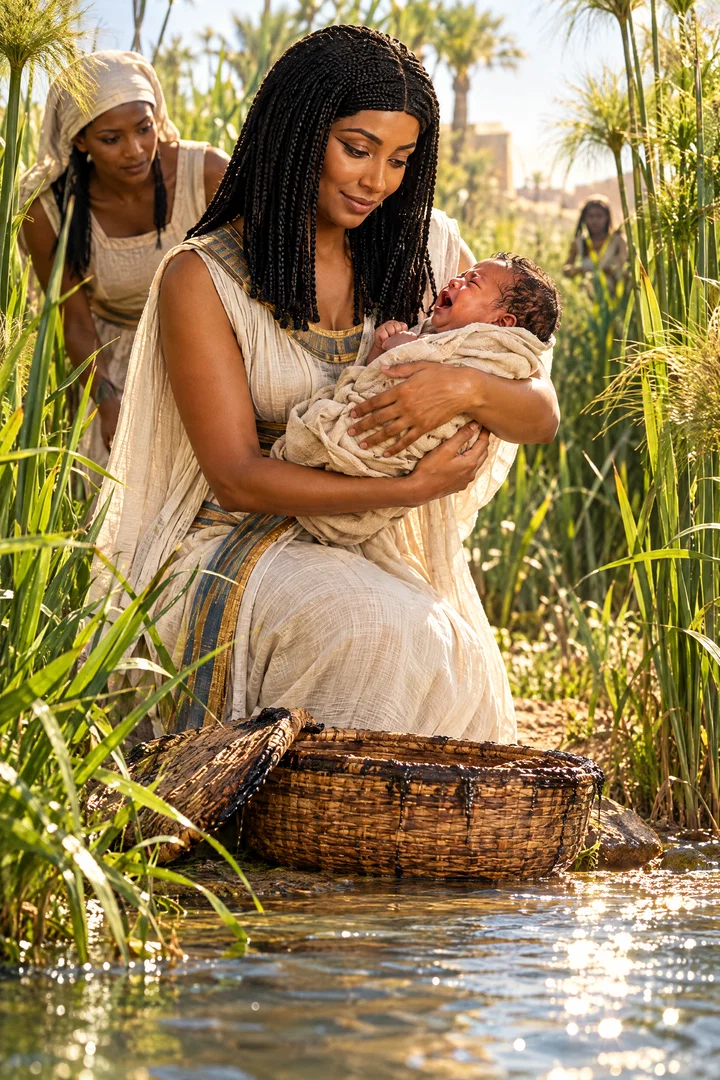
And the child grew, and she brought him unto Pharaoh’s daughter, and he became her son. And she called his name Moses: and she said, Because I drew him out of the water.
Translations
And the child grew, and she brought him to Pharaoh’s daughter, and he became her son. And she called his name Moses: and she said, Because I drew him out of the water.
King James Version, KJV Cambridge Paragraph Bible
And the child grew, and she brought him unto Pharaoh’s daughter, and he became her son. And she called his name Moses: and she said, Because I drew him out of the water.
And the child grew, and she brought him to Pharaoh's daughter, and he became her son. And she called his name Moses: and she said, Because I drew him out of the water.
Revised Version, American Standard Version
And the child grew, and she brought him unto Pharaoh’s daughter, and he became her son. And she called his name Moses, and said, Because I drew him out of the water.
And the lad groweth, and she bringeth him in to the daughter of Pharaoh, and he is to her for a son, and she calleth his name Moses, and saith, 'Because — from the water I have drawn him.'
And when the child was grown, she brought him to Pharaoh's daughter, and he became her son. And she called his name Moses, and said, Because I drew him out of the water.
And the child grew, and she brought him in to Pharaoh’s daughter, and he became her son. And she called his name Moses, and said—For out of the water, I drew him.
Berean Standard Bible, Majority Standard Bible
When the child had grown older, she brought him to Pharaoh’s daughter, and he became her son. She named him Moses and explained, “ I drew him out of the water.”
The child grew, and she brought him to Pharaoh’s daughter, and he became her son. She named him Moses, and said, “ Because I drew him out of the water.”
And when the child was older, she took him to Pharaoh's daughter and he became her son, and she gave him the name Moses, Because, she said, I took him out of the water.
Nowe the childe grewe, and she brought him vnto Pharaohs daughter, and he was as her sonne, and she called his name Moses, because, said she, I drewe him out of the water.
Douay-Rheims (Challoner revision)
And she adopted him for a son, and called him Moses, saying: Because I took him out of the water.
Pictures
Cross-references
- Acts 7:22
And Moses was learned in all the wisdom of the Egyptians, and was mighty in words and in deeds.
adoption gave him wisdom of Egypt
- Exodus 1:22
And Pharaoh charged all his people, saying, Every son that is born ye shall cast into the river, and every daughter ye shall save alive.
Pharaoh’s decree to kill Hebrew boys makes Moses’s rescue and preservation significant.
- Hebrews 11:23
By faith Moses, when he was born, was hid three months of his parents, because they saw he was a proper child; and they were not afraid of the king’s commandment.
Moses’ parents preserved him by faith despite the king’s command.
- Hebrews 11:24-25
By faith Moses, when he was come to years, refused to be called the son of Pharaoh’s daughter;
Moses refused Pharaoh’s household status and chose to suffer with God’s people.
- Exodus 1:15-17
And the king of Egypt spake to the Hebrew midwives, of which the name of the one was Shiphrah, and the name of the other Puah:
The midwives defied Pharaoh’s decree, helping preserve Moses from its danger.
- Exodus 2:15
Now when Pharaoh heard this thing, he sought to slay Moses. But Moses fled from the face of Pharaoh, and dwelt in the land of Midian: and he sat down by a well.
Moses fled from Pharaoh to Midian.
- Exodus 3:1
Now Moses kept the flock of Jethro his father in law, the priest of Midian: and he led the flock to the backside of the desert, and came to the mountain of God, even to Horeb.
Moses keeps sheep in Midian before God calls him to lead Israel.
- Exodus 2:6
And when she had opened it, she saw the child: and, behold, the babe wept. And she had compassion on him, and said, This is one of the Hebrews’ children.
The infant Moses is discovered in the ark, and Pharaoh’s daughter has compassion on him.
- Acts 7:20
In which time Moses was born, and was exceeding fair, and nourished up in his father’s house three months:
Moses’ beauty prompted his preservation and adoption.
- Matthew 2:13-16
And when they were departed, behold, the angel of the Lord appeareth to Joseph in a dream, saying, Arise, and take the young child and his mother, and flee into Egypt, and be thou there until I bring thee word: for Herod will seek the young child to destroy him.
Herod’s attempt to kill Jesus recalls Pharaoh’s threat to Moses.
- Acts 7:25
For he supposed his brethren would have understood how that God by his hand would deliver them: but they understood not.
Moses expected Israel to understand that God would deliver them through him.
- Exodus 2:2
And the woman conceived, and bare a son: and when she saw him that he was a goodly child, she hid him three months.
Moses’ beauty prompted his parents to risk preserving him.
- Revelation 15:3
And they sing the song of Moses the servant of God, and the song of the Lamb, saying, Great and marvellous are thy works, Lord God Almighty; just and true are thy ways, thou King of saints.
Moses’ story leads to the song of Moses.
- Jude 1:9
Yet Michael the archangel, when contending with the devil he disputed about the body of Moses, durst not bring against him a railing accusation, but said, The Lord rebuke thee.
Alludes to the dispute over Moses’ body.
- Exodus 3:10
Come now therefore, and I will send thee unto Pharaoh, that thou mayest bring forth my people the children of Israel out of Egypt.
Moses is called to lead Israel out of Egypt after his Midian training.
- Matthew 2:16
Then Herod, when he saw that he was mocked of the wise men, was exceeding wroth, and sent forth, and slew all the children that were in Bethlehem, and in all the coasts thereof, from two years old and under, according to the time which he had diligently enquired of the wise men.
Herod’s decree mirrors Pharaoh’s decree against the children.
- Matthew 17:3
And, behold, there appeared unto them Moses and Elias talking with him.
Moses appears with Elijah and Christ in heavenly glory.
- Acts 7:30
And when forty years were expired, there appeared to him in the wilderness of mount Sina an angel of the Lord in a flame of fire in a bush.
Moses spent forty years in the wilderness before his mission.
- Exodus 4:10-16
And Moses said unto the LORD, O my Lord, I am not eloquent, neither heretofore, nor since thou hast spoken unto thy servant: but I am slow of speech, and of a slow tongue.
Moses’s mission continues with Aaron as his spokesman.
Commentary
Each commentary is drawn from primary sources: the writings of Ellen G. White and Adventist pioneers and periodicals. Each commentary is separate. Its own words are not a quotation; follow the references to read the source passages.
Ellen G. White
18 sources
The verse records that after being drawn from the water the child grew for a time under his mother's care and was then brought to Pharaoh's daughter, becoming her adopted son and a grandson of the king in the royal household.SG3 180.1–182.11SP 163.1–164.11SP 167.2–168.1 His Hebrew mother, strong in faith, had placed him as a babe in an ark of bulrushes to save him from the decree of death, and after his discovery at the river she was paid to nurse her own child without fear until he was about twelve years old.SG3 180.1–182.11SP 163.1–164.1CE 223.2–224.1Ms 52, 1903, par. 8SG3 182.2–184.1 The decree against the Hebrew boys was thus overruled to place him in Pharaoh's family, showing the Lord guiding even minute details of life while all human actions are seen by Him and the heavenly angels.1SP 164.2Ms 52, 1903, par. 8 There he received a most thorough palace education to make him wise as the Egyptians understood wisdom and fit in many ways for leading Israel out, yet it did not qualify him for God's appointed work, which required further fitting in adversity as a shepherd in Midian where Christ taught him humility, faith, and unwavering trust.1SP 164.21SP 167.2–168.1FE 342.1ST Jul 12, 1905 Those short early years under his mother laid the foundation of his greatness and kept him faithful under the court's corrupting influence, for she trained him not for an earthly throne but for loyalty to God, and those implanted principles were never renounced.ED 61.3ED 61.2CE 223.2–224.11SP 165.2–166.1ST Jun 9, 1881
Transfer to Pharaoh's Household
The child grew under his mother's nursing and care and was then brought to Pharaoh's daughter, becoming her adopted son in the royal family.SG3 180.1–182.11SP 163.1–164.11SP 167.2–168.11SP 165.2–166.1SG3 182.2–184.1 As her son he was raised as the king's grandson.1SP 167.2–168.11SP 165.2–166.1
The rescue that led to this adoption came after his anxious Hebrew mother sought to save him as a babe from Pharaoh's cruel decree of death for all the male children of the Hebrews by placing him in a little ark of bulrushes.Ms 52, 1903, par. 8 Miriam watched nearby while the heavenly host watched with interest, Pharaoh's daughter came to the river and discovered the babe, and Miriam obtained permission to find a nurse.Ms 52, 1903, par. 8 She brought the child's own mother, and her decision to adopt him after he was rescued from the water placed him in the royal family.Ms 52, 1903, par. 8SG3 182.2–184.1
That nurse was his own mother Jochebed, a Hebrew exile and slave, strong in faith and unafraid of the king's command.CE 223.2–224.1Ms 52, 1903, par. 8MH 372.1 She was paid to bring up her own child and could care for him without fear until he grew.SG3 180.1–182.1Ms 52, 1903, par. 8MH 372.1 She kept him until he was about twelve years old, when he left her care.SG3 180.1–182.11SP 163.1–164.1
The verse thus marks his passage at about twelve from his Hebrew kindred and lowly cabin home in Goshen to Pharaoh's household and the guardianship of people who did not know God.ED 61.3ED 61.2CE 223.2–224.1 There as heir to an earthly empire he received the education and advantages of the royal family.CE 223.2–224.1SG3 182.2–184.1 Pharaoh intended him to become a leader of Egypt's armies and possibly to inherit the throne.SG3 182.2–184.1
Providence and Palace Training
Pharaoh's cruel decree of death for all the male children of the Hebrews was overruled to place Moses in Pharaoh's own family, where he could receive the education and training that prepared him to lead Israel out of Egypt.1SP 164.2 The anxious Hebrew mother sought to save her babe by placing him in a little ark of bulrushes while Miriam watched, while the heavenly host watched with interest, until Pharaoh's daughter came to the river and discovered him, and Miriam received permission to find a nurse and brought the child's own mother, who could then care for him without fear until he grew and was brought to Pharaoh's daughter to become her son.Ms 52, 1903, par. 8 The Lord God guided in all these transactions, in the minute details of life as much as in the greatest affairs, by the same divine Instructor who guided the prophetic records of Revelation and the history of Christ's life, condemnation, and crucifixion.Ms 52, 1903, par. 8 The history was placed on record to show that all human actions are seen by Him and by the heavenly angels.Ms 52, 1903, par. 8
In that royal place as the king's grandson he received a very thorough palace education in which nothing was neglected that could make him a wise man as the Egyptians understood wisdom.1SP 167.2–168.1FE 342.1STE 119.2 He had the greatest advantages of the best schools in the land, was learned in all things necessary for a general of armies to know, gained superior abilities, and was taught to expect praise and flattery because of them.ST Jul 12, 1905 That palace education helped him in many respects for his life-work of leading Israel out of Egypt, but it did not fit or qualify him to do God's appointed work of delivering them from cruel bondage.1SP 164.2FE 342.1ST Jul 12, 1905STE 119.2SG3 182.2–184.1 Pharaoh intended him to become a leader of Egypt's armies and possibly to inherit the throne, yet those advantages only prepared him in part.SG3 182.2–184.1
He was not yet ready for the work God had for him, but needed further experience in adversity and poverty.1SP 167.2–168.1 The most valuable part of his fitting came later while employed as a shepherd, when as he led his flocks through mountain wilds and valley pastures the God of nature taught him the highest and grandest wisdom.FE 342.1STE 119.2 In the school of nature with Christ Himself for teacher he learned humility, meekness, faith, trust, gentleness, goodness, longsuffering, and humble living that bound his soul closer to God, and in the solitude of the mountains he learned simple, unwavering faith and constant trust in the Lord that all his instruction in the king's palace was unable to impart or give him.FE 342.1ST Jul 12, 1905STE 119.2 Though offered royal honor and pressured to adopt Egyptian worship amid the court's corrupting influence, he remained faithful to God and did not hide that he was Hebrew, and even the prospect of a crown could not draw him from loyalty to God.1SP 165.2–166.1ST Jun 9, 1881
Mother's Formative Influence
Before the transfer Moses spent his first years in the lowly cabin home in Goshen under the Hebrew system where home and school were one, with instruction not from stranger lips but from loving parental hearts, chiefly his mother.SG3 180.1–182.1FE 95.5–96.1RH Oct 30, 1900 She kept him until he was about twelve, being even paid to nurse and bring up her own child, and she used that time to associate thoughts of God with all daily events and to recount with eloquence and reverence God's mighty works and dealings in delivering His people.SG3 180.1–182.1FE 95.5–96.1RH Oct 30, 1900 She faithfully taught him love and loyalty to God, faith, truth and justice, God's requirements, His providence and the future life, and the true, the good, and the beautiful.SG3 180.1–182.1ED 61.3FE 95.5–96.1RH Oct 30, 1900 Those lessons were illustrated by figures and symbols to fix them in memory and to guide thinking, feeling and anticipating beyond things seen and transitory to the unseen and eternal.FE 95.5–96.1RH Oct 30, 1900
She dealt patiently and perseveringly with his developing mind and character, sowing seed for good that would bear fruit for eternity and impressing the image of the divine upon his very young soul.CE 223.2–224.1ST Jun 9, 1881 That training made him vigorous in body and mind, quick to perceive and strong to act, with a heart prepared like good ground for the growth of the precious seed.FE 95.5–96.1RH Oct 30, 1900 His mind was trained to see God in revelation and nature, so that the stars, trees, flowers, mountains and brooks spoke to him and the voices of the prophets heard throughout the land met a response in his heart.FE 95.5–96.1RH Oct 30, 1900
Those only twelve short early years with his Hebrew kindred laid the foundation of his greatness through the influence of one little known to fame, and that short early training shaped his whole future life and the great mission he fulfilled as Israel's deliverer and leader.ED 61.2CE 223.2–224.1 The principles of truth implanted then were not later renounced but remained with him all through life.ED 61.3CE 223.2–224.1 They kept him from corruption when he later faced great temptation amid the court's corrupting influence, for though offered royal honor and pressured to adopt Egyptian worship he remained faithful to God and did not hide that he was Hebrew, and even the prospect of a crown could not draw him from loyalty to God.1SP 165.2–166.1ST Jun 9, 1881 She trained him not for an earthly throne as heir to an earthly empire, but to be a Christian and a king unto God to reign through unending ages.CE 223.2–224.1
His history therefore illustrates a mother's power to mold a child's character when her influence is paramount, for his mother held his destiny in her hands.CE 223.2–224.1ST Nov 10, 1881 Jochebed protected and cared for him, strong in faith and unafraid of the king's command, and he became Israel's deliverer, showing a mother's responsibility and influence in shaping her child.MH 372.1 No other work equals the work of the Christian mother, and a mother's moments are priceless because her work decides between failure and crime and a life that blesses the world with truth and holiness.CE 223.2–224.1
Sources
Pioneers and periodicals
79 sources
After he had been hidden three months and then laid in a pitched ark of bulrushes among the reeds where his sister watched, Pharaoh's daughter found him in pity at the river and, when he had grown older, took him as her own son into the royal palace and called him Moses because she drew him out of the water.ST Feb 12, 1880ST May 7, 1894RH Jan 20, 1916 What seemed a chance finding was God's overruling care preserving the child Pharaoh sought to destroy, raising him in Pharaoh's own home at his expense and turning the hostile decree into the preparation of the deliverer.RH Jan 9, 1913ST Dec 25, 1901ST Jun 11, 1894 In the few years before he left for the palace his mother laid the foundation of his greatness by teaching him reverence for God, the sinfulness of idolatry, and the history and promises given to Abraham and his people, which shielded him from pride and corrupting worship.ST Oct 11, 1883RH Mar 4, 1915RH Apr 2, 1861 As Pharaoh's daughter's son he was learned in all the wisdom of the Egyptians and trained as a prospective sovereign and leader mighty in words and deeds, yet he kept his integrity and still needed forty years alone with God in Midian to learn humility and faith for delivering Israel.ST May 7, 1894ST Jun 11, 1894RH Jun 6, 1912ST Jan 28, 1913RH Feb 4, 1873 He thus became Israel's deliverer leading them toward the promised land as a type of Christ, an illustration of adoption into Heaven's royal family, and the abiding proof of a mother's power to mold character for eternity by faithful early training.ST Nov 10, 1881ST Mar 30, 1904RH May 7, 1901RH Nov 28, 1912ST Nov 3, 1881
Historical Setting and Historicity
About three and one-half millenniums ago Egypt ruled the world as its greatest kingdom, famed for might and power and skill and wisdom in statecraft.ST Nov 14, 1906 Its kings held title as representative of the sun-god, in a land that deified its fertilizing river as a god and worshiped the sun that with the river produced food.ST Nov 14, 1906 At that time the Hebrews were only a few descendants of the nomadic patriarch Abraham who had sought supplies from Egypt's granaries.ST Nov 14, 1906 Only a few years before, a captive slave of the same people named Joseph had taught Pharaoh to store grain in plenteous years to become rich in famine and had given Egypt an easy land-law of rental and taxes, so that while he was prime minister and while his memory lived Egypt prospered without oppression.ST Nov 14, 1906
The verse belongs to the oppression of Israel in Egypt under new kings who knew not Joseph, when Israel prospered despite oppression.ST Jan 28, 1913ST Jan 20, 1909 It was a time when the enslaved Israelites could not keep the Sabbath, from which condition God's deliverance brought them out.RH May 16, 1854 Egypt was the home of Moses.ST Sep 5, 1900
The events of Exodus 1-14 obtain no direct mention in the historical records of Egypt.RH Apr 23, 1908 Nothing was ever registered on the public monuments except successes and triumphs, and events of this kind were not entitled to be inscribed there.RH Apr 23, 1908 The court historiographers refrained from all mention of failures and disasters suffered by Egypt, and the monarch did not inscribe any account of them upon his edifices.RH Apr 23, 1908
The account is true and reliable history, not fable or myth.ST Apr 13, 1904 This is shown because it is largely reproduced by Stephen in Acts 7, covering the early history from hiding three months by his parents through adoption by Pharaoh's daughter to flight into Midian.ST Apr 13, 1904 Believing the Bible account of Moses is simpler than accepting critics who dispute his existence, identity and connection with Egypt.ST May 10, 1910
Moses was the son of Amram and Jochebed of the tribe of Levi, born into the house of Levi.ST Nov 12, 1894RH Feb 3, 1910 He lived with his father, mother, brother Aaron and sister Miriam in a lowly cabin home by the riverside in Goshen, a thatched cabin almost hidden by reeds, while his father was away making brick.RH Oct 30, 1900 Aaron and Miriam were wise and trusty, and the birth was kept a family secret under the cruel king's decree that every male Hebrew child be destroyed at birth and thrown into the river.RH Feb 3, 1910 He and Aaron were Levites chosen to minister as priests, and his beauty moved his mother to preserve him, hid three months at home and then placed in a water-tight vessel among the tall vegetation at the verge of the Nile.ST Nov 12, 1894RH Feb 3, 1910 That earliest home was at once home and school, where loving parental hearts associated God with daily events and trained him before he became Pharaoh's daughter's son.RH Oct 30, 1900
One account identifies the princess who drew him out of the Nile and made him her son as the daughter of Seti I.ST Nov 25, 1886 Seti I was a mighty conqueror who opened a canal between the Red Sea and the Mediterranean and rebuilt the Great Wall in front of that canal after it had fallen into ruin under the Shepherd kings.ST Nov 25, 1886 He was the father of Rameses II, the chief oppressor of the Hebrews, and the grandfather of the Pharaoh whose host pursued Moses and the Hebrew multitude into the bared bed of the Red Sea.ST Nov 25, 1886 The faces of Seti I and Rameses II, whose mummified bodies were unrolled and put on exhibition in the museum at Boolaq, struck terror to the hearts of beholders.ST Nov 25, 1886
Another account identifies the Pharaoh whose daughter adopted Moses as Rameses II, the Pharaoh of the Oppression of the nineteenth dynasty who knew not Joseph.RH Aug 24, 1905 He is the same king who made Israel serve with rigor, who talked with Moses, and from whose presence Moses fled into Midian.RH Aug 24, 1905 His mummy was found in 1881 in a deep chamber of rock in the royal cemetery among the limestone hills across the plain from Thebes, was carried down to the river and conveyed to the museum at Cairo, and is identified without mistake by his name written on his mummy case and again upon his burial coverings.RH Aug 24, 1905RH Jun 25, 1901 On June 1, 1886 the mummy was unwrapped and photographed.RH Jun 25, 1901
Still another account places the adoption at the court of Thouoris, daughter of Pharaoh Remeses II the great Sesostris and perhaps also of her father, where Moses was brought into the king's palace with princely rank.ST Nov 7, 1878 That was in the golden period of Egyptian greatness in the fourteenth and fifteenth centuries B.C., when Egypt was the source and center of world civilization in art, science and literature.ST Nov 7, 1878 There he received the best education the nation could afford, of the very highest order as the highest nobles and princes were educated, such as could scarcely have been obtained in any other nation at that time.ST Nov 7, 1878
Rescue Adoption and Naming
After being hidden three months at home because of the decree that Hebrew boy babies be thrown into the river, the babe grew so large he could be hid no longer.ST Feb 12, 1880RH Jan 30, 1872ST Mar 30, 1904 He was placed by his mother and sister in a water-tight vessel of bulrushes daubed with pitch, a little basket boat plastered with pitchy mud outside until every opening was covered with a soft lining inside.ST Feb 12, 1880RH Jan 30, 1872ST Mar 30, 1904 It was set among the reeds and flags at the Nile's verge, at the river's brink among the tall grass-like plants growing in the water.ST Feb 12, 1880RH Jan 30, 1872RH Feb 3, 1910 His sister was left nearby to watch what would happen without going to the baby, faithfully crouching among the reeds, while angels guarded him.ST Feb 12, 1880ST Oct 10, 1911 His beauty suggested a future fit for a king's household.ST Oct 10, 1911
Pharaoh's daughter came down to the river with her maids to bathe.RH Mar 9, 1869RH Feb 3, 1910RH May 24, 1864 God directed that she with a woman's tenderness, not the monsters of the river nor Pharaoh's hard-hearted officers, should find the ark.RH Jan 30, 1872RH Mar 9, 1869RH May 24, 1864 The sight of the beautiful weeping infant, bearing witness to her father's cruelty and to Hebrew anguish, bitter servitude, and cruel fate as one of the Hebrews' children, pleaded powerfully for him.ST Feb 12, 1880RH Mar 9, 1869RH Feb 3, 1910RH May 24, 1864 His tears, innocence, and beauty moved her pity, mother love, and compassion, and she could not resist the appeal.ST Feb 12, 1880RH Jan 30, 1872RH Mar 9, 1869RH Feb 3, 1910 Her heart was touched to save him and to turn to God's purpose so he could fulfill the work assigned him.RH Jan 30, 1872RH Mar 9, 1869RH May 24, 1864
When the child grew his mother brought him to Pharaoh's daughter, and he became her son.ST May 7, 1894RH Jan 9, 1913ST Dec 25, 1901RH Jan 20, 1916ST May 7, 1894 She adopted him as her son and member of the royal family in the king's palace with princely rank, determining to confer on him all that the wisdom of Egypt could give.ST May 7, 1894RH Jan 9, 1913ST May 7, 1894RH Mar 9, 1869 Unknowingly she hired his own mother to nurse and care for him until he was old enough to enter the household.RH Jan 9, 1913ST Dec 25, 1901 His rescue in infancy from Egyptian danger was thus through his parents' faith answering humble faith, with his own mother caring for and teaching him during his early years.ST Dec 25, 1901RH Jan 20, 1916 The child Pharaoh sought to destroy was therefore raised in Pharaoh's home and educated at his expense.RH Jan 9, 1913
He was about twelve years old when he left his mother's sheltering care in Goshen for the palace.RH Aug 26, 1909ST Nov 13, 1901RH Mar 4, 1915RH Feb 4, 1873RH Feb 27, 1908 This was younger than Joseph or Daniel when removed, after the foundation of his greatness was laid during twelve years with his Hebrew kindred.RH Aug 26, 1909RH Feb 27, 1908 One account holds that he remained only a little beyond helpless infancy until old enough to be a source of pleasure to his new mother.RH Mar 9, 1869 In either reckoning, the lessons learned at his mother's side stayed with him and shielded him from the pride, unbelief, and vice of the court.RH Aug 26, 1909ST Nov 13, 1901RH Mar 4, 1915
She called his name Moses because she drew him out of the water.ST Nov 13, 1901RH Jan 20, 1916RH Nov 19, 1861ST May 7, 1894RH Feb 3, 1910 In the Egyptian original it signifies Saved from the water, describing the circumstance of his rescue.RH Nov 19, 1861RH Feb 3, 1910 His name recalls that he was drawn out of the water.ST Nov 13, 1901RH Jan 20, 1916ST Mar 30, 1876 He was known by the single name Moses with no separate first name and surname.RH Nov 19, 1861
Upbringing and Egyptian Training
For about twelve years Moses remained in his mother's care before he entered the palace, and in those years she laid the foundation of his greatness by linking his soul with heaven and implanting love and loyalty to God.RH Aug 26, 1909RH Mar 4, 1915 She taught him reverence for God, truthfulness and justice, the sinfulness of idolatry, and the history, traditions, prophecies and providential dealings of his people.RH May 7, 1901RH Apr 2, 1861 She taught him so effectually the treasures of divine truth handed down from Abraham and Jacob and Levi concerning the second advent of Christ and the resurrection of the just that the lessons stayed with him for life.ST Oct 11, 1883RH Mar 4, 1915 That early teaching shut his soul forever against corrupting Egyptian idolatry and shielded him in the court from pride, unbelief and vice.RH Mar 4, 1915RH Feb 4, 1873 He left that sheltering care in Goshen at about twelve years old, younger than Joseph or Daniel when they were removed from home.RH Aug 26, 1909RH Mar 4, 1915RH Feb 4, 1873
That lowly cabin home in Goshen was at once home and school, where in place of stranger lips loving parental hearts associated thoughts of God with all daily events.RH Oct 30, 1900RH Apr 2, 1861 There father and mother recounted God's mighty works in delivering His people with eloquence and reverence, and impressed God's providence and the future life and the true, the good and the beautiful on the young mind.RH Oct 30, 1900RH Apr 2, 1861 They illustrated lessons by figures and symbols to fix them in memory and to guide thinking, feeling and anticipating beyond things seen and transitory to the unseen and eternal.RH Oct 30, 1900 This training, with God's blessing, made him vigorous in body and mind, quick to perceive and strong to act, with a heart prepared like good ground for precious seed and a mind trained to see God in revelation and nature.RH Oct 30, 1900RH Apr 2, 1861
When the child grew he became Pharaoh's daughter's son and a member of the royal family, welcomed as a loved and cherished son into the guardianship of those who knew not God.RH Aug 26, 1909ST May 7, 1894ST May 7, 1894 As a prince he received an extensive Egyptian education in the best schools of the land, associated with the priests, in all the wisdom of the Egyptians, then the most cultured and advanced nation with the profoundest wisdom in the world.ST Feb 12, 1880ST May 7, 1894ST Jun 11, 1894RH Jun 6, 1912 Nothing necessary to make him wise as the Egyptians understood wisdom was neglected, including all things necessary for a general of armies to know.ST Jul 12, 1905ST Jun 11, 1894 He grew to noble form with rare talents improved by all the advantages royalty could bestow, became great and renowned among the Egyptians and neighboring nations, mighty in words and deeds, a leader of Egypt's armies regarded as future king.ST May 7, 1894ST May 7, 1894RH Feb 4, 1873
He entered the highest civil and military training of Egypt as prospective sovereign and heir to its honors and throne.RH Aug 26, 1909RH Feb 25, 1915ST Mar 15, 1910 He was taught to expect praise and flattery because of superior abilities, and lived as a member of a heathen king's family in an atmosphere of wickedness, surrounded by heathenism, allurements, pomp and everything calculated to make him only a man of the world whose interest is in this life alone.ST Jul 12, 1905RH Feb 4, 1873RH Mar 9, 1869 Yet in the full blaze of worldly prosperity and glory he kept integrity, held the principles of truth that were his mother's teaching and life, refused to join in heathen worship, still revered the God of his fathers, and even the prospect of a crown could not draw him from loyalty to God.RH Aug 26, 1909ST Jun 9, 1881RH Feb 4, 1873 That faithful choice to value Christ's reproach above Egypt's treasures foreshadowed his refusal of royal place to suffer with God's people.ST May 7, 1894RH Feb 25, 1915
This Egyptian learning made him feel sufficient in himself to attempt by human means to deliver Israel before the time, leading to failure and flight to Midian.ST Jun 11, 1894ST Jan 28, 1913 Though learned in all the wisdom of Egypt, that education did not fit or qualify him to lead Israel from bondage and deliver them from cruel bondage.ST Jul 12, 1905ST Jun 11, 1894 For that work he still needed the discipline of humility, meekness, faith, trust, gentleness, goodness and longsuffering learned through forty years alone with God and nature keeping sheep in the desert of Midian.ST Jul 12, 1905ST Jun 11, 1894ST Mar 15, 1910 The palace years begun in Exodus 2:10 are thus the first of three forty-year periods of his life, extending to his flight to Midian.ST Jun 11, 1894ST Nov 7, 1878
God located him by the side of the throne of Egypt not for sharing civil power but to give God's work advantage to make itself widely known, and He designs His work to have like advantage today by nearness to the capital of the nation.RH Jan 21, 1904
Providence and Deliverance Purpose
The verse belongs to God's overruling care for the seed in raising up Moses amid the effort to destroy the male children of Israel.ST Jun 11, 1894 His preservation through his parents' faith and his adoption by Pharaoh's daughter into the royal court was God's special providence answering humble faith, sparing his life and arranging for his own mother to care for and teach him in his early years.ST Dec 25, 1901RH Jan 30, 1872 What must have seemed at the time a small affair, an accidental occurrence by the river's brink when his pious mother in her last extremity committed him to a little ark of bulrushes in the flags, was all providential, and God was in the anguish she suffered in leaving her babe there.RH Jan 30, 1872 It teaches that God's hand is in occurrences now passed over without thought, that He who keeps Israel never slumbers or sleeps, His watchcare never withdrawn, and He will withhold no good thing from them that walk uprightly.RH Jan 30, 1872 It shows also the importance of the training God gives His servants, for Moses was trained in all the wisdom of Egypt, then the most cultured nation in the world, yet still needed a special training of forty years in the desert alone with God and nature before he was fitted to deliver His people.ST Jun 11, 1894
The child Pharaoh sought to destroy was therefore raised in Pharaoh's home and educated at his expense, turning the king's hostile purpose into a means of preserving and preparing Moses.RH Jan 9, 1913RH Nov 17, 1910 After his mother hid him as long as she dared, she put him in a little ark of bulrushes on the Nile where Pharaoh's daughter came to bathe, and God led the daughter of that very king to that place where she saw the helpless babe.RH Nov 17, 1910 The sight stirred her pity and mother love so that she saved him and adopted the doomed Hebrew child as her son, and unknowingly hired his own mother to nurse him until he was old enough to enter Pharaoh's household.RH Jan 9, 1913 God thus made every means devised against Israel work for their growth, turning Pharaoh's opposition into blessing and bringing Moses into Pharaoh's court where he could receive the education needed for his future role as Israel's deliverer.ST Jul 21, 1881RH Nov 17, 1910 The attempt to destroy him became the very means of bringing him to Pharaoh's daughter as her son, securing the utmost advantage of earthly wisdom and proving Satan's malice impotent, giving reason for stronger faith in God.RH Mar 9, 1869RH Nov 28, 1912
Satan stirred Pharaoh to order all Hebrew male children thrown into the river to destroy Moses at birth because the time of Hebrew deliverance was near, with the same malice later aimed at the child Jesus.RH Mar 9, 1869 When the time was ripe for the deliverer who should lead Israel out of bondage into the promised land, Satan caused the decree that every male child born to Israel should be put to death and thrown into the river, meaning that Moses, the type of Christ, should perish under Pharaoh's decree and never lead God's people into the typical land of promise.RH Nov 28, 1912 His purpose was to defeat God's purpose, to prevent Israel's deliverance from Egypt and keep Israel in Egyptian bondage, and to destroy the promised Seed.RH Nov 28, 1912RH Jan 9, 1913 God overruled the edict and preserved him so that he became Pharaoh's daughter's son and led the people out.RH Mar 9, 1869RH Nov 28, 1912
Moses is the child who was later qualified and commissioned by Jehovah to make Israel know God's statutes and laws.ST Feb 28, 1906 He is one of the men the Lord has always raised up to fill a certain important place in His work and great plan, a man of the hour specially called and fitted for that particular occasion.RH Oct 19, 1916 God chose him as a child and trained him to become the mighty leader who would call Israel out of Egypt, beginning as a helpless infant under sentence of death but preserved and fitted by his life and training for the work of the exodus.RH Jun 13, 1912RH Sep 17, 1914RH Aug 22, 1865 After God redeemed Israel with a mighty hand, He used Moses to instruct a people unfitted by hundreds of years of slavery to comprehend His great salvation and the character He required, directing him to ask for free-will offerings and to build a sanctuary that God might dwell among them as a multiple object-lesson of the great plan of salvation.
While in Pharaoh's household his mother instructed him while serving as his governess, and from her teaching he learned that God would deliver Israel through him. He remembered this, had faith in it, regarded his education in Egyptian wisdom as fitting him for the work, and gave up his claim to the throne for that purpose. When the child grew his mother brought him to Pharaoh's daughter and he became her son, a member of the royal family called Moses because she drew him out of the water, and as Pharaoh's daughter's son he was learned in all the wisdom of the Egyptians and became great.ST May 7, 1894 Yet he afterward chose by faith to refuse that royal place and suffer with God's people.ST May 7, 1894
Prophecy Doctrine and Parallels
Moses survived Pharaoh's decree to kill the Hebrew boys, for his mother hid him three months at home and then placed him in a water-tight basket among the reeds of the Nile, and God preserved him.ST Mar 30, 1904RH Nov 28, 1912 When the time was ripe for the deliverer who should lead Israel out of bondage, Satan had stirred Pharaoh to order every male child born to Israel put to death and thrown into the river, seeking to keep Israel in Egyptian bondage and to destroy the promised Seed.RH Nov 28, 1912 Satan meant that Moses, the type of Christ, should perish under that decree and never lead God's people out of Egypt toward the promised land and into the typical land of promise.ST Mar 30, 1904RH Nov 28, 1912 Preserved instead, he became Pharaoh's daughter's son and became Israel's deliverer leading the people out of Egypt toward the promised land.ST Mar 30, 1904RH Nov 28, 1912 Pharaoh's daughter preserved the infant from danger by taking him from the water and raising him as her son, showing that God can preserve a promised deliverer through unexpected human agents.ST Mar 8, 1910 That preservation supports the hope that God would protect Jesus from Herod.ST Mar 8, 1910
The story of the babe in the ark of bulrushes, together with the Babe of Bethlehem in the manger, is now told and sung by nearly all the nations of men in nearly all the languages of earth.ST Mar 1, 1905 Its universal spread shows that the Bible is indestructible and on its road to complete and final victory.ST Mar 1, 1905 It points forward to when the triumphant church of God will sing the song of Moses and the Lamb on the sea of glass.ST Mar 1, 1905 A Hebrew foundling taken from a basket in the Nile into the imperial palace of Egypt to become Pharaoh's daughter's son received a great honor.ST Nov 3, 1881 That exaltation illustrates the supreme honor of adoption into the royal family of Heaven, where those picked up in the beggarly rags of sin and guilt are renewed after the image of God and received into the number of God's children with right to all the privileges of sonship.ST Nov 3, 1881 Rescued from the Nile by Pharaoh's daughter and raised as her son, with a name recalling that he was drawn out of the water, his rescue stands as a symbol of a woman's humane instincts overcoming male tyranny.ST Mar 30, 1876
The helpless babe in the ark of bulrushes proves that truth and right are not decided by the majority.ST Jul 14, 1887 He is an illustrious example of divine strength made perfect in human weakness and of the power of a minority when God is on its side, so that those who stand for truth with few numbers should not be intimidated or discouraged by multitudes against them.ST Jul 14, 1887 Moses was the son of a poor Levite and the son of a slave, proving that God chooses the humblest instruments and exalts the humble.ST Jul 22, 1886ST Oct 22, 1902 His rise from obscurity to renown and power stands as an example of a heroic life overcoming poverty and hardship.ST Oct 22, 1902
Placed in Pharaoh's household as Pharaoh's daughter's son, Moses stood as heir to Egypt's throne and its riches.RH Feb 25, 1915 That royal status gave him worldly ambition, honor, treasures and greatness to refuse when he chose affliction with God's people instead, valuing the reproach of Christ above Egypt's treasures.RH Feb 25, 1915 That faithful choice led to service as God's agent in forming a just commonwealth.RH Feb 25, 1915 He ultimately received resurrection and glory rather than the perished throne of Pharaoh.RH Feb 25, 1915
Example and Present Application
Moses remained with his own mother only for the few years of earliest childhood, about twelve years, before she brought him to Pharaoh's daughter, and he was taken from her while still a child to become the princess's son amid all the vices and alluring temptations, pomp, pride and heathen influence a king's court could offer.RH Feb 27, 1908RH Aug 28, 1913 She understood the importance of that brief opportunity and used it with greatest earnestness to work, instil principles and plant truth in his mind and heart, with watchful care and careful prayerful instruction laying the foundation for his useful life.RH Feb 27, 1908RH Aug 28, 1913RH Jul 2, 1908 That training developed him into the mighty man who delivered Israel, made it possible for him to stay true to God and to his own manhood in the midst of palace influences, and safeguarded him against Satan, so his after life of service to God was the result of her efforts.RH Feb 27, 1908RH Aug 28, 1913 Her work is an example to all mothers to use the time children are still under personal care to build character and train them to live by principle, so they are prepared to leave home and stand alone in battle with the world, a privilege shared by every mother.RH Aug 28, 1913
To a very great extent a mother holds the destiny of her children in her own hands, dealing with developing minds and characters, working not for time alone but for eternity, sowing seed that will spring up and bear fruit either for good or for evil and impressing upon a human soul the image of the divine.RH Mar 4, 1915 Her influence in the earliest years is greater than any other, when even an infant absorbs her spirit and copies her conduct, and impressions made upon developing minds remain with them all through life.RH Mar 4, 1915 The far-reaching result appears in one Hebrew woman, an exile and a slave, whose whole future influence is testified by the life of Moses and the great mission he fulfilled as leader of Israel.RH Mar 4, 1915 Parents should therefore direct the instruction and training of their children while very young to the end that they may be Christians, trained not as heirs to the throne of an earthly empire but as kings unto God to reign through unending ages, and faithful prayers and tears water the seed that grows into an abundant harvest of service.RH Mar 4, 1915RH Jul 28, 1904 When parents walk fully in the light of God's counsel, including Christian education in home school and church school, God works with them for the salvation of their children and makes them instruments of service in the cause of right, giving lasting spiritual development so they never forget the God of their fathers nor lose sight of the promised deliverance and are prepared for future usefulness in giving God's message in this later day of deliverance.RH Jul 28, 1904RH Aug 17, 1916
His history illustrates the mother's paramount power to mold a child's character and shape loyalty to God through patient faithful training when her influence is paramount, even when the child is placed in Pharaoh's palace surrounded by Egyptian heathenism.ST Nov 10, 1881RH May 7, 1901 Jochebed's home influence gave the world one of its greatest blessings, proving that God designed the home to educate the human family and still makes the home the principal gateway for the entrance of the Gospel and the home school. Such great and good men were raised by mothers marked by practical diligence, prayer, and fear of God, not by fashionable display.ST Apr 3, 1879 At his mother's knee in tender childhood before he was brought to Pharaoh's daughter she implanted strong faith in him, and those lessons were not forgotten though seemingly buried by worldly ambition in Egypt.ST Sep 12, 1916 They came to the surface when the parting of the way was reached, so by faith he forsook Egypt without fearing the wrath of the king and endured as seeing Him who is invisible, bringing the child to stand with his parents, to endure the desert journey, and to rest at the end of the way in Canaan.ST Sep 12, 1916
Children are a legacy from the Lord to be highly prized by parents and by the church, talents He has entrusted to parents to be dedicated to Him from earliest infancy and trained for His service.RH Jul 28, 1903 Parents will be held accountable for the use they make of them and will not be commended if they misdirect their minds to the world and cause them to bury their talents in the earth, but a child trained in the way of the Lord will not depart from it in manhood.RH Jul 28, 1903RH Jul 28, 1904 The verse illustrates the worth and possibilities of a child, who with proper training can develop into a person of great character, and Moses' life is set before children as a prominent figure whose ideals are worthy of imitation and whose faith in God enabled him to accomplish great things.ST Nov 19, 1902RH Dec 14, 1911 God chose Moses as a child and trained him to become the mighty leader who would call Israel out of Egypt, proving that God calls the young to do a great work of saving men.RH Jun 13, 1912 His calling as a man of the hour specially called and fitted for that particular occasion proves that every faithful child is just as truly called with a special place designated on earth where to work in cooperation with Christ for the salvation of souls.RH Oct 19, 1916 God-fearing parents even in humble circumstances, like Amram and Jochebed, can thus lay foundations for education and strong Christian character and prepare their children for Christian work and leadership.RH Sep 17, 1914
God cared for Moses as a child and preserved him, giving assurance that He will care for the widow and the orphan.ST Dec 9, 1913 His mother saved him for his great career as lawgiver and leader of his people through the wilderness by days and nights of watching by his hidden cradle in the rushes of the Nile, and her story runs always with his name and fame, proving that mother is the highest name given to the noblest women and that unparalleled motherly devotion demands love and honor.RH Sep 16, 1902 The verse begins the story of one who knew heartache and homesickness while bearing responsibilities such as none before him nor after him have borne, the burden of a great and rebellious people, at times longing for his peaceful home in Midian and the restful quiet of the desert where for forty pleasant and prosperous years he lived guiding and tending the flocks of his father-in-law.ST Feb 18, 1913 As Moses drawn from the water and named for that rescue became an instrument of deliverance, so a book drawn out of the water can be a Moses of deliverance bringing knowledge of the Creator of the universe and of the character, work, nature and life of Jesus Christ, producing intelligent belief, admiration, overwhelming emotion, and captivity to Christ even under threat of punishment for conversion.RH Feb 11, 1915 The Nile where Moses, a son of Levi, was miraculously saved and destined to become leader of God's people was centuries later the place where believers were baptized.ST Nov 28, 1878
Sources