Exodus 32:15
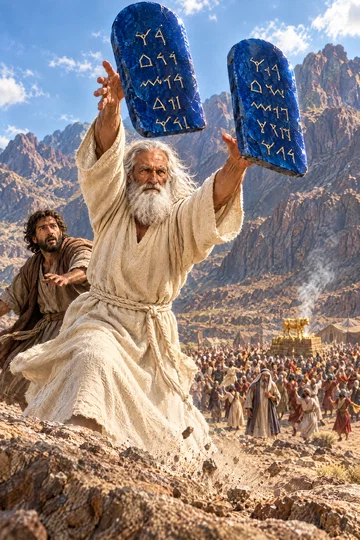
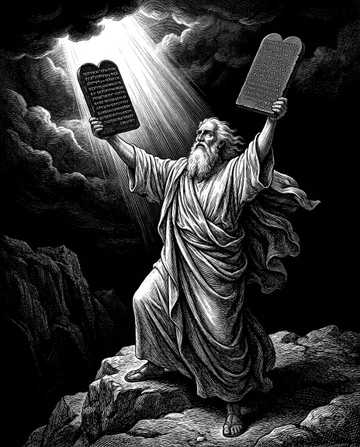
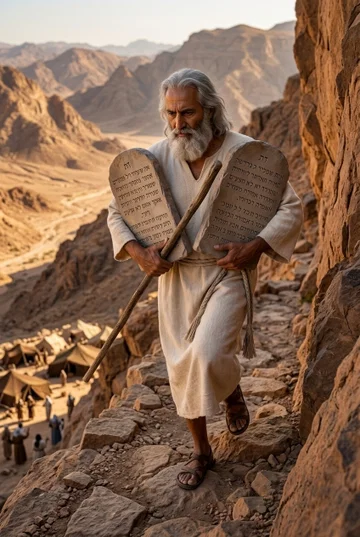
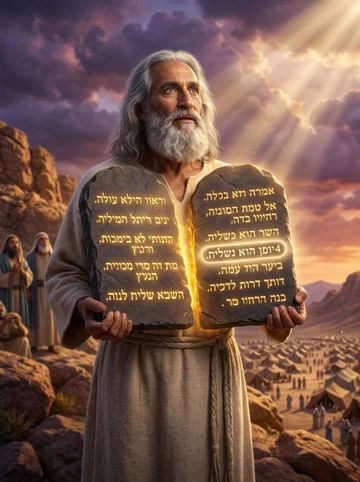
And Moses turned, and went down from the mount, and the two tables of the testimony were in his hand: the tables were written on both their sides; on the one side and on the other were they written.
Translations
American King James Version, King James Version, Webster Bible
And Moses turned, and went down from the mount, and the two tables of the testimony were in his hand: the tables were written on both their sides; on the one side and on the other were they written.
And Moses turned, and went down from the mount, and the two tables of the Testimony were in his hand: the tables were written on both their sides; on the one side and on the other were they written.
Revised Version, American Standard Version
And Moses turned, and went down from the mount, with the two tables of the testimony in his hand; tables that were written on both their sides; on the one side and on the other were they written.
And Moses turneth, and goeth down from the mount, and the two tables of the testimony [are] in his hand, tables written on both their sides, on this and on that [are] they written;
And Moses turned and went down from the mountain, [ with] the two tables of the testimony in his hand — tables written on both their sides: on this side and on that were they written.
And Moses turned and went down out of the mount, with the two tables of testimony in his hand,—tables written upon on both sides of them, on this and on that, were they written.
Berean Standard Bible, Majority Standard Bible
Then Moses turned and went down the mountain with the two tablets of the Testimony in his hands. They were inscribed on both sides, front and back.
Moses turned, and went down from the mountain, with the two tablets of the covenant in his hand; tablets that were written on both their sides. They were written on one side and on the other.
Then Moses came down the mountain with the two stones of the law in his hand; the stones had writing on their two sides, on the front and on the back.
So Moses returned and went downe from the mountaine with the two Tables of the Testimonie in his hande: the Tables were written on both their sides, euen on the one side and on the other were they written.
Douay-Rheims (Challoner revision)
And Moses returned from the mount, carrying the two tables of the testimony in his hand, written on both sides,
Pictures

Cross-references 20 of 54
- Exodus 31:18
And he gave unto Moses, when he had made an end of communing with him upon mount Sinai, two tables of testimony, tables of stone, written with the finger of God.
God gives Moses the stone tablets written by his finger.
- Exodus 24:12
And the LORD said unto Moses, Come up to me into the mount, and be there: and I will give thee tables of stone, and a law, and commandments which I have written; that thou mayest teach them.
God promises Moses stone tablets bearing the law and commandments.
- Deuteronomy 10:4-5
And he wrote on the tables, according to the first writing, the ten commandments, which the LORD spake unto you in the mount out of the midst of the fire in the day of the assembly: and the LORD gave them unto me.
God writes the commandments on the tablets, which Moses places in the ark.
- Deuteronomy 4:13
And he declared unto you his covenant, which he commanded you to perform, even ten commandments; and he wrote them upon two tables of stone.
Identifies the Ten Commandments as God’s covenant written on two stone tablets.
- Exodus 34:28
And he was there with the LORD forty days and forty nights; he did neither eat bread, nor drink water. And he wrote upon the tables the words of the covenant, the ten commandments.
Names the words written on the tablets as the covenant’s Ten Commandments.
- Deuteronomy 5:22
These words the LORD spake unto all your assembly in the mount out of the midst of the fire, of the cloud, and of the thick darkness, with a great voice: and he added no more. And he wrote them in two tables of stone, and delivered them unto me.
God spoke the commandments and wrote them on two stone tablets.
- Deuteronomy 9:10
And the LORD delivered unto me two tables of stone written with the finger of God; and on them was written according to all the words, which the LORD spake with you in the mount out of the midst of the fire in the day of the assembly.
Both describe the stone tablets written by God’s finger.
- Exodus 32:19
And it came to pass, as soon as he came nigh unto the camp, that he saw the calf, and the dancing: and Moses’ anger waxed hot, and he cast the tables out of his hands, and brake them beneath the mount.
Moses breaks the tablets after seeing Israel worship the calf.
- Exodus 34:1
And the LORD said unto Moses, Hew thee two tables of stone like unto the first: and I will write upon these tables the words that were in the first tables, which thou brakest.
God promises to write the commandments again on replacement stone tablets.
- Exodus 20:3-17
Thou shalt have no other gods before me.
The commandments spoken at Sinai are identified as the contents of the tablets.
- Exodus 25:16
And thou shalt put into the ark the testimony which I shall give thee.
Commands that the testimony be placed in the ark.
- Exodus 25:21
And thou shalt put the mercy seat above upon the ark; and in the ark thou shalt put the testimony that I shall give thee.
Both texts place the testimony tablets inside the ark.
- Exodus 32:1-6
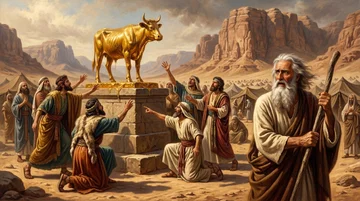
And when the people saw that Moses delayed to come down out of the mount, the people gathered themselves together unto Aaron, and said unto him, Up, make us gods, which shall go before us; for as for this Moses, the man that brought us up out of the land of Egypt, we wot not what is become of him.
Israel turns to the golden calf after receiving God’s law.
- 2 Corinthians 3:7
But if the ministration of death, written and engraven in stones, was glorious, so that the children of Israel could not stedfastly behold the face of Moses for the glory of his countenance; which glory was to be done away:
The stone tablets carried the glorious ministration of death, contrasted with the Spirit’s greater glory.
- Hebrews 9:4
Which had the golden censer, and the ark of the covenant overlaid round about with gold, where in was the golden pot that had manna, and Aaron’s rod that budded, and the tables of the covenant;
Names the tables of the covenant among the ark’s contents.
- Revelation 11:19
And the temple of God was opened in heaven, and there was seen in his temple the ark of his testament: and there were lightnings, and voices, and thunderings, and an earthquake, and great hail.
The heavenly temple opens, revealing the ark of the testament.
- Exodus 34:29
And it came to pass, when Moses came down from mount Sinai with the two tables of testimony in Moses’ hand, when he came down from the mount, that Moses wist not that the skin of his face shone while he talked with him.
Moses comes down from the mount with the testimony tables.
- Exodus 40:20
And he took and put the testimony into the ark, and set the staves on the ark, and put the mercy seat above upon the ark:
Moses places the tablets of the testimony in the ark.
- Exodus 24:3-8
And Moses came and told the people all the words of the LORD, and all the judgments: and all the people answered with one voice, and said, All the words which the LORD hath said will we do.
The covenant is written, read, and ratified with blood before the tables are given.
- Revelation 15:5
And after that I looked, and, behold, the temple of the tabernacle of the testimony in heaven was opened:
The heavenly sanctuary is called the tabernacle of the testimony.
Commentary
Each commentary is drawn from primary sources: the writings of Ellen G. White and Adventist pioneers and periodicals. Each commentary is separate. Its own words are not a quotation; follow the references to read the source passages.
Ellen G. White
18 sources
Moses turned and came down from the mountain carrying the two tables of the testimony in his hand, written by God on both their front and back sides.1SP 247.1–248.1SG3 278.2–279.1Ms 13, 1906, par. 21–24 They were God's own work, graven by His finger with a copy of the Ten Commandments to teach Israel, the symbol of His authority and embodiment of His will to dwell among them as their King.SG3 278.2–279.1Ms 13, 1906, par. 21–24PP 314.1 He descended after forty days communing with the divine glory, accompanied by Joshua, hearing the wild uproar of the camp below which was revelry and singing and not war.SG3 278.2–279.1PP 315.2–3PP 319.3–320.4ST May 20, 1880 Coming near he saw the people dancing around a golden calf in heathen riot, and in hot anger he cast the tables down and broke them beneath the mount to show that as Israel had broken their covenant so recently made, so God had broken His covenant with them.1SP 247.1–248.1SG3 278.2–279.1PP 319.3–320.4RH Jul 29, 18733T 298.1 Though the apostasy was treason and a daring insult aimed at Israel's ruin, God did not arbitrarily destroy them but gave opportunity for repentance, cutting off only those who persisted, so that swift punishment upheld justice and was mercy to Israel and the world.Ms 117, 1909, par. 15–22PP 335.1–2Ms 156, 1905
Tables Brought Down
Moses turned and went down from the mount with the two tables of the testimony in his hand, the stone tables written on both their sides, on the one side and on the other.1SP 247.1–248.1SG3 278.2–279.1Ms 13, 1906, par. 21–24Ms 92, 1900, par. 22–25 The tables were the work of God, and the writing was God's own writing graven upon them by His finger.SG3 278.2–279.1Ms 13, 1906, par. 21–24 They were a copy of the Decalogue, the law of the Ten Commandments, the tables of the covenant given to Moses with the law and commandments that he might teach them.PP 314.1Ms 58, 1900, par. 23–25RH Jul 29, 18733T 298.1
They were the symbol of God's authority and the embodiment of His will, to be sacredly enshrined in the sanctuary as the visible center of the nation's worship where His abiding presence would dwell among Israel as their King and God.PP 314.1 During that same ascent Moses was also given directions for building a sanctuary and the pattern of the ark.Ms 58, 1900, par. 23–25
He descended after forty days in the mount communing with God, just come from the awful presence of the divine glory.SG3 278.2–279.1PP 319.3–320.4PP 335.1–2 He was accompanied by Joshua, having been absent with him on Sinai in the cloud of thick darkness and divine glory while Israel waited below.PP 315.2–3PP 319.3–320.4ST May 20, 1880 His delay in coming down caused the people waiting below to become discontented, and their unbelief began to reveal itself in a marked manner.Ms 58, 1900, par. 23–25
On the way down Moses and Joshua heard the shouts of the excited multitude in wild uproar from the camp.PP 319.3–320.4ST May 20, 1880 Joshua mistook the shouting for the noise of war, but Moses more truly judged it to be revelry and the noise of singing.PP 319.3–320.4ST May 20, 1880
Covenant Broken in Idolatry
At the time Moses turned to come down, Israel below had been given days and weeks to meditate on the law they had heard and to prepare their hearts for further revelation, but instead they became careless, inattentive, lawless, and impatient to go forward to the land flowing with milk and honey.PP 315.2–3 They lost sight that the goodly land was promised only on condition of obedience.PP 315.2–3 Feeling helpless without Moses and led by the mixed multitude, they desired some image to represent God and to go before them in the place of Moses.PP 315.2–3 At the suggestion of those practiced in Egyptian idolatry they made and worshiped a calf after the ox or calf regarded as a symbol of deity in Egypt.PP 315.2–3
They did this even though God had given no manner of similitude of Himself and had prohibited any material representation.PP 315.2–3 The mighty miracles in Egypt and at the Red Sea had been designed to establish faith in Him as the invisible all-powerful Helper and only true God.PP 315.2–3 He had already granted them a visible manifestation of His presence in the pillar of cloud and of fire that guided them, in the revealing of His glory on Sinai, and in the cloud of the Presence still before them.PP 315.2–3
When Moses came near the camp he saw the calf and the dancing, with the people shouting and dancing around the idol in excited heathen riot in imitation of the idolatrous feasts and idol-worshipers of Egypt, so unlike solemn and reverent worship of God.1SP 247.1–248.1SG3 278.2–279.1PP 319.3–320.4ST May 20, 1880 Although God had warned him that the people had corrupted themselves and made an idol and sacrificed to it, Moses was in a measure unprepared and was overwhelmed by the dreadful exhibition of Israel's degradation and great sin after coming from God's presence.1SP 247.1–248.1SG3 278.2–279.1PP 319.3–320.4ST May 20, 1880
Aaron, left in charge, failed in the crisis by yielding to the people, joining their plans, and allowing revelry and wrongdoing instead of firmly resisting them, and that first concession opened the way to idolatry.RP 45.1Ms 92, 1900, par. 22–25SG4 19.2 He could have prevented the evil if he had stood for the right irrespective of consequences, unswervingly maintained his own allegiance to God, cited the people to the perils of Sinai, and reminded them of their solemn covenant to obey God's law.RH Feb 4, 1909 Instead his compliance and the calm assurance with which he carried out their plans emboldened them to go to greater lengths in sin than had before entered their minds.RH Feb 4, 1909 He would have been slain for joining the apostasy if Moses had not interceded for him, and his weakness in making a molten calf proves he and Miriam did not bear the burden of the work as Moses did, despite their claim that God had spoken by them as well as by Moses.Ms 92, 1900, par. 22–25SG4 19.2
Moses felt his weakness and felt the greatness of the work committed to him as no other man had felt it, and God had ever been his counselor, granting his plea for Israel before he descended with the tablets of the covenant.3T 298.1SG4 19.2 In utter discouragement with hot anger, to show abhorrence of their crime, Moses by divine direction cast the tables out of his hands and broke them beneath the mount in the sight of all the people.1SP 247.1–248.1SG3 278.2–279.1PP 319.3–320.4ST May 20, 1880 Breaking the tables signified that as Israel had broken their covenant with God through idolatry so recently made, so God had broken His covenant with them.PP 319.3–320.4RH Jul 29, 18733T 298.1ST May 20, 1880
At the very foot of Sinai, while God was writing His law to be committed to His covenant people who had pledged to obey it, Israel was denying loyalty to Jehovah and bowing in open defiance before a golden image.PP 335.1–2 This was because Satan was exciting doubt, apostasy, and rebellion to overthrow God's law, carrying forward the same work he had begun in heaven.PP 335.1–2 The moment was a daring insult and blasphemy by which Satan planned to cause Israel's ruin, to make God divorce them and devote them to destruction.PP 335.1–2 Thus he sought to secure the extinction of the seed of Abraham, the seed of promise that was to preserve the knowledge of the living God and through whom He was to come, the true seed that was to conquer Satan.PP 335.1–2
Justice, Mercy, and Warning
This descent with the tables belongs to the account of Israel's apostasy at Sinai, which was treason against God who had loaded the people with benefits and whose authority they had pledged themselves to obey.Ms 156, 1905 God would not arbitrarily destroy Israel for worshiping the calf, but gave them a chance to return and place themselves on the Lord's side, giving opportunity for repentance so that only those who persisted in rebellion were cut off.Ms 117, 1909, par. 15–22 Swift punishment in that crisis upheld divine justice and protected Israel and others from the greater ruin that persistent rebellion would bring, and was an act of mercy to the people, to the world, and even to the transgressors themselves.
The golden-calf rebellion was an experience whose lesson should have remained with Israel.3T 342.1 God's displeasure was still evident in the people's broken ranks and reduced numbers after that punishment.3T 342.1 Yet they failed to learn from what had been inflicted and again gave in to temptation.3T 342.1
Sources
Pioneers and periodicals
105 sources
Moses turned and came down from the mount with the two tables of the testimony in his hand, carrying what God gave him there after forty days and nights with God.ST Jul 22, 1908ST Mar 11, 1889ST Oct 31, 1878 The tables were written on both their sides, on the one side and on the other, with divine writing covering front and back.ST Dec 9, 1908ST Jul 22, 1908ST Nov 5, 1894 The tables were the work of God and the writing was the writing of God graven upon them with His own finger, bearing the Ten Commandments, the words of the covenant spoken from the midst of the fire.ST Dec 9, 1908ST Jul 22, 1908ST Nov 5, 1894ST Apr 25, 1906RH Mar 19, 1857 They hold the perpetual moral law reflecting God's character, distinct from the ceremonial ordinances and civil statutes that Moses wrote in a book, and it remains in force with unchanging authority.RH Oct 14, 1915ST Jul 12, 1905RH Jul 9, 1901RH Oct 21, 1851RH Feb 17, 1852 He came down to a people already breaking that covenant in worshiping the golden calf, and when he saw the idolatry he broke the tables at the foot of the mount, signifying their transgression.RH Aug 19, 1852ST Jan 31, 1911ST Oct 8, 1885
Sinai Apostasy Setting
The verse belongs to the account of Israel's worship of the golden calf, with Moses' intercession, the renewal of the stone tables and the reconfirmation of the covenant.RH Jan 12, 1911ST Jul 30, 1902 It places Moses turning and descending Mount Sinai with the two tablets of the testimony in his hand after Israel had made and worshiped the calf while he was away receiving the tables and communing with God.RH Aug 19, 1852RH Dec 9, 1852RH Oct 8, 1872 The apostasy came soon after the awful and glorious display at Sinai, during his forty days on the mount, with the people worshiping below as he came down.ST Jul 10, 1901ST Jan 10, 1906ST Jan 29, 1908
That worship was not sincere conception of God as a person but substitution of something else called God, the worship of the carnality of the human heart deifying lust and putting that false god in the place of Jehovah while calling it worship of the true God.ST Jul 16, 1902ST Jan 29, 1908 At Sinai the carnal heart longed for the old Egyptian nature worship of the sun-god Apis with its sensuousness and licentiousness, and the golden calf was the exaltation of low, lustful nature worship.ST Jul 16, 1902ST Jul 10, 1901 The people gave themselves to gluttonous eating and drinking and to wanton, naked, lewd orgies with excited heathen shouting, singing and dancing around the idol like the idolatrous feasts of Egypt, unlike solemn and reverent worship of God, yet called that sun-god feast a feast to Jehovah, which was awful backsliding and blasphemy.ST May 20, 1880ST Jul 16, 1902 It was a human invention that brought idolatry, disaster and death, with no merit or value because God had not appointed it, unlike what He appointed such as the brazen serpent.ST Jun 6, 1916
Israel by this broke its covenant with God even before Moses came down, within forty days and less than forty days after solemnly promising obedience.RH Nov 13, 1856RH Jan 8, 1857ST Jul 10, 1901 The tablets he carried down were the testimony of the Ten Commandments concerning which the covenant had been made.RH Jan 12, 1911ST Sep 23, 1913 The episode shows disobedience soon after receiving His law in written form and after hearing God's law and receiving great light, so the rebellion was judged more sternly than sins of a people still emerging from spiritual darkness.RH Aug 19, 1852ST Jan 10, 1906
When Moses saw the idolatry he broke the tables at the foot of the mountain in anger and distress, apparently under divine impulse and by divine direction.RH Aug 19, 1852ST Oct 8, 1885RH Apr 28, 1874 His breaking them in anger expressed his strong sense of the purity of God's worship and the gravity of the apostasy, and the record does not show God reproving him for it.RH Oct 7, 1862 The breaking symbolized the people's transgression and signified that they had broken the covenant so recently made and that God had broken His covenant with them, though God later wrote the commandments on stone again.RH Jul 29, 1873ST May 20, 1880ST Jan 31, 1911
Moses pleaded for the people and God relented from threatened punishment and destruction for their fathers' sake, granting pardon offered to all Israel that day.ST Jun 16, 1914RH Nov 13, 1856RH Jan 7, 1862 As pardon had been offered to Adam in Eden on the day of his transgression and fall, the kingdom of grace originally established then was reestablished in the nation of Israel on the day of their transgression at Sinai through the new covenant.ST Jun 16, 1914 Through Moses the people, the church in the wilderness, were restored to the Lord, saving those who repented, while those loyal to the Lord were set against the rest and about three thousand men were killed.RH Aug 19, 1852RH Nov 13, 1856
Aaron helped the impatient people make the image to replace God as their leader, and is held responsible for leading them into idolatry.ST Mar 31, 1909 He failed to stop the apostasy when he could have prevented the evil if he had stood for the right irrespective of consequences, unswervingly maintained his own allegiance to God, cited the people to the perils of Sinai, and reminded them of their solemn covenant to obey His law.RH Feb 4, 1909 Instead his compliance with their desires and the calm assurance with which he carried out their plans emboldened them to go to greater lengths in sin than had before entered their minds, showing that weak leadership can lead God's people into apostasy and that faithful leaders must stand firmly.RH Feb 4, 1909RH Mar 5, 1908 He then tried to evade blame by excusing himself and blaming the people, but Moses rebuked him rather than accepting the excuse, for as high priest and Moses' representative he was responsible for opposing their plans and his failure helped bring sin and disaster upon them.ST Aug 31, 1882ST Nov 30, 1904 His guilt was not excused by the people's influence, and he was spared death only after humbling himself in true penitence.ST Aug 31, 1882
Tables Written Both Sides
Moses turned and went down from the mount with the two tables of the testimony in his hand, carrying what God gave him there after forty days and nights with God.ST Jul 22, 1908ST Mar 11, 1889ST Oct 31, 1878ST Jan 14, 1886ST The tables were in his literal hand as literal stone, not merely the law held in his mind in a spiritual sense.ST The tables were written on both their sides, on the one side and on the other, front and back, with divine writing covering both faces.ST Dec 9, 1908ST Jul 22, 1908ST Nov 5, 1894RH Dec 23, 1852ST Mar 11, 1889 That writing on both sides is identified with the work of God and the writing of God cut and graven upon the tables.ST Dec 9, 1908ST Jul 22, 1908ST Nov 5, 1894RH Dec 23, 1852RH Dec 9, 1852
The tables being literal stone is proved by the fact that Moses threw them down and broke them.ST The writing was not merely a spiritual impression in Moses' mind nor inscribed by Moses, but the work of God.STST The account describes a real connection between heaven and earth in the giving of the law, and shows God to be a substantial being as well as a spiritual being.STST Pictures usually show the commandments on one side only so the two tables can be displayed and read at once, but the Scriptural manner is writing on both sides, which makes no difference to the law itself.ST Dec 9, 1908
The tables are judged about two by four feet from the size of the ark made expressly to contain them, giving some thirty-two feet of surface that was all written over.RH Aug 21, 1855 On so much space God could write a great deal and did write a great deal, with a great many more than the ten commandments written on the tables of stone.RH Aug 21, 1855 The weight of testimony holds that the Ten Commandments filled the entire surface on both sides.ST Dec 9, 1908ST Jul 22, 1908ST Nov 5, 1894ST Mar 11, 1889ST Apr 15, 1886 The stone signifies permanence as an expression of God's will, and the complete writing signifies that the commandments form a whole requiring no additions or improvements.ST Apr 15, 1886
The writing was engraved by God in durable stone and rock so the law would be preserved and its words would not be erased, blotted out, or forgotten.ST Jan 25, 1910ST May 17, 1877 Because they were so engraved in stone it would not be proper to speak of nailing them to the cross, proving they have no connection with the handwriting of ordinances against us which Christ blotted out. By speaking this law in an audible voice and engraving it Himself, and by having the tables placed for safest preservation in the holy golden ark, God differentiated it from all other laws and honored His law by every means appealing to men.ST Jan 25, 1910
God Wrote Engraved
The tables were the work of God, and the writing upon them was the writing of God Himself, graven upon the tables and cut into them with His own finger.ST Dec 9, 1908ST Jul 22, 1908ST Nov 5, 1894RH Dec 23, 1852ST Mar 11, 1889 That divine engraving gave the law and commandments He had written to be taught, holding the Ten Commandments as a law and rule of life whose divine origin and placement in the ark set them apart from ceremonial regulations and marked their sacred authority.ST Jul 22, 1908ST Nov 5, 1894ST Mar 11, 1889ST Oct 31, 1878 The writing covered both faces of the stone, engraved on both sides, and the surrounding verses identify both tablets and inscription as God's work and God's writing.ST Jul 22, 1908ST Nov 5, 1894RH Dec 23, 1852ST Mar 11, 1889
The Ten Commandments were therefore written by God, not authored or written by Moses.ST Oct 31, 1878ST Jun 2, 1881ST Jan 20, 1881 This was given in fulfillment of the promise to give Moses tables of stone with law and commandments written by God Himself.ST Oct 31, 1878 They hold all the words the Lord spoke with Israel in the mount out of the midst of the fire in the day of the assembly.ST Mar 11, 1889 Those words were spoken in the hearing of the people and uttered by God's own great voice, too holy and glorious to be spoken by tongues of men and angels or taken down by any human hand.ST Mar 11, 1889RH Mar 19, 1857ST Jan 14, 1886RH Jul 4, 1912
The tables contained the law and commandments God Himself had written to be taught, namely the words He had spoken to all the people from Sinai, the ten commandments.RH Mar 19, 1857ST Jan 14, 1886 Christ shared in that writing as Creator who is one with the Father.RH Oct 14, 1915 Moses broke the first tables at the foot of the mount when he saw the golden calf.ST Jan 14, 1886ST Jan 31, 1911RH Apr 28, 1874 God then wrote the same words that were in the first tables on two new tables of stone, so that the second tables were like the first with similar writing.ST Dec 9, 1908ST Jan 14, 1886RH Mar 26, 1872
The original tables were made by God, while Moses hewed the replacements.ST Jan 14, 1886RH Jun 23, 1868 The breaking of the tablets symbolized the people's transgression, and the law was later written again on a second set of tablets in distress apparently under divine impulse, showing its superiority to ritual ordinances and its enduring, unchanging authority.ST Jan 31, 1911RH Apr 28, 1874RH Mar 26, 1872 The verse comes at the close of forty days and nights with God on the mount after the covenant with Israel was made and ratified and after the instructions concerning the sanctuary in Exodus 25-31, the tables containing the law graven by the finger of God.ST Jan 14, 1886ST Mar 25, 1889 All worship, all services, and all remedies have as their object bringing men into harmony with that holy law.ST Mar 25, 1889
Testimony Ten Commandments
The tables of the testimony bore the Ten Commandments, the Decalogue, the Ten Words, God's witness against sin, and the words of the covenant and testament.ST Nov 5, 1894ST Apr 25, 1906RH Mar 19, 1857RH Apr 30, 1857ST Sep 30, 1886 They were spoken by God in the hearing of the people and written with His own finger, God's work engraved on stone on both sides.ST Nov 5, 1894ST Apr 25, 1906RH Mar 19, 1857ST Sep 30, 1886RH Nov 25, 1852 They are the covenant's Ten Commandments, the law God calls His own, given as a rule of life.ST Nov 5, 1894ST Apr 25, 1906RH Nov 25, 1852 They are distinct from the law of Moses written in a book, for they are God's testimony belonging in the ark, and their divine origin and placement set them apart from ceremonial regulations and mark their sacred authority.ST Nov 5, 1894ST Apr 25, 1906RH Apr 30, 1857
The writing on the tables is therefore called commandments, law, and testimony.ST Oct 31, 1878 It is the very law and testimony meant by the appeal to the law and to the testimony in Isaiah 8:20.ST Oct 31, 1878 The Ten Commandments and the Ten Commandments alone were what was written and engraved in stones.ST Oct 31, 1878ST Aug 5, 1889 So the ministration of death written and engraven in stones in 2 Corinthians 3:7 means the Ten Commandments.ST Aug 5, 1889
The name testimony means the Ten Commandments written on the tables.ST May 23, 1878RH Jan 4, 1870ST May 23, 1878 It gives its name to the tables that bear them.ST May 23, 1878ST May 23, 1878 Those tables therefore give their name to the ark that holds them and, in turn, to the tabernacle associated with the ark.ST May 23, 1878 That testimony kept within the ark gave the sanctuary its name, and the law in the ark made an atonement, priesthood, and sanctuary necessary for sinful people.RH Apr 6, 1869
The Ten Commandments were given together as one law, spoken by the Lord and engraved with His own finger on the two tablets.ST Mar 10, 1890 The fourth commandment was included among the other moral precepts, and its place in the Decalogue shows its sacred and moral character.ST Mar 10, 1890ST Mar 4, 1903 All the commandments share the honors of being spoken by God's own voice and written by His own finger, while the Sabbath commandment has an additional distinction.RH Mar 17, 1863 That testimony applies to the law as a whole, especially the fourth commandment, which identifies the Creator and the only One who can redeem.ST Mar 4, 1903
God chose Israel as a peculiar people to give a more perfect knowledge of His moral law after all flesh had corrupted the law first engraven on the heart.ST May 22, 1884 He wrote the heads or summary of that law on two tables of stone because they were slow of understanding.ST May 22, 1884 He commanded the fathers to teach what was so written to their children through all succeeding generations.ST May 22, 1884
The tablets contain the perfect constitution of God's universal and eternal kingdom.ST Aug 27, 1912 The Decalogue on them is the moral law, spoken by God and written by His own finger, serving as the standard for judging actions as good or evil.RH Jun 9, 1853ST Aug 27, 1912 It confronts the sinner as broken law demanding blood, requiring that the one who has broken it must die because the soul that sins must die, so that justice must be satisfied.RH Nov 26, 1857 It identifies the law for which Christ died and whose transgression requires atonement, the literal Ten Commandments kept in the ark of the testimony.RH May 26, 1853RH Jun 2, 1859
Enduring Moral Law Distinct
The descent with the two tables in hand shows the moral law of God written on stone by His own finger, entirely distinct from the ceremonial and civil regulations of the Mosaic dispensation that the Lord dictated but Moses wrote in a book.ST Jul 12, 1905RH Jul 9, 1901RH Oct 21, 1851 The stone tables hold the perpetual Ten Commandments, the true indicator of sin, while the book held typical ordinances that came to an end when Christ the Antitype came and fulfilled His earthly mission.ST Jul 12, 1905RH Oct 21, 1851 Those stone tablets were written on both sides, were themselves the work of God, and bore writing engraved by God, and the words upon them were the same Ten Commandments God had spoken to the people.RH Jul 9, 1901ST Apr 6, 1915 These tablets were a durable record of the moral law, which reflects God's character and governs moral conduct, and its principles are unchangeable and extend through the ages.ST Apr 6, 1915
This law was spoken in an audible voice and engraved by God Himself, and the tables were placed for safest preservation in the holy golden ark, by which God differentiated it from all other laws and honored His law by every means that would appeal to men.ST Jan 25, 1910RH Jan 12, 1905 The Ten Commandments were uttered by God's own great voice and twice inscribed by His own finger on tablets of enduring rock, too holy and glorious to be spoken with tongues of men and angels or taken down by any human hand.ST Jan 25, 1910RH Jul 4, 1912 The stone tablets were deposited inside the ark of incorruptible shittim wood overlaid within and without and above with gold, under the overshadowing cherubim and the inviolable Shekinah.RH Jan 12, 1905RH Jul 4, 1912 This sets them apart from the laws of temporary polity and shadowy ritual, which were uttered in the ears of Moses alone, written by the hand of Moses, and placed beside the ark as things warranting less reverence and care and ready to be removed.RH Jan 12, 1905RH Jul 4, 1912
Because the Ten Commandments were engraved in stone so they could not be blotted out, it would not be proper to speak of nailing them to the cross, proving they have no connection with the handwriting of ordinances that was against us and contrary to us which Christ blotted out and nailed to His cross.RH Nov 25, 1852 They were chiseled into stone rather than existing only as writing in a book, and therefore could not be blotted out like written ordinances or fittingly described as nailed to the cross. The writing on the tablets could not be blotted out like the ordinances Moses wrote in the book of the law, for the commandments express lasting duties rooted in people's nature and their relations to God and one another.RH Nov 25, 1852
This divinely written law of ten commandments was not destroyed, changed, or altered but remains in force, with Christ sharing in that writing as Creator who is one with the Father.RH Oct 14, 1915 The Sabbath was among these commandments and therefore part of the first principles of God's moral government, and the tablets' inscription does not mean that God's law or the Sabbath was abolished.RH Feb 17, 1852RH Nov 2, 1911RH Feb 17, 1852 The reference identifies the law engraved on stone, written on both sides, as the law whose continued authority is being defended, and its stone inscription with the account that God wrote the same commandments on replacement tablets shows the law's superiority to ritual ordinances and its enduring, unchanging authority.RH Nov 2, 1911RH Feb 17, 1852RH Mar 26, 1872
The passage is part of the record of the law given through Moses at Horeb, included among the laws and commandments that Malachi 4:4 calls the law of Moses.ST Jan 25, 1910 The law of Moses encompasses the Ten Commandments as well as statutes and judgments, including civil, health, ceremonial, sacrificial, and moral laws. The Ten Commandments are part of that law and interwoven in all its precepts, yet a distinct code by itself called the law.ST Jan 25, 1910
The tables were the written copy of the Ten Commandments, which Israel did not possess in written form when the covenant was ratified at least eighty days before receiving them.RH Jun 26, 1900 The commandments were the basis of the covenant, not the covenant itself.RH Jun 26, 1900 The tablets of testimony are the written terms of the Sinaitic covenant, the written condition of the agreement between God and Israel, the covenant tablets containing the Ten Commandments.RH Apr 12, 1860
The two tables contain the one law by which God governs the world, the written ten commandments spoken and written by God Himself on stone.RH Mar 20, 1856 This is the perfect law that was within Christ's heart as the one who confirms the new covenant, the same law God writes in the hearts of His people under the new covenant and that Christ magnified and taught as eternally binding with not one jot or tittle to pass.RH Mar 20, 1856 The ten commandments and the ten commandments alone were what was written and engraved in stones, so the ministration of death written and engraven in stones spoken of in 2 Corinthians 3 means the ten commandments.ST Aug 5, 1889RH Sep 6, 1864 These tables are distinct from the rough, unhewn altar stones and great plastered stones on which Joshua wrote a copy of the law of Moses at Mount Ebal forty years later, and when Moses so came down his face shone with a glory so that the children of Israel could not steadfastly behold his countenance, which glory was to be done away.RH Sep 6, 1864RH Sep 6, 1864
Sanctuary Ark Heaven
Exodus 32:15 belongs to the account of Israel's wilderness sanctuary, for after bringing the people out of Egypt God commanded Moses to have them build Him a dwelling place following the directions and divine pattern given in the mount.ST Jun 26, 1907 The law of God rested in the most holy place beneath the mercy seat and stood at the center of earthly worship.ST Jun 19, 1907 That testimony was set apart from other laws, written on enduring stone tablets and placed in an ark prepared for it.ST May 20, 1908
Moses turned and went down from the mount carrying in his hand what God gave him there, the two stone tables of the testimony written on both sides.RH Jan 12, 1905ST Aug 19, 1913 Those tablets held God's royal law, the Decalogue of Ten Commandments written by God's own finger on enduring stone.RH Feb 3, 1916RH Jan 12, 1905ST Aug 19, 1913 They bore the law later placed in the ark of the sanctuary, identified as the Ten Commandments kept in the ark.STRH Jan 6, 1853RH Mar 1, 1870 These commands were kept inside the sacred ark in the sanctuary and most holy place, unlike the other laws and ceremonies written by Moses in a book and kept beside the ark.RH Jan 12, 1905ST Aug 19, 1913
The tables engraved by God and placed in the earthly sanctuary correspond to the testimony kept in the heavenly tabernacle, whose original is represented by the tablets in the sanctuary built by Moses.ST Dec 10, 1894 That testimony was kept within the ark and gave the sanctuary its name, and the law in the ark made an atonement, priesthood, and sanctuary necessary for sinful people.RH Apr 6, 1869 The commandments are the testimony kept in the ark, and their presence in the heavenly temple continues through the gospel age until the seventh trumpet.ST Sep 4, 1879 Their writing on both sides is connected with the book in Revelation 5, while the book's meaning is explained through the eternal sacrifice and victory of the Son of God.ST Apr 1, 1897 This testimony of the Ten Commandments written on both sides is the law that Isaiah's command to bind up and seal among God's disciples concerns, showing that in the last days the law will be restored.ST Jun 13, 1878
Covenant Grace Warning
Through the kingdom of grace pardon was offered to all Israel on the day of the transgression at Sinai, as pardon had been offered to Adam in Eden on the day of his fall, and the kingdom of grace first established then was reestablished in the nation that day.ST Jun 16, 1914 The rebellion was treason against a God who had bestowed benefits and to whose authority obedience had been pledged, yet God gave opportunity for repentance and cut off only those who persisted in rebellion. Swift punishment upheld divine justice and protected Israel, the world, and even the transgressors themselves from the greater ruin to which persistent rebellion would lead, making the punishment an act of mercy to people, world, and transgressors. That summary punishment under the theocracy shows God was no less merciful then than now and that sin is punished in every age.ST Jan 2, 1901 The judgments left signs of displeasure among the people, but those signs failed to keep them from later rebellion, and the episode is counted among the swift, signal punishments suffered by discontented Israel.ST Sep 9, 1880ST May 23, 1911
God's favor toward literal Israel was conditional on obedience rather than an unconditional promise of future blessing or land.RH Nov 13, 1856RH Jan 8, 1857 Israel broke the covenant made at Horeb within forty days after promising to obey, by worshiping an idol even before Moses came down with the covenant tables, so that covenant and its promise of the land were forfeited by disobedience.RH Nov 13, 1856RH Jan 8, 1857 Because of that disobedience God considered disinheriting them, but Moses pleaded for them and God relented from the threatened punishment for their fathers' sake, saving those who repented.RH Nov 13, 1856
Israel's idolatry soon after God spoke the law shows the need for the law to be received in the heart and not merely written on stone, since service to God comes through love and not through fear or compulsion.ST Jan 27, 1909 As Moses prepared the second tables, people must yield their hearts to God so that the divine finger may engrave the holy law there.ST Apr 9, 1902
The experience warns against becoming careless or indifferent and thinking it makes no great difference if God's requirements are not exactly fulfilled, especially thinking it matters not whether to observe as the Sabbath the day God plainly specified or to substitute a day of man's invention.RH Dec 2, 1909 In the Judgment all will be judged by the standard of God's Word.RH Dec 2, 1909 It reveals the mercy and compassion of God in long-suffering kindness to His people and the measure of His love seen in the gift of Christ.RH Dec 2, 1909 It calls to follow on to know the Lord, to live in communion with God revealing the fruits of pure and undefiled religion rather than worthless profession, to come as little children to receive choicest blessings and power, to come to the Saviour just as they are for conversion, to seek the Lord with all the heart, and to prepare in earnest for the coming of the Saviour in the clouds of heaven before the power of Satan is fully manifest.RH Dec 2, 1909
The law in Moses' hands as he came down to the calf worship below is divine and immutable, and those who break it must suffer consequences and answer for it under retribution, so that wrongdoing brings punishment.ST Jan 2, 1907ST Jan 2, 1907 The people who praised Jehovah could turn to a golden calf, illustrating the danger of spiritual fickleness and wavering between loyalties.RH Apr 28, 1863 The calf worship shows a religion of gold that still retains vitality when faith and self-sacrifice are dead and gold has become the mainspring of human energy.RH Aug 25, 1874 The majority and even the high priest could not make that idolatrous worship right, for Moses and the few who stood with him were right despite being outnumbered.ST Jun 25, 1912
Moses descending with the two tablets while the people feasted and worshiped below calls for direct response to sin, requiring those on God's side to separate from the idolatrous people and act decisively.ST Feb 3, 1881 Silence is not permitted when wrongdoing breaks out, as shown by Moses confronting apostasy at Sinai.RH Jun 14, 1906 Weak leadership can lead God's people into apostasy, so faithful leaders must stand firmly against it.RH Mar 5, 1908 Israel's turning to the calf while Moses was away demonstrates the need for the leader God had appointed.RH Mar 7, 1907
Sources