Hebrews 9:19
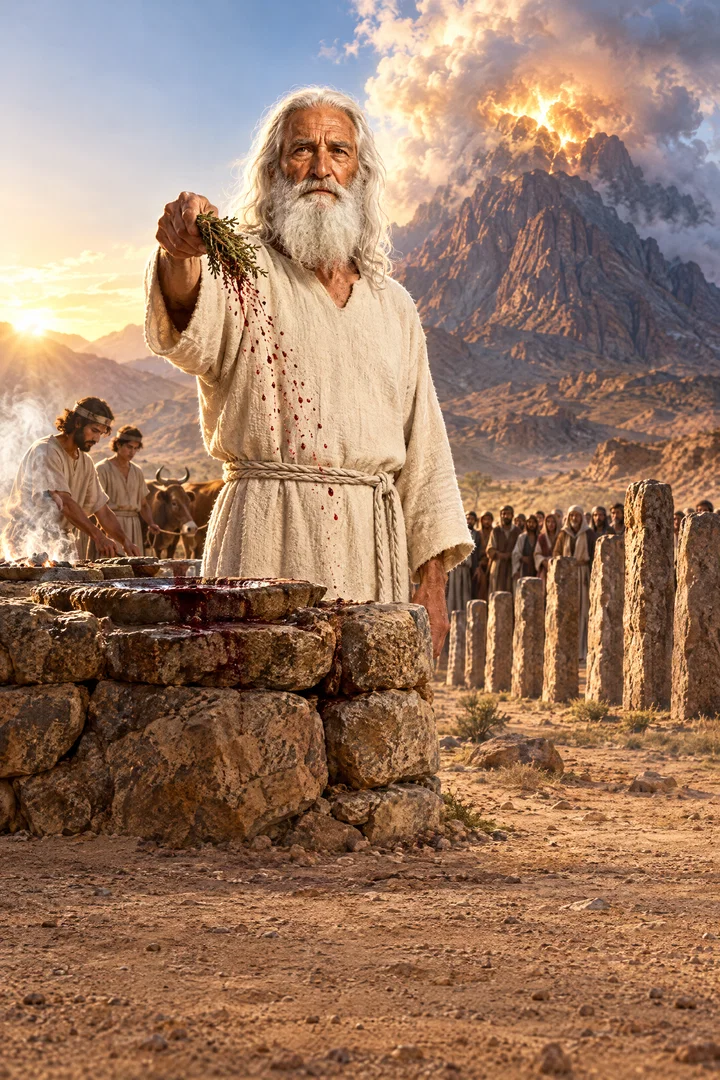
For when Moses had spoken every precept to all the people according to the law, he took the blood of calves and of goats, with water, and scarlet wool, and hyssop, and sprinkled both the book, and all the people,
Translations
American King James Version, King James Version, KJV Cambridge Paragraph Bible
For when Moses had spoken every precept to all the people according to the law, he took the blood of calves and of goats, with water, and scarlet wool, and hyssop, and sprinkled both the book, and all the people,
For when Moses had spoken every precept to all the people according to the law, he took the blood of calves and of goats, with water, and scarlet wool, and hyssop, and sprinkled both the book and all the people,
For when every commandment had been spoken by Moses unto all the people according to the law, he took the blood of the calves and the goats, with water and scarlet wool and hyssop, and sprinkled both the book itself, and all the people,
For when every commandment had been spoken by Moses unto all the people according to the law, he took the blood of the calves and the goats, with water and scarlet wool and hyssop, and sprinkled both the book itself and all the people,
for every command having been spoken, according to law, by Moses, to all the people, having taken the blood of the calves and goats, with water, and scarlet wool, and hyssop, he both the book itself and all the people did sprinkle,
For every commandment having been spoken according to [ the] law by Moses to all the people; having taken the blood of calves and goats, with water and scarlet wool and hyssop, he sprinkled both the book itself and all the people,
For, when every commandment according to the law had been spoken by Moses unto all the people, taking the blood of the calves and the goats, with water and scarlet wool and hyssop, both, the scroll itself, and all the people, he sprinkled;
Berean Standard Bible, Majority Standard Bible
For when Moses had proclaimed every commandment of the law to all the people, he took the blood of calves and goats, along with water, scarlet wool, and hyssop, and sprinkled the scroll and all the people,
For when every commandment had been spoken by Moses to all the people according to the law, he took the blood of the calves and the goats, with water and scarlet wool and hyssop, and sprinkled both the book itself and all the people,
For when Moses had given all the rules of the law to the people, he took the blood of goats and young oxen, with water and red wool and hyssop, and put it on the book itself and on all the people,
For when Moses had spoken euery precept to the people, according to the Law, he tooke the blood of calues and of goates, with water and purple wooll and hyssope, and sprinckled both the booke, and all the people,
Douay-Rheims (Challoner revision)
For when every commandment of the law had been read by Moses to all the people, he took the blood of calves and goats, with water, and scarlet wool and hyssop, and sprinkled both the book itself and all the people,
Pictures
Cross-references 20 of 63
- Exodus 24:7-8
And he took the book of the covenant, and read in the audience of the people: and they said, All that the LORD hath said will we do, and be obedient.
Moses reads the covenant and seals the agreement by sprinkling the people with blood.
- Hebrews 9:11-12
But Christ being come an high priest of good things to come, by a greater and more perfect tabernacle, not made with hands, that is to say, not of this building;
Christ enters the true sanctuary with his own blood.
- Leviticus 16:15-16
Then shall he kill the goat of the sin offering, that is for the people, and bring his blood within the vail, and do with that blood as he did with the blood of the bullock, and sprinkle it upon the mercy seat, and before the mercy seat:
The high priest cleanses the sanctuary through the people’s blood offering.
- Hebrews 10:1
For the law having a shadow of good things to come, and not the very image of the things, can never with those sacrifices which they offered year by year continually make the comers thereunto perfect.
The law’s sacrifices were shadows that could not perfect worshipers, pointing forward to Christ’s sacrifice.
- Exodus 19:5-8
Now therefore, if ye will obey my voice indeed, and keep my covenant, then ye shall be a peculiar treasure unto me above all people: for all the earth is mine:
God offers the covenant terms, and Israel agrees to obey.
- Hebrews 9:23
It was therefore necessary that the patterns of things in the heavens should be purified with these; but the heavenly things themselves with better sacrifices than these.
Earthly patterns are cleansed with animal blood, while heavenly things require a better sacrifice.
- Hebrews 9:1-7
Then verily the first covenant had also ordinances of divine service, and a worldly sanctuary.
Describes the first covenant’s earthly sanctuary and the priests’ service in its two holy places.
- Hebrews 8:5
Who serve unto the example and shadow of heavenly things, as Moses was admonished of God when he was about to make the tabernacle: for, See, saith he, that thou make all things according to the pattern shewed to thee in the mount.
Earthly sanctuary service is a pattern and shadow of heavenly things.
- Hebrews 9:26
For then must he often have suffered since the foundation of the world: but now once in the end of the world hath he appeared to put away sin by the sacrifice of himself.
Christ’s once-for-all self-sacrifice fulfills the repeated offerings and puts away sin.
- Exodus 24:3-6
And Moses came and told the people all the words of the LORD, and all the judgments: and all the people answered with one voice, and said, All the words which the LORD hath said will we do.
Moses speaks the covenant words, records Israel’s assent, and begins the blood ceremony.
- Exodus 24:7
And he took the book of the covenant, and read in the audience of the people: and they said, All that the LORD hath said will we do, and be obedient.
Moses reads the covenant book before the people affirm their obedience.
- Hebrews 9:13-14
For if the blood of bulls and of goats, and the ashes of an heifer sprinkling the unclean, sanctifieth to the purifying of the flesh:
Contrasts ceremonial purification by animal blood with Christ’s cleansing work.
- Exodus 24:12
And the LORD said unto Moses, Come up to me into the mount, and be there: and I will give thee tables of stone, and a law, and commandments which I have written; that thou mayest teach them.
God gives Moses the stone tablets after the covenant is ratified.
- Jeremiah 31:31-34
Behold, the days come, saith the LORD, that I will make a new covenant with the house of Israel, and with the house of Judah:
Introduces the new covenant in contrast with the covenant made at the Exodus.
- Deuteronomy 10:5
And I turned myself and came down from the mount, and put the tables in the ark which I had made; and there they be, as the LORD commanded me.
Moses placed the written tablets of the law in the ark.
- Hebrews 9:15
And for this cause he is the mediator of the new testament, that by means of death, for the redemption of the transgressions that were under the first testament, they which are called might receive the promise of eternal inheritance.
Christ’s death redeems transgressions committed under the first covenant.
- Hebrews 12:24
And to Jesus the mediator of the new covenant, and to the blood of sprinkling, that speaketh better things than that of Abel.
Christ’s blood speaks better things than Abel’s, and Jesus mediates the new covenant.
- Hebrews 10:4
For it is not possible that the blood of bulls and of goats should take away sins.
Animal blood cannot take away sins.
- Leviticus 14:4-7
Then shall the priest command to take for him that is to be cleansed two birds alive and clean, and cedar wood, and scarlet, and hyssop:
The cleansing rite uses blood, scarlet, and hyssop for sprinkling.
- Hebrews 10:10
By the which will we are sanctified through the offering of the body of Jesus Christ once for all.
Christ’s once-for-all offering fulfills the sacrifices and sanctifies the people.
Commentary
Each commentary is drawn from primary sources: the writings of Ellen G. White and Adventist pioneers and periodicals. Each commentary is separate. Its own words are not a quotation; follow the references to read the source passages.
Ellen G. White
9 sources
After every precept had been spoken to all the people according to the law, Moses sprinkled both the book and all the people with the blood of calves and of goats, with water and scarlet wool and hyssop.WLF 18.3–4PP 311.5–312.2 The solemn service set Israel apart as a peculiar people and sealed them to God.Ms 126, 1901, par. 52–56Ms 65, 1906, par. 17–18 Moses told them all the words of the Lord and all the judgments, wrote the words, built an altar under the hill with twelve pillars for the twelve tribes, had young men offer burnt offerings and peace offerings of oxen, put half the blood in basins and sprinkled half on the altar, read the book of the covenant in the audience of the people, and then sprinkled the blood on the people as the blood of the covenant concerning all these words.Ms 126, 1901, par. 52–56Ms 65, 1906, par. 17–18
The book contained the Lord's words and judgments and the people's pledge to obey.PP 311.5–312.2Ms 126, 1901, par. 52–56 The conditions were given to the people again, and the people freely and unanimously reaffirmed with one voice that they would do all the Lord had said and be obedient.PP 311.5–312.2Ms 126, 1901, par. 52–56Ms 65, 1906, par. 17–181MR 115.1 The blood marked the covenant as one God had enjoined upon them.PP 311.5–312.2 It was made on plainly laid conditions of obedience to the commandments and the particularized judgments of the law, which if kept would have made them happy by keeping God's ways instead of following their own hearts.Ms 126, 1901, par. 52–56
The sprinkling in two parts carried two meanings.Ms 126, 1901, par. 52–561MR 115.1 The portion on the altar signified that the people consecrated themselves to God in body, mind, and soul.Ms 126, 1901, par. 52–561MR 115.1 The portion on the people signified that through the sprinkled blood of Christ God graciously accepted them as His special treasure.Ms 126, 1901, par. 52–561MR 115.1 The blood of calves and goats belonged to the sacrificial offerings of the Jewish law that foreshadowed Christ giving His own life as the one great offering.ST Apr 8, 1875 The sprinkling of the blood on the book and the people represented the shedding of the blood of Jesus by which human beings are cleansed from sin.Ms 65, 1906, par. 17–18
The blood rites point to Christ's blood ratifying the new covenant, in contrast to the old covenant at Sinai ratified by the blood of a sacrifice.RH Oct 17, 1907DA 656.5 The Abrahamic covenant is called the new covenant because its sealing blood, Christ's blood, was shed later.RH Oct 17, 1907 When type met antitype at the death of Christ, the offering of the blood of beasts became valueless and the value of all the sacrificial offerings of the Jewish law was terminated.ST Apr 8, 1875 Yet Christ, though a Jew, had observed the law binding upon the Jews to the hour of His death on the cross, proving without foundation the charge that He did not regard the law of Moses.ST Apr 8, 1875
The Sinai covenant typifies the covenant made between God and every believer in Jesus Christ.Ms 126, 1901, par. 52–56 Its blessings belong to all who receive Him as God's children and joint-heirs with Christ.DA 656.5 Jesus' efficacious blood is the believer's only hope and stronghold, and God's promise is signed and sealed with His blood.Lt 40, 1874, par. 1–3 The sacrament keeps before believers Christ's infinite sacrifice for each person and for fallen humanity as a whole.DA 656.5 Israel's rebellion against the law and authority of God caused their destruction, and the honor of being conducted by God's Son increased their sin.ST Apr 8, 1875
Sources
Pioneers and periodicals
108 sources
Moses first spoke every precept of the law to all the people and then took the blood of calves and of goats with water and scarlet wool and hyssop and sprinkled both the book and all the people, in the ceremony recorded in Exodus 24 where he wrote the Lord's words, read them, received the promise to obey, and sprinkled the blood kept in basins after half had been offered upon the altar.ST Sep 20, 1899ST May 16, 1878RH May 13, 1862ST Oct 25, 1883ST Mar 8, 1883
That sprinkling dedicated, ratified, sealed, inaugurated and confirmed the first or old covenant, showing a covenant is solemnly established and bound by shedding of blood.ST Sep 20, 1899RH Jul 18, 1854ST May 16, 1878
It belonged to the ordinances of the earthly tabernacle and Levitical priesthood, which serve as figure, shadow, pattern and example of the heavenly sanctuary and of Christ's mediatorial work there, and as Moses consecrated the earthly pattern with animal blood so Christ consecrated the true sanctuary with His own blood shed on the cross when He entered as High Priest after His ascension.LDT 179.2ST Oct 22, 1874ST Aug 15, 1878RH Feb 18, 1858RH Aug 18, 1863
The blood of calves and goats purified the earthly patterns as temporary means of remission under the law, pointing to purification of the heavenly things themselves by Christ's better sacrifice and precious blood in the cleansing of the heavenly sanctuary as the blotting out of the sins of God's people.ST Dec 12, 1916RH Apr 5, 1864RH Jan 9, 1855ST May 1, 1879RH May 9, 1871
The covenant so dedicated was the solemn agreement between God and Israel concerning obedience to God's law, whose written book contained the moral, civil and ceremonial laws regulating the theocracy, with the Ten Commandments as its conditions, terms and basis and not the contract itself, while those who held the other taught the words concerned were the words God spoke with His own voice and called His covenant, namely the Ten Commandments.ST Feb 13, 1879ST Mar 8, 1883ST Aug 13, 1885ST Jul 1, 1875RH Mar 18, 1875
Words and Sinai Setting
Moses first spoke every precept of the law to all the people, then took the blood of calves and of goats, with water and scarlet wool and hyssop, and sprinkled both the book and all the people.ST Sep 20, 1899ST May 16, 1878RH May 13, 1862RH Oct 2, 1856ST Dec 16, 1897 The sprinkling sealed the people's agreement to obey the law and marked the covenant as solemnly established and confirmed by the shedding of blood.ST Sep 20, 1899ST May 16, 1878ST Dec 16, 1897RH Mar 1, 1864 The written book so dedicated contained moral, civil and ceremonial laws regulating the Jewish theocracy, and the covenant itself was Israel's agreement to obey those laws, forming the foundation of the Jewish theocracy and Levitical priesthood.ST Dec 16, 1897RH Mar 1, 1864 That blood-dedicated covenant recorded in a book is distinct from the Ten Commandments written on stone, which contain no provision for atonement or priesthood, unlike the covenant connected with symbolic atonement.RH May 13, 1862RH Mar 1, 1864 The earthly arrangement of sanctuary services and sacrifices thus divinely appointed could not itself take away sin but served as a type of the new-covenant sanctuary and its priestly ministry.RH Oct 2, 1856
The Greek verb is rhantizō, meaning to sprinkle, translated sprinkle in the King James Version.ST Jan 10, 1906 It does not describe immersion or dipping, but the application of blood to the book and the people.ST Jan 10, 1906 Scarlet denotes scarlet wool, a textile material that could be spun and woven into cloth.RH May 30, 1912ST Mar 25, 1889 It is understood as wool from a sheep dyed scarlet, doubtless cotton or wool, used with blood in the cleansing rite whose ritual details are types of Christ and His death.RH May 30, 1912ST Mar 25, 1889
The ceremony is the one recorded in Exodus 24.ST Oct 25, 1883ST Mar 8, 1883RH Dec 31, 1861 Moses wrote down the Lord's words, read them to the people, received their promise to obey, and then sprinkled the book containing the words of the covenant and the people.ST Oct 25, 1883ST Mar 8, 1883RH Dec 31, 1861ST Feb 6, 1879ST Nov 16, 1888 Half of the blood of the sacrificed oxen had first been offered to God upon the altar, and the remaining half kept in basins was used for this act.ST Mar 8, 1883 After sprinkling the book and the people together, solemnly binding them to obey all those words, Moses announced the blood of the covenant which the Lord had made with them concerning all these words.ST Mar 8, 1883RH Dec 31, 1861ST Feb 6, 1879ST Oct 1, 1885 That dedicating work occurred once, was not done in the sanctuary, and was not done yearly by the blood of the sin offering, being altogether different in form and object from the yearly cleansing of the sanctuary by the high priest with sin-offering blood.ST Oct 25, 1883
The dedication occurred in the wilderness at the leading out of Egypt before Moses had received the stone tablets.ST May 16, 1878RH May 13, 1862RH Jun 26, 1900ST May 16, 1878ST May 16, 1878 The Ten Commandments in written stone form were therefore not yet in the people's possession and were not the book sprinkled.ST May 16, 1878RH Jun 26, 1900ST May 16, 1878ST May 16, 1878 The stone tables were not sprinkled and are not identified as part of that blood-dedicated covenant, but were the words to which the covenant related as its basis.RH May 13, 1862RH Jun 26, 1900RH May 13, 1862 Testament and covenant mean the same thing here, and the covenant so ratified was the first or old covenant, not the Ten Commandments.ST May 16, 1878ST May 16, 1878 The chapter's reference belongs with Hebrews 7-9 as testimony to the Mosaic authorship and authority of the laws recorded in Leviticus.ST Oct 21, 1930
Covenant Ratification and Terms
The verse describes the dedication, ratification, sealing, inauguration and confirmation of the first or old covenant by blood, showing that a covenant is confirmed by the shedding of blood and is solemnly established and bound by that act.ST Sep 20, 1899RH Jul 18, 1854ST May 16, 1878RH May 13, 1862RH Oct 2, 1856 After Moses had spoken every precept to all the people according to the law, he took the blood of calves and of goats, with water and scarlet wool and hyssop, and sprinkled both the book and all the people, thereby sealing the people's agreement to obey the law.ST Sep 20, 1899ST May 16, 1878RH May 13, 1862RH Oct 2, 1856ST Oct 25, 1883 The first covenant was thus ratified by blood through Moses' ceremony, while the new covenant was established through Christ's death.RH Jul 18, 1854ST May 16, 1878RH May 13, 1862 The blood of calves and goats could not take away sin or provide forgiveness and offered no remedy for the transgressor, but served as a divinely appointed type pointing to Christ's future sacrifice, whose blood cleanses from sin.RH Jul 18, 1854RH Oct 2, 1856 That dedicating work occurred once, not in the sanctuary and not yearly by the blood of the sin offering, and is altogether different in form and object from the yearly cleansing of the sanctuary by the high priest for the uncleanness of Israel.RH Oct 2, 1856ST Oct 25, 1883
The covenant so dedicated was the solemn agreement between God and Israel concerning obedience to God's law, with promises and conditions, and Paul calls that blood-dedicated agreement the first covenant.ST Feb 13, 1879ST Mar 8, 1883ST Aug 13, 1885ST Dec 16, 1897RH Apr 16, 1861 Its written book contained moral, civil and ceremonial laws regulating the Jewish theocracy, and the covenant itself was Israel's agreement to obey those laws.ST Feb 13, 1879ST Dec 16, 1897RH Apr 16, 1861 It formed the foundation of the Jewish theocracy and Levitical priesthood, while the old-covenant plan concerned that theocracy, not the plan of salvation.ST Dec 16, 1897 The covenant agreement is distinct from the Ten Commandments themselves: the commandments were its conditions, terms and basis, not the contract itself.ST Feb 13, 1879ST May 16, 1878RH May 13, 1862ST Mar 8, 1883ST Aug 13, 1885 The stone tables were not sprinkled and are not identified as part of that blood-dedicated covenant, for Moses had not yet received them when the book and the people were sprinkled.ST May 16, 1878RH May 13, 1862
The blood sprinkling ratified the people's reiterated promise to obey, first made before the dedication and repeated at its dedication, concerning certain words.ST Jul 1, 1875RH Mar 18, 1875 Those words were the words God spoke with His own voice and called His covenant, namely the Ten Commandments, as in Deuteronomy 4:12-13, and the law was not itself the covenant but the condition of the covenant which the people covenanted to do and keep.ST Jul 1, 1875RH Mar 18, 1875 The covenant was put in writing after the people had promised to obey and was then dedicated with blood, and the Ten Commandments as writing containing its terms were associated with the covenant without being the agreement itself.ST Aug 13, 1885ST Jul 1, 1875 Those who held the other position identify the blood-dedicated covenant in Exodus 24:3-8 with the Ten Commandments and their amplification in the following chapters as the old covenant that was done away.RH Mar 25, 1873
The precepts Moses spoke and the blood rites belong to the ceremonial law and covenant book distinguished from the moral law on stone.RH May 6, 1862RH May 13, 1862RH Jun 14, 1864RH Oct 7, 1851 The verse's reference to precepts of the first covenant is not a reference to commandments found in the Ten Commandments, for the covenant's precepts were spoken by Moses while the Ten Commandments were spoken by God from Sinai.RH May 6, 1862RH May 13, 1862RH Jun 14, 1864 Some laws were tied to ceremonies and types, unlike the enduring moral law.ST Nov 15, 1910 The verse is thus used to show that a law governed the old covenant and that the ceremonial law was added at Sinai.RH Jan 28, 1902 The first covenant included sacrifices that could not truly take away sin, serving as a temporary, symbolic provision pointing to the new covenant, which takes away sin.RH Jul 18, 1854RH May 13, 1862
Earthly Type and Heavenly Ministry
Hebrews 9:19 belongs to the account of the earthly tabernacle and its ordinances of divine service and priesthood under the first covenant.LDT 179.2ST Oct 22, 1874ST Aug 15, 1878RH Aug 28, 1853ST Apr 23, 1912 That earthly sanctuary and its service were made only as a figure, shadow, pattern and example of the heavenly sanctuary and of Christ's mediatorial work there.LDT 179.2ST Oct 22, 1874ST Aug 15, 1878RH Aug 28, 1853ST Apr 23, 1912 The old-dispensation ceremonies were shadows pointing to heavenly realities and to Christ as their true substance, and the sprinkling of the book and the people formed part of a service that pointed to the Redeemer.ST Jan 13, 1914RH Oct 2, 1856ST Oct 14, 1913 While the first tabernacle stood the way into the holy places of the heavenly temple was not opened, but with the new covenant came the real sanctuary of God, the tabernacle which the Lord pitched and not man.ST Aug 15, 1878
The sanctuary where mortal priests ministered by animal blood had two apartments whose service indicates the order of Christ's ministration as High Priest in the two holy places of the temple above.RH Sep 21, 1905ST Aug 15, 1878RH Aug 28, 1853ST Nov 20, 1879 The first apartment contained the seven-branched golden candlestick, the table for the showbread, and the altar of incense.RH Sep 21, 1905RH Jan 24, 1856 The second apartment within the veil contained the ark of the covenant, a chest overlaid with gold holding the two tables of stone on which were engraved the Ten Commandments as the standard of righteousness.RH Sep 21, 1905 The old tabernacle was longer than wide and divided by a veil into these two rooms, the first where ministry went forward every day and the second where the high priest went alone only once a year to carry blood and sprinkle it before the mercy seat to make atonement for the sins of the people.RH Sep 21, 1905RH Jan 24, 1856 Christ's ministration in those two apartments of the temple above can be traced in the New Testament.ST Aug 15, 1878ST Nov 20, 1879
The first covenant's sanctuary services and sacrifices were divinely appointed, though the blood of calves and goats used in them could not themselves take away sin, bring perfection, or provide forgiveness.RH Jul 18, 1854RH Oct 2, 1856ST May 1, 1879RH Jan 20, 1853 They served as a type pointing to Christ's future sacrifice, His once-for-all shedding of blood, and the virtue of His own life ministered in heaven as High Priest.RH Jul 18, 1854ST Oct 14, 1913ST May 1, 1879RH Jan 20, 1853ST Sep 21, 1915 The earthly arrangement served as a type of the new-covenant sanctuary and its priestly ministry.RH Oct 2, 1856ST Sep 21, 1915
The tabernacle and temples were God's sanctuary on earth until Christ died, and the divine services of the earthly tabernacle ended on earth when Jesus the true Sacrifice died on the cross.RH Feb 18, 1858 When the veil was torn God's presence left the earthly sanctuary and it was laid open to common view, so that God no longer had a sanctuary on earth.ST May 28, 1896 From then on, while the gospel continues and people receive forgiveness of sins, the services take place in heaven where Jesus ministers in the tabernacle not made by human hands. The old-covenant order of sacrifices and priestly service to which the sprinkling with blood of calves and goats mixed with water and applied with scarlet wool and hyssop belonged therefore ceased at the crucifixion, when type met antitype and animal blood no longer had efficacy as an expression of faith.ST May 27, 1880ST Sep 20, 1899ST May 28, 1896
Moses and Aaron consecrated the earthly pattern with animal blood as Christ consecrated the true sanctuary with His own blood when He entered as High Priest after His ascension.RH Feb 18, 1858RH Aug 18, 1863RH May 8, 1856RH Jan 20, 1853 By His own blood means the sacrifice He shed on the cross which He as High Priest presents to the Father in heaven itself, just as Aaron entered the most holy place not by the blood in his own veins but by the blood of the sin offering slain outside the sanctuary.RH Aug 25, 1874RH Jan 20, 1853 Christ as High Priest carries out in the heavenly sanctuary what they did in the earthly one, and He had to enter within the veil before fulfilling that pattern.RH Feb 18, 1858RH Aug 18, 1863RH May 8, 1856
The description of the pattern does not establish that Christ began ministry in both heavenly holy places at the same time.RH Aug 28, 1853 The anointing of the earthly Holy of Holies immediately preceded the presentation of the sin offering, pointing to the order of Christ's heavenly ministry.RH May 8, 1856 The anointing of the most holy at the close of the seventy weeks was the anointing of the heavenly Holy of Holies, not the earthly one made with hands, preparatory to the commencement of Christ's ministration there.RH May 8, 1856
Cleansing and Atonement by Blood
Both the ministration of the sanctuary and its cleansing are by blood, for the earthly tabernacle pitched by man was served by mortal priests with animal blood applied by sprinkling in a system of gifts and sacrifices, meats and drinks, divers washings and carnal ordinances imposed until the time of reformation.RH Jan 9, 1855RH Feb 21, 1856 That blood service belongs to the first-covenant sanctuary and stands in contrast to the greater and more perfect tabernacle which the Lord pitched and not man in heaven, where Christ as High Priest ministers not with animal blood but by His own blood to appear in the presence of God.RH Jan 9, 1855RH Feb 21, 1856 Sanctuary cleansing concerns the removal of sin and iniquity and remission, not physical dirt, and the purification of the heavenly sanctuary by blood is the same work referred to in Daniel 8:14.RH Jan 9, 1855RH Feb 21, 1856 Cleansing the sanctuary is priestly work performed with blood, not by fire, and it is the work by which the high priest concludes his ministry there, completed before the Second Advent while His intercession still restrains wrath.RH Dec 5, 1854RH Apr 28, 1853RH Apr 30, 1857 Whether that cleansing occurs at the beginning or at the conclusion of Christ's ministration is the question the chapter answers, foreshadowing the last great work of salvation when sins are blotted out, not the physical renovation of the earth by fire.RH Jan 9, 1855RH Dec 5, 1854
The dedication of the covenant by sprinkling the book and the people is altogether different in form and object from the yearly cleansing of the sanctuary by the high priest with sin-offering blood.ST Oct 25, 1883ST Jul 24, 1884 The dedicating work occurred once after the people promised to do the will of God, when blood was sprinkled on the book containing the words of the covenant as recorded in Exodus 24 and upon the people, and it was not done in the sanctuary and was not done yearly by the blood of the sin offering.ST Oct 25, 1883ST Jul 24, 1884 The sanctuary itself was consecrated once for all, while blood was applied to its articles each year to remove pollution for the uncleanness of Israel.ST Oct 25, 1883ST Jul 24, 1884
The blood of calves and goats purified the earthly patterns and served in a sanctuary that pointed to Christ and the heavenly sanctuary, but such animal blood could not take away sin and served only as temporary means of remission under the law.ST Dec 12, 1916RH Jan 9, 1855ST May 1, 1879 The earthly sanctuary covenant was thus ratified and its services cleansed with the blood of animals as a pattern for the heavenly sanctuary, anticipating purification of the heavenly things themselves by Christ's better sacrifice and precious blood, even the blood of the perfect sacrifice.ST Dec 12, 1916RH Jan 9, 1855ST May 1, 1879RH Jun 17, 1915 The example of the first-covenant sanctuary and its services points to the cleansing of the heavenly sanctuary with Christ's atoning blood, accomplished by Christ's own sacrifice.ST Dec 12, 1916RH Sep 14, 1869RH Jan 23, 1900
That heavenly cleansing is effected by the better sacrifice, the blood of the Lamb slain at Calvary, and it also purifies the worshipers.RH Apr 5, 1864RH Sep 14, 1869 It is the blotting out of the sins of God's people in all ages and a work of judgment that acquits them, cleansing the heavenly sanctuary from all their transgressions in all their sins and determining their part in the first resurrection and their exemption from the second death.RH Apr 5, 1864RH Sep 14, 1869RH Jan 23, 1900 The yearly service under Aaron's priesthood was a type of that heavenly work, and its atonement cleansed and hallowed the sanctuary from Israel's uncleanness by removing sins from the sanctuary, for the slain goat's blood represents Christ's blood and the priest's ministry cleanses the sanctuary from the sins borne there.RH May 9, 1871ST Nov 18, 1880 When that cleansing is finished Christ lays all the iniquities of all the people in all their sins upon the head of Azazel, who is Satan the originator of all sin, so that Azazel bears them into a land not inhabited when Satan is bound in the wasted and desolate earth for a thousand years.RH May 9, 1871RH Jan 23, 1900ST Nov 18, 1880 That cleansing begins at the end of the 2300 days, before Christ leaves His priesthood to come as King, as the annual cleansing of the former sanctuary illustrates.RH Sep 14, 1869
The blood did not cancel or weaken the law, for after the law's precepts were declared Moses sprinkled the book and the people to ratify the ancient covenant, showing that because the law had been broken pardon required a blood offering.RH Aug 22, 1854 This typical ceremony pointed forward to Christ's sacrifice and the blood He presents as High Priest in the heavenly sanctuary for the forgiveness of repentant sinners.RH Aug 22, 1854 Remission requires shedding of blood, so people who lived under the old covenant and its priestly system also need redemption through Christ's blood, and the blotting out of their sins depends only on His priestly work.RH Dec 21, 1869ST Apr 18, 1878ST Jan 21, 1903 The Messiah's coming opened a fountain for sin and uncleanness, and He put away sin through the sacrifice of Himself and the shedding of His blood once for all, whose sprinkling denotes forgiveness and whose atoning work those who are saved and obedient have accepted.RH Nov 18, 1862ST Jan 21, 1903ST Jun 28, 1905
The scarlet wool dipped in blood represents the animal kingdom, for animal life is cursed by sin but through the redeeming power of the blood of Christ it will be restored, when the wolf shall dwell with the lamb and the leopard shall lie down with the kid.RH May 23, 1912 The blood held in an earthen dish over running water shows that in cleansing the cleansing blood came into direct contact not only with the unclean person but with all else cursed by sin — earth, air, water, vegetation, and the animal kingdom.RH May 23, 1912
Prophecy Judgment and Second Coming
The first covenant with its sanctuary and ordinances of divine service necessarily implies a second covenant that also has its own sanctuary with divine service.ST May 27, 1880RH Feb 18, 1858 Only 490 years of the 2300 years were allotted to the first covenant, to its worldly sanctuary and to Jewish pre-eminence above other peoples.ST May 27, 1880RH Feb 18, 1858 At the end of those 490 years the confirmation of the new covenant was finished, the old covenant passed away, the services of the worldly sanctuary ceased forever, and the Jewish church no longer held exclusive standing as the children of God.ST May 27, 1880RH Feb 18, 1858 Since 1810 years still remained before the 2300 years were completed when the sanctuary is to be cleansed, the sanctuary to be cleansed belongs to the second covenant.ST May 27, 1880RH Feb 18, 1858
That sanctuary to be cleansed at the termination of the 2300 days in the autumn of 1844 is in the heavens where Jesus ministers as High Priest.RH Sep 2, 1851RH May 13, 1875 This proves the present time is the day of atonement and the time of the third angel's warning.RH Sep 2, 1851 The sanctuary is the temple in heaven where Christ ministers as great High Priest for sinners, and its cleansing is the concluding work for sinners that ends His sanctuary ministry and finishes the plan of salvation.ST May 20, 1875RH May 13, 1875
That cleansing or justification is the closing work of Christ the great High Priest, typified by the high priest's atonement for the sanctuary and for Israel's sins during the year, especially sins of ignorance, on the tenth day of the seventh month.ST May 20, 1875RH Feb 26, 1867RH Feb 21, 1856 The sanctuary cleansing concerns the removal of sin and iniquity, not physical dirt, and the earthly tabernacle was a pattern of God's true tabernacle in heaven which with Christ's ministry as High Priest took its place at the close of the typical dispensation.RH Feb 21, 1856 The purification of the heavenly sanctuary is by blood, and the disputed question is whether this cleansing occurred at the beginning or at the conclusion of Christ's ministration.RH Feb 21, 1856 This cleansing with blood is priestly work performed by blood, not by fire, completed by the High Priest before the Second Advent while His intercession still restrains God's wrath.RH Feb 21, 1856RH Apr 30, 1857 This cleansing work is of indefinite but short duration and proves the end is at the very doors.RH May 13, 1875
Christ's work as great High Priest ministering in the true sanctuary and making atonement for sin with His own blood precedes His coming again to bring salvation.ST Sep 18, 1884 The priests who ministered under the Mosaic or typical dispensation prefigured in their ministry the work of Christ as great High Priest in this dispensation, and that work includes a preliminary work of judgment before the Lord comes which is the burden of the everlasting gospel preached when the message of Revelation 14:6 is given.RH May 18, 1869RH Jan 20, 1874 The earthly sanctuary service is a type of Christ's work in the heavenly sanctuary, teaching that His atonement and judgment take place there just as the high priest made atonement in the earthly sanctuary.RH May 18, 1869 That cleansing with Christ's atoning blood is the blotting out of God's people's sins and a work of judgment that acquits them, determining their part in the first resurrection and their exemption from the second death.RH Sep 14, 1869 It begins at the end of the 2300 days, before Christ leaves His priesthood to come as King, as the annual cleansing of the former sanctuary illustrates.RH Sep 14, 1869
The earthly ceremonies were shadows pointing to heavenly realities and to Christ as their true substance, forming part of a service that pointed to the Redeemer though the people did not have the full light of the gospel meaning of those ceremonies.ST Jan 13, 1914 Hebrews 8 and 9 connect those services with the cleansing of the heavenly sanctuary and show that the earthly rites point to the plan of atonement and judgment.ST Apr 20, 1904RH Feb 21, 1856 This cleansing with blood is the same work referred to in Daniel 8:14.RH Feb 21, 1856 The sanctuary pattern and the prophecies connected with its service gave spiritually minded Israelites reason to look for Christ's first advent.ST Jan 13, 1914
Law Sabbath and Gospel Life
The ark holding God's moral law stood in the second apartment, the most holy place, of the earthly sanctuary, with the mercy seat as its cover where atoning blood was sprinkled to bring pardon to the breaker of the law beneath it.ST Aug 10, 1882ST Jan 6, 1881ST Sep 21, 1876ST Oct 29, 1902 The law inside the ark is what was transgressed and demands atonement, while the ceremonial system of Levitical priesthood and sacrifices for sin only taught how atonement could be made and enabled sinners to approach the broken law.ST Aug 10, 1882ST Jan 6, 1881ST Sep 21, 1876 That shadowy service foreshadowed restitution of the pardoned and destruction of the impenitent, proving the law demanding it is perfect and remains, since guilt is removed from the transgressor rather than the law removed.ST Aug 10, 1882ST Jan 6, 1881 The earthly sanctuary was patterned after the heavenly sanctuary where Jesus Christ ministers as High Priest and where the ark of God's testament contains the original law, so His death is the real antitype of all Levitical sacrifices that magnifies and honors the broken law while pardoning the penitent sinner, showing the tables of the testament still remain as the foundation of the divine government.RH Mar 8, 1906ST Oct 29, 1902
The sprinkling of book and people belongs to the ministration of the first covenant, not the law itself, for ministration means the act of performing service.RH Mar 8, 1906RH Jan 1851 It describes the Levitical priesthood with its ordinances of divine service doing the service of the words written and engraven in stones, a ministry that was typical and met its antitype in Christ's ministry under the new covenant.RH Mar 8, 1906RH Jan 1851 That service is distinct from the law and distinct from the handwriting of ordinances in its function, being the shadow, the ministration of condemnation, the typical service and veil that had no glory by reason of the glory that excelleth and was abolished and done away in Christ.RH Mar 8, 1906 Christ's more excellent ministry in all its branches fulfills the ministration of the second covenant as its antitype and substance.RH Mar 8, 1906
The bull and goat sacrifices and the Mosaic system of sanctuary service, priesthood, and offerings belonged to the time then present and shadowed forth the only effectual offering, that of Jesus Christ.RH Jan 20, 1853ST Oct 1, 1896RH Sep 11, 1856RH Jan 13, 1852 The sprinkling of the blood of calves and goats on the book and the people was shadow while Christ is sunlight, and the old covenant's ceremonies with conditions written by Moses and performed in connection with the worldly sanctuary were temporary, lasting with washings and carnal ordinances imposed until the time of reformation.ST Oct 1, 1896RH Jan 13, 1852ST May 28, 1896 When type met antitype at the cross the ceremonial law of types and shadows pointing to Christ was abolished and the law contained in ordinances was nailed to the cross, the rent veil signifying God's presence had left the earthly sanctuary open to common view and animal blood no longer had efficacy as an expression of faith.RH Jul 4, 1854ST May 28, 1896 Christ offered Himself once for all, so the thousands of sheep and oxen can never be renewed without making His offering of none effect, building again the things destroyed and returning from sunlight to shadow, and therefore the sanctuary offerings shown in Ezekiel 40 to 48 will not be literally fulfilled in the future and bull and goat sacrifices are no longer acceptable to God.RH Jan 20, 1853ST Oct 1, 1896RH Sep 11, 1856
The new covenant is Christ's last will and testament, confirmed and sealed by His death, containing all promises and blessings for saving men from transgression of God's law, and like any will after the death of the maker it cannot be disannulled or added to in any way, whether one hour or a thousand years later.ST Mar 18, 1889RH Mar 10, 1868 Whatever Sabbath law was binding when Christ died is therefore eternally binding and whatever was not binding then can never become binding.ST Mar 18, 1889 The seventh-day Sabbath was in force at the sealing and forever remains in force, while a first-day Sabbath coming even the day after the crucifixion comes too late for legal recognition.ST Mar 18, 1889
Both covenants were dedicated with blood, the first or old covenant with blood and the new or everlasting covenant brought in after sin with Christ's blood, the old with corruptible typical animal blood in contrast to the blood of Christ by which the everlasting new covenant was ratified and confirmed.RH Jul 7, 1874ST May 18, 1904ST May 12, 1898ST Jul 7, 1914 Blood gives validity to a covenant: Christ's ministry introduced the covenant and His death was its ratification, His giving His life shedding His blood making it valid, and those finally redeemed receive salvation and deliverance from sin through its terms.ST Feb 22, 1883ST Jan 23, 1879ST Jul 7, 1914 The cup represents His blood and His pledge to die for His people.ST Feb 22, 1883
The earthly tabernacle and its ordinances were types of the heavenly sanctuary whose ceremonies also taught through outward, perishable symbols the enduring spiritual truths of God, including the need to be cleansed from spiritual contamination and to remain unspotted from compromise with evil, with practical lessons about the atonement. The covenant book and the people being marked with blood shows the Bible as a charter sealed with blood, and the sprinkling of blood in the Aaronic service denotes forgiveness of sin and points to Christ's atoning work which those who are saved and obedient have accepted.RH Aug 8, 1865ST Jun 28, 1905 Moses confirmed the covenant by first speaking every commandment to the people according to the law, then inaugurating it through the blood of the sacrifices with water, scarlet wool, and hyssop, including both its written terms and the people, and that sprinkling of the book of the law and all the people together solemnly bound them to obey all the Lord's words as a type of Christ offering His own blood for His people.ST Feb 22, 1883ST Mar 6, 1901ST Jun 3, 1913 Accepting the cup of the new covenant represents pledging to receive salvation through His blood and fulfill the covenant's conditions.ST Feb 22, 1883 Hebrews speaks of the law as one single law of God given through Moses in singular wording, not dividing it into a law of Moses and a law of God and not speaking of two laws.RH Aug 5, 1851
Sources