Exodus 25:18
And thou shalt make two cherubims of gold, of beaten work shalt thou make them, in the two ends of the mercy seat.
Translations
And you shall make two cherubim of gold, of beaten work shall you make them, in the two ends of the mercy seat.
King James Version, KJV Cambridge Paragraph Bible
And thou shalt make two cherubims of gold, of beaten work shalt thou make them, in the two ends of the mercy seat.
And thou shalt make two cherubim of gold, of beaten work shalt thou make them, in the two ends of the mercy-seat.
Revised Version, American Standard Version
And thou shalt make two cherubim of gold; of beaten work shalt thou make them, at the two ends of the mercy-seat.
and thou hast made two cherubs of gold, beaten work dost thou make them, at the two ends of the mercy-seat;
And thou shalt make two cherubim of gold; [ of] beaten work shalt thou make them, at the two ends of the mercy-seat.
And thou shalt make two cherubim of gold,—of beaten work, shalt thou make them, out of the two ends of the propitiatory.
Berean Standard Bible, Majority Standard Bible
Make two cherubim of hammered gold at the ends of the mercy seat,
You shall make two cherubim of hammered gold. You shall make them at the two ends of the mercy seat.
And at the two ends of the cover you are to make two winged ones of hammered gold,
And thou shalt make two Cherubims of golde: of worke beaten out with the hammer shalt thou make the at ye two endes of the Merciseate.
Douay-Rheims (Challoner revision)
Thou shalt make also two cherubims of beaten gold, on the two sides of the oracle.
Pictures
Cross-references 20 of 66
- Hebrews 9:1-5
Then verily the first covenant had also ordinances of divine service, and a worldly sanctuary.
Describes the ark and the cherubim over the mercy seat.
- Revelation 11:19
And the temple of God was opened in heaven, and there was seen in his temple the ark of his testament: and there were lightnings, and voices, and thunderings, and an earthquake, and great hail.
The ark of God’s covenant is seen in the heavenly temple.
- Hebrews 8:5
Who serve unto the example and shadow of heavenly things, as Moses was admonished of God when he was about to make the tabernacle: for, See, saith he, that thou make all things according to the pattern shewed to thee in the mount.
The earthly sanctuary was made as a pattern of the heavenly one.
- Exodus 25:22
And there I will meet with thee, and I will commune with thee from above the mercy seat, from between the two cherubims which are upon the ark of the testimony, of all things which I will give thee in commandment unto the children of Israel.
God meets and speaks above the mercy seat between the cherubim.
- Hebrews 9:23-24
It was therefore necessary that the patterns of things in the heavens should be purified with these; but the heavenly things themselves with better sacrifices than these.
The earthly sanctuary was a pattern of the heavenly sanctuary where Christ ministers.
- Leviticus 16:14-15
And he shall take of the blood of the bullock, and sprinkle it with his finger upon the mercy seat eastward; and before the mercy seat shall he sprinkle of the blood with his finger seven times.
The high priest sprinkles sacrificial blood on and before the mercy seat to make atonement.
- Hebrews 8:1-2
Now of the things which we have spoken this is the sum: We have such an high priest, who is set on the right hand of the throne of the Majesty in the heavens;
Jesus ministers in the heavenly sanctuary typified by the ancient one.
- Exodus 25:8
And let them make me a sanctuary; that I may dwell among them.
God commands a sanctuary so he may dwell among his people.
- Psalms 99:1
The LORD reigneth; let the people tremble: he sitteth between the cherubims; let the earth be moved.
Both describe the Lord enthroned between the cherubim.
- Exodus 26:33-34
And thou shalt hang up the vail under the taches, that thou mayest bring in thither within the vail the ark of the testimony: and the vail shall divide unto you between the holy place and the most holy.
Places the ark and mercy seat behind the veil in the Most Holy Place.
- Hebrews 9:4
Which had the golden censer, and the ark of the covenant overlaid round about with gold, where in was the golden pot that had manna, and Aaron’s rod that budded, and the tables of the covenant;
Identifies the ark and its sacred contents beneath the mercy seat.
- Deuteronomy 10:5
And I turned myself and came down from the mount, and put the tables in the ark which I had made; and there they be, as the LORD commanded me.
The stone tables of the law are placed in the ark beneath the mercy seat.
- Hebrews 9:1
Then verily the first covenant had also ordinances of divine service, and a worldly sanctuary.
Identifies the sanctuary as belonging to the first covenant.
- Exodus 26:1
Moreover thou shalt make the tabernacle with ten curtains of fine twined linen, and blue, and purple, and scarlet: with cherubims of cunning work shalt thou make them.
Cherubim were woven into the tabernacle curtains.
- Hebrews 9:7
But into the second went the high priest alone once every year, not without blood, which he offered for himself, and for the errors of the people:
The high priest alone entered the most holy place once a year with blood.
- Psalms 80:1
Give ear, O Shepherd of Israel, thou that leadest Joseph like a flock; thou that dwellest between the cherubims, shine forth.
Calls on God who dwells between the cherubim.
- Exodus 25:9
According to all that I shew thee, after the pattern of the tabernacle, and the pattern of all the instruments thereof, even so shall ye make it.
Moses was to build the sanctuary according to the heavenly pattern shown him.
- Exodus 37:7-9
And he made two cherubims of gold, beaten out of one piece made he them, on the two ends of the mercy seat;
Records the cherubim made according to the instruction.
- Leviticus 16:2
And the LORD said unto Moses, Speak unto Aaron thy brother, that he come not at all times into the holy place within the vail before the mercy seat, which is upon the ark; that he die not: for I will appear in the cloud upon the mercy seat.
The Lord appears in the cloud above the ark’s mercy seat, between the cherubim.
- Hebrews 9:9
Which was a figure for the time then present, in which were offered both gifts and sacrifices, that could not make him that did the service perfect, as pertaining to the conscience;
The earthly sanctuary and its services served as a figure of the heavenly.
Commentary
Each commentary is drawn from primary sources: the writings of Ellen G. White and Adventist pioneers and periodicals. Each commentary is separate. Its own words are not a quotation; follow the references to read the source passages.
Ellen G. White
31 sources
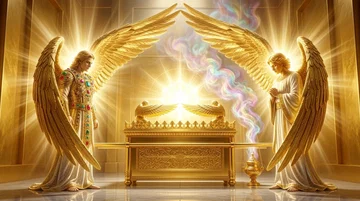
God directed that two cherubim of beaten, pure, solid gold be wrought as one piece with the mercy seat, one standing at each of its ends as its covering over the ark.Ms 8, 1902, par. 3–6WLF 14.3–16.1SG4 7.2–8.2 Their faces turn toward each other and look reverently downward toward the ark and mercy seat, with wings spread over it and meeting above in reverence and humility.Ms 8, 1902, par. 3–6WLF 14.3–16.1SG4 7.2–8.2 Between the cherubim the divine presence is manifested as the Shekinah glory where the will is made known, resting as Israel's glory, strength, and pledge of victory.RH Nov 9, 1905SG4 101.11SP 398.1 The earthly ark and its cherubim are a pattern of the true ark in heaven, and the cherubim represent all the heavenly host regarding with reverential awe and worship the law within the ark, which is the foundation of God's government.Ms 8, 1902, par. 3–6WLF 18.3–48MR 349.1–2SG4 7.2–8.21SP 272.1 The mercy seat is where the prayers, praise, penitent confession, and obedience of true believers ascend, defiled in themselves but gathered by the Intercessor into the censer of His own spotless merits and presented with His righteousness so they rise wholly acceptable and gracious answers are returned.WLF 18.3–4SG1 158.1CET 91.2–3
Form and Sanctuary Setting
The command is to fashion two cherubim of beaten, pure, solid gold, one standing at each of the two ends of the mercy seat as its covering over the ark.Ms 8, 1902, par. 3–6RH Nov 9, 19051SP 272.1ST Mar 4, 1903GC88 411.1–412.3 The mercy seat itself is made of one solid piece of gold, and the cherubim are wrought as one piece with it.RH Nov 9, 1905GC88 411.1–412.3 Their faces are turned toward each other and look reverently downward toward the ark and mercy seat.Ms 8, 1902, par. 3–6WLF 14.3–16.1SG4 7.2–8.2RH Nov 9, 19051SP 272.1 Their wings are spread over the mercy seat and meet above it, with one wing of each stretched forth on high while the other is folded over the body in token of reverence and humility.WLF 14.3–16.1SG4 7.2–8.2RH Nov 9, 1905ST Mar 4, 1903
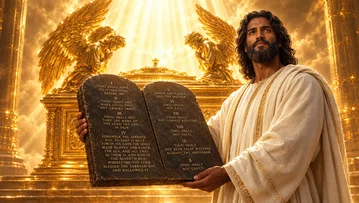
The mercy seat is the cover of the sacred chest in the most holy place behind the second veil.SG2 82.1RH Nov 8, 1915Ms 6a, 1886, par. 38 That ark is a chest of precious wood overlaid with gold, holding the two tables of stone with the law of the ten commandments, together with the golden pot of manna and Aaron's rod that budded.SG4 101.1RH Jul 21, 1851RH Nov 8, 1915 The tables are folded together like a book.RH Jul 21, 1851 Above the mercy seat is the Shekinah manifestation of the divine presence from between the cherubim, where the will is made known.RH Nov 9, 1905Ms 15, 1850, par. 8–11 It is an exceeding bright glory resting as a cloud, remaining upon the ark day and night as Israel's glory and strength and as the enduring token of the presence and a pledge of victory.SG4 101.1ST Feb 21, 1911Ms 15, 1850, par. 8–11GC88 411.1–412.3
Light and glory upon the cherubim on the right signified favor, while a cloud upon those on the left signified refusal.1SP 398.1 That glory and disapproval flashed forth even upon the precious stones in the breastplate of the high priest.5RED 86.23SP 166.2–167.1 The directions for all this were given to Moses on the mount as the detailed pattern for the sanctuary, including the pattern of the ark.Ms 97, 1899, par. 3–4Ms 58, 1900, par. 23–25 They were repeated even in tentmaking labor while working quickly and skillfully with the hands, to educate fellow workers in diligence and thoroughness, to teach that supreme honor is to be given to God, and that the skill, genius, and wisdom brought into the work were given by God to be used for His glory.Ms 97, 1899, par. 3–4
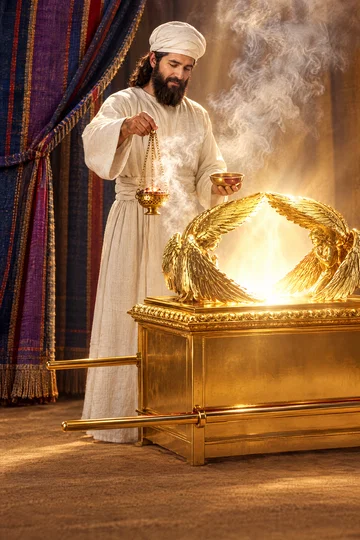
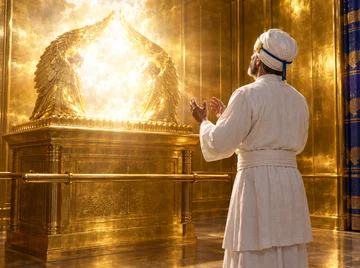
The sacred ark represented Jehovah amid His people, and when removed from the sanctuary the cherubim were never exposed to view but the ark was always kept covered so that no curious eye might look upon it.Lt 28a, 1897, par. 6 Above the mercy seat and the bowed, worshiping angels dwells the glory of the Holiest, glory upon which no man may look and live, so to lift the veil inwrought with cherubim and intrude unbidden into that sacred mystery is death.8T 284.3–285.1 Only the high priest may enter, on the one day of the year appointed for ministry in the most holy place, and he enters with trembling while clouds of incense veil the glory from his sight.8T 284.3–285.1 At that time every sound throughout the courts is hushed, no priests minister at the altars, and the hosts of worshipers bow in silent awe sending up petitions for mercy.8T 284.3–285.1 These arrangements happened by way of example and were written for admonition upon those upon whom the ends of the ages are come.8T 284.3–285.1
At the moment Christ died the veil of the temple was rent in two from top to bottom by the hand of God, and the most holy place that had been entered by human feet only once a year was laid open to common gaze.5RED 86.23SP 166.2–167.1 From that time the presence of God no longer overshadowed the earthly mercy seat.5RED 86.23SP 166.2–167.1 The light of His glory and the cloud of His disapproval were no longer shown forth there, even upon the precious stones in the breastplate of the high priest.5RED 86.23SP 166.2–167.1 Its sacred service and the blood of beasts offered for sin became valueless, because the Lamb of God had died for the sins of the world.3SP 166.2–167.1
Heavenly Pattern and Meaning
The two cherubim commanded at the ends of the mercy seat are the pattern of the true ark in heaven, beside which living angels stand with overshadowing wings in the same posture of reverence and humility.WLF 18.3–4SG4 7.2–8.21SP 272.1ST Mar 4, 1903 Their faces are turned toward one another and look reverently downward toward the mercy seat, representing heavenly angels regarding God's law in the ark with interest and reverence.SG4 7.2–8.21SP 272.1ST Mar 4, 1903 The earthly ark and its cherubim of beaten gold thus copy the heavenly ark and the living angels beside it, whose wings overshadow the mercy seat and whose folded posture shows reverence and humility.WLF 18.3–4SG4 7.2–8.2ST Mar 4, 1903
The heavenly ark has purest, finest gold on its top and sides, with a crown-like border around its top and a lovely cherub on each end.WLF 18.3–4SG1 158.1CET 91.2–3RH Jul 21, 1851 The cherubs have their wings spread over the ark and raised high until they touch each other above, with faces turned toward each other and looking downward to the ark.WLF 18.3–4SG1 158.1CET 91.2–3RH Jul 21, 1851LSEGW 100.1–3 Between the angels is a golden censer, and above the ark where the angels stand is an exceeding bright glory like a throne where God dwells, which shines down upon the ark and fills the temple.WLF 18.3–4CET 91.2–3RH Jul 21, 1851Ms 15, 1850, par. 8–11 Jesus stands by the ark, and as the prayers of the saints in faith come up to Him the incense in the censer smokes and He offers them with its smoke to His Father.WLF 18.3–4SG1 158.1CET 91.2–3RH Jul 21, 1851 Inside the ark are the tables of stone folded together like a book containing the ten commandments, together with the golden pot of manna and Aaron's rod that budded.SG1 158.1RH Jul 21, 1851
The position of the cherubim, with faces turned toward each other and looking down toward the ark, represents the reverential awe of the heavenly universe toward the law within the ark.Ms 8, 1902, par. 3–6SG4 7.2–8.2RH Nov 9, 1905 That law is the foundation of God's government, and the cherubim represent all the heavenly host looking with interest, reverence, and worship at the law of God.Ms 8, 1902, par. 3–6SG4 7.2–8.2RH Nov 9, 19051SP 272.1SG1 158.1 One wing of each angel is stretched forth on high while the other is folded over the body in token of reverence and humility.RH Nov 9, 1905 Their reverence shows heaven's interest in the plan of redemption, and above the mercy seat is the Shekinah manifestation of the divine presence from between the cherubim where the will is made known.8MR 349.1–2RH Nov 9, 1905
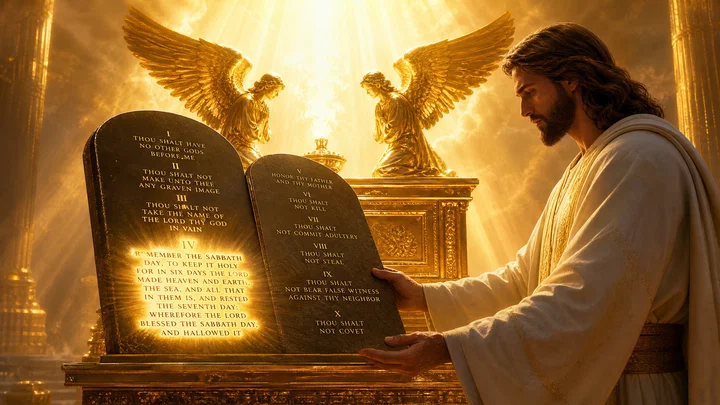
Jesus lifts the cover of the ark behind the second veil to reveal the tables of stone holding the ten commandments written by the finger of God and kept beneath the mercy seat.SG2 82.1CET 85.4–86.11T 75.4–76.1 The fourth commandment stands in the very center encircled with a halo of glory and light above the other nine.SG2 82.1CET 85.4–86.11T 75.4–76.1 It alone points out and defines the living God as the maker and Creator of heaven and earth and all things therein.SG2 82.1CET 85.4–86.11T 75.4–76.1 The Sabbath founded when the foundations of the earth were laid was meant to keep God as Creator before men and to preserve the world from infidelity, atheism, and idolatry.CET 85.4–86.1
The heavenly original of the ark is kept in heaven, where the tables of the law are kept and mercy and truth meet, and Jesus stands before it to mediate for humanity.WLF 18.3–4SG1 158.1Ms 6a, 1886, par. 38 There Christ ministers before the ark in the Most Holy place of the heavenly sanctuary, offering the saints' prayers with the smoke of incense to the Father.WLF 18.3–4SG1 158.1CET 91.2–3RH Jul 21, 1851 The cherubim belong to the sanctuary and the great day of atonement, and after the cross Christ officiates as Priest and Advocate in the heaven of heavens.Ms 6a, 1886, par. 38 The sanctuary and its symbols were closely connected with worship and pointed to the Saviour, opening a new and living way for Jew and Gentile, while the ark beneath the cherubim contained the tables of the law and represented God's presence and a pledge of victory.ST Feb 21, 1911
Prayer Mercy and Healing
The mercy seat in the heavenly sanctuary is the place where the prayers, praise, penitent confession of sin, religious services and obedience of true believers come up before God as incense.WLF 18.3–4SG1 158.1CET 91.2–3RH Jul 21, 1851Ms 50, 1900, par. 17–18 Passing through corrupt human channels they are defiled and without value unless purified by blood, and they do not ascend in spotless purity unless the Intercessor at God's right hand presents and purifies all by His righteousness, for all incense from earthly tabernacles must be moist with the cleansing drops of the blood of Christ.Ms 50, 1900, par. 17–18 He holds before the Father the censer of His own merits with no taint of earthly corruption, gathers into it the prayers, praise and confessions of His people with His own spotless righteousness, and perfumed with the merits of His propitiation the incense comes up wholly and entirely acceptable as a fragrant cloud around the mercy seat, and then gracious answers are returned, with everything of obedience, penitence, praise and thanksgiving placed upon the glowing fire of the righteousness of Christ.WLF 18.3–4SG1 158.1CET 91.2–3RH Jul 21, 1851Ms 50, 1900, par. 17–18 The ark there is covered on top and sides with purest and finest gold with a crown-like border around its top, holding inside the tables of stone containing the ten commandments written by the finger of God and folded together like a book, together with the golden pot of manna and Aaron's rod that budded, with a lovely cherub on each end with wings spread out over it and raised high until they touch above, faces turned toward each other and looking downward to the ark in representation of all the angelic host looking with interest at the law of God.WLF 18.3–4SG1 158.1CET 91.2–3RH Jul 21, 1851 Between the angels is a golden censer where the saints' prayers in faith come up to Jesus as He stands by the ark, and as they come up to Him the incense smokes and He offers them with its smoke to His Father, while above where Jesus stands before the ark and the angels stand dwells an exceeding bright glory like a throne where God dwells that overshadows the mercy seat and fills the temple.WLF 18.3–4SG1 158.1CET 91.2–3RH Jul 21, 1851
The mercy seat makes known a ministry of healing and grace that everyone is to become acquainted with.CH 533.2–3CH 422.1 Its light of grace shines forth from many places to sin-sick souls in the last days when the end of all things is at hand.CH 533.2–3CH 422.1 God understands what is needed and brings advantages to workers in various places so they can more effectively arouse attention to the truths that bring deliverance from both physical and spiritual ills, and small gospel medical plants and sanitariums are to make this mercy known to high and low, rich and poor, and by their work call attention to the message God has sent to the world.CH 533.2–3CH 422.1
Sources
Pioneers and periodicals
136 sources
God directed Moses on Sinai to form two cherubim of solid beaten gold as one piece with the mercy seat, one standing at each end with outstretched wings overshadowing it and faces turned toward each other and downward toward the ark.ST Nov 12, 1912RH Apr 1, 1862ST Mar 11, 1886ST Jan 7, 1886RH Jan 6, 1853 From above that mercy seat between the two cherubim He manifested His glory and communed with Moses, making the ark His earthly throne and dwelling among Israel.ST May 20, 1880RH Aug 4, 1863ST Jan 17, 1884RH Jul 27, 1916 Beneath that covering were placed the tables of the ten commandments, so the mercy seat stood above the broken law as the place where atoning blood was sprinkled for pardon without setting the law aside.ST Nov 11, 1897ST Jan 7, 1886ST Jan 6, 1881ST Aug 10, 1882RH Dec 31, 1861 The cherubim standing over the testimony are guardians of God's law as the foundation of His government, and their reverent gaze toward it shows the honor heaven gives to that holy and unchangeable law.RH Nov 9, 1905ST Nov 12, 1912RH Aug 1, 1912ST Apr 11, 1911ST Jun 20, 1906 The arrangement was made after the heavenly pattern, where living angels stand beside the true ark, and the mercy seat above the law typifies Christ standing between the sinner and condemnation so that mercy prevails over death.ST Jun 24, 1880ST Jun 20, 1906ST Nov 11, 1897ST May 16, 1878ST Mar 17, 1898
Sanctuary Instructions and History
Exodus 25:18 belongs to the detailed pattern for the tabernacle and its furniture given by God to Moses during his forty days in the mount, when he also received the tables of stone.ST May 20, 1880RH Feb 11, 1858 It stands within His call in Exodus 25-30 to build Him a sanctuary as the center of worship where His manifest presence would abide, given together with the materials desired for the work and with the consecration of the priests.ST Jan 29, 1908RH Feb 11, 1858ST Mar 11, 1886 The commission came in the third month after the departure from Egypt when Israel came to the wilderness of Sinai, where Moses was summoned up into the mount and remained forty days and forty nights, being shown the pattern of the sanctuary and all its sacred vessels and receiving full instructions concerning them.RH Feb 11, 1858 There the office of the cherubim is fully set forth, because the earthly sanctuary was to be made according to the pattern of things in the heavens so that its representations of the heavenly cherubim harmonize with their office in the courts above.ST Jun 20, 1906ST Jun 26, 1907ST Nov 23, 1904 Two cherubim of beaten gold were to be made at the two ends of the pure gold mercy seat, spreading their wings on high and covering the mercy seat, with the mercy seat put above upon the ark and the testimony, which is the law of God, put in the ark, and from above the mercy seat from between the two cherubim upon the ark of the testimony God would meet and commune concerning all His commandments to Israel.ST Jun 20, 1906ST May 20, 1880ST Jan 27, 1909 The complete description in Exodus 25-30 prescribes the sanctuary Moses was commanded to make from offerings of gold, silver, brass, acacia wood, fine linen, goat's hair and other materials, that God might dwell among Israel, including its gold-covered framework, its linen door and coverings, its division by a second veil into the holy place and the most holy place, and all its furniture and vessels, with the cherubim as part of the most holy place positioned above the ark on the mercy seat.ST Jan 29, 1908ST May 20, 1880ST Mar 11, 1886
Exodus 25 begins the first formal written law regulating the typical service, covering sacrifices, altar, temple, priesthood, and everything relating to the typical system, extending through Leviticus.ST May 20, 1875ST May 6, 1875ST Apr 15, 1886 It follows immediately after the giving of the moral law of ten commandments and the solemn ratification of the covenant concerning it, which Moses received on the mount during several weeks and wrote out in a book of parchment.ST May 20, 1875ST May 6, 1875ST Jul 8, 1886 It stands to the ceremonial system what the decalogue stands to the moral system, as its foundation and epitome, with later explanations, illustrations, and added light from teachers and prophets showing how it was to be applied and carried out.ST May 20, 1875 Such laws given through Moses concerning the sanctuary and its furnishings, which Moses was commanded to remember, revealed offerings, sacrifices, and types through which the substance of the new dispensation could be traced from the shadows of the old, including ceremonies imposed on Israel that concern the sacrificial system and find their fulfillment in Christ.ST Apr 15, 1886ST Jul 8, 1886 The ordinances for building and setting up the tabernacle in Exodus 25:1-40 therefore belonged to Israel's wilderness period rather than to the original institution of the Sabbath.ST May 20, 1875RH Mar 21, 1865
The sanctuary was to be built exactly as directed as God's dwelling among Israel after deliverance from Egypt across the Red Sea, prescribing its dimensions, material, and furnishings, and it was later carried out just as God directed when the ark was built with all its furniture and equipment, after which blessing and glory came down upon the congregation and the building.ST Jan 27, 1909ST Jun 4, 1885ST Jun 26, 1907 To secure proper erection of the building and proper doing of the work He placed His Spirit upon the builders Bezalel and Oholiab together with other devoted men and women, showing that He is just as willing to bless workers in material things who are consecrated to Him as workers in spiritual things.ST Jan 27, 1909 The dwelling place built exactly according to those directions in the wilderness was the worldly sanctuary, first pitched in the wilderness and afterward succeeded by the magnificent temple of Solomon in Jerusalem, where the true worship of God for Israel and all nations centered until Christ's sacrifice and offering at Calvary.ST Jun 4, 1885ST Jun 26, 1907ST May 17, 1877 That sanctuary served as the sanctuary during the first covenant and was later embodied in the temples of Solomon, Zerubbabel, and Herod, continuing as God's dwelling place from the wilderness sanctuary through the time of Israel's leaders and into Solomon's temple.ST Jan 24, 1911ST Jun 4, 1885ST May 17, 1877 The ancient tabernacle was built for ministry involving sacrifices and offerings as an earthly object lesson of God's plan for governing and saving sinners, through which His people cooperated with Him in His work through Christ.ST Jan 24, 1911ST Jun 26, 1907 That earthly sanctuary with its furniture and priestly service was always typical of and foreshadowed the better temple, the true tabernacle which the Lord pitched and not man, serving unto the shadow of heavenly things, with all its rites and ceremonies as object lessons pointing to the Lamb of God that taketh away the sins of the world and His power to forgive sin, transform character, and deliver from burdens.ST Jan 24, 1911ST Jun 26, 1907 Its service passed away when Christ died once for all, and it passed away entirely and forever when the veil of the temple was rent in twain at the death of Christ, while the sanctuary typified the heavenly temple where Jesus now ministers.ST Jan 24, 1911ST Jun 26, 1907
The sanctuary of the first covenant was a worldly tabernacle pitched by man, thirty cubits long and ten broad, located in the midst of Israel's camp as the center of worship where the plan of redemption was carried forward through law, priesthood, sacrifices, and symbols of pardon.ST Jun 19, 1907RH Mar 4, 1862ST Jun 26, 1907 Exodus 25:18 belongs to the account of that wilderness tabernacle, commanding the making of two golden cherubim for the ends of the mercy seat as part of the description of the holy of holies, where the law of God rested beneath the mercy seat and around which Israel's worship and service centered.ST Jun 19, 1907ST Jan 27, 1909RH Mar 4, 1862 It shows that the first covenant had an earthly sanctuary with an ark containing the law of God in ten commandments, with a priesthood ministering before that ark to make atonement for sin.RH Mar 4, 1862RH Nov 3, 1874ST Jun 14, 1883 That tabernacle erected by Moses was the pattern of the true, greater and more perfect tabernacle in heaven where Christ ministers as High Priest before the ark of God's testament.RH Mar 4, 1862RH Nov 3, 1874ST Nov 23, 1904 The wilderness tabernacle, the sanctuary of the first covenant, was thus a type and pattern of the heavenly sanctuary of the new covenant, built according to the pattern shown to Moses as an object lesson of the heavenly sanctuary and Christ's service there as High Priest.ST Jun 14, 1883ST Dec 3, 1874ST Nov 23, 1904
Cherubim Material and Form
Two cherubim of pure, solid, beaten gold were to stand one at each end of the mercy seat of pure gold.ST Mar 11, 1886ST Jan 7, 1886RH Jan 6, 1853RH Mar 28, 1854ST Jun 19, 1907 The mercy seat itself was two cubits and a half long and a cubit and a half broad, and cover and cherubim were wrought together as one solid piece.RH Nov 9, 1905ST Mar 11, 1886ST Jan 7, 1886RH Jan 6, 1853RH Mar 28, 1854 The cover was the cover of the ark in the most holy place, and the cherubim represented angels who minister in the heavenly sanctuary.ST Mar 11, 1886RH Mar 28, 1854ST Jun 19, 1907 Within the ark under them was put the testimony, the ten commandments spoken from Sinai and written on tables of stone with the finger of God.RH Nov 9, 1905ST Mar 11, 1886ST Jan 7, 1886RH Mar 28, 1854
The cherubim stand with wings stretched forth on high forming an arch over the ark and covering or shadowing the mercy seat.RH Apr 1, 1862ST Mar 11, 1886ST Jul 2, 1896RH Mar 28, 1854RH May 19, 1874 One wing of each is stretched forth on high while the other is folded over the body in token of reverence and humility.RH Nov 9, 1905ST Mar 11, 1886 Their faces are turned toward each other and reverently downward toward the mercy seat and the ark and the law within it.RH Nov 9, 1905ST Nov 12, 1912ST Mar 11, 1886ST Jul 2, 1896RH Mar 28, 1854 Together with the mercy seat and the cloud of glory they form a shadow of God's throne and presence, where God promised to meet and commune above the mercy seat between the wings.ST Nov 12, 1912RH May 19, 1874ST Jun 12, 1907ST Oct 25, 1905
The figures are not mere ornament but represent the real, living order of cherubim, companies of angels near the throne of God in heaven.RH Apr 1, 1862ST Apr 2, 1912ST Aug 23, 1910ST Jan 31, 1911ST Apr 8, 1889 They are ministering spirits continually standing in God's presence, an organized body arranged for special service, sent always on errands of mercy for the succor and help of His people and to show His wonderful power and goodness.ST Apr 2, 1912ST Aug 23, 1910ST Jan 31, 1911ST Apr 8, 1889 They were made with wings because the angels they represent have wings.RH Apr 1, 1862 The cherubim of the ark had one face and two wings, unlike the different forms described in later visions.ST Jan 31, 1911
Cherubim belonged also to the other ornamentation of the sanctuary, for the inner veil and the innermost curtain were decorated with them, and angels embroidered in fine linen in the ceiling curtains likewise represented the angels of heaven waiting upon His bidding.ST Jun 3, 1908ST Nov 14, 1892ST Mar 10, 1898RH Apr 18, 1907ST Nov 14, 1900 Like them were the cherubim figures woven into the tabernacle curtains and drapery, which was covered with figures of cherubim representing the ministering host of God in heaven.ST Jun 3, 1908RH Apr 18, 1907ST Nov 14, 1900 Parallel adornments to glorify God and make His house beautiful were pomegranates, bells, lions, cattle, oxen, and lilies with temple carvings of angelic figures and fruits.ST Jun 3, 1908ST Sep 20, 1899ST Nov 14, 1900
Presence Between the Cherubim
The two cherubim stand at the two ends of the mercy seat above the ark in the most holy place, and above the ark, over the mercy seat, between the cherubim, God manifested His immediate presence and glory and communicated with His people.ST May 20, 1880RH Aug 4, 1863ST Jun 26, 1884 From above the mercy seat, from between the two cherubim upon the ark of the testimony, He met and communed with Moses concerning all His commandments to Israel, giving commands for the people.ST Jun 20, 1906ST Jan 17, 1884ST Jun 4, 1885 There the name of the Lord of hosts is called upon, for God communes with the people from between those cherubim.ST Jun 26, 1884 The mercy seat is the solid gold cover of the ark, a chest of shittim wood overlaid within and without with pure gold, shadowed by the wings of the cherubim of beaten gold stretched upward over it.RH Aug 4, 1863ST Jan 17, 1884ST Feb 17, 1890 Between the cherubim was the holy Shekinah, the visible manifestation of God, before whose mercy seat atonement was made and favor extended to the penitent.ST Feb 17, 1890
The space between the cherubim was the place of God's constant presence, represented by the Shekinah over the ark where the law was kept.ST Dec 29, 1909 The glory of the Shekinah abode above the mercy seat, with the glorious Shekinah above it and the wings spread over it, making the space between the cherubim a symbol of God's throne.ST Aug 19, 1913STST Dec 29, 1909 The visible cloud of glory and divine light abode and shone between the cherubim above the mercy seat as the only light in the holy of holies, marking the point from which the symbol of His presence would be seen and from which He would speak.RH Jul 27, 1916 There mercy and truth meet and righteousness and peace come together, for the cherubim with the mercy seat and the Shekinah above it symbolize God's throne between them.ST Aug 19, 1913STST Dec 29, 1909 Its placement above the law means mercy prevails over the law's decree of death for sin, and the Shekinah glory on the mercy seat between the cherubim gives assurance of a compassionate hearing and hope of forgiveness for transgression of the law beneath.RH Jul 27, 1916
The ark with its mercy seat and overshadowing cherubim is the earthly representation, made after the heavenly pattern, of the throne of God where He meets His people to dispense judgment and mercy.ST Jun 20, 1906RH Aug 1, 1912ST Jun 20, 1906 Within the ark, under the mercy seat, were the tables of the law, and between the cherubim upon the mercy seat and above the tables was where the glory of God was seen and where God spoke as the one who sits between the cherubim.ST Mar 26, 1896 Together with the law inside the ark and the mercy seat covering it, the cherubim formed a symbol of God's throne, the law at its foundation representing the basis of God's moral government and the very foundation of His throne in heaven, identical with the law spoken from Sinai.ST Mar 26, 1896 The whole arrangement was a type of the throne of God, the angels about the throne, the law the foundation of His government, the mercy seat typifying the interposition of mercy and pardon, with the visible glory of the Lord, the Shekinah, shining out above it.RH Jan 6, 1916 The voice of God's commands issues from His throne, from above the mercy seat from between the two cherubim, above the place where the law rests.RH Aug 1, 1912
Because God's glory and immediate presence were there, no one except the high priest could enter the most holy place, and he only once a year, with a cloud of incense from his censer concealing the mercy seat, lest he die.ST Mar 11, 1886 That entering was on the tenth day of the seventh month, the day of atonement, when the ministration changed from the holy place to the most holy place and the cloud of glory representing God's presence removed from the holy place to the most holy place, so the presence was not in both apartments at the same time.RH May 11, 1869 The high priest alone entered within the veil in the holiest of all only once a year to cleanse the sanctuary and never got up upon the mercy seat.RH Though this sacred place and its holy objects were cleansed annually, they were cleansed by blood, not fire, in the innermost holy place where the Lord dwelt between the cherubim in the cloud of divine glory.RH Sep 30, 1852 Jesus enters the holiest to cleanse the true tabernacle only at the end of the 2300 days, but He never was and never will be seated upon the mercy seat, and His ministry after ascension was in the first apartment before the throne with the seven lamps burning, distinct from the second apartment to which the ark with its mercy seat belongs and where the high priest ministers alone.RHRH Sep 14, 1911
Law Beneath the Mercy Seat
The mercy seat of pure gold, two cubits and a half long and a cubit and a half broad, was put above upon the ark in the most holy place.ST Nov 11, 1897ST Jan 7, 1886 That ark was an oblong chest of acacia or shittim wood overlaid within and without with gold, placed as the only article in the inner oblong two-room sanctuary with no outside entrance, while table of showbread, golden candlesticks, and altar of incense stood in the holy place.ST Jan 7, 1886RH Nov 17, 1863 Inside beneath the mercy seat were put the testimony, the two tables of stone written with the finger of God containing the covenant, even the ten commandments spoken from Sinai, and the ark was made on purpose to hold that law of God.ST Nov 11, 1897ST Jan 7, 1886RH Dec 31, 1861 It was called the ark of the testimony because it held the tables of the law, also called the tables of testimony, which testified of God's will, and the mercy seat is its cover.RH Mar 17, 1863 The book of the law placed beside or before the ark testified against rebellious tendencies, while the pot of manna and Aaron's budding rod testified to God's goodness despite unworthiness and stood beside or before it.
The top of the ark was called the mercy seat because the breaker of the law shut up beneath it could find pardon by the sprinkling of the blood of atonement upon and before that place.ST Jan 6, 1881ST Sep 21, 1876 The law within demanded an atonement, and the sprinkled blood above it extended pardon to the penitent sinner who responds with repentance and faith, when the high priest sprinkles the blood of a sin offering upon it.ST Nov 20, 1879 The whole ceremonial system was ordained to enable man to approach again to this broken law, showing that the shadowy atonement related to that perfect law and typifying the restitution of the pardoned to their inheritance and the destruction of the impenitent.ST Jan 6, 1881 The real atonement does not take away the broken law but takes away the guilt of the transgressor.ST Aug 10, 1882
Ark and mercy seat are closely joined because God's law is the rule of human life, while mercy and pardon for transgression of that law are found through the Son of God's blood.ST Oct 22, 1874RH May 27, 1852RH Oct 7, 1873 The mercy seat with its two cherubim of gold rests above the ark containing the law, and both belong together and both abide in the heavenly tabernacle where Christ ministers as High Priest with a more excellent ministry, even though the glory associated with Moses' ministry and the Levitical service has passed away.RH Dec 12, 1854RH Feb 17, 1852 It does not replace, remove, set aside, or blot out the law beneath it, and the law remains in the heavenly tabernacle beneath the mercy seat, kept beneath God's throne.RH Dec 12, 1854RH Feb 17, 1852RH Apr 13, 1869 To prize the mercy seat while despising the law beneath it is wrong, for the blood of Christ did not blot out the moral law that made His death necessary.RH Dec 12, 1854 Removing the law would remove ark and mercy seat.RH Dec 12, 1854
Placing the decalogue alone inside under the mercy seat, under the wings of the cherubim and the Shekinah with its flaming manifestation of the very presence of Almighty God, where sprinkled blood could atone for breaking it, forever marks its divine source, honor, binding permanence, and separation from ceremonial law.ST Feb 4, 1886RH Aug 19, 1909ST Sep 9, 1913 That honor was never given to any ceremonial or repealable law, in contrast to the temporary polity and shadowy ritual spoken to Moses alone, written by the hand of Moses, and placed beside the ark with less reverence and care ready to be removed, which were not spoken to the people by God's own voice nor written by His own finger.RH Jul 4, 1912ST Feb 4, 1886RH Nov 8, 1853 This majesty of giving and keeping sets the Ten Commandments above all other laws given to man, marking the whole law and the fourth commandment equally as holy, glorious, and eternal rather than a temporary Jewish rite belonging to a decaying covenant ready to vanish away, with incorruptible shittim wood overlaid with gold within and without and the inviolable Shekinah keeping the tablets spoken by God Himself and twice written by His own finger for secure and sacred keeping.RH Jul 4, 1912ST Feb 4, 1886 The ark with the mercy seat and overspreading cherubim is the typical representation of the throne of God, from which mercy and forgiveness come, and showed the holiness, perfection, and completeness of the Ten Commandments.RH Aug 19, 1909ST Sep 9, 1913 Because the earthly ark is the type that explains the ark of the testament seen when the temple of God is opened in heaven in Revelation 11:19, attention called to the heavenly ark leads to its earthly pattern and then to its contents, the tables of the testimony with the ten commandments, and because the ark contains the law and the law contains the fourth commandment unabolished and unchanged, sanctuary truth and Sabbath truth are inseparably connected, so those who by faith follow the High Priest into the Most Holy Place where He ministers before the ark must restore the breach made in the law and keep all the commandments.RH Jul 25, 1854
Heavenly Pattern and Counterpart
The earthly tabernacle with its two holy places and its sacred vessels was made exactly like the pattern shown to Moses in the mount, so that it stands as the pattern and figure of the heavenly temple and proves that temple consists of two apartments.ST Jun 20, 1906ST May 16, 1878RH Dec 30, 1873 The golden cherubim at the two ends of the mercy seat belong to that patterned furnishing of the second apartment, where God's glory was manifested between them and where He met and communed concerning all His commandments.ST Jun 20, 1906ST Nov 11, 1897ST May 16, 1878RH Dec 30, 1873 Every part of that building must have a corresponding reality in the antitypical sanctuary, and neither the land of Canaan, nor the whole earth, nor the church, nor heaven and earth together supplies anything answering to the two apartments, the golden candlestick, the altar of incense, the ark of the covenant, and the continual priestly service, so none of them can be the antitype.RH Oct 2, 1856 The ark and its testimony to God's righteousness therefore have a counterpart in the heavenly sanctuary, where Revelation 11:19 shows the ark, and the earthly services and appointments foreshadow the real work of Christ as High Priest in heaven.ST Mar 17, 1898
The earthly ark and its cherubim were the pattern and object lesson of the true ark in heaven, where living angels stand beside the ark with wings overshadowing the mercy seat in reverence and humility.ST Jun 24, 1880ST Mar 21, 1911ST Mar 4, 1903 The two cherubim beaten from the same piece of gold as the costly mercy-seat cover stood one on each end, with faces turned toward one another and looking reverently downward toward the mercy seat, representing all the heavenly angels looking with interest and reverence to the law of God deposited in the ark in the heavenly sanctuary.ST Jun 24, 1880ST Mar 21, 1911ST Mar 4, 1903 One wing of each angel was stretched forth on high while the other was folded over the form, in token of reverence and humility, and so it is with the living angels beside the heavenly ark.ST Mar 21, 1911ST Mar 4, 1903 That heavenly ark in the Most Holy Place of the temple in heaven is covered on top and sides with purest gold, with a lovely cherub on each end with wings spread over it and faces turned toward each other and looking downward, with exceeding bright glory above them like a throne where God dwells, and with Jesus standing by the ark to offer the saints' prayers with incense to the Father.RH Jul 21, 1851GSAM 255.3 Inside that ark are the golden pot of manna, Aaron's rod that budded, and the tables of stone folded together like a book with the ten commandments written by the finger of God, the fourth commandment in the very center encircled with a soft halo of light as the only one defining the living God who created the heavens and the earth.RH Jul 21, 1851GSAM 255.3
What is in the heavenly sanctuary belongs to the universal government of God: an ark, cherubim upon the ark, God as Ruler sitting and dwelling between the cherubim, and the testimony or Ten Commandments in the ark.ST Nov 11, 1897ST Nov 11, 1897 The earthly furniture proves corresponding heavenly articles, for the two cherubim of beaten gold on the two ends of the pure gold mercy seat set above the ark of shittim wood in the most holy place were patterned after cherubim in the sanctuary in heaven where Christ ministers.ST Nov 11, 1897ST Nov 11, 1897 Within the earthly ark under the mercy seat were the tables of the law, and between the cherubim upon the mercy seat and above the tables was where the glory of God was seen and where God spoke as the one who sits between the cherubim.ST Mar 26, 1896 That ark with its mercy seat and cherubim is a representation of the throne of God, showing that the Ten Commandments are the very foundation of His throne in heaven, identical with the law spoken from Sinai, since the earthly tabernacle is a figure of the true tabernacle in heaven.ST Mar 26, 1896ST May 20, 1886 Because the Ten Commandments lay beneath the cherubim in the figure, they are beneath the covering cherubim in the heavenly reality, and the Sinai law is only a duplicate of the testimony in the heavenly ark which is the habitation of His throne.ST May 20, 1886ST Nov 11, 1897
The tabernacle's forms and services, including its cherubim, belong to Moses' testimony of Christ.RH Dec 31, 1901 The dwelling built exactly according to the directions given on Sinai was the worldly sanctuary first pitched in the wilderness and afterward succeeded by Solomon's temple, where true worship centered until Christ's sacrifice at Calvary, and it was always typical of and foreshadowed the better temple, the true tabernacle which the Lord pitched and not man, serving unto the shadow of heavenly things.ST Jun 26, 1907 All its rites and ceremonies were object lessons pointing to the Lamb of God that takes away the sin of the world and His power to forgive sin, transform character, and deliver from burdens, and the earthly sanctuary built according to the pattern shown to Moses was an object lesson of the heavenly sanctuary and Christ's service there as High Priest.ST Jun 26, 1907ST Nov 23, 1904 Their extended wings cast shadows of things to come, and the sanctuary's design helps lead toward a fuller understanding of divine love and wholehearted worship of God.
Throne Guardians of Government
The two cherubim standing at the two ends of the mercy seat above the ark are guardians of that representation of the throne of God where He meets His people to dispense judgment and mercy, and guardians of the law of God placed in the ark under the mercy seat which is the very foundation of His moral government.RH Aug 1, 1912ST Jun 20, 1906ST May 20, 1886ST May 14, 1894RH Sep 24, 1861 Their place over the law in the most inaccessible portion of the tabernacle, with the tables of stone on which Divinity engraved the Decalogue set under His throne with the angels of His presence guarding them, is an object lesson to Israel and through them to all the world of the sacredness and undying perpetuity of the law.RH Aug 1, 1912ST Apr 11, 1911ST Jun 20, 1906 The law cannot be tampered with without tampering with the throne of God and cannot be abolished or changed without overturning the very throne itself, so that even if men strip the gold from the ark, melt the cherubim, break the tablets, and kill those in whose hearts the law is written, they only break themselves and do not touch God's government left untouched in heaven.RH Aug 1, 1912ST Apr 11, 1911ST Jun 20, 1906 The voice of God's commands issues from His throne, from above the mercy seat from between the two cherubim above the place where the law rests, and because the law lay beneath the throne of mercy God's pardon and rule are in harmony with the law as the source of the principles by which He dispenses justice and mercy, revealing Him as both just and compassionate.RH Aug 1, 1912ST May 14, 1894RH Sep 24, 1861 The ark with its mercy seat and cherubim is a figure of God's throne in the heavenly temple, because the Ten Commandments lay beneath the cherubim in the figure they are beneath the covering cherubim in the heavenly reality.ST Mar 26, 1896ST May 20, 1886
The law kept inside the ark reflects God's character and forms the very foundation of God's throne in heaven, identical with the law spoken from Sinai and written on the tables of stone placed in the ark, since the earthly tabernacle with its most holy place made for God to dwell among the people is a figure of the true tabernacle in heaven.ST Mar 26, 1896ST Oct 21, 1930 Beneath the typical throne crowned by the cherubim lay the Ten Commandments as the pillars of God's eternal government, with the divine light called the Shekinah resting between the cherubim and shining from beneath their wings as a symbol of God's presence from which He dispensed mercy to Israel through the high priest's atonement.ST Oct 21, 1930ST Mar 10, 1898 Their covering of the law in the most holy place beneath the visible presence of God shows the honor God gives His holy law, so that mercy does not set the law aside or dishonor it.RH Apr 4, 1871 Their downward gaze into the ark where the law was placed as the central thing of the ark and of the whole tabernacle system represents the attitude of heaven and earth toward the commandments, showing that the law is the foundation of everything worth having and is to be regarded with reverence.
The cherubim were beaten from the same solid piece of gold as the mercy seat cover, with one wing of each angel stretched forth on high while the other is folded over the body in token of reverence and humility, and with faces turned toward one another looking reverently downward toward the ark holding the ten commandments and toward the mercy seat where the Shekinah manifestation of the divine presence abides between the cherubim where God makes known His will.RH Nov 9, 1905ST Jun 24, 1880ST Mar 21, 1911ST Mar 4, 1903ST Nov 12, 1912 Their position represents the reverence with which the heavenly host regard the law of God and their interest in the plan of redemption, for the earthly ark was the pattern of the true ark in heaven where living angels stand beside the ark with wings overshadowing the mercy seat in the same posture.RH Nov 9, 1905ST Jun 24, 1880ST Mar 21, 1911ST Mar 4, 1903 All the heavenly angels look with interest and reverence to the law of God deposited in the ark in the heavenly sanctuary, with faces turned attentively toward the center where God's glory rests and toward Christ's mediatorial work by which God can be just and the justifier of believers, and sinners who come confessing their sins receive mercy and pardon where God covers the broken law with the mercy seat and takes His position there.ST Mar 21, 1911ST Mar 4, 1903ST Nov 12, 1912 The posture means all the heavenly host looking with reverential awe toward the law written by the finger of God kept inside the ark, the tables of stone with the ten commandments seen when Jesus raises the cover, with the fourth commandment in the very center encircled with a soft halo of light as the only one defining the living God who created the heavens and the earth.GSAM 255.3
The two gold cherubim at the ends of the mercy seat were representations of the living creatures closely connected with the throne of God in heaven, called the cherubim of glory shadowing the mercy seat. The covering cherub position was a high honor of closeness to God's throne, and one who was once exalted to it rebelled against his Maker and led other angels away with him, becoming the devil and his angels. The command to make the cherubim for the ends of the mercy seat was given to impress the holiness of the law contained in the ark, not the holiness of the ark itself.ST Apr 8, 1889 Holiness was inherent in the law itself, absolute and eternal, while the holiness of the ark and everything connected with it was derived, relative and temporal, yet what the ark contained made it the center of all worship, gave it a place in the holy of holies veiled in the glory of the Infinite, and made it the enduring token of God's presence and pledge of victory in battle before which idols could not stand and where irreverent touching or curious gazing brought death.ST Feb 21, 1911ST Jun 3, 1886ST Apr 8, 1889
Mercy Atonement and Christ
The cover of the ark was solid gold, with a cherub standing at each end and their wings stretched out to meet over its center, and that cover was called the mercy seat, the point from which the symbol of God's presence would be seen between the cherubim and from which He would speak to His people.RH Jul 27, 1916 It represented the throne of God, with the ten commandments resting beneath it as the pillars of His government and the foundation of His moral rule, and with the shining Shekinah between the guardians as God's presence.RH Jul 27, 1916RH Apr 24, 1913ST May 14, 1894 The mercy seat beneath them is a type of Christ standing between the sinner and the broken law and paying on Calvary the penalty for transgression, so that mercy and justice meet in God's throne.RH Apr 24, 1913 Its placement above the law means mercy prevails over the law's decree of death for sin, while the Shekinah glory on the mercy seat between the cherubim gives assurance of a compassionate hearing and hope of forgiveness for transgression of the law beneath.RH Jul 27, 1916RH Feb 18, 1904 The law in the ark is the great rule of righteousness and judgment pronouncing death upon the transgressor, but above the law is the mercy seat upon which the presence of God is revealed and from which, by virtue of the atonement, pardon is granted to the repentant sinner, so that in Christ's redeeming work mercy and truth are met together and righteousness and peace have kissed each other.RH Feb 18, 1904ST May 14, 1894RH Aug 7, 1900
The law reveals sin and condemns the transgressor, while the blood provided through the gospel covers sin and blots it out in the sinner's record, and the law beneath the mercy seat remains the enduring standard of righteousness and foundation of God's throne in vital connection with the gospel and every person reached by Christ's work.RH Aug 7, 1900 While the law cries for vengeance, the blood of Christ sprinkled on the mercy seat appeases its severity without abolishing the holy law but satisfying justice.RH Jun 9, 1853 On the Day of Atonement the high priest entered within the veil into the Most Holy Place with the blood of a sin offering and, while the cloud of incense from his censer covered the mercy seat, sprinkled the blood before and upon it seven times to make atonement for the holy sanctuary, for the tabernacle of the congregation, for the altar, for the priests, and for all the people because of uncleanness and transgressions.RH Jan 9, 1855RH Jun 21, 1864 The mercy seat lay between God, whose glory is above the cherubim, and the law beneath it, and when the law had been violated the sprinkled covenant blood honored the law and its penalty through an accepted substitute so that the penitent sinner could be pardoned.RH Jun 23, 1874ST Jun 19, 1907RH Aug 30, 1864 Through this service mercy and pardon were granted to the repentant sinner who came to God with repentance and faith, while the blood honored and satisfied the claims of the divine law kept beneath it, and the cleansing work removed the people's sins from the sanctuary by blood.ST Jun 19, 1907RH Mar 10, 1874
Those sacrifices did not actually remove sin, which is taken away by Christ's blood, for in heaven Christ serves as High Priest before the same unchanged law, pleading His blood for those who have broken it, and the heavenly ark contains that law as the standard by which God judges.RH Aug 30, 1864 God covers the broken law with the mercy seat and takes His position there, with wings stretched over the ark and faces looking reverently toward the law within, forming a shadow of God's throne and presence, and sinners who come confessing their sins receive mercy and pardon.ST Nov 12, 1912 There mercy and truth meet together and righteousness and peace kiss each other without abolishing the holy law.RH Jun 9, 1853 Those coming to the mercy seat must keep all His commandments, including the despised and broken fourth commandment, that they may have right to the tree of life and may enter in through the gates into the city.RH Jun 9, 1853
The ark of the covenant and its mercy seat is a picture of the place where God's forbearance is shown, holding back the avenging sword and preserving a reckless world in life, and representing the true presence of divine life and a genuine representation of Jesus in contrast with religious forms that lack practical spiritual life.RH Jun 26, 1856 The mercy seat, or propitiatory, with its two cherubim of beaten gold on the ark of the covenant belongs to Christ as Mediator and Saviour.ST Sep 29, 1881 To call Mary the Ark of the New Testament, the antitype of the ark of the covenant, the mercy seat and the propitiatory perverts Scripture and leaves nothing to be applied to Christ, making Mary the only hope of the saints and the mediatrix between God and man by whose merits and intercession people are saved.ST Sep 29, 1881
Images Worship and Application
God's express order to fashion two golden cherubim to shadow the mercy seat proves the second commandment does not forbid the making of every likeness, but only the making of graven images as idol gods to be bowed down to, worshiped, reverenced, or served.ST Jul 1, 1897ST Jun 3, 1908RH Mar 9, 1916RH Aug 9, 1864RH Apr 5, 1864 The cherubim were images of angels above, commanded as part of the sanctuary furniture and vessels according to the pattern shown in the mount, and like the cherubim woven into the tabernacle curtains and ceiling, the pomegranates, bells, lions, cattle, oxen, lilies, and other temple figures, they were permitted for ornament, beauty, illustration, teaching, and aid to worship to glorify God and make His house beautiful.ST Jul 1, 1897ST Jun 3, 1908RH Mar 9, 1916RH Apr 5, 1864 Their commanded likenesses, with faces looking toward the law in the ark with sacred respect, show that making images is not itself forbidden, for the prohibition is explained by its warning against bowing down to them or serving them, or by any attachment that interferes with devotion to God.ST Jun 3, 1908RH Apr 5, 1864RH May 7, 1867 Making images and keeping and honoring them in houses and churches is not itself adoring them and is lawful, since the commandment limits itself to forbidding adoring images and serving them, so that to condemn honoring images would condemn God who commanded them.ST Jun 29, 1876
The sanctuary's design, with the cherubim made as part of the mercy seat and their extended wings casting shadows of things to come, helps lead people toward fuller understanding of divine love and wholehearted worship of God. The old sanctuary where Israel worshiped was richly grand, filled with the treasures of the land and adorned with golden cherubim, where deepest reverence was paid with hushed and slow footfall and bowed foreheads, and that ancient sanctuary pointed to the new gospel ministry now celebrated in Christian churches.RH May 30, 1912 A wooden church is no less holy and good than that old sanctuary, because Jesus' grace granted in a humble place makes that humble house of prayer a sanctuary.RH May 30, 1912
God makes things sacred by setting them apart for His service and presence, as with the sanctuary and the ark unlike an ordinary box or chest, teaching the difference between the common and the sacred without depriving man of blessing but to bring untold blessings to humanity.ST Jan 27, 1909ST Aug 8, 1916RH Sep 11, 1913 The direction for the cherubim was one of the explicit directions for the sanctuary whose center was the holy of holies holding the ark of the covenant containing God's holy law on tables of stone, to be carried out exactly as given, and it was later carried out just as directed when the ark was built with all its furniture and equipment, after which blessing and glory came down upon the congregation and the building.ST Jan 27, 1909 The command shows God is just as willing to bless workers in material things who are consecrated to Him as workers in spiritual things, and to secure proper erection of the building and proper doing of the work He placed His Spirit upon the builders Bezalel and Oholiab together with other devoted men and women.ST Jan 27, 1909
The mercy seat with its two golden cherubim at its ends is a place where the soul draws near to God in prayer and is spiritually quickened, stirred to deeper desire, and drawn toward God.RH Dec 11, 1856RH Sep 24, 1908 It is where sinful, erring youth are to be led by God for watchful care and guidance to the truth.RH Dec 11, 1856 It is where those who have greatly sinned and deserve wrath come trembling to seek God's side, asking Him to direct their wayward feet, to spare them in kindness and compassion, and to receive mercy because the Saviour died for them.RH Dec 11, 1856
The golden cherubim at the two ends of the mercy seat are associated with the judgment seat and its light of mercy.ST Nov 7, 1878 The ark of the testimony placed in the holiest place within the very heart of the temple built by Moses means the holiest character is found at the center and at home, so a true gentleman is proved within the sanctuary of home among his nearest intimates and associates, where those who know him best love him most.RH Nov 24, 1863 The mercy seat stood above the law in the ark and represented the Lord's mercy even toward sinful Jericho, and the cherubim were part of this glorious mercy seat which accompanied Israel as the ark went around the city.ST Mar 20, 1901 God enthroned between the cherubim over the mercy seat covering the ark that holds His law is the Redeemer who will lead the redeemed hosts through the gates into the eternal city, for as the ark with the law within opened a gateway through Jordan for commandment-keeping Israel to enter Canaan, loyalty to the law by the last generation will make it possible for Him to open the way into the new earth.RH Mar 18, 1909
The mercy seat, pictured as surrounded forever by guiding lights of love, warns that habitual selfishness can leave a person unwilling to turn toward that love and can become a prison of the soul.ST Oct 8, 1894 The cover of the ark, called the mercy seat, with a golden cherub standing on each end of it, is a chest placed in the holy of holies behind the veil and behind the altar of incense, holding the stone tablets of the law beneath the mercy seat.RH Feb 10, 1910 The two cherubs face inward with wings extending inward and heads bowed, as if watching over the sacred treasure beneath their feet, and the ark is the one portion for which all other parts of the tabernacle exist and to which they are only preliminary, approached by the high priest passing through the veil into close proximity with it.RH Feb 10, 1910 The ark, mercy seat, and cherubim had a highly figurative character and were easy to interpret.ST Sep 3, 1912
The ark and mercy seat both exist in the present dispensation in heaven, with the mercy seat resting on the ark which contains the Ten Commandments, where the merciful High Priest stands ready to plead the case of those who come to Him sincerely and truthfully.RH May 27, 1852RH May 27, 1852ST Oct 22, 1874 The ark beneath the mercy seat is also worthy of love, so attention to the heavenly ark leads to its contents and inseparably connects sanctuary truth with Sabbath truth for those who follow Christ into the most holy place.RH May 27, 1852RH May 27, 1852ST Oct 22, 1874
Sources