Daniel 8:14
And he said unto me, Unto two thousand and three hundred days; then shall the sanctuary be cleansed.
Translations
And he said to me, To two thousand and three hundred days; then shall the sanctuary be cleansed.
King James Version, KJV Cambridge Paragraph Bible
And he said unto me, Unto two thousand and three hundred days; then shall the sanctuary be cleansed.
And he said to me, Until two thousand and three hundred days; then shall the sanctuary be cleansed.
Revised Version, American Standard Version
And he said unto me, Unto two thousand and three hundred evenings and mornings; then shall the sanctuary be cleansed.
And he saith unto me, Till evening — morning two thousand and three hundred, then is the holy place declared right.
And he said unto me, Until two thousand and three hundred evenings [ and] mornings: then shall the sanctuary be vindicated.
And he said unto him, Until two thousand and three hundred evening-mornings,—then shall the sanctuary, be vindicated.
Berean Standard Bible, Majority Standard Bible
He said to me, “ It will take 2,300 evenings and mornings; then the sanctuary will be properly restored.”
He said to me, “ To two thousand and three hundred evenings and mornings. Then the sanctuary will be cleansed.”
And he said to him, For two thousand, three hundred evenings and mornings; then the holy place will be made clean.
And he answered me, Vnto the euening and the morning, two thousand and three hundreth: then shall the Sanctuarie be clensed.
Douay-Rheims (Challoner revision)
And he said to him: Unto evening and morning two thousand three hundred days: and the sanctuary shall be cleansed.
Pictures

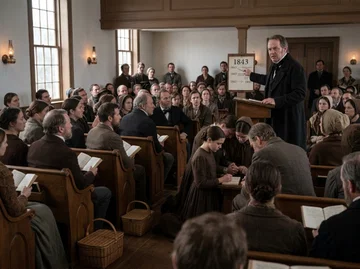
Cross-references 20 of 83
- Daniel 9:24
Seventy weeks are determined upon thy people and upon thy holy city, to finish the transgression, and to make an end of sins, and to make reconciliation for iniquity, and to bring in everlasting righteousness, and to seal up the vision and prophecy, and to anoint the most Holy.
The seventy weeks are cut off from the 2,300-day period.
- Hebrews 8:1-2
Now of the things which we have spoken this is the sum: We have such an high priest, who is set on the right hand of the throne of the Majesty in the heavens;
Christ ministers as High Priest in the heavenly sanctuary.
- Hebrews 9:23-24
It was therefore necessary that the patterns of things in the heavens should be purified with these; but the heavenly things themselves with better sacrifices than these.
Heavenly things are purified through Christ’s better sacrifice and heavenly ministry.
- Leviticus 16:29-30
And this shall be a statute for ever unto you: that in the seventh month, on the tenth day of the month, ye shall afflict your souls, and do no work at all, whether it be one of your own country, or a stranger that sojourneth among you:
The Day of Atonement’s service cleanses the sanctuary and the people from sin.
- Daniel 9:25
Know therefore and understand, that from the going forth of the commandment to restore and to build Jerusalem unto the Messiah the Prince shall be seven weeks, and threescore and two weeks: the street shall be built again, and the wall, even in troublous times.
The decree to restore Jerusalem dates the seventy weeks, the first portion of the 2,300-year period.
- Revelation 11:19
And the temple of God was opened in heaven, and there was seen in his temple the ark of his testament: and there were lightnings, and voices, and thunderings, and an earthquake, and great hail.
The opened heavenly temple reveals the ark as Christ ministers in the most holy place.
- Daniel 9:22-23
And he informed me, and talked with me, and said, O Daniel, I am now come forth to give thee skill and understanding.
Gabriel comes during Daniel’s prayer to explain the vision left unfinished.
- Ezekiel 4:6
And when thou hast accomplished them, lie again on thy right side, and thou shalt bear the iniquity of the house of Judah forty days: I have appointed thee each day for a year.
A symbolic prophetic day represents a year.
- Daniel 8:26
And the vision of the evening and the morning which was told is true: wherefore shut thou up the vision; for it shall be for many days.
Confirms the 2300-day vision is true and concerns many days in the future.
- Leviticus 16:15-19
Then shall he kill the goat of the sin offering, that is for the people, and bring his blood within the vail, and do with that blood as he did with the blood of the bullock, and sprinkle it upon the mercy seat, and before the mercy seat:
Describes cleansing the sanctuary from Israel’s uncleanness and sins through sacrificial blood.
- Hebrews 9:24
For Christ is not entered into the holy places made with hands, which are the figures of the true; but into heaven itself, now to appear in the presence of God for us:
Christ enters heaven, the true sanctuary, to appear before God for his people.
- Hebrews 9:11-12
But Christ being come an high priest of good things to come, by a greater and more perfect tabernacle, not made with hands, that is to say, not of this building;
Christ enters and ministers in the heavenly sanctuary through his own blood, accomplishing cleansing.
- Hebrews 8:5
Who serve unto the example and shadow of heavenly things, as Moses was admonished of God when he was about to make the tabernacle: for, See, saith he, that thou make all things according to the pattern shewed to thee in the mount.
The earthly sanctuary service is a pattern and shadow of heavenly things.
- Hebrews 9:1-7
Then verily the first covenant had also ordinances of divine service, and a worldly sanctuary.
Describes the earthly sanctuary and its annual priestly service as the type.
- Numbers 14:34
After the number of the days in which ye searched the land, even forty days, each day for a year, shall ye bear your iniquities, even forty years, and ye shall know my breach of promise.
Establishes the day-for-a-year measure used to interpret the 2,300 days.
- Leviticus 16:20-22
And when he hath made an end of reconciling the holy place, and the tabernacle of the congregation, and the altar, he shall bring the live goat:
Describes the sanctuary cleansing and the scapegoat bearing sins away.
- Daniel 12:11-12
And from the time that the daily sacrifice shall be taken away, and the abomination that maketh desolate set up, there shall be a thousand two hundred and ninety days.
The 1,290- and 1,335-day periods are linked to the same prophetic vision and its 2,300-day period.
- Exodus 25:8-9
And let them make me a sanctuary; that I may dwell among them.
The earthly sanctuary is made according to a divinely shown pattern.
- Hebrews 9:7
But into the second went the high priest alone once every year, not without blood, which he offered for himself, and for the errors of the people:
The high priest’s yearly blood-bearing entry into the most holy place parallels Christ’s sanctuary ministry.
- Leviticus 23:27
Also on the tenth day of this seventh month there shall be a day of atonement: it shall be an holy convocation unto you; and ye shall afflict your souls, and offer an offering made by fire unto the LORD.
The annual Day of Atonement provides the type for the sanctuary’s cleansing and judgment.
Commentary part 1 of 6
Each commentary is drawn from primary sources: the writings of Ellen G. White and Adventist pioneers and periodicals. Each commentary is separate. Its own words are not a quotation; follow the references to read the source passages.
Ellen G. White
115 sources
Unto two thousand and three hundred days the trampling of the sanctuary and the host would last, then the sanctuary would be cleansed.PK 554.1LS 61.1–2Ms 142, 1901, par. 6 In symbolic prophecy a day stands for a year, making this the longest and last prophetic period, reckoned from the autumn of 457 B.C. when Artaxerxes' decree took effect unto the autumn of 1844.ST Mar 30, 18761T 52.2–53.24SP 493.1GC88 324.2GC 324.3–325.1 The seventy weeks of Daniel 9:24-27 are cut off from this period as 490 years assigned especially to the Jews, beginning together with the 2,300 years and confirmed by the baptism of Christ in A.D. 27, His crucifixion in A.D. 31, and the going of the gospel to the Gentiles in A.D. 34.GC88 328.2GC88 351.1–352.34SP 493.1CET 48.1GC88 681.1–682.1 Because no earthly sanctuary existed when the period ends, the sanctuary is the heavenly true tabernacle, and its cleansing is the closing work of atonement prefigured by the Day of Atonement, when sins are removed by blood and blotted from the heavenly records after examination in the investigative judgment.GC88 417.1SG1 161.1GC 417.1GC88 351.1–352.3LS 110.3–112.1 In 1844 Christ closed His ministry in the holy place and entered the Most Holy Place to begin that cleansing, an event distinct from His second advent to earth, calling all to humble themselves, repent, and be made ready to stand in the day of God.SG1 161.1LSEGW 278.1GC 424.1LS 110.3–112.1RH Sep 21, 1916
Vision Words and Context
The utterance is heaven's answer to how long the trampling of the sanctuary and the host under the vision will continue, fixing the limit at 2,300 days and then declaring that the sanctuary shall be cleansed.LS 61.1–2 The days are symbolic rather than literal, each day standing for a year, so that the period is 2,300 years.LS 44.2 Such a span is required because the vision concerns the empires of Persia, Greece and Rome, whose combined existence stretches across nearly all of those centuries and could not be covered by about six and a half literal years.LS 44.2 Its little horn is Rome, not Antiochus Epiphanes.LS 67.3–69.3
The announcement was made by a heavenly visitor by the Ulai and was given in the third year of Belshazzar.RH Mar 21, 1907 It was declared to be for many days, belongs especially to the last days, and is now in process of fulfillment with its foretold events soon to come to pass.PK 554.1RH Mar 21, 1907Ms 142, 1901, par. 6 Daniel was perplexed at how this 2,300 days or 2,300 years to the cleansing could be reconciled with the seventy years of Jerusalem's desolation foretold through Jeremiah and the promised return from captivity.PK 554.1RH Mar 21, 1907 As that seventy years seemed near its end he prayed for favor toward the ruined sanctuary of Jerusalem.LS 45.2–3
Gabriel explained part of the vision but said it concerned many days, leaving Daniel still without understanding.PK 554.1RH Mar 21, 1907 The other parts of the vision were explained, but the time element remained unexplained in chapter 8 and troubled him, leaving him astonished with none understanding it.LS 45.1GC88 325.1–2 Daniel fainted at the sight of the persecution to come upon the church, was sick certain days, and Gabriel's explanation was left incomplete.GC 324.3–325.1GC88 325.1–2 Chapter 8 therefore gives no clue to the starting point of the period, the point relating to time being the one point left unexplained.GC 324.3–325.1GC88 325.1–2
The word sacrifice as added to the daily does not belong in the text.ExVEGW 61.2 The correct view of the daily was held by those who proclaimed the judgment-hour message, nearly all being united upon it before 1844.ExVEGW 61.2 Later competing views brought confusion.ExVEGW 61.2
Prophetic Time Calculation
In symbolic prophecy a day stands for a year, so the 2,300 days are 2,300 literal years.4SP 493.1GC88 324.2GC 324.3–325.1GC 327.1–328.2LS 44.2 It is the longest and last prophetic period in the Bible, extending far beyond the close of the Jewish dispensation and therefore not referring to the sanctuary of that dispensation.4SP 493.1GC88 324.2GC 324.3–325.1GC 351.1 The vision concerns Persia, Greece and Rome, whose combined duration could not be covered by about six and a half literal years, but requires the 2,300 years to span nearly all their existence.LS 44.2 The seventy weeks of Daniel 9:24-27 form part of this same period, its 490 years being cut off from the 2,300 years and beginning at the same time with the command to restore and rebuild Jerusalem.4SP 493.1GC 327.1–328.2GC 351.1
Reckoned from 457 B.C., when the decree of the Persian king recorded in Ezra 7 was given, the period was first counted simply to terminate with 1843.ST Mar 30, 18761T 52.2–53.2ST May 2, 1878LS 185.2–3LSEGW 57.3–58.1 Because the decree of Artaxerxes was issued near the close of 457 B.C. and took effect in the autumn, the 2,300 years were not completed at the close of 1843 but must reach to the fall or autumn of 1844.ST Mar 30, 18761T 52.2–53.2ST May 2, 1878LS 185.2–3LSEGW 57.3–58.1 The year 1843 was at first calculated by the ancient year beginning in spring as lasting into the spring of 1844, but the autumn starting point corrected the close to autumn 1844.GC88 681.1–682.1 So the vision did not tarry or fail to meet its appointed time, though it had seemed to do so, and the mistake in reckoning was shared even by learned opposers who held the calculation of time was right.ST Mar 30, 18761T 52.2–53.2ST May 2, 1878LS 185.2–3LSEGW 57.3–58.1
The cleansing was linked to the Day of Atonement on the tenth day of the seventh Jewish month, which fell on October 22 in 1844.GC88 398.2–3GC 398.3–4GC 399.1–4GC88 398.4–400.1 In the application to Christ as High Priest the cleansing was expected then, as the great High Priest appearing to purify the earth and bless His waiting people, and as Christ's coming as the bridegroom in Matthew 25.GC88 398.2–3GC 399.1–4GC88 398.4–400.1 As the events concerning Christ's first advent under the Mosaic types were fulfilled both in event and in timing, the sanctuary-cleansing type pointed to the autumn.GC88 398.4–400.1
The period was understood as a revealed, appointed time extending to Christ's second coming and pointing to the great events of human history.GC88 323.3 Finding its correct starting point would therefore make known the time of the second advent, the end of the present state with its pride and power, pomp and vanity, wickedness and oppression, the removal of the curse, the destruction of death, the rewarding of God's servants, the prophets and saints and all who fear His name, and the destruction of those who destroy the earth.GC88 324.2GC 324.3–325.1
No prophetic period extends to Christ's second coming, whose exact time is not foretold.GC 456.1–457.1GC88 456.1 The 2,300-day period concerns the sanctuary and closed in the autumn of 1844, so it does not give the date of Christ's return and cannot support repeated predictions of a definite time for that event.GC 456.1–457.1GC88 456.116MR 178.1–3 After 1844 prophetic time ceased to be a test and will not again be a test, leaving a period of waiting and watching without authority to proclaim another definite time.ExVEGW 61.216MR 177.216MR 178.1–3 The time was not shown in vision, the first vision coming several months after it had passed, and the reckoning shows Christ is near while believers remain watchful and prayerful.16MR 177.216MR 178.1–3
Starting Point and Seventy Weeks
Chapter 8 contains no clue to the starting point of the 2,300 days, for the time element was the one point left unexplained when Gabriel gave only a partial explanation and Daniel fainted and was sick certain days, astonished at the vision with none understanding it.GC 324.3–325.1GC88 326.1GC88 325.1–2 The command to make Daniel understand the vision had to be fulfilled, so Gabriel afterward returned as commanded to give skill and understanding, bidding him understand the matter and consider the vision.GC88 326.1GC88 325.1–2 In resuming his explanation he dwells exclusively upon time, and Daniel 9:24-27 explains the vision of chapter 8 and supplies the start.4SP 493.1GC88 326.1GC88 325.1–2
The seventy weeks, meaning 490 years, are cut off from the 2,300 days and assigned especially to the Jews.GC88 328.24SP 493.1GC88 326.1 Because they are the only other time period in the vision, they are cut off from the 2,300 days and both periods begin at the same time, the seventy weeks forming a part of the longer period.GC88 351.1–352.3GC 351.1GC88 326.1GC 325.2–326.3 The first-advent preaching on Daniel 9 and the second-advent preaching on the 2,300 days were thus based on fulfillment of different portions of the same great prophetic period.GC88 351.1–352.3GC 351.1
The common starting point is the command to restore and rebuild Jerusalem.4SP 493.1CET 48.1GC88 326.1 That command is recorded in Ezra 7 and was completed through Cyrus and Darius by the decree of Artaxerxes in 457 B.C., taking effect in the autumn when issued near the close of that year.ST Mar 30, 18761T 52.2–53.2ST May 2, 1878LS 185.2–3GC 410.1–2 The prophetic periods of Daniel 8 and 9 are therefore reckoned from 457 B.C., and identifying the date of the decree identifies the beginning of the 2,300-day period.ST Mar 30, 1876GC 687.4GC88 326.1
Reckoned as years, the first 490 years extend from autumn 457 B.C. and expire in A.D. 34, leaving 1,810 years to be fulfilled after the seventy weeks end.GC88 328.2GC88 409.1–410.1GC 327.1–328.2GC 410.1–2 The remaining 1,810 years from A.D. 34 extend to 1844, so the full reckoning is autumn 457 B.C. to A.D. 34 for 490 years and onward to 1844 for 2,300 years.GC88 328.2GC88 409.1–410.1GC 410.1–2GC 325.2–326.3 Counted simply from 457 B.C. the period was first reckoned to terminate with 1843, and by the ancient year beginning in spring into the spring of 1844, but the autumn taking effect of the decree corrected the close to the fall of 1844.ST Mar 30, 1876GC88 681.1–682.1
The starting date is confirmed by fulfillment of the seventy-week markers.GC 325.2–326.3LS 47.2–48.3 Jerusalem's street and wall were to be completed after 49 years, and 483 years reach to Messiah the Prince at Christ's baptism and anointing in A.D. 27 when He began His ministry.CET 48.1GC 410.1–2LS 47.2–48.3 The crucifixion falls in the midst of the final week in A.D. 31 after sixty-nine and a half weeks, confirming the covenant, and the apostles' turn with the gospel to the Gentiles marks the close of the 490 years in A.D. 34.CET 48.1GC88 681.1–682.1GC 410.1–2LS 47.2–48.3
Sanctuary to Be Cleansed
The sanctuary to be cleansed at the end of the 2,300 days is the heavenly sanctuary of the new covenant, the true tabernacle to which the earthly tabernacle of Moses pointed.GC88 417.1GC 417.1RH Nov 8, 1915 The prophecy reaches its fulfillment in the Christian dispensation, when no earthly sanctuary had existed for centuries, so it cannot refer to the sanctuary of the Jewish dispensation.GC88 417.1GC 417.14SP 493.1GC88 324.2 The typical service of the earthly sanctuary ended at the crucifixion, when the temple veil was torn, and Christ's blood has since been ministered by Him in the heavenly sanctuary.SG1 161.1RH Nov 8, 1915 In 1844, when the 2,300 days ended, Jesus entered the Most Holy Place of that heavenly sanctuary to make a final atonement for those who could benefit from His mediation and to cleanse the sanctuary.SG1 161.1GC 417.1
The verse was first taken to mean that the sanctuary is the earth in the Christian age and its cleansing is the earth's purification by fire at Christ's second coming.4SP 493.1GC88 324.2GC 351.2–352.1GC 409.1–2 On that understanding the end of the period was held to reveal the time of the advent, bringing the end of pride and power, pomp and vanity, wickedness and oppression, the removal of the curse, the destruction of death, the rewarding of God's servants, the prophets and saints and all who fear His name, and the destruction of those who destroy the earth.GC88 324.2 Believers therefore expected Christ to return in 1844 to cleanse the earth by fire before it became the saints' home.ST May 9, 1878LSEGW 63.1–2GC 409.1–2 That conclusion was mistaken because it rested on an incorrect view of what the sanctuary is, while the date assigned to the end of the prophetic days was not necessarily in error.GC 351.2–352.1GC 409.1–2
The cleansing is not the purification of the earth by fire at the coming of the Lord, nor the removal of physical impurities, but cleansing from sin by blood.GC88 351.1–352.3LS 110.3–112.1 It follows the pattern of the earthly high priest's yearly entry into the Most Holy Place to cleanse the sanctuary from sins conveyed there.SG1 161.1LS 110.3–112.1EW 214.2–215.1 In the typical system it was the last service of the high priest in the yearly round, the closing work of atonement in the removal of sin from Israel on the Day of Atonement.GC88 351.1–352.3 It prefigured the closing work of Christ as High Priest in heaven in the removal and blotting out of the sins of His people registered in the heavenly records.GC88 351.1–352.3LS 110.3–112.1GC 421.2–422.1RH Nov 8, 1915
Before those sins are blotted out the records are examined to determine who through repentance and faith in Christ may receive the benefits of His atonement.GC 421.2–422.1RH Nov 8, 19154SP 265.2–266.3 This service involves a work of investigation and judgment that takes place before Christ comes to redeem His people.GC88 351.1–352.3GC 421.2–422.1RH Nov 8, 19154SP 265.2–266.3 The cleansing takes place in the courts of heaven while men are still dwelling upon the earth, when the lives of all His professed followers, living and dead, pass in review before God according to the record of the books of heaven.ST Nov 8, 1905GC 479.1–3 According to his deeds the destiny of each is forever fixed, sins that have not been repented of and forsaken will not be pardoned and blotted out but will stand to witness against the sinner in the day of God, and the work immediately precedes the coming of Christ in the clouds with power and great glory, because when He comes every case has been decided.GC88 351.1–352.3ST Nov 8, 1905
Heavenly Ministry Beginning 1844
At the close of the 2,300 days in 1844 Jesus finished His ministry in the holy place of the heavenly sanctuary, where He had ministered since His ascension in A.D. 31, and entered the Most Holy Place to cleanse the sanctuary and begin the closing work of atonement.SG1 161.1LSEGW 278.1LS 110.3–112.1GC88 422.1GC88 421.2 That closing work is a special atonement for those who can benefit from His mediation, patterned after the earthly high priest's yearly entry with blood into the Most Holy Place to cleanse the sanctuary, for the earthly services ended at the crucifixion when the temple veil was torn and His blood was thereafter ministered by Him in heaven.SG1 161.1LS 110.3–112.1SG1 157.1 The sanctuary to be cleansed is in heaven, not on earth, and the length of this ministry in the Most Holy Place could not be determined in advance, nor did the cleansing mean He would come out of heaven that day.LS 110.3–112.1SG1 157.1 At that time He did not come to earth, but entered to perform the final phase of His high-priestly ministry in preparation for His coming, following His long ministry in the first apartment where His blood secured pardon and acceptance for penitent believers while their sins remained recorded.GC88 422.1GC88 421.2
This entrance to cleanse the sanctuary is Christ's coming as High Priest into the Most Holy Place, the same event as the Son of man coming to the Ancient of Days and the Lord coming to His temple, and pictured by the bridegroom coming to the marriage in the parable of the ten virgins.GC88 426.1GC 425.3–426.1 It is distinct from His second advent to earth to execute judgment, and it had to take place before He could appear to reward His servants and destroy the wicked, for the prophetic time was correctly reckoned while the mistake was expecting redemption and destruction at its end.GC 424.1GC88 423.2–424.2GC 425.3–426.1 In 1844 He came before God in heaven, not to earth, to receive His kingdom and dominion and to begin the final work of His priestly ministry, conducting the investigative judgment and making atonement for those shown to be entitled to its benefits.GC 479.1–34SP 307.1–2
The change from the holy to the Most Holy Place did not end intercession, hope, mercy, or access to God, for a door to the heavenly sanctuary remained open and one part of His ministry closed as the other began.LS 121.4–6GC 429.2–430.1 There He stands before the Father as High Priest by the ark containing the Ten Commandments and the mercy seat, pleading His blood, presenting the prayers of the saints as incense and offering them to the Father, securing pardon and acceptance while sins remain on record until removed.GC88 421.2SG1 158.1LS 122.1–123.1LS 121.4–6 His followers by faith enter with Him, direct their faith and prayers to Him there, receive the Holy Spirit, and regain hope and certainty, while those who cherish the light are separated from those left in darkness.ExVEGW 43.1SG1 158.1
The transition opened rather than closed the way of mercy, and this change of ministration became the basis for the shut-and-open-door teaching and confirmed the timing of the movement.LS 122.1–123.1LS 121.4–66MR 249.2–250.1 Christ's presence before the ark and mercy seat upheld the continuing claims of the whole law, including the fourth commandment.LS 122.1–123.1 The cleansing stands as a landmark with a decided relation to God's people on earth, connected with the first, second, and third angels' messages and with the heavenly temple and the ark containing God's law, and the sanctuary work then nearing completion is connected with the shut door in 1844.Ms 13, 1889, par. 8–96MR 249.2–250.1 After completing the cleansing, receiving the Father's kingdom, and finishing the final atonement that completes God's plan of redemption, He will return in kingly power to gather those who have patiently waited for Him and take His people to live with Him forever.SG1 157.1EW 212.211MR 54.1–210MR 157.2–3Ms 69, 1912, par. 46–47
The cleansing is the cleansing of the New Jerusalem Temple where Christ ministers as its minister at the end of the 2,300 days.WLF 12.8 As His work there nears its end, sins confessed are placed upon the scapegoat.Lt 8, 1850, par. 7–8 So borne, they are carried away into the land of forgetfulness.Lt 8, 1850, par. 7–8
Advent Expectation and Disappointment
The verse was the foundation and central pillar of the Advent faith, and the 2,300-day warning drawn from it was preached by Miller and his associates.GC 409.1–24SP 258.1–259.2GC 352.3 The 2,300 prophetic days were calculated from the decree recorded in Ezra 7, dated to 457 B.C., and were first expected to end in 1843, so the Lord was expected to come that year.4SP 495.4CET 49.2 When reckoned to the autumn, the period was understood to end in the autumn of 1844, and believers then expected the Lord in 1844.GC 409.1–24SP 258.1–259.2SG1 139.2 They thought the sanctuary was the earth or part of it, and that its cleansing meant the earth would be purified by fire at Christ's second coming, so the time for warning and saving souls seemed very short.GC 409.1–24SP 258.1–259.2
The warning based on the verse was the right message at the right time, joined to the first angel's message that the hour of judgment is come.GC88 351.1–352.3GC 352.3 Its expiration announced that judgment was at hand and the everlasting kingdom was to be ushered in, for the seventy weeks of Daniel 9 form part of the 2,300 days.GC88 351.1–352.3GC 351.1 Thus the first-advent preaching on Daniel 9 and the second-advent preaching on the verse rested on fulfillment of different portions of the same great period, the longest and last prophetic period in the Bible, though other messages of Revelation 14 were still to be given before the advent.GC88 351.1–352.3GC 351.1 The period was first calculated to spring 1844, but the corrected reckoning to autumn 1844, because Artaxerxes' decree took effect in autumn 457 B.C., prompted the midnight cry announcing the Bridegroom's coming.4SP 248.24SP 495.2–3
The prophetic reckoning stands without impeachment, for the time was correctly calculated and the other events of the timetable were fulfilled.GC88 409.1–410.14SP 495.4GC 424.1 The disappointment came not from error in the date assigned to the end of the days but from misunderstanding the sanctuary and what event would then occur.4SP 495.4GC 409.1–24SP 258.1–259.2GC 352.3 Closer study found no biblical support for the earth as the sanctuary, but a clear account of its nature, location and services as the heavenly sanctuary where Christ ministers.GC88 409.1–410.14SP 258.1–259.2EW 206.1 The event foretold was Christ's coming as High Priest to the most holy place to cleanse the sanctuary and begin the investigative judgment, which had to take place before He could appear to reward His servants and destroy the wicked.GC88 409.1–410.1GC 424.1GC88 423.2–424.2
Counted simply from 457 B.C. the period must terminate with 1843, the year first looked to for the coming of the Lord, but because the decree was given near the close of 457 B.C. the 2,300 years were not completed at the close of 1843 and must reach to the fall of 1844, so the vision did not tarry or fail though it had seemed to do so.ST Mar 30, 18761T 52.2–53.2 The passing of 1843 without the Saviour's coming and the disappointment of 1844 were a test designed by God to reveal hearts, test hearers, develop true character, and strengthen those sincere in faith.ST Mar 30, 18761T 52.2–53.2Ms 6, 1876, par. 5–6 It became a tarrying time in which believers could gain a better understanding of Scripture and learn further features of faith, while the delay gave the world more time to repent and prepare.LS 204.1–3Ms 6, 1876, par. 5–6Lt 102, 1908, par. 5 The message still fulfilled its purpose as from God in announcing the approach of the heavenly event, and life and labor continued afterward.LS 204.1–3ST May 4, 1876Ms 6, 1876, par. 5–6
The light on the sanctuary and the 2,300 days explained the past Advent movement, identified the present position, and gave certainty about the future.EW 53.1–2ExVEGW 51.1–24MR 403.2 It established the faith of those who doubted, clarified where God's people stood in prophecy, and removed perplexities about the prophetic position and the disappointment.EW 53.1–2ExVEGW 51.1–24MR 403.2 Following Christ by faith into the sanctuary in heaven, where He began another work of ministry in 1844, led to understanding of the church's closing work and its warning to the world, which was to spread worldwide.Ms 76, 1886, par. 74SP 271.2 The same searching made clear the binding claims of God's law, that the seventh-day Sabbath was God's holy day and that the man of sin had substituted a common day for it.Ms 76, 1886, par. 7 That sanctuary truth gave a firm platform of faith, and rejecting it hindered the work that should have advanced with power.Ms 194, 1901, par. 7–8
Present Call to Readiness
The close of the 2,300 days, understood as 2,300 years, does not mark the purification of the earth by fire to become the home of the saints at the second advent.ST May 9, 1878LSEGW 63.1–2LS 192.2–3ST Apr 20, 18761T 58.2–3 It marks the closing work of Christ as High Priest in heaven, the finishing of the atonement and the preparation of His people to abide the day of His coming and to stand through it.ST May 9, 1878LSEGW 63.1–2LS 192.2–3ST Apr 20, 18761T 58.2–3 The prophecy therefore does not place the second advent at the end of the 2,300 years, but points to the heavenly sanctuary to be cleansed.1T 58.2–3CET 56.2–3
As faith follows Christ into the sanctuary, believers review their lives and compare their characters with the standard of righteousness, recognizing their defects and their need of the Holy Spirit.5T 575.1 Understanding this closing work of cleansing the heavenly sanctuary from the sins of the people, which belongs to the atonement, leads them to cooperate with Christ in preparing a people to stand in the day of God.5T 575.1Ms 13, 1888, par. 20–23 Angels draw them to look to and contemplate Jesus, whose perfection reveals the imperfections in their own characters and prepares them for the great trial of every soul, while His followers by faith enter with Him from the holy to the most holy place to understand His ministry in present truth and the last message of mercy.Ms 48, 1890, par. 30Ms 13, 1888, par. 20–23
The present is the antitypical Day of Atonement and great day of atonement, bearing the same solemn character of humility and confession as the typical day.RH Sep 21, 1916ASCOP 25.25T 520.112MR 320.3 It is the time when Christ's work of atonement is going forward and sins confessed with repentance and true penitence go beforehand to judgment to be blotted out.RH Sep 21, 1916Ms 26, 1888, par. 19–22 Each person is to humble himself before God, seek pardon for sin, receive Christ's justifying grace, be made holy through the work of the Holy Spirit, and search the heart with deep contrition, a work with eternal results connected with having the name retained in the Lamb's book of life and with times of refreshing from the Lord's presence.RH Sep 21, 1916ASCOP 25.212MR 320.3Ms 26, 1888, par. 19–22
In 1844 Christ entered the most holy place of the heavenly sanctuary to cleanse it, the sanctuary to be cleansed being the heavenly sanctuary and not the earth, the reckoning standing without failure and the disappointment coming from mistaking the event.Lt 38, 1888, par. 1216MR 177.310MR 269.1–3 At that time the investigative judgment began for the dead, and the third angel's message is given to prepare a people to stand true to God during that judgment.Lt 38, 1888, par. 1216MR 177.310MR 269.1–31MR 228.2 While the sins of penitent believers are being removed from the sanctuary, God's people on earth are to undergo a special work of purification and put away sin to be ready for Christ's appearing, for the cleansing in the Holy of Holies must accord and be in harmony with the purifying of souls on earth from envy, jealousy, hatred, selfish pride and all unrighteousness.GC 424.4–425.26MR 316.111MR 83.4Ms 26, 1888, par. 19–2215MR 24.1 From the Holy of Holies Christ officiates and angels communicate instruction, Christ and angels working in human hearts as the church above joins the church below in its struggle.15MR 24.1 The same cleansing applies to holy places cleansed from moral defilement, until which God will overthrow corrupt methods and human control in His work and will not work with persistent sin among those in responsible positions.Ms 7, 1897, par. 1
Sources
Pioneers and periodicals
1,281 sources
The verse answers how long the trampling of the sanctuary and host will last, that unto 2,300 evening-mornings the sanctuary shall be cleansed, justified and purified.ST Feb 18, 1886RH Feb 17, 1853RH Oct 6, 1863 Evening-morning means whole days of twenty-four hours, and the 2,300 are complete days, not halved into 1,150, with all Hebrew copies reading 2,300.ST Mar 26, 1912RH Nov 1, 1864STRH Jan 17, 1865ST May 12, 1909 In this symbolic prophecy days are years, so the period is 2,300 literal years, the longest definite prophecy, whose first 490 years are the seventy weeks cut off from its beginning.RH Mar 17, 1853ST Mar 26, 1912ST Mar 12, 1912RH Feb 22, 1912ST Oct 25, 1905 Counted from the decree to restore Jerusalem in 457 B.C., the seventy weeks reach to Christ's baptism and the gospel going to the Gentiles, leaving 1,810 years to autumn 1844, on October 22, when the cleansing was to begin.RH Mar 17, 1853ST Mar 12, 1912ST Oct 21, 1880 The sanctuary then to be cleansed is the true tabernacle in heaven where Christ ministers, not earth or the earthly temple, and its cleansing is the finishing of the atonement, the investigative judgment in progress since 1844 examining every case before Christ comes.RH Mar 17, 1853ST Dec 15, 1881ST Mar 12, 1912 The reckoning to 1844 is correct with no flaw, and the disappointment came not from the time but from expecting the earth to be purified by fire at Christ's coming instead of the heavenly sanctuary to be cleansed.ST May 9, 1878ST Feb 19, 1885RH Feb 17, 1853RH Nov 3, 1874RH Jan 24, 1856
Words Evening Morning Cleansed
The phrase in the verse is evening-morning, a Hebraism for a whole civil day of twenty-four hours, evening plus morning as in Genesis 1, rendered as days in every language and in the Septuagint.ST Mar 26, 1912RH Nov 1, 1864STST May 30, 1895RH Nov 18, 1909 The vision of the evening and the morning takes its name from this period, and the 2,300 evening-mornings are 2,300 whole days rather than half-days.ST Mar 26, 1912STRH Apr 5, 1864ST May 30, 1895RH Nov 18, 1909 In symbolic prophecy each day represents a year, so the period is 2,300 years, whose expiration marks the end of the trampling of the sanctuary and host and the restoration of the continual.ST Mar 26, 1912RH Nov 1, 1864STRH Apr 5, 1864RH Nov 18, 1909
The 2,300 evening-mornings are 2,300 complete days, not 1,150 days made by halving them or by counting evening and morning sacrifices.RH Jun 12, 1866RH Nov 1, 1864RH Dec 29, 1863RH May 1, 1856ST May 27, 1875 The phrase does not refer to the sacrifices, and it is not yamim as in Daniel 12:11-12, but erev-boker as in Daniel 8:26 and Genesis 1:5 where evening and morning were the first day.RH Jun 12, 1866RH Nov 1, 1864RH Dec 29, 1863RH May 1, 1856RH Feb 28, 1871 Counted by evenings and mornings as literal time this would give only 1,150 literal days, which cannot fit the historical events, since the pollution under Antiochus Epiphanes lasted only about three years and ten days.RH Jun 12, 1866RH Dec 29, 1863RH May 1, 1856RH May 15, 1856ST May 27, 1875 The Hebrew compound denotes a civil calendar day including night and day while the sun is below or above the horizon in the earth's daily rotation between two successive returns of the same meridian to the sun, corresponding to a solar day in astronomy, with evening placed before morning.RH Nov 1, 1864ST May 30, 1895RH Feb 28, 1871 Limiting the vision to Antiochus, his persecution about 160 B.C., and 1,150 literal days is false, for the symbolic days belong to symbolic prophecy reaching to the time of the end.RH Dec 29, 1863RH Apr 5, 1864RH May 1, 1856RH May 15, 1856ST May 27, 1875
The true number is 2,300 days, not 2,400 or 2,200.RH Jan 17, 1865ST May 12, 1909RH Mar 15, 1864RH Dec 29, 1863 All Hebrew manuscripts and printed editions read 2,300, and the Vatican manuscript itself reads 2,300 despite a typographical error in its printed edition.RH Jan 17, 1865ST May 12, 1909RH Nov 20, 1866RH Dec 29, 1863 The 2,400 reading in common Septuagint editions is a typographical or copyist error crept into the edition and inherited by later copies, while the Alexandrian copy reads 2,300 and 2,200 occurs in only a single copy.RH Jan 17, 1865ST May 12, 1909RH Mar 15, 1864RH Dec 29, 1863 The older Septuagint editions agree with the Hebrew on 2,300, and readings of 2,400 or 2,200 are not supported by any extant Hebrew manuscript or by the best ancient copies.RH Jan 17, 1865ST May 12, 1909RH Nov 20, 1866RH Dec 29, 1863 Reckoned as years from 457 B.C. to 1844, crossing from B.C. to A.D. without a year zero, the verse specifies 2,300 and does not extend from 536 B.C. to 1866.RH Jan 17, 1865RH Mar 15, 1864
Prophetic reckoning uses the regular Jewish year of twelve thirty-day months, 360 days called a time, with the short year corrected by an added month and continually brought back to the autumnal equinox.ST Apr 6, 1915GSAM 88.1–2RH Jul 16, 1901 The Flood account supports thirty days per month by describing 150 days as five months.ST Apr 6, 1915RH Jul 16, 1901 The 2,300 prophetic days symbolize 2,300 solar years, and the days stand for so many natural years irrespective of whether a year is counted as 360 days, 365 days, or any number of days, so the added five days make no difference in the number of years.ST Apr 6, 1915GSAM 88.1–2RH Jul 16, 1901
Cleansed literally means justified, vindicated, declared just and right, sanctified, purified and free from guilt, with atonement made and sentence revoked.RH Apr 27, 1916RH Apr 6, 1869ST Feb 7, 1906RH Jun 29, 1911 It is not the Hebrew kaphar commonly rendered atonement and is never used for cleansing land.RH Feb 17, 1853RH Apr 27, 1916RH Apr 6, 1869 The Septuagint uses for cleansed the same word as Hebrews 9:23 for the purification of heavenly things, linking the cleansing of the heavenly sanctuary by Christ's blood at the conclusion of His work there with the yearly cleansing described in Leviticus 16.RH Apr 27, 1916RH Apr 6, 1869ST Feb 7, 1906RH Jun 29, 1911 The verse answers how long the vision concerning the continual and the transgression of desolation that gives both sanctuary and host to be trodden under foot will last, giving the length as 2,300 days before the sanctuary is cleansed, justified or purified, with wording that leaves out words supplied by translators.RH Feb 17, 1853RH Apr 27, 1916ST Feb 7, 1906ST
Daily by itself means continuance, not sacrifice, standing for the continual, living, connecting service between God and His people in its various parts, since the word sacrifice is added by translators.RH Nov 1, 1864RH Feb 17, 1853ST The question answered is how long that true service will be obscured and truth hidden, with a fixed limit of 2,300 days on the work of the oppressive power before the sanctuary is cleansed.RH Feb 17, 1853RH Nov 18, 1909ST An evening-morning taken as half a prophetic day of six months for a tarrying time was held by those who made an evening or night half of one of those prophetic days and therefore six months, the whole length of the tarrying while the Bridegroom tarried until midnight, commencing about mid-July with the strong cry to go out to meet Him and ending with the tenth day of the seventh month in 1844.STGSAM 162.1–2RH Oct 6, 1904
Question Answered and Setting
The verse is heaven's answer to the question in Daniel 8:13, how long the vision concerning the continual and the transgression of desolation, to give both the sanctuary and the host to be trodden under foot, shall last.ST Feb 18, 1886RH Feb 17, 1853RH Oct 6, 1863ST Mar 4, 1889 The answer is unto two thousand three hundred evening-mornings, then the sanctuary shall be cleansed, justified or purified.ST Feb 18, 1886ST Mar 4, 1889STST Jul 18, 1911 It measures how long the perversion of truth and worship, oppression and persecution of God's people, and the cruel sway of the persecuting power over sanctuary and host shall continue.ST Mar 4, 1889STST Jul 18, 1911 The answer follows the ram, the goat with the notable horn broken for four horns, and the little horn waxing exceeding great, the same Medo-Persian, Grecian and Roman powers shown in Daniel 2 and Daniel 7.ST Feb 18, 1886RH Feb 17, 1853
The answer was spoken by one holy one to another in Daniel's hearing, showing heaven's intense interest in the vision.ST Aug 3, 1915 It was addressed to Daniel and to the church, and its placement on record shows the time was designed to be understood.ST Aug 3, 1915ST Nov 28, 1895 The prophecy is definite and dependable, given hundreds of years before the Christian era and fulfilled with minute accuracy, giving absolute certainty about the outcome.ST Nov 24, 1914 It was given for the benefit of men, especially those who should live at the end of the days, when the closing work of Christ as High Priest and the appointed day of judgment should come.RH Jun 17, 1915ST Mar 30, 1876
The vision was given in the third year of Belshazzar, dated to B.C. 553, nineteen years before the vision in Daniel 10.ST Jan 24, 1878ST Apr 1, 1880RH Dec 20, 1870 That was fifty-three years after Jerusalem was taken in B.C. 606 and thirty-five years after the city and temple were destroyed in B.C. 588.ST Jan 24, 1878ST Apr 1, 1880 It came after Babylon's career as a world empire had run its course, when Medo-Persia was about to take its place, which Medo-Persia did in succeeding Babylon in 538 B.C.ST Jan 24, 1878ST Apr 1, 1880ST Sep 2, 1913
After their mention the 2,300 days are not again spoken of in chapter 8, while all the other parts concerning ram, goat and horn are fully explained there.RH Mar 20, 1856ST Jan 24, 1878ST Apr 1, 1880 The time part alone was left unexplained, and this troubled the prophet and left him astonished, faint, sick and with none understanding it.ST May 30, 1895ST Jan 24, 1878ST Apr 1, 1880 Daniel fainted before the angel could explain the time, so further instruction was postponed because he had received all he could bear.ST May 10, 1877GSAM 55.1ST May 30, 1895 Gabriel therefore stopped and returned in Daniel 9 to give skill and understanding, bidding Daniel consider the vision left unexplained, with the seventy weeks determined, meaning cut off, upon his people as the beginning of the explanation upon time.RH Oct 3, 1912RH Mar 20, 1856RH Sep 27, 1906
Daniel so far misunderstood the 2,300 days as to suppose they ended with the seventy years of Israel's servitude and captivity learned from Jeremiah.RH Dec 31, 1857ST Jan 24, 1878ST Apr 1, 1880 Learning from Jeremiah 25 in the first year of Darius the Mede in B.C. 538 that the seventy years were nearing their end, he apparently thought the 2,300 days ended with that captivity.RH Dec 31, 1857ST Jan 24, 1878ST Apr 1, 1880 With Jerusalem's temple in ruins for more than fifty years he wondered whether it would lie ruined another 2,300 years before restoration, and how the days related to Jeremiah's promise of return after seventy years and Isaiah's promise of rebuilding under Cyrus.ST Aug 31, 1915RH Aug 23, 1870 He therefore prayed God to cause His face to shine upon His sanctuary which is desolate, making the ruined sanctuary the burden of his prayer.RH Dec 31, 1857ST Jan 24, 1878ST Apr 1, 1880
The verse raises three questions of when the 2,300 days terminate, what sanctuary is to be purified at their end, and what that purification means.ST Sep 7, 1915RH Jul 11, 1871 It teaches what the sanctuary is and the nature of its cleansing, and Daniel 8 and Daniel 9 belong together to explain it.RH Dec 18, 1856RH Sep 4, 1856RH Aug 7, 1856 It gives a two-part answer, first a definite prophetic period of 2,300 days and second a following indefinite period of the cleansing of the sanctuary.RH Jul 11, 1871 This same pattern of a definite time followed by an indefinite continuation before the consummation appears in Daniel 12:7, where a time, times and a half, or 1,260 years, is followed by an indefinite finishing of the scattering of the power of the holy people.RH Jul 11, 1871
The period is the leading feature of the vision and gives the vision its name, the vision of the evenings and mornings.ST May 30, 1895ST Gabriel later affirmed that the vision of the evenings and mornings was true and concerned a distant time, for many days to come at the time of the end.STST Dec 22, 1881 It had been sealed from the church for about 2,400 years, sealed until the time of the end, and when that time came it was unsealed and its end proclaimed as time no longer.RH Feb 17, 1853RH Jun 4, 1857ST Feb 7, 1878 Its opening in the time of the end aroused people to prepare for the cleansing of the sanctuary.RH Feb 17, 1853ST Feb 7, 1878
The sanctuary in verse 14 is the same sanctuary as in Daniel 8:11, God's dwelling place and place of priestly service for fallen people, while the host is the people who worship there.RH Apr 4, 1854ST Jan 27, 1890 Sanctuary and host are separate and distinct objects, place of worship distinct from worshipers, the church being the host and the sanctuary another object toward which that worship and prayer are directed.RH Apr 4, 1854RH Jan 6, 1853RH Aug 11, 1863 Prince of the host, sanctuary and host are thus separate, as Bridegroom, bride and guests.ST Jan 27, 1890RH Jan 6, 1853 The sanctuary there is not the earth, not the land of Canaan, and not the church, but what Daniel would understand by sanctuary, the earthly tabernacle and temple built after the pattern of the heavenly sanctuary, defiled by sin transferred through daily service and cleansed by appointed ceremony, pointing to a similar defiling and cleansing in the heavenly sanctuary.RH Feb 6, 1900RH Aug 11, 1863
Empires Ram Goat Horn
The vision traces prophetic history from Persia to the final destruction of earthly kingdoms by God.GSAM 55.1ST May 11, 1876 It shows the same powers as Daniel 2 and Daniel 7, with parallel lines in Daniel 10-12 and Revelation.RH Feb 17, 1853ST Jul 15, 1913 It begins after Babylon fell and omits Babylon then at hand, being given in the third year of Belshazzar when Babylon had practically passed away.STST Jul 15, 1913 The ram, the goat and the little horn belong to a 2,300 evening-morning period extending to the judgment and the cleansing of the sanctuary, a long span concerning many days whose starting date was not yet given in Daniel 8.GSAM 55.1RH Nov 21, 1854 Because the duration occurs in symbolic prophecy each day stands for a year, spanning Persia, Greece and Rome and the long oppression of the sanctuary and host by Roman power in pagan and papal phases.RH Nov 1, 1864RH Nov 21, 1854
The ram with two high horns is Media and Persia succeeding Babylon as the world empire in 538 B.C.STST Jan 22, 1880 Its two horns are the Medes and the Persians, with the higher coming up last as Persia rising after Media held sole regal power under Darius while Cyrus served as commander-in-chief and then succeeded to the whole empire.ST Jan 22, 1880 The ram pushes westward and northward and southward under Cyrus.RH Sep 13, 1915 It is the same power as the bear of Daniel 7, with the Persian element gaining ascendancy as the bear raised up on one side.ST Jul 15, 1913ST May 3, 1877
The goat is Greece, the same power as the leopard of Daniel 7, coming swiftly with rapidity of conquest under Alexander.ST Jul 15, 1913ST May 3, 1877 Its great horn between its eyes is Alexander the Great as first king of Grecia.RH Mar 21, 1854RH Sep 13, 1915 After that horn is broken four horns stand up toward the four winds, denoting the kingdom divided into four successor divisions corresponding to the four heads and four wings of the leopard.ST Jul 15, 1913RH Mar 18, 1862 Those four are Macedon, Thrace, Syria and Egypt under Cassander, Lysimachus, Ptolemy and Seleucus, Alexander's four generals, showing a horn symbolizes a ruler civil or ecclesiastical.RH Mar 21, 1854RH Sep 13, 1915 All the acts ascribed to that beast were done before its notable horn was broken and the empire was divided.RH Mar 18, 1862
The little horn waxing exceeding great coming out of the Macedonian horn is Rome in its two phases, pagan and papal, to the end of the world.RH Sep 13, 1915 It is the fourth kingdom corresponding to the fourth kingdom in the other visions, greater than Persia called great and Grecia called very great, conquering Macedonia in 168 B.C. and continuing from ancient Rome to modern Rome.RH Apr 10, 1900ST Sep 9, 1880 It is identified by destroying God's people, standing against the Prince of princes at the crucifixion, taking away the continual, casting down the sanctuary and truth, persecuting the saints, and it is to be broken without hand at the second coming.ST May 11, 1876RH Feb 17, 1853 Its specifications apply partly to pagan Rome and fully to Rome in its apostate form, with some features applying only to modern Rome.RH Apr 10, 1900ST Mar 12, 1912 Its period of activity reaches up to the sanctuary's cleansing at the end of the 2,300 days.RH Jan 28, 1858
The little horn is not Antiochus Epiphanes.ST Dec 27, 1905RH Dec 23, 1852 He was only the eighth of twenty-six Syrian kings, vile and mad, a Roman hostage subject to Rome, dying 164 years before Christ.RH Dec 29, 1863RH May 15, 1856 His pollution of the Jewish sanctuary lasted only about three years and ten days, so a literal-day interpretation does not fit the historical events.RH Dec 29, 1863 Limiting Daniel 8 to him and making the period 1,150 literal days by halving the days is false.RH May 1, 1856ST May 27, 1875 Tracing Daniel again in fulfillment shows the evidence cannot be overthrown and does not place the setting up of God's everlasting kingdom on earth among the ten horns.ST Dec 27, 1905
The continual stands alone without the added words sacrifice or burnt offerings supplied by translators.ST Aug 3, 1915RH Apr 3, 1866 It means the continual living service, worship, mediation and grace of Christ as Priest in the heavenly sanctuary, Christ present and acknowledged in His church as Prince of the host and strength of heaven. The perversion is turning people aside from Christ ministering as High Priest in heaven to an earthly service, earthly priests and an earthly sacrifice in the mass. The transgression of desolation is the papal abomination succeeding paganism, with paganism as the daily or continual desolation and popery as the later transgression of desolation under Roman power.RH Jan 6, 1853RH Jan 28, 1858 The daily began war against the church in the days of Nebuchadnezzar and continued under Medes and Persians, Grecians and imperial Rome before giving way to the papal power.RH Apr 3, 1866 The last step in restoring Christ's continual service began at the close of the 2,300 days in 1844 after displacement dated from 508 for 1,290 years until 1798.
There are two opposing sanctuaries in Daniel 8.RH Jan 6, 1853 The sanctuary in Daniel 8:13-14 is the sanctuary of Jehovah of hosts, the habitation of the only living and true God and the heavenly sanctuary where Christ ministers, trodden under foot by the daily desolation and the transgression of desolation until the end of the 2,300 days.RH Jan 6, 1853ST Aug 3, 1915 It is distinct from the other sanctuary in Daniel 8:11, which is the sanctuary of Satan, the dwelling place of all the gods, belonging to paganism and then to popery.RH Jan 6, 1853ST Aug 3, 1915 A sanctuary can belong to heathen and idolatrous worship as well as to the worship of God.ST Aug 3, 1915 Being trodden under foot does not mean literal violence done in heaven or that wicked men or angels enter heaven itself. Christ Himself is trodden under foot when sinners become apostate and count His blood an unholy thing, and the sanctuary where He ministers is trodden in the same way by erecting rival sanctuaries and turning mankind away from the true sanctuary.RH Jan 1851 The host means the worshipers distinct from the sanctuary, who worship outside while the priest alone goes inside on their behalf.
After ancient Babylon drops from view the vision concerns the outworking of Babylon's principles in modern Babylon. Pagan principles revived under Christian forms and names are taught in place of the genuine gospel of salvation. The prophecy exposes the mystery of iniquity as the Papacy, the counterfeit of the mystery of godliness, which after failing to secure world empire by force seeks universal spiritual rule by enthroning itself as professed vicar of Christ.RH Sep 13, 1915 The Papacy takes away Christ's mediation and substitutes human mediation, with the pope as head of the Roman priesthood continuing the Pontifex Maximus of the ancient pagan religions in priestly functions.RH Apr 10, 1916 That earthly priesthood claiming succession with its ceremonial so completely eclipsed the sanctuary and service of Christ in heaven that at the expiration of the prophecy the most enlightened Christians were unaware of any such heavenly sanctuary, though three centuries of gospel light had passed since Protestantism arose.ST Oct 13, 1909
Sources