Exodus 32:5
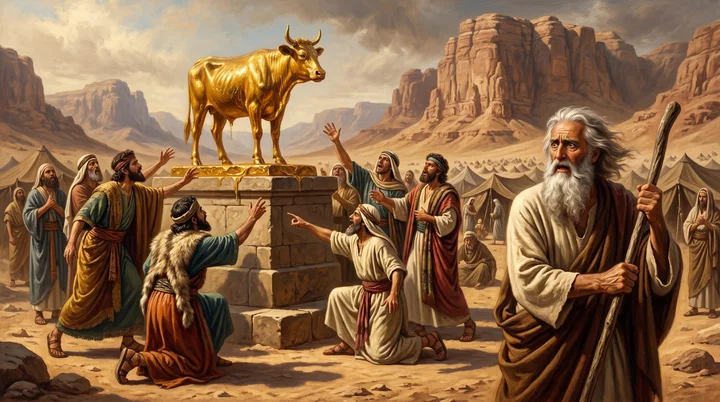
And when Aaron saw it, he built an altar before it; and Aaron made proclamation, and said, To morrow is a feast to the LORD.
Translations
American King James Version, King James Version
And when Aaron saw it, he built an altar before it; and Aaron made proclamation, and said, To morrow is a feast to the LORD.
And when Aaron saw it, he built an altar before it; and Aaron made proclamation, and said, To morrow is a feast to the Lord.
And when Aaron saw it, he built an altar before it; and Aaron made proclamation, and said, To-morrow is a feast to the LORD.
And when Aaron saw this, he built an altar before it; and Aaron made proclamation, and said, Tomorrow shall be a feast to the LORD.
And when Aaron saw this, he built an altar before it; and Aaron made proclamation, and said, To-morrow shall be a feast to Jehovah.
And Aaron seeth, and buildeth an altar before it, and Aaron calleth, and saith, 'A festival to Jehovah — to-morrow;'
And Aaron saw [ it], and built an altar before it; and Aaron made a proclamation, and said, To-morrow is a feast to Jehovah!
And when Aaron saw it, he built an altar before it. And Aaron made proclamation, and said, A festival to Yahweh, to-morrow!
Berean Standard Bible, Majority Standard Bible
When Aaron saw this, he built an altar before the calf and proclaimed: “ Tomorrow shall be a feast to the LORD.”
When Aaron saw this, he built an altar before it; and Aaron made a proclamation, and said, “ Tomorrow shall be a feast to the LORD.”
And when Aaron saw this, he made an altar before it, and made a public statement, saying, Tomorrow there will be a feast to the Lord.
When Aaron sawe that, he made an Altar before it: and Aaron proclaimed, saying, To morow shalbe the holy day of the Lord.
Douay-Rheims (Challoner revision)
And when Aaron saw this, he built an altar before it, and made proclamation by a crier’s voice, saying: Tomorrow is the solemnity of the Lord.
Pictures
Cross-references 20 of 37
- Exodus 20:3-5
Thou shalt have no other gods before me.
The calf and its worship violate the commands against other gods and graven images.
- Psalms 106:19-20
They made a calf in Horeb, and worshipped the molten image.
Israel’s calf worship is recalled as exchanging God’s glory for an ox’s image.
- Exodus 32:26
Then Moses stood in the gate of the camp, and said, Who is on the LORD’s side? let him come unto me. And all the sons of Levi gathered themselves together unto him.
Moses calls the people to the Lord’s side after Aaron’s idolatry.
- Exodus 32:1
And when the people saw that Moses delayed to come down out of the mount, the people gathered themselves together unto Aaron, and said unto him, Up, make us gods, which shall go before us; for as for this Moses, the man that brought us up out of the land of Egypt, we wot not what is become of him.
The people demand gods to go before them, prompting the altar and calf worship.
- 1 Kings 12:28-29
Whereupon the king took counsel, and made two calves of gold, and said unto them, It is too much for you to go up to Jerusalem: behold thy gods, O Israel, which brought thee up out of the land of Egypt.
Jeroboam repeats Aaron’s golden-calf worship to represent Israel’s God.
- Exodus 32:19
And it came to pass, as soon as he came nigh unto the camp, that he saw the calf, and the dancing: and Moses’ anger waxed hot, and he cast the tables out of his hands, and brake them beneath the mount.
Moses sees the calf and breaks the stone tablets.
- Exodus 32:11-14
And Moses besought the LORD his God, and said, LORD, why doth thy wrath wax hot against thy people, which thou hast brought forth out of the land of Egypt with great power, and with a mighty hand?
Moses pleads for Israel, appealing to God’s covenant promises, and God grants mercy.
- Exodus 24:18
And Moses went into the midst of the cloud, and gat him up into the mount: and Moses was in the mount forty days and forty nights.
Moses’ forty-day absence precedes the people’s turn to a visible god.
- Deuteronomy 9:20
And the LORD was very angry with Aaron to have destroyed him: and I prayed for Aaron also the same time.
God was angry with Aaron, but Moses interceded and spared him.
- 1 Corinthians 10:7
Neither be ye idolaters, as were some of them; as it is written, The people sat down to eat and drink, and rose up to play.
Paul warns against idolatry by recalling Israel’s calf worship and revelry.
- Exodus 20:4-6
Thou shalt not make unto thee any graven image, or any likeness of any thing that is in heaven above, or that is in the earth beneath, or that is in the water under the earth:
The golden calf worship breaks the commandment against making images for worship.
- Exodus 32:31-32
And Moses returned unto the LORD, and said, Oh, this people have sinned a great sin, and have made them gods of gold.
Moses acknowledges the people’s sin and pleads with God for forgiveness.
- Exodus 32:28
And the children of Levi did according to the word of Moses: and there fell of the people that day about three thousand men.
Three thousand Israelites die after the golden calf worship.
- Exodus 31:18
And he gave unto Moses, when he had made an end of communing with him upon mount Sinai, two tables of testimony, tables of stone, written with the finger of God.
Moses receives the stone tablets on the mountain while Aaron is left in charge.
- Romans 1:23-25
And changed the glory of the uncorruptible God into an image made like to corruptible man, and to birds, and fourfooted beasts, and creeping things.
Image-making leads to worshipping and serving created things instead of God.
- 1 Corinthians 10:11
Now all these things happened unto them for ensamples: and they are written for our admonition, upon whom the ends of the world are come.
Israel’s history provides examples and warnings for later believers.
- Exodus 33:13-14
Now therefore, I pray thee, if I have found grace in thy sight, shew me now thy way, that I may know thee, that I may find grace in thy sight: and consider that this nation is thy people.
Moses pleads after the calf incident, and God promises his presence and rest.
- Daniel 3:18
But if not, be it known unto thee, O king, that we will not serve thy gods, nor worship the golden image which thou hast set up.
Firm refusal to worship the image contrasts with Aaron’s yielding.
- Deuteronomy 9:16
And I looked, and, behold, ye had sinned against the LORD your God, and had made you a molten calf: ye had turned aside quickly out of the way which the LORD had commanded you.
Israel’s calf worship prompts Moses to break the tablets.
- Acts 7:39-40
To whom our fathers would not obey, but thrust him from them, and in their hearts turned back again into Egypt,
Israel turns from God and asks for gods to lead them.
Commentary
Each commentary is drawn from primary sources: the writings of Ellen G. White and Adventist pioneers and periodicals. Each commentary is separate. Its own words are not a quotation; follow the references to read the source passages.
Ellen G. White
56 sources
When Aaron saw how gladly the golden calf was received, he built an altar before it and proclaimed a public religious feast to the LORD for the morrow, heralded through the camp.Ms 13, 1906, par. 5–719MR 109.2–3SPBC 155.4PP 316.1–317.1RH Jul 29, 1873
He thereby joined the worship of an idol to the name and worship of Jehovah, giving it his sanction and making apostasy look like devotion to God.Ms 13, 1906, par. 5–719MR 109.2–3Ms 170, 1904, par. 12
He did this after first objecting but then cowardly yielding from fear for his life and fear of displeasing the people, choosing to please them at the sacrifice of principle.3T 340.23T 296.1–3SG3 275.1SG4 19.21SP 285.1–286.1
The religious name did not make the act faithful, for only weeks after pledging obedience and hearing the Ten Commandments from Sinai, the people broke the first and second commandments by substituting the calf for Jehovah.1SP 242.3–244.1ST May 13, 1880SG3 275.1
The daring insult brought God's anger and required judgment, yet those who repented and took their stand for loyalty were preserved while the stubbornly persistent were cut off, leaving the history as a perpetual warning against joining idolatry to God's worship today.SG3 275.1PP 335.1–23T 342.1Ms 52, 1898, par. 23–27
Setting at Sinai
Moses was absent on the mount receiving the sacred oracles, the law and special instructions from God, including the tables of stone written with the finger of God, remaining forty days and forty nights without eating or drinking while the cloud of the Presence was still before the camp.RH Feb 4, 1909SG3 273.2PP 335.1–2Ms 26, 1900, par. 5–8Ms 125, 1909, par. 40–41 This building of an altar before the calf and proclaiming a feast took place in sight of the mount, at its very foot, where the children were corrupting themselves even as Moses was with God writing down His law to commit to His covenant people.RH Feb 4, 1909SG3 273.2PP 335.1–2 It came soon after the people had heard God speak the Ten Commandments, and shortly after they had seen a wonderful display of God's power on the mount.RH Feb 4, 1909Ms 1, 1865, par. 8
The people became discontented and unbelieving because Moses delayed coming down, and their unbelief began to reveal itself in a marked manner.PP 315.2–3Ms 58, 1900, par. 23–25 In place of Moses they demanded some image to represent God and to go before them, visible gods to lead them, even gods to lead them back to Egypt.PP 315.2–3RH Apr 23, 1901 As guardian left in charge, Aaron should have kept them faithful to God, but he yielded to their pressure for gods.
The demand for the calf came at the suggestion of those who had practiced this form of idolatry in Egypt, where the ox or calf was regarded as a symbol of deity.PP 315.2–3 The worship inaugurated before the calf was modeled on Egyptian worship of Apis and Osiris, professing to worship God through an image whose real object of adoration was the sun-god, not Jehovah, so that God could not accept the service.PP 315.2–3PP 761.1–3 That calf worship represented Egyptian sun-worship, whose chief festival day was the first day of the week, set in opposition to the Sabbath God had made known to them.PP 761.1–3
The image was both forbidden and needless, for God had given no manner of similitude of Himself and had prohibited any material representation of Himself, making the act a turning back in heart to the idolatry of Egypt and a representing of the glory of the invisible God by the similitude of an ox.PP 315.2–3 It was needless because the mighty miracles in Egypt and at the Red Sea were designed to establish faith in Him as the invisible, all-powerful Helper of Israel, the only true God.PP 315.2–3 The desire for a visible manifestation of His presence had already been granted in the pillar of cloud and of fire that guided them and in the revealing of His glory upon Mount Sinai, with the cloud of the Presence still before them.PP 315.2–3 Israel was waiting right at the foot of the mount needing a proclamation to confirm them in faith, yet unable to bear the test, revealing a foolishness that God must bear with.Ms 117, 1909, par. 15–22
Aaron's Yielding Leadership
Aaron had been left in charge as guardian of the people while Moses was in the mount receiving the sacred oracles and the tables of stone written with the finger of God, and though he had before brought them along step by step, he failed to keep them faithful, to carry them through the crisis of severe temptation to idolatry, and to hold the congregation back from wrongdoing, instead uniting with them in their plans and betraying his sacred trust.RH Feb 4, 1909CT 351.2Ms 92, 1900, par. 22–25Ms 26, 1900, par. 5–8 This took place in sight of the mount where the people had shortly before seen a wonderful display of God's power, yet with their leading men proclaiming that the calf-gods had brought them up out of Egypt they were led into idolatry.RH Feb 4, 1909 His building the altar and proclaiming a feast was the first beginning of wrong, a failure to stand firmly against the propositions of the people from a desire to please them even at the sacrifice of principle.CT 351.2Ms 73, 1912, par. 13Ms 32, 1900, par. 1–8
Though chosen to aid Moses, he did not bear the burden of the work as Moses did, for Moses felt his own weakness under the great work committed to him and had God ever as his counselor, while Aaron lacked that dependence and weight.SG4 19.21SP 285.1–286.1 He first argued against the plan for a visible god but gave up when the people seemed determined to carry it out.SG3 275.1 He had much ability yet was morally weak and indecisive, and when placed where he must think and act for himself he dared not express any settled opinion but was changed by every current, waited to hear what others thought and accepted it as true, allowed another to be conscience for him and think for him, and spoke after he had spoken, saying what he said and acting as he acted.Ms 121, 1898, par. 24–26
He cowardly yielded from fear for his own safety and life amid the people's clamors instead of standing nobly for God's honor and trusting his life to the God who had worked wonders for Israel, and from fear of displeasing and offending them and desire to please them even at the sacrifice of principle he joined in making the idol.3T 340.23T 296.1–3GW92 81.3–4SG3 275.1PP 316.1–317.1 He yielded to the guidance of people he knew were in error, losing courage and trust in God in direct opposition to God's commands, and by his desire to please the people he sacrificed God's honor and greatly dishonored God in grievous sin.3T 296.1–3SG3 275.1RH Jul 29, 1873 Afraid of offending them, he failed to stop the rebellion when it began.GW92 81.3–4
Seeing with what satisfaction the golden god was received and that the idol pleased the people, after permitting the insult of calling the molten calf the gods that brought Israel from Egypt, he built and ordered an altar before it and confidently announced a feast to the LORD for the morrow.SPBC 155.4PP 316.1–317.1RH Jul 29, 1873 The proclamation was heralded by trumpeters from company to company through the camp.PP 316.1–317.1 By attaching the Lord's name to their idolatry he gave it decisive sanction and made the people think their sinful course was acceptable, so that his assurance and influence served a wrong cause rather than defending God's honor and law.RH Jul 29, 1873
At the very first permission to go contrary to God's commands in the least particular he permitted a spirit of hilarity, reveling, and commonness to come into the camp, lost his power of command and weakened his authority, and showed the same defective administration he had shown with his children in his home.CT 351.2RP 45.1Ms 73, 1912, par. 13 That permission let the spirit of reveling and commonness in, and the spirit of idolatry came in as a result, setting in motion a current that could not be stayed until stern and decisive measures were taken.CT 351.2RP 45.1Ms 73, 1912, par. 13 His yielding to them let wrong begin and led into idolatry, showing how a leader's desire to please people at the expense of principle can bring grave consequences.Ms 32, 1900, par. 1–8
A timely, firm, decisive stand could have checked the evil, for if he had unswervingly maintained his own allegiance to God, pointed the people to the perils of Sinai, reminded them of their solemn covenant to obey God's law, and plainly and timely rebuked sin, the apostasy would have been stopped.3T 340.2RH Feb 4, 19093T 341.1 His failure was especially serious because Israel looked up to him as a good leader, and a clear, decisive protest could have stopped the idolatrous worship and spared the people disgrace.Ms 6, 1889, par. 27–28 Instead his calm compliance in carrying out their plan and his assurance emboldened Israel to go to greater lengths in sin than had before entered their minds, failing to stand for the right irrespective of consequences when he could have prevented the apostasy.RH Feb 4, 1909
Idol Joined to Jehovah
When Aaron saw the calf he built an altar before it and announced that the next day would be a feast to the LORD, turning its worship into a public religious feast and publicly proclaiming whom Israel would serve.Ms 13, 1906, par. 5–719MR 109.2–3Lt 69, 1904, par. 29–30Ms 170, 1904, par. 12SG3 273.2 The altar was set up directly in front of the golden calf while Moses was still on the mount receiving special instructions from God and the people below were corrupting themselves.Ms 13, 1906, par. 5–7Ms 16, 1896, par. 3–5SG3 273.2 The proclamation joined the calf's worship to the Lord's name, and the Israelites mixed worship of the Lord with apostasy and rebellion, turning sacred services into part of their idolatrous celebration.Ms 13, 1906, par. 5–7Lt 69, 1904, par. 29–30Ms 170, 1904, par. 12
He joined the worship of an idol to the name and worship of Jehovah, presenting idolatrous worship as worship of the Lord.Ms 13, 1906, par. 5–719MR 109.2–3Ms 170, 1904, par. 121SP 242.3–244.13T 296.1–3 By attaching the LORD's name to worship centered on an idol he gave it decisive sanction and a false appearance of devotion.1SP 242.3–244.13T 296.1–3RH Jul 29, 1873 That assurance made the people think their sinful course was acceptable and encouraged them in apostasy, while his influence served a wrong cause rather than defending God's honor and law.1SP 242.3–244.13T 296.1–3RH Jul 29, 1873 He yielded to the people's demand instead of standing for God's honor, and his desire to please them led him to dishonor God rather than firmly resist.1SP 242.3–244.13T 296.1–3
He raised the altar and announced a day to consecrate the graven image as an object of worship, declaring that the image represented the gods who had brought Israel out of Egypt.3T 340.2SG3 275.1Ms 185, 1907, par. 13–16 In this way he presented the idol as God and stirred up enthusiasm for a false god, submitting while the people credited the calf with bringing them up out of Egypt.SG3 275.1Lt 206, 1906, par. 34–37Lt 10, 1896, par. 4–7 The people's doubt and demand for something visible and dependable led to this idolatry, despite their recent experience of God's presence and deliverance from Egypt and the wonders He had worked for Israel.SG3 275.1Lt 206, 1906, par. 34–37Lt 10, 1896, par. 4–7
The feast's religious label did not make the worship faithful.19MR 109.2–3Ms 16, 1896, par. 3–5ST May 13, 1880 Only a few weeks after pledging obedience and hearing God speak the Ten Commandments, the people broke their covenant and substituted a golden calf for Jehovah.1SP 242.3–244.1SG3 275.1PP 371.2–4 In direct violation of God's recent commands against idolatry they offered sacrifices to an idol and celebrated, breaking the first and second commandments just after hearing God's law proclaimed from Sinai amid sublime demonstrations of divine power.1SP 242.3–244.1ST May 13, 1880SG3 275.1ST Jul 29, 1897 They replaced God's plans with their own ideas as if human wisdom were better than God's, and their failure showed they did not understand their own sinfulness or their inability to obey God's law without Christ, bringing them to recognize their need for pardon and the Saviour promised in the Abrahamic covenant.Ms 60, 1890, par. 11PP 371.2–4
Under pretense of holding a feast to the Lord, the next day the people offered sacrifices to the idol.Ms 13, 1906, par. 5–719MR 109.2–3Ms 16, 1896, par. 3–5ST May 13, 1880PP 316.1–317.1 Then they gave themselves to eating and drinking, dancing, gluttony, and licentious, shameful heathen revelry.Ms 13, 1906, par. 5–719MR 109.2–3Ms 16, 1896, par. 3–5SPBC 155.4PP 316.1–317.1 The celebration that began with offerings and feasting before the calf ended in shameful heathen rites.19MR 109.2–3Ms 16, 1896, par. 3–5SPBC 155.4
Judgment with Mercy
The altar and feast before the calf were a daring insult and blasphemy to Jehovah and a great offense to God, committed just after Israel had heard His law proclaimed from Sinai amid sublime demonstrations of divine power, breaking the commandments just forbidden and kindling His anger and displeasure.SG3 275.13T 342.1Ms 52, 1898, par. 23–27 Satan excited the doubt, apostasy, and rebellion to carry forward against the law the same work of overthrow he had begun in heaven.PP 335.1–2 By this insult he planned to cause Israel's ruin, to lead God to divorce them and devote them to destruction, and thus to secure the extinction of the seed of Abraham, the seed of promise that was to preserve the knowledge of the living God and through whom He was to come, the true Seed that was to conquer Satan.PP 335.1–2 He was defeated, for sinful as they were Israel was not destroyed.PP 335.1–2
Rebellion against God's authority required judgment, yet God still gave freedom to repent. Moses called for everyone to come and take position on his side in loyalty and truth and to come out on the Lord's side and stand right with the Lord, and those who yielded were preserved alive while those who stubbornly persisted and ranged themselves on Satan's side were cut off.PP 335.1–2Ms 185, 1907, par. 13–16Ms 125, 1909, par. 40–41 Three thousand men who refused perished for disloyalty.Ms 185, 1907, par. 13–16 The humbled and repentant people were mercifully pardoned, and prompt punishment protected Israel and others from greater ruin, showing how the Lord thus tests His people.PP 335.1–2Ms 125, 1909, par. 40–41
Aaron's course in uniting with the people in the crisis of severe temptation to idolatry deserved death, and he certainly would have been slain had Moses not interceded in his behalf.Ms 26, 1900, par. 5–8 After the transgression Moses pleaded with God on behalf of the people.GW92 33.1–34.3 The history of this sin, faithfully exposed, stands as a perpetual testimony to the guilt and punishment of idolatry and to the justice and long-suffering mercy of God, an example for later generations to learn from and avoid.PP 335.1–24T 12.1–3 God allowed the hidden designs of Aaron and the leading men to develop into open wrongdoing for wise and holy purposes, because exposing the evil could prevent still greater evils.Ms 13, 1906, par. 15Ms 156, 1905
The verse exposes two parties in the world, those serving apostasy and those serving God and keeping distinct from apostasy, and presses the question which side each person is on.Ms 117, 1909, par. 15–22
Warning for Today
The golden-calf experience stands as a warning example for God's people today, part of a devising to introduce the same evils followed by the same results that laid many Israelites in their graves, a devising still at work today with the same deadly result.RH Feb 4, 190919MR 107 While Moses was away in the mount the people broke their vow to keep all the commandments given from Sinai, made a calf, called it the gods that brought them out of Egypt, and proclaimed a feast to the LORD before it, taking a great step into idolatry in sight of the mount where God's power had shortly before been displayed.RH Feb 4, 1909Ms 185, 1907, par. 13–16 When Moses called for everyone to take position on his side in loyalty and truth, those who yielded were given a chance to redeem themselves, while three thousand men who refused perished for disloyalty.Ms 185, 1907, par. 13–16 The same test will come in our day, so young and old must be Bible students, pray, and obey God's Word to keep hold on God and have strength of character under every temptation, with the sin faithfully exposed for later generations to learn from and avoid.Ms 185, 1907, par. 13–164T 12.1–3
The people should have remembered its consequences and learned to obey, but they failed to take the lesson to heart and were again overcome by temptation.3T 342.1 Aaron's building an altar before the calf and proclaiming a feast to the LORD proves that no dependence can be placed on any man whatever his experience unless his experience harmonizes with the Word of the living God.Ms 117, 1909, par. 15–22
The same idolatrous influence is cherished in families and churches today, worship turned from God to a visible idol while still claiming a feast to the LORD, in small as well as large matters.Ms 52, 1898, par. 23–27 It appears in pride of apparel, fashions of dress, speech, deportment, outward adorning, self-gratification and worship of self.Ms 52, 1898, par. 23–27 Such idolatry was a great offense to God, and still separates from God, steals away love and trust and confidence in Him, mars religious experience, and develops a selfishness God cannot look upon.Ms 52, 1898, par. 23–27 God's distinct and separate people must therefore search themselves, put away idols, practice self-denial and economy, relieve the needy and suffering, and show modest apparel and good works in harmony with faith and the Word.Ms 52, 1898, par. 23–27
Aaron serves as an example of an unfaithful leader in the apostasy, building an altar before the calf and proclaiming a feast to the Lord while the people were turning to idolatry, joining the people's false worship to the Lord's name.Ms 13, 1906, par. 9Lt 121, 1906, par. 3–5 He built up what God had forbidden, used his influence in opposition to divine instruction, and led people to trust in human authority rather than God, encouraging others in a wrong course by acting against God's warnings.Ms 13, 1906, par. 9Lt 121, 1906, par. 6Lt 121, 1906, par. 3–5 His failure was especially serious because Israel looked up to him as a good leader, and a clear, decisive protest could have stopped the idolatrous worship and spared the people disgrace.Ms 6, 1889, par. 27–28 To act the part of Aaron is to help on the work of apostasy rather than faithfully heeding spiritual counsel, to betray the interests of God's cause, to prove not to be trusted, to spoil one's record and make the cause the sport of sinners.Lt 242, 1906, par. 43–45Lt 356, 1907, par. 5–6 It is to do the enemy's work by making of none effect God's word and destroying confidence in His messages of reproof and warning, and to sneer at and scorn messages of heavenly origin sent to prepare His people to stand in the last days.Lt 356, 1907, par. 5–6 Men called by God must not do as Aaron did but must build up the cause in right lines and must not give fearful or compromising counsel when God's people need strengthening.Ms 6, 1889, par. 27–28
The history warns guardians of youth and all in charge not to heed wrong inclinations and permit contempt for the counsel of God, but to trust God, walk tremblingly for fear of offending Him, and watch for souls as those who must give an account.Ms 26, 1900, par. 5–8 It warns against siding with and accommodating men who oppose the work of God and who resist light and evidence without repenting of their course.5MR 452.1
Sources
Pioneers and periodicals
94 sources
While Moses was on Sinai receiving the law and the sanctuary pattern, Aaron built an altar before the golden calf and announced a feast to the LORD for the next day, thereby formalizing and sanctioning the people's worship.ST Jun 16, 1914ST Jul 16, 1902RH Aug 19, 1852ST Jan 31, 1911RH Jan 7, 1862 The calf was set forth as a visible representation of the true God who had brought Israel out of Egypt, yet it was the Egyptian sacred bull, the sun-god Apis honored at Heliopolis.ST Jul 16, 1902RH Aug 14, 1868ST Sep 8, 1881ST Sep 24, 1896ST Jul 16, 1902 Only weeks after covenanting to obey, Israel broke the first and second commandments by crediting its deliverance to the work of its own hands and bowing before an image.ST Jun 16, 1914ST Sep 17, 1902RH Nov 13, 1856RH Aug 14, 1868RH Aug 1, 1871 Calling the idol by the LORD's name did not make it the LORD nor make the worship acceptable, for Jehovah received only lip service while the people praised the idol in gluttony and lewd revelry.RH Jul 29, 1873ST Jul 16, 1902RH Aug 19, 1852RH Oct 8, 1872ST Aug 6, 1896 The failure showed the law had been received only outwardly and not in the heart, revealing Israel's sinfulness and need of Christ and pardon, while Aaron's fearful yielding to the multitude warns against following popularity rather than right.ST Sep 17, 1902ST Jan 27, 1909ST Jul 14, 1887RH Oct 15, 1908
Sinai Setting and Timing
The altar and feast belong to the forty days Moses was absent in Mount Sinai receiving the Ten Words on tables of stone with instruction concerning the building of the sanctuary and its service.ST Jan 31, 1911RH Jan 7, 1862 That sanctuary was to be made from free-will offerings that God might dwell among the people, a great multiple object-lesson comprehending the plan of salvation by various forms and rites, built to a divine pattern shown to Moses in the mount by specially endowed workmen. It was the time after deliverance from Egyptian bondage, and the episode is set among God's personal descent with His angels at Sinai.RH Dec 24, 1861 While Moses was entranced in vision beholding God's magnificent divine temple and receiving its pattern to be copied on earth, the people below fell into shameful sin and crime.ST Jan 31, 1911
The fall came within forty days, only a few weeks, after hearing God speak at Sinai in sight of cloud and fire.ST Jan 27, 1909RH Jan 12, 1911RH Jan 8, 1857 Less than forty days after promising to obey and witnessing His power and glory, most of the people turned back to Egyptian idolatry.RH Nov 13, 1856ST Sep 23, 1913ST Sep 24, 1896 They had just been brought out of Egypt, had covenanted to do all the Lord commanded, and had received the covenant, yet they broke it by worshiping the work of their own hands even before Moses came down with the tables of the covenant.RH Nov 13, 1856RH Jan 12, 1911RH Jan 8, 1857 With the glory of the law still before them they turned the glory of God into the likeness of a four-footed beast, and Moses broke the tables in just indignation as the symbol of their transgression.ST Jan 27, 1909ST Jan 31, 1911
The people grew impatient waiting for Moses out of sight and failed to trust God.ST Sep 17, 1902ST Apr 17, 1907RH Jul 8, 1858 They lost sight of God by faith, neglected to prepare their hearts for further instruction, and demanded a visible god to go before them and lead them toward the land they hoped to enter as their anticipated refuge.ST Sep 12, 1895ST Apr 17, 1907ST Mar 31, 1909 That demand for other gods quickly became the making of a calf and worship of an image made by their own hands.ST Sep 12, 1895RH Jul 8, 1858RH Apr 3, 1879 Aaron as God's representative yielded to the demand because he was afraid to deny them, building the altar and proclaiming the feast.ST Sep 17, 1902RH Jul 8, 1858
Aaron had been left in charge of the people as their guardian while Moses was in the mount with God receiving the sacred oracles.RH Feb 4, 1909ST Jun 17, 1903 He should have kept them faithful to God, but he betrayed his sacred trust by responding to the demand for gods with worship set up before the calf.RH Feb 4, 1909 Only a loyal few stood for Jehovah when public opinion demanded the calf, showing the need and importance of God-appointed leadership.ST Jun 17, 1903RH Mar 7, 1907 Moses' God-appointed leadership did not cause the worship, for the revolt and forgotten trust belonged to his absence.RH Jul 8, 1858RH Mar 7, 1907
Hundreds of years of slavery had unfitted Israel to comprehend God's salvation and the character He required. Having grown so accustomed to God's powerful presence they grew careless and turned to idolatry, adopting Egyptian forms of worship with little sense of the sacredness of God's law in wide departure from the faith of their fathers.RH Aug 3, 1869ST Mar 1, 1883ST Sep 27, 1883 They excused disobedience by prevailing religious custom, treating the common custom of their time as permission to disregard commandments they had heard with witnessed works.ST Mar 1, 1883ST Sep 27, 1883 They fell into a snare of distrust because they fled from the voice of God instead of knowing Him and trusting in His sublime love, which if known and trusted would have let them see and shun the snare.RH Aug 3, 1869
Aaron's Altar and Feast
When Aaron saw the calf he built an altar before it and proclaimed a feast to the LORD for the morrow, thereby furthering, formalizing, establishing and sanctioning the people's worship and joining calf worship to the worship of the LORD.ST Jun 16, 1914ST Jul 16, 1902RH Aug 19, 1852ST Apr 17, 1907RH Oct 8, 1872 He set up the altar before the calf and announced the feast for the next day, presenting what centered on an idol as worship of the LORD even though attaching the Lord's name to false worship does not make it faithful to God's word.ST Aug 6, 1896ST Jul 16, 1902ST Jul 16, 1902 This was a human religious invention without God's appointment, despite its devotion, zeal, sacrifice and prized gold, and it arose when the people grew impatient waiting for Moses and neglected to prepare their hearts for further instruction.ST Apr 17, 1907RH Oct 8, 1872
The calf was presented as a representation of the true God who brought Israel out of Egypt, with worship directed before an image as honoring the true God rather than at first intending to introduce another god or deliberately replace Him.RH Aug 14, 1868ST Sep 8, 1881RH Aug 1, 1871 By building an altar before it and proclaiming a feast to the LORD, Aaron directed worship toward an image presented as honoring the true God, treating the idol as though it represented God and imitating true worship, from which false worship originates.RH Aug 14, 1868ST Jul 16, 1902ST Jul 16, 1902 Making an image to represent God and worshiping before it violated the second commandment's prohibition against representing God, a sin like Jeroboam's later calves to represent the God who brought Israel out of Egypt that could prepare the way to treat images as gods and forsake the true God.ST Sep 8, 1881RH Aug 1, 1871 Though their intended object was named as the true God, using the calf as the means of worship made God secondary and turned the worship into idolatry.ST Feb 11, 1886
The calf was the Egyptian sacred bull, the sun-god Apis, the image and incarnation of Osiris identified with the sun and with Ra honored at Heliopolis, the familiar Egyptian sun-worship that is the oldest and most universal rival of Jehovah's worship.ST Jul 16, 1902ST Mar 11, 1889 To declare its worship to be worship of Jehovah was to substitute something else for God and call it God, a festival in fact to Egypt's sun-god represented by the calf.ST Jul 16, 1902ST Jun 18, 1902 Less than forty days after Israel promised obedience and witnessed God's power and glory, most of the people turned back to this Egyptian idolatry.ST Sep 24, 1896 In that first idolatry the people worshiped the Egyptian sun-god Apis represented by a sacred bull, called the calf their god and deliverer, and had Aaron proclaim a feast to the LORD, yet calling an idol by the LORD's name did not make it the LORD or give it power to redeem Israel from Egypt.ST Aug 13, 1896ST Sep 10, 1896 Done just after Israel heard God's holy law, the feast was a Heaven-daring insult to the God who delivered them from Egyptian bondage that they might serve Him, breaking especially the first, second, fourth, and seventh commandments, and in intent a complete return to Egyptian bondage worse than craving the leeks and onions of Egypt, since deliverance from physical bondage was given to deliver from spiritual bondage and by plunging into Egypt's idolatry they placed themselves in worse bondage than any physical oppression.ST Mar 11, 1889 The same solar worship gives Sunday its name and character as the day anciently dedicated to the sun, with Ra's name living in Pharaoh as Ph'Ra, the sun.ST Mar 11, 1889
The feast was kept with sacrifices and offerings to the idol followed by gluttonous eating and drinking and wanton, naked, lewd revelry, orgies and merriment in heathen manner, the apotheosis of low, lustful nature worship that carnality longed for because of its sensuousness and licentiousness, yet named as Jehovah's feast in awful backsliding and blasphemy, the worship and deifying of the carnality and lust of the human heart in place of Jehovah.RH Jul 29, 1873ST Jul 16, 1902RH Nov 6, 1866 Aaron's desire to please the people led him to sacrifice God's honor instead of firmly resisting them, attaching the LORD's name to worship centered on an idol.RH Jul 29, 1873 The people's merriment over the calf turned to lamentation when Moses came down.RH Jul 2, 1861
The people credited the calf with their deliverance, called it their god that brought them up out of Egypt, and bowed to it with blind adoration despite having witnessed God's mighty acts, heard His voice, and seen the plagues on Egypt, the parting of the Red Sea and the drowning of their pursuers.ST Aug 13, 1896RH Oct 7, 1862RH Jan 29, 1867RH Oct 28, 1873RH Nov 6, 1866 After the calf was made Aaron accommodated the idolatry by building the altar and proclaiming the feast to the LORD, presenting calf worship under the name of the true God, and the people then ascribed the victories of their deliverance to it, which was an insult to God.RH Oct 7, 1862RH Oct 28, 1873 Only forty days after leaving Egypt and seeing the Red Sea deliverance, while Moses was on Sinai receiving the covenant and the law, Israel treated the calf as the power behind their rescue, revealing how quickly they fell, the moral weakness and danger of brief inexperienced faith, and the power of Satan who with his legions hovered about the people in their leader's absence to turn their minds to idolatry.RH Jan 29, 1867RH Oct 28, 1873RH Nov 6, 1866 Their idolatry and rebellion occurred despite the mercies and deliverance God had shown them, even though the people had made and worshiped the calf as the god who brought them out of Egypt while Aaron built the altar and proclaimed the feast to the LORD.RH Jan 12, 1869
Broken Covenant and Commandments
Only a few weeks, within forty days, after promising to do all the Lord commanded, Israel broke its covenant with God by turning to worship a graven image made by their own hands, failing to keep its part and forfeiting its promised benefit.RH Jan 12, 1911RH Jan 8, 1857ST Sep 23, 1913RH Apr 8, 1915 Aaron as God's representative yielded to the demand for a god because he was afraid to deny the people, building an altar before the calf and proclaiming a feast to the Lord, while Israel failing to trust God because Moses was out of sight broke the law to which it had just assented and covenanted to keep.ST Jun 16, 1914ST Sep 17, 1902 This apostasy under the covenant's demand for perfect obedience brought the people under the sentence of death.ST Jun 16, 1914
The act broke the first commandment by putting another being or thing before God and worshiping the work of their own hands immediately after deliverance from Egypt and covenanting to obey, even before Moses came down with the tables.RH Nov 13, 1856 While Moses communed with God in the mount and rumor spread that their leader was gone for good, the waiting camp lost self-control, having trusted Moses as their god because he was the highest leader their eyes could see, and with him out of sight demanded a visible god to lead them to their anticipated refuge, bringing gold ornaments from Egypt for Aaron to shape.ST Nov 11, 1908 The breach means more than constant worship of the sun or some living earthly creature, covering every time those who profess to be led by Providence credit God in prosperity but when plans are thwarted or calamity comes resort to some known physical force for relief, seeking help from a source outside God's appointment.ST Nov 11, 1908 That Aaron's part broke one of God's important commandments is held by those who apply the verse generally, while those who would apply the first commandment to what it does not name are in error no more justified than applying the fourth commandment which names the seventh day to Sunday.ST Mar 31, 1909
By making the calf as a representation of the God who brought Israel out of Egypt and holding a feast to the Lord before it with altar and worship directed before an image as honoring the true God, Aaron and the people did not at first intend another god yet violated the second commandment's prohibition against representing God.RH Aug 14, 1868ST Sep 8, 1881 This sin was like Jeroboam's later use of golden calves to represent the God who brought Israel out of Egypt, and it could prepare the way for people to treat images as gods and forsake the true God.RH Aug 1, 1871
The idolatry was a grave breach of God's law which included the Sabbath, belonging to the first forty days of Moses' absence and presented as rebellion and Sabbath violation for which God intended to destroy the people but spared them after Moses interceded, with the tablets broken and the leading idolaters put to death.RH Jan 7, 1862RH Apr 28, 1874 Done just after Israel had heard God's holy law, Aaron's feast before the calf was Egyptian calf-worship which was sun-worship, the worship of Ra the sun-god honored at Heliopolis whose name lives in Pharaoh as Ph'Ra the sun and gives Sunday its name and character as the day anciently dedicated to the sun, a Heaven-daring insult to the Deliverer that they might serve Him, breaking especially the first, second, fourth, and seventh commandments.ST Mar 11, 1889 In intent it was a complete return to Egyptian bondage showing willingness to be under Pharaoh again more fully than when craving the leeks and onions of Egypt, because deliverance from physical bondage was given to deliver from spiritual bondage and represented it, so that plunging into Egypt's idolatry placed them in worse bondage than any physical oppression.ST Mar 11, 1889 The calf as an Egyptian divinity identified with Apis carried a hidden meaning that led the people to break the commandments heard at Sinai and promised to be obeyed, and their turn to idolatry and forgetting God's works polluted the Sabbath and kept them from observing it, whereas the Sabbath rightly observed promotes worship of the true God and guards against idolatry.ST Sep 22, 1914ST Sep 22, 1914 The account does not establish that Moses changed the Sabbath, and the return to Egyptian sun-worship did not alter the Lord's Sabbath.ST Dec 16, 1908
Fear or compulsion does not produce faithful service, for within forty days of hearing God speak at Sinai in sight of cloud and fire the people turned to the calf, showing God's law must be received into the heart and not only written on stone.ST Jan 27, 1909 The law had no power over them because it was not in their hearts and was weak through the flesh, and only if the Spirit of Christ is in the heart with the law written there does the law have power to control action.ST Sep 17, 1902 Good intentions and promises alone could not secure obedience, and they needed God's grace in Christ to make obedience possible.RH Oct 15, 1908
God's dealing with literal Israel remained conditional, to bless when obedient and punish when disobedient, as shown when He thought to disinherit them but at Moses' plea repented of the evil thought for their fathers' sakes and saved all who repented.RH Nov 13, 1856 By breaking the covenant to keep the commandments they rendered null their claim to God's promises given on condition of obedience, but their violation did not abolish the ten commandments and did not render null God's claim to their obedience, for the ten commandments and the covenant made concerning them are distinctly two things and failure by man dissolves man's claim while God's requirement remains good.RH Jun 25, 1872 The failure lay with the people, not with the covenant's requirements.RH Apr 8, 1915
The quick turn to idolatry showed they did not understand their own sinfulness or their inability to keep God's law without Christ, could not rely on their own righteousness or expect favor under the covenant they had broken, and could not establish their own righteousness or keep the law without Christ.RH Jul 3, 1900RH Oct 17, 1907 They did not recognize Christ as the design of the law or seek by faith the strength to obey, though the everlasting covenant offered help in Christ, and their failure exposed their need for pardon and for the Saviour promised through the Abrahamic covenant and represented in the sacrificial offerings.RH Jul 3, 1900RH Apr 8, 1915 That displeasure was felt in condemnation pressing on their hearts at Moses' open rebuke, meriting instant destruction with rebuke and burning displeasure, so that stripping off ornaments at God's command they humbled proud hearts before Him and awaited final sentence, exposing need for revelation of another element of God's name little known so recently after bondage, His mercy and forgiveness.ST Dec 11, 1901
Aaron's Failure and Judgment
As high priest and guardian left in charge, Aaron should have kept the people faithful to God, but from fear of the people, desire to please them, and mild yielding to public opinion and the mixed multitude he complied calmly with their plan for gods to go before them and betrayed his sacred trust.RH Jul 29, 1873RH Feb 4, 1909ST Sep 17, 1902RH Oct 28, 1873 Afraid to deny their demand while Moses was out of sight forty days receiving the law, he drifted on the tide of popular feeling into infidelity and idolatry, building the altar and proclaiming the feast, while Satan with his legions hovered about the leaderless people to turn their minds despite the plagues on Egypt, the parted Red Sea, and the drowned pursuers.RH Feb 4, 1909ST Sep 17, 1902RH Oct 28, 1873 He failed to stand for the right irrespective of consequences when he could have checked the evil by unswervingly maintaining his own allegiance, pointing to the perils of Sinai, reminding them of their solemn covenant to obey, and firmly resisting their godless plans instead of sacrificing God's honor to please them.RH Jul 29, 1873RH Feb 4, 1909ST Aug 31, 1882RH Mar 5, 1908 As high priest he was responsible to oppose them, and leaders are warned by his weak example to stand firmly against policies that would lead God's people into similar apostasy.ST Aug 31, 1882RH Mar 5, 1908
By ordering the altar and confidently proclaiming a feast to the LORD over idol worship, attaching the LORD's name to it with assurance, he gave the idolatry decisive sanction and made the people think their sinful course was acceptable.RH Jul 29, 1873RH Jul 29, 1873 His influence thus served a wrong cause rather than defending God's honor and law, helped lead the whole nation into idolatry, and emboldened Israel to go to greater lengths in sin than had before entered their minds.RH Jul 29, 1873RH Feb 4, 1909ST Dec 7, 1904 The danger of following a multitude into evil is shown in his choice.ST Dec 7, 1904 When Moses returned, Aaron tried to avoid responsibility and excused his guilt by the pressure of the people, claiming the calf had simply come out of the fire.ST Aug 31, 1882ST Nov 30, 1904
The rebellion so soon after the awful and glorious display at Sinai, committed in great light by a people who had heard God's law and had statutes and judgments so righteous, revealed God's anger, rebuke, and burning displeasure.ST Nov 4, 1897ST Jan 29, 1908ST Jan 10, 1906ST Dec 11, 1901 He thought to disinherit Israel and cut them off entirely for prostituting themselves to the basest idolatry, to refuse at first to go with them, and He visited them with judgment in which three thousand, the leaders in rebellion, were slain and the rest felt condemnation under Moses' open rebuke, stripping off ornaments, humbling proud hearts, and awaiting final sentence.ST Nov 4, 1897ST Jan 10, 1906ST Mar 18, 1903ST Dec 11, 1901 Calling the calf festival a feast to the LORD did not make the act acceptable.ST Mar 18, 1903 Moses broke the tables in just indignation as a symbol of transgression, then made a heart-breaking plea for the people.ST Jan 31, 1911RH Apr 28, 1874 For the fathers' and Abraham's sake God repented of the evil He thought to do, restored the backsliding church through Moses, and spared all who repented while cutting off only those persisting in rebellion.RH Nov 13, 1856ST Jan 31, 1911ST Nov 4, 1897 His acceptance of their repentance was shown by His glory manifested at the building and inauguration of the sanctuary and its services, with the glory reflected in Moses and the commandments written a second time on stone, proving Him no less merciful then than now though sin in every age, including grave breach of the law with the Sabbath, will surely be punished.ST Jan 31, 1911ST Jan 2, 1901RH Apr 28, 1874
False Worship Under God's Name
Aaron built an altar before the calf and proclaimed a feast to the LORD for the morrow, joining calf worship to the worship of the LORD and announcing idolatry under the name and worship of God.RH Aug 19, 1852RH Oct 8, 1872ST Aug 6, 1896ST Aug 19, 1897ST Jan 10, 1906 The feast was wrongly presented as worship of the LORD even though it centered on an idol, for the people had made an image of the Egyptian sun-god Apis and called the calf their god and deliverer from Egypt.ST Aug 6, 1896ST Aug 13, 1896ST Aug 19, 1897 Calling an idol by the LORD's name did not make it the LORD, did not give it power to redeem Israel from Egypt, and did not make the act acceptable, for Jehovah received only lip service while the people praised the idol.RH Aug 19, 1852RH Oct 8, 1872ST Aug 13, 1896 This rebellion was committed within weeks of Israel's deliverance from Egypt and God's giving of the law at Sinai, in the face of great light, so Israel could no longer be treated as a people still emerging from Egypt's ignorance, and the hardened rebellion brought judgment in which three thousand leaders were destroyed.RH Oct 8, 1872ST Jan 10, 1906 That religious leaders can attach the LORD's name to false worship shows that tradition and their authority do not make it faithful to God's word, despite its devotion, zeal, and sacrifice.RH Oct 8, 1872ST Aug 6, 1896
Aaron further enabled the people's idolatry by treating the idol as a representation of the true God and imitating true worship with its altar and feast before the calf.ST Jul 16, 1902ST Jul 16, 1902 Such imitation, treating an idol as though it represented God while copying the forms of true worship, is the origin of false worship.ST Jul 16, 1902ST Jul 16, 1902
The calf was a human religious invention without God's appointment, and humanly devised worship does not replace what God has appointed.RH Oct 8, 1872RH May 25, 1876ST Jun 6, 1916 Though made of prized gold in the form of the useful ox, it had no merit and was useless and valueless because God did not command it, bringing embarrassment, idolatry, disaster, and death.RH Oct 8, 1872ST Jun 6, 1916 It stands opposite the brazen serpent, which though made of inferior brass in the form of a dreaded serpent brought forgiveness, healing, life, and a prophetic view of the world's Redeemer because it was God's own appointment, showing that the Lord does not see as man sees and that nothing comes to pass when the Lord does not command it.ST Jun 6, 1916 Men readily depart from the truth and true worship of God to a religious invention of their own, forsaking what God intended for fables and superstition, clinging to such substitutes with tenacity, and even when convinced of folly reforming only feebly and being slow to break down idols and thoroughly remove the monuments of wickedness.RH May 25, 1876RH Apr 7, 1868
Even the participation of Israel and of Aaron as high priest could not make calf worship right, for religious truth is not determined by the size of a majority and God's work is accomplished by His Spirit, not by human numbers or power.ST Jun 25, 1912ST Jul 14, 1887 The multitude of Israel joining together in worship of the golden calf were wrong despite their numbers, without the approval of Heaven, proving that truth and right are determined by the word of God and not by the sentiments or count of fallible men.ST Aug 6, 1896ST Jun 25, 1912ST Jul 14, 1887 Outward religious ceremony can use God's name while directing worship toward an idol, and that warns against elaborate ritual and sensory display that displaces the work of winning souls.ST Apr 15, 1880 The feast to the LORD before the calf was an attempt to share God's glory with the gods of paganism and to join Jehovah with pagan gods under names like Jehovah, Jove, or Lord, which God disfavored and for which He would not allow Moses to honor the followers of Apis.ST Apr 15, 1880ST Nov 13, 1893 Setting up the calf as a savory figure-head drew the masses rushing pellmell to do homage to it, and the same law works when the pulpit sets up secular and sensational subjects as an attraction to draw an audience.ST Apr 3, 1879
Warnings for Later Worship
The golden calf lives on as mammon worship, with gold made the idol of the heart in a race of money-getters where faith and self-sacrifice die and a thing is valued not for what it is but for what it will bring in the market.ST Mar 4, 1913RH Aug 25, 1874 People bow to the modern calf when they value others by money, popularity, and display rather than character, measure and class men by wealth, treat poverty as a crime and reduce respectability to social status.ST Dec 30, 1880ST May 27, 1880ST Dec 30, 1880RH Aug 25, 1874 The ledger becomes the Bible and the counting-house becomes the church, buying and selling crush every noble feeling, art is degraded into making marketable goods for filthy lucre, and the young are taught to revere only money-getting.RH Aug 25, 1874 The proclamation once made over the calf is now given to commercial and popular success measured by money, to the writer whose book sells widest not from virtue in the book but from popularity of the writer, and to the singer whose songs are sung widest not because of sublimeness of melody but because the author is on the crest of the wave and the shekels roll his way.
Idolatry steals affections from Jehovah and leads to disobedience, and fashion, wealth, and fame do the same work now, leading professed Christians away from the true God just as truly as the calf led Israel and keeping them from receiving and obeying sanctifying truth.RH Nov 14, 1854RH Jun 13, 1865 Greed for gold and what gold will buy for lust is worship at the chief shrine of lust, whose gilding blinds minds lest the light of the glorious gospel of Christ shine in, and out of this selfish material worship rises strife issuing in class hatred, crime, and revolution.ST Dec 23, 1903 The same defection appears as covetousness and worldliness stealing upon hearts, as complaining of the weariness of the way and longing for Egyptian luxuries, as reluctance to go forward at God's command to possess the promised land, and as desire to return to Egypt with ingratitude for deliverance.RH Nov 14, 1854 By the same principle, greed for land and empire that excuses taking from others replaces God's command not to steal with a new rule that permits it.
The episode warns against becoming careless and thinking it makes no great difference if God's requirements are not exactly fulfilled, as when men think it matters not whether to observe as the Sabbath the day God plainly specified or to substitute a day of man's invention, for in the Judgment all will be judged by the standard of God's Word.RH Dec 2, 1909 The calf was an Egyptian divinity whose hidden meaning led the people to break the commandments they had heard at Sinai and promised to obey, and their turn to idolatry polluted the Sabbath.ST Sep 22, 1914 Forgetting God's works led them into this transgression at Horeb while Moses was on the mountain and kept them from observing the Sabbath, whereas the Sabbath rightly observed promotes worship of the true God and guards against idolatry.ST Sep 22, 1914ST Sep 22, 1914 Those who held the calf to be sun-worship understood it as Sunday-keeping from which Israel had to be rescued by Sabbath reformation.ST Sep 22, 1914ST Sep 22, 1914
Aaron's yielding to the demand for an idol, building an altar and announcing a feast, shows the danger of following a multitude into evil and of being governed by compromise, popular acclaim, and fear of the people rather than by the fear of God and by what is right.ST Jun 17, 1903ST Dec 7, 1904 Only a loyal few stood for Jehovah while public opinion demanded the calf, proving majorities without Heaven's approval can be wrong and that truth and right are determined by the word of God and not by the sentiments or count of fallible men.ST Jun 17, 1903ST Jul 14, 1887 The same fickleness honors Jehovah one day and turns to the calf or Baal another day.RH Apr 28, 1863
Aaron's fall while God led by cloud and fire proves the church on earth has never been without sin and grievous sinners, yet God was leading His people just the same and in the midst of turmoil was developing character that will stand through eternity, so present coldness does not prove the movement is not in God's order.RH Jun 25, 1914 The altar and feast belonged to rebellion against God's authority that required judgment, while God still gave freedom to repent and cut off only those who persisted in rebellion, and prompt punishment protected Israel and others from greater ruin. Moses did not leave apostasy unchecked, and the judgment left broken ranks and missing people as visible marks of displeasure that should have taught obedience and trust in appointed leadership.ST Sep 9, 1880RH Jun 14, 1906 It was Satan's devising to introduce the same evils followed by the same results that laid many Israelites in their graves, a devising used today with the same deadly result in sight of the mount where God's power had been displayed and with leading men claiming calf-gods brought them up out of Egypt.RH Feb 4, 1909
The need and importance of having a leader is seen in that Moses' God-appointed leadership did not cause the worship during the forty days' absence, and the making and revelry broke the covenant calling and kept Israel from serving as a kingdom of priests to bring the knowledge of God to the world.RH Mar 7, 1907ST Sep 17, 1902 Bowing to the calf was worshiping it as God in great wickedness swiftly punished for discontent and rebellion.ST Mar 18, 1889ST May 23, 1911 The scene is likened to the crowning and worship of religious images in Manila, and by analogy to rejecting wholesome reform for processed foods and drugs.ST Mar 18, 1889RH Dec 12, 1907 To teach children that Israel worshiped God through the calf confuses them and leads them to imagine the calf was hollow.RH Dec 3, 1901
Sources