Exodus 5:7
Ye shall no more give the people straw to make brick, as heretofore: let them go and gather straw for themselves.
Translations
You shall no more give the people straw to make brick, as heretofore: let them go and gather straw for themselves.
King James Version, KJV Cambridge Paragraph Bible, Revised Version, American Standard Version, Darby Translation
Ye shall no more give the people straw to make brick, as heretofore: let them go and gather straw for themselves.
Ye shall no more give the people straw to make brick, as heretofore; let them go and gather straw for themselves.
'Ye do not add to give straw to the people for the making of the bricks, as heretofore — they go and have gathered straw for themselves;
Ye shall no more give straw unto the people, for making the bricks as heretofore: Let them, go, themselves, so shall they gather for themselves straw:
Berean Standard Bible, Majority Standard Bible
“ You shall no longer supply the people with straw for making bricks. They must go and gather their own straw.
“ You shall no longer give the people straw to make brick, as before. Let them go and gather straw for themselves.
Give these men no more dry stems for their brick-making as you have been doing; let them go and get the material for themselves.
Ye shall giue the people no more strawe, to make bricke (as in time past) but let them goe and gather them strawe them selues:
Douay-Rheims (Challoner revision)
You shall give straw no more to the people to make brick, as before: but let them go and gather straw.
Pictures
Cross-references
- Exodus 1:11-14
Therefore they did set over them taskmasters to afflict them with their burdens. And they built for Pharaoh treasure cities, Pithom and Raamses.
Both describe the Israelites’ harsh forced labor in Egypt, including brickmaking for Pharaoh.
- Exodus 5:18-19
Go therefore now, and work; for there shall no straw be given you, yet shall ye deliver the tale of bricks.
The quota remains unchanged despite the Israelites receiving no straw.
- Exodus 1:13-14
And the Egyptians made the children of Israel to serve with rigour:
Describes the Israelites’ harsh forced labor in Egypt.
- Exodus 5:1
And afterward Moses and Aaron went in, and told Pharaoh, Thus saith the LORD God of Israel, Let my people go, that they may hold a feast unto me in the wilderness.
The straw order answers Moses and Aaron’s request to let Israel go worship.
- Exodus 5:13
And the taskmasters hasted them, saying, Fulfil your works, your daily tasks, as when there was straw.
daily brick quota left no day for rest
- Exodus 5:22-23
And Moses returned unto the LORD, and said, Lord, wherefore hast thou so evil entreated this people? why is it that thou hast sent me?
Moses appeals to God after Pharaoh intensifies the burden.
- Exodus 5:20-21
And they met Moses and Aaron, who stood in the way, as they came forth from Pharaoh:
The officers blame Moses and Aaron for worsening their treatment.
- Acts 7:34
I have seen, I have seen the affliction of my people which is in Egypt, and I have heard their groaning, and am come down to deliver them. And now come, I will send thee into Egypt.
God recalls Israel’s affliction and hears their groaning.
Commentary
Each commentary is drawn from primary sources: the writings of Ellen G. White and Adventist pioneers and periodicals. Each commentary is separate. Its own words are not a quotation; follow the references to read the source passages.
Ellen G. White
27 sources
Pharaoh spoke these words the same day Moses and Aaron asked only for leave for Israel to go three days into the wilderness to sacrifice and worship God, answering that he did not know the LORD and would not let them go.SG3 197.11SP 177.1–180.1 He ordered the taskmasters and officers to give the people no more straw for brickmaking as before but to make them go and gather straw and stubble for themselves, while still laying on them the full former number of bricks.SG3 197.1PP 257.5–258.2ST Mar 4, 1880 Since straw was mixed with clay to hold sun-dried bricks together and brickmaking employed many laborers, forcing them to find the material themselves made the bondage more cruel and oppressive and exposed workers and their officers to beating when the unchanged quota could not be met.1SP 177.1–180.1PP 257.5–258.2ST Mar 4, 1880 The demand was haughty defiance of God and delight in power over those he could control, yet God purposed to overrule it until the proud ruler bowed and acknowledged His authority as supreme.SG3 197.1SG3 238.2–239.11SP 212.2–4 Withholding what was needed while still demanding the work is unjust and shortsighted, and it stands as a warning against burdening God's workers without regard for their needs, whether by denying missionaries needed facilities and means or by pushing the work beyond available resources.Lt 137, 1898, par. 23Lt 92, 1902, par. 14–1521MR 359.6–360.1Ms 149, 1899, par. 7–818MR 67.2–3
Pharaoh's Harsher Bondage
The command was given the same day Moses and Aaron made their modest request for only a three days' journey into the wilderness to sacrifice to God and worship Him, which Pharaoh answered by claiming not to know the LORD and refusing to let Israel go.SG3 197.11SP 177.1–180.1 He called the people idle for crying to go and sacrifice to their God, and on that ground laid the full former tale of bricks upon them.SG3 197.1 Pharaoh commanded the Egyptian taskmasters and their officers that the people should no longer be given straw for brickmaking as before but must go and gather straw and stubble for themselves, while the unchanged quota of bricks was still required.SG3 197.11SP 177.1–180.1PP 257.5–258.2ST Mar 4, 1880
Straw was mixed with clay or earth to hold sun-dried bricks together, and brickmaking employed many Israelite laborers.PP 257.5–258.2ST Mar 4, 1880 Having to find the material themselves while still meeting the same tale of bricks made the slavery more cruel and oppressive.1SP 177.1–180.1PP 257.5–258.2ST Mar 4, 1880 The order was meant to leave them no time for resistance, and when the unchanged demand could not be met the Hebrew workers and their officers were beaten and punished for the shortfall.1SP 177.1–180.1PP 257.5–258.2ST Mar 4, 1880
The demand displayed Pharaoh's haughty defiance of God's authority and his delight in showing his power as ruler over those he could control by refusing to acknowledge God and bow to His authority.SG3 197.1SG3 238.2–239.11SP 212.2–4 After this demand Moses declared that the God whom Pharaoh pretended not to know would compel him to yield to His claims and acknowledge His authority as supreme ruler.SG3 197.1SG3 238.2–239.11SP 212.2–4 God purposed to overrule such defiance so that proud rulers would bow.SG3 197.1 Withholding straw while still demanding brick made the conditions of labor again and again harder and more exacting in an attempt to force Israel to labor through the week and crowd out Sabbath rest.PK 180.2RH Nov 6, 1913 This brought the Sabbath institution prominently before the people just before God delivered them to a place where they could observe unmolested all His precepts.PK 180.2RH Nov 6, 1913 For the Hebrews it was an unexpected trial of faith and suffering instead of the easy deliverance without hardship many had expected.SG3 197.1
Working Without Needed Means
The verse pictures essential and demanding work that must be carried forward under added burdens and with fewer resources, where workers are ordered to produce without being given what the work requires, so that the work cannot advance.Lt 137, 1898, par. 21Lt 83, 1897, par. 3–4 To demand production while withholding its means is unjust, the product of shortsighted ambition that lays burdens on workers without regard for their needs and feelings.Ms 149, 1899, par. 7–818MR 67.2–3 It stands as a warning not to oppress or unfairly judge those laboring in God's work.Ms 149, 1899, par. 7–8
The image fits mission workers burdened by difficulties and decisions created by others and left to labor without necessary support.Lt 137, 1898, par. 2321MR 359.6–360.1 It is like requiring missionaries in foreign fields to work without the facilities and means they need, and like telling workers to go without providing facilities or help.Lt 92, 1902, par. 14–15Ms 3, 1897, par. 22 The new missionary work in Melbourne was in that same condition, expected to carry on demanding work while the resources needed for it were withheld through the hindering decisions of others.21MR 359.6–360.121MR 359.4–5
Brickmaking depended on a supply of straw, and without that essential material the work was hindered and could not be done.3MR 268.5–6Lt 245, 1904, par. 7 In the same way working without money is difficult, and lack of money and equipment handicaps building work.Lt 23, 1905, par. 5Ms 2, 1905, par. 22–23 Lack of money and facilities handicapped the starting and enlarging of the work in Australia because needed support had not been provided.Lt 2, 1899, par. 14–15 The work at Cooranbong was handicapped without money and equipment, needing book royalties and practical resources including a printing press to support the school's work.Lt 140, 1898, par. 16 The Huntsville school likewise could not proceed without practical assistance and resources, especially the money needed to support it.3MR 268.5–6Lt 245, 1904, par. 7
The phrase also describes workers making desperate efforts to advance their work while burdened by severe difficulties beyond their control.Lt 119, 1902, par. 18–24 To demand the preparation of books while denying the means to pay the workers and meet printing costs is such an impossible burden.Lt 262, 1899, par. 2–5 Mission work left without resources through mismanagement and misuse of funds elsewhere yet determined to continue illustrates the same deprivation, so that money was borrowed to advance it.Lt 140, 1898, par. 8 The attempt at Nashville to push the publishing work beyond available resources into debt shows the opposite danger, warning that God's work should not be pushed forward faster than available means allow, even when this means waiting.7T 235.4–236.1
Sources
Pioneers and periodicals
64 sources
Pharaoh answered Moses and Aaron's request to go and sacrifice to God by ordering the same day that straw no longer be supplied for brickmaking while the full former number of bricks was still required without diminishment, because he called the people idle and laid more work on them to turn them from their words.ST Mar 4, 1880ST Dec 28, 1888ST Jan 20, 1909RH May 27, 1852 The bricks were mud mixed with chopped straw to hold them together, and the people were forced to scatter into the fields to gather stubble for themselves where grain had been cut below the ear, then were beaten when they could not meet the quota.ST Sep 23, 1886ST Jan 20, 1909RH May 27, 1852RH Nov 27, 1866RH Apr 22, 1858 The added burden was laid to keep Israel from resting and worshiping God, for Moses was teaching them to remember the Creator by keeping His Sabbath, and Pharaoh denied that authority and made Sabbath-keeping impossible by compulsion to unceasing toil.ST Aug 1, 1911ST Nov 14, 1906RH Mar 25, 1909ST Nov 14, 1906ST Aug 22, 1911 The Lord allowed the oppression to grow heavier and more cruel to bring Israel to despair and prayer and thus prepare them for deliverance by His mighty hand toward Canaan.RH Feb 3, 1852RH May 27, 1852RH Nov 25, 1909RH Oct 27, 1874 To demand the full tale of bricks without giving straw is the act of a hard master laying an unjust burden beyond reach, the opposite of Christ, whose service is liberty and whose yoke is easy with sufficient grace for all He requires.RH Sep 23, 1862ST Jun 27, 1900ST Sep 22, 1881RH Mar 26, 1861
Historical Setting in Exodus
Exodus 5:7 belongs to the interviews of Moses and Aaron with Pharaoh and to the contest that leads through the plagues to Israel's departure from Egypt.ST Feb 4, 1913 It is Pharaoh's first response to their reasonable demand to let Israel go to serve and worship God in the wilderness, and it stands at the start of the conflict in Exodus 5 to 8 that leads to God's repeated promises and the plagues of blood, frogs, lice, and flies.ST Feb 4, 1913ST Apr 22, 1913 By those plagues God would show Pharaoh and the people that the gods of Egypt were vanity and that the God of Israel was the true God, though Pharaoh could have yielded to the first request and instead hardened his heart.ST Feb 4, 1913 The request itself showed that Israel could not properly serve God under Pharaoh's treatment and needed to leave.ST Apr 22, 1913
The order was given the same day Moses and Aaron told Pharaoh to let Israel go to hold a feast to God in the wilderness.ST Dec 28, 1888 That same day Pharaoh commanded the taskmasters and officers no longer to supply straw for brickmaking but to make the people gather straw for themselves.ST Dec 28, 1888 He still required the full former tale of bricks without diminishment, because he called them idle for crying to go and sacrifice to their God.ST Dec 28, 1888 He ordered more work to be laid on them so they would not regard vain words.ST Dec 28, 1888
The verse stands in the history portion of Exodus, chapters 1 to 18, and concerns forced labor in Egypt and the method by which it was imposed.RH Apr 23, 1908RH Jan 20, 1916 It belongs to the detailed story of Israel grown more and mightier than the Egyptians and held in bitter bondage and oppression in Egypt.RH Jan 20, 1916ST Jan 30, 1912 It opens the account of their great deliverance, the going out from Egypt that gives the book its name, with the whole power of Egypt set against them.RH Jan 20, 1916ST Jan 30, 1912 That deliverance is God's mighty creative work in saving Israel, such work as was never done in saving any nation, ending in the song of triumph on the farther side of the Red Sea.ST Jan 30, 1912 Through it they became a nation with thorough organization, efficient leadership, a complete code of laws, and an established form of worship.RH Jan 20, 1916
The servitude belongs to the long and terrible oppression and bitter servitude of Abraham's family in Egypt after brief prosperity.RH Dec 17, 1861 That servitude is the iron furnace foreshadowed by the horror of great darkness and the smoking furnace seen by Abraham in vision.RH Dec 17, 1861 The verse shows Israel working in the brick-yards of Pharaoh, king of Egypt, with Moses as the true leader of labor who organized and led those workers out from those brick-yards toward the Promised Land. Pharaoh lived nearly fifteen centuries before Herod, and Pharaoh was king of Egypt while the Herods were kings in Syria.
Brickmaking Labor and Hardship
Bricks were made of mud and Nile mud mixed with chopped straw to hold sun-dried bricks together, and such mud bricks were used to build the walls of houses.ST Sep 23, 1886RH Nov 27, 1866 Bricks made in that way with straw fragments are still found in Egypt's ruins, and this exact Egyptian detail shows one learned in Egypt's wisdom.RH Nov 27, 1866RH Apr 22, 1858
Pharaoh ordered that straw no longer be supplied for brickmaking but that the same daily number of bricks still be produced, forcing the people to search for stubble and gather it themselves.ST Mar 4, 1880ST Jan 20, 1909RH May 27, 1852 The order made slavery more cruel because they could not meet the quota, and Hebrew officers and workers were beaten for the shortfall.ST Mar 4, 1880 He used the request to worship God as a pretext to call the people idle and to crush their desire for liberty.RH Apr 23, 1908 This added burden illustrates why they could not keep the Sabbath while enslaved in Egypt.RH May 27, 1852
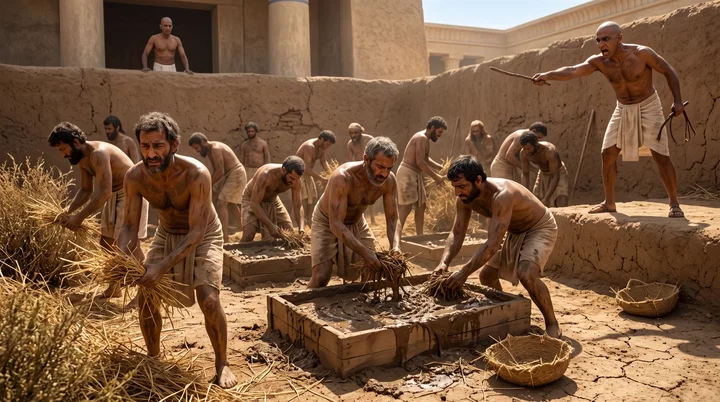
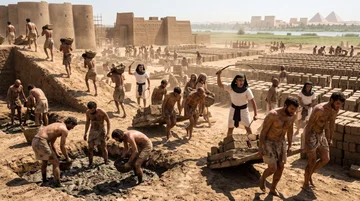
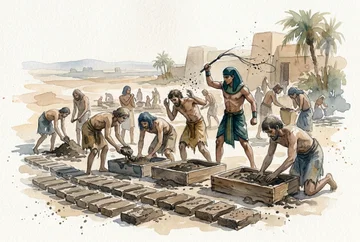
Egyptian harvest practice explains the added labor, since grain was cut a little below the ear with straw left standing in the field so Israel had to go into the fields and collect it instead of having it brought to hand.RH Apr 22, 1858 The setting is verified by brick-making scenes in the rock tombs of Thebes from the time of Thothmes III, depicting digging and mixing clay, shaping in molds, taking bricks from molds and placing them in rows, and carrying them away to dry, with a taskmaster with rod overseeing slaves at work.RH Apr 22, 1858 The withheld materials and doubled labor count as part of the wages owed to Israel for their work.ST Mar 18, 1880
The order added to labor but still left material to work with, since even in cruelty Pharaoh never commanded slaves to make bricks without any material whatever.RH Jan 25, 1906 To command work as the condition of life and welfare while denying necessary means would be an impossible command, and no just and benevolent command to labor can deny the necessary means for labor.RH Jan 25, 1906 The Israelites labored in brick-yards under taskmasters, and harsh treatment with denial of religious privileges contributed to their rebellion.ST Aug 11, 1909
Archaeological Confirmation of Account
The withholding of straw while the full quota of bricks was still demanded is confirmed by bricks recovered from Pithom, some containing straw and others containing none.RH Apr 23, 1908ST Aug 7, 1901RH Aug 4, 1910ST Aug 12, 1913RH Feb 22, 1912 The lower portion of Pithom's storehouses is built of bricks containing straw, while most of the bricks are made without straw, showing the change when straw was withheld yet brick still had to be made.RH Apr 23, 1908RH Aug 4, 1910ST Aug 12, 1913 Excavated bricks were found in layers with good straw, poorer straw, and no straw, matching the worsening conditions imposed on the enslaved workers.ST Aug 7, 1901 Bricks made without straw still found in the walls of the storehouses corroborate the record, and their rigor almost reechoes Pharaoh's words, with stones crying out in confirmation through records uncovered by exploration.RH Feb 22, 1912
The command belongs to literal history from Israel's slavery in Egypt, where Semite slaves built the city of Raamses-Mera-Amen on the eastern delta of the Nile and the city of Pithom, mixing straw and mud to make bricks stamped with the name Raamses.ST Oct 21, 1930 That forced labor was building of treasure or storage cities, including Pithom in the land of Goshen, where Israel labored in mortar and in brick under bitter bondage.ST Nov 20, 1884RH Jun 25, 1901 Pithom was a square town enclosed by twenty-two-foot-thick walls, filled with vast brick storage chambers laid with mortar.RH Jun 25, 1901 Those great brick storehouses, chiefly without windows or doors, were for preserving grain for use in war or famine.ST Nov 20, 1884 The city was built by Rameses II, the Pharaoh of the bondage, and is now found with its name on an inscription.RH Aug 4, 1910ST Nov 20, 1884RH Jun 25, 1901 Houses in Pithom were built with strawless bricks under this order, and some tiers of its bricks were made with straw and some without straw, showing the change made by the command.ST Oct 21, 1930RH Jun 25, 1901
Egyptian pictures and accounts show slaves with Hebrew features making bricks in the same way the Hebrews worked.ST Nov 20, 1884 Their pictures and accounts of land, habits, and customs agree with the Bible account.ST Nov 20, 1884 The Egyptian monuments give no record of the miracles of the oppression because kings do not report their disasters.ST Nov 20, 1884
Sabbath Conflict in Egypt
The added burden belongs to a conflict over Moses and Aaron teaching the people to rest from labor and worship God, which Pharaoh resisted by laying heavier work on them so no day could be set aside.ST Aug 1, 1911RH Mar 25, 1909 The withholding of straw for brickmaking was to stop Israel from keeping the Sabbath, forcing them to gather stubble themselves while still delivering the full daily tale of bricks.ST Aug 1, 1911 This marks the time when as servants in Egypt they were not allowed to keep the Sabbath, in contrast to the later command to let servants rest on the Sabbath day.ST Aug 1, 1911
Under a new dynasty that knew not Joseph, after enslaving prosperous Israel in Goshen under taskmasters and ordering male children slain failed to check their growth, Pharaoh learned their teachers were calling them to faithfulness to the God of their fathers and to remember His creative power by observing His Sabbath.ST Nov 14, 1906ST Nov 14, 1906 He accused the teachers of making the people sabbatize from their burdens and called the people idle.ST Nov 14, 1906 He therefore ordered bricks without furnished straw with the same tale of bricks to compel them to desecrate the holy day or suffer corporal punishment.ST Nov 14, 1906ST Nov 14, 1906 The order was given because Moses taught Sabbath observance as the memorial of God's name as Creator, which Pharaoh charged was making the people rest.ST Aug 22, 1911 By adding work to make Sabbath-keeping impossible Pharaoh denied God as Creator and supreme Ruler and set aside His memorial.ST Aug 22, 1911
A Sabbath reform begun through Moses in Egypt was suppressed by Pharaoh, leaving Israel in great measure prevented from practically observing God's law through rigorous servitude.ST Oct 11, 1883ST Sep 10, 1896 They attempted to keep the seventh-day Sabbath and were probably prevented from keeping it, while the clash was not about keeping or refusing the first day.ST Oct 21, 1889ST Oct 21, 1889 Pharaoh denied the Lord's authority and compelled such severe toil that Israel could not keep the Sabbath, revealing their abject condition, bitter suffering, and cries before deliverance.RH Feb 3, 1852RH May 27, 1852 Pharaoh stopped supplied straw and ordered the people to gather stubble themselves while still delivering the full daily tale of bricks, which kept them from resting on God's Sabbath; otherwise they could meet the quota in six days and rest on the seventh.ST Apr 28, 1909RH Jun 20, 1912 This added labor was intended to leave them no time for rest and to frustrate efforts to observe the Sabbath.RH Jun 20, 1912
Lack of subjection to God's law in Egypt was not liberty but bondage, which God so calls in bringing them out of the house of bondage to enjoy obeying and serving Him in a land flowing with milk and honey, repeating His law audibly to the whole multitude and furnishing it in indestructible form to assist liberty.ST Oct 11, 1883 Though they might have kept the other nine commandments, they could not keep the Sabbath even if they desired, so God delivered them as bondmen with a mighty hand to bring them where they could keep it.RH May 16, 1854 The Sabbath itself was made for all mankind as rest and memorial of creation, not as memorial of deliverance from Egypt, whose appointed memorial is the fourteenth day of the first month.RH May 16, 1854 The cruel conditions under which Israel murmured and complained bitterly were afterward swept away with the oppressors, leaving no excuse for refusing Sabbath rest when God gave sufficient daily bread with a double portion on the sixth day.ST Mar 7, 1906
Taskmasters attempted to force labor on the Sabbath by withholding straw while demanding brick, with conditions made again and again harder and more exacting, bringing the Sabbath institution prominently before God's people just before deliverance to a place where they could observe unmolested all Jehovah's precepts.RH Nov 6, 1913 Hebrews under increased brick-making labor could not keep the Sabbath and God did not hold them responsible for what they could not help.RH Sep 9, 1862 Drafted Sabbath-keepers in the army are in the same position and likewise not held responsible, since God would not be honored by their resisting unto death.RH Sep 9, 1862 By contrast, those who held otherwise teach that the hardship describes conflict over labor but gives no indication they were refusing work on a sacred rest day, which is used to argue the account records no dispute over Sabbath observance.ST Oct 21, 1889
Divine Purpose and Deliverance
The Lord prepared Israel for deliverance by allowing heavier oppression, laying heavier tasks without abating the daily tale of bricks, making the taskmasters more exacting and cruel, making their lives wretched as cruelty and bondage could make them, and joining this with more rigid enforcement of the decree to destroy the male children.RH Nov 25, 1909 While this affliction deepened, Moses, called out from Pharaoh's courts, was receiving forty years of training in the wilderness to act as visible deliverer, since deliverance was not wrought by an angel independent of man.RH Nov 25, 1909 The rapidly worsening conditions brought despair and unbearable helplessness and drove the people to prayer for mercy and deliverance, after which Moses was sent from the wilderness to lead Israel to the promised Canaan.RH Nov 25, 1909 The withholding of straw therefore proves that God rarely does much for His people without preceding suffering and heart anguish, great travail of soul before deliverance.RH Nov 25, 1909 That increased hardship in gathering straw while still making brick was part of the events through which God answered their prayer for deliverance and brought their bondage toward an end.RH Oct 27, 1874
The episode is that of idolatrous Egyptians persecuting Hebrews who worshiped the true God, proving that he that was born after the flesh persecutes him that was born after the Spirit and that the wicked persecute the righteous.RH Jun 8, 1916 The oppression in the brick-kilns fell on the children of Joseph who had saved Egypt as deliverer, now forgotten and set to work without material, forced to gather straw for themselves and still make brick. This bondage was joined to murdering their infants to cover guilt, done by enemies against the descendants of their own benefactor, and such cruelty and ingratitude proves God's forbearance in not cutting the oppressors off at once and leaves men without excuse.
Hundreds of years of slavery with hard labor in making brick unfitted Israel to comprehend God's great salvation and the character He required. Therefore after redeeming them with a mighty hand God gave them a great multiple object-lesson by various forms and rites comprehending the plan of salvation, commanding them to build Him a sanctuary that He might dwell among them. Yet release from this bodily oppression did not by itself give them inward rest, because they remained captive to sin and continued to murmur.ST May 26, 1914
Practical Applications and Illustrations
The withholding of straw while demanding the full tale of bricks is hard, close-fisted mastery that hurries laborers without time to read or pray and lays onerous burdens on the oppressed, and it marks modern oppressors whose profession of Sabbath-keeping doctrine will only sink them like a millstone in an ocean deep as eternity, calling for prayer that God pity the oppressed and speedily deliver them.RH May 17, 1860 It is the unjust, impossible burden laid by rulers on the oppressed, as when the great men of the American republic sustained slavery, voted for ambitious proslavery men, and exacted national prosperity while denying help to the brother in bonds, a guilt bringing sure national punishment to be stayed only by repentance toward God, humbling in sackcloth, withdrawing aid from slavery, and praying for respite until God's servants are sealed to enter the everlasting fruition of the kingdom of the Lord and His Christ.RH Sep 23, 1862 The same impossible demand pictures freed Black people after the Civil War, set free and turned from old homes without education or experience in providing for themselves and expected to survive alone, to sink or swim, survive or perish, generally under the cold indifferent or unfriendly gaze though with a few true friends, yet struggling upward with noble evidences of God-given talent amid cruel suffering.
To be required to make bricks without supplied straw illustrates doing right from compulsion rather than delight in God's will, which is burdensome service unlike obedience prompted by God's Spirit.ST Jun 27, 1900 It pictures hard, joyless bondage under the lash of the taskmaster without needed materials that makes workers sigh and cry, the opposite of working for God as Father who guarantees strength, supplies all materials, fellowships while they work, forgives blunders, and accepts work in love so His service is perfect freedom done cheerfully for joy.ST Sep 22, 1881 To demand brick without straw and keep people on short allowance to famine and starvation is the act of a hard master and cruel slave-holder imposing a task beyond reach, which Christ never does, for His will is perfect, His service liberty, His yoke as easy as possible, and all He requires is for highest good with sufficient grace to obey, contrary to saying His commandments are grievous and His grace too sparing to obey in this life.RH Mar 26, 1861 Making bricks without straw is fruitless work, like human efforts to reform the world without God, which will prove even more fruitless, as if making bricks without clay and ending in worthless fruit.ST Oct 15, 1894
Being forced to gather straw while still making bricks pictures being made to work without needed materials, conveniences, or assistance, as with a woman expected to manage household work without equipment while her husband has machines for farm work, who refuses to keep working at that disadvantage, and more generally being burdened with difficult work while deprived of help.ST Aug 28, 1879ST Nov 27, 1879 As bricks cannot be made without straw, a wife cannot keep house without money, so to demand management while withholding funds and requiring account for every sixpence leaves an empty purse, fretting, worry, and petty mortification, and a husband must practice openness about resources, keep definite household accounts, and supply yearly expense proportioned to the family's position, bringing peace to the home.ST Apr 2, 1885 Making brick without straw means attempting a needed enterprise without means in hand and without keeping out of debt, pushing forward with buildings, facilities, or new work such as publishing when Providence has not opened the way with funds, departing from the avowed purpose to keep out of debt and bringing difficulty and embarrassment to God's work.RH Jul 31, 1913 It likewise means undertaking needful work without resources, as when a small poor people must build with almost no money in sight, and expresses the thought that prejudice and hardship might make success seem impossible.ST Oct 22, 1902RH Jun 23, 1903
As bricks cannot be made without straw, ministers must not try to work without needed material and preparation, and doctors cannot be trained without medical students.ST Jan 30, 1912ST Apr 20, 1888 To make bricks while straw is withheld means attempting work without required materials, describing subjective criticism that reconstructs history from its own theories and rejects what does not fit, in contrast to the excavator and decipherer who seek facts and loyally follow them wherever they lead. The mission image of making brick without straw applies where work began without believers to help, so workers taught and preached without helpers sharing their faith, and God enabled the work in that extreme situation with some encountered through its enterprises later accepting truth and joining, but such providence is exceptional and not a general rule.RH Mar 23, 1916 The verse distinguishes making brick from gathering straw for the makers, meaning that in harvest work those who by age and failing strength can no longer do heavy work can still do lighter work by staying up active laborers' hands with cheering words and encouragement.RH Jan 9, 1872
Sources