Genesis 21:14
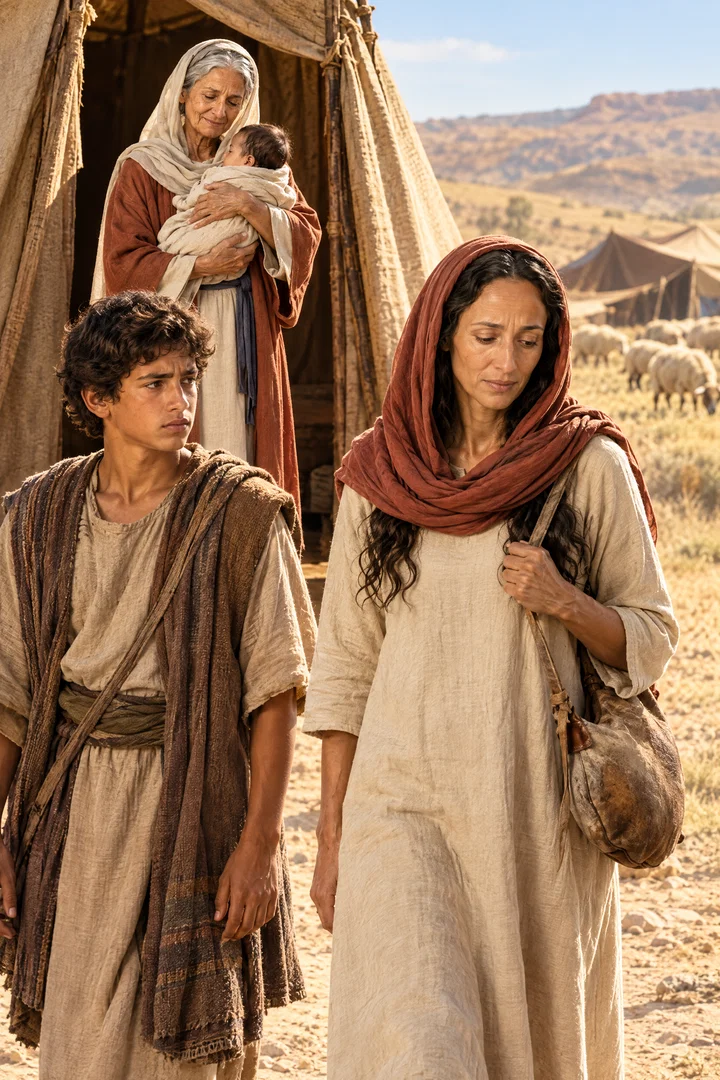
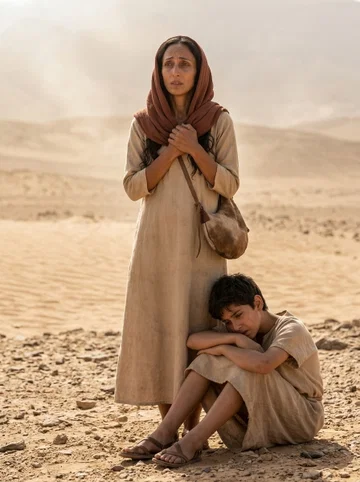
And Abraham rose up early in the morning, and took bread, and a bottle of water, and gave it unto Hagar, putting it on her shoulder, and the child, and sent her away: and she departed, and wandered in the wilderness of Beer-sheba.
Translations
And Abraham rose up early in the morning, and took bread, and a bottle of water, and gave it to Hagar, putting it on her shoulder, and the child, and sent her away: and she departed, and wandered in the wilderness of Beersheba.
King James Version, KJV Cambridge Paragraph Bible
And Abraham rose up early in the morning, and took bread, and a bottle of water, and gave it unto Hagar, putting it on her shoulder, and the child, and sent her away: and she departed, and wandered in the wilderness of Beer-sheba.
And Abraham rose early in the morning, and took bread, and a bottle of water, and gave it to Hagar (putting it on her shoulder) and the child, and sent her away; and she departed, and wandered in the wilderness of Beer-sheba.
And Abraham rose up early in the morning, and took bread and a bottle of water, and gave it unto Hagar, putting it on her shoulder, and the child, and sent her away: and she departed, and wandered in the wilderness of Beer-sheba.
And Abraham rose up early in the morning, and took bread and a bottle of water, and gave it unto Hagar, putting it on her shoulder, and gave her the child, and sent her away: and she departed, and wandered in the wilderness of Beer-sheba.
And Abraham riseth early in the morning, and taketh bread, and a bottle of water, and giveth unto Hagar (placing [it] on her shoulder), also the lad, and sendeth her out; and she goeth on, and goeth astray in the wilderness of Beer-Sheba;
And Abraham rose up early in the morning, and took bread, and a flask of water, and gave [ it] to Hagar, putting [ it] on her shoulder — and the child, and sent her away. And she departed, and wandered about in the wilderness of Beer-sheba.
So Abraham rose up early in the morning—and took bread and a skin of water and gave unto hagar,—putting them on her shoulder and the child, and sent her forth,—so she went her way and wandered, in the desert of Beer-sheba.
Berean Standard Bible, Majority Standard Bible
Early in the morning, Abraham got up, took bread and a skin of water, put them on Hagar’s shoulders, and sent her away with the boy. She left and wandered in the Wilderness of Beersheba.
Abraham rose up early in the morning, and took bread and a container of water, and gave it to Hagar, putting it on her shoulder; and gave her the child, and sent her away. She departed, and wandered in the wilderness of Beersheba.
And early in the morning Abraham got up, and gave Hagar some bread and a water-skin, and put the boy on her back, and sent her away: and she went, wandering in the waste land of Beer-sheba.
So Abraham arose vp early in ye morning, and tooke bread, and a bottell of water, and gaue it vnto Hagar, putting it on her shoulder, and the childe also, and sent her away: who departing wandred in the wildernesse of Beer-sheba.
Douay-Rheims (Challoner revision)
So Abraham rose up in the morning, and taking bread and a bottle of water, put it upon her shoulder, and delivered the boy, and sent her away. And she departed, and wandered in the wilderness of Bersabee.
Pictures
Cross-references
- Genesis 16:1-4
Now Sarai Abram’s wife bare him no children: and she had an handmaid, an Egyptian, whose name was Hagar.
Sarah gives Hagar to Abraham, beginning the family conflict.
- Galatians 4:22-31
For it is written, that Abraham had two sons, the one by a bondmaid, the other by a freewoman.
Hagar and Ishmael represent bondage, contrasted with Sarah and Isaac and the promise.
- Genesis 21:10
Wherefore she said unto Abraham, Cast out this bondwoman and her son: for the son of this bondwoman shall not be heir with my son, even with Isaac.
Sarah’s demand gives the reason Hagar and Ishmael are sent away.
- Genesis 17:18-20
And Abraham said unto God, O that Ishmael might live before thee!
Abraham pleads for Ishmael, and God distinguishes his blessing from the covenant promised through Isaac.
- Genesis 16:11-12
And the angel of the LORD said unto her, Behold, thou art with child, and shalt bear a son, and shalt call his name Ishmael; because the LORD hath heard thy affliction.
Ishmael’s later life fulfills the prophecy of his name and future character.
- Genesis 25:6
But unto the sons of the concubines, which Abraham had, Abraham gave gifts, and sent them away from Isaac his son, while he yet lived, eastward, unto the east country.
Abraham gives gifts to Hagar’s son and sends him away from Isaac.
- Genesis 21:18
Arise, lift up the lad, and hold him in thine hand; for I will make him a great nation.
The angel promised to make Ishmael a great nation.
- Galatians 4:30
Nevertheless what saith the scripture? Cast out the bondwoman and her son: for the son of the bondwoman shall not be heir with the son of the freewoman.
Paul applies Sarah's cast-out command
- Genesis 17:20
And as for Ishmael, I have heard thee: Behold, I have blessed him, and will make him fruitful, and will multiply him exceedingly; twelve princes shall he beget, and I will make him a great nation.
God had promised to bless Ishmael and make him a great nation.
- Genesis 22:3
And Abraham rose up early in the morning, and saddled his ass, and took two of his young men with him, and Isaac his son, and clave the wood for the burnt offering, and rose up, and went unto the place of which God had told him.
both show Abraham obeying the next morning without delay
- Romans 9:7-8
Neither, because they are the seed of Abraham, are they all children: but, In Isaac shall thy seed be called.
Not all Abraham’s physical descendants count as the promised seed.
- Hebrews 11:19
Accounting that God was able to raise him up, even from the dead; from whence also he received him in a figure.
The later lesson contrasts Abraham’s trust with his earlier distress.
- Genesis 15:2-4
And Abram said, Lord GOD, what wilt thou give me, seeing I go childless, and the steward of my house is this Eliezer of Damascus?
Abraham first proposes a household heir before God promises him a child.
- Galatians 3:29
And if ye be Christ’s, then are ye Abraham’s seed, and heirs according to the promise.
Those who belong to Christ are Abraham’s seed and heirs according to promise.
- Genesis 15:5
And he brought him forth abroad, and said, Look now toward heaven, and tell the stars, if thou be able to number them: and he said unto him, So shall thy seed be.
The promise of descendants like the stars is recalled as Abraham faces the command concerning Isaac.
Commentary
Each commentary is drawn from primary sources: the writings of Ellen G. White and Adventist pioneers and periodicals. Each commentary is separate. Its own words are not a quotation; follow the references to read the source passages.
Ellen G. White
3 sources
Abraham sent Hagar and Ishmael away in obedience to God's direction and command, submitting because God required it.PP 146.2ST Mar 27, 1879PP 147.2–148.1 The separation caused him deep grief because he dearly loved his son, bowing his soul with grief and sorely testing his faith.PP 146.2ST Mar 27, 1879 Their departure was meant to restore peace in the household.PP 146.2 Ishmael was not abandoned by God in being sent away; his life would be preserved, and he would become the father of a great nation.PP 146.2
The sending away to wander in the wilderness was an act of obedience in faith and one of the trials that preceded his later test.ST Mar 27, 1879PP 147.2–148.1 This earlier painful obedience is recalled as a test that was later surpassed by the command to offer Isaac.ST Mar 27, 1879
Sources
Pioneers and periodicals
26 sources
Abraham rose early in obedience to God's command given in the night and sent Hagar and Ishmael away at once, giving her bread and a skin bottle of water on her shoulder and giving her the child.RH Aug 30, 1870ST Sep 8, 1898ST Apr 1, 1889ST Feb 12, 1894ST Sep 8, 1898 The provision was small and meager, and without escort she lost her way and wandered in the wilderness of Beer-sheba until the water ran out and the boy grew weak, when God in mercy showed her a well to revive him and promised to make Ishmael a great nation because he was Abraham's seed.ST Nov 15, 1910STST Feb 12, 1894ST Sep 8, 1898ST Oct 1, 1896 The sending followed Isaac's birth when the two mothers and sons could not remain together, and though it was grievous to Abraham because Ishmael was also his son, he consented to Sarah's demand to cast out the bondwoman and her son so he would not be heir with Isaac, thus breaking his bond of heirship.ST Jan 24, 1900STRH Mar 16, 1869 His prompt submission without hesitating, reasoning, or waiting bowed his soul with grief and tested his faith, and it pleases God as an example of obedience in a painful test later surpassed by the command to offer Isaac.ST Mar 27, 1879RH Aug 30, 1870ST Sep 8, 1898 Read with Galatians 4, Hagar and her son sent away represent bondage and those who rely on their own works through human scheming, while Sarah and Isaac the miraculous child represent freedom and the children of promise through whom the promised Seed would come.RH May 29, 1900RH Jul 5, 1915STRH Jun 26, 1900ST Sep 28, 1915
Sending into Wilderness
Abraham rose early and sent Hagar and Ishmael away into the wilderness of Beer-sheba, giving Hagar bread and a skin bottle of water, putting it on her shoulder and giving her the child with her.ST Apr 1, 1889ST Feb 12, 1894ST Sep 8, 1898ST Apr 11, 1911ST Oct 27, 1898 The supply was only a small provision of bread and water for the journey.ST Sep 8, 1898ST Apr 11, 1911ST Oct 27, 1898
She was not cast out without provision, for she was sent without an escort toward one of Abraham's encampments that was to become hers.ST Nov 15, 1910 The provision was meager, and she lost her way on the journey and wandered in the wilderness.ST Nov 15, 1910ST Sep 8, 1898ST Oct 1, 1896
In the heat the water was soon spent and ran out, and the child grew weak and exhausted with thirst.STST Sep 8, 1898ST Oct 1, 1896 Hagar laid him beneath a shrub and wept in despair over the lonely mother and her thirsty son.STST Sep 8, 1898ST Oct 1, 1896 God in mercy and compassion remembered them and came to their relief, answering the child's cries by showing Hagar a well where she found water and revived him.ST Feb 12, 1894ST Sep 8, 1898ST Oct 1, 1896 He also promised to make Ishmael a great nation because he was Abraham's seed, an Egyptian woman's distressed son going out from Abraham yet not forsaken.STST Feb 12, 1894 Ishmael afterward received a large share of Abraham's property and rose to a high position among the Arab tribes.ST Nov 15, 1910
Cause and Obedience
The sending came after the birth of Isaac, when rivalry had arisen between Hagar and Sarah so that the two boys and their two mothers could not remain together in one house.STRH Mar 16, 1869 Ishmael was the son of the bondwoman, brought forth through human effort to secure the promised heir, while Isaac was the son God had promised to Sarah, brought forth through God's power despite her barrenness.ST The painful necessity of sending Hagar and Ishmael away was thus the consequence of Abraham's taking Hagar as wife.RH Mar 16, 1869
The root lay in the human expedient of having Hagar bear Abraham a son instead of trusting God's promise to give him a son of his own, and that failure brought later sorrow upon Abraham when separation came.ST Sep 28, 1915ST Jan 20, 1898 Birth through such human scheming rather than through God's promise led to bondage and trouble, for Hagar's standing as handmaid and Ishmael's birth to a slave represent reliance on one's own works.ST Sep 28, 1915
Sarah demanded that the bondwoman and her son be cast out, that the son of the bondwoman should not be heir with Isaac.ST Jan 24, 1900 The proposal was grievous to Abraham because Ishmael was his son also, yet he consented and sent them away.ST Jan 24, 1900 That act broke the bond of heirship and inheritance as it pertained to Ishmael and put Hagar and her son in bondage indeed, whereas before they had stood in a comparatively exalted position, for had Isaac not appeared Ishmael would have succeeded to his father's titles and inheritance.ST Jan 24, 1900
Abraham obeyed the command given to him in the night by rising early the next morning and sending Hagar and Ishmael away from his house at once.ST Mar 27, 1879RH Aug 30, 1870ST Sep 8, 1898 Though he loved Ishmael and it pained him exceedingly, and though the separation bowed his soul with grief and sorely tested his faith, he submitted because God required it.ST Mar 27, 1879RH Aug 30, 1870 He did not hesitate, reason about the cross, or wait days to consider whether to obey, but went right about what God commanded.RH Aug 30, 1870 Such prompt obedience greatly pleases God and stands as a good example, and this test of faith and obedience according to Sarah's word was an earlier painful trial later surpassed by the command to offer Isaac.ST Mar 27, 1879RH Aug 30, 1870ST Sep 8, 1898
The trouble that forced Hagar and the child to wander in the wilderness of Beer-sheba shows God's disapproval of plural marriage in Abraham's days.ST Mar 17, 1914RH Mar 1, 1870RH Mar 16, 1869ST Apr 11, 1911 Having more than one wife brought family trouble and unhappiness, and Abraham's sending Hagar and her son away with only bread and a bottle of water is set forth as the consequence of his mistake and a warning against polygamy.ST Mar 17, 1914RH Mar 1, 1870RH Mar 16, 1869ST Apr 11, 1911 Plural marriages entered as the result of apostasy and are always a source of trouble, contrary to the moral and perpetual marriage law that joins one man to one woman so completely that they become one flesh for the highest good of mankind.ST Mar 17, 1914 The episode, in which Abraham sent Hagar away with bread and water while his heart yearned for his firstborn son, acknowledges the harm in a union formed for a mercenary purpose rather than true unselfish love, for such a union is not made holy by God but is profane and spiritual adultery.ST Oct 27, 1898
Covenant Meaning and Application
The account is to be read with Galatians 4, where Hagar and Sarah represent the two covenants and their sons represent the children of those covenants.RH May 29, 1900RH Jun 26, 1900 It provides Paul with an allegory about the two covenants, the typical and antitypical systems, and literal and true Israel.RH May 29, 1900RH Jun 26, 1900ST Jan 24, 1900 Ishmael was born to Hagar, a maidservant, and Isaac to Sarah, the freewoman.ST Jan 24, 1900
Isaac was the miraculous child of promise, born through God's power despite barrenness.RH Jul 5, 1915ST He was the son through whom the promised Seed would come in Abraham's chosen family, whose providential dealings show God's care for the chosen progenitor of the Seed.RH Jul 5, 1915ST Ishmael, though Abraham's son, was sent away with Hagar and was not included among the children of promise, so that only some of Abraham's descendants were counted as the promised seed.RH Jul 5, 1915RH May 29, 1855
Ishmael was the son of a bondwoman, born through human efforts and human scheming to secure the promised heir rather than through God's promise, which led to bondage and trouble.ST Sep 28, 1915ST Isaac was the son God had promised Sarah, and after his birth the two boys and their mothers could not remain together.ST Hagar's status as a handmaid and Ishmael's birth to a slave represent those who rely on their own works, while Isaac's birth to the freewoman represents the promise.ST Sep 28, 1915ST
The sending broke the bond of heirship and inheritance as it pertained to Ishmael, so that the son of the bondwoman would not be heir with Isaac.ST Jan 24, 1900 It put Hagar and her son in bondage indeed, whereas before they had held a comparatively exalted position, for if Isaac had not appeared Ishmael would have succeeded to the titles and inheritance of his father Abraham.ST Jan 24, 1900 Those who held the other teaching held that their departure with bread and water was the beginning of their freedom, not a return to bondage.RH Oct 13, 1859
Ishmael's being sent away with a small gift illustrates preferring a limited portion in this life over waiting for the promised inheritance.RH Jun 3, 1858
Sources