Genesis 21:10
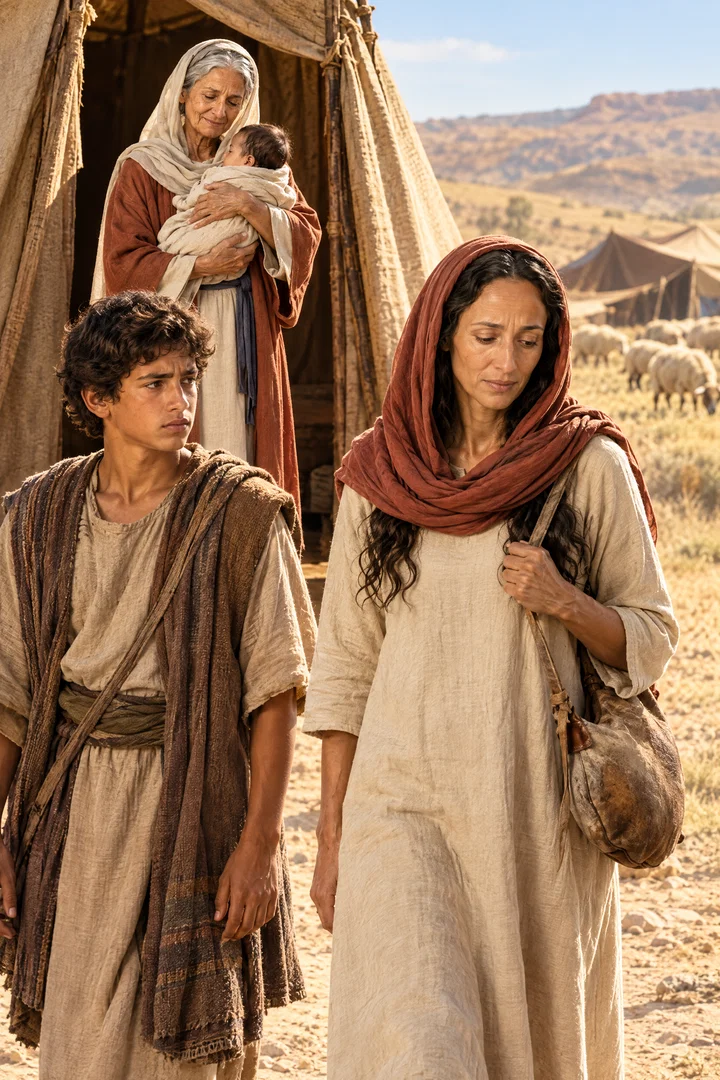
Wherefore she said unto Abraham, Cast out this bondwoman and her son: for the son of this bondwoman shall not be heir with my son, even with Isaac.
Translations
Why she said to Abraham, Cast out this female slave and her son: for the son of this female slave shall not be heir with my son, even with Isaac.
King James Version, KJV Cambridge Paragraph Bible, Revised Version
Wherefore she said unto Abraham, Cast out this bondwoman and her son: for the son of this bondwoman shall not be heir with my son, even with Isaac.
Wherefore, she said to Abraham, Cast out this bond-woman, and her son: for the son of this bond-woman shall not be heir with my son, even with Isaac.
Wherefore she said unto Abraham, Cast out this handmaid and her son: for the son of this handmaid shall not be heir with my son, even with Isaac.
and she saith to Abraham, 'Cast out this handmaid and her son; for the son of this handmaid hath no possession with my son — with Isaac.'
And she said to Abraham, Cast out this handmaid and her son; for the son of this handmaid shall not inherit with my son — with Isaac.
So she said to Abraham, Cast out this bondwoman and her son,—for the son of this bondwoman must not inherit with my son with Isaac.
Berean Standard Bible, Majority Standard Bible
and she said to Abraham, “ Expel the slave woman and her son, for the slave woman’s son will never share in the inheritance with my son Isaac!”
Therefore she said to Abraham, “ Cast out this servant and her son! For the son of this servant will not be heir with my son, Isaac.”
So she said to Abraham, Send away that woman and her son: for the son of that woman is not to have a part in the heritage with my son Isaac.
Wherefore she saide vnto Abraham, Cast out this bond woman and her sonne: for ye sonne of this bonde woman shall not be heire with my sonne Izhak.
Douay-Rheims (Challoner revision)
Cast out this bondwoman, and her son: for the son of the bondwoman shall not be heir with my son Isaac.
Pictures
Cross-references 20 of 29
- Galatians 4:21-31
Tell me, ye that desire to be under the law, do ye not hear the law?
Paul uses Hagar, Sarah, Ishmael, and Isaac to explain the two covenants and the casting out.
- Genesis 17:19-21
And God said, Sarah thy wife shall bear thee a son indeed; and thou shalt call his name Isaac: and I will establish my covenant with him for an everlasting covenant, and with his seed after him.
God establishes the covenant through Isaac, not Ishmael.
- Genesis 16:1-4
Now Sarai Abram’s wife bare him no children: and she had an handmaid, an Egyptian, whose name was Hagar.
Sarah and Abraham seek an heir through Hagar, resulting in Ishmael’s birth.
- Galatians 4:29
But as then he that was born after the flesh persecuted him that was born after the Spirit, even so it is now.
Paul identifies Ishmael’s persecution of Isaac as flesh-born persecution of the Spirit-born.
- Galatians 4:22-24
For it is written, that Abraham had two sons, the one by a bondmaid, the other by a freewoman.
Abraham’s two sons represent the two covenants.
- Genesis 22:2
And he said, Take now thy son, thine only son Isaac, whom thou lovest, and get thee into the land of Moriah; and offer him there for a burnt offering upon one of the mountains which I will tell thee of.
Isaac is Abraham’s only son and heir to the promises, whose faith is tested after Ishmael is cast out.
- Genesis 16:12
And he will be a wild man; his hand will be against every man, and every man’s hand against him; and he shall dwell in the presence of all his brethren.
Ishmael is described as a wild man opposed by others.
- Genesis 15:5-6
And he brought him forth abroad, and said, Look now toward heaven, and tell the stars, if thou be able to number them: and he said unto him, So shall thy seed be.
Abraham is reminded to trust God’s promise of descendants rather than human effort.
- Galatians 4:31
So then, brethren, we are not children of the bondwoman, but of the free.
Believers are identified as children of the free woman.
- Genesis 15:2-4
And Abram said, Lord GOD, what wilt thou give me, seeing I go childless, and the steward of my house is this Eliezer of Damascus?
Abraham laments having no son to inherit, before God promises an heir from his own body.
- Genesis 18:10-14
And he said, I will certainly return unto thee according to the time of life; and, lo, Sarah thy wife shall have a son. And Sarah heard it in the tent door, which was behind him.
God promises Sarah will bear a son at the appointed time, by his power.
- Isaiah 54:1
Sing, O barren, thou that didst not bear; break forth into singing, and cry aloud, thou that didst not travail with child: for more are the children of the desolate than the children of the married wife, saith the LORD.
Promises many children to the desolate barren woman.
- Galatians 5:1
Stand fast therefore in the liberty wherewith Christ hath made us free, and be not entangled again with the yoke of bondage.
The contrast prompts a call to remain free from bondage.
- Genesis 16:3-5
And Sarai Abram’s wife took Hagar her maid the Egyptian, after Abram had dwelt ten years in the land of Canaan, and gave her to her husband Abram to be his wife.
Hagar’s role and the conflict arising from Abraham and Sarah’s plan.
- Romans 9:8
That is, They which are the children of the flesh, these are not the children of God: but the children of the promise are counted for the seed.
Distinguishes the children of the flesh from the children counted as Abraham’s seed by promise.
- Genesis 15:4
And, behold, the word of the LORD came unto him, saying, This shall not be thine heir; but he that shall come forth out of thine own bowels shall be thine heir.
God promised Abraham an heir from his own body.
- Genesis 17:18
And Abraham said unto God, O that Ishmael might live before thee!
Abraham loved Ishmael as his son.
- Galatians 3:29
And if ye be Christ’s, then are ye Abraham’s seed, and heirs according to the promise.
Those who belong to Christ are Abraham’s seed and heirs according to the promise.
- Galatians 4:7
Wherefore thou art no more a servant, but a son; and if a son, then an heir of God through Christ.
Sonship through Christ makes believers heirs, unlike the bondwoman’s son.
- Galatians 4:27
For it is written, Rejoice, thou barren that bearest not; break forth and cry, thou that travailest not: for the desolate hath many more children than she which hath an husband.
Cited alongside the account of Hagar and her son.
Commentary
Each commentary is drawn from primary sources: the writings of Ellen G. White and Adventist pioneers and periodicals. Each commentary is separate. Its own words are not a quotation; follow the references to read the source passages.
Ellen G. White
6 sources
Sarah demanded that Hagar and her son Ishmael be sent away from Abraham's household.SG3 103.2–104.21SP 97.1–98.2ST Mar 27, 1879PP 146.2 Ishmael was not to share the inheritance promised through Isaac, who was the heir of God's promise and the son of promise.SG3 103.2–104.21SP 97.1–98.2ST Mar 27, 1879PP 146.2PP 147.2–148.1 The demand followed Ishmael's hostility toward Isaac after Isaac's birth, described as despising, disrespect, mockery, and a turbulent disposition that made him a continuing source of family discord, sharing his mother Hagar's jealousy and claim that Ishmael as Abraham's son would be heir to the promise.SG3 103.2–104.21SP 97.1–98.2PP 146.2
God directed Abraham to heed Sarah and comply with her request, commanding him through angels to send them away.SG3 103.2–104.21SP 97.1–98.2ST Mar 27, 1879PP 146.2PP 147.2–148.1 Sarah's demand was right, and God did not rebuke or reprove her for requiring her rival's banishment to protect Isaac's place.1SP 97.1–98.2ST Mar 27, 1879PP 147.1 Ishmael's separation did not mean he would die, be forsaken, or be abandoned by God; God comforted Abraham with the promise that Ishmael would be preserved and made a great nation, becoming the father of a great nation.SG3 103.2–104.21SP 97.1–98.2ST Mar 27, 1879PP 146.2 Affection for Hagar and Ishmael was not to prevent Abraham from granting the separation, which was the only course that could protect the marriage relationship and its rights and restore harmony and happiness to the family.SG3 103.2–104.21SP 97.1–98.2PP 146.2
The episode teaches that the rights and happiness of the marriage relation must be respected and guarded even at great sacrifice, with Sarah as Abraham's first and only true wife entitled to rights as wife and mother that no other woman in the household could claim or share.SG3 103.2–104.21SP 97.1–98.2ST Mar 27, 1879PP 147.1 The command to send them away proves that God did not sanction polygamy.1SP 97.1–98.2 Abraham and Sarah had distrusted God's power to fulfill the promise, and that error led to Abraham's marriage with Hagar in the thought that the promise would be fulfilled through her, for which they were reproved.1SP 97.1–98.2ST Mar 27, 1879PP 147.1
Sources
Pioneers and periodicals
58 sources
Sarah demanded that Abraham send Hagar the bondwoman and her son Ishmael away, because Ishmael would not share the inheritance with her son Isaac.RH Jul 3, 1900ST Apr 11, 1900ST Mar 1, 1905 The demand came after the feast for Isaac's weaning, when Sarah saw Ishmael mocking and persecuting Isaac, and though Abraham was grieved God directed him to heed her.ST Apr 20, 1888RH Jan 2, 1913ST Jun 4, 1885 The promised Seed and inheritance were to be reckoned through Isaac alone, the miraculous child of promise born to barren Sarah by God's power, and not through Ishmael, who came by human planning and unbelief.RH Jul 3, 1900ST Apr 11, 1900STST Mar 1, 1905RH Jul 5, 1915 Hagar and Sarah represent the two covenants, bondage from Sinai and freedom by promise, and Ishmael and Isaac represent the two classes of children, those born after the flesh seeking righteousness by works and those born after the Spirit by faith.RH May 29, 1900ST Mar 1, 1905RH Jun 26, 1900ST Sep 28, 1915RH Jul 3, 1900 The command to cast out the bondwoman and her son means those in bondage have no share in the inheritance of the children of promise, so human schemes and reliance on human effort must be renounced and the covenant of bondage rejected for the liberty Christ gives.RH Feb 28, 1856ST Dec 19, 1900RH Feb 7, 1854RH Jul 3, 1900RH Jul 3, 1900
Story and Wording
Sarah demanded that Abraham send away Hagar the bondwoman and her son Ishmael, because Ishmael was not to share the inheritance with her son Isaac.RH Jul 3, 1900ST Apr 11, 1900ST Mar 1, 1905ST Sep 8, 1898GSAM 42.2 Ishmael was not to be co-heir with Isaac the son of promise, for the seed and the inheritance were to be called through Isaac alone.RH Jul 3, 1900ST Apr 11, 1900ST Mar 1, 1905ST Aug 7, 1901 Sarah's earlier plan to hasten the promise through Hagar had been unwise, and the sending away was presented as a test of Abraham's faith and obedience.ST Sep 8, 1898GSAM 42.2 The mocking of Isaac by the bondwoman's son marked the beginning of the four hundred years that ended with Israel's deliverance from Egypt.ST Aug 7, 1901
The demand came after the feast for Isaac's weaning, when Sarah saw Hagar's boy laughing at, mocking, and persecuting Isaac.ST Apr 20, 1888RH Jan 2, 1913ST Jun 4, 1885ST Feb 4, 1889ST Sep 8, 1898 This hostility of Ishmael the son of the bondwoman against Isaac the son of the freewoman, born after the flesh against him born after the Spirit, was the recorded persecution that began the four hundred years of affliction foretold in Genesis 15:13 and ended when Abraham's descendants came out of Egypt.ST Apr 20, 1888RH Jan 2, 1913ST Jun 4, 1885ST Feb 4, 1889 Since Isaac was born twenty-five years after the promise and was weaned at about five years old, the affliction began about thirty years after the promise, about 1891 B.C. in that reckoning.ST Apr 20, 1888ST Jun 4, 1885 The chapter belongs to the account of Isaac's birth, Ishmael's mocking, and Hagar being sent away, and it also records God's mercy to Hagar in the wilderness.ST Feb 12, 1894
Abraham was distressed because Ishmael was also his son, but he eventually sent them away after God directed him to heed Sarah.ST Jan 24, 1900 Handmaid means a female slave and is equivalent here to bondwoman. Ishmael had been regarded as free and as heir of Abraham's house, and Abraham sent him away rather than treating him as property to be sold, which shows Hagar and her son were not treated as chattel slaves.RH Oct 1, 1861 This ended Ishmael's claim to Abraham's heirship and inheritance, to which without Isaac he would have succeeded.ST Jan 24, 1900 Later Bedouins are described as regarding that exclusion as an unjust loss of Ishmael's share in Abraham's property.
The household conflict arose from plural marriage, which brought rivalry over which son would inherit and unhappiness into the family.ST Mar 17, 1914RH Mar 1, 1870 Plural marriages arose through apostasy, and God disapproved of them because of the trouble they caused.ST Mar 17, 1914 The rights and happiness of marriage are to be respected and guarded even at great sacrifice, and Sarah as Abraham's first and only true wife had rights that no other woman in the household could claim.ST Mar 27, 1879 God did not rebuke her for seeking to protect Isaac's place, though she had earlier been reproved for distrusting God's power and thinking the promise would be fulfilled through Hagar.ST Mar 27, 1879 Abraham's heart yearned for his firstborn, yet his sending them away acknowledged the wrong of a union formed for mercenary motive rather than true unselfish love, a union not made holy by God and called profane, common, and spiritual adultery by those who so taught.ST Mar 27, 1879ST Oct 27, 1898
Although Sarah's earlier counsel to take Hagar as a wife was wrong, her later counsel to send Hagar and her son away was right and God approved it, so an earlier mistake does not make every later decision wrong.RH Jun 4, 1867 The trouble and division between Isaac and Ishmael was made by the one who did not care to obey God, so all responsibility for the break rests on the disobedient side and not on the obedient.RH Apr 9, 1872 The verse thus proves, in that teaching, that the religion of Christ and the Bible divides families, with blame always on those who refuse to obey God and oppose those who do.RH Apr 9, 1872
The verse falls within the account of God's dealings with Abraham from his call through the events surrounding Isaac.ST Dec 20, 1910 That is the account of God's providential dealings with Abraham's family, whose chosen role was to carry forward the promised Seed, and it is read with the Promised Seed in mind.ST Dec 20, 1910ST In that sequence Genesis 21 places the destruction of Sodom just before Isaac's birth.ST Oct 4, 1883
Time Prophecy Begins
The mocking and affliction of Isaac by Ishmael after Isaac was weaned marks the beginning of the 400 years of affliction foretold in Genesis 15:13, which ended when Abraham's descendants came out of Egypt in deliverance from Egypt.ST Apr 20, 1888RH Jan 2, 1913ST Jun 4, 1885ST Feb 4, 1889ST Aug 7, 1901 Ishmael, the son of the bondwoman born after the flesh, mocked, afflicted and persecuted Isaac, the son of the freewoman born after the Spirit, and Sarah's demand that Hagar and Ishmael be sent away because Ishmael would not share the inheritance with Isaac arose from that hostility.RH Jan 2, 1913ST Jun 4, 1885ST Feb 4, 1889ST Aug 7, 1901 The recorded persecution and expulsion is reckoned as the opening event of the period that closed at the exodus.ST Apr 20, 1888RH Jan 2, 1913ST Aug 7, 1901
The beginning is dated about thirty years after the promise to Abraham, since Isaac was born twenty-five years after the promise and was about five years old when weaned.ST Apr 20, 1888ST Jun 4, 1885 The start of the 400-year period of affliction is therefore placed about the time Isaac was weaned, around 1891 B.C.ST Aug 12, 1913ST Apr 20, 1888ST Jun 4, 1885
Promised Seed and Heir
The promised Seed and the inheritance were to be called through Isaac alone, not through Ishmael, for the son of the bondwoman was not to share the inheritance with the son of promise.RH Jul 3, 1900ST Apr 11, 1900RH Jul 5, 1915 Although Abraham had two sons, and Ishmael was nevertheless Abraham's seed whom God promised to preserve and make a great nation, the line of promise did not pass through Ishmael.RH Jul 3, 1900STRH Jul 5, 1915 Sarah demanded that Hagar and Ishmael be sent away because the two boys could not live together as co-heirs, and God told Abraham to heed her, affirming that Abraham's seed would be called through Isaac.RH Jul 3, 1900STST Jun 2, 1881 The inheritance of the promise belonged to Isaac, the son of Sarah, so that Abraham could not rely on Ishmael as heir if Isaac were lost, and the family account belongs to the omitted reading about the family through whom the promised Seed was to come, connecting God's promises extending from Abraham to Isaac.ST Jan 14, 1913ST Jun 2, 1881
Isaac was the miraculous child of promise born to barren Sarah by God's own power, in contrast to Ishmael who was born to Hagar through human planning, unbelief, and the unwise scheme to hasten the promise.ST Apr 11, 1900ST Mar 1, 1905ST Since Sarah was barren by human reckoning, Isaac's birth showed that God could fulfill His word by His own power and not by human effort.ST Mar 1, 1905STST Apr 6, 1915 Sarah was right to reject the idea that Ishmael, born through human effort to the bondwoman, should be co-heir with Isaac, the freewoman's son, and God confirmed that the promised seed and inheritance are to be called through Isaac.ST Apr 11, 1900ST Mar 1, 1905ST Apr 6, 1915 The exclusion of Ishmael from the heirship therefore illustrates that God's promise is fulfilled by His power, not by human schemes, as a figure of the difference between fleshly effort that leads to bondage and God's promise that brings freedom.ST Apr 11, 1900ST Mar 1, 1905ST Apr 6, 1915
The verse falls within the account of God's dealings with Abraham from his call through the events surrounding Isaac, and that account is read with the Promised Seed in mind.ST Dec 20, 1910ST It belongs to God's providential dealings with the chosen family whose role was to carry forward the promised Seed.ST Dec 20, 1910ST The Messiah was to descend from Abraham through Isaac, as traced in the genealogy of Jesus in Matthew 1:1-16.RH Nov 18, 1862
Applied to the present world, the demand that the son of the bondwoman would not share the inheritance with the son of the freewoman highlights the contrast that the wicked may possess more of this world while the righteous, who are poor, are heirs to a different inheritance.ST May 8, 1884
Two Covenants Meaning
The two women stand for the two covenants, with their sons standing for the children of those covenants.RH May 29, 1900RH Jun 26, 1900 The bondwoman is the covenant from Sinai and bondage, while the freewoman with Isaac is promise and freedom.RH Jul 3, 1900 Hagar answers to Jerusalem as it then was, in bondage with her children, while the freewoman answers to the New Jerusalem above, which is free and the mother of all.RH Feb 28, 1856 The bondwoman and her son were to be cast out and denied inheritance with Isaac the son of the freewoman, which is the Sinai covenant and those in bondage under it having no share in the inheritance of the children of promise.RH Feb 28, 1856RH Feb 7, 1854
Ishmael, born through human effort to Hagar the bondwoman, could not share the inheritance promised through Isaac, Sarah's son by the freewoman, for the promised heir came by God's power and promise and not by human schemes.ST Mar 1, 1905ST Sep 28, 1915 The bondwoman's son, born after the flesh to a slave woman, figures those in bondage under condemnation who rely on human effort and seek righteousness by works and can inherit only bondage, while the child of promise, born after the Spirit through faith, figures the children of promise and freedom.RH Jul 3, 1900RH Jul 31, 1900ST Mar 6, 1893ST Mar 22, 1899 As then he that was born after the flesh persecuted him that was born after the Spirit, even so it is now, and those who as Isaac was are children of promise are not children of the bondwoman but of the free.RH Jul 3, 1900 The casting out of the bondwoman and her son illustrates the final separation of those who follow human schemes from God's children of promise.ST Sep 28, 1915
The command to cast out means the flesh-born and the covenant of bondage have no share in the inheritance belonging to the children of promise.RH Feb 7, 1854RH Jul 31, 1900ST Mar 6, 1893 It is a call to reject bondage, to reject the Sinai covenant as a way to righteousness, and to stand in the liberty Christ gives.RH Jul 31, 1900ST Oct 22, 1896 The bondwoman represents bondage that must be cast out, while the children of promise receive the inheritance.ST Dec 19, 1900RH Jul 31, 1900 The covenant from Mount Sinai with old Jerusalem and her children is to be cast out and not improved and made free, because they are in bondage under condemnation for violating the law of God which they promised to keep, in contrast to the New Jerusalem and her children who are free because they keep the same law with it written upon their hearts and walk at liberty in love of that law, and the old covenant could not forgive sins so without the new no sinner could be saved.RH Feb 28, 1856
The two covenants existed in every essential detail in Abraham's time and still exist today, so they are not successive eras of time but two spiritual conditions.ST Mar 22, 1899ST Jan 24, 1900 No one is free from the old covenant merely because centuries have passed, and its time is past for a person only when that person leaves behind a life of sinful indulgence.ST Mar 22, 1899 The history of Ishmael and Isaac teaches the two covenants, testaments or dispensations, the typical and antitypical systems, and literal Israel and the true Israel of Jews and Gentiles as representatives of the Lord and His work in two special periods of its development in the earth, turning on Ishmael born of the maidservant Hagar and Isaac born of the freewoman Sarah.ST Jan 24, 1900
The casting out represents the end of the old shadow-based services when Christ the Seed came and the dispensations changed, with earthly priestly work giving way to Christ's ministry in heaven so the former services could no longer continue as a living religious system.RH Jul 31, 1900ST Jan 24, 1900 When Christ brought the fullness of the gospel it pointed to the casting out of Israel's corrupted system of ceremonies and righteousness by works, with the bondwoman and her son for bondage and the freewoman and her son for the Abrahamic new covenant and its blessings received through righteousness by faith.ST Apr 6, 1915RH Jul 31, 1900 The Jewish people could have been children of promise by accepting Christ and trusting God, but they refused and were cast out, while God's people are those who live by faith, and those who try to control God's people through reliance on human effort are cast out.ST Apr 6, 1915
The bondwoman's son would not share the heirship of the freewoman's son, for those under the law as bondservants of sin and Satan are not heirs and are to be cast out while the son abides in the house, and their casting out means judgment and destruction over against adoption as sons.RH Jun 13, 1907ST Mar 15, 1899 At the final judgment the bond servant of sin and self will be cast out to give place to the righteous and free.RH Jun 13, 1907ST Mar 15, 1899 The casting out points to God's final rejection of mere professors who seek their own righteousness, while those made free in Christ and changed to obey God are saved.RH Jun 13, 1907ST Mar 9, 1915
Moral and Gospel Application
Abraham had to renounce not only Hagar and Ishmael but the whole human scheme that had brought them into his household, returning wholly to God's original promise instead of depending on the flesh.RH Jul 3, 1900RH Jul 3, 1900 Ishmael was born through the attempt to secure the promise by human planning, and his exclusion shows that human expedients used in place of trusting God cannot inherit or accomplish what God has appointed.RH Jul 3, 1900RH Jul 3, 1900ST Jan 20, 1898 What was cast out was therefore reliance on human effort itself, which cannot take the place of what God effects by His own power.RH Jul 3, 1900ST Jan 20, 1898
The command still speaks with present authority, requiring separation from the covenant of bondage now as in Abraham's day.ST Mar 22, 1899 The bondwoman and her son, representing carnality, were cast out when Isaac was weaned, showing that the bondwoman and carnality must be cast out when one is weaned from the flesh.ST Feb 19, 1894 God's church is to remain free from sinful and earthly bondage, and those who try to control God's people through reliance on human effort are cast out.ST Apr 6, 1915ST Jan 20, 1898 The two covenants are not successive eras of time but two spiritual conditions existing then and now, so no one is free from the old covenant merely because centuries have passed, and its time is past for a person only when that person leaves behind a life of sinful indulgence.ST Mar 22, 1899
The son of the bondwoman would not inherit with the son of the freewoman, distinguishing sinful people as slaves without a lasting claim to the household from those who live by Christ's testimony as Abraham's true spiritual sons and heirs.ST Sep 2, 1886 The bondwoman and her son represent the old covenant and those seeking salvation and their own righteousness by works, while the freewoman's child represents the new covenant, God's saving work, and the children of promise who receive salvation by faith.ST Apr 6, 1915ST Mar 9, 1915 Natural descent from Abraham cannot make anyone an heir of God's kingdom, which belongs to those born again by the Spirit and made children of promise through faith.RH Jan 15, 1901 Those made free in Christ and changed to obey God are saved, while mere professors seeking their own righteousness will be finally rejected; the Jewish people could have been children of promise by accepting Christ and trusting God, but they refused and were cast out, and God's people are those who live by faith.ST Apr 6, 1915ST Mar 9, 1915
The casting out pictures rejecting a religious movement based on works and compulsion, which has no part in Christianity based on faith represented by Isaac the child of promise.ST Jun 9, 1914 Enforced religious observance is incompatible with freedom of individual choice and is not of God.ST Jun 9, 1914 Ishmael's persecution of Isaac illustrates how those who seek God's kingdom apart from His everlasting covenant persecute the children of faith and obedience, while at the final judgment the bond servant of sin and self will be cast out to give place to the righteous and free.RH Jun 13, 1907 Alcohol is the Ishmael of society, whose hand is against every man, poisoning people by itself and breeding crime, pauperism and death, so it must be given no place and be banished by law from the public street and by public opinion and enlightened conscience from the private table and the social circle.ST Mar 4, 1889
Sources