Genesis 25:34
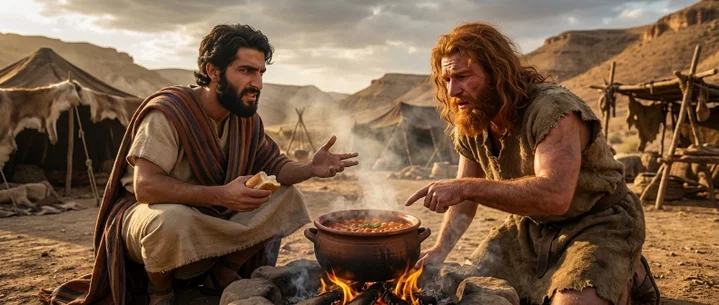
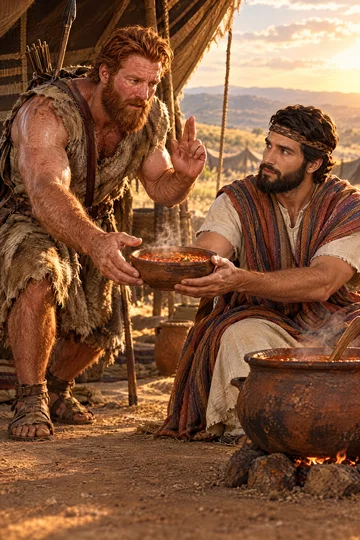
Then Jacob gave Esau bread and pottage of lentiles; and he did eat and drink, and rose up, and went his way: thus Esau despised his birthright.
Translations
Then Jacob gave Esau bread and pottage of lentils; and he did eat and drink, and rose up, and went his way: thus Esau despised his birthright.
King James Version, KJV Cambridge Paragraph Bible
Then Jacob gave Esau bread and pottage of lentiles; and he did eat and drink, and rose up, and went his way: thus Esau despised his birthright.
Then Jacob gave Esau bread and pottage of lentiles; and he ate and drank, and rose and went his way: thus Esau despised his birth-right.
Revised Version, American Standard Version
And Jacob gave Esau bread and pottage of lentils; and he did eat and drink, and rose up, and went his way: so Esau despised his birthright.
and Jacob hath given to Esau bread and pottage of lentiles, and he eateth, and drinketh, and riseth, and goeth; and Esau despiseth the birthright.
And Jacob gave Esau bread and the dish of lentils; and he ate and drank, and rose up and went away. Thus Esau despised the birthright.
And Jacob, having given to Esau bread and a dish of lentils, he did eat and drink and rose up, and went his way,—thus Esau despised his birthright!
Berean Standard Bible, Majority Standard Bible
Then Jacob gave some bread and lentil stew to Esau, who ate and drank and then got up and went away. Thus Esau despised his birthright.
Jacob gave Esau bread and lentil stew. He ate and drank, rose up, and went his way. So Esau despised his birthright.
Then Jacob gave him bread and soup; and he took food and drink and went away, caring little for his birthright.
Then Iaakob gaue Esau bread and pottage of lentiles: and he did eate and drinke, and rose vp, and went his way: So Esau contemned his birthright.
Douay-Rheims (Challoner revision)
And so taking bread and the pottage of lentils, he ate, and drank, and went his way; making little account of having sold his first birthright.
Pictures
Cross-references 20 of 28
- Hebrews 12:16-17
Lest there be any fornicator, or profane person, as Esau, who for one morsel of meat sold his birthright.
Esau sold his birthright for a meal and later could not recover the blessing.
- Genesis 27:27-29
And he came near, and kissed him: and he smelled the smell of his raiment, and blessed him, and said, See, the smell of my son is as the smell of a field which the LORD hath blessed:
Isaac’s blessing conveys the inheritance and dominion associated with the birthright.
- Hebrews 12:17
For ye know how that afterward, when he would have inherited the blessing, he was rejected: for he found no place of repentance, though he sought it carefully with tears.
Esau later sought the blessing he had forfeited but was rejected.
- Genesis 25:23
And the LORD said unto her, Two nations are in thy womb, and two manner of people shall be separated from thy bowels; and the one people shall be stronger than the other people; and the elder shall serve the younger.
God foretold that the elder would serve the younger, framing Esau’s sale of his birthright.
- Genesis 27:34-38
And when Esau heard the words of his father, he cried with a great and exceeding bitter cry, and said unto his father, Bless me, even me also, O my father.
Esau bitterly pleads for a blessing after discovering Jacob has received it.
- Romans 9:13
As it is written, Jacob have I loved, but Esau have I hated.
God’s verdict contrasts his love for Jacob with his rejection of Esau.
- Hebrews 12:14-15
Follow peace with all men, and holiness, without which no man shall see the Lord:
Esau’s example warns against bitterness and falling short of grace.
- Genesis 27:41-45
And Esau hated Jacob because of the blessing wherewith his father blessed him: and Esau said in his heart, The days of mourning for my father are at hand; then will I slay my brother Jacob.
Esau’s anger over the stolen blessing leads to a death threat and Jacob’s flight.
- Genesis 27:1-4
And it came to pass, that when Isaac was old, and his eyes were dim, so that he could not see, he called Esau his eldest son, and said unto him, My son: and he said unto him, Behold, here am I.
Isaac intends to bless Esau, unaware that he has sold his birthright.
- Malachi 1:2-3
I have loved you, saith the LORD. Yet ye say, Wherein hast thou loved us? Was not Esau Jacob’s brother? saith the LORD: yet I loved Jacob,
Jacob and Esau represent their peoples and contrasting characters.
- Genesis 25:28
And Isaac loved Esau, because he did eat of his venison: but Rebekah loved Jacob.
Isaac favored Esau, while Rebekah favored Jacob.
- Genesis 28:10-17
And Jacob went out from Beer-sheba, and went toward Haran.
God reveals his mercy and promises to Jacob as he flees.
- Genesis 27:11-13
And Jacob said to Rebekah his mother, Behold, Esau my brother is a hairy man, and I am a smooth man:
Jacob objects to deceiving Isaac, but Rebekah persuades him to proceed.
- Joshua 24:4
And I gave unto Isaac Jacob and Esau: and I gave unto Esau mount Seir, to possess it; but Jacob and his children went down into Egypt.
Esau’s birthright and inheritance are contrasted with the inheritance God gave him.
- Genesis 36:8
Thus dwelt Esau in mount Seir: Esau is Edom.
Esau settled in Mount Seir, the earthly possession associated with him.
- Matthew 1:1-16
The book of the generation of Jesus Christ, the son of David, the son of Abraham.
Jesus’ genealogy traces his descent through Jacob, not Esau.
- Genesis 32:6
And the messengers returned to Jacob, saying, We came to thy brother Esau, and also he cometh to meet thee, and four hundred men with him.
Esau approaches Jacob with four hundred men.
- Genesis 35:29
And Isaac gave up the ghost, and died, and was gathered unto his people, being old and full of days: and his sons Esau and Jacob buried him.
brothers meet united at father's death
- Genesis 36:6-7
And Esau took his wives, and his sons, and his daughters, and all the persons of his house, and his cattle, and all his beasts, and all his substance, which he had got in the land of Canaan; and went into the country from the face of his brother Jacob.
brothers part because of great possessions
- Genesis 33:3-4
And he passed over before them, and bowed himself to the ground seven times, until he came near to his brother.
Jacob and Esau meet and embrace after their estrangement.
Commentary
Each commentary is drawn from primary sources: the writings of Ellen G. White and Adventist pioneers and periodicals. Each commentary is separate. Its own words are not a quotation; follow the references to read the source passages.
Ellen G. White
46 sources
Esau came faint from the field and asked for the lentil food Jacob was preparing, and Jacob demanded the birthright as its price, so Esau sold it for a meal and confirmed the bargain with an oath, then ate and went his way as if it were of little value, though it carried family honor and authority, consecration to God and the priest's office, and a double portion of goods.PP 179.1–2ST Apr 17, 1879SG3 113.2 Thus he despised his birthright by counting a lasting and precious privilege as worthless beside momentary satisfaction.Lt 111, 1899, par. 6SG3 113.21SP 106.1 Long indulgence of appetite had weakened his power to value sacred and eternal things until desire overwhelmed every other consideration.2T 37.3–38.2CH 110.2CTBH 43.1–44.2 He flattered himself he could recover it later, but when he sought the blessing again earnestly and with tears it was beyond recovery and forever removed, which warns all who trade eternal inheritance for present gratification that regret may come too late.2T 37.3–38.2CH 110.21SP 108.1–2ST Apr 24, 1879SG3 116.1–117.1 Jacob also was at fault in seizing the promise that the elder should serve the younger instead of waiting in faith for God to fulfill it in good time, and by fraud brought guilt and exile upon himself, yet God did not utterly forsake him but led him through affliction to repentance and mercy.ST Apr 17, 1879ST Jul 31, 1884ST Nov 17, 1909
Narrative Setting and Transaction
Esau came in faint and weary from the field from the chase and asked for the food Jacob was preparing, and Jacob seized the hunger to demand the birthright as the price for satisfying him.PP 179.1–2ST Apr 17, 1879SG3 113.21SP 106.1 He sold it to Jacob for red lentil pottage, renouncing all claim to the birthright, and confirmed the transaction by an oath.PP 179.1–2ST Apr 17, 1879SG3 113.21SP 106.11SP 106.2 Then he ate and drank the meal Jacob gave him, and rose up and went his way, treating its special privileges as of little value.1SP 106.11SP 106.2ST Feb 24, 1887 The need was not desperate, for a short time at most would have secured him food in his father's tents.PP 179.1–2
The birthright at stake carried peculiar advantages and special privileges: honor and authority in the family and tribe next to the parents, special consecration to God and selection to fill the priest's office, and a double portion of the father's goods.ST Apr 17, 1879 Having sold it, he did not tell Isaac when Isaac planned to bless him as the firstborn.1SP 106.2SG3 114.1
Afterward Esau resented Jacob for taking his father's blessing and looked to Isaac's death as the time for revenge, but his feelings greatly changed.ST Dec 4, 1879 After Jacob became wealthy he returned to Esau the blessing of possession that had been sold for a bowl of stew.ST Dec 4, 1879 So the two brothers met at their father's death-bed united in grief with enmity, jealousy, and hatred gone, then parted because their possessions were too great to dwell together and because their religious faith was so unlike that it was better to live apart.ST Dec 4, 1879
Meaning of Despising Birthright
To despise the birthright was to reckon a lasting and precious privilege as worthless and of little value, trading the special privileges of the firstborn for a meal and immediate satisfaction of hunger.Lt 111, 1899, par. 6SG3 113.21SP 106.1ST Feb 24, 1887Lt 98a, 1897, par. 1–6 The contempt was shown in eating and drinking what was given for lentil stew and then rising up and going away, confirming the sale even by an oath.Lt 111, 1899, par. 6SG3 113.21SP 106.11SP 106.2ST Feb 24, 1887
It was care only for the present, carelessly bartering the glorious heritage God Himself had promised to the fathers in order to satisfy the desire of the moment.PP 179.1–2PP 181.3–182.1 It was sacrificing the heavenly for the earthly and exchanging a future good for momentary indulgence.PP 179.1–2PP 181.3–182.1 There was relief in disposing of it, with the way now unobstructed to do as he liked, choosing wild pleasure miscalled freedom over an inheritance pure and undefiled, eternal in the heavens, a sale many still repeat.PP 179.1–2PP 181.3–182.1
Long indulgence of appetite had weakened power to value sacred and eternal things, until dwelling on desire overwhelmed every other consideration and the birthright lost its value and sacredness.2T 37.3–38.2CH 110.2CTBH 43.1–44.2 What was regarded as scarcely worth a thought was the crisis of life, revealing the prevailing traits of character, the choices made, and the true estimate of what was sacred and should have been sacredly cherished.Lt 5, 1877, par. 16PP 208.2 Counting a morsel of meat as more than the service of the Master, valuing immediate temporal good above spiritual good and choosing what was wanted, determined the aftercourse of life and by deliberate choice separated from the people of God.Lt 5, 1877, par. 16PP 208.2
The exchange is trading eternal things and the heavenly birthright for cheap, unsatisfying worldly pleasure that is made to appear more desirable.ST Jun 20, 1900PP 181.3–182.1 Satan lays ingenious plans to lead into this indulgence, throwing a glamor over worldly pleasures so they take the place of eternal things.ST Jun 20, 1900 Thereby the broad road is made attractive and the narrow road grievous, humiliating, and objectionable.ST Jun 20, 1900
Irreversible Loss and Warning
Esau flattered himself that he could dispose of the birthright for the moment and buy it back later, but when the hunger was gone he found he could not recover what he had sold.2T 37.3–38.2CH 110.2CTBH 43.1–44.2 When he saw his folly he sought to regain the blessing earnestly and with tears, even at great cost, yet it was beyond recovery and removed from him forever.2T 37.3–38.2CH 110.2CTBH 43.1–44.2Lt 98a, 1897, par. 1–6Lt 47, 1894, par. 41–42 He bitterly regretted his rashness, folly and madness in trading a lasting privilege for a meal.CH 110.2CTBH 43.1–44.2Lt 98a, 1897, par. 1–6
His later mourning was grief over the unexpected consequences of his sin, not true repentance.2SP 205.2–206.1ST Apr 19, 1877 Sorrow that comes only from being caught or from suffering the painful results of wrongdoing does not change the heart.2SP 205.2–206.1ST Apr 19, 1877 Such grief may leave a person ready to repeat the sin.2SP 205.2–206.1
Esau stands for those who sacrifice an enduring spiritual inheritance for present worldly gain or gratification.2T 37.3–38.21SP 108.1–2ST Apr 24, 1879 They value Christ's redemption and heaven lightly, sacrificing promised heavenly blessings and heirship for perishable possessions, unhealthy appetites and selfish pleasures.1SP 108.1–2ST Apr 24, 1879SG3 116.1–117.1ST Jun 20, 1900 Such a deliberate choice is not ignorance, and many still repeat the sale.PP 179.1–22T 37.3–38.2ST Jun 20, 1900
When the clamor of appetite contends against the high and heavenly blessings God promises only to the self-denying and God-fearing, appetite generally prevails.ST Apr 24, 1879SG3 116.1–117.1PP 181.3–182.1 For self-gratification God and heaven are then virtually despised.ST Apr 24, 1879PP 181.3–182.1 Self-denial is necessary to receive the promised blessings, and no selfish act is small, for anyone who does a selfish act and sacrifices integrity for selfish advantage is in danger of selling the birthright the same way, selling peace and soul to gratify carnal desire and walking unguarded into snares.ST Apr 24, 1879SG3 116.1–117.1Lt 47, 1894, par. 41–42
Those who barter away their heavenly inheritance may regret it too late.1SP 108.1–2SG3 116.1–117.1PP 181.3–182.1 In the day of God sinners who bartered heaven for selfish gratifications and hurtful lusts will recognize their loss.ST Apr 24, 1879SG3 116.1–117.1PP 181.3–182.1 They will find no place for repentance though they seek it carefully and with tears.1SP 108.1–2ST Apr 24, 1879SG3 116.1–117.1Lt 47, 1894, par. 41–42
Jacob's Fault and Mercy
Jacob had learned, through his mother, that God had declared the elder should serve the younger, and with youthful reasoning he concluded that promise could not be fulfilled while Esau retained the firstborn's privileges.ST Apr 17, 1879 The promise would have been fulfilled in good time if he had been willing to wait in faith, but instead he lacked faith and would not leave the matter submissively in the Lord's hands.ST Jul 31, 1884 Like many who now profess to be God's children, he thought he must act himself and tried to secure by his own doing what God had promised.ST Jul 31, 1884 So when Esau came in faint from the field, he used that hunger to gain the birthright, proposing to feed him the pottage if he would renounce all claim to it.ST Apr 17, 1879
By that course he obtained by fraud the blessing designed for his brother Esau.ST Jul 31, 1884 Resorting to fraud was sin bringing guilt before God.PP 201.3–202.2 His actions brought his brother's hatred and later suffering, showing how wrongdoing bears consequences.ST Nov 17, 1909
That guilt gave Satan ground to accuse him before the angels, to claim the right to destroy him, to move Esau against him, and to force a sense of guilt upon him to discourage him and break his hold on God during the night of wrestling.PP 201.3–202.2 He had learned that God is merciful, had sincerely repented of that sin, pointed back to that repentance, cast himself on mercy, and pleaded for deliverance.PP 201.3–202.2 Because of that prior repentance God could hear his prayer and mercifully preserve his life, and without it God could not have heard him.PP 201.3–202.2
As a result he became a fugitive from his father's house, fleeing for his life from Esau's rage, cast down and fearing he had lost God's blessing forever.ST Jul 31, 1884 Yet God did not utterly forsake His erring, distrustful servant but still extended mercy to him.ST Jul 31, 1884 He permitted affliction until Jacob learned patient submission, and revealed to him a Saviour and a way to be restored to favor.ST Jul 31, 1884 Thus wrongdoing bears consequences, while repentance can lead to forgiveness and a transformed character.ST Nov 17, 1909
Present-Day Applications
Knowledge of Bible truth is itself a birthright that must not be traded away for immediate concerns, as Esau treated his own birthright as of little value for a meal.Lt 111, 1899, par. 6 Yielding to appetite rather than resisting it surrenders lasting spiritual value and turns from God, bringing unhappiness, degradation, and backsliding.4T 31.2–32.1 This includes indulgence of unhealthy appetite and corrupt passions such as tea, coffee, snuff, tobacco, and spirits, which benumb the finer sensibilities of the soul, sacrifice health, enfeeble mental faculties, and sell Heaven.ST Apr 24, 1879 When appetite's clamor contends against the high and heavenly blessings God promises only to the self-denying and God-fearing, appetite generally prevails, and for self-gratification God and Heaven are virtually despised.ST Apr 24, 1879 Intemperate habits and indulgence in unlawful passions likewise sell the birthright for a mess of pottage and must be reformed without delay.Ms 34, 1902, par. 9–12
Young people sell the birthright for a mess of pottage when they become absorbed in education and neglect prayer, religious duties, and care for the soul.CE 246.1–2 Knowledge is valuable when used to serve God and bless others, but it cannot compensate for abandoning spiritual responsibilities.CE 246.1–2 They gain education at the expense of filial duties and to the neglect of the soul's interest, following inclination rather than duty at home, and thereby barter away Heaven cheaply.Ms 2, 1871, par. 13–15 Selling the birthright for immediate worldly advantage includes holding fast to earthly treasures and loving the world.5T 274.3 Clinging to money, withholding from God His proportion in tithes and offerings, and refusing to support His work despises the birthright as Esau did and brings the curse of the Lord.5T 274.3
The faithful course is to loosen hold on earthly treasure, lay up treasure in Heaven, render to God His own, and labor to prepare a people to stand when the Son of man shall be revealed.5T 274.3 Failing to cultivate strict integrity likewise trades what is valuable for immediate gain.Lt 110, 1897, par. 36 Covetousness and temporary gain may lead a person to sell a spiritual birthright for money, allowing what is precious to be outweighed.Lt 15, 1898, par. 17–19 Selling the soul and giving up correct principles for material advantage forgets that the soul and the eternal reward are worth more than money or possessions.Ms 5, 1897, par. 16–20 Spiritual and eternal concerns must be guarded against being traded for business, influence, or other immediate advantages.Lt 59, 1903, par. 7–11
Foolishly trading lasting spiritual good for immediate desires includes spending money to satisfy love of display on what does not nourish the soul while neglecting inward Christian graces.6MR 160.3Ms 56, 1900, par. 16–17 Such attachment can keep people from entering the strait and narrow way because they will not give it up to believe in Christ and follow Him.6MR 160.3Ms 56, 1900, par. 16–17 Selling the birthright for a mess of pottage also means giving up what God gives for the friendship of His enemies through doubt, complaint, and unbelief coming from Satan's fountain.Lt 1, 1880, par. 14 That spirit of doubt is contagious and polluting, and the atmosphere surrounding such a course is like a poisonous miasma that contaminates other minds.Lt 1, 1880, par. 14
A man who yields to impulse and unconsecrated passion and chooses an unbeliever for his wife on condition of giving up God's Sabbath and claims sells his birthright for pottage.Lt 17, 1896, par. 8–9 It is choosing the wife over God in a very cheap market, bringing the reproach of disloyalty, imperilling the soul, and bringing unhappiness into the family.Lt 17, 1896, par. 8–9 Sacrificing spirituality and eternal life for position and praise of men and worldly honor, when motives are not single to God's glory and Satan's fascinating bribe of honor overcomes, is the same sale.Lt 25, 1873, par. 4–5 Striving for higher position rather than seeking purity and consecration repeats this disregard for what matters most.Lt 117, 1897, par. 8–10 Escape requires humbling the heart, seeing the danger, and making strong determined effort, for eternal life is worth everything and can be had by willingness to make every sacrifice, but without that sacrifice it must be lost.Lt 25, 1873, par. 4–5
Trading the birthright pictures selling everlasting life and sacrificing Heaven for present gratification by holding to worldliness, thoughtless and angry words, and uncontrolled temper.Lt 7, 1864, par. 10–12 It means trampling on reforming light that calls to overcome, instead of being refined, pardoned through Christ's blood, and fitted for the society of angels.Lt 7, 1864, par. 10–12 Being controlled by desires with appetite ruling sells peace and soul for carnal gratification and walks unguarded into Satan's snares.Lt 47, 1894, par. 41–42 The inheritance God gives is wasted and sacred interests entrusted for humanity's blessing are betrayed through appetite, greed, and even dishonest practices.Ms 14a, 1897, par. 13–14Lt 83, 1897, par. 17–20 Choosing self-gratification over loyalty to God and His law loses the soul and also leads others away from Christ toward destruction.Lt 63, 1896, par. 1610MR 190.1–194.1 This warns especially those who know present truth to inspect motives, follow peace and holiness, and depart from iniquity.Lt 47, 1894, par. 41–42
Sources
Pioneers and periodicals
127 sources
After swearing to sell, Esau received bread and lentil stew from Jacob, ate and drank, then rose and left, and in doing so treated his birthright as worthless.ST Mar 25, 1880ST Mar 30, 1888ST Feb 19, 1894 That birthright carried the father's chief blessing with headship of the family and a double share of the estate, and with it consecration to the Lord, the promises to Abraham and Isaac, the household priesthood, and the honor of continuing the line through whom blessing would come to all nations.ST Mar 25, 1880RH Jul 22, 1873RH Sep 21, 1911RH Nov 18, 1862RH Apr 14, 1859 To despise it was to value a lasting inheritance at no more than a single meal, choosing immediate relief grasped at once over future good grasped only by faith, as a slave of appetite without self-control and without the faith of Abraham.RH Jun 10, 1902ST Feb 19, 1894ST Mar 31, 1881 Jacob valued what the birthright meant and believed God's promise to Abraham, yet while still unconverted he schemed to secure it by taking advantage of his brother's hunger, though God had intended it for him and would have fulfilled it in good time if waited for in faith.ST Jul 31, 1884ST Nov 18, 1897ST Oct 4, 1905ST Feb 19, 1894ST Oct 1, 1902 The birthright therefore stands for the heavenly inheritance of eternal life, and the stew for the whole world and whatever present advantage is gained at its cost, as shown in the warning of Hebrews 12 against the profane person who sold his birthright for one morsel.ST Apr 24, 1879RH Feb 25, 1862ST Mar 30, 1888RH May 15, 1866RH Jul 24, 1855
Words and Meal Setting
The transaction was finished after the oath to sell, when bread and lentil stew were handed over, eaten and drunk, followed by rising, going away, and treating the birthright as worthless.ST Mar 25, 1880ST Mar 30, 1888ST Feb 19, 1894ST Sep 22, 1898 The exchange traded the father's chief blessing with special consecration, a double share twice as large as the brother's, and succession to official dignities and privileges for a single meal that preserved life at the point of starvation.ST Mar 25, 1880RH Jul 22, 1873 It was folly and a poor bargain, the pattern for present bargains in which standing, home, and hope of inheritance with the redeemed are given up to indulge perverted appetite.ST Mar 25, 1880RH Jul 22, 1873 The drunkard and the dyspeptic make the same trade and get even less, since at least life was saved in the first sale.ST Mar 25, 1880RH Jul 22, 1873
The pottage was a boiled soup of lentils, a pulse of the pea family of yellowish-red color.ST Feb 19, 1894 The lentils were red or Egyptian, distinct in appearance and flavor from brown or German lentils.RH Jun 12, 1900ST Feb 19, 1894 They were probably the same as the red dahl widely eaten in India, identifying a simple staple food.ST Mar 14, 1906
Esau came in faint and weary from the field and the chase, with enterprise dead and hope gone.ST Mar 31, 1881ST Oct 4, 1905 As a slave of appetite he counted character, friends, and prospects as nothing, claimed to be at the point of death from hunger, and demanded immediate food.ST Mar 31, 1881RH May 29, 1900 He covenanted to give all truly valuable on earth for one gratification, determined to have the dinner though it cost perdition, judging fat valleys, Zion, and Lebanon worthless beside pottage and renouncing providence in this life and paradise hereafter for an hour's gratification bringing bitterness of death.ST Mar 31, 1881 The advantage taken of his faint hunger for the birthright, together with the deceitful taking of the father's blessing, stirred hot wrath and a vow of vengeance against the more pious brother and forced hasty flight from home.ST Oct 4, 1905 His readiness to trade any right for food when the chase proved unprofitable and need pressed upon him is the example of yielding to temptation under immediate need.RH May 29, 1900
The verse stands within the account of providential dealings with Abraham's family as chosen progenitor of the Seed.STST Jan 6, 1909 Its chapter forecasts the characters of Esau and Jacob and contrasts Esau's later troubled course with providential care for Isaac.ST Jan 9, 1912ST Jan 9, 1912 It shows the defects of Isaac and his two sons on the way to Jacob's victory when he became Israel, prevailer with God.ST Jan 6, 1909 The lentil stew eaten in exchange for the birthright is not the Lord's supper.RH Nov 16, 1911
What the Birthright Held
In temporal terms the birthright meant the father's chief blessing and a double share in the father's estate twice as large as the brother's, with right to succeed to the father's official dignities and privileges.ST Apr 17, 1879ST Mar 25, 1880RH Jul 22, 1873 It carried honor and authority in the family and tribe next to the parents, with headship of the family including the privileges of prophet, priest, and king.ST Apr 17, 1879ST Feb 19, 1894ST Mar 30, 1888 It included patriarchal headship and precedence, the father's dignity and position, and patriarchal rulership.RH Apr 14, 1859ST Mar 30, 1888 The pottage for which it was traded was a boiled dish of lentils, a pulse of the pea family of yellowish-red color, like soup.ST Feb 19, 1894
In spiritual terms it meant special consecration to the Lord, since the firstborn was especially devoted to God, with selection to fill the priest's office.ST Apr 17, 1879ST Mar 25, 1880ST Mar 30, 1888 It meant succession to the spiritual blessings and the promises made to Abraham and Isaac, afterward to Jacob, and by the sale all claim to those promises was sold.ST Mar 31, 1881ST Mar 30, 1888 It included the family priesthood and the covenant of Heaven's favor, understood as God's covenant with Abraham and Isaac of the possession of Canaan to them and their posterity, with Canaan as the earnest and representation of the heavenly inheritance.RH Apr 14, 1859ST Mar 31, 1881 It carried the honor of leading the chosen family through whom all nations would be blessed, becoming an ancestor of Christ, as shown by the Messiah descending from Jacob and not Esau according to his genealogy.RH Sep 21, 1911RH Nov 18, 1862RH Apr 14, 1859ST Feb 19, 1894
The birthright and the father's blessing were distinct, and Esau hoped to obtain the blessing by pleasing his father with food even after foolishly selling and never properly valuing the birthright.ST Jacob gained the birthright except for the double portion of the estate, the Abrahamic birthright otherwise including the double portion, the family priesthood, and the honor of becoming an ancestor of Christ.RH Sep 21, 1911 After Jacob became wealthy he returned to Esau the blessing of possession that had been sold for a bowl of stew, so the two brothers met at their father's death-bed united in grief with enmity, jealousy, and hatred gone.ST Dec 4, 1879 They then parted because their possessions were too great to dwell together, and because their religious faith was so unlike that it was better to live apart.ST Dec 4, 1879
Esau preferred what he could possess at once and received Mount Seir as an earthly possession, while Jacob's portion was an inheritance in the promises, not yet fulfilled in his lifetime.ST Aug 21, 1884 The verse thus illustrates that God's promises may be better than present possessions, and that people may receive what they choose.ST Aug 21, 1884 In divergent readings the birthright means the abundant natural capital God gave to everyone for independent livelihood, first patterning men parting with it to covetous and shrewd men and becoming half-equipped servants of doubly-equipped owners, first as hired servants selling labor for wages and then degenerating into bond-servants.ST It likewise means patrimony received through God's providence surrendered for what appears a present advantage, leaving dependence on others for a living, and the spirit of power and of love given to every person, whose sale for a mess of pottage desecrates the divine gift and sins against God the Giver.RH Nov 16, 1911ST
Esau Despising the Birthright
To despise the birthright was to treat a priceless lasting inheritance as worthless, exchanging it and its spiritual blessings for immediate relief from hunger and choosing what could be enjoyed at once over future good that could be grasped only by faith.RH Jun 10, 1902ST Feb 19, 1894RH Feb 25, 1862ST Mar 30, 1888ST Oct 21, 1886 He valued it at no more than one meal of bread and lentil stew to satisfy present need, eating and drinking and then going his way without regard for what he had surrendered.RH Jun 10, 1902ST Feb 19, 1894ST Mar 30, 1888 His casual response showed he counted it of little value, recklessly bartering it when faint and casting it off forever.ST Feb 19, 1894RH Feb 25, 1862 The question pressed by this is how highly one prizes a heavenly birthright, for to cherish disparaging views of the inheritance God has promised — the restoration of this earth and its possession by the redeemed through Christ — hinders growth in grace and fitness for the kingdom and brings peril of being denied its possession and left among the lost.RH Feb 25, 1862ST Oct 21, 1886 His choice warns against treating spiritual privilege as less valuable than immediate physical need, and against giving up the Sabbath to protect business and thereby exchanging eternal joy for temporary earthly security.ST Feb 19, 1894ST Oct 21, 1886
His guilt was not merely selling when hungry and near death, for after recovering strength he could have recognized and repudiated the bargain but showed no godly sorrow.RH Jun 10, 1902RH Jun 10, 1902 His continued carelessness and indifference revealed contempt even when not under immediate pressure, expecting to regain the birthright through his father or by violence against Jacob.RH Jun 10, 1902 He sought both the meal and the birthright, not expecting the bargain to cost him the blessing, and planned to receive the blessing as though he had not sold it.RH Apr 14, 1859RH Apr 14, 1859 The birthright and the father's blessing were distinct, and he hoped to obtain the blessing by pleasing his father with food.ST He understood the covenant of Heaven's favor — possession of Canaan to Abraham and Isaac and their posterity and the heavenly inheritance of which Canaan was the earnest — yet despised it in unbelief, judging the fat valleys, Zion, and Lebanon worthless beside pottage.ST Mar 31, 1881 He had more than forty years in which to repent but let the opportunity pass, and only after losing the blessing did he recognize its value in anguish and self-reproach for loss he had brought on himself.RH Apr 14, 1859RH Apr 14, 1859RH Jun 10, 1902
He acted as slave of appetite, counting nothing of character, friends, or prospects, feigning himself ready to die of hunger and covenanting to give all truly valuable on earth for one gratification of gluttony, determined to have that dinner though it cost perdition forever.ST Mar 31, 1881 He was reckless, passionate without self-control, sport-loving and appetite-loving, a hunter with his eye on the game who seldom looks upward to God, satisfied with things of time and sense.ST Apr 24, 1879ST Mar 31, 1881ST Oct 4, 1905RH Aug 27, 1901 His ambition pictures worldliness still living today, making a good bag in business, money, and pleasure and seeking nothing higher, having heard of a glorious heritage and spiritual birthright but absorbed in something more to taste. Hundreds and even thousands still sell in the same way, generous and good fellows in general yet pursuing riches, honors, pleasures, and applauses of the world to entire forgetfulness of what is to come, sacrificing the future for the present, putting money, luxury, pleasure, and financial success first to be secured by all means and then trying in odd moments and by side efforts to secure what is to come. By this sale he sold all claim to the promises made to Abraham and Isaac, and afterwards to Jacob, proving he had no trace of the faith of Abraham and despised the promises of God.ST Mar 30, 1888
The birthright he sold included the family priesthood, the father's dignity and position, patriarchal headship and precedence, a double share of the estate, succession to whatever position his father held, special consecration of the firstborn to God, and hopes connected with Abraham's promised descendant through whom all families of the earth would be blessed.RH Apr 14, 1859ST Mar 30, 1888RH Jun 10, 1902 It included influence in the family and succession to the spiritual blessings promised through Abraham for all nations.RH Jun 10, 1902 In contrast Jacob believed God, remembered the promise to Abraham and the predictions about the seed of Abraham and of Isaac, and regarded God's promise and blessing above all else, though his method in getting the birthright was not approved.ST Oct 4, 1905 Esau's choice is repeated today by thousands who barter away all the promises of God for lust, for pleasure, for power, for wealth, and for fame.ST Oct 4, 1905 When appetite's clamor contends against the high and heavenly blessings God promises only to the self-denying and God-fearing, appetite generally prevails, and for self-gratification God and Heaven are virtually despised.ST Apr 24, 1879
This applies to indulgence of unhealthy appetite and corrupt passions, including tea, coffee, snuff, tobacco, and spirits that benumb the finer sensibilities of the soul, for which health is sacrificed, the mental faculties are enfeebled, and Heaven is sold.ST Apr 24, 1879 He bound the sale with a solemn oath, and the case stands on record as a warning.ST Apr 24, 1879 The same is done today by those who sell for gratification of appetite or some other passionate lust, determined to have the things that please the fancy irrespective of what the Lord says, losing all reason so as to see only the desire of a passionate heart and counting the birthright as no profit in faintness.RH Aug 27, 1901 Such determination seals doom, for it is falling from the grace of God through a root of bitterness springing up to trouble and defile, a sin against the Holy Ghost ending in entire separation from God.RH Aug 27, 1901 He acted as a profane person who for one morsel deliberately sold his birthright in a trade that could not be altered.ST Mar 30, 1888
It was a small transaction mighty in consequence that could not afterward be repurchased even with savory venison, for when he would inherit the blessing he was rejected and found no place to change the transaction though he sought it carefully with tears.ST Apr 24, 1879ST Mar 30, 1888RH May 15, 1866 Though he sought to undo the fatal act with tears, he could not change its settled consequence, and the fatal pottage represents a decision made in an hour of passion whose lost inheritance later tears cannot recover.RH May 15, 1866RH May 15, 1866 After rashly selling it he was greatly distressed when Jacob obtained the blessing that would have been his, repenting when too late to remedy it.ST Apr 24, 1879 Neglecting one's case in the court of heaven, from which there is no appeal and whose decision grants the felicities of endless life or casts into outer darkness forever separated from God and his people, simply to amuse oneself with the toys of earth while flattering oneself with hope of everlasting life, leaves thousands of careless souls engulfed in ruin with no more chance of repentance than he had, for though they weep then it will be too late.RH Nov 19, 1857 After long treacherous silence and sanction of the sin of slavery, even a late awakening is too late to avert judgment.RH Nov 24, 1859
His sorrow was grief over the unexpected painful result, not true repentance of heart, showing regret for losing personal advantage and that tears do not necessarily remove consequences.ST Apr 19, 1877RH Jun 10, 1902ST Mar 31, 1881 His later regret was for losing the blessing as a personal advantage, not godly sorrow for despising his birthright.RH Jun 10, 1902 His tears could not undo the transaction or restore what he had surrendered, and choosing present pleasure over future good can lead to lasting loss.ST Mar 31, 1881 Grief over painful consequences does not itself change the heart or lead to repentance.ST Apr 19, 1877 The lesson is not to flatter oneself that God does not require giving up comforts and making great sacrifice, but to flee sin and trust in the Saviour's grace and to make a covenant with him by sacrifice, following peace with all men and holiness without which no man shall see the Lord, looking diligently lest any fail of grace and any root of bitterness spring up to defile.ST Mar 30, 1888RH Nov 19, 1857RH May 15, 1866
Jacob Obtaining the Birthright
Jacob believed God, remembering the promise to Abraham and the predictions concerning the seed of Abraham and of Isaac, and he set God's promise and blessing above all else.ST Nov 18, 1897ST Oct 4, 1905ST Feb 19, 1894 He longed for God and desired better and spiritual things, including the spiritual blessings and the prospect of a home in God's kingdom, while Esau was satisfied with things of time and sense.ST May 17, 1910RH Dec 30, 1915ST Jan 30, 1907 The birthright he valued carried the headship of the family with the offices of prophet, priest and king, honor and authority next to the parents, special consecration to God, a double portion of goods, rulership in the family, and leadership of the chosen family through whom all nations would be blessed, through whom Christ would come.ST Apr 17, 1879ST Feb 19, 1894ST May 17, 1910 For that reason obedience to God and denial of sinful worldly pleasure were worth choosing, in contrast to selling an enduring spiritual inheritance for a temporary meal that perishes with its use.ST Nov 18, 1897ST Oct 4, 1905RH Dec 30, 1915 Though still unconverted and lacking a renewed heart, Jacob already prized what the birthright meant; after conversion his name was changed to Israel, and God knew his desire for the blessing, honored it, and regarded his repentance even though his method was not approved.ST Oct 4, 1905ST Feb 19, 1894ST May 17, 1910
He had learned from his mother that God had said the elder should serve the younger, yet instead of leaving fulfillment to God he tried to secure it by human craft.ST Apr 17, 1879ST Feb 19, 1894ST Nov 21, 1906 Thinking the opportunity was passing, impatient to make sure by his own scheming the standing God had ordained for him, he took advantage of Esau's hunger and reckless character when Esau came faint from the field, proposing food in exchange for renunciation of all claim to the birthright.ST Apr 17, 1879ST Feb 19, 1894ST Nov 21, 1906 That buying of the birthright for pottage was coveting and overreaching, fitting the name Jacob as supplanter, and was trickery, fraud, duplicity, deception, deceit and intrigue.ST Feb 28, 1906ST Apr 1, 1897ST Nov 21, 1906 His mother encouraged him, pressing upon him the promise and keeping the importance of the Seed before him in a material way without full appreciation of the spiritual blessings.ST Jan 14, 1913ST Nov 21, 1906ST Oct 6, 1914 Real success never comes by such means; scheming to hasten what would have come legitimately brings only trouble and delay until deep penitence, sorrow for sin, repentance, surrender to God, and determination to put away all guile bring change of character, victory and blessing.ST Nov 21, 1906ST Oct 6, 1914
God had promised the birthright to Jacob, and the promise would have been fulfilled in good time if he had waited in faith and left the matter submissively in the Lord's hands.ST Jul 31, 1884ST Oct 1, 1902 It was intended for him because of superior character, and God intended to give it in His own way rather than by human work to supplement the promise.ST Jul 31, 1884ST Oct 1, 1902ST Feb 26, 1894 When Jacob later came in for Isaac's consecration as heir of the covenant and for the priestly blessing as high priest of the household, God approved and sanctified the consecration because Jacob owned the long-since purchased claim.ST Mar 31, 1881ST Feb 26, 1894 He obtained Isaac's blessing not because of deception but in spite of it, for a fair representation of his proper claims was all that was needed, while God despised and abhorred the intrigues and falsehoods used as means.ST Mar 31, 1881ST Feb 26, 1894
His course brought division into the family, for Isaac's overfond affection for Esau drew Rebekah's stronger sympathy for Jacob and gave Jacob an unsatisfactory early experience that caused much later trouble.ST Jul 31, 1884ST Jan 14, 1913 The taking of the birthright and the deceitful taking of the father's blessing were two wrongs against Esau, and together with Esau's hot, appetite-loving and lust-loving temper they stirred hatred and a vow of vengeance to shed the more pious brother's blood.ST Jul 31, 1884ST Oct 4, 1905ST Oct 1, 1902 Jacob therefore became a fugitive from his father's house, fleeing for his life in eager haste, cast down in exile and fearing he had lost God's blessing forever.ST Jul 31, 1884ST Nov 21, 1906ST Oct 4, 1905 That demonstrated failure brought family trouble, long separation, and enmity between Esau's descendants and Israel for hundreds of years, yet God did not utterly forsake His erring servant but extended mercy, permitting affliction until he learned patient submission, revealing a Saviour and the way of restoration, and in mercy bringing the change by which grace reunited the brothers.ST Jul 31, 1884ST Jan 14, 1913ST Oct 1, 1902
The episode shows the moral law was known and taught before it was proclaimed at Sinai.ST Jun 6, 1906 Jacob is charged with violating the eighth commandment by stealing the birthright.ST Jun 6, 1906 Covetousness for Esau's birthright and blessing led him to take an unrighteous course to obtain them.
Election and Who Is Israel
Genesis 25:34 belongs to the account of Jacob being chosen as the channel through whom the promise and God's truth would continue to the world.ST Apr 10, 1907ST Apr 11, 1906 This was a special, temporal choosing for a particular work, not on account of greatness, wisdom, learning, refinement or culture, but because Jacob longed for God and desired better and spiritual things while Esau was satisfied with things of time and sense.ST Jan 30, 1907ST Apr 11, 1906 Such choosing did not guarantee Jacob's eternal salvation, just as passing over Esau did not consign him to destruction or shut him from seeking God and being saved.ST Apr 10, 1907ST Apr 11, 1906ST Sep 22, 1898ST Sep 22, 1898 Esau voluntarily despised and sold his birthright for food, for a meal, valuing God's gift and blessing so little, while Jacob's character showed that he valued them.ST Apr 11, 1906ST Sep 22, 1898ST Sep 22, 1898 God's grace through Christ is freely offered to all, God's hatred of Esau was hatred of sin, and the responsibility for turning from God rests with each person rather than with an arbitrary shutting out by God.ST Sep 22, 1898ST Sep 22, 1898
Esau represents the carnal and selfish character that treats God's blessings and God's character as worthless, rejects Him, and chooses sin without the faith that prizes His gift.ST Sep 22, 1898ST Feb 27, 1901 Jacob represents the imperfect person who believes God, longs to become like Him, desires better things, and gains victory by God's grace, the spiritual in contrast to the carnal.ST Sep 22, 1898ST Feb 27, 1901 These are contrasting character types found in every age, repeating the call of the Hebrews.ST Jan 30, 1907ST Feb 27, 1901 In that repetition Jacob stands for Israel as God's remnant in the earth, poor and miserable and unpresentable yet longing for God, and Esau stands for the other peoples of the world who have rejected God for temporal things.ST Jan 30, 1907
Fleshly descent from Abraham does not by itself make anyone an Israelite heir to the promises, for some other principle besides lineal descent decides who is Israel.RH Jan 16, 1872 Thus the Edomites descended from Esau, Isaac's other son who lost his birthright, though lineally descended from Abraham and Isaac, are not reckoned as Israel entitled to the promises.RH Jan 16, 1872 The same is true of the Arabs descended from Ishmael and from Keturah.RH Jan 16, 1872 That Jacob, though younger than Esau, is called the firstborn shows that firstborn can mean pre-eminent in status rather than first in birth order.ST Jan 11, 1905
Isaac's later blessing of Jacob was prophetic.ST Sep 22, 1898 In that history Esau is the one who persecuted Jacob, who avowed loyalty to God.RH Jun 8, 1916 Jacob's later deception in obtaining the blessing did not prevent Esau from seeking God's blessing.ST Sep 22, 1898
Links to Other Scripture
The verse shows Esau despising his birthright by valuing it as worth no more than a meal to satisfy present hunger.ST Apr 24, 1879ST Mar 30, 1888RH Aug 27, 1901 He acted as a profane person who for one morsel of meat deliberately sold his birthright in a trade that could not afterward be altered.ST Apr 24, 1879ST Mar 30, 1888RH Aug 27, 1901 Though he had commendable traits, he was passionate without self-control, determined to have what he wanted at any cost, losing all reason until he could see only the desire of a passionate heart and counted the birthright as no profit in his faintness.RH Aug 27, 1901 He even bound the sale with a solemn oath, and afterward when he wanted to inherit the blessing he was rejected and found no place of repentance though he sought it carefully with tears.ST Apr 24, 1879ST Mar 30, 1888 His great distress when Jacob obtained the blessing that would have been his shows that in the day of God sinners who bartered heaven for selfish gratifications and hurtful lusts will seek repentance too late to remedy it.ST Apr 24, 1879
The case stands as a warning to follow peace with all and holiness without which no one shall see the Lord, to look diligently lest any fail of the grace of God, lest any root of bitterness springing up trouble and defile many, and lest any be a fornicator or profane person like Esau.ST Mar 30, 1888 It represents the course of the unrighteous who count the redemption purchased by Christ of little worth and sacrifice their heirship to heaven for perishable treasures.ST Apr 24, 1879 When the clamor of appetite contends against the high and heavenly blessings God promises only to the self-denying and God-fearing, appetite generally prevails, and for self-gratification God and heaven are virtually despised.ST Apr 24, 1879 Such falling from the grace of God through a root of bitterness springing up to trouble and defile is sin against the Holy Ghost ending in entire separation from God.RH Aug 27, 1901 The same is done today by those who sell their birthright for gratification of appetite or some other passionate lust, determined to have the things that please the fancy irrespective of what the Lord says, and that determination seals their doom.RH Aug 27, 1901
This indulgence includes unhealthy appetite and corrupt passions, including tea, coffee, snuff, tobacco, and spirits that benumb the finer sensibilities of the soul, for which health is sacrificed, the mental faculties are enfeebled, and heaven is sold.ST Apr 24, 1879 As Esau sold his heritage for food, so Adam by disobeying God sold himself and his posterity into bondage and sold his birthright heritage.ST Sep 24, 1894ST Oct 13, 1898 Esau after receiving bread and lentil stew ate, left, and thereby treated his birthright as worthless, providing the comparison for Adam's disobedience.ST Oct 13, 1898 The wrong choice of trading a great spiritual blessing for a small present temporal gain, valuing food and goods above salvation, stands with Judas betraying his Lord for thirty pieces of silver and with the people of Gadara turning the great Redeemer out of the land for a few thousand swine.RH Jan 8, 1875 That turning away of Christ for the sake of swine was a bargain even more shameful than Esau's or Judas's, teaching not to turn Christ away from town or home for fear of the cost of receiving Him to bless and save.RH Jan 8, 1875
By contrast, Daniel's later faithfulness stands opposite Esau's surrender of his birthright for a meal.ST Oct 19, 1904 Even in old age and under threat of death, Daniel would not trade his principles of faith and temperance for safety.ST Oct 19, 1904
Warnings for Today
The birthright stands for the heavenly inheritance, mansions and land in the Celestial City, eternal life and the world to come, the restoration of this earth and its possession by the redeemed through Christ, and the eternal home as joint heir with Christ, to be secured on conditions of repentance, faith and a life of faithful obedience to God, while the pottage stands for the whole world and whatever riches or advantage is gained at its cost.RH Jul 24, 1855ST Jul 8, 1930ST Jan 11, 1916 Esau lost the inheritance he was entitled to because he despised his birthright, thinking it of so little value that when faint and hungry he recklessly bartered it for bread and hot lentil stew and cast it off forever.RH Feb 25, 1862RH Jul 24, 1855 To cherish disparaging views of that promised inheritance hinders growth in grace and fitness for the kingdom and brings peril of being denied its possession and left among the lost.RH Feb 25, 1862 The birthright also stands for manhood, honesty, nobility, purity of soul, fellowship with God, heavenly hope, unspeakable joy and immeasurable bliss, and the pottage stands for what is offered to buy them now, wealth and glittering toys and trinkets, luxury and rioting in eating and drinking, a moment's sensual pleasure, an hour of wild exhilaration from drink, and embraces that bring disease, rottenness, remorse, death and perdition.RH May 15, 1866
The same foolish bargain is still made extensively, for the pleasure passes in an hour and fades in a day and turns to loathing, while innocence, purity, peace and honor are gone, leaving a stain tears cannot efface, dark memories regrets cannot obliterate, and a load years cannot lift from the conscience.RH May 15, 1866 Esau is the picture of worldliness that still lives today, the hunter with eye on the game who seldom looks upward to God, whose ambition is to make a good bag in business, money and pleasure and who seeks nothing higher. Hundreds and even thousands are selling their birthright today in the same way, generous and good fellows in general yet pursuing the riches, honors, pleasures and applauses of the world to entire forgetfulness of that which is to come, sacrificing the future for the present, putting money, luxury, pleasure and financial success first to be secured by all means and then trying in odd moments and by side efforts to secure that which is to come. His bargain illustrates how sin deceives people into trading lasting good and great future blessings and spiritual privileges for a small, visible gratification enjoyed at once and an apparent present benefit they cannot ultimately secure.RH Jun 5, 1866RH Jun 10, 1902
Choosing appetite and self-indulgence over God repeats the sale, exchanging eternal things and the heavenly birthright for cheap, unsatisfying worldly pleasure that appears more desirable.ST Jun 20, 1900RH Aug 23, 1864ST Feb 28, 1906 The Christian's whole life is one of self-denial and cross-bearing, renouncing not only outward sins but whatever retards progress in the race, yet professed followers wrapped in robes of self-righteousness hug their idols close and refuse to lay every idol on the altar, and if tried today would sell their birthright for a mess of pottage.RH Jan 12, 1864 Satan lays ingenious plans to lead men and women into indulgence of appetite, throwing a glamor over worldly pleasures so they take the place of eternal things, thereby making the broad road attractive and the narrow road grievous, humiliating and objectionable, and many still do as Esau did.ST Jun 20, 1900 People driven by appetite trade spiritual privileges for bodily gratification and make appetite their god, giving up the kingdom of heaven along with health, hope, peace and goodness for drink, food, passion, pride or money.RH Nov 29, 1864ST Dec 24, 1894ST Feb 28, 1906
It applies to indulgence of unhealthy appetite and corrupt passions, including tea, coffee, snuff, tobacco and spirits that benumb the finer sensibilities of the soul, for which health is sacrificed, the mental faculties are enfeebled, and Heaven is sold.ST Apr 24, 1879 When appetite's clamor contends against the high and heavenly blessings God promises only to the self-denying and God-fearing, appetite generally prevails, and for self-gratification God and Heaven are virtually despised.ST Apr 24, 1879 A drinker sells his birthright of advantage, health, sound mind and usefulness for a glass of liquor, leaving himself in frightful bondage to habit, unfit for business, unable to fix attention, and wretched and hopeless.ST May 2, 1878 Professors of religion who spend money for tobacco and persist in its injurious use give up their interest in the kingdom even more cheaply than Esau did, for a meal would prolong life a little while indulgence cuts life short, so eternal life is sold for less than a meal of victuals.RH Aug 25, 1859 The same trade happens now for even less when those who held truth relax their hold to gratify appetite with tobacco and whisky or to withhold the tithe, and such small compromise lets a little darkness spread until the whole light goes out, while those given to strong drink likewise sell their birthright and should not expect to inherit the kingdom.ST Feb 10, 1881ST Feb 20, 1912
It warns against giving up the Sabbath and obedience to truth when obedience costs a living, for giving up the Sabbath to protect business exchanges eternal joy for temporary earthly security.ST Oct 21, 1886 Esau putting present food and temporal livelihood above a great spiritual blessing means the law of bread and butter is made higher than the law of God.ST Feb 14, 1884 It is reproduced when a man convinced that the seventh day is the Sabbath refuses to keep the fourth commandment because obedience would bring a cross and cost him his living.ST Feb 14, 1884 Knowing the value of a heavenly birthright yet giving it up for small earthly gain is the same mistake, choosing livelihood over obedience being selling one's birthright for a mess of pottage, just as the same excuse is used for sexual sin, since offending in one point makes a person guilty of the whole law and God shows no favoritism.RH Jul 13, 1905ST Jul 5, 1910
It warns mothers and youth against squandering priceless heritage for momentary appetite, for Esau did not care much about his heritage and sold it for something to eat.ST Mar 7, 1906 Though very hungry he knew his father's tender love well and should have trusted his father to give him all the food he needed, but in hunger, impatience and unreasoning folly he traded his inheritance for a meal.ST Mar 7, 1906 Mothers do the same when they undervalue their children as a heritage from the Lord and sell that birthright by giving more time to trimming dresses, preparing dainty lunches for envy, polishing silver and finishing embroidery than to teaching Bible reasons, studying the Sabbath-school lesson, preparing wholesome food and keeping daily devotions, thereby selling to the enemy of souls and teaching worldliness and carelessness.ST Mar 7, 1906 The fatal pottage represents consequences decided in an hour of passion where once the inheritance is lost later tears cannot recover it, warning against trifling with sin and urging youth to flee sin and trust in the Saviour's grace.RH May 15, 1866
It warns against bartering honor, principle, veracity and liberty for favor, gain or secrecy.RH Dec 6, 1870ST May 27, 1913ST Nov 11, 1875RH Sep 15, 1874 The birthright is applied to purity, nobleness, principle and manliness, and ultimately to the heritage of immortality, whose surrender for sinful pleasures brings degradation, regret and loss.RH Jun 5, 1866 To sell veracity and truthfulness and the reputation for it, one's better self and self-respect, is to become a burned-out shell, isolated and condemned, exiled from self-respect by self-inflicted infamy, and no amount of money nor luxuries and splendor can compensate that loss or bring happiness to a self-condemned soul.ST May 27, 1913 In the same way a person who promises to keep unknown matters secret gives up the birthright of personal liberty and the duty to exercise private judgment, and giving up the eternal reward to have one's own way is likewise a bad bargain.ST Nov 11, 1875RH Sep 15, 1874
It warns the church and its ministers not to sell divine calling and mission for material gain, modernity or social schemes.ST Sep 20, 1905RH Oct 8, 1908 Their divine birthright is to keep the church a place of worship where souls receive divine influence, to stick to their God-given calling, to preach Christ as the only name by which the world can be saved, to know the Bible and to pray.ST Sep 20, 1905 For that mess of pottage they make the church a social center, lectureship, school, literary society, place of amusement, bazaar, soup kitchen, employment bureau or political caucus, and run after every scheme for saving the world by vote, purchase or organization, quoting Browning rather than Christ and lecturing on the North Pole rather than preaching the Gospel.ST Sep 20, 1905 The church surrendering to evolution as a master key in hasty desire to appear modern and up-to-date is selling itself just as Esau did, and accepting a gift of land for mission in South Africa from Cecil Rhodes and the British South African Company is accepting African pottage, trading faithfulness to religious liberty and separation of church and state for free land.
It warns against selfish unions and wealth-seeking that sell eternity for a mess of pottage, for the birthright of eternity is worth more than temporary gains won by self-serving unions and struggles.RH Jul 25, 1912RH Sep 2, 1915ST Dec 16, 1903 Human unions built on selfish ambition sell that birthright and end in loss of what might have been and exclusion from eternal riches, producing no lasting fruit and ending in destruction.RH Sep 2, 1915ST Dec 16, 1903 Bending every faculty toward amassing wealth for self-gratification or perverting the faculty for acquiring knowledge into unsanctified channels for selfish gain repeats Esau's bargain day by day until the sale is complete, when no desire is left to turn to God and all desire for His work and promised blessings is crushed out.RH Nov 23, 1911 Those who receive means consecrated to God have the privilege of giving from what they receive to their account, and withholding is selling that privilege even more cheaply than Esau sold his birthright.ST Jul 1, 1880 That bargain is the besetting sin of the new century, civic corruption from insatiable cupidity with public men susceptible to the dollar and millions selling liberty, manhood and soul for gold, for a mess of Mammon.ST May 24, 1905
It warns against surrendering liberty and justice for present advantage.STRH Sep 2, 1862ST Oct 25, 1899ST Sep 9, 1886 A nation should not barter its liberty for the shame of conquest or take from other peoples the inheritance that belongs to them, as in imperialism.ST Oct 25, 1899 Unlike those who sacrifice shared liberties for personal advantage, Esau's act injured only himself.ST Sep 9, 1886 Sacrificing real and eternal riches, conscience, principle and God's law of equity and impartial liberty for money and temporary prosperity gained by injustice and oppression such as slavery brings bitter fruit, loss of the very gain sought, bankruptcy, bloodshed and mourning, with God taking up the work of justice refused by men, while doing right secures an eternal inheritance.RH Sep 2, 1862 In divergent teaching the birthright means the abundant natural capital God gave all for independent livelihood, and selling it for naught to covetous and shrewd men leaves sellers as half-equipped servants of doubly-equipped owners, first as hired servants selling labor for wages then degenerating into bond-servants gathered into companies and cities where one class lives in luxury and wage-earners sink into penury.ST
It warns that the loss is lasting and advances little by little, for birthrights sold for pottage are never redeemed on earth.RH Oct 8, 1857 Selling the birthright for immediate temporal advantage leaves no place for repentance though sought carefully with tears, and after long sanction of the sin of slavery even a late awakening is too late to avert judgment.RH Nov 24, 1859 The exchange can happen little by little as worldly attractions gain a hold and conscience is bartered away for this world's fashions and pleasures.ST Mar 25, 1880 Satan does not tempt at first to great sin such as stealing, murder or lying, but begins with a small temptation like Esau's and then adds larger ones little by little until destruction.ST Apr 8, 1875
It warns that neglecting heaven's court for earth's toys brings grief and loss of soul that cannot be compensated.RH Nov 19, 1857RH Sep 30, 1852RH Nov 19, 1857ST Jul 4, 1878 Esau selling for present food because the present outweighed the future means neglecting one's case in the court of heaven, from which there is no appeal and whose decision grants endless life or casts into outer darkness, simply to amuse oneself with toys of earth while flattering oneself with hope of everlasting life.RH Nov 19, 1857 Thousands will find themselves engulfed in ruin with no more chance of repentance than Esau had, for though they weep then it will be too late, and the lesson is to make covenant by sacrifice rather than flatter oneself that God does not require giving up comforts.RH Nov 19, 1857 To be convinced truth is true yet keep silent for fear of losing goods is trading heaven and eternal glory for earthly goods and a good name, and Heaven is worth sacrificing all for, while those who will not sacrifice must expect to be beaten with many stripes.RH Sep 30, 1852 To give up the chance to meet Jesus and enter the Father's house for one evening's work and a new hat, or to choose work on a bonnet over meeting, is to do just what Esau did.RH Apr 18, 1871ST Jul 4, 1878 Eternal life is to be valued more highly than relief from hardship, warning against selling it because of trials, and against surrendering lasting blessing for passing appetite during the time of trouble for a morsel of meat.RH Nov 19, 1857
It pictures humanity forfeiting right to life and inheritance through sin while God pities and provides escape, and pictures the sinner who rejects Christ giving up crown and kingdom for what cannot endure and facing exclusion from the coming kingdom.RH Aug 17, 1911 Esau could sell his birthright and die with the world rejecting what God offered, while a person may instead accept God and live, though that choice means facing trial and pleading with God in faith.
It applies to trading heaven for worldly fame, enticements of a sinful world, and dearly loved passion or ambition known to be incompatible with being Christian, such as the stage.ST Aug 26, 1889ST Dec 9, 1880ST Feb 10, 1881 Men and women sell their glorious birthright as children of God, which is salvation in Jesus, for miserable messes of pottage, loving a passion or ambition more than salvation while knowing it cannot go with being Christian yet refusing to give it up.ST Dec 9, 1880 Everything by which men are seduced from God is Satan's bargain, for Satan never fulfills his pledges while he makes men fulfill all of theirs, and the goods he delivers prove cheap and vain when received, so yielding wholly to the Lord for time and eternity is better than trading the birthright for trifles.RH Jun 18, 1872
It shows a parent's sorrow when a child rejects value, as Esau throwing away his birthright for a meal brought his father sorrow.ST Mar 18, 1897 Despising it means treating as worthless what could have been valued and gained, and giving up the Christian struggle in discouragement while disregarding promised help and goal is likewise despising one's birthright.RH Mar 21, 1871 The sale of a birthright for a mess of pottage stands as the measure of an inexcusable cheap sale that must not be undercut by selling out for even less.RH Apr 25, 1871ST Aug 22, 1878
It shows Esau foolishly trading future for hunger that could have been relieved and trusted to a father's love.RH Apr 14, 1859ST Mar 7, 1906 He did not expect the sale to cost him the birthright and planned to receive the blessing as though he had not sold it, but when he later claimed his right as firstborn he was rejected, and the loss he brought on himself filled him with anguish and self-reproach.RH Apr 14, 1859 Even when driven by need, trading lasting value for immediate gratification warns against letting appetite rule and against rejecting simple habits and self-denial to pamper appetite at risk of spiritual loss.
It is used of women freely choosing sexual shame for reward in contrast to forced slavery, as selling oneself for a mess of pottage.ST Feb 18, 1913 Jacob's selfish dealings took advantage of Esau's weakness and led to estrangement, tears and heartache, yet the brothers were finally reunited through grace after Jacob repented and sought God in prayer, showing reconciliation begins with surrender to God and that his later attitude shows a changed mind.RH Jan 7, 1915ST Oct 20, 1898
It belongs to the failure of faith in which Rebekah from motherly love helped deceive Isaac rather than leaving the matter to God.ST Feb 17, 1914 It belongs also to Jacob fleeing Esau after deceiving his father in connection with securing the birthright for himself.ST Sep 6, 1883
Sources