Genesis 27:39
And Isaac his father answered and said unto him, Behold, thy dwelling shall be the fatness of the earth, and of the dew of heaven from above;
Translations
And Isaac his father answered and said to him, Behold, your dwelling shall be the fatness of the earth, and of the dew of heaven from above;
And Isaac his father answered and said unto him, Behold, thy dwelling shall be the fatness of the earth, and of the dew of heaven from above;
And Isaac his father answered and said unto him,
Behold, thy dwelling shall be the fatness of the earth,
And of the dew of heaven from above;And Isaac his father answered, and said to him, Behold, thy dwelling shall be the fatness of the earth, and of the dew of heaven from above;
Revised Version, American Standard Version
And Isaac his father answered and said unto him, Behold, of the fatness of the earth shall be thy dwelling, And of the dew of heaven from above;
And Isaac his father answereth and saith unto him, 'Lo, of the fatness of the earth is thy dwelling, and of the dew of the heavens from above;
And Isaac his father answered and said to him, Behold, thy dwelling shall be of the fatness of the earth, And of the dew of heaven from above;
Then answered Isaac his father and said unto him,—Lo! of the fat parts of the earth, shall be thy dwelling, And of the dew of the heavens, above;
Berean Standard Bible, Majority Standard Bible
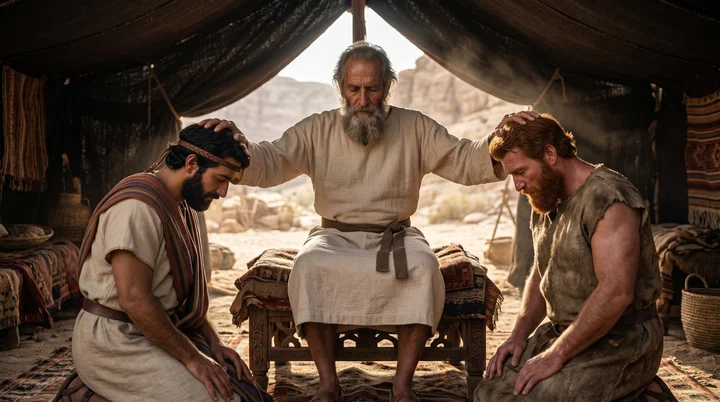
His father Isaac answered him:
“ Behold, your dwelling place shall be
away from the richness of the land,
away from the dew of heaven above.Isaac his father answered him,
“ Behold, your dwelling will be of the fatness of the earth,
and of the dew of the sky from above.Then Isaac his father made answer and said to him, Far from the fertile places of the earth, and far from the dew of heaven on high will your living-place be:
Then Izhak his father answered, and sayde vnto him, Behold, the fatnesse of the earth shall be thy dwelling place, and thou shalt haue of the dewe of heauen from aboue.
Douay-Rheims (Challoner revision)
Isaac being moved, said to him: In the fat of the earth, and in the dew of heaven from above,
Pictures
Cross-references
- Hebrews 12:16-17
Lest there be any fornicator, or profane person, as Esau, who for one morsel of meat sold his birthright.
Esau sold his birthright and was later rejected when seeking the blessing.
- Genesis 25:29-34
And Jacob sod pottage: and Esau came from the field, and he was faint:
Jacob bought Esau’s birthright before Esau received this blessing.
- Genesis 25:23
And the LORD said unto her, Two nations are in thy womb, and two manner of people shall be separated from thy bowels; and the one people shall be stronger than the other people; and the elder shall serve the younger.
The foretold order of elder and younger frames Jacob’s taking the blessing.
- Genesis 27:28-29
Therefore God give thee of the dew of heaven, and the fatness of the earth, and plenty of corn and wine:
Isaac’s blessing of Jacob contrasts with the blessing he gives Esau.
- Hebrews 11:20
By faith Isaac blessed Jacob and Esau concerning things to come.
Identifies Isaac’s words of blessing to his sons as spoken in faith.
- Malachi 1:2-3
I have loved you, saith the LORD. Yet ye say, Wherein hast thou loved us? Was not Esau Jacob’s brother? saith the LORD: yet I loved Jacob,
Contrasts God’s treatment and inheritance of Jacob and Esau.
- Genesis 28:13-15
And, behold, the LORD stood above it, and said, I am the LORD God of Abraham thy father, and the God of Isaac: the land whereon thou liest, to thee will I give it, and to thy seed;
God assures Jacob of the land, descendants, and protection after his flight.
- Romans 9:13
As it is written, Jacob have I loved, but Esau have I hated.
States that Jacob was loved and Esau hated.
- 2 Samuel 8:14
And he put garrisons in Edom; throughout all Edom put he garrisons, and all they of Edom became David’s servants. And the LORD preserved David whithersoever he went.
Israel later subdued Edom by warfare.
- Romans 4:13
For the promise, that he should be the heir of the world, was not to Abraham, or to his seed, through the law, but through the righteousness of faith.
The promise to Abraham and his seed is described as an inheritance.
Commentary
Each commentary is drawn from primary sources: the writings of Ellen G. White and Adventist pioneers and periodicals. Each commentary is separate. Its own words are not a quotation; follow the references to read the source passages.
Ellen G. White
4 sources
The words were spoken by Isaac to Esau after the chief blessing had already been given to Jacob, who had taken his brother's place before their blind father by fraud.SG3 115.14SP 437.2GC88 616.1–2Lt 7, 1896, par. 1–4 The temporal prosperity contained in that secondary blessing was not automatic but conditional, to be given by God only in proportion to Esau's course — blessing if he loved and reverenced God, withheld if he rejected God and His commandments.SG3 115.1 Likewise Jacob's reception of divine blessing did not depend on holding the outward rights of the firstborn, but could be secured by a righteous life.SG3 115.1
The fraud brought its immediate penalty in that Jacob had to flee to save his life from Esau's threatening revenge.GC88 616.1–2 That early wrongdoing set the context for his later experience of repentance and earnest prayer and for God's preserving care over him.4SP 437.2 The same spirit of deceit reappears whenever there is partiality and hypocrisy, men treated as mere machinery, their liberty restricted, authority exercised as lordship over God's heritage, persons turned aside from their rights, and advantage grasped by crafty reasoning with no regard for agreements or for the disappointment and injury inflicted on others.Lt 7, 1896, par. 1–4
Sources
Pioneers and periodicals
26 sources
Isaac's answer gave Esau a dwelling marked by earthly richness and heavenly dew, a promise of temporal provision and material prosperity that still left him in a secondary and inferior lot without the mastery, rule and higher inheritance granted to Jacob.ST Sep 22, 1898ST Jan 3, 1911ST May 17, 1910 Esau had already recklessly sold his birthright for temporary gratification and a mess of pottage, and Jacob then took the father's blessing designed for Esau by personating his hairy brother, leaving Esau distressed and enraged yet unable to recover what he had lost.ST Jul 31, 1901ST Mar 30, 1888ST May 17, 1910ST Apr 1, 1897ST Oct 1, 1902 Rebekah and Jacob acted as if God could not fulfill His promise that the elder should serve the younger without their help, trying to supplement it by human ingenuity and impatience instead of waiting in faith for its proper time.ST Jul 31, 1901STST Oct 1, 1902 Their deception and overreaching was transgression that roused Esau's vengeance for revenge, brought Jacob long affliction as God's chastisement, and separated mother and son for the rest of life.ST Jul 31, 1901ST Jan 9, 1912ST Jan 6, 1909ST Feb 28, 1906ST Jan 9, 1912 Esau's lost birthright and blessing stands as a warning that those who despise spiritual heirship for perishable treasure and depraved appetite will at last seek repentance carefully and with tears and find no place to regain it.ST Apr 24, 1879ST Mar 30, 1888ST Nov 18, 1897
Blessing's Wording and Setting
Genesis 27:39 is Isaac's answer to Esau after Jacob had taken the first blessing, giving Esau a dwelling in the fatness, richness and abundance of the earth and the dew of heaven from above.ST Sep 22, 1898ST Jan 3, 1911ST May 17, 1910 It promises temporal blessing and material provision and prosperity, with the earth's abundance and heaven's dew for his dwelling, but it assigns him a secondary and inferior place and lot and does not give him the mastery, rule, and superior inheritance and privileges granted to Jacob.ST Sep 22, 1898ST Jan 3, 1911ST May 17, 1910ST Feb 23, 1915 The birthright and blessing concerned family rule and inheritance, which Esau had traded away for temporary gratification, while Jacob received the greater privileges and Esau the inferior lot.ST May 17, 1910ST Feb 23, 1915 It was spoken as a prophetic blessing in Isaac's own name in keeping with carnal desires, in contrast to the spiritual blessing he gave Jacob in God's name.ST Sep 22, 1898
Isaac had been arranging to pronounce the blessing upon Esau and had told him to prepare venison to receive it, though the Lord had promised that Jacob would inherit the blessing decreed upon Abraham and Isaac.ST Jul 31, 1901ST Oct 1, 1902 While Esau was in the fields hunting, Rebekah, fearing the promise that the elder should serve the younger would be frustrated, urged Jacob to personate Esau by killing kids, preparing the meal, and covering his neck and hands with skins to imitate his hairy brother.ST Jul 31, 1901ST Oct 1, 1902 Jacob had already lived up to the name supplanter as overreaching, mercenary and covetous by taking advantage of Esau's appetite to purchase the birthright, and then by fraud obtained the father's blessing designed for Esau.ST Jul 31, 1884ST Apr 1, 1897ST Oct 1, 1902 That blessing's importance belonged with the birthright and its inheritance and rulership, and God had promised the birthright to Jacob, which would have been fulfilled in its proper time had he waited in faith.ST Jul 31, 1884
When Esau returned and learned what had been done he was greatly distressed and enraged at Jacob and resolved to kill him and have revenge.ST Jul 31, 1901ST Oct 4, 1905 He sought to inherit the blessing but was rejected and could not recover what he had lost after deliberately and recklessly selling his birthright.ST Mar 30, 1888ST Feb 23, 1915 He had sold and traded away the birthright and its privileges for temporary gratification and a mess of pottage which perishes with the using, confirming it to Jacob with a solemn oath.ST May 17, 1910ST Nov 18, 1897 The temporal blessing of the fatness of the earth and the dew of heaven from above was then given after Jacob took the first blessing by fraud and deceit.ST Nov 18, 1897ST Oct 4, 1905
To escape his brother's vengeance Jacob became a fugitive and fled from Canaan to a distant country to Rebekah's father's people and took refuge in Mesopotamia, the country God had called Abraham out of and to which Abraham would not return nor let Isaac return.ST Jul 31, 1901RH Apr 17, 1900 There he remained many long years passing through bitter experiences and evil, and God by providence worked through that past without erasing or ignoring it until at the brook Jabbok Jacob became one who prevailed with God and people.ST Jul 31, 1901RH Apr 17, 1900 That human scheming brought lifelong separation of mother and son with grief, for Rebekah never saw her son again and more than twenty years passed before even formal reconciliation.STST Oct 1, 1902 The episode belongs to the continuing story of Abraham and his family and their gradual development of faith, concerning Isaac and his two sons and their defects, on the way to Jacob's victory by which he became Israel, and to their checkered and unsatisfactory experiences.ST Jan 6, 1909RH Apr 17, 1900
Providence, Faith, and Consequences
The Lord performs what He promises at its proper time, and the promise that Jacob should inherit the blessing decreed upon Abraham and Isaac would have been fulfilled in its proper time had he waited in faith.ST Jul 31, 1884ST Jul 31, 1901 Rebekah and Jacob acted as if God could not fulfill His promises without their help, and sought to supplement His promise with human works and human impatience and ingenuity.ST Jul 31, 1901STST Oct 1, 1902 That lack of faith was first manifest in Abraham, and quiet waiting until ready to receive brings His prompt blessing.ST Jul 31, 1901ST While Esau was in the fields hunting, Isaac was arranging to pronounce the blessing upon Esau, and Rebekah, fearing the promise that the elder should serve the younger would be frustrated, urged Jacob to personate Esau by killing kids, preparing the meal, and covering his neck and hands with skins to imitate his hairy brother.ST Jul 31, 1901ST Oct 1, 1902 The deception succeeded in obtaining the blessing, but human scheming brought lifelong separation of mother and son and great hardship to Jacob, with Esau's hatred threatening Jacob's life, Jacob fleeing from home to his mother's father's people in a distant country where he remained many long years passing through bitter experiences, Rebekah never seeing her son again, and more than twenty years passing before even formal reconciliation.ST Jul 31, 1901STST Oct 1, 1902
The trickery, treachery, deception, selfish plotting and overreaching by Jacob and his mother was disobedience, transgression and apostasy within the chosen people.ST Jan 9, 1912ST Feb 28, 1906 That treachery roused Esau's vengeance, so to escape his brother Jacob fled from Canaan and took refuge in Mesopotamia, the country God had called Abraham out of and to which Abraham would not return nor let Isaac return.RH Jul 4, 1865 Overreaching brings retribution sooner or later, and checkered and unsatisfactory experiences with suffering and hardship and distress followed.ST Jan 9, 1912ST Jan 9, 1912 Rebekah's error brought her grief and separation from her son, while Jacob was led to penitence.RH Jul 4, 1865
Jacob's sin and act in the case of Esau made him a fugitive from his father's house and brought evil into his life, with long-continued afflictions upon him as the chastisement of God.ST Jul 21, 1881RH Apr 17, 1900 God did not erase or ignore that past but by providence worked through it, and at the brook Jabbok Jacob became one who prevailed with God and people.RH Apr 17, 1900 The chastisement closed forever when he went down into Egypt, because his suffering had worked deep and thorough repentance and God withdrew the rod.ST Jul 21, 1881 His sojourn in Egypt was the period assigned for his ripening for the kingdom of God, so his life ended in heavenly brightness, and the prosperity of the Hebrew people continued for a time after this before it ceased and turned to forgotten services and rigorous cruelty.ST Jul 21, 1881
The blessing upon Esau of a dwelling in the fatness and richness and abundance of the earth and the dew of heaven from above describes material prosperity, but it did not guarantee prosperity from God.ST Feb 24, 1887ST Feb 24, 1887 Esau's welfare and well-being depended on his conduct: if he loved and revered God he would be accepted and blessed and God could grant prosperity, but if he rejected God and followed his own corrupt course he would be rejected and God would bring adversity, as Cain was.ST Feb 24, 1887ST Feb 24, 1887 Jacob too could receive God's blessing through righteous conduct even without the privileges ordinarily given to the firstborn.ST Feb 24, 1887
Warning Types and Connections
Esau deliberately and recklessly sold his birthright for temporary gratification, a mess of pottage which perishes with the using, confirming it to Jacob with a solemn oath, and afterward when he sought to inherit the blessing he was rejected and could not recover what he had lost.ST Apr 24, 1879ST Mar 30, 1888ST Nov 18, 1897RH Mar 20, 1879 He represents those who have no faith, children of unbelief and disobedience, and the unrighteous who count the redemption purchased by Christ of little value and sacrifice their heirship to Heaven for perishable treasures and gratification of depraved appetite and hurtful lusts, virtually despising God and Heaven.ST Apr 24, 1879ST Nov 18, 1897 His course is left on record as a warning that in the day of God sinners who have bartered away their heirship to Heaven for selfish gratifications will likewise find no place for repentance although they seek it carefully and with tears, illustrating how a person may surrender a precious inheritance and be unable to regain it and forfeit eternal glory through apostasy.ST Apr 24, 1879ST Mar 30, 1888RH Mar 20, 1879
Jacob in taking the birthright by selfish advantage of his brother's need and taking the blessing by fraud and deceit represents religionists who seek the Lord's blessing as place or position, loaves and fishes, the temporal instead of the spiritual, sacrificing principle, taking the unholy suggestions of the faithless, and uniting with the world and the State, only to be utterly disappointed at last.ST Nov 18, 1897 That act belonged to human interference in God's plans for the Promised Seed and the channels through which that Seed should come, when Rebekah and Jacob acted as if God could not fulfil His promises without their help, showing lack of faith first manifest in Abraham and found at the basis of all union of church and state, and that human scheming brought lifelong separation of mother and son and great hardship to Jacob.ST
The deception succeeded but brought disaster to the whole family, for Isaac had told Esau to prepare venison to receive his blessing, and Rebekah, fearing the promise that the elder should serve the younger would be frustrated, had Jacob kill kids, prepared the meal, and covered his neck and hands with skins to imitate his hairy brother and sent him to personate Esau, with the result that Esau's hatred threatened Jacob's life, Jacob fled from home, Rebekah never saw her son again, and more than twenty years passed before even formal reconciliation.ST Oct 1, 1902 The animosity affected Esau's descendants for hundreds of years, so Edom refused to let Israel pass through their land on the journey from Egypt to Canaan, Israel could only subdue Edom by warfare under David and under Amaziah, and Israel never wielded any moral influence over Esau's descendants, all coming from trying to supplement the Lord's promise with human works.ST Oct 1, 1902 That treachery was apostasy within the chosen people and it roused Esau's vengeance, so to escape his brother Jacob fled from Canaan and took refuge in Mesopotamia, the country God had called Abraham out of and to which Abraham would not return nor let Isaac return, and Jacob's return to that land foreshadows the later history of his posterity, who after deliverance from Egyptian bondage and planting in Canaan fell into apostasy and were carried as captives back to that same country.
Isaac through dimness of his sight blessed Jacob and passed Esau, showing how ignorance and forgetfulness in the creature can estrange love and knowledge, while the Lord knows who are His and His eye is always over them, undarkened by time, place, speech, or apparel.RH Nov 4, 1858 Jacob being led into error and exile through the influence of his mother proves that people are accountable for the influence they exert upon the conduct of others, cannot evade the consequences of causing others to do wrong, and that many will be lost through the negligence or misconduct of others.ST Apr 12, 1883
Sources