Genesis 27:40
And by thy sword shalt thou live, and shalt serve thy brother; and it shall come to pass when thou shalt have the dominion, that thou shalt break his yoke from off thy neck.
Translations
And by your sword shall you live, and shall serve your brother; and it shall come to pass when you shall have the dominion, that you shall break his yoke from off your neck.
And by thy sword shalt thou live, and shalt serve thy brother; and it shall come to pass when thou shalt have the dominion, that thou shalt break his yoke from off thy neck.
And by thy sword shalt thou live,
And shalt serve thy brother;
And it shall come to pass when thou shalt have the dominion,
That thou shalt break his yoke from off thy neck.And by thy sword shalt thou live, and shalt serve thy brother: and it shall come to pass when thou shalt have the dominion, that thou shalt break his yoke from off thy neck.
And by thy sword shalt thou live, and thou shalt serve thy brother; And it shall come to pass when thou shalt break loose, That thou shalt shake his yoke from off thy neck.
And by thy sword shalt thou live, and thou shalt serve thy brother;
And it shall come to pass, when thou shalt break loose,
That thou shalt shake his yoke from off thy neck.and by thy sword dost thou live, and thy brother dost thou serve; and it hath come to pass when thou rulest, that thou hast broken his yoke from off thy neck.'
And by thy sword shalt thou live; And thou shalt serve thy brother; And it shall come to pass when thou rovest about, That thou shalt break his yoke from off thy neck.
And on thy sword, shalt thou live, And thy brother, shalt thou serve: But it shall come to pass when thou shalt rove at large, Then shalt thou break his yoke from off thy neck.
Berean Standard Bible, Majority Standard Bible
You shall live by the sword
and serve your brother.
But when you rebel,
you will tear his yoke from your neck.”You will live by your sword, and you will serve your brother.
It will happen, when you will break loose,
that you will shake his yoke from off your neck.”By your sword will you get your living and you will be your brother's servant; but when your power is increased his yoke will be broken from off your neck.
And by thy sword shalt thou liue, and shalt be thy brothers seruant. But it shall come to passe, when thou shalt get the masterie, that thou shalt breake his yoke from thy necke.
Douay-Rheims (Challoner revision)
Shall thy blessing be. Thou shalt live by the sword and shalt serve thy brother: and the time shall come, when thou shalt shake off and loose his yoke from thy neck.
Pictures
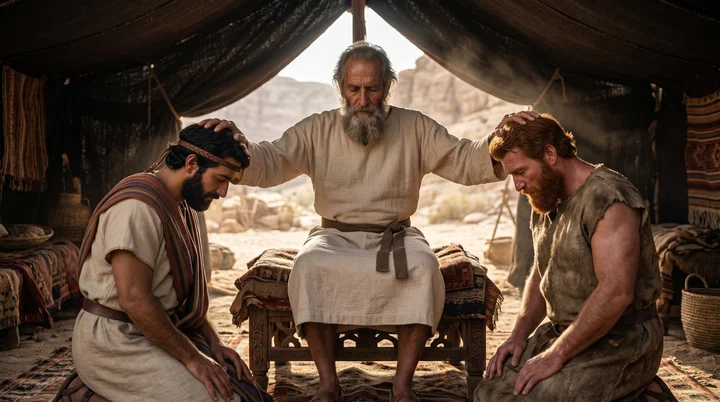
Cross-references
- Genesis 25:31-34
And Jacob said, Sell me this day thy birthright.
Esau sells his birthright to Jacob for food.
- Hebrews 12:16-17
Lest there be any fornicator, or profane person, as Esau, who for one morsel of meat sold his birthright.
Esau sells his birthright and is later rejected when he seeks the blessing.
- Genesis 25:23
And the LORD said unto her, Two nations are in thy womb, and two manner of people shall be separated from thy bowels; and the one people shall be stronger than the other people; and the elder shall serve the younger.
The prophecy that the elder would serve the younger is echoed in Esau’s subjection to Jacob.
- Genesis 32:28
And he said, Thy name shall be called no more Jacob, but Israel: for as a prince hast thou power with God and with men, and hast prevailed.
Jacob receives the name Israel after wrestling and prevailing.
- 2 Samuel 8:14
And he put garrisons in Edom; throughout all Edom put he garrisons, and all they of Edom became David’s servants. And the LORD preserved David whithersoever he went.
Israel subdued Edom by warfare only
- Genesis 27:29
Let people serve thee, and nations bow down to thee: be lord over thy brethren, and let thy mother’s sons bow down to thee: cursed be every one that curseth thee, and blessed be he that blesseth thee.
Isaac’s blessing places Jacob above Esau.
- Malachi 1:2-3
I have loved you, saith the LORD. Yet ye say, Wherein hast thou loved us? Was not Esau Jacob’s brother? saith the LORD: yet I loved Jacob,
Contrasts God’s treatment of Jacob and Esau.
- Hebrews 11:20
By faith Isaac blessed Jacob and Esau concerning things to come.
Isaac’s blessings to Jacob and Esau were prophetic.
- 2 Chronicles 25:11-14
And Amaziah strengthened himself, and led forth his people, and went to the valley of salt, and smote of the children of Seir ten thousand.
Israel again subdued Edom by warfare only
- Genesis 33:1-4
And Jacob lifted up his eyes, and looked, and, behold, Esau came, and with him four hundred men. And he divided the children unto Leah, and unto Rachel, and unto the two handmaids.
Jacob meets Esau and is delivered from him.
- Numbers 20:14-21
And Moses sent messengers from Kadesh unto the king of Edom, Thus saith thy brother Israel, Thou knowest all the travail that hath befallen us:
Esau's hatred continued in refusal of passage
- Romans 9:13
As it is written, Jacob have I loved, but Esau have I hated.
Quotes the statement about loving Jacob and hating Esau.
Commentary
Each commentary is drawn from primary sources: the writings of Ellen G. White and Adventist pioneers and periodicals. Each commentary is separate. Its own words are not a quotation; follow the references to read the source passages.
Ellen G. White
4 sources
Genesis 27:40 is part of Isaac's blessing to Esau, given in the account of Jacob's deception in obtaining the birthright blessing.SG3 115.14SP 437.2GC88 616.1–2Lt 7, 1896, par. 1–4 A father's blessing and the privileges of the firstborn could not by themselves secure God's favor.SG3 115.1 Esau's prosperity depended on whether he loved and revered God, and Jacob could still be blessed by God without those privileges if he lived righteously.SG3 115.1 Esau's anger over the blessing intended for him caused Jacob to flee for his life.GC88 616.1–2 Years later Jacob returned to his native country fearing Esau's revenge, while facing him with an unarmed and defenseless family.GC88 616.1–2
Jacob had to repent of his fraud in obtaining the blessing, and God heard his prayer and mercifully preserved his life.4SP 437.2 His experience shows that in the time of trouble God's people can plead for deliverance with confidence when their sins have been confessed and forgiven.4SP 437.2 Unconfessed sins would overwhelm them and cut off their faith.4SP 437.2 Sins already brought to judgment and blotted out cannot be recalled against them as concealed wrongs.4SP 437.2
The deception in the chapter was marked by partiality, hypocrisy, and secret working that is open to God's sight.Lt 7, 1896, par. 1–4 The same deception is practiced by men in high places of trust who treat people as machinery, bind their freedom by methods and terms, harness and drive them, and rule as lords over God's heritage.Lt 7, 1896, par. 1–4 They pervert right principles through selfishness and covetousness.Lt 7, 1896, par. 1–4 God never justifies turning a person from his rights or grasping all that can be gotten by deceptive reasoning without regard for agreements and for the disappointment and wrong done to others.Lt 7, 1896, par. 1–4 Christ's teachings to ancient Israel must be investigated to expose and correct such a course.Lt 7, 1896, par. 1–4
Sources
Pioneers and periodicals
27 sources
Isaac's blessing foretold that Esau would live a life of conflict by the sword and serve his younger brother, yet in time he would gain power and break his brother's yoke from off his neck.ST Sep 22, 1898ST Sep 22, 1898 God had already promised that the elder would serve the younger, but after Esau rashly sold his birthright for a meal that perishes, Jacob through fraud personated his brother before their blind father and took the blessing meant for the firstborn.ST Feb 24, 1887ST Jul 31, 1901ST Apr 1, 1897ST Nov 18, 1897ST Oct 1, 1902 That word was fulfilled when Esau's descendants in Edom kept up the enmity, refused Israel passage to Canaan, were subdued only by warfare under David and Amaziah, and at last revolted from Judah's rule to set up their own king.ST Oct 1, 1902 The birthright at stake was no small thing, for it carried pre-eminence in the family and in a measure the line through whom Christ would come for the salvation of the race, which Jacob prized as the will of God while Esau as a worldly man traded it for temporary gratification.ST May 17, 1910 The blessing would have come to Jacob in God's time if Rebekah and Jacob had quietly waited instead of scheming, and their lack of faith brought long exile, separation, and chastisement unto repentance, while Esau's tearful yet rejected seeking of the blessing warns that those who sell their heavenly inheritance for selfish pleasure will find no place for repentance.ST Apr 24, 1879ST Jul 31, 1901STST Oct 1, 1902ST Apr 12, 1883
Story and Prediction
God had promised that Jacob would be a prince in Israel and inherit the blessing decreed upon Abraham and Isaac, with the elder serving the younger, yet Isaac was arranging to pronounce the blessing upon Esau.ST Feb 24, 1887ST Jul 31, 1901ST Oct 1, 1902 At Rebekah's urging Jacob practiced gross deception upon his blind father, whose sight was dim, personating Esau while Esau was in the fields hunting, and so received the blessing designed for his brother.ST Jul 31, 1884ST Jul 31, 1901ST Apr 1, 1897ST Oct 1, 1902RH Nov 4, 1858 Jacob lived out his name Jacob, which means supplanter, in an overreaching, mercenary, covetous character that fit that name.ST Apr 1, 1897ST Nov 18, 1897 Taking selfish advantage of Esau's appetite and need, he purchased the birthright for a mess of pottage that perishes with the using, then coveted the birthright and blessing and took an unrighteous course of fraud and deceit to secure them.ST Apr 1, 1897ST Nov 18, 1897ST Oct 1, 1902
Esau, though the firstborn, was given second place because he had rashly sold his birthright.ST Apr 24, 1879ST Jan 3, 1911ST Mar 30, 1888 Afterward he sought to inherit the blessing with tears, distress and regret, but was rejected when he later sought it and could not undo what he had done, for it was too late.ST Apr 24, 1879ST Mar 30, 1888ST Feb 23, 1915RH Mar 20, 1879 The verse is part of Isaac's prophetic blessing to Esau, foretelling his lot that his life would be marked by conflict, living by the sword, and that he and his descendants would serve Jacob and his descendants.ST Sep 22, 1898ST Sep 22, 1898ST Sep 22, 1898 But when Esau should have the dominion he would eventually break free, gain power, cast off that rule, and throw off his brother's yoke.ST Sep 22, 1898ST Sep 22, 1898ST Sep 22, 1898
The deception enraged Esau so that his anger turned to a vow to kill Jacob and to seek vengeance, stirring hatred that threatened Jacob's life.ST Jul 31, 1901ST Oct 1, 1902ST Oct 4, 1905 That forced Jacob to flee from home and from Canaan to a distant country in Mesopotamia among Rebekah's people, to her father's people, where he had to remain many long years and pass through bitter experiences.ST Jul 31, 1901ST Jan 3, 1911 The passage thus belongs to the troubled experiences of Esau and Jacob in which Jacob's selfish plotting brought suffering and his overreaching was met with overreaching and retribution.ST Jan 9, 1912ST Jan 9, 1912 It belongs to the continuing story of Abraham and his family, showing Isaac and his two sons in their defects on the way to Jacob's victory that made him Israel, the prevailer with God.ST Jan 9, 1912ST Jan 6, 1909ST Jan 9, 1912
Fulfillment and Doctrine
The promise that Esau would break his brother's yoke was fulfilled when Edom revolted from under Judah's rule and set up its own king. That breaking did not come through Roman dominion, for the Romans were not the descendants of Esau. It came when Israel departed from God.
The hatred kindled between the brothers passed to Esau's descendants for hundreds of years, so that Edom refused to let Israel pass through their land on the journey from Egypt to Canaan.ST Oct 1, 1902 Israel never gained moral influence over them, but subdued them only by warfare under David and afterward under Amaziah.ST Oct 1, 1902 The birthright at stake in the account included pre-eminence and rulership in the family.ST May 17, 1910 In a measure it also involved the line through whom Christ would come and the salvation of the human race.ST May 17, 1910 Esau was a worldly man who traded it for temporary gratification, while Jacob valued what it offered and longed to know and do God's will.ST May 17, 1910 After Jacob received the blessing Isaac had intended for Esau, Esau was enraged and swore vengeance, and Jacob was forced to flee.
Esau's future was to live by the sword and to serve Jacob, yet in time to break free from Jacob's rule.ST Feb 24, 1887 That blessing did not guarantee him prosperity from God.ST Feb 24, 1887 His outcome would depend on whether he loved and reverenced God or followed a corrupt course, and Jacob likewise could have received God's blessing through righteousness even without the privileges given to the firstborn.ST Feb 24, 1887 Jacob and Esau are types of men everywhere.ST Nov 18, 1897 Jacob took the birthright by selfishly taking advantage of his brother's need for a mess of pottage that perishes with the using, and then took the blessing by fraud and deceit, while Esau sold his birthright for that temporal gratification.ST Nov 18, 1897 In this Jacob the supplanter represents a religious class that desires the Lord's blessing even by fraud.ST Nov 18, 1897 He represents religionists who seek the blessing as place and position, loaves and fishes, the temporal instead of the spiritual, and who to obtain it sacrifice principle, take the unholy suggestions of the faithless, and unite with the world and the State, only to be utterly disappointed at last, while Esau represents those who have no faith, children of unbelief and disobedience.ST Nov 18, 1897 Jacob's coveting of the birthright and blessing and his unrighteous course to secure them broke the tenth commandment before Moses was given, proving the law was already in force, and since covetousness is idolatry it also broke the first and second commandments.
Warning and Conduct
The blessing would have come to Jacob just as God had promised if Rebekah had let the Lord alone without nervous human ingenuity.ST Jul 31, 1901ST When the Lord promises a thing He will perform it at the proper time, so His people should not become impatient or uneasy but quietly wait until ready to receive His blessings, which He will then promptly bestow.ST Jul 31, 1901 Rebekah and Jacob acted as if God could not fulfil His promises unless they took a hand in it, a lack of faith first manifest in Abraham and nearly always found at the basis of all union of church and state.ST That human scheming resulted in lifelong separation of mother and son and great hardship to Jacob, who had to flee to a distant country among Rebekah's people and remain many long years passing through bitter experiences after Esau was enraged and resolved to kill him.ST Jul 31, 1901ST
Jacob's sin in the case of Esau brought long-continued afflictions upon him as God's chastisement.ST Oct 1, 1902ST Jul 21, 1881RH Jul 4, 1865 The deception worked but brought disaster to the whole family, stirring Esau's hatred to threaten Jacob's life, forcing Jacob to flee from home, separating Rebekah from her son so she never saw him again, and delaying even formal reconciliation for over twenty years.ST Oct 1, 1902RH Jul 4, 1865 His suffering worked deep and thorough repentance in him through prolonged wrestling with the angel, bringing Jacob to penitence.ST Jul 21, 1881RH Jul 4, 1865 That chastisement was a captivity that lasted until Jacob went down into Egypt, which was the turning point where his afflictions were closed forever.ST Jul 21, 1881 His sojourn in Egypt was the time appointed by Providence for his ripening for the kingdom of God, when God's rod was withdrawn and his life ended in heavenly brightness.ST Jul 21, 1881
God did not forget or ignore the past of deception that made Jacob a fugitive from his father's house and brought evil into his life, but overruled it by His providence.RH Apr 17, 1900 At the brook Jabbok Jacob became one who prevailed with God and man, so that what followed was shaped by what had come before under God.RH Apr 17, 1900 Jacob's later repentance and prayer for deliverance from Esau show that past wrongs must be confessed.RH Nov 14, 1912
Esau learned that Jacob had received the blessing that would have belonged to him had he not rashly sold his birthright, and he was distressed and regretted his act with tears, but it was too late to undo it and he was rejected.ST Apr 24, 1879RH Mar 20, 1879 His experience warns that people who trade their heavenly inheritance and hope of eternal glory for selfish pleasure and apostasy will likewise find no place for repentance when it is too late.ST Apr 24, 1879RH Mar 20, 1879 Jacob was led into error and exile through the influence of his mother, showing that people are accountable for the influence they exert upon the conduct of others and cannot evade the consequences of causing others to do wrong.ST Apr 12, 1883 Many will be lost through the negligence or misconduct of others.ST Apr 12, 1883
After Jacob's treachery toward Esau, Esau sought vengeance and Jacob had to flee Canaan and take refuge in Mesopotamia, the country God had called Abraham out of. That return was apostasy, unlike Abraham who would not return and would not allow Isaac to return. It foreshadowed the later apostasy when Jacob's posterity, after deliverance from Egypt and planting in Canaan, were carried captive back to that same country.
Sources