Translations
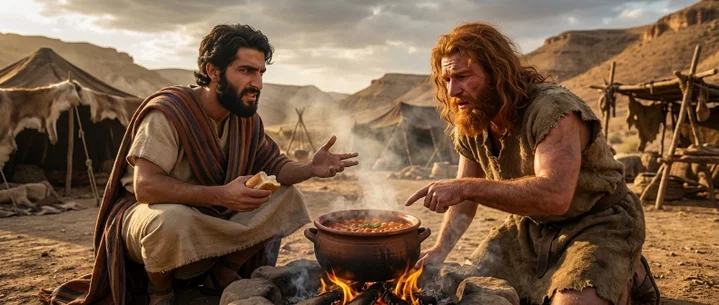
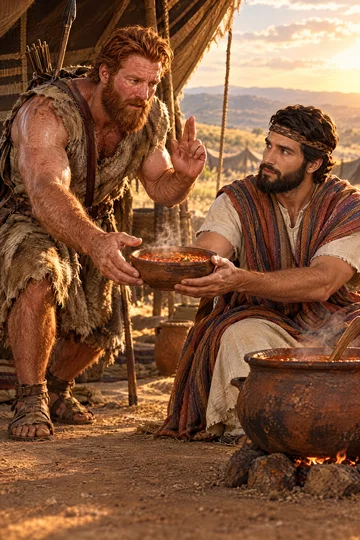
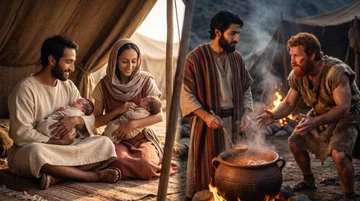
And Jacob said, Sell me this day your birthright.
King James Version, KJV Cambridge Paragraph Bible, Revised Version
And Jacob said, Sell me this day thy birthright.
And Jacob said, Sell to me this day thy birth-right.
And Jacob said, Sell me first thy birthright.
and Jacob saith, 'Sell to-day thy birthright to me.'
And Jacob said, Sell me now thy birthright.
And Jacob said,—Come sell, just now, thy birthright unto me.
Berean Standard Bible, Majority Standard Bible
“ First sell me your birthright,” Jacob replied.
Jacob said, “ First, sell me your birthright.”
And Jacob said, First of all give me your birthright.
And Iaakob sayd, Sell me euen nowe thy birthright.
Douay-Rheims (Challoner revision)
And Jacob said to him: Sell me thy first birthright.
Pictures
Cross-references
- Hebrews 12:16-17
Lest there be any fornicator, or profane person, as Esau, who for one morsel of meat sold his birthright.
Esau sold his birthright for a meal and later grieved the lost blessing.
- Genesis 27:1-29
And it came to pass, that when Isaac was old, and his eyes were dim, so that he could not see, he called Esau his eldest son, and said unto him, My son: and he said unto him, Behold, here am I.
Jacob’s deception in obtaining Isaac’s blessing follows the birthright sale.
- Genesis 25:23
And the LORD said unto her, Two nations are in thy womb, and two manner of people shall be separated from thy bowels; and the one people shall be stronger than the other people; and the elder shall serve the younger.
The prophecy that the elder would serve the younger shaped Jacob’s view of the birthright.
- Hebrews 12:17
For ye know how that afterward, when he would have inherited the blessing, he was rejected: for he found no place of repentance, though he sought it carefully with tears.
Esau’s loss of the blessing follows his earlier choice to sell his birthright.
- Romans 9:13
As it is written, Jacob have I loved, but Esau have I hated.
God’s choice of Jacob and judgment on Esau follows Esau’s despising his birthright.
- Genesis 27:41
And Esau hated Jacob because of the blessing wherewith his father blessed him: and Esau said in his heart, The days of mourning for my father are at hand; then will I slay my brother Jacob.
Esau’s anger over losing the birthright and blessing leads him to threaten Jacob.
- Genesis 32:28
And he said, Thy name shall be called no more Jacob, but Israel: for as a prince hast thou power with God and with men, and hast prevailed.
Jacob’s struggle and new name show his changed character as he seeks God’s blessing.
- Genesis 27:36
And he said, Is not he rightly named Jacob? for he hath supplanted me these two times: he took away my birthright; and, behold, now he hath taken away my blessing. And he said, Hast thou not reserved a blessing for me?
Esau links the birthright he sold with the blessing Jacob took.
- Genesis 28:13-14
And, behold, the LORD stood above it, and said, I am the LORD God of Abraham thy father, and the God of Isaac: the land whereon thou liest, to thee will I give it, and to thy seed;
God confirms his promise to Jacob and continues the ancestral line.
- Genesis 33:3-4
And he passed over before them, and bowed himself to the ground seven times, until he came near to his brother.
Jacob humbly approaches Esau, and they reunite in tears after Jacob’s earlier deception.
- 1 Chronicles 5:1-2
Now the sons of Reuben the firstborn of Israel, (for he was the firstborn; but, forasmuch as he defiled his father’s bed, his birthright was given unto the sons of Joseph the son of Israel: and the genealogy is not to be reckoned after the birthright.
Reuben’s birthright was lost and divided among Joseph and Judah.
- Joshua 24:4
And I gave unto Isaac Jacob and Esau: and I gave unto Esau mount Seir, to possess it; but Jacob and his children went down into Egypt.
Esau received Mount Seir after choosing present possession over the birthright’s promise.
- Genesis 27:34
And when Esau heard the words of his father, he cried with a great and exceeding bitter cry, and said unto his father, Bless me, even me also, O my father.
Esau’s sale of his birthright led to a bitter cry for the blessing.
- Genesis 27:19
And Jacob said unto his father, I am Esau thy firstborn; I have done according as thou badest me: arise, I pray thee, sit and eat of my venison, that thy soul may bless me.
Jacob deceives his father to take the elder’s blessing.
- Hosea 12:3-4
He took his brother by the heel in the womb, and by his strength he had power with God:
Jacob’s birthright story recalls his later struggle with the angel and supplication.
- Genesis 48:14-20
And Israel stretched out his right hand, and laid it upon Ephraim’s head, who was the younger, and his left hand upon Manasseh’s head, guiding his hands wittingly; for Manasseh was the firstborn.
Jacob gives Ephraim the firstborn status despite Manasseh being older.
- Matthew 1:1-16
The book of the generation of Jesus Christ, the son of David, the son of Abraham.
The genealogy presents Jesus as descended from Jacob.
- Genesis 36:6-7
And Esau took his wives, and his sons, and his daughters, and all the persons of his house, and his cattle, and all his beasts, and all his substance, which he had got in the land of Canaan; and went into the country from the face of his brother Jacob.
The brothers part because their possessions are too great.
- Hebrews 11:20
By faith Isaac blessed Jacob and Esau concerning things to come.
Isaac’s blessing of Jacob concerned things to come.
- Matthew 16:26
For what is a man profited, if he shall gain the whole world, and lose his own soul? or what shall a man give in exchange for his soul?
Both warn against trading eternal blessing for temporal gain.
Commentary
Each commentary is drawn from primary sources: the writings of Ellen G. White and Adventist pioneers and periodicals. Each commentary is separate. Its own words are not a quotation; follow the references to read the source passages.
Ellen G. White
49 sources
Faint with hunger from the field, Esau was met by Jacob's demand to sell his birthright that very day for food and pottage.ST Apr 17, 1879SG3 113.21SP 106.1 The birthright at stake carried peculiar honor and authority in the family, consecration to God in the priest's office, a double portion of goods, and the blessing of possession.ST Apr 17, 1879ST Dec 4, 1879 Esau treated that sacred inheritance as of little value beside a morsel to meet present want, assuming he could give it up and reclaim it afterward, and that crisis choice revealed his true estimate of sacred things and fixed the course of his life.2T 37.3–38.2CH 110.21SP 108.1–2Lt 5, 1877, par. 16CTBH 43.1–44.2 He could not regain what he had despised, and though he sought the blessing with bitter tears it was gone forever.2T 37.3–38.2CH 110.2CTBH 43.1–44.2 The birthright stands for heirship to heaven and eternal life and the redemption Christ purchased, and the sale is repeated whenever that inheritance is traded for temporary gratification of appetite, earthly treasure, or honor.2T 37.3–38.2ST Apr 24, 1879ST Jun 20, 1900Lt 7, 1864, par. 10–12PP 181.3–182.1
Bargain and Birthright Setting
Esau came in faint with hunger from the field, and Jacob that day demanded and offered him food and pottage in exchange for selling his birthright.ST Apr 17, 1879SG3 113.21SP 106.1ST Feb 24, 1887Lt 117, 1897, par. 8–10 Jacob had learned from his mother what God had told Rebekah, that the elder would serve the younger.ST Apr 17, 1879SG3 113.21SP 106.1 With youthful reasoning he concluded that the promise could not be fulfilled while Esau held the rights of the firstborn.ST Apr 17, 1879SG3 113.21SP 106.1
He therefore used Esau's hunger and necessity to his own advantage to gain the firstborn's privileges.ST Apr 17, 1879SG3 113.21SP 106.1ST Feb 24, 1887 The birthright at stake meant peculiar advantages and special privileges: honor and authority in the family and tribe next to the parents, consecration to God and selection to the office of priest, a double portion of the father's goods, and the blessing of possession.ST Apr 17, 1879ST Dec 4, 1879 Esau bound himself by solemn oath to give Jacob the birthright, and later concealed that oath-bound sale from Isaac when seeking the blessing belonging to the firstborn.ST Apr 24, 1879SG3 114.1
In so doing Jacob sought to secure by fraud what was already his by God's promise instead of waiting in faith for God to fulfill it in good time.ST Jul 31, 1884ST Nov 17, 1909PP 201.3–202.2 That lack of faith and deceit brought trouble upon himself and his brother's hatred and began a harvest of wrongs that followed him.ST Jul 31, 1884ST Nov 17, 1909 Yet having repented of obtaining the birthright by fraud he could plead for deliverance with confidence rather than being overwhelmed by concealed, unconfessed sin.PP 201.3–202.2 The material loss of possession was later made good when Jacob became wealthy and returned that blessing to Esau, so that enmity, jealousy and hatred ended and they parted because of their possessions.ST Dec 4, 1879
Esau's Contemptuous Choice
Long indulgence in self-gratification and repeated yielding to appetite had created in Esau an overpowering craving for food that overcame every other concern when the birthright was demanded for pottage.2T 37.3–38.2CH 110.2CTBH 43.1–44.2 His willingness to sell for momentary gratification sprang from indifference to divine blessings and requirements, being controlled by inclination and depraved appetite rather than practicing the self-denial promised blessing requires.2T 37.3–38.2ST Apr 24, 1879PP 181.3–182.1
He treated the sacred inheritance as having little value and as though it had lost its value and sacredness, valuing a morsel of meat and a small indulgence to meet present wants more than the service of his Master and trading heavenly promise for temporary pleasure and corrupt passion.2T 37.3–38.2CH 110.21SP 108.1–2Lt 5, 1877, par. 16CTBH 43.1–44.2 He assumed he could give up the birthright for the meal and later reclaim it or buy it back.2T 37.3–38.2CH 110.2CTBH 43.1–44.2
What he regarded as scarcely worth a thought was a crisis passed without knowing it that revealed the prevailing traits of his character, his choices, and his true estimate of what was sacred and should have been sacredly cherished, and it determined the aftercourse of his life.Lt 5, 1877, par. 16
What Birthright Signifies
The birthright stands for an enduring inheritance and blessing, heirship to heaven and eternal life itself.2T 37.3–38.2ST Jun 20, 1900Lt 7, 1864, par. 10–12 Worldly pleasure can make that heavenly inheritance seem less desirable, so that cheap present pleasures are chosen over eternal things.2T 37.3–38.2ST Jun 20, 1900 To trade it for food, for worldly-mindedness and sinful choice, for immediate worldly advantage and desire, is to sell everlasting life, and that loss is not simply undone.2T 37.3–38.2Lt 7, 1864, par. 10–12
It stands for the redemption Christ purchased and the promised heavenly inheritance, which the sale counts as of little worth and virtually despises.ST Apr 24, 1879SG3 116.1–117.1PP 181.3–182.1 When gratification of depraved appetite is set against the high heavenly blessings promised only to the self-denying and God-fearing, the clamor of appetite generally prevails, inclination rules instead of self-denial, and God and heaven are treated as of little worth.ST Apr 24, 1879PP 181.3–182.1 Corrupt passions then rule, health is sacrificed, mental faculties are enfeebled, and the finer sensibilities of the soul are benumbed, while cleansing from all filthiness of flesh and spirit to perfect holiness in the fear of God is refused as too straight a way.ST Apr 24, 1879SG3 116.1–117.1PP 181.3–182.1
It stands also for knowledge of Bible truth as a precious inheritance, which must not be treated as lightly as a mess of pottage, since even neglect can amount to selling it.Lt 111, 1899, par. 6 It means abiding forever as a faithful child of God by doing the will of God.Lt 23, 1890, par. 6–7 It is a God-given inheritance and sacred trust entrusted for the blessing of humanity and the good of others, which is wasted and betrayed when sacred interests are given up to appetite or greed for money and dishonest practices, and one who for selfish gratification and indulgence of selfish passions and lusts yields with divided heart to another than God may profess godliness for a time yet end finally and forever as something else than a faithful child of God.Lt 83, 1897, par. 17–20Ms 14a, 1897, par. 13–14Lt 23, 1890, par. 6–7
To sell it is to sacrifice heirship to heaven for perishable things of earth and mere temporary, weakening and debasing pleasure, especially gratification of appetite and corrupt passions.1SP 108.1–2PP 181.3–182.1 It is to live only for the present in indifference to divine blessings and requirements, turning from the strait way to eternal life because hurtful gratifications will not be given up.1SP 108.1–2PP 181.3–182.1 The folly of despising the promised inheritance is seen only when it is too late to recover it, when grief over what was given up can no longer restore it.1SP 108.1–2PP 181.3–182.1
Irreversible Loss and Warning
The loss cannot simply be undone, for having traded the birthright for a meal Esau found he could not reclaim it or buy it back, though he bitterly regretted his rash choice and sought it with tears, and the blessing was removed and gone from him forever.2T 37.3–38.2CH 110.2CTBH 43.1–44.2Lt 98a, 1897, par. 1–6 He had assumed the sacred inheritance could be given up for present appetite and later recovered, but that expectation proved false.2T 37.3–38.2CH 110.2CTBH 43.1–44.2 The exchange was foolish, warning that a person can trade away the soul itself for a price.Lt 98a, 1897, par. 1–6
When he would have inherited the blessing he was rejected, finding no place of repentance though he sought it carefully and with tears.ST Apr 24, 1879SG3 116.1–117.1Lt 47, 1894, par. 41–42 So in the day of God sinners who have bartered heaven for selfish gratifications and hurtful lusts will find no repentance.ST Apr 24, 1879SG3 116.1–117.1 His sale pictures those who count the redemption purchased by Christ as of little worth and give up heirship to heaven for perishable treasures and temporary pleasures.ST Apr 24, 1879SG3 116.1–117.1
His grief over despising and selling his birthright was sorrow for its painful consequences and unexpected results, not godly sorrow that changes the heart and leads to repentance.2SP 205.2–206.1ST Apr 19, 1877 Regret of that kind does not transform the character.2SP 205.2–206.1ST Apr 19, 1877
Knowingly sacrificing truth and duty for present gain is willful wrongdoing, and indulging appetite weakens the ability to value eternal things.2T 37.3–38.2ST Apr 24, 1879 When gratification of depraved appetite competes with the high heavenly blessings promised only to the self-denying and God-fearing, the clamors of appetite generally prevail and God and heaven are virtually despised.ST Apr 24, 1879PP 181.3–182.1 Health is sacrificed, mental faculties are enfeebled, and the finer sensibilities of the soul are benumbed by hurtful indulgences such as tea, coffee, snuff, tobacco and spirits, while cleansing from all filthiness of flesh and spirit to perfect holiness in the fear of God is refused as too straight a way.ST Apr 24, 1879PP 181.3–182.1 The folly of exchanging heaven for mere temporary weakening and debasing pleasure is seen only when too late to recover.PP 181.3–182.1
The record stands as a warning to others, for Esau acted recklessly and bound himself by solemn oath, then was greatly distressed with no remedy left when the blessing that would have belonged to him was obtained by another.ST Apr 24, 1879 Until the end of earth's history people will still trade what is of lasting value for temporary satisfaction if they yield to temptation and abandon allegiance to God.ST Apr 24, 1879Lt 13, 1900, par. 7–8
Repeating the Sale Today
The sale is repeated whenever a spiritual inheritance is traded for the satisfaction of appetite, for intemperate habits and health-destroying indulgences that sacrifice godlike character and lead away from God.4T 31.2–32.1Ms 34, 1902, par. 9–12 As Esau's craving overpowered every other concern until he treated the birthright as having no value or sacredness, so repeated indulgence creates desire that rules, and professed Christians cling to hurtful gratifications that benumb the sensibilities of the soul.CTBH 43.1–44.2PP 181.3–182.1 It is sacrificing heirship to heaven for perishable things of earth, lightly valuing the redemption purchased by Christ, choosing gratification of depraved appetite over blessings promised only to the self-denying and God-fearing.PP 181.3–182.1 It brings loss of health, enfeebling of mental faculties, and forfeiture of heaven for mere temporary weakening and debasing pleasure, an exchange whose folly is seen only when too late to recover, and it calls for prompt reform because God will not be trifled with.PP 181.3–182.1Ms 34, 1902, par. 9–12
The bargain is repeated by holding fast to earthly treasures and loving money, withholding from God His proportion in tithes and offerings while excusing covetousness.5T 274.3Lt 15, 1898, par. 17–19 A covetous desire for money risks selling the birthright, and yielding to appetite or greed for money dishonors a God-given inheritance entrusted for humanity's blessing and falls into dishonest practices.Lt 15, 1898, par. 17–19Ms 14a, 1897, par. 13–14 Selling the birthright for a meal illustrates selling the soul or heavenly reward for worldly advantage, and its eternal cost outweighs any money involved in dishonest or selfish conduct.Ms 5, 1897, par. 16–20 Instead the birthright is kept by loosening hold on earthly treasures and laying up treasure in heaven in harmony with God and in advancement of the work of preparing a people to stand in the day when the Son of man shall be revealed.5T 274.3
It is repeated by sacrificing spirituality and eternal life for position and praise of men, for honor and influence with the world.Lt 25, 1873, par. 4–5 It comes from motives that are not right, without an eye single to God's glory, wanting to exalt self and being overcome by Satan's fascinating tempting bribe of honor.Lt 25, 1873, par. 4–5 Avoiding it requires humbling the heart to see the danger and making a strong, determined effort for everlasting life, for durable honor and enduring riches.Lt 25, 1873, par. 4–5 That means buying gold tried in the fire to be rich, white raiment to be clothed, and eyesalve to see, dealing justly, loving mercy and walking humbly with God even as Christ walked, for eternal life is worth everything and can be had by willingness to make any and every sacrifice, while infinite sacrifice has been made to exalt through Jesus Christ to honor and glory and immortal riches if the conditions are complied with.Lt 25, 1873, par. 4–5
It is repeated by giving up loyalty to God and obedience including the Sabbath to obtain or keep a wife, trading what is precious for self-gratification.10MR 190.1–194.1Lt 17, 1896, par. 8–9 A man who gives up obedience to marry a woman who requires it sells his birthright cheaply, choosing his own wishes over God and imperiling his soul.Lt 17, 1896, par. 8–9 Pleasing himself thus outweighs pleasing God, and the choice brings unhappiness.10MR 190.1–194.1 It is repeated when students become absorbed in education while neglecting prayer, religious duties, and service to others, exchanging lasting spiritual responsibility for immediate gratification.CE 246.1–2 Young men imitate the cheap barter when they gain education at the expense of filial duties and to the neglect of the soul's interest.Ms 2, 1871, par. 13–15
It is repeated by spending on dress and display and thereby sacrificing the soul's hope of entering the narrow gate.6MR 160.3Ms 56, 1900, par. 16–17 Treating a valuable inheritance as less important than immediate appetite is the same foolishness as spending on display instead of what nourishes the soul, and love of display can keep professed believers in Christ from entering the narrow way.6MR 160.3Ms 56, 1900, par. 16–17 Failing to cultivate strict integrity likewise surrenders something valuable for fleeting gain, exchanging lasting value for immediate advantage.Lt 110, 1897, par. 36 It is repeated by giving up a precious place with the Lord for friendship with His enemies, a grave loss in which doubts, complaints, and unbelief draw others toward the same ruin.Lt 1, 1880, par. 14 Disregarding individual stewardship when large repeated gifts are entrusted to one person to use at his own discretion likewise despises what God has entrusted.Lt 170, 1899, par. 28–30
It is repeated by selling eternal interest cheaply to depart from the living God, enthrone and worship self, and leave no room for Jesus, light, love, meekness and lowliness of heart.Lt 17a, 1891, par. 25–2618MR 245.3–247.2 Letting self rule sets life or death before a person, requiring repentance, conversion, renewing the covenant at the cross, cleansing the soul-temple of moral defilement, and dying to self, or else losing the life that measures with the life of God.Lt 17a, 1891, par. 25–2618MR 245.3–247.2 The warning applies against sacrificing spiritual standing and eternal interests in pursuit of influence and business success.Lt 59, 1903, par. 7–11 It is repeated by selling the soul for temporary worldly gain, with nothing a man can give in exchange for his soul, through bitter jealousy and through advice and decisions that involve a brother in distress or perplexity or bind him in poverty.Lt 98a, 1897, par. 1–6Lt 63, 1896, par. 16 Words, example, and evil-spun theories then lead others into perplexity and difficulty, draw men away from Christ to rank under the prince of darkness, destroy principles God commanded to live and souls Christ came to save, making the seller a soul-slayer instead of one who heals and saves day by day.Lt 63, 1896, par. 16
Choosing financial relief through betrayal is trading the soul for pottage, bartering what is precious for temporary advantage.Lt 15, 1898, par. 1–5 The birthright, meaning abiding forever as a faithful child of God by doing the will of God, can easily be sold for selfish gratification, for indulgence of selfish passions and lusts with a divided heart yielding service to another than God.Lt 23, 1890, par. 6–7 One may for a time profess godliness and appear a shepherd while unfaithful to solemn trust, but will end finally and forever as something else than a faithful child of God, and repentance may come too late.Lt 23, 1890, par. 6–7 Every selfish act controlled by desire, where appetite and inclination rule, sells soul, peace, and integrity for gratification of appetite and carnal desires and for selfish advantage, a danger even to those who know present truth and whose names are on church books if they walk unguarded into Satan's snares.Lt 47, 1894, par. 41–42 Neglecting the precious inheritance of Bible truth can amount to selling it, and the exchange warns against trading what is sacred and precious and lasting for a small passing gain or immediate desire and worldly advantage.Lt 111, 1899, par. 6Ms 5, 1897, par. 16–20Lt 117, 1897, par. 8–10
Sources
Pioneers and periodicals
108 sources
Faint from hunting, Esau asked for Jacob's cooked pottage, and Jacob required him to sell his birthright that day, so Esau reasoned he was near death, swore and sold it, then ate and drank and went his way in contempt of it.ST Mar 30, 1888ST Sep 22, 1898ST Sep 22, 1898 The birthright at stake carried the covenant promise to Abraham and Isaac of Canaan, ancestry of Christ, and the heavenly inheritance of which Canaan was the earnest.RH Nov 18, 1862STST Jan 14, 1913 Jacob prized that promise above all else, yet being still unrenewed he impatiently tried to secure by his own craft what God would have given in His own time.ST Apr 17, 1879ST Oct 4, 1905ST Feb 19, 1894ST Nov 21, 1906ST Oct 6, 1914 Esau by contrast lived for present gratification, deliberately valuing an immediate meal above the spiritual privilege and future blessing, and his voluntary act shut him out by its own natural result rather than by arbitrary decree.RH Jun 10, 1902ST Mar 24, 1898ST Mar 31, 1881ST Mar 31, 1881ST Sep 22, 1898 The sale was small in the act but beyond recall in consequence, for brief indulgence bartered away blessing and inheritance so that later bitter seeking with tears could not undo it.ST Apr 24, 1879ST Apr 19, 1877RH May 15, 1866RH Nov 24, 1859ST Mar 31, 1881 So the verse warns against trading lasting spiritual good and eternal life for momentary pleasure, appetite, wealth, or livelihood.ST Feb 19, 1894RH Jul 24, 1855ST Aug 26, 1889RH Nov 16, 1911ST Jul 8, 1930
Setting and Exchange
Esau came in faint from the field from hunting while Jacob had cooked red pottage, and when Esau asked to be fed Jacob required him to sell his birthright that day in exchange for the food.ST Mar 30, 1888ST Sep 22, 1898ST Sep 22, 1898 Esau reasoned that he was at the point to die so the birthright would do him no profit, then swore to Jacob and sold it.ST Mar 30, 1888ST Sep 22, 1898 He then received bread and lentil pottage, or lentil stew, and ate and drank and went his way, thus despising his birthright.ST Mar 30, 1888ST Sep 22, 1898ST Sep 22, 1898 So exhausted and hungry after hunting was he that he was ready to give up his birthright for food, sacrificing something of lasting value for immediate gratification. His selling when starving is the comparison for those who reject simple habits and self-denial to gratify appetite, sacrificing health and readiness for Christ's coming for temporary pleasure, and acting even more foolishly than he did.
The birthright was treated as valuable enough to require a formal bargain, yet Esau later showed contempt for it by trading it for a meal when hungry.ST Feb 19, 1894 His sale was voluntary, for he was not so close to death that he could not have waited for food or prepared some himself, but chose a small immediate benefit over the valuable inheritance.ST Oct 21, 1886ST Feb 19, 1894 Hunger and circumstances pressed upon him, showing how immediate physical need can lead someone to surrender a valuable spiritual inheritance.RH May 29, 1900 He valued immediate appetite more than his birthright and the lasting blessings it represented, choosing present pleasure when he could have waited without giving it up.ST Feb 19, 1894
The birthright and the father's blessing are distinct but joined.STST Feb 26, 1894 Esau had never properly valued the birthright he sold, yet still hoped afterward to obtain the blessing by pleasing Isaac with food.ST God intended both the birthright and the blessing for Jacob because his character was superior to Esau's in morality, integrity, and faith in God, and Jacob nevertheless obtained the blessing associated with the birthright by deception, not because of his deceit but in spite of it.ST Feb 26, 1894ST Feb 26, 1894 That selfish purchase was to be given in God's own way, not through Jacob's use of his own wisdom and deception.ST Feb 26, 1894
The exchange grew out of family division caused by the aged father's overfond affection for Esau and the mother's stronger sympathy for her neglected favored child Jacob.ST Jan 14, 1913 That favoritism shaped the family and led to deception and lasting sorrow.ST Rebekah helped Jacob deceive Isaac from failure to trust God to work out the situation, and it brought sorrowful consequences.ST Feb 17, 1914 The account concerns Isaac and his two sons and shows their defects, standing in the course that ends with Jacob's victory which made him Israel, prevailer with God.ST Jan 6, 1909 It also forecasts Esau's and Jacob's characters and shows God working for Isaac when he does not contend for his rights but commits his cause to God.ST Jan 9, 1912 Jacob's demand fit his name supplanter as material overreaching, pressed because his mother knew God's promise would be manifest through Jacob and kept the importance of the Seed before him in a material way without the fullest appreciation of the spiritual blessings, belonging to his unsatisfactory early experience that brought much later trouble until God in mercy changed him.ST Jan 14, 1913
The sale was a small transaction in itself but mighty in its consequences and turned the current of his life beyond recall.ST Mar 31, 1881 By selling his birthright for a mess of pottage to indulge his sensual appetite once, he bartered away the blessing and made himself a servant among his kindred, and it could not afterward be repurchased by a dish of savory venison.ST Mar 31, 1881 It was a bargain never redeemed on earth.RH Oct 8, 1857 A brief indulgence cost him his inheritance, and he later regretted the act bitterly but could not undo it, even when he sought the blessing with tears.RH May 15, 1866RH Nov 24, 1859 Those who surrender what is of lasting value for immediate relief may likewise find that repentance comes too late, even when sought with tears.RH Nov 24, 1859
Contents of the Birthright
The birthright included a double share of the father's estate and temporal possessions of blessing.ST Apr 17, 1879RH Sep 21, 1911ST Mar 30, 1888ST May 17, 1910 Jacob received the birthright except for the double portion of the estate.RH Sep 21, 1911 He later became wealthy and returned that blessing of possession to Esau, so the loss was made good and the enmity over possessions ended.ST Dec 4, 1879
It also included honor and authority in the family and tribe next to the parents, pre-eminence or rulership, and succession to whatever position the father held.ST Apr 17, 1879ST Mar 30, 1888ST May 17, 1910 It meant family headship with the privileges of prophet, priest and king.ST Feb 19, 1894 It carried consecration to God and selection to the priest's office, the family priesthood with its special spiritual blessings.ST Apr 17, 1879ST Mar 30, 1888ST May 17, 1910
In Isaac's family it carried the covenant promise made to Abraham and Isaac.ST Mar 31, 1881ST Feb 19, 1894ST Mar 30, 1888 That promise was possession of Canaan for them and their descendants, and the heavenly inheritance of which Canaan was an earnest.ST Mar 31, 1881 It was the honor of becoming an ancestor of Christ, the chosen line through which all families of the earth would be blessed and through which truth and salvation would go to the world.STST Jan 14, 1913ST Feb 19, 1894ST Mar 30, 1888ST May 17, 1910 Jesus descended from Jacob, fulfilling that lineage.RH Nov 18, 1862
Firstborn can refer to preeminence rather than birth order, for Jacob is called firstborn although Esau was older.ST Jan 11, 1905
The birthright stands for eternal life and the rich blessings connected with it.RH Aug 23, 1864 It is a heavenly inheritance bought by Jesus' blood and a home in God's kingdom that should not be exchanged for sin or earthly wealth.ST Jun 20, 1900ST Jul 8, 1930RH Aug 23, 1864 God also gives as birthright the true fire of the Holy Spirit, a spirit of power and love that purifies completely and burns gentle and blessing, and selling it for false fire desecrates the gift and sins against the Giver.RH Nov 16, 1911
Jacob's Motive and Conduct
Jacob had learned from his mother the word spoken to Rebekah that the elder should serve the younger, and in his youth he reasoned the promise could not stand while Esau kept the rights of the firstborn.ST Apr 17, 1879 He therefore prized, desired and valued the birthright and the promise and blessing of God above all else, remembering the promise to Abraham concerning the seed of Abraham and of Isaac.ST Apr 17, 1879ST Oct 4, 1905 That longing was a longing for God and spiritual good, for the birthright's peculiar advantages of honor and authority in family and tribe next to the parents, consecration to God and selection to the priest's office, and a double portion of goods, while the world is satisfied with what time and sense offer.ST Apr 17, 1879ST Jan 30, 1907 He intensely desired it and asked Esau to sell it, standing for God's plan even while not yet converted, and he later received its spiritual blessing of a home in God's kingdom through faith, prayer, confession, pardon and prevailing with God.ST Oct 6, 1914RH Dec 30, 1915
Because he had not been renewed by divine grace he was impatient to secure what the Lord had ordained, trying by his own craft and worldly means to make sure by human works what God would give in His own way and good time instead of waiting in faith, even though it was already his by promise.ST Jul 31, 1884ST Nov 17, 1909ST Feb 19, 1894ST Oct 1, 1902 Encouraged by his mother through intrigue, he acted out his name supplanter by taking undue advantage of Esau's hunger, necessity and reckless character to buy the birthright for a mess of pottage.ST Nov 21, 1906ST Oct 1, 1902 That scheming to hasten what would have come legitimately brought only trouble, delay, hatred, flight, long separation, and enmity between Esau's descendants and Israel for hundreds of years, until in later penitence he put away guile and trusted God to work out His purpose.ST Nov 21, 1906ST Oct 1, 1902 His fraud brought his brother's hatred and began a harvest of wrongs that followed him.ST Nov 17, 1909
He turned Esau's need to his own advantage, offering food for the birthright in a selfish, overreaching, mercenary, covetous purchase, an act of trickery, fraud, duplicity and deception carried out with his mother.ST Feb 24, 1887ST Feb 28, 1906ST Apr 1, 1897 That selfish advantage of a brother's supposed need pictures seeking the Lord's blessing through deceit or expediency, valuing worldly position and temporal gain above spiritual things and sacrificing principle to obtain them.ST Nov 18, 1897ST Sep 1, 1909 His coveting of the birthright and blessing to take an unrighteous course to secure them is idolatry transgressing the first and second commandments, and his stealing of the birthright violated the eighth commandment, proving the commandments known and in force long before Sinai.ST Jun 6, 1906 Esau's part in the same sale made him a profane man by swearing, violating the third commandment against swearing and profanity, which likewise proves that commandment known and in force long before Sinai, a profanity so serious that bitter weeping afterward could not recover birthright and life.ST May 9, 1906
Jacob's heart was better than his sport-loving brother's, superior in morality, integrity and faith in God, prizing the birthright and blessing of God so highly he would do anything to obtain them while Esau despised them enough to sell them for pottage.ST Oct 4, 1905ST Apr 11, 1906ST Feb 26, 1894 God loved Jacob's character and hated Esau's character as characters perpetuated in descendants, choosing Jacob as progenitor of those through whom truth would go to the world and setting aside Esau from that channel, yet intending both birthright and blessing for Jacob.ST Apr 11, 1906ST Feb 26, 1894ST Feb 26, 1894 He had a proper claim to the heir's blessing by purchase of the sacred covenant and promised inheritance of Canaan and the heavenly inheritance, obtaining the blessing by deception not because of deceit but in spite of it, though the deceitful means were wrong and unnecessary and God meant to give them in His own way without human wisdom and deception.ST Mar 31, 1881ST Feb 26, 1894ST Feb 26, 1894 His bargaining remained despicable from a generous standpoint which God could not approve, and those who stress his overweening desire teach he coveted birthright and blessing evidently not for spiritual but for temporal ends, which was evil.ST Oct 4, 1905ST Oct 4, 1905
That evil coveting drove him as an exile from his parents' home to wander in a strange land, forced out, hated by his only brother, lonely and sad with conscience sorely smiting him for what he had done.ST Oct 4, 1905 His wrongful effort to secure what God had promised helped lead to deceit, Esau's anger, and flight from home, with guilty and cowardly conscience after deceiving his father through his mother's connivance to steal the blessing, fleeing to Padan-aram to escape Esau's intent to kill him, leaving his mother never to see her again, lying on the bare ground feeling utterly forsaken of God and man with sins like a great gulf separating him from Heaven until God revealed love and care.ST Oct 4, 1905ST Jul 27, 1904 After deceiving his father to secure it he fled toward Padan-aram and made a vow to God on the journey.ST Sep 6, 1883 God knew his desire for the promise, granted his desire and regarded his repentance, and his later heartfelt repentance and surrender marked changed character, with reunion coming after prayer and repentance before God, so his later attitude at meeting Esau is to be considered in light of that earlier dealing.ST Oct 4, 1905ST Oct 6, 1914RH Jan 7, 1915ST Oct 20, 1898
Esau's Appetite and Contempt
Esau lived for bodily gratification and temporary advantage, valuing immediate appetite above inheritance and trading it for a meal.ST May 17, 1910RH Nov 22, 1906 He was a hunter with eye on the game and seldom looking upward to God, more ready to use strong limbs in the chase than to bend the knee in prayer and consecration, absorbed in what suited taste though he had heard of the heritage. His heart was passionate and uncontrolled, determining to have what it wants at any cost and losing all reason except present desire, leading to hasty words, hasty conclusions and thoughtless speech.RH Aug 27, 1901 That worldliness puts the present before the future and sacrifices the future for the present, securing the world first by business, money, pleasure, luxury, riches, honors, financial success and applauses, then trying in odd moments and by side efforts to secure that which is to come. Though he had commendable traits, bitterness and lack of self-control marred them, and choosing what pleases fancy irrespective of what the Lord says, whether gratification of appetite or other passionate lust, seals doom and falls from grace into entire separation from God.RH Aug 27, 1901
He treated the birthright as worth less than an immediate meal, a spiritual privilege and future blessing sacrificed to appetite and exchanged through craving for food.RH Jun 10, 1902ST Mar 24, 1898 That birthright carried the covenant blessing with Abraham and Isaac, possession of Canaan for them and descendants and the heavenly inheritance of which Canaan was an earnest, with God's care, and he traded it for a moment's appetite as worthless.ST Mar 31, 1881 His sale was a deliberate sale of all claim to the promises made to Abraham and Isaac and afterwards to Jacob, proving no trace of Abraham's faith and despising the promises of God.ST Mar 30, 1888 He was selfish in character, rejecting God's blessings, never properly valuing his heritage, and in hungry, impatient, unreasoning folly he did not stop to consider that his father would give him all the food he needed in dire hunger despite well knowing his father's tender love manifested in many ways.ST Mar 7, 1906ST
He chose immediate tangible possession over future promise, while Jacob chose an inheritance in the promises over present gain and was willing to walk by faith and not by sight, living and dying without the fulfilled promises and without dissatisfaction.ST Aug 21, 1884 In his strait the present outweighed the future, and he did not mean to lose all in the future but thought he might reach future good in some other way than through the birthright.RH Nov 19, 1857 Because faith cannot grasp what lies ahead but only what can be seen and felt, men trade spiritual privileges and great future good for short-lived pleasures or apparent advantages.RH Jun 10, 1902 The Lord gave each what he chose, Esau first receiving solid earthly Mount Seir to possess while Jacob and his children went down into Egypt with only promises to live on, for neither pottage nor a real estate transfer is so good a portion as an inheritance in the promises, which is worth infinitely more, and no one can have both but must decide for one or the other.ST Aug 21, 1884 Thousands do the same, flattering themselves with hope of everlasting life while striving to enjoy present life too and telling themselves God does not require sacrifice of comfort, and they will be engulfed in ruin and cast into outer darkness forever separated from God and His people with no more chance though they weep then, for God gathers those in covenant by sacrifice.RH Nov 19, 1857
His choice shut him out of the birthright's privileges by his own voluntary act, not by arbitrary decision of God, and Jacob's later deception did not prevent him from seeking and receiving God's blessing because grace is freely offered to all.ST Sep 22, 1898 His cries and bitter tears are the legitimate natural result of his own conduct, as certain as the course of the sun, not a special judgment like the flood on the antediluvian world or meteoric fire on Sodom or the pouring out of the vials of wrath.ST Mar 31, 1881 The votary of sensuality finds wretchedness in life, bitterness in death and accumulating horrors beyond, and vain regrets cannot bring back heavenly peace of innocence and virtue nor abate penalty while he still gives himself to pursue lusts of the heart.ST Mar 31, 1881 Habits of sin grow with growth and strengthen with strength until they bind as chains of sinful lust and drag downward to eternal death.ST Mar 31, 1881
His sorrow over despising and selling it came from painful consequence of sin, not from true repentance, and regret of that kind does not change the heart and is not godly sorrow.ST Apr 19, 1877 He acted recklessly and bound himself by solemn oath to give the birthright, then was greatly distressed and repented too late when the blessing that would have belonged to him was obtained, with no remedy left.ST Apr 24, 1879 So he will find no place of repentance or change in God in the eternal world though seeking carefully with tears.ST Apr 24, 1879ST Mar 31, 1881 When gratification of depraved appetite must compete with high heavenly blessings promised only to the self-denying and God-fearing, the clamors of appetite generally prevail and God and Heaven are virtually despised.ST Apr 24, 1879
After selling his birthright he later persecuted Jacob who avowed loyalty to God, showing that the wicked persecute the righteous.RH Jun 8, 1916 His throwing away the birthright for a meal brought sorrow to his father, illustrating suffering endured for another's good.ST Mar 18, 1897
Promise, Election, and Law
Jacob, the younger son of Isaac, was the one chosen to carry forward the promise made to his father as progenitor of the Seed through whom truth would go to the world.ST Apr 10, 1907ST Apr 11, 1906 This special choice for a role in God's plan did not itself guarantee his eternal salvation or condemn Esau.ST Apr 10, 1907ST Apr 11, 1906 Election did not forbid Esau's salvation if he would seek God in His appointed way, and Jacob's later deception did not prevent Esau from seeking and receiving God's blessing because grace is freely offered to all.ST Apr 11, 1906ST Sep 22, 1898
God chose Jacob because he loved and honored God and had superior character, while Esau belonged to another realm.ST Apr 11, 1906ST Dec 8, 1914 Knowing that the character of each would be perpetuated to a greater or less extent in his descendants, God chose Jacob for progenitor of those through whom His truth was to be given and set aside Esau from that channel.ST Apr 11, 1906ST Dec 8, 1914 Descent from Abraham alone did not make one part of the Israel to whom promises were given, for Esau's descendants the Edomites were not entitled merely by ancestry.RH Jan 16, 1872
Esau's sale made him a profane man by violating the third commandment against swearing and profanity.ST May 9, 1906 That proves the third commandment was known and in force long before Sinai, for he could not have been guilty without knowing the law.ST May 9, 1906 The profanity was so serious he permanently lost birthright and life and bitter weeping could not recover it.ST May 9, 1906
Adam's disobedience is compared to Esau's sale, as Adam sold himself and his descendants into bondage.ST Sep 24, 1894 By disobedience Adam forfeited his heritage of sonship and dominion, leaving his children without an estate through him.ST Oct 13, 1898 Humanity is described as having forfeited its right to life and sold its inheritance in the earth for a mess of pottage.RH Aug 17, 1911
The first selling of a birthright for nothing means men failing to appreciate God's gift of abundant natural capital for everyone and wantonly disposing of it to covetous and shrewd men who gather it in.ST This sale makes the half-equipped class the servants of the doubly-equipped class, degenerates hired servants into bond-servants, gives the capital class control over the wage-earning class whose main dependence is wage-earning, and gathers wage-earners into companies, colonies, villages and finally large cities with one class in luxury and wage-earners grading down to straitened circumstances and those whom no one hires in penury and suffering.ST Likewise disposing of inherited patrimony for immediate gain leaves one without that inheritance, as giving up one's share of God-given capital for a daily wage leads to dependence on employers for work and a living.ST
Warning Against Selling Birthright
The verse warns against trading lasting spiritual good for brief pleasure or gain, selling what is valuable and permanent for momentary gratification, purity and principle and hope of eternal life for sinful indulgence whose consequences cannot be undone.ST Feb 19, 1894RH Jul 24, 1855RH May 15, 1866RH Jul 13, 1905RH Jul 25, 1912 It is an unprofitable bargain exchanging something of great worth for little worth, a birthright traded for a meal and lasting inheritance sold for a song, leaving guilt and aching regret and a blighted life.RH Jul 24, 1855RH May 15, 1866ST May 2, 1878RH Jul 25, 1912ST Mar 25, 1880 Esau valued immediate appetite more than the birthright and the lasting blessings it represented, though he could have waited for food without giving it up, and choosing any indulgence or desire contrary to God's word over God's blessing likewise shows the heavenly birthright despised.ST Feb 19, 1894RH May 15, 1866RH Jul 13, 1905 Later longing for the blessing cannot recover what was rejected, for the sinner is left with lost inheritance and no way to regain it.ST Feb 19, 1894ST Aug 26, 1889RH May 15, 1866 That same bargain is repeated wherever innumerable messes of pottage, piping hot, are bought with birthrights, with tracts of land and golden mansions in the Celestial City exchanged at very disadvantageous rates for a few years' lease of small tenements in Vanity Fair, and where hope of heaven is given up for worldly fame and passing pleasures followed by spiritual loss and distance from God.RH Jul 24, 1855ST Aug 26, 1889
That same trade continues today when men barter away manhood, honesty, nobility, purity of soul, fellowship with God and with those God has anointed to be kings and priests and will soon crown, the heavenly hope, the eternal inheritance, and unspeakable joy and bliss.RH May 15, 1866ST Mar 7, 1906 They exchange them for Satan's savory messes of wealth, toys and trinkets, luxury and rioting, a moment's sensual pleasure, household possessions at the cost of music and reading and social life, strong young eyes labored away until sight is lost and all possessions would gladly be given to regain them, fashions and pleasures of this life, a new hat, dainty lunches, dress trimming, silver polishing and embroidery.RH May 15, 1866ST Mar 7, 1906ST Mar 25, 1880 They trade them for intoxicating drink that bites like a serpent and stings like an adder, for a glass of liquor costing health, mind, social position, wealth and useful manhood, and for the kiss and embrace of prostitutes that brings disease into the body, rottenness into the bones, remorse into the heart, death and perdition.RH May 15, 1866ST May 2, 1878 The pleasure passes in an hour and turns to loathing, while innocence, purity, peace and honor are gone, and tears cannot efface the stain, regrets cannot remove the memory, and years cannot unburden the conscience, leaving a blighted life of bondage, misery, restlessness and hopelessness.RH May 15, 1866ST May 2, 1878 The bargain is seldom meant all at once but is made little by little by grieving the Holy Spirit and bartering away conscience for what the world offers until its hold is so strong they never break away, warning young men to avoid dissipated company, idle habits and the first taste of wine lest sowing indulgence in youth reap ruin in later years.ST May 2, 1878ST Mar 25, 1880
It pictures counting Christ's purchased redemption of little worth and rejecting the offered way to life, losing eternal life and heavenly reward through voluntary choice to disregard the offered way.ST Jul 8, 1930RH Nov 19, 1857 It means valuing the toys of earth and enjoyment of the present life above the decision of heaven's judgment, from which there is no appeal, flattering hope of everlasting life while refusing sacrifice and striving to enjoy the present life too, telling themselves God does not require giving up comfort or making great sacrifice.RH Nov 19, 1857RH Jan 12, 1864 Those who profess Christ while wrapped in self-righteousness and expecting to merit eternal life by good deeds will make that trade when tried, because they hug idols close instead of laying every idol on the altar, whereas the Christian's whole life is self-denial and cross-bearing and expecting to reach heaven by any other path is vain.RH Nov 19, 1857RH Jan 12, 1864 It is the same choice as Judas betraying his Lord for thirty pieces of silver and the Gadarenes turning the great Redeemer out of the land to keep swine, a bargain even more shameful than Esau's, teaching not to turn Christ away from town or home for fear of cost nor begrudge what His presence and salvation require.RH Jan 8, 1875 They will be engulfed in ruin and cast into outer darkness forever separated from God and His people, with no more chance though weeping, for when God calls for His people He gathers those who have made a covenant with Him by sacrifice, and Satan's bargains cheat, never fulfilling pledges while goods prove mean and worthless, so it is better to yield wholly to the Lord.RH Nov 19, 1857RH Jan 8, 1875
It applies to appetite and intemperance in the generation living at the revelation of Jesus Christ, when masses in large cities, both professors and non-professors, repeat Esau's trade by being immersed in eating and drinking and making a god of the belly.RH Nov 29, 1864ST Feb 10, 1881 Lust then demands satisfaction in tea, coffee, snuff, tobacco, spirits and whisky even when prices are enormous and should force reform, with men holding to tobacco or whisky or refusing to give God the tithe of income, spending money for tobacco and persisting in its injurious use and selling interest in the kingdom even more cheaply.RH Nov 29, 1864ST Feb 10, 1881RH Aug 25, 1859 It is worshipping strong drink and trading hope of the kingdom for alcohol, giving up health, mind, position and manhood for liquor, sacrificing health and readiness for His coming for temporary pleasure.RH Nov 29, 1864ST May 2, 1878 Relaxing hold on God's truths for such small gains lets a little darkness spread in the mind until the whole light goes out, so he that thinks he stands must take heed lest he fall.ST Feb 10, 1881ST Mar 25, 1880 Believers should remain faithful through the time of trouble rather than sacrifice birthright for a morsel of meat, deny self and lay idols on the altar, for yielding begins little by little until conscience is bartered away.RH Jan 12, 1864ST Mar 25, 1880
It means putting the law of bread and butter above the law of God by giving up Sabbath keeping to protect business or livelihood.ST Oct 21, 1886ST Feb 14, 1884ST Jul 5, 1910 Esau was not so close to death that he could not have waited for food or prepared some himself, yet he chose a small immediate benefit over the valuable inheritance and treated a sacred spiritual blessing as less valuable than immediate food.ST Oct 21, 1886ST Feb 14, 1884 Choosing a livelihood over obedience to God's Sabbath command is the same kind of exchange as selling one's soul for temporary provision, made by those convinced the seventh day is the Sabbath yet refusing to obey the fourth commandment.ST Oct 21, 1886ST Feb 14, 1884ST Jul 5, 1910
It warns against sacrificing real and eternal riches for temporary money, gold, worldly prosperity, pride, power, wealth and fame, giving up conscience, justice, humanity, equity and impartial liberty and obedience to God for gain.RH Sep 2, 1915ST Sep 9, 1886RH Sep 2, 1862 The bargain brings bitter fruit and penalty, toiling and trampling on God's laws to gain a great worldly inheritance only to lose it from within grasp, with millions wasted, blood shed in defense of liberty, and mourning filling households for doing business on injustice, whereas doing right and seeking prosperity founded on equity pays a hundredfold in this life and secures eternal inheritance in the life to come.RH Sep 2, 1915RH Sep 2, 1862 It is echoed in sordid trade of liberty, manhood and soul for gold and bribery producing civic corruption as a foretoken of the Lord's return, in bartering God-given freedom and liberty for the shame of imperial conquest, in courting Romanism for office or profit and surrendering hard-won liberties for personal ambition, in Baptists abandoning resistance to secular power, in tolerating domination of organizations, in restricting missionary work by interdenominational arrangement as bartering away a birthright, in missionaries accepting a land gift for selfish advantage, and in turning God-given abilities to selfish wealth and joining selfish schemes for temporary advantage.RH Sep 2, 1915ST Sep 9, 1886ST Oct 25, 1899ST Sep 4, 1893
It means ministers giving up their divine, God-given calling to lead the worship of God, bring divine influence into souls, preach the Gospel, pray, know the Bible, and hold up Christ as the only name under heaven by which the world can be saved.ST Sep 20, 1905RH Oct 8, 1908 The mess of pottage is turning the church into a social center, lectureship, school, literary society, place of amusement, bazaar, soup kitchen, employment bureau and political caucus, running after every fad to save the world by vote or organization, quoting poets rather than Christ, lecturing on secular subjects, writing novels rather than sermons, riding hobbies, and giving excursions and entertainments, causing absence of soul life and spiritual power and decline of the church with increase of sin and evil.ST Sep 20, 1905RH Oct 8, 1908 Likewise it is trading what is valuable and sacred for immediate cheap gain to appear up-to-date by surrendering to evolution, treating God's heritage as merchandise and giving up entrusted work for selfish advantage, giving up steadfast faith when trials cut to the quick and murmuring for Egypt's flesh-pots for an easier life, selling truthfulness as priceless as virtue for money, and trading lifelong loyalty of faith and temperance held from youth to old age for temporary safety by obeying human law against prayer instead of kneeling toward Jerusalem three times daily.RH Oct 8, 1908ST May 27, 1913ST Oct 19, 1904RH Apr 18, 1912
It is reflected in squandering through reckless living and returning in need not merely of food but of faith and bread of life, and in selling selves freely for pottage unlike those kidnapped and enslaved.ST Feb 18, 1913 Mothers mirror Esau when, underestimating the priceless heritage of children from the Lord, they sell it by being troubled about many things and forgetting the Father knows their needs, spending more time trimming a dress than in a whole month teaching Bible reasons for faith, giving more thought to a dainty lunch to arouse envy than to the Sabbath-school lesson or wholesome food, and hurrying through devotions or neglecting them to polish silver or finish embroidery, thereby teaching worldliness.ST Mar 7, 1906RH Apr 18, 1871 It is yielding what is right to please for favor, trading salvation and coming to Jesus for worthless passions such as a stage career known to be incompatible with Christianity yet refused to be given up, and asking how highly one prizes the heavenly birthright.ST Dec 9, 1880RH Dec 6, 1870 The mess of pottage is not the Lord's supper, and Jacob could sell his birthright and die with the world, representing a choice that can be forfeited while accepting God leads to life.ST Dec 9, 1880
Foreshadowing Future Judgment
The demand to sell the birthright that day for a morsel of food shows how easily the right to eternal glory can be given up, for some who turn away like Esau go so far that they cannot return even when they earnestly seek to do so.RH Mar 20, 1879 His agreement to sell it was a choice of present gratification regardless of future good, and it stands as a warning to every youthful heart that such a choice ends in pain and remorse and inevitable ruin.ST Mar 31, 1881 No special judgment falls on him like the flood upon the antediluvian world or meteoric fire upon Sodom or the pouring out of the vials of wrath, but his cries and bitter tears are the legitimate natural result of his own conduct, as certain as the course of the sun.ST Mar 31, 1881 The votary of sensuality and lust finds wretchedness in life and bitterness in death and accumulating horrors beyond, and vain regrets and cries and bitter tears cannot bring back heavenly peace of innocence and virtue nor abate the penalty while he still gives himself up to pursue the lusts of his heart.ST Mar 31, 1881
Habits of sin grow with growth and strengthen with strength until they bind as with chains of sinful lust and drag downward to eternal death, so that he will find no place of repentance or change in God in the eternal world though he seeks it carefully with tears.ST Mar 31, 1881 The sale pictures the course of the unrighteous who count the redemption Christ purchased as of little worth and give up their heirship to Heaven for perishable treasures and self-gratification.ST Apr 24, 1879 When gratification of depraved appetite must compete with the high heavenly blessings promised only to the self-denying and God-fearing, the clamors of appetite generally prevail and God and Heaven are virtually despised, with many controlled by inclination rather than deny unhealthy appetite, health sacrificed, mental faculties enfeebled, and the finer sensibilities of the soul benumbed by hurtful indulgences such as tea, coffee, snuff, tobacco and spirits, while cleansing of all filthiness of flesh and spirit to perfect holiness in the fear of God is refused as too straight a way.ST Apr 24, 1879 The record stands as a warning because Esau acted recklessly and bound himself by solemn oath to give the birthright to Jacob, then was greatly distressed and repented too late when Jacob had obtained the blessing that would have belonged to him, with no remedy left.ST Apr 24, 1879 So in the day of God sinners who have bartered Heaven for selfish gratifications and hurtful lusts will find no place for repentance though they seek it carefully and with tears.ST Apr 24, 1879
Sources