Genesis 3:23
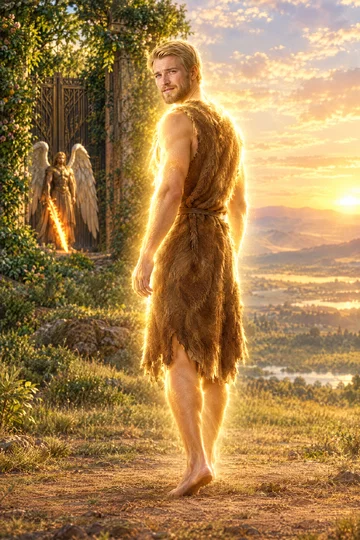
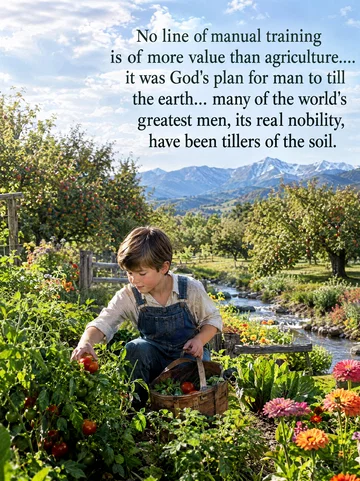
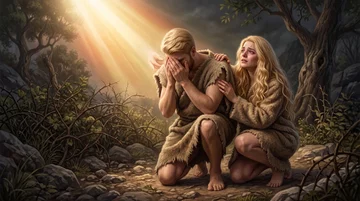
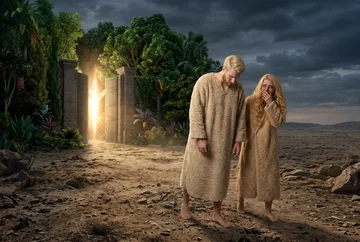
Therefore the LORD God sent him forth from the garden of Eden, to till the ground from whence he was taken.
Translations
Therefore the LORD God sent him forth from the garden of Eden, to till the ground from where he was taken.
Therefore the LORD God sent him forth from the garden of Eden, to till the ground from whence he was taken.
therefore the Lord God sent him forth from the garden of Eden, to till the ground from whence he was taken.
Therefore the LORD God sent him forth from the garden of Eden, to till the ground from which he was taken.
therefore the LORD God sent him forth from the garden of Eden, to till the ground from whence he was taken.
therefore Jehovah God sent him forth from the garden of Eden, to till the ground from whence he was taken.
Jehovah God sendeth him forth from the garden of Eden to serve the ground from which he hath been taken;
Therefore Jehovah Elohim sent him forth from the garden of Eden, to till the ground from which he was taken.
So Yahweh God put him forth from the garden of Eden,—to till the ground wherefrom he had been taken.
Berean Standard Bible, Majority Standard Bible
Therefore the LORD God banished him from the Garden of Eden to work the ground from which he had been taken.
Therefore the LORD God sent him out from the garden of Eden, to till the ground from which he was taken.
So the Lord God sent him out of the garden of Eden to be a worker on the earth from which he was taken.
Therefore the Lord God sent him foorth from the garden of Eden, to till ye earth, whence he was taken.
Douay-Rheims (Challoner revision)
And the Lord God sent him out of the paradise of pleasure, to till the earth from which he was taken.
Pictures

Cross-references 20 of 43
- Genesis 3:17-19
And unto Adam he said, Because thou hast hearkened unto the voice of thy wife, and hast eaten of the tree, of which I commanded thee, saying, Thou shalt not eat of it: cursed is the ground for thy sake; in sorrow shalt thou eat of it all the days of thy life;
Adam’s sin curses the ground and brings labor, death, and return to dust.
- Genesis 2:17
But of the tree of the knowledge of good and evil, thou shalt not eat of it: for in the day that thou eatest thereof thou shalt surely die.
Disobedience to God’s command brought death and forfeited access to life.
- Revelation 22:14
Blessed are they that do his commandments, that they may have right to the tree of life, and may enter in through the gates into the city.
Obedience grants access to the tree of life, restoring the lost Eden privilege.
- Romans 5:12
Wherefore, as by one man sin entered into the world, and death by sin; and so death passed upon all men, for that all have sinned:
Connects Adam’s sin with sin and death entering the world.
- Revelation 2:7
He that hath an ear, let him hear what the Spirit saith unto the churches; To him that overcometh will I give to eat of the tree of life, which is in the midst of the paradise of God.
The promise of the tree of life contrasts Eden’s exclusion with restored access in God’s Paradise.
- Genesis 3:6
And when the woman saw that the tree was good for food, and that it was pleasant to the eyes, and a tree to be desired to make one wise, she took of the fruit thereof, and did eat, and gave also unto her husband with her; and he did eat.
Adam and Eve’s disobedience in eating the forbidden fruit led to their expulsion from Eden.
- Genesis 2:7
And the LORD God formed man of the dust of the ground, and breathed into his nostrils the breath of life; and man became a living soul.
Adam was formed from the ground to which he was sent back.
- Revelation 22:2
In the midst of the street of it, and on either side of the river, was there the tree of life, which bare twelve manner of fruits, and yielded her fruit every month: and the leaves of the tree were for the healing of the nations.
The tree excluded from Adam is present in the restored Paradise.
- Genesis 2:9
And out of the ground made the LORD God to grow every tree that is pleasant to the sight, and good for food; the tree of life also in the midst of the garden, and the tree of knowledge of good and evil.
The tree of life stood in the garden from which humanity was driven.
- Genesis 1:26-28
And God said, Let us make man in our image, after our likeness: and let them have dominion over the fish of the sea, and over the fowl of the air, and over the cattle, and over all the earth, and over every creeping thing that creepeth upon the earth.
Humanity’s God-given dominion is lost through the fall.
- Genesis 2:15
And the LORD God took the man, and put him into the garden of Eden to dress it and to keep it.
Adam’s garden work precedes his post-fall labor tilling the ground.
- Genesis 3:17-18
And unto Adam he said, Because thou hast hearkened unto the voice of thy wife, and hast eaten of the tree, of which I commanded thee, saying, Thou shalt not eat of it: cursed is the ground for thy sake; in sorrow shalt thou eat of it all the days of thy life;
Adam’s transgression brings a curse on the ground, which yields thorns and thistles.
- 1 Corinthians 15:21-22
For since by man came death, by man came also the resurrection of the dead.
Paul contrasts death through Adam with resurrection through Christ.
- Genesis 3:4-5
And the serpent said unto the woman, Ye shall not surely die:
The serpent’s denial of death and promise of exaltation are contradicted by the expulsion.
- 1 Corinthians 15:45-47
And so it is written, The first man Adam was made a living soul; the last Adam was made a quickening spirit.
Christ, the life-giving second Adam, reverses the first Adam’s earthly loss.
- Genesis 1:28
And God blessed them, and God said unto them, Be fruitful, and multiply, and replenish the earth, and subdue it: and have dominion over the fish of the sea, and over the fowl of the air, and over every living thing that moveth upon the earth.
The command to subdue the earth and exercise dominion was interrupted by Adam’s expulsion.
- Genesis 5:5
And all the days that Adam lived were nine hundred and thirty years: and he died.
Adam’s death fulfills the sentence following his expulsion from Eden.
- Revelation 22:3
And there shall be no more curse: but the throne of God and of the Lamb shall be in it; and his servants shall serve him:
The curse following sin is removed in the restored world.
- 1 Timothy 2:13-14
For Adam was first formed, then Eve.
affirms forming of Adam and Eve and Fall as fact
- Genesis 2:8
And the LORD God planted a garden eastward in Eden; and there he put the man whom he had formed.
God planted the garden that remained after the expulsion.
Commentary part 1 of 3
Each commentary is drawn from primary sources: the writings of Ellen G. White and Adventist pioneers and periodicals. Each commentary is separate. Its own words are not a quotation; follow the references to read the source passages.
Ellen G. White
131 sources
The Lord sent Adam out of Eden to till the ground from which he had been made, ending his life inside the garden. SG3 45.3SG3 64.1 He was expelled because he disobeyed God's express command by eating the forbidden fruit from the tree of knowledge of good and evil. Lt 31, 1898, par. 20–21Lt 35a, 1877, par. 3–64T 11.3 The sending forth cut fallen humanity off from the tree of life, so that transgressors could not eat again and live forever as immortal sinners in disobedience and misery. Lt 31, 1898, par. 20–21ExVEGW 32.4EW 42.38T 288.1–21SP 69.1 That exclusion defeated Satan's plan to immortalize sin and hold Eden as the throne of his dominion. EW 119.1–2SG1 21.21SP 30.3–4 Even as the curse was pronounced God gave the gospel promise of pardon through a coming Saviour, and through Christ's merits the way to the tree of life is now open to the obedient who keep the commandments. SG3 88.1SCEV 47.1ST Jan 17, 19111SP 49.1–50.2
Sending and Its Setting
Therefore the Lord God sent Adam out of Eden to work the ground from which he had been made, ending his life inside the garden.SG3 45.3SG3 64.1ST Apr 15, 1875GC88 532.2–533.1 His removal followed disobedience to the express command and the curse pronounced upon the ground, and it placed him outside where he could no longer freely eat from the tree of life and continue a life of sin.SG3 45.3ST Apr 15, 1875GC88 532.2–533.1 Without continuing to eat of that tree human vitality would gradually wear out and diminish until life became extinct, and the sentence to return to dust means extinction of life and subjection to death.SG3 64.1PP 60.3GC88 532.2–533.1 Satan had planned to beguile Adam and Eve into disobedience in hope God would provide pardon in which he and all the fallen angels would share mercy, or failing pardon that their transgression would place them in rebellion with the fallen angels to unite and take possession of Eden as their home.ST Jan 16, 1879 If they could then gain access to the tree of life in the midst of the garden, their strength would become equal to that of the holy angels so that even God Himself could not expel them.ST Jan 16, 1879
The sending closed the first parents' daily labor together in the garden.PP 53.5 In Eden each day's pleasant work brought health and gladness, and God visited and taught them daily as He walked and talked with them in the cool of the day.Ms 41, 1902, par. 12–15 During that labor Eve had been cautioned by angels to beware separating herself from her husband, for with him she would be in less danger from temptation than alone.PP 53.5 Absorbed in her pleasing task she unconsciously wandered from his side, felt apprehension of danger on perceiving she was alone but dismissed her fears, deciding she had sufficient wisdom and strength to discern evil and withstand it.PP 53.5 Unmindful of the caution she soon found herself gazing with mingled curiosity and admiration upon the forbidden tree, questioning why God had withheld its very beautiful fruit, and lingered wonderingly to hear the wise and beautiful serpent speak instead of fleeing.PP 53.5
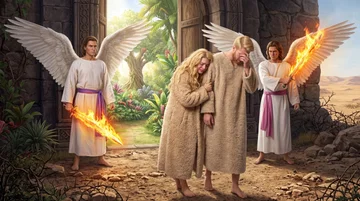
The sending forth was decided by counsel in heaven over the guilty pair and carried out by holy angels.EW 119.1–2SG1 21.2 The angels who had been appointed to guard Adam before his sin were assigned to guard the gates of paradise and the way to the tree of life, preventing return.LC1 116.12RED 12.1 They drove the transgressors out and barred the way with the appearance of glittering swords of light in the right hand, with beams of light flashing around them like a glittering sword turning every way, so that none of Adam's family could pass the barrier to eat the life-giving fruit.EW 119.1–2PP 60.3 The reason was to keep them from putting forth the hand to eat again of the tree of life and becoming immortal sinners living forever in sin, misery, and disobedience.EW 119.1–2SG1 21.2PP 60.3
The garden itself remained on earth after the first parents were driven out.1SP 61.1SG3 55.1ST Feb 20, 1879 God preserved it as a specimen and sample of His perfect creation and handiwork as it was in the beginning, specially blessed and kept free from the curse sin brought upon the earth, for He would not suffer it to feel the marks of the curse.1SP 61.1SG3 55.1ST Feb 20, 187910MR 158.2 He withdrew it and caught it up from the earth when He destroyed the world by the Flood in preparation for that judgment.1SP 61.1SG3 55.1ST Feb 20, 187910MR 158.2 He will return it to earth more gloriously adorned than before, and that lovely garden still exists preserved, beheld with joy.1SP 61.1SG3 55.1ST Feb 20, 187910MR 158.2 As Adam and Eve were shut out of Paradise for their fall, so Satan had been shut out of heaven for his fall, and Satan triumphed in their expulsion because by his own fall he had made others suffer.EW 119.1–2SG1 22.1
Reason for Expulsion
Adam and Eve were expelled because they disobeyed God's express command and prohibition by eating the forbidden fruit from the tree of knowledge of good and evil, transgressing His law imprinted on their hearts.Lt 31, 1898, par. 20–214T 11.3RH Feb 24, 18742RED 74.3LC1 178.3 Their loss of Eden was retribution for that transgression, showing that sin drove man from Paradise, that disobedience brings punishment and God's justice does not fail.Lt 35a, 1877, par. 3–64T 11.3RH Feb 24, 18742RED 74.3 The driving out was necessary to separate fallen man from the tree of life, lest after transgression he eat and live forever as an immortal sinner and thus perpetuate sin.Lt 31, 1898, par. 20–21RH Feb 24, 18741SP 44.1 Death entered the world because of transgression, yet the expulsion left the fallen race needing God giving His Son from heaven to save them, whose sacrifice to pay the debt of transgression exalts the law and makes it possible through merits and blood to return to loyalty and keep the commandments.Lt 31, 1898, par. 20–21Lt 35a, 1877, par. 3–6RH Feb 24, 1874 If the race had ceased falling when Adam was driven out it would now be far more elevated in physical, mental, and moral condition, but his fall brought sin into the world with unutterable woe and began a succession of falls.2RED 74.3LC1 178.3
The fall began during daily labor together when Eve was cautioned by angels to beware separating herself from her husband, with whom she would be in less danger than alone.PP 53.5 Absorbed in her pleasing task she unconsciously wandered from his side, felt apprehension at being alone but dismissed her fears, deciding she had sufficient wisdom and strength to discern evil and withstand it.PP 53.5 Unmindful of the caution she gazed with mingled curiosity and admiration upon the forbidden tree, questioned why God had withheld its very beautiful fruit, and lingered wonderingly to hear the wise and beautiful serpent speak instead of fleeing.PP 53.5 She was beguiled by the serpent to disbelieve God's warning that in the day of eating they would surely die, ate and felt no death but a pleasurable sensation she imagined as new and more exalted life like the angels, bore the fruit to her husband, and Adam permitted her experience to stand against Jehovah's positive command and was seduced.CTBH 42.1–3MYP 75.3 Seeking happiness by having one's own unrestrained way occupies Eve's position and ends in the same loss of all the glories of Eden.MYP 75.3
Believing Satan's words and misrepresentations over the Lord's words caused the exclusion, for Adam insulted his Maker by believing Satan and disbelieving the Lord and discarded the words of the Lord to heed the words of Satan.Ms 180, 1897, par. 4Lt 31, 1898, par. 41Ms 141, 1899, par. 5–6 Satan's promise that eating would give higher perceptions to know good and evil and make them like the angels in heaven proved a lie, and their expulsion to work among thistles, brambles, thorns and weeds proved it so.Ms 120, 1899, par. 8 They lost their beautiful home because they believed the lie of Satan rather than the instruction of the word of God, though before revolt Adam was created full of light and knowledge, pure and perfect, bearing God's signature, loving his Creator, holding personal communion with God, and made only a little lower than the angels.Ms 110, 1893, par. 6–7 By listening to Satan's sophistry their fall gave him his first control in the Lord's vineyard to begin sowing seeds of evil in the earth.Ms 129, 1899, par. 2–4 The same temptation has continued ever since, the word received through human agencies against a plain thus saith the Lord, to make the law of Jehovah of no consequence and bring in every species of deception so that God's great moral standard, His memorial of creation, the Sabbath day, shall not be respected.Ms 110, 1893, par. 6–7
The act seemed simple and unworthy of notice, a small act of eating what was beautiful and pleasant to taste, a single gratification of appetite and desire, yet it broke allegiance to God and opened the floodgates of woe to the world.Lt 35a, 1877, par. 3–6CTBH 42.1–3 That first surrender to appetite opened the gates to a flood of guilt and woe, brought sin and death into the world, and proves the greatest events hang on apparently small things and God approves no work with even one thread of selfishness.Lt 35a, 1877, par. 3–6CTBH 42.1–3 True experience is in harmony with natural and divine law while false experience arrays itself against the laws of life and the precepts of Jehovah.CTBH 42.1–3 The loss of Eden came through intemperate desire by yielding to appetite with curiosity and ambition, weakening moral powers by indulgence of perverted appetite, and temperance in all things has more to do than men realize with restoration to Eden.MH 129.2CTBH 193.2ST Jul 8, 18803T 561.3 The record of being sent forth to till the ground was written for the benefit of all who should live upon the earth, to deter them from recklessly departing from God's requirements and following the same steps.ST Jul 8, 1880
Adam's accusation against Eve did not save him from the result of disobedience, and he and Eve were shut out with an angel with a flaming sword guarding the way so the disloyal pair could not gain access to the tree of life and thus immortalize transgression.ST May 29, 1901 They begged to stay in the home of innocence and joy, admitted they had lost all right to that happy home, and promised strict obedience in the future, but they were refused and their promises could not restore forfeited right to Eden.1SP 44.1PP 61.4 Sin had made their nature depraved, weakened their strength to resist evil, left them weaker after falling from innocence, and opened the way for Satan to gain easier access to them, so having yielded in innocence they would have even less power to maintain integrity in conscious guilt.1SP 44.1PP 61.4 Remaining there in that sinful state would have let them reach the tree of life and continue a life of sin, and they now understood that sin brought death.1SP 44.1
Tree of Life Guarded
The sending forth cut fallen humanity off from the tree of life, whose fruit in the earthly garden had power to sustain life and immortality and counteract death.8T 288.1–2PP 60.3ST Jun 17, 1897 Endless existence required continuing to eat of it, and deprived of it human vitality gradually wears out and diminishes until life becomes extinct.1SP 69.1SG3 64.1ST Feb 27, 1879PP 60.3 After disobedience Adam lost the privilege of eating and continuing to live indefinitely, and Adam and the human family came under the death penalty.SG3 64.1ST Feb 27, 1879ST Jun 17, 1897
The tree possessed supernatural virtue: to eat of its fruit was to live forever, its fruit was the antidote for death and its leaves were for the sustaining of life and immortality.17MR 351.3–352.2Ms 41, 1902, par. 12–15ST Mar 31, 1909 By that loss of access through being sent forth, everlasting life was lost.Ms 41, 1902, par. 12–15Ms 71, 1896, par. 19–20 The tree was a type of the one great Source of immortality, Christ the fountain of life and the bread of life, in whom was life, whose flesh and blood received by faith perfects spiritual life, whose words are spirit and life, and obedience to whom is life-giving power that gladdens the soul.17MR 351.3–352.2Ms 41, 1902, par. 12–15ST Mar 31, 1909Ms 71, 1896, par. 19–20Ms 114, 1898, par. 17–19 The tree of life is also truth, whose fruit perpetuates immortality and gives life that measures with the life of God, granted to him that overcomes to eat in the midst of the paradise of God.17MR 351.3–352.2Ms 41, 1902, par. 12–15Lt 60, 1900, par. 11–12 Those who eat of the forbidden tree by accepting fallacies in place of Thus saith the Lord partake of error and die in their sins with no eternal life unless they repent.Lt 60, 1900, par. 11–12
God barred the way with cherubim and a flaming sword turning every way, with beams of light flashing like a glittering sword, so the transgressors could not put forth the hand, approach, eat again, and become immortal sinners living forever in sin, misery, and disobedience.Lt 31, 1898, par. 20–21EW 42.3EW 119.1–2EW 103.2PP 60.3 Man was dependent on the tree for immortality, and to eat after transgression would have perpetuated sin and a life of sin.Lt 31, 1898, par. 20–21ExVEGW 32.41SP 42.2 The driving out was therefore necessary to separate fallen man from the tree, lest men eat and live forever as immortal sinners.Lt 31, 1898, par. 20–21ExVEGW 32.4EW 42.3SCEV 46.4
Not one of Adam's family has passed that flaming sword and eaten of that tree, so there is not an immortal sinner.ExVEGW 32.4EW 42.3EW 182.1SG1 113.216MR 35.1 The soul that sins dies an everlasting death that lasts forever with no hope of resurrection, and then wrath is appeased.ExVEGW 32.4EW 42.3EW 182.1SG1 113.2 This proves false Satan's word that sinners will not die.SG1 113.2
The exclusion defeated Satan's studied plan that after disobeying and incurring God's frown and displeasure the pair would without forgiveness eat of the tree and immortalize sin and perpetuate an existence of sin and misery.EW 119.1–2SG1 21.2PP 60.3 He intended first to lead them to disobey and receive God's frown and then to lead them to partake, and he also planned to beguile them so God would provide a pardon they received that he and his fallen angels could then share.SG1 21.21SP 30.3–4ST Jan 16, 1879 If pardon failed, their transgression would place them in rebellion like the fallen angels to unite with them, take possession of Eden as home, and hold it as headquarters and throne for his dominion after claiming the world by conquering Adam.1SP 30.3–4ST Jan 16, 18792RED 13.1 His party thought that if they could gain access to the tree in the midst of the garden their strength would become equal to the holy angels so that even God Himself could not expel them.1SP 30.3–4ST Jan 16, 1879
Access to the tree in the earthly garden was conditional and was finally withdrawn after the entrance of sin.8T 288.1–2ST Mar 31, 1909ED 302.1 God transplanted the tree to the paradise above, yet its branches reach to the lower world and hang over the wall, so that through redemption purchased by Christ's blood fallen people may still eat its life-giving fruit.8T 288.1–2ST Mar 31, 1909
Changed Life Outside
Driven from Eden to till the ground from which he had been taken, Adam must now work the cursed earth under toil and anxiety for daily bread instead of dressing and keeping the garden.ST Jan 23, 1879Ms 120, 1899, par. 8ST Oct 9, 1884Ms 129, 1899, par. 2–4 The pleasant labor known before is replaced by struggle with stubborn soil that brings forth thistles, brambles, thorns, briers and weeds, the growth of the curse Satan sowed.LC1 117.12RED 13.1Ms 120, 1899, par. 8ST Oct 9, 1884 The removal was necessary because it was no longer safe to remain near the tree of life and perpetuate a life of sin, for all right to the beautiful home was forfeited by disobedience and listening to Satan's sophistry.ST Jan 23, 1879LC1 117.12RED 13.1Ms 129, 1899, par. 2–4 Exclusion is enforced by strong angels as sentinels with beams of light like flaming swords turning every way toward the tree, barring the approach of Satan and the guilty pair lest they partake and immortalize transgression, while God's curse is pronounced on the earth.LC1 117.12RED 13.1Ms 129, 1899, par. 2–4 The event exposes Satan's promise of higher perceptions to know good and evil and likeness to angels as a lie, and marks his first control in the Lord's vineyard to begin sowing seeds of evil.Ms 120, 1899, par. 8Ms 129, 1899, par. 2–4
That toilsome labor is widely different from the pleasant, invigorating occupation of Eden, yet it remains a blessing and not a curse, appointed by God who understands what is for man's happiness.ST Oct 9, 1884PP 50.1 It was given to occupy the mind, strengthen the body, and develop the faculties, and the true joy of life is found only by working men and women.PP 50.1 Even in stubborn soil it protects from temptation and gives happiness.ST Oct 9, 1884PP 50.1
Conditions of life are changed outside, for the atmosphere once mild and uniform in temperature is now subject to marked changes of heat and cold, and the Lord mercifully provides garments of skins as protection from extremes of heat and chill.SG3 46.1ST Jan 30, 18791SP 49.1–50.2PP 61.5 The guilty race is sent out in humility and deep sadness to dwell where the curse rests, bidding farewell in unutterable sadness to the holy estate, and being cut off from the life-giving tree brings sadness, suffering, disease, misery and death.SG3 46.1Ms 140, 1903, par. 16PP 61.5 Earth is divorced from heaven and separated from communion and favor with God, the fallen race shut out because on the point of appetite they did not live by every word from the mouth of God.MH 427.2SG3 46.2Ms 16, 1886, par. 3–4
Sent out, man becomes subject to death and must finally pass through death back to dust again, no longer freely eating from the tree that prolongs life, so that the sentence of returning to dust means extinction of life.LC1 117.12RED 13.1GC88 532.2–533.1 Leaving the garden brings home to Adam that he must die, at first regarded as a dreadful calamity, though after centuries of sorrow he comes to see the sentence as just and merciful because it would end a miserable life.SG3 50.2 Only a few generations pass between that access and the days of Noah, so the race still retains much early vigor and man's existence is still measured by centuries.PP 90.2 While he lives he remains exposed to Satan's temptations.LC1 117.12RED 13.1
The fall brings unutterable woe with loss of elevated physical, mental and moral condition, marring the divine likeness, weakening powers, dimming spiritual vision, and bringing subjection to death.LC1 178.3ED 15.2RH Mar 4, 1875 Humanity becomes estranged from God and earth is separated from heaven, with separation from communion bringing misery to the race, yet without lessening or changing the claims of God's law.MH 427.2ED 15.2SG3 46.2 The close attachment to God and tender attachment to one another purposed for men is broken, and the race is put on trial during probationary time.SPBC 178.2–4 If falls had stopped when Adam was driven out the race would now be far more elevated in health, beauty and moral power, but successive falls bring greater crime, disease and loss.LC1 178.3RH Mar 4, 1875
Sent from Eden to till the ground, Adam lives nearly a thousand years among men as a witness to the results of sin and faithfully seeks to stem the tide of evil.PP 82.1 He is commanded to instruct his posterity in the way of the Lord, carefully treasures what God reveals, and repeats it to children and children's children to the ninth generation.PP 82.1 He describes man's holy and happy estate in Paradise, repeats the history of the fall, tells of the sufferings by which God taught the necessity of strict adherence to His law, and explains the merciful provisions for salvation, yet few give heed and often he is met with bitter reproaches for the sin that brought woe upon posterity.PP 82.1 The sending forth marks the degradation of beautiful Eden by the introduction of sin.20MR 151.2
Redemption and Restoration
Even as the curse was pronounced and wrath hung over the guilty pair, pardon through a coming Saviour was promised, the gospel first preached in Eden to a dark future not relieved by a single ray of hope.ST Jan 17, 1911Ms 180, 1897, par. 4 Adam and Eve sincerely repented of guilt, believed the promise, and were saved from utter ruin, their case not altogether hopeless because the promised sacrifice opened a door of hope and a way to redemption through faith.1SP 49.1–50.2 The Son of God undertook to become the Redeemer of the race, and while wrath still hung over fallen Adam the full execution of the pronounced sentence of death was delayed and divine indignation restrained because Christ had entered upon taking the wrath which in justice should fall upon man.2RED 16.2–17.1 Christ became a refuge so that the criminal deserving wrath could by faith run into the provision and be safe, with life in the midst of death if he chose to accept it.2RED 16.2–17.1 The holy and infinite God dwelling in unapproachable light could no longer talk directly with man, yet Satan's claim to have forever broken the link between heaven and earth was mistaken, for the Father gave the world into the hands of His Son to redeem it from the curse and disgrace of failure, an invincible Deliverer, the Only Begotten full of grace and truth to be received and worshiped, so that through Christ alone man finds access to God and through Christ alone God holds communication with man.2RED 16.2–17.1Ms 180, 1897, par. 4
Driving out was necessary to separate fallen man, dependent on the tree for immortality, from the tree of life, lest he eat after transgression and perpetuate sin as an immortal sinner.Lt 31, 1898, par. 20–21 Death entered by transgression, but Christ gave His life to give man another trial and a second probation, not to abolish the law and not to make sin immortal, but to suffer insult and death and bear sins and take the sentence of death upon Himself as ransom for the race and for the whole world.Lt 31, 1898, par. 20–21EW 104.1–2 In close converse with the Father He obtained permission to give His own life a ransom, thus opening a way of escape whereby through the merits of His blood pardon for past transgressions is found.EW 104.1–2 By that suffering of the full penalty of the broken law He secured the right to destroy the devil who had the power of death, that men would return to loyalty and keep the commandments.Lt 31, 1898, par. 20–21 Because He took the human family into close relationship to His humanity and gave His life as Substitute, everyone now has privilege to put forth the hand to soul-reviving fruit and eat freely and live forever, with the barrier removed.Ms 89, 1900, par. 31 Adam was sent forth and placed with all posterity upon probation where the salvation of every soul is determined by obedience or disobedience, and through Jesus' life given as ransom, His blood and His obedience to God's law, lost people can receive pardon and favor and be brought into the garden to eat from the tree of life, reuniting earth with heaven and fallen man with God.Lt 110, 1896, par. 9–151SP 45.1Ms 16, 1886, par. 3–4
That provision does not set aside law or penalty at the expense of justice, for God expelled them rather than changing His changeless law to meet man fallen.Lt 31, 1898, par. 20–21Lt 110, 1896, par. 9–15ST Dec 15, 1887 If change had been possible Adam would have been pardoned and retained Eden and Christ retained in heaven, but the penalty remained death with binding force upon every human being.Lt 110, 1896, par. 9–15 There is no return to innocence and life except through repentance for breaking God's law and faith in Jesus as the only Redeemer and in His atoning blood and sacrifice, whose merits avail for sinful humanity, with acceptance conditioned on obedience to the Creator's commandments.RH Feb 24, 1874LC1 116.2ST Dec 15, 1887 Obedience to the words spoken from Sinai, which are the conditions of life, will give free access to the tree again, and doing the commandments is the condition for having right to it again.SG3 88.1SG4 150.1 Loss of Eden proves that to be once in grace is not to be always in grace, and with Satan's fall from heaven it demonstrates the sure result of transgression, whose awful results the condition of the race today testifies.Ms 2, 1904, par. 38–41
Christ overcame the test Adam failed and redeemed Adam's failure and fall, His humble obedience making it possible to regain lost Eden from under the power of the prince of darkness.4T 293.2–3LC1 118.2 Adam's disgraceful failure put the family at disadvantage with God, but Christ in the wilderness of temptation passed over the same ground where Adam fell and gained the victory Adam failed to gain.Lt 148a, 1897, par. 3–4 He met there a temptation a hundred times more trying than Adam and Eve met in Eden, fasting forty days and forty nights and overcoming appetite by living by every word that proceeds from the mouth of God, whereas they fell on appetite by not living by every word.Ms 16, 1886, par. 3–4 By that victory He redeemed the disgraceful fall, encircled the fallen race, and placed the human family on vantage ground with God, making it possible to overcome through the merits of the crucified and risen Saviour and to be brought back to the Eden home by living by every word.Lt 148a, 1897, par. 3–4Ms 16, 1886, par. 3–4
By virtue of His blood obedience to the law makes man worthy of heavenly blessing and grants right again to the tree of life and entrance through the gates into the City, disobedience having taken away the right.SG3 88.1 Through the gospel the way to its fruit, barred by the flaming sword, is now open to all who will receive it, that they may live forever, and no flaming sword bars those who obey God's commandments despite opposition.ST Feb 27, 19126T 19.3Ms 89, 1900, par. 31 Relying on the merits of His blood, people receive pardon, keep the law, return to loyalty and receive Christ's righteousness, and are brought back to the garden from which they were driven to again have access and eat of immortal fruit.SCEV 47.1EW 104.1–21SP 45.1 After resurrection Adam himself again sees Paradise and is granted access, his loss and return linked to disobedience and to repentance and faithful obedience.SG3 88.2–89.1 The life thus offered is more perfect than what was forfeited.1SP 45.1
Doctrine and Warning
The sending out of Eden stands as proof that the divine word is sacred and must be obeyed, that disobedience is met with punishment, and that divine justice does not fail.4T 11.3ST Apr 15, 1875ST Dec 15, 1887HSFM 231.3 The expulsion followed transgression of an express prohibition, and it shows that violation of law is the greatest loss and that breaking even one requirement brings serious consequences under severe and exacting justice.Lt 35a, 1877, par. 3–64T 11.3ST Apr 15, 1875 Disregard of the expressed will cost a beautiful home and brought sin and woe into the world, warning all against the path of disobedience and calling to humble obedience.2RED 74.3ST Dec 15, 1887HSFM 231.3
The law could not be changed or altered to meet man in his fallen condition.Lt 110, 1896, par. 9–15SG3 46.2 If change had been possible, pardon would have retained the first home in Eden and the immense sacrifice for a fallen race would have been avoided with Christ retained in the heavenly courts.Lt 110, 1896, par. 9–15 Instead the penalty of transgression remained death, the law remained changeless in character and binding upon every human being, and the fall did not lessen its claims though it brought separation from communion and misery to the race.Lt 110, 1896, par. 9–15SG3 46.2 The fallen pair with all posterity were therefore placed upon probation where salvation is determined by obedience or disobedience, with a Substitute and Surety given in their behalf.Lt 110, 1896, par. 9–15
The loss warns that to violate one command such as the Sabbath brings punishment as surely as to violate stealing, murder, or adultery, for an act that seemed simple and unworthy of notice opened the floodgates of woe.Lt 35a, 1877, par. 3–6 Mercy does not excuse transgression but covers guilt only after sin is repented of and forsaken, while the costly sacrifice to pay the debt exalts the law and makes keeping it possible through merits and blood.Lt 35a, 1877, par. 3–6 After the fall the pair continued to observe the Sabbath, having learned that commands are serious and that transgression is surely punished.SG3 52.21SP 59.1ST Feb 6, 1879
The first fall began a succession of falls that has continued ever since, bringing unutterable woe with loss of elevated physical, mental, and moral condition.2RED 74.3LC1 178.3ST Feb 11, 1875RH Jul 9, 1901 If falling had stopped with the driving out, the race would now be far more elevated, but men repeat the violation while mourning it, compounding consequences instead of learning from the example.LC1 178.3ST Feb 11, 1875RH Mar 4, 1875 Successive disobedience has brought greater crime, disease, and loss of health, beauty, and moral power, perpetuating the first violation from parents to children and marring all beauty given.RH Mar 4, 1875RH Jul 9, 1901Ms 25, 1885, par. 28–29
The sending was mercy, not arbitrary severity.PP 120.3Lt 57, 1895, par. 4–7 The builders of Babel misread the expulsion together with the Flood as harshness and complained against God instead of gratefully remembering mercy, thereby revealing a false view of Him as arbitrary and severe.PP 120.3 By rejecting His justice, purity, and love they placed themselves under the cruelest tyrant, whose oppression, violence, and brutality supplant divine attributes.PP 120.3 In the same way Cain judged the expulsion harsh, finding torture in the constant confession of dependence shown in the blood of the slain lamb and refusing in his own offering to acknowledge a Power outside himself, though the expulsion was meant to keep sin ever before the mind.Lt 57, 1895, par. 4–7
The verse belongs to sacred history outlining the fall and its results, to inspired history of the race that all may research, recording disobedience and impenitence with just retribution after holy innocency and communion with God and sinless angels.CT 427.3MYP 254.2–255.1GC88 582.3 From that turning away and departure, children of God have watched, waited, longed, and prayed for events to come.ED 183.1–2PK 731.3 From the sending forth down through patriarchal and Jewish ages to the present there is a gradual unfolding of one purpose in the plan of redemption, the same work in all time with different degrees of development and manifestations of power to meet human wants in different ages.ST Jun 3, 1886
Application and Witness
Seeking happiness by having one's own unrestrained way brings unhappiness and loss instead of exaltation, for Eve imagined she would be highly exalted by eating fruit God had forbidden even to touch lest she die, and when she ate she lost all the glories of Eden and was sent out.MYP 75.3 To desire one's own way unrestrained is to occupy Eve's position in Eden and to end in the same loss.MYP 75.3 Adam and Eve lost the right to their Eden home through disobedience and were sent out from it, and choosing that same disobedience now forfeits the right to the Eden restored.Lt 236, 1903, par. 21–22 Adam lost Eden because he discarded the words of the Lord and heeded the words of Satan, proving transgression does not pay, and the same result follows transgression of God's commandments now, causing loss of heaven and an eternity of bliss, so each must decide whether to follow the Lord or Baal.Lt 31, 1898, par. 41Ms 8, 1888, par. 31–32 Paradise was lost by disobedience, and keeping the precepts of God's law in home life and in all business transactions fits a people to regain that lost Paradise.Ms 71, 1896, par. 3 Adam and Eve lost Eden because they disobeyed God's commandments, and keeping God's commandments is the test of love for Him, so the human family must obey the light given about the binding claims of God's law and lift the cross before the whole world.Ms 8, 1888, par. 31–32Ms 16, 1895, par. 19
The loss of Eden came through intemperate desire by the first parents, and temperance in all things has more to do than men realize with restoration to Eden.MH 129.2 Eating what God had forbidden cost man his right to Paradise, making perverted appetite the cause of expulsion.Ms 126, 1903, par. 21–22 Getting ready for Paradise restored requires bringing perverted appetite under strict control, because indulging depraved appetite weakens the power to resist evil and enables Satan to fasten evil habits upon man and ensnare him in his devices.Ms 126, 1903, par. 21–22 When Adam lost his Eden home and was sent out to till the ground, God did not cut off the supply of fruit but still prepared for him the most nourishing food because He knew how to give proper nourishment.Lt 157, 1900, par. 17–18 That continued provision teaches gratitude and gives a lesson for diet now to appreciate good food in its natural state with clear discernment, without spending time and labor cooking a variety of foods and mixing them together, for food good to eat in its natural state is rendered unwholesome by mixing and burdens the digestive organs.Lt 157, 1900, par. 17–18
Gaining the forbidden knowledge through disobedience led Adam and Eve to lose their Eden home, warning that pursuing knowledge from unsatisfied desires and unholy aims brings loss rather than bliss.5T 503.3RH Aug 4, 1910 The forbidden knowledge they sought brought an experience God had not intended them to have, and their expulsion illustrates the grave cost of unholy desires and aims.RH Aug 4, 1910 They were sent out of Eden to live on the earth under sin's curse, and had to regain their lost position under the unfavorable conditions their choice had brought, for Eden could no longer teach them the lessons they now needed to learn.ED 25.4–26.1ED 14.3–4 Had they never touched that tree they would have remained where God could impart to them knowledge from His word, knowledge that would not have to be left behind with the things of this world but could be carried with them to the paradise of God.FE 446.1 The knowledge they seized instead wearies minds to death with unnecessary labor to obtain it, and is like the godless education of today, mere wood and stubble to be consumed in the last great burning, dying with its holder and of no value to God.FE 446.1 Man's first education in sinless manhood in Eden by communion with God was broken by the coming in of a knowledge of evil, and understanding education requires considering this change together with the nature of man, God's purpose in creating him, and God's plan for still fulfilling His glorious purpose in educating the human race.ED 14.3–4
Because of transgression Adam and Eve were sent out of Eden, their home, which is the Paradise of God from which they were excluded, and faithful spiritual labor and sharing God's instruction and grace with others are part of the work through which people may enter that Paradise.ST Feb 3, 1909 Adam was not permitted to keep working in the garden because he believed Satan's misrepresentations and disobeyed his Creator, and his exclusion is reversed through mercy by Christ calling fallen men back to work in His vineyard as His purchased heritage, accepted as laborers together with God to build obedient character.Ms 141, 1899, par. 5–6 Because of sin they were sent to work the ground from which Adam had been formed and the earth was cursed, but God's people can cooperate with Him in restoring their land to fertility and beauty by following His instructions for cultivating the soil, and the land's renewed abundance illustrates the spiritual fruits of obedience to God's moral law.COL 289.2–3 The fall ending in expulsion from the Eden home was witnessed by angels, the very ones who fought for God when Satan sought supremacy in heaven and who shouted for joy over creation of the world and of the first parents to inhabit it.RH Mar 19, 1901ST Dec 1, 1909Ms 65a, 1900, par. 4–7 Those same heavenly messengers who desire to look into the plan of redemption are now most intensely interested to work in union with the fallen, redeemed race for salvation of human beings perishing in sins, with invisible angelic agencies cooperating with visible human agencies to bind up the wounds and bruises sin has made and to restore the moral image of God in man.RH Mar 19, 1901ST Dec 1, 19096T 456.1–457.2Ms 65a, 1900, par. 4–7
Adam and Eve were banished from Eden because they transgressed God's law, and their expulsion provides the setting for Christ as humanity's Substitute to suffer and die outside Jerusalem's gate and boundaries.ST Jan 27, 1914DA 741.1–2 The sending marks the beginning of life outside where people must work the ground from which they were formed, and continued violation of God's physical laws has greatly aggravated the evils brought by Eden's transgression, bringing suffering, disease, and weakness. After the fall Satan claimed control over nature, though God permitted his work while protecting those who follow heaven's principles.Ms 154, 1903, par. 16–18 The fall broke the close attachment to God and tender attachment to one another purposed for men, and put the human race on trial during probationary time.SPBC 178.2–4 In that history the same principles of Satan are still at work, with Satan playing the game of life for every soul while Christ works for every soul, and each works out salvation by the choice of character formed, laying hold of the Saviour and receiving His merits by faith to perfect a character like His; those consenting to receive the moral image of God become like Him in character, but those refusing the character of Christ lose heaven.SPBC 178.2–4
Sources