Genesis 3:9
And the LORD God called unto Adam, and said unto him, Where art thou?
Translations
And the LORD God called to Adam, and said to him, Where are you?
And the LORD God called unto Adam, and said unto him, Where art thou?
And the Lord God called unto Adam, and said unto him, Where art thou?
And the LORD God called to Adam, and said to him, Where art thou?
And the LORD God called unto the man, and said unto him, Where art thou?
And Jehovah God called unto the man, and said unto him, Where art thou?
And Jehovah God calleth unto the man, and saith to him, 'Where [art] thou?'
And Jehovah Elohim called to Man, and said to him, Where art thou?
And Yahweh God called unto the man,—and said to him, Where art thou?
Berean Standard Bible, Majority Standard Bible
But the LORD God called out to the man, “Where are you?”
The LORD God called to the man, and said to him, “Where are you?”
And the voice of the Lord God came to the man, saying, Where are you?
But the Lord God called to the man, and said vnto him, Where art thou?
Douay-Rheims (Challoner revision)
And the Lord God called Adam, and said to him: Where art thou?
Pictures



Cross-references
- Romans 5:12
Wherefore, as by one man sin entered into the world, and death by sin; and so death passed upon all men, for that all have sinned:
Adam’s transgression brought sin and death into the world and spread them to all humanity.
- Genesis 2:16-17
And the LORD God commanded the man, saying, Of every tree of the garden thou mayest freely eat:
God’s command and warning establish the consequence of Adam’s disobedience.
- Genesis 3:17-19
And unto Adam he said, Because thou hast hearkened unto the voice of thy wife, and hast eaten of the tree, of which I commanded thee, saying, Thou shalt not eat of it: cursed is the ground for thy sake; in sorrow shalt thou eat of it all the days of thy life;
The passage connects Adam’s transgression with the curse and its consequences.
- 1 Corinthians 15:21-22
For since by man came death, by man came also the resurrection of the dead.
Adam’s role in the fall grounds the contrast between death in Adam and life in Christ.
- Genesis 3:23-24
Therefore the LORD God sent him forth from the garden of Eden, to till the ground from whence he was taken.
Adam and Eve are driven from Eden after their disobedience.
- Genesis 3:4-5
And the serpent said unto the woman, Ye shall not surely die:
The serpent’s false promise of godlike knowledge led to humanity’s fall.
- Genesis 4:9
And the LORD said unto Cain, Where is Abel thy brother? And he said, I know not: Am I my brother’s keeper?
God asks Cain where Abel is, echoing his question to Adam.
- Genesis 3:13
And the LORD God said unto the woman, What is this that thou hast done? And the woman said, The serpent beguiled me, and I did eat.
Eve blames the serpent, saying it beguiled her.
- 1 Timothy 2:13-14
For Adam was first formed, then Eve.
It recounts Adam’s formation and Eve’s deception in the transgression.
- Genesis 2:8-15
And the LORD God planted a garden eastward in Eden; and there he put the man whom he had formed.
Describes Eden, prepared for humanity in innocence.
- Genesis 1:26-27
And God said, Let us make man in our image, after our likeness: and let them have dominion over the fish of the sea, and over the fowl of the air, and over the cattle, and over all the earth, and over every creeping thing that creepeth upon the earth.
Adam, made in God’s image, is the one God calls.
- Luke 19:10
For the Son of man is come to seek and to save that which was lost.
God seeks Adam, illustrating the Son of Man’s mission to seek and save the lost.
- Genesis 5:2
Male and female created he them; and blessed them, and called their name Adam, in the day when they were created.
God called the male and female together Adam before the fall.
- 1 Kings 19:9
And he came thither unto a cave, and lodged there; and, behold, the word of the LORD came to him, and he said unto him, What doest thou here, Elijah?
Both texts ask a direct divine question that prompts self-examination.
- Luke 3:38
Which was the son of Enos, which was the son of Seth, which was the son of Adam, which was the son of God.
Adam is identified as the son of God.
- Romans 5:19
For as by one man’s disobedience many were made sinners, so by the obedience of one shall many be made righteous.
Connects humanity’s sin to Adam’s disobedience.
- James 4:8
Draw nigh to God, and he will draw nigh to you. Cleanse your hands, ye sinners; and purify your hearts, ye double minded.
Contrasts hiding from God with drawing near to Him.
Commentary part 1 of 2
Each commentary is drawn from primary sources: the writings of Ellen G. White and Adventist pioneers and periodicals. Each commentary is separate. Its own words are not a quotation; follow the references to read the source passages.
Ellen G. White
85 sources
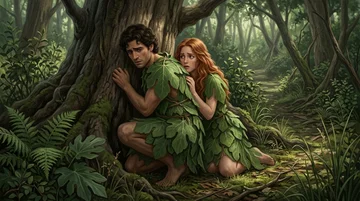
After they ate the forbidden fruit, knew they were naked, and hid among the trees at the sound of God walking in the garden, He called to Adam asking where he was.Ms 97, 1901, par. 3–8Ms 31, 1901, par. 4–8Ms 17, 1893, par. 3–5 The question was not asked to gain information, but to seek out the hiding pair, bring them to conviction of guilt, and draw from them confession about their fear, nakedness, and eating.ST Jan 23, 18791SP 42.3Ms 31, 1901, par. 4–8 Their nakedness was the loss of the covering of heavenly light, purity, glory and innocence that had enshrouded them, leaving the soul polluted and without righteousness.Lt 106, 1896, par. 4–62RED 33.1–34.2PP 57.1 That one transgression broke the binding law, let sin and death enter the world, opened the floodgates of woe and suffering, and caused the loss of the Eden home and access to the tree of life.Ms 97, 1901, par. 3–8Lt 35a, 1877, par. 3–6CTBH 42.1–3EW 103.2ST Feb 27, 1912 Yet God did not leave the guilty pair without hope, but confronted them with the first promise of the gospel, in which Christ would bear the wrath due sinners, delay the sentence of death, and clothe the repentant with the white robe of His own righteousness.Lt 106, 1896, par. 4–6Ms 17, 1893, par. 3–5ST Dec 23, 18862RED 16.2–17.18MR 323.2
Words and Setting
The call sounds after the eating of the forbidden fruit, when the pair knew they were naked and sewed fig leaves into aprons, and when hearing the voice of the Lord God walking in the garden in the cool of the day they hid themselves from His presence among the trees of the garden.Ms 97, 1901, par. 3–8Ms 31, 1901, par. 4–8 It seeks out Adam in Eden after yielding to the tempter, drawing from him the confession that he heard the voice and hid because he was afraid and naked, which opens the further questioning of who told him of his nakedness and whether he had eaten of the forbidden tree, until he throws the blame on the woman given to him.Ms 97, 1901, par. 3–8Ms 31, 1901, par. 4–8 The fall it exposes came by listening to Satan's misrepresentation of God, through which sin entered the world and death by sin, and it leaves Adam without excuse because all his wants were supplied and only one prohibition had been laid upon him.Ms 97, 1901, par. 3–8
Before sin they had been glad to see their Creator when He came to walk and talk with them, clothed in a covering of light as a garment of innocence, and in innocence and holiness they had joyfully welcomed His approach and delighted to meet Him.ST Jan 23, 18791SP 42.3Ms 31, 1901, par. 4–8ST Nov 18, 1913PP 57.4 After disobedience that covering was taken away, their eyes were opened not to godhood but to their own shame and ruin, and they saw that nakedness is the result of transgression.Ms 31, 1901, par. 4–8ST May 29, 1901 In sinfulness they were afraid to meet Him, and on hearing His voice among the trees they fled in terror, shame and remorse from His presence and hid themselves from His face in guilt, seeking the deepest recesses of the garden because they now anticipated a condemnation of God they had never known.Ms 31, 1901, par. 4–8Ms 17, 1893, par. 3–5ST Nov 18, 1913PP 57.4ST May 29, 1901 The question asking where Adam is was not asked for information but to bring the guilty pair to conviction of guilt, to seek out the hiding one and confront disobedience against binding law by exposing that they had eaten from the tree of knowledge.ST Jan 23, 18791SP 42.3Ms 17, 1893, par. 3–5 God thus manifests His divine presence as the great Lawgiver to make known the consequences of transgression, beginning the encounter in which fear and nakedness and eating what was commanded not to be eaten are laid open, yet He does not leave them there but gives a star of hope to illuminate the dark future in the first gospel promise.Ms 17, 1893, par. 3–5ST Nov 18, 1913PP 57.4
Their nakedness means the garments of purity and brightness, the covering God had given, had fallen away and left them naked, ashamed and afraid rather than ready to respond.Lt 106, 1896, par. 4–6 It means the robe of light that had enshrouded them disappeared, the light of the garments of heavenly innocence departed, and with it went the glory that had covered them and the purity and dignity received from God.Lt 106, 1896, par. 4–62RED 33.1–34.2PP 57.1ST Jun 11, 1874ST May 5, 1909 Unclothed they could not meet the eye of God and holy angels, their imagined higher existence giving way to terror over sin, loss of love and peace, a sense of sin, dread of the future, and nakedness of soul, while even the mild air seemed to chill them so that they tried to fashion a covering for themselves.PP 57.1 Nakedness is a soul polluted with sin and without Christ's righteousness, the same condition of all who yield to temptation and give themselves to obey Satan, who are naked and afraid to meet God and need to be clothed again with white raiment, the white robe of Christ's righteousness obtained by repentance toward God and faith toward the Lord Jesus Christ.Lt 106, 1896, par. 4–68MR 323.2 That righteousness never covers sin left on the soul, so sin must be taken away by the Lamb of God and laid on Christ as bearer of the sins of the whole world, received by laying hold of the merits of a crucified and risen Saviour through belief, giving man another trial to prove loyal by keeping God's commandments and showing God's character.8MR 323.2 Deprived of that heavenly light they could no longer discern the character of God in the works of His hand, for transgression brought a blight upon the earth and intervened between nature and nature's God, and through disobedience a change was wrought in nature itself so that marred by the curse of sin it bears only imperfect testimony regarding the Creator and cannot reveal His character in perfection, with poverty, sickness, suffering and the curse becoming the portion of descendants.ST Jun 11, 1874ST May 5, 1909
The history behind the call begins with Eve separating from Adam despite angelic caution to remain together, wandering alone and gazing with curiosity and admiration on the forbidden tree while questioning why God withheld its beautiful fruit.PP 53.5 She lingered instead of fleeing when the serpent in a musical voice with subtle praise echoed her thought questioning God's command, without thinking that the fascinating serpent could be the medium of the fallen foe.PP 53.5
The account to which the call belongs is authentic, inspired history of the early history of the world, the creation of man and his fall and the introduction of sin into the world, together with the origin of the earth and the fall of the covering cherub.Ms 42, 1904, par. 7 It gives dependable knowledge that keeps the mind from fables, conjectures, false theories, superstition, falsehood, and the enfeebling of the intellect that comes from entertaining error.Ms 42, 1904, par. 7 It is the inspired account of the fall of man, a great fact and a pillar of the Christian faith to be accepted as the guide of life, yet practically rejected, wholly or in part, by much of the professedly Christian world.GC88 582.34SP 398.3
After the fall from a holy and happy estate in Paradise, Adam was commanded to instruct his posterity in the way of the Lord, and for nearly a thousand years he lived among men as a witness to the results of sin who faithfully sought to stem the tide of evil.PP 82.1 He carefully treasured what God had revealed to him and repeated it to succeeding generations, to his children and children's children to the ninth generation, describing Paradise, repeating the fall, telling of the sufferings by which God taught him the necessity of strict adherence to His law, and explaining the merciful provisions for salvation.PP 82.1 Yet few gave heed to his words, and he was often met with bitter reproaches for the sin that had brought such woe upon his posterity.PP 82.1
God's Seeking Question
The question asking where Adam is was not put for information, but to seek out the hiding pair, to bring them to conviction of guilt, and to draw out confession concerning fear and nakedness and eating from the forbidden tree.ST Jan 23, 18791SP 42.3Ms 31, 1901, par. 4–8PP 57.4 Before disobedience they had delighted to meet the One who came to walk and talk with them, welcoming His approach in innocence and holiness while clothed in a covering of light as a garment of innocence, but after yielding to the tempter and becoming transgressors of binding law they were afraid to meet Him, fled in terror, shame and remorse, and hid from His presence among the trees and in the deepest recesses of the garden.ST Jan 23, 18791SP 42.3Ms 31, 1901, par. 4–8Ms 17, 1893, par. 3–5PP 57.4 On hearing His voice they hid themselves, and His call drew out Adam's confession that he heard the voice and hid because he was afraid and naked, which opened the further questioning of who told him of his nakedness and whether he had eaten of the tree commanded not to be eaten, to which Adam answered by throwing blame on another and blaming the woman given to him.Ms 31, 1901, par. 4–8PP 57.4 That confrontation exposed that they had eaten from the tree of knowledge, yet He did not leave them then but gave a star of hope to illuminate the dark future in the first gospel promise.Ms 17, 1893, par. 3–5
He manifested His divine presence in the garden as the great Lawgiver to confront disobedience and to make known the consequences of transgression, and the question begins that encounter in which the results are declared.ST Nov 18, 1913PP 57.4ST Dec 23, 1886 Terror kept from Him those who had once welcomed Him joyfully, yet in seeking him and confronting him about his sin He also gave a gracious promise of deliverance bringing hope to fallen humanity.ST Nov 18, 1913ST Dec 23, 1886
Sin separated Adam from God and cut off open communion and close access to his Maker, for by transgression he separated himself and broke right relation with God.GC88 c.29MR 37.1–2Ms 84, 1886, par. 5–6 Having become a law to himself, discord and unhappiness came into his life through that separation, and the human race was put into the hands of Satan with the Eden home lost.9MR 37.1–2Ms 84, 1886, par. 5–6 God had planned clearsightedness in all His work with cooperation between man and God, but transgression interfered with that plan, and after sin He would no longer communicate with man as when sinless.Lt 91, 1900, par. 15 Since people could no longer approach God directly, access to God and communication with humanity would henceforth be through Christ alone, who opened a door of hope by undertaking to redeem humanity and bear the wrath due sinners, so that the sentence of death was delayed and wrath restrained.2RED 16.2–17.1Ms 84, 1886, par. 5–6 Man's only means of safety is entire obedience to all God's words, never making the experiment of testing the evil course with all its results which brings weakness through disobedience, and those who do not repeat the transgression but obey all requirements and overcome as Christ overcame by perfect obedience will be ransomed, have communication renewed, and be brought back to the Eden home bending their footsteps heavenward and pointing others there.Lt 91, 1900, par. 15Ms 84, 1886, par. 5–6
Wicked works separate men from God so that they love not to behold Him nor to retain Him in their knowledge, and they do not want to see God any more than Adam did after transgression when he hid himself from the approach of his heavenly Father.ST Oct 3, 1895 That example must not be followed, for not one of the human family can hide himself from God.ST Oct 3, 1895 A man may turn his face from God so that he cannot see Him, but he cannot place himself where God will not see him, for darkness is as light to God and He knows every secret thing.ST Oct 3, 1895 The call stands at the commencing of God's work for man after the fall, beginning a gradual unfolding of His purposes in the plan of redemption, with the same work in all time in different degrees of development and different manifestations of power to meet the wants of man in different ages, continuing through the patriarchal and Jewish ages even to the present time.ST Jun 3, 1886Ms 69, 1897, par. 15 That talk in Eden to give heavenly instruction began the gospel shining forth with clear light from Genesis to Revelation, a light that has continued to shine down through the ages.Ms 69, 1897, par. 15 Where art thou is thereby a present call to know one's spiritual standing, for no servant needs to answer that he does not know how he stands, since it is every servant's privilege to know whether his life is hid with Christ in God.Ms 6, 1849, par. 11
Fall and Its Consequences
Adam and Eve's eating from the forbidden tree broke God's binding law and their allegiance to Him, and by listening to Satan's misrepresentation and temptation sin entered the fair world and death by sin.Ms 97, 1901, par. 3–8CTBH 42.1–32RED 74.32RED 33.1–34.2 Adam was left without excuse, for all his wants were supplied and only one prohibition had been laid upon him.Ms 97, 1901, par. 3–8 Their disobedience disregarded God's prohibition and began a succession of falls in which men continue to disobey God's law despite the warning of his example.ST Feb 11, 1875ST Apr 15, 1875
That one transgression opened the floodgates of woe upon the world, opening upon it disappointment, sorrow and suffering.Lt 35a, 1877, par. 3–65T 365.2ST May 26, 1898ST Feb 26, 1894Lt 90, 1898, par. 14–16 With it came guilt and suffering, the penalty of nature's laws, and the curse.Lt 35a, 1877, par. 3–6CTBH 42.1–3 The story gives all people the privilege of learning the lesson of disobedience and is to be kept before tender minds to train children to obey all statutes and commandments.Lt 90, 1898, par. 14–16Ms 193, 1897, par. 4
By disobedience they lost their Eden home and beautiful Paradise, were driven from the garden, and lost access to the tree of life.EW 103.2ST Feb 27, 1912ST May 26, 1898Lt 236, 1903, par. 21–22Ms 2, 1904, par. 38–41 Cherubim and a flaming sword guarded the way of the tree of life so man could not approach and eat of its fruit which perpetuates immortality, lest they become immortal sinners.EW 103.2 The earth was marred by sin and the brightness of God's presence departed from nature, so nature bears only imperfect testimony of the Creator.COL 18.1
The fall weakened physical, mental, moral and spiritual powers, nearly obliterated the divine likeness in humanity, dimmed spiritual vision, and made man subject to death.LC1 178.3ST Oct 31, 1878ED 15.2 It brought woe and unutterable suffering, poverty, sickness, disease of every type, deformity, decrepitude, decay, lessened vital force, and imbecility, with vigor passing away and signs of decay appearing by the third generation from Adam and swifter degeneration after the flood.ST Oct 31, 1878ST Jun 11, 1874LC1 179.1 Parents transmit inflamed and corrupted blood, evil inclinations, disease, licentiousness and imbecility as an inheritance of woe from father to son and from generation to generation, and continued violations and present indulgence repeat the fall with increasing harm in a succession of falls each greater than the last.ST Oct 31, 1878LC1 179.1Lt 22, 1900, par. 9–10 Adam's sin thus perpetuated darkens the intellect, deadens conscience by repetition until sin no longer arrests the transgressor, enthrones abominations where God should reign, spreads calamity and defiles the earth with increasing curse until purification by fire.Lt 22, 1900, par. 9–10
Seeking knowledge God had withheld gave an acquaintance with sin and its results, for by reaching for that knowledge they lost what was worth possessing, whereas the knowledge God would have given would have brought lasting joy without sin's curse.MH 427.2 That disobedience estranged humanity from God and separated earth from heaven.MH 427.2 It put the fallen pair under the power of the prince of darkness in a helpless condition requiring redemption, and began humanity's separation from God and probation in which each chooses whether to receive Christ's character or refuse it.LC1 118.2SPBC 178.2–4
God's original plan was clearsightedness in all His work for Adam, with cooperation between man and God, but transgression interfered with that plan.Lt 91, 1900, par. 15 Even after man sinned and insulted his Creator, God continued love to the race and allowed light to shine so people could learn to live in harmony with the laws governing their being.ST Sep 2, 1875 In love and mercy He preserved the beautiful things in nature first seen in Eden as specimens of Eden's beauty and an expression of His love, to direct minds from created things to nature's God, while permitting Satan to sow tares and work out evil principles and at the same time protecting from Satan's wrath those who desire to work out the principles of heaven.Ms 154, 1903, par. 16–18
Justice, Law and Redemption
The law given in Eden is the basis of all right conduct, with reward for obedience and penalty for disobedience, and it is to be plainly brought out before everyone, especially rulers and all in positions of responsibility, to make them realize accountability to God.FE 504.1–3Lt 188, 1903, par. 7–9 That law could not be changed and altered to meet man in his fallen condition so as to pardon Adam and let him retain his home in Eden, but remains unalterable, and obedience or disobedience decides eternal destiny.Lt 110, 1896, par. 9–15 In Adam's fall that law was broken and the divine government dishonored, bringing a penalty that justice required to be paid.Ms 196, 1903, par. 1 The provision made did not abolish the law to give unconditional pardon, for the Father did not show benevolence at the expense of justice, which would set aside principles of righteousness, exalt the sinner in impenitence and encourage transgression, and His later judgment of impenitent transgressors exhibits His power and exemplifies the truth of His word that those who will not keep the commandments of heaven receive death.FE 504.1–3Ms 143, 1898, par. 28
What looked like a simple thing unworthy of notice brought terrible retribution and opened the floodgates of woe, proving God means what He says and His prohibition was absolute.Lt 35a, 1877, par. 3–6MYP 441.2–442.1 Even one departure from right brings ruin and stands as a beacon of warning, for a very small sin opened the floodgates of woe to the world and will bring eternal ruin to thousands upon thousands, millions upon millions, since sinning against light easily debases the soul.ST Nov 17, 1909Lt 116, 1893, par. 8–9 Adam and Eve were shut out of Paradise for what looked small, proving no work with even one thread of selfishness can be approved, while sin has increased in volume ever since yet divine benevolence still flows earthward calling men to fear their littleness and receive imparting love.Ms 94, 1899, par. 29–30 That judgment against Adam for breaking the law proves transgression will not now be passed over any more lightly, for walking contrary to God causes Him to walk contrary to us and entire obedience at whatever cost is the only safe course.MYP 441.2–442.1ST Sep 1, 1881
Mercy alone does not excuse the sinner continuing in sin or lessen guilt, and if it could there would have been no need to give the darling Son from heaven to save the fallen race.Lt 35a, 1877, par. 3–6 The disobedience cost so much that the Son had to leave the royal courts, lay aside robes of royalty, clothe divinity with humanity, take a humble place as a man of sorrows acquainted with grief, endure insult, rejection, mockery and crucifixion by those He came to bless, take man's transgressions with their just penalty upon Himself, and be sacrificed to save man from the penalty of his crime and pay the debt of transgression.ST Sep 1, 1881Ms 18, 1887, par. 4 That valuable sacrifice exalts the law and evidences its sacred character, making it possible for fallen man to be elevated by Christ's merits and keep the law through the merits of His blood.Lt 35a, 1877, par. 3–6
God did not leave the guilty pair without hope when He came to visit them after they ate and became transgressors against binding law and hid in guilt though they had once welcomed His approach, but confronted them, exposed their eating from the tree of knowledge, and gave a star of hope to illuminate the dark future in the first gospel promise.Ms 17, 1893, par. 3–5 Though terror, shame and remorse made Adam want to flee, God sought him and with confrontation gave a gracious promise of deliverance bringing hope to fallen humanity.ST Dec 23, 1886 Christ opened a door of hope by undertaking to redeem humanity and bear the wrath due sinners, so the sentence of death was delayed and wrath restrained, and since direct approach was no longer possible access and communication would henceforth be through Christ alone.2RED 16.2–17.1
Christ entered human life on the ground where Adam fell to redeem Adam's failure, for Adam made upright, holy and happy lost divine favor and happiness by disobedience to the express command and brought the race into misery and despair.4T 293.2–3 Adam's failure through appetite brought disgrace and a fall beginning a succession of human falls, and Christ's victory over temptation redeemed it and brought divine aid so people can overcome as He overcame.RH Jul 9, 1901ST Mar 7, 1878 In the wilderness He passed over the same ground where Adam fell and gained the victory where Adam failed, placing the family on vantage ground with God and making it possible to overcome through the merits of the crucified and risen Saviour and regain what was lost through Adam's failure by a humble obedient life.LC1 118.2Lt 148a, 1897, par. 3–4
After sin the garments of purity and brightness had fallen away leaving Adam and Eve naked, which means deprived of the divine covering of light and innocence, afraid to meet God and hiding among the trees, and the same is true of all who yield to temptation to obey Satan.Lt 106, 1896, par. 4–6 That nakedness means a soul polluted with sin and without Christ's righteousness, needing to be clothed again with white raiment, the white robe of Christ's righteousness, and gold tried in the fire, obtained by repentance toward God and faith toward the Lord Jesus.Lt 106, 1896, par. 4–68MR 323.2 The righteousness of God never covers sin left on the soul, so sin must be taken away by the Lamb of God as bearer of the sins of the world, laid on Christ and received by laying hold of the merits of the crucified and risen Saviour through belief.8MR 323.2
Through that sacrifice fallen man helpless under the prince of darkness was granted another trial and with all posterity placed upon probation to prove loyal by keeping commandments, Christ becoming substitute and surety.Lt 110, 1896, par. 9–15Lt 14, 1885, par. 1–3 The purpose of redemption from the fall that nearly obliterated the divine likeness, weakened physical and mental powers, dimmed spiritual vision and subjected humanity to death is to restore the Creator's image and bring back the perfection for which men were created, making it possible to regain what was lost.LC1 118.2ED 15.2 Jesus paid the price to ransom humanity from Satan and renew communication, and those who search the Scriptures to learn that price and who do not repeat the transgression but obey all requirements and overcome by perfect obedience as Christ overcame will be brought back to the Eden home, while the example and its woe should lead every soul to abhor sin and feel it better to suffer loss of all things than depart from the least commandment.Lt 14, 1885, par. 1–3Ms 84, 1886, par. 5–6
Warning and Obedience
The history of the first family was traced by inspiration for the benefit of all who should live upon the earth, that they should not follow in the same steps but learn the penalty of breaking God's law.4T 11.34T 248.1ST May 31, 1910ST Jul 8, 1880HSFM 231.3 That record shows the wages of sin is death, that disobedience brings guilt and sorrow with grave consequences, that God's retributive justice never fails, and that He requires strict regard for His commandments.4T 11.34T 248.1ST May 31, 1910RH Mar 4, 1875 Adam's fall brought sin into the world and became a standing warning against disobeying God's law, yet later generations repeated that disobedience rather than learning from his example, choosing either to repeat the path of disobedience or to choose humble obedience whose blessings and promises belong to those who love and obey Him.ST Jul 8, 1880HSFM 231.3RH Mar 4, 1875 Reckless departure from God's requirements comes when moral powers are weakened by indulgence of perverted appetite, and the example of Adam and its outcome should deter men from a like experience in a continuing succession of falls.LC1 178.3ST Jul 8, 1880RH Mar 4, 1875
The call Where art thou stands as a lesson for all mankind that God's Word is to be sacredly respected and His requirements implicitly obeyed, leaving Adam without excuse because all his wants were supplied and only one prohibition had been laid upon him.Ms 97, 1901, par. 3–8ST Jun 3, 1886Lt 91, 1900, par. 15 Reverence for God's commandments means obedience without questioning the feasibility or convenience of such obedience, for man's only means of safety is entire obedience to all God's words, never making the experiment of testing the evil course with all its results which brings weakness through disobedience.Ms 97, 1901, par. 3–8ST Jun 3, 1886Lt 91, 1900, par. 15 God means what He says, His prohibition against eating the fruit of the tree of knowledge was absolute, and their disobedience opened the floodgates of woe to the whole world.ST Jun 3, 1886MYP 441.2–442.1Lt 90, 1898, par. 14–16 Walking contrary to God causes Him to walk contrary to us, so the only safe course is obedience to all His requirements at whatever cost, for all are founded in infinite love and wisdom.Lt 91, 1900, par. 15MYP 441.2–442.1
Love for God is tested by having and keeping His commandments, and the divine law given in Eden is the basis of all right conduct with reward for obedience and penalty for disobedience.Lt 188, 1903, par. 7–9Lt 90, 1898, par. 14–16Ms 16, 1895, par. 19 All must obey the light that comes to them about the binding claims of the law of God, open their eyes to behold wondrous things out of His law filled with positive promises to the obedient, and lift the cross in view of the whole world in order to become members of the royal family, children of the heavenly King.Lt 188, 1903, par. 7–9Lt 90, 1898, par. 14–16Ms 16, 1895, par. 19 This is to be plainly brought out before everyone, especially rulers of nations and all standing in positions of responsibility, to make them realize their accountability to God and their duty to obey all His requirements, for God sees the perversity of human agents on the downward path yet will not compel obedience.Lt 188, 1903, par. 7–9Lt 90, 1898, par. 14–16 The story gives all people the privilege of learning the lesson of disobedience and shows why warnings about God's law must be given to protect the human family.Lt 188, 1903, par. 7–9Lt 90, 1898, par. 14–16
Grace once possessed does not secure against the result of transgressing God's law, and the condition of the fallen race today testifies to the awful results of that transgression by which Adam and Eve lost the right to their Eden home.Lt 236, 1903, par. 21–22Ms 2, 1904, par. 38–41Ms 8, 1888, par. 31–32 The same law still binds, so transgressing it now will cause loss of heaven, and choosing that same disobedience forfeits the right to the Eden restored.Lt 236, 1903, par. 21–22Ms 2, 1904, par. 38–41Ms 8, 1888, par. 31–32 The sinner must no longer remain on the side of the great rebel but repent for giving time and talents to the enemy and with strong determination seek the Lord without delay, taking a stand before the heavenly universe to choose the good and refuse the evil.Lt 236, 1903, par. 21–22Ms 2, 1904, par. 38–41 The fall began the division between the obedient and the disobedient and a history in which men became more and more disobedient.FE 504.1–3ST May 26, 1898ST Feb 11, 1897
Adam violated the express law of Jehovah by indulging appetite and passion, brought sin into the world with unutterable woe, and was driven from Eden, leaving the race lowered physically, mentally, and morally.LC1 178.3ST Oct 31, 1878LC1 179.1 That fall brought woe and suffering, disease of every type, deformity, decrepitude and imbecility, lessened vital force, and decay of mental, moral and physical power, with vigor passing away and signs of decay appearing by the third generation from Adam and swifter degeneration after the flood.LC1 178.3ST Oct 31, 1878LC1 179.1 Parents transmit inflamed and corrupted blood, evil inclinations, disease, licentiousness and imbecility as an inheritance of woe from father to son and from generation to generation, and present indulgence in surfeiting, drunkenness and luxurious living repeats the fall and leaves disease, enfeebled intellects and polluted morals as a legacy.ST Oct 31, 1878LC1 179.1 Obedience to God's law in every respect would save men from intemperance, licentiousness, and disease of every type, for no one can violate natural law without suffering the penalty, yet from Adam's day there has been a succession of falls each greater than the last as men indulge appetite and passion in direct violation of God's law while mourning Adam's transgression.LC1 178.3ST Oct 31, 1878LC1 179.1 Man lost his right to Paradise by eating what God had forbidden through intemperance in desire, so preparing for Paradise restored requires bringing perverted appetite under strict control, because indulgence of depraved appetite weakens the power to resist evil and enables Satan to fasten evil habits upon man and ensnare him in the net of his devices.Ms 126, 1903, par. 21–22LC1 179.16MR 36.5–37.1
The account of the sin of Adam and Eve in disobeying God's requirements, which opened upon the world the floodgates of disappointment, sorrow and suffering, is to be kept before the tender minds of children to train them to be obedient to all the statutes and commandments of the Lord.Ms 193, 1897, par. 4Ms 20, 1894, par. 38–42 Adam's disobedience and transgression brought a fall that has been followed by a succession of falls ever since, and to keep disobeying God is to perpetuate Adam's disobedience.Ms 193, 1897, par. 4Ms 20, 1894, par. 38–42 Parents who refuse to obey set a bad example that leads their children to follow the same disobedience instead of being responsible moral agents and obedient children in the kingdom of heaven.Ms 193, 1897, par. 4Ms 20, 1894, par. 38–42 Partaking of the fruit of disobedience by refusing light is repeated whenever anyone after hearing truth turns from it to protect success in business lines, doing the same as Adam and Eve in Eden by turning from God and the light, selling his soul in a cheap market, violating conscience, and making a bargain with Satan.ST Jul 8, 1880Ms 27, 1900, par. 26–28
Adam and Eve were shut out of Paradise for what looked like a small transgression, proving God cannot approve any work with even one thread of selfishness in it.Ms 94, 1899, par. 29–30Lt 22, 1900, par. 9–10 That fall began sin increasing in volume and prevalence ever since and still increasing, with Adam's sin perpetuated in humanity bringing death by sin upon one after another.Ms 94, 1899, par. 29–30Lt 22, 1900, par. 9–10 Repetition of sin darkens the intellect so truth fades and is not valued, practiced, or sanctifying, deadens conscience until sin no longer arrests the diseased, depraved, dying transgressor, silences the voice that should echo God, and enthrones abominations in the heart where God should reign.Ms 94, 1899, par. 29–30Lt 22, 1900, par. 9–10 Man has lost the reflection of God's character and degenerated, the serpent's track and venomous sting spreading to every place on earth with universal calamity, defiling the whole earth under its inhabitants and increasing the curse as transgression increases until the earth is prepared for purification by fire.Ms 94, 1899, par. 29–30Lt 22, 1900, par. 9–10 Yet this did not cut off divine benevolence, for God's love and care still flow earthward, calling people to fear their own littleness and sin-loving propensities and to receive and impart the love which passes knowledge.Ms 94, 1899, par. 29–30Lt 22, 1900, par. 9–10
After breaking the law given in Eden Adam's transgression introduced sin into the fair world God had created, and afterward men and women became more and still more bold in disobeying His law, with God's judgment of impenitent transgressors exhibiting His power and exemplifying the truth of His word that those who will not keep the commandments of heaven receive death.FE 504.1–3ST May 26, 1898ST Feb 11, 1897 From that fall sin grew worse until God destroyed the world by a flood, saving only Noah and his sons, and has kept steadily increasing since, bringing judgments such as the destruction of Sodom by fire from heaven and the threatened then delayed then final destruction of Nineveh.FE 504.1–3ST May 26, 1898 It reaches the present time when Adam's sin is repeated in discarding and scorning God's Sabbath while exalting a spurious sabbath.FE 504.1–3ST May 26, 1898ST Feb 11, 1897 After the fall Adam and Eve observed the Sabbath and learned that disobedience brings the punishment God has declared.1SP 59.1ST May 26, 1898
Sources