Genesis 3:10
And he said, I heard thy voice in the garden, and I was afraid, because I was naked; and I hid myself.
Translations
And he said, I heard your voice in the garden, and I was afraid, because I was naked; and I hid myself.
King James Version, KJV Cambridge Paragraph Bible, Revised Version, American Standard Version
And he said, I heard thy voice in the garden, and I was afraid, because I was naked; and I hid myself.
And he said, I heard thy voice in the garden: and I was afraid, because I was naked; and I hid myself.
and he saith, 'Thy sound I have heard in the garden, and I am afraid, for I am naked, and I hide myself.'
And he said, I heard thy voice in the garden, and I feared, because I am naked; and I hid myself.
And he said, The sound of thee, heard I in the garden, and I was afraid, for, naked, was I, so I hid myself.
Berean Standard Bible, Majority Standard Bible
“ I heard Your voice in the garden,” he replied, “ and I was afraid because I was naked; so I hid myself.”
The man said, “ I heard your voice in the garden, and I was afraid, because I was naked; so I hid myself.”
And he said, Hearing your voice in the garden I was full of fear, because I was without clothing: and I kept myself from your eyes.
Who saide, I heard thy voyce in the garden, and was afraide: because I was naked, therefore I hid my selfe.
Douay-Rheims (Challoner revision)
And he said: I heard thy voice in paradise; and I was afraid, because I was naked, and I hid myself.
Pictures



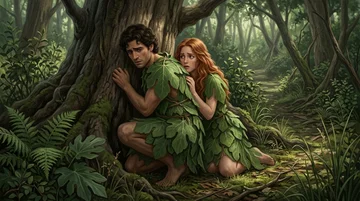
Cross-references 20 of 29
- Romans 5:12
Wherefore, as by one man sin entered into the world, and death by sin; and so death passed upon all men, for that all have sinned:
Adam’s transgression brought sin and death into the world.
- Genesis 2:16-17
And the LORD God commanded the man, saying, Of every tree of the garden thou mayest freely eat:
The forbidden command and its threatened penalty explain Adam’s guilt, fear, and hiding.
- Genesis 3:24
So he drove out the man; and he placed at the east of the garden of Eden Cherubims, and a flaming sword which turned every way, to keep the way of the tree of life.
The flaming sword guarded the tree of life after Adam was driven from Eden.
- Genesis 3:4-5
And the serpent said unto the woman, Ye shall not surely die:
The serpent’s lie promised godlike knowledge while denying that transgression would bring death.
- Genesis 3:17-19
And unto Adam he said, Because thou hast hearkened unto the voice of thy wife, and hast eaten of the tree, of which I commanded thee, saying, Thou shalt not eat of it: cursed is the ground for thy sake; in sorrow shalt thou eat of it all the days of thy life;
God declares the toil and mortality following the sin.
- Genesis 2:8-9
And the LORD God planted a garden eastward in Eden; and there he put the man whom he had formed.
Describes Eden, the garden prepared for humanity, including the tree of life.
- 1 Timothy 2:14
And Adam was not deceived, but the woman being deceived was in the transgression.
Eve was deceived in the transgression, while Adam hid after disobeying.
- Revelation 3:18
I counsel thee to buy of me gold tried in the fire, that thou mayest be rich; and white raiment, that thou mayest be clothed, and that the shame of thy nakedness do not appear; and anoint thine eyes with eyesalve, that thou mayest see.
Christ offers white raiment to cover the shame of nakedness.
- Genesis 3:6
And when the woman saw that the tree was good for food, and that it was pleasant to the eyes, and a tree to be desired to make one wise, she took of the fruit thereof, and did eat, and gave also unto her husband with her; and he did eat.
Eve and Adam ate the forbidden fruit, bringing about the fall.
- Genesis 3:4
And the serpent said unto the woman, Ye shall not surely die:
The serpent’s denial of death was the falsehood believed in Eden.
- 1 Corinthians 15:21-22
For since by man came death, by man came also the resurrection of the dead.
Adam’s fall brought death, while Christ brings resurrection life.
- 1 John 4:18
There is no fear in love; but perfect love casteth out fear: because fear hath torment. He that feareth is not made perfect in love.
Perfect love casts out fear, contrasting Adam’s fearful hiding.
- Genesis 2:7
And the LORD God formed man of the dust of the ground, and breathed into his nostrils the breath of life; and man became a living soul.
Humanity’s creation is contrasted with its degeneration and mortality after sin.
- Romans 5:18-19
Therefore as by the offence of one judgment came upon all men to condemnation; even so by the righteousness of one the free gift came upon all men unto justification of life.
Adam’s disobedience brought condemnation; Christ’s obedience brings righteousness.
- Isaiah 59:2
But your iniquities have separated between you and your God, and your sins have hid his face from you, that he will not hear.
Explains that sin separates people from God.
- Revelation 22:3-5
And there shall be no more curse: but the throne of God and of the Lamb shall be in it; and his servants shall serve him:
Contrasts the fall, where sin brought fear and hiding, with a world where the curse is gone.
- Job 31:33
If I covered my transgressions as Adam, by hiding mine iniquity in my bosom:
Job compares concealing transgression with Adam hiding after his sin.
- 2 Corinthians 11:3
But I fear, lest by any means, as the serpent beguiled Eve through his subtilty, so your minds should be corrupted from the simplicity that is in Christ.
Eve was beguiled by the serpent in Eden.
- Genesis 3:21
Unto Adam also and to his wife did the LORD God make coats of skins, and clothed them.
God clothes Adam and Eve with skins, linked to sacrifice and worship after the fall.
- Genesis 3:1
Now the serpent was more subtil than any beast of the field which the LORD God had made. And he said unto the woman, Yea, hath God said, Ye shall not eat of every tree of the garden?
serpent's opening question to Eve
Commentary part 1 of 2
Each commentary is drawn from primary sources: the writings of Ellen G. White and Adventist pioneers and periodicals. Each commentary is separate. Its own words are not a quotation; follow the references to read the source passages.
Ellen G. White
75 sources
Adam answered God's call asking where he was by saying he had heard His voice in the garden and, being naked, was afraid and hid himself among the trees in the deepest recesses of the garden.Ms 97, 1901, par. 3–8Ms 31, 1901, par. 4–8Ms 17, 1893, par. 3–5
His nakedness was the loss of the covering of light, heavenly innocence, purity and glory with which God had clothed him, which departed when he sinned and left his soul naked in guilt, shame and dread of condemnation.Lt 106, 1896, par. 4–6ST Nov 18, 1913ST Jan 23, 18791SP 41.1PP 57.1
Where he had once delighted to welcome God's approach to walk and commune with Him, he now fled in terror and sought to hide, and his admission of fear was no repentance but the beginning of shifting blame to others as all are prone to do.1SP 42.3ST Jan 23, 1879Ms 31, 1901, par. 4–8PP 57.4MYP 254.2–255.1
What seemed a small eating of the one forbidden fruit opened the floodgates of woe, death and misery upon the world, proving God means what He says and exacts strict justice for transgression of His unchangeable law.Ms 97, 1901, par. 3–8Lt 35a, 1877, par. 3–6Ms 17, 1893, par. 3–54T 11.35T 365.2
God did not leave the guilty pair in hiding but gave a star of hope in gracious promise, fulfilled when the Son of God clothed divinity with humanity to pay the penalty and provide white raiment, His own righteousness, which alone can cover the shame of sin and regain lost Eden through repentance and obedience.Lt 106, 1896, par. 4–6Lt 35a, 1877, par. 3–6Ms 17, 1893, par. 3–54T 248.1ST Dec 23, 1886
Voice in the Garden
Adam's words are his answer to God's call, Where art thou, spoken when God manifested His presence in the garden to make known to Adam and Eve the consequences of their disobedience.Ms 97, 1901, par. 3–8Ms 31, 1901, par. 4–8Ms 17, 1893, par. 3–5PP 57.4 Hearing God's voice, Adam said he was afraid because he was naked, and he hid himself among the trees, fleeing in terror into the deepest recesses of the garden.Ms 97, 1901, par. 3–8Ms 31, 1901, par. 4–8Ms 17, 1893, par. 3–5PP 57.4 His fear, shame and hiding expose guilt after breaking God's one prohibition, for which there is no excuse since all his wants had been generously supplied.Ms 97, 1901, par. 3–8Ms 31, 1901, par. 4–8Ms 17, 1893, par. 3–5
The setting is the aftermath of eating the forbidden fruit, for permission had been given to eat of every tree except the tree of knowledge of good and evil, with warning that in the day they ate of it they would surely die.CTBH 42.1–3EW 103.2 Eve separated from her husband while laboring despite angelic caution to stay together for safety, wandered alone, felt apprehension of danger yet trusted her own wisdom and strength, gazed with curiosity and admiration at the forbidden tree and questioned why it was withheld, and lingered instead of fleeing when addressed.CTBH 42.1–3PP 53.5 Through the seductions of the wily foe she was beguiled to believe God would not do as He said, felt no death but only what she imagined was a new and more exalted pleasurable life like the angels feel, and bore the fruit to her husband.CTBH 42.1–3Ms 9, 1893, par. 22–24 Adam let her experience stand against God's positive command and was seduced to eat, thus accepting another's word before God's, bringing woe upon the world and losing access to Eden and the tree of life.CTBH 42.1–3ST Feb 27, 1912 Satan had flattered them that God was withholding knowledge by restriction, and they wanted to know evil when God wanted them to know good only.Ms 9, 1893, par. 22–24
The verse belongs to the authentic, inspired, full and explicit history of Paradise, the temptation, fall, punishment and expulsion, tracing the introduction of sin and its results upon mankind.ST May 31, 1910MYP 254.2–255.1Ms 42, 1904, par. 7 Privileged to behold Eden in holy innocency enjoying communion with God and sinless angels, the transgressors became sinners, sorrow spread through heaven where every harp was hushed lest they put forth the hand and eat of the tree of life and become immortal sinners, so God drove them out and set cherubim and a flaming sword to guard the way of the tree of life whose fruit perpetuates immortality.EW 103.2MYP 254.2–255.1 Beautiful Eden was thus degraded by sin, and the account records man's disobedience and impenitence with just retribution, proving the wages of sin is death and that God's retributive justice never fails but exacts strict regard for His commandments as definite and sure as the penalty at Sinai.ST May 31, 1910MYP 254.2–255.1 This true knowledge of creation, the fall and the beginning of the world keeps the mind from fables and conjectures, false theories, superstition and falsehood, and enfeebling of the intellect, leaving no need to be hampered by human conjectures and unreliable theories.Ms 42, 1904, par. 7 Adam treasured what God revealed, lived nearly a thousand years among men as a witness to the results of sin, and told the history with man's holy estate, sufferings teaching strict adherence to law, and merciful provisions for salvation to his children to the ninth generation to instruct posterity, though few heeded and he was often met with bitter reproaches for bringing woe.PP 82.1 It is a great fact presented by inspired writers and a pillar of faith, yet practically rejected by much of the professed Christian world.4SP 398.3
That meeting in Eden where God talked with Adam and Eve to give heavenly instruction is the beginning of the gospel shining with clear light from Genesis to Revelation, a light continuing down through the ages.Ms 69, 1897, par. 15 The fall and its consequences that opened the floodgates of woe upon the world is a grand truth of sacred history of amazing strength and beauty reaching to eternity.CT 427.3 It stands together with Christ's first advent, incarnation, divinity, atonement, wonderful life in heaven as advocate, and office of the Holy Spirit as golden links in a perfect chain of truth to be exalted in every school.CT 427.3 There God's work begins that is the same in all time, the gradual unfolding of His purposes in the plan of redemption with different developments and different manifestations of power to meet human wants in different ages.CT 427.3ST Jun 3, 1886
Nakedness Fear and Hiding
Before transgression Adam and Eve were clothed with a covering of light, the light of God, heavenly innocence, purity, brightness and glory given as a covering, which illuminated all they approached.Lt 106, 1896, par. 4–6ST Nov 18, 1913ST Jan 23, 18791SP 41.1PP 57.1 When they listened to the tempter and sinned, that robe of light and those garments of heavenly innocence and brightness departed and they became naked.Lt 106, 1896, par. 4–6ST Nov 18, 19132RED 33.1–34.2ST Feb 22, 18831SP 41.1 God's glory could no longer cover disobedience and sin, for the glory God had given as a covering departed and disobedience could not remain covered by it.2RED 33.1–34.2ST Feb 22, 18831SP 41.1 Nakedness in the verse therefore means being deprived of the divine covering, left conscious of nakedness and shame.Lt 106, 1896, par. 4–6ST Jan 23, 18791SP 41.1
In innocence and holiness they had delighted to meet God, joyfully welcomed His approach, and were glad when their Creator came to walk, talk, visit and commune with them.1SP 42.3ST Jan 23, 1879PP 57.4ST Dec 23, 1886 After transgression they fled in terror, were seized by terror and constant dread, were afraid to answer and to meet Him, refused to go to meet Him, wished to be as far as possible from the presence they had loved, and sought to hide.1SP 42.3ST Jan 23, 1879PP 57.4ST Dec 23, 1886 Even the air, before mild and uniform, seemed to chill the guilty pair.PP 57.1
Their fear and physical sense of nakedness reflected a deeper loss and spiritual want: guilt, shame, dread of the future, loss of love, peace and contentment, nakedness of soul.ST Nov 18, 1913ST Jan 23, 18791SP 41.1PP 57.1 Their eyes were opened not to godhood but to shame and ruin, and they realized nakedness was the result of transgression.1SP 41.1ST May 29, 1901 They turned attention to their bodies and sought a covering, fearing how to face God and holy angels unclothed while they could not meet the eye of God and holy angels unclothed.1SP 41.1PP 57.1 They hid because they now anticipated the condemnation of God they had never known.ST May 29, 1901
Their attempt to supply the place of lost innocence with fig leaves and coverings of their own fashioning could not replace it, make them ready to meet God, or make them acceptable.ST Nov 18, 1913PP 57.1COL 310.4–311.2 Human efforts to cover the shame and guilt caused by sin cannot restore what was lost.ST Nov 18, 1913COL 310.4–311.2
Heart Changed by Sin
In innocence and holiness Adam delighted to meet God, but after disobedience he became afraid of His approach, ashamed of his nakedness, and hid himself from Him.1SP 42.3ST Jan 23, 1879ED 15.2ST That fear and hiding reveal the change brought by sin, with awareness of nakedness belonging to guilt and loss of innocence.1SP 42.3ST Jan 23, 1879 Sin marred humanity's likeness to its Creator, dimmed spiritual vision, and brought humanity under death and misery.ED 15.2ST By disobedience Adam became a law to himself, and discord and unhappiness entered because separation was made between him and God, for seeking knowledge God had withheld led into sin and disobedience estranged humanity from God.MH 427.29MR 37.1–2
Wicked works separated Adam from God so that he loved not to behold Him or retain Him in knowledge and did not want to see Him.ST Oct 3, 1895 The same unwillingness to see God marks those who accept Satan's sophistries in place of God's word, and his example must not be followed.ST Oct 3, 1895 No one can hide from God, for a sinner may turn his face so he cannot see God but cannot place himself where God will not see him.ST Oct 3, 1895 Darkness is as light to God and He knows every secret thing.ST Oct 3, 1895
God's plan was clearsightedness in all work through cooperation between man and God, but transgression greatly interfered with that plan.Lt 91, 1900, par. 15 After sin God would not communicate with Adam as when sinless, and direct communication could no longer continue.Lt 91, 1900, par. 152RED 16.2–17.1 Before sin Adam and Eve knew God through creation and discerned His character clearly in nature, but deprived of heavenly light they could no longer discern it.COL 18.1ST May 5, 1909 Brightness departed from nature, the earth was marred and defiled, a blight came between nature and nature's God and changed nature itself so it bears only imperfect testimony and cannot reveal His character in perfection.COL 18.1ST May 5, 1909 The fall gave Satan ground to claim as prince of the power of the air with control of nature, which God permitted while protecting those who work heaven's principles, yet in love He preserved Eden's beauties as specimens and expressions of love.Ms 154, 1903, par. 16–18
Adam's fear at God's voice in his nakedness was the first arresting impression of sin, but that sin has been perpetuated until truth fades and intellect darkens.Lt 22, 1900, par. 9–10 Conscience loses sensitiveness by repetition until the impression no longer arrests the diseased, depraved, dying transgressor, and the human voice no longer echoes God's voice while the heart brings forth abominations.Lt 22, 1900, par. 9–10 The fine gold dims in loss of God's reflected character and degeneration, and the serpent's track and venomous sting are seen everywhere in universal calamity.Lt 22, 1900, par. 9–10 The earth is defiled, decay, deformity, disease and death have come, the curse increases with transgression, and the earth prepares for purification by fire.Lt 22, 1900, par. 9–10
Confession Without Repentance
After disobedience Adam became afraid and ashamed at his nakedness and hid from God, though in innocence and holiness he had delighted to meet Him and was glad when his Creator came to walk and talk and commune with him.1SP 42.3ST Jan 23, 1879Ms 31, 1901, par. 4–8 Before transgression he and Eve had been clothed with a covering of light, a garment of heavenly innocence, but when they yielded to the tempter that robe of light departed and left them naked.Ms 31, 1901, par. 4–8ST Nov 18, 1913 Hearing God's voice in the garden and answering His call, Where art thou, Adam confessed fear because he was naked and hid himself among the trees, and his fear and physical sense of nakedness reflected guilt and loss of innocence and the dread that replaced former love and peace.ST Jan 23, 1879Ms 31, 1901, par. 4–8ST Nov 18, 1913 Their attempt to cover themselves with leaves of their own fashioning could not supply the place of lost innocence or make them ready to meet God.ST Nov 18, 1913 When questioned he admitted that he had eaten, but his answer was no expression of repentance, for his next words began evasion of responsibility, shifting blame toward Eve and indirectly toward God rather than confessing with repentance.1SP 42.3ST Jan 23, 1879ST Nov 18, 1913
That evasion exposes guilt and shows what is natural for all human beings, to throw blame on someone else.Ms 31, 1901, par. 4–8 The inspired history of the race thus traces not only the disobedience of man in holy innocency after communion with God and sinless angels, but his impenitence, followed by just retribution for sin.Ms 31, 1901, par. 4–8MYP 254.2–255.1
Justice and Consequences
What seemed a simple thing unworthy of notice opened the floodgates of woe, disappointment, sorrow and suffering upon the world.Lt 35a, 1877, par. 3–65T 365.2ST Feb 11, 1875ST May 26, 1898MYP 441.2–442.1 Breaking the one prohibition by eating the forbidden fruit brought sin, death, misery, terrible results and great woe, after which sin grew worse and has steadily increased in volume and prevalence.Ms 97, 1901, par. 3–85T 365.2ST Feb 11, 1875ST May 26, 1898MYP 441.2–442.1 Even one wrong act brings ruin, and for breaking that one prohibition there is no excuse since every want had been generously supplied.Ms 97, 1901, par. 3–8Lt 35a, 1877, par. 3–6 Through that transgression humanity fell from its high estate and perfect, holy state, losing divine favor and happiness.Ms 97, 1901, par. 3–84T 293.2–3ST Sep 2, 1875 The beautiful Eden given by God was lost, with the right to the Eden home forfeited, and Adam and Eve were driven out and expelled.Lt 35a, 1877, par. 3–6LC1 178.3ST May 26, 1898Ms 2, 1904, par. 38–41
They with all posterity were placed upon probation under sentence of death and subject to death, left fallen and helpless under the power of the prince of darkness, sold into his hands.4T 293.2–3LC1 118.2Lt 110, 1896, par. 9–15 Justice demanded the penalty be paid, for God's law being unchangeable could not be altered to meet man in his fallen condition, so Adam could not be pardoned and kept in Eden.Lt 110, 1896, par. 9–15 This dishonored the divine government, and the condition of the fallen race today testifies to the awful results of transgressing God's law.LC1 118.2Ms 2, 1904, par. 38–41 The fall came through indulgence of appetite and passion in breaking the law of God, which is the law of nature, beginning with the first surrender to appetite.LC1 178.3ST Oct 31, 1878ST Jul 8, 1880 Reckless departure from God's requirements through indulgence of perverted appetite weakening moral power was traced for the benefit of all who live on earth.LC1 178.3ST Jul 8, 1880
Fallen man thus began woe with loss of vital force, weakened energies, corrupted blood, inflamed passions, disease of every type, deformity, decrepitude, imbecility, enfeebled intellect and polluted morals.ST Oct 31, 1878 To this belong poverty, sickness, suffering, diminished dignity and loss of elevated physical, mental and moral condition, leaving the race feeble in mental, moral and physical power compared with the complete faculties, perfect soundness and perfect health in which man was made.LC1 178.3ST Oct 31, 1878ST Feb 22, 1883 That evil is transmitted from father to son and generation to generation as inherited inclinations, evil tendencies and disease from inflamed and corrupted blood, accumulating woe upon the race.ST Oct 31, 1878 Later violations of moral and physical laws aggravate those evils and pass their effects onward, while every indulgence in surfeiting, drunkenness, luxurious living, wine, licentiousness, excess and violence repeats the fall and persists in breaking God's law.ST Oct 31, 1878
The retribution proves God means what He says and does not pass lightly over transgression, nor will He pass more lightly now.Lt 35a, 1877, par. 3–64T 11.3ST Apr 15, 1875 His justice in punishing disobedience does not fail, and His retributive justice exacts strict regard for His commandments as definite and sure as the penalty annexed to the law proclaimed at Sinai, proving the wages of sin is death.4T 11.3ST Apr 15, 1875ST May 31, 1910 His law given in Eden is the divine rule and basis of all right conduct with reward for obedience and penalty for disobedience, binding when Adam and Eve were on trial and still binding now upon all in responsibility, most of all upon rulers.Ms 17, 1893, par. 3–54T 11.3FE 504.1–3 God cannot approve work with one thread of selfishness, and mercy does not excuse the sinner, lessen guilt, or allow continuance in sin.Lt 35a, 1877, par. 3–6 Mercy only covers guilt after sin is repented of and forsaken, nor did the Father put benevolence above justice to grant unconditional pardon and abolish the law, for that would set aside righteousness, exalt the impenitent sinner and encourage transgression.Lt 35a, 1877, par. 3–6
After transgression men and women became more and still more bold in disobeying His law, leading God to exhibit His power against impenitent transgressors.FE 504.1–3 Violation brings terrible loss to the disobedient and deepest injury to God, because every transgressor's influence leads and holds others in the same transgression that caused the fall.Lt 33, 1893, par. 10–11 Adam's fall was not the last but the first in a succession of falls continuing since, perpetuated by continued disobedience, with disobedient parents setting an example their children follow in that fallen disobedience.LC1 178.3RH Jul 9, 1901LC1 179.1Ms 20, 1894, par. 38–42 The first fall thus connects with later disobedience, though adding no detail beyond fear, nakedness and hiding.LC1 179.1
Promise and Redemption
God did not leave Adam and Eve in guilty fear after they broke His law by eating from the tree of knowledge, but gave them a star of hope to illuminate the dark future.Ms 17, 1893, par. 3–5 Before disobedience they welcomed God when He came to visit them in the garden, yet after they partook and became transgressors they were afraid and hid from His face among the trees.Ms 17, 1893, par. 3–5ST Dec 23, 1886 God called, Adam where art thou, heard Adam's answer that he was afraid because naked, and told him he had eaten of the forbidden tree, which proves His law was binding when they were on trial in Eden and remains binding now.Ms 17, 1893, par. 3–5 He followed the conscience-stricken, terror-stricken man seized by terror and constant dread, with shame and remorse torturing his soul and wishing to be as far as possible from the presence He had loved to meet in his Eden home, condemned the sin of which he was guilty, and gave him words of gracious promise.ST Dec 23, 1886
That disobedience, which looked like a simple thing unworthy of notice, opened the floodgates of woe to the world and caused the holy pair to fall, lose Eden, and be expelled from it.Lt 35a, 1877, par. 3–6Lt 14, 1885, par. 1–3ST Sep 1, 1881 Their retribution proves God does not overlook disobedience or pass lightly over transgression of His law, and will not pass more lightly over any transgression now, for His mercy does not excuse the sinner, lessen guilt, or allow continuance in sin, but only covers guilt after sin is repented of and forsaken.Lt 35a, 1877, par. 3–6ST Sep 1, 1881 Because His law was unchangeable and could not be altered to meet man in his fallen condition, Adam could not be pardoned and kept in his Eden home, but with all his posterity was placed upon probation under sentence of death, helpless and under the power of the prince of darkness.LC1 118.2Lt 110, 1896, par. 9–15 That disobedience at infinite expense led the Son of God to leave heaven and the royal courts, lay aside robes of royalty, take a humble place on earth, and be subjected to insult, rejection, reproach, mockery, and crucifixion by the very ones He came to bless.4T 248.1ST Sep 1, 1881 The Majesty of heaven was sacrificed, pledging His own life and giving Himself as substitute, surety, and sacrifice to take man's transgressions and their just penalty upon Himself, pay the debt of transgression, ransom the race, and save fallen man from the penalty, not to abolish the law but to exalt it and evidence its sacred character.Lt 35a, 1877, par. 3–6Lt 110, 1896, par. 9–15ST Sep 1, 1881
Through His humiliation and obedience Christ provided another trial and the means to regain lost Eden, and through the sacrifice of Christ alone fallen man has been granted that trial in God's wise plans.LC1 118.2Lt 14, 1885, par. 1–3 He gave a refuge and a way to approach God, delayed full execution of the sentence while undertaking redemption, and without His goodness and mercy the race would have been plunged into hopeless despair.LC1 118.2 Their result should lead every soul to avoid sin and abhor it as the hateful thing it is, feeling in view of the sufferings sin inflicts that it is better to suffer loss of all things than to depart from the least of God's commandments, since it is possible for fallen man to be elevated by the merits and blood of Christ to keep God's law.Lt 35a, 1877, par. 3–6Lt 14, 1885, par. 1–3
Christ passed over the ground where Adam fell and in the wilderness of temptation overcame Satan's temptations, including appetite, redeeming Adam's failure, fall, and disgrace.4T 293.2–3ST Mar 7, 1878Lt 148a, 1897, par. 3–4 Adam's disobedience to God's command had caused him to lose divine favor and happiness and brought misery to the human race, but Christ's victory placed the human family on vantage ground with God.4T 293.2–3Lt 148a, 1897, par. 3–4 It is thereby made possible for them to overcome in their own behalf through the merits of the crucified and risen Saviour by perfect obedience as He overcame, so that through obedience the lost home is regained, which is the first portion of the subject of temperance.Lt 148a, 1897, par. 3–4
Nakedness in the verse means being deprived of the divine covering, for sin took away the garments of purity, brightness, light, and innocence God had given as a covering, so the covering of God was no longer enveloping them and they were conscious they were naked and ashamed.Lt 106, 1896, par. 4–68MR 323.2 The same condition falls on all who yield to temptation and give themselves up to obey Satan, leaving them afraid to meet God and in need of buying from Christ gold tried in the fire and white raiment, which is Christ's righteousness to be put on.Lt 106, 1896, par. 4–68MR 323.2 That white robe is obtained by repentance toward God and faith toward the Lord Jesus Christ, by laying hold of the merits of the crucified and risen Saviour.Lt 106, 1896, par. 4–68MR 323.2 God's righteousness never covers a soul still polluted with sin, so sin must be taken away by the Lamb of God, giving man another trial now in which belief brings everlasting life instead of perishing and is shown by rectitude in keeping God's commandments.8MR 323.2
Warning and Obedience
Adam's trembling answer in the garden teaches all mankind that God's Word is to be sacredly respected and His requirements implicitly obeyed.Ms 97, 1901, par. 3–8 That obedience is to be rendered with reverence, without questioning whether obedience is feasible or convenient, for love is tested by having and keeping His commandments.ST Jun 3, 1886 The guilt and sorrow that fell upon Adam and Eve and upon the world through listening to the enemy's specious temptations stand as a sufficient warning to deter all from the same experience.ST Jun 3, 1886ST Jul 8, 1880 Their history was traced by inspiration as the history of one family for the benefit of all who live on the earth, that later people would shun his example and not follow in the same steps.ST Jul 8, 1880RH Oct 13, 1874 All have the privilege of learning the lesson from their disobedience, and to protect the human family from the same result the light of God's law is to be made so clear that it is as a city set upon a hill which all can understand if they will.Lt 90, 1898, par. 14–16 Men must therefore choose whether to repeat that disobedience or to walk in the light through humble obedience to God.HSFM 231.3
Continuing in that same disobedience forfeits the right to Eden restored, just as disobeying God's command lost the right to the Eden home.Lt 236, 1903, par. 21–22Ms 2, 1904, par. 38–41 Being once in grace does not mean always remaining in grace, for Adam and Eve lost beautiful Eden because they ate what God had forbidden, and transgressing the same law will cause loss of heaven.ST May 26, 1898Lt 236, 1903, par. 21–22Ms 2, 1904, par. 38–41 Adam violated the law of Jehovah by indulging appetite and passion, bringing sin and unutterable woe into the world and being driven from Eden with loss of elevated physical, mental, and moral condition, and his experience warns men not to disobey God's express injunctions.LC1 178.3 Yet men deplore his transgression while repeating it themselves, becoming more and still more bold in disobeying His law until God must exhibit His power against impenitent transgressors.LC1 178.3FE 504.1–3 Adam's sin is repeated when men trample God's law and discard the Sabbath, for to refuse light is to partake of the same fruit of disobedience.ST May 26, 1898Lt 188, 1903, par. 7–9 The penalty of disobedience follows disobedience as surely as reward follows obedience, for God's law given in Eden is the divine rule of conduct and basis of all right conduct, binding on everyone in responsibility and most of all on rulers, and the blood of Christ stands as the sinner's only hope.Lt 188, 1903, par. 7–9
The sinner must therefore cease pleasing self, leave the side of the great rebel, repent for giving time and talents to the enemy, give the whole soul to God, and with strong determination seek the Lord while He may be found, taking a stand to choose good and refuse evil.Lt 236, 1903, par. 21–22 In preparing for Paradise restored, perverted and depraved appetite must be brought under strict control, since man lost his right to Paradise by eating what God had forbidden.Ms 126, 1903, par. 21–22 Indulgence of depraved appetite weakens the power to resist evil and enables Satan to fasten evil habits upon man and ensnare him in the net of his devices.Ms 126, 1903, par. 21–22 Indulged appetite and unhealthful habits weaken physical, mental, and moral efficiency, lessen sincere piety and religious fervor, and make it impossible to overcome temptation, so decided reform in food preparation and habits of life is needed in every family, beginning with the lesson of the first surrender to appetite.CTBH 42.1–36MR 36.5–37.1
The fall reveals the workings of the wily foe since Adam's day, showing the same principles still at work and what their end will be.SPBC 178.2–4 All remain on trial in probationary time, with Satan playing the game of life for every soul and Christ at work for every soul, and destiny depends on will and action and choice of character.SPBC 178.2–4 Those who consent to receive the moral image of God become like Him in character, but if they refuse the character of Christ heaven is lost to them, yet gracious opportunity remains to lay hold of the Saviour and by faith receive His merits and perfect a character like His.SPBC 178.2–4 Through the sacrifice of Christ alone fallen man has been granted another trial, and the result of violating God's law in losing beautiful Eden and opening the floodgates of woe should lead every soul to avoid sin and abhor it as hateful, feeling that it is better to suffer loss of all things than to depart from the least of God's commandments.Lt 14, 1885, par. 1–3 The fall is therefore to be plainly brought out to magnify and glorify the law before all people, while the exposition of the law runs like golden threads through the fabric of the gospel.Lt 188, 1903, par. 7–9
Sources
Pioneers and periodicals
171 sources
Adam answered God's call of where he was by saying he had heard God's voice in the garden and had hidden himself among the trees because fear had seized him over being naked.ST Jan 1, 1894ST Apr 7, 1914ST Nov 23, 1904ST Dec 20, 1910ST Mar 20, 1893 This belongs to real, literal history, not myth or parable, with a real garden and real first pair standing at the head of the fall of man.ST Apr 7, 1914ST Jul 28, 1881ST Jan 3, 1911ST Jul 28, 1881 His nakedness was both bodily and inward, for with sin the covering of light and glory that had clothed innocence departed and left body and soul exposed in guilt and shame, which fig leaves could not cover.ST Nov 18, 1913ST Jan 23, 1879ST Apr 7, 1914RH Aug 14, 1900ST Jan 1, 1894 That fear and hiding came only from disobedience, turning former delight in meeting God into terror, distrust and vain attempt to flee from One from whom no one can hide.ST Jan 23, 1879ST Sep 12, 1900ST Jul 26, 1910ST Mar 18, 1897ST Nov 17, 1909 Yet God came to Adam in that hour not in wrath to destroy but in love and pity to call him back, condemning the sin and giving the gracious promise of the Seed to bruise the serpent, opening the way by which what was lost in Adam is restored in Christ to fearless communion face to face.ST Aug 6, 1894ST Sep 23, 1875ST Jan 28, 1875PGGC 5.1–2RH Feb 26, 1867
Garden Encounter and Words
Adam's words are his answer to God's call of Where art thou, spoken after he and his wife hid themselves from God's presence among the trees when they heard God's voice walking in the garden in the cool of the day.ST Jan 1, 1894ST Dec 20, 1910ST May 7, 1894 He said he heard God's voice and was afraid because he was naked, and that fear is why he hid himself.ST Jan 1, 1894RH Apr 4, 1871ST Jul 15, 1913 After disobeying God he had lost his innocence and come under condemnation, hiding when he heard the Lord and trembling at His word, with fear and hiding revealing the change brought by sin.ST Dec 20, 1910ST Mar 20, 1893ST May 7, 1894 His response shows how unbelief and sin brought misery and estrangement where simple faith and obedience would have led to a life of love and happiness.ST May 7, 1894 The startling of people by the Sabbath bell is like Adam and Eve hiding when they heard God, presenting the Sabbath call as a reminder of sin and accountability, and the coming of Christ is like that moment, when those who reject Him will flee in fear.RH Apr 4, 1871ST Jul 15, 1913
He heard God in the garden and became afraid because he was naked, so he hid, with nakedness a source of shame because the glory that had clothed the innocent pair had disappeared.ST Apr 7, 1914ST Nov 23, 1904RH Dec 10, 1908 Fear led them to shrink from God's presence and try to cover themselves with fig leaves, yet the verse illustrates how sin brought alienation from God.ST Apr 7, 1914ST Nov 23, 1904RH May 23, 1912 Since then people in sin's service have remained blinded and captive, hardened by sin's deceit, and unwilling to seek God's favor, having been led into disobedience by Satan's wiles unto disgrace.RH May 23, 1912ST Apr 12, 1883 His words explaining that fear and awareness of nakedness led him to hide do not show that God compelled him to sin but are an apology for his own choice.RH Dec 10, 1908 His conduct also involved a law and the consequences of breaking it, though the details are supplied elsewhere in Scripture.ST May 9, 1906
The verse records only that Adam heard God's voice and says nothing about Adam seeing God, so it does not establish that no one has ever heard God's voice.RH Jun 18, 1867RH Jun 18, 1867 The Lord who spoke with Adam was the angel, God's personal representative and messenger of His will.RH Jun 18, 1867
The verse belongs to the first conversation between Christ and Adam and Eve after they sinned, when the possibility of returning to God was first made known to them.ST Dec 23, 1886ST Aug 6, 1894PGGC 5.1–2 Their fear and despair followed their sin, and the words of hope that followed revealed that they could still choose the right and receive life through the promised Seed.ST Aug 6, 1894 Before sin man had communion with God face to face, but after sin God instructed His people in an audible voice, and His speaking to Adam in the garden is an example of that audible instruction.PGGC 5.1–2 God followed this conscience-stricken man, condemned the sin of which he was guilty, and gave him words of gracious promise.ST Dec 23, 1886 He was seized by terror, under constant dread, with shame and remorse torturing his soul, wishing to be as far as possible from the presence of God whom he had loved to meet in his Eden home.ST Dec 23, 1886 Satan had led him to believe God was approaching to pour out wrath and anger for his destruction, but in truth God was coming in love and infinite kindness to call Adam to Himself, to pity him for the course he had taken, and to abide with him and make his soul the dwelling of His throne. He did not manifest the angry temper Satan had taught Adam to expect but gave the promise of the indwelling Seed to bruise the serpent that stole man's affections and cursed the ground on man's behalf to turn his desires to things above. Spoken after the fall, God's word to Adam is a reproof as well as timely instruction suited to his unhappy change, telling him who in defiance of prohibition had sought another sort of wisdom and knowledge than was proper that his truest wisdom is to fear the Lord and pay implicit obedience to His commands and to depart from evil.RH Feb 26, 1867
The setting is nearly six thousand years ago after God finished His perfect work and pronounced it good, when two lovely beings made in the image of God were placed in a beautiful garden surrounded by all that was pleasing to the eye and tempting to the taste and were given government over all animate things the world contained.RH May 22, 1866 It shows man's fall through disobedience, for which the beautiful earth was cursed for his sake, and by sin death came with chilling breath upon everything so that all things must die: tall stately trees die and decay, exquisite flowers wither and fade, the animal creation suffers in the general doom, and man himself, bent with the weight of sorrow and years, bows to death and is laid away in the tomb.RH May 22, 1866 By man's failure to continue in uprightness Paradise was lost, Adam was excluded from the tree of life, the curse of God fell upon the earth, and death entered by sin and passed upon all men. That fall, when Adam and Eve sinned, ceased to be very good, fell from their integrity, and placed themselves under the government of the enemy, did not happen on the sixth day when God saw everything He had made as very good, nor on the seventh day when God rested and was refreshed and delighted in His perfect works and in laying the foundation of the Sabbath.RH Jan 7, 1862 The record of the Sabbath's institution by resting on the seventh day and blessing and sanctifying it precedes the account of the fall, which follows the more extended account of the creation of man and woman in Genesis 2, so the Sabbath was made before man had sinned, before man needed types to show he was a sinner and that Christ must die, and is not a type growing out of the fall to be ended by Christ but a memorial pointing back to creation.RH Jan 7, 1862ST Sep 1, 1881 After that sad apostasy no further mention of the Sabbath occurs until Moses said on the sixth day that tomorrow is the rest of the holy Sabbath unto the Lord, yet the Sabbath remained a human need, ordained for people both in Eden and after the fall.ST Jan 28, 1889
Literal History Defended
Genesis 3:10 belongs to real, factual, literal history received by Moses through revelation from God, not to myth, allegory, parable, poem, tradition, fable, legend, forgery, or merely a valuable religious story apart from real history.ST Apr 7, 1914ST Jul 28, 1881ST Jul 28, 1881ST Nov 13, 1893ST Aug 25, 1881 The account of the fall in Genesis 1-3 is a true account of fact and a historical narrative rather than tradition, allegory, parable, or spiritualized legend.ST Jul 28, 1881ST Jul 28, 1881ST Aug 25, 1881ST Nov 25, 1889 If the fall were imaginary there would be no need for redemption and the gospel would rest on a fable.ST Nov 13, 1893 The garden, the serpent, and Adam and Eve are real historical realities.ST Apr 7, 1914ST Jul 28, 1881ST Jul 28, 1881ST Nov 13, 1893ST Aug 25, 1881
The first chapters of Genesis are the foundation utterances of the Bible on which faith in the general teaching of the Bible rests.ST Apr 7, 1914 The first ten chapters give an epitome of 1,656 years of the world's history before the universal Deluge, and the whole Bible stands by that record of creation and the fall.ST Apr 7, 1914 Rejection of creation and the fall leads to rejection of the inspiration of Scripture, the atonement, Christ's resurrection and His second coming, the incarnation, redemption, the plan of salvation, and the teaching of Christ and His apostles.ST Jan 3, 1911ST Apr 2, 1896ST Nov 15, 1883ST Jul 26, 1910 Denying that there was a specially created humanity that sinned and fell makes the fall fabulous and undermines the Bible's account of sin and the redemption provided to remedy it, requiring reconsideration of all doctrines built on that plan of salvation.ST Apr 2, 1896ST Nov 15, 1883ST Jul 26, 1910
That history stands directly against evolution, successive geological ages, and descent from ape and animal creations.RH Aug 23, 1906RH Apr 1, 1909RH Jul 4, 1912 Man was formed by the infinite Creator as a perfect being and fell downward from a higher state through disobedience by the first parents Adam and Eve who hid in fear and shame, not upward from lower order of life.RH Apr 1, 1909AUST Jun 14, 1920ST Jun 3, 1913 Since sin man has been degenerating through the ages in physical strength and prowess, mental power, and morals, rather than advancing from savagery through barbarism to civilization.AUST Jun 14, 1920ST Jun 3, 1913 The evolutionary teaching that man advanced upward and that the fall was upward and not downward denies the Mosaic account as fable and utterly subverts the Biblical doctrine of the atonement and Christ's mission to suffer and die to rescue man from sin, destroying the credibility and authority of Bible revelation.RH Aug 23, 1906RH Apr 1, 1909AUST Jun 14, 1920
The Mosaic record in the pentateuch is familiar Bible history carrying God's authority, the only authentic history of these remote events, more ancient and more safely relied on than any other history.RH Feb 5, 1867 It is the truthful inspired record of Eden and humanity's fall from primal purity and primeval rectitude, in which man was formed with full-grown powers of body and mind and stood in federal character with the promised Saviour and His predicted victories.ST Feb 10, 1887RH Feb 5, 1867 Its substance is substantially paralleled by older Assyrian legends and preserved in essentials by Karen traditions alongside creation and a sinless pair in the garden, agreeing in all essentials with Scripture and pointing to a remote knowledge of Jehovah.ST Aug 12, 1880ST Oct 31, 1911ST Jul 25, 1911RH Aug 10, 1905 Moses himself learned the story of Adam's fall from his mother in childhood as a shield against Egypt.ST Feb 10, 1887RH Feb 5, 1867
Opposing views treat the second and third chapters of Genesis as myth and a picture of error throughout, with no utterance of Truth or Science, blaming its translation on a false sense of Being and belief in matter.ST Jan 28, 1903 That denial repudiates the reality of sin and human moral responsibility and rejects Adam's fall into sin from an original state of innocence.STRH Mar 28, 1907 The same account is charged with showing God as unfair and unjust, as laying a trap for man and then condemning and punishing him for falling into it, and is used as ground for rejecting all divine revelation by presuming with human reason to balance the right or wrong of God's course and to pass judgment upon the Almighty who reads all hearts, knows all motives, and sees the end from the beginning.RH Feb 18, 1902 The Adam who speaks in Genesis 3:10 is the same Adam as the man of Genesis 1:26-27, where the word man is the Hebrew Adam, made in the image and likeness of God, never without inheritance and dominion over the earth, and part of the creation pronounced very good.ST Jan 28, 1903
Nakedness and Lost Glory
Before disobedience the pair wore no clothing yet were not truly naked, for they were clothed with garments of glory and vestures of light as with a garment after the likeness of God, emblematic of purity, innocence, holiness and heavenly protection.ST Apr 7, 1914ST Jan 1, 1894RH Mar 5, 1872 That light clothed them even as angels are clothed and illuminated all they approached, but when they sinned the light and glory departed with righteousness and they became truly naked, even more naked than the beasts around them.ST May 5, 1909ST Jan 1, 1894RH Mar 5, 1872 The nakedness became a source of shame and fear, so that hearing God in the garden they shrank from His presence, felt afraid to meet Him, and tried to cover themselves with fig leaves and hide among the trees.ST Apr 7, 1914ST Apr 7, 1914ST Nov 28, 1900 Their disobedience had stripped away their glory, and they fled from the One who had entrusted them with the garden.ST Jan 30, 1912ST Nov 28, 1900
The nakedness confessed is more than bodily exposure, for it is nakedness of soul felt on the first trial of sin.ST Jul 26, 1910ST Jan 1, 1894 Guilt, dread of the future, spiritual want, alarm of conscience and remorse stripped the heart of all covering and left it naked and undone, and this inward stripping helped drive the hiding when God came.ST Jan 23, 1879ST Jul 26, 1910 That loss made them aware of guilt and of their changed condition after the Fall, with fear following the loss of righteousness pictured by the departure of the glorious light.ST Jan 1, 1894ST Jan 1, 1894 Deprived of heavenly light they could no longer discern God's character in the works of His hand, for transgression came between nature and nature's God and brought a blight upon the earth, so that marred nature can bear only imperfect testimony.ST May 5, 1909
Their aprons did not truly cover their nakedness, for after making them there was still confession of being naked and hiding from God.ST Nov 18, 1913RH Aug 14, 1900 The attempt to cover with leaves could not make them ready to meet God, exposing the pitiable foolishness of fallen people trying by feeble human might, with tear-dampened fig-leaf sewing, to clothe their limbs anew and turn aside near-impending doom.ST Nov 18, 1913ST Jan 30, 1912 The glory God had given as a covering departed at transgression, showing that God's glory cannot cover disobedience and sin, a loss connected with resulting poverty, sickness, suffering and diminished human dignity.ST Feb 22, 1883ST Jun 11, 1874 Clothing itself thus began with sin, both to cover bodies with leaves and to hide the shame of having fallen from a high estate of spotless purity.ST Jul 29, 1897
What was lost will be reversed in the glorified state, which will be a restored state in which Christ restores what was lost in Adam.RH Mar 5, 1872ST May 27, 1897 Then man is again encircled with light and enshrouded with glory, restored beyond humanity's first estate with every faculty of mind, body and soul renewed.RH Mar 5, 1872ST May 27, 1897
Sources