Genesis 37:25
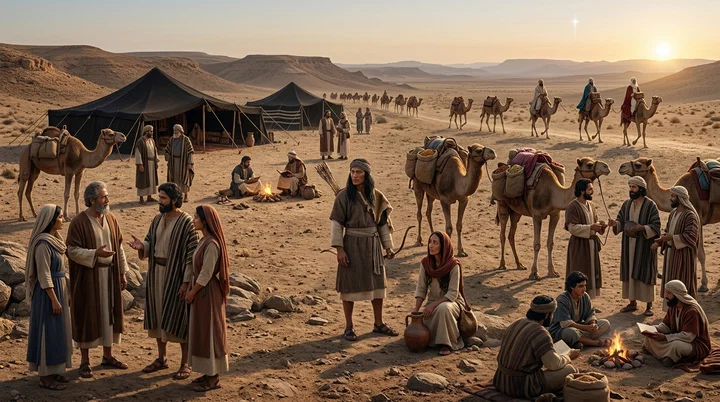
And they sat down to eat bread: and they lifted up their eyes and looked, and, behold, a company of Ishmeelites came from Gilead with their camels bearing spicery and balm and myrrh, going to carry it down to Egypt.
Translations
And they sat down to eat bread: and they lifted up their eyes and looked, and, behold, a company of Ishmeelites came from Gilead with their camels bearing spices and balm and myrrh, going to carry it down to Egypt.
And they sat down to eat bread: and they lifted up their eyes and looked, and, behold, a company of Ishmeelites came from Gilead with their camels bearing spicery and balm and myrrh, going to carry it down to Egypt.
And they sat down to eat bread: and they lift up their eyes and looked, and behold, a company of Ishmeelites came from Gilead with their camels bearing spicery and balm and myrrh, going to carry it down to Egypt.
And they sat down to eat bread: and they lifted up their eyes and looked, and behold, a company of Ishmaelites came from Gilead, with their camels bearing spicery, and balm, and myrrh, going to carry them down to Egypt.
And they sat down to eat bread: and they lifted up their eyes and looked, and, behold, a travelling company of Ishmaelites came from Gilead, with their camels bearing spicery and balm and myrrh, going to carry it down to Egypt.
And they sat down to eat bread: and they lifted up their eyes and looked, and, behold, a caravan of Ishmaelites was coming from Gilead, with their camels bearing spicery and balm and myrrh, going to carry it down to Egypt.
And they sit down to eat bread, and they lift up their eyes, and look, and lo, a company of Ishmaelites coming from Gilead, and their camels bearing spices, and balm, and myrrh, going to take [them] down to Egypt.
And they sat down to eat bread; and they lifted up their eyes and looked, and behold, a caravan of Ishmaelites came from Gilead; and their camels bore tragacanth, and balsam, and ladanum — going to carry [ it] down to Egypt.
And when they had sat down to eat bread, they lifted up their eyes and looked, and lo! a caravan of Ishmaelites, coming in from Gilead,—and, their camels, were bearing tragacanth gum, and balsam and cistus-gum, they were going their way, to take them down to Egypt.
Berean Standard Bible, Majority Standard Bible
And as they sat down to eat a meal, they looked up and saw a caravan of Ishmaelites coming from Gilead. Their camels were carrying spices, balm, and myrrh on their way down to Egypt.
They sat down to eat bread, and they lifted up their eyes and looked, and saw a caravan of Ishmaelites coming from Gilead, with their camels bearing spices and balm and myrrh, going to carry it down to Egypt.
Then seating themselves, they took their meal: and looking up, they saw a travelling band of Ishmaelites, coming from Gilead on their way to Egypt, with spices and perfumes on their camels.
Then they sate them downe to eate bread: and they lift vp their eyes and looked, and behold, there came a companie of Ishmeelites from Gilead, and their camels laden with spicerie, and balme, and myrrhe, and were going to cary it downe into Egypt.
Douay-Rheims (Challoner revision)
And sitting down to eat bread, they saw some Ismaelites on their way coming from Galaad, with their camels, carrying spices, and balm, and myrrh to Egypt.
Pictures
Cross-references
- Acts 7:9
And the patriarchs, moved with envy, sold Joseph into Egypt: but God was with him,
The patriarchs’ envy moved them to sell Joseph into Egypt.
- Genesis 50:20
But as for you, ye thought evil against me; but God meant it unto good, to bring to pass, as it is this day, to save much people alive.
God turned the brothers’ evil intent in selling Joseph toward good, saving many lives.
- Genesis 37:3
Now Israel loved Joseph more than all his children, because he was the son of his old age: and he made him a coat of many colours.
Jacob’s special love for Joseph is shown by giving him a distinctive coat.
- Genesis 39:20-23
And Joseph’s master took him, and put him into the prison, a place where the king’s prisoners were bound: and he was there in the prison.
Joseph suffers unjustly, yet God remains with him and makes his work prosper.
- Genesis 41:40-43
Thou shalt be over my house, and according unto thy word shall all my people be ruled: only in the throne will I be greater than thou.
Joseph is raised to high office in Egypt.
- Genesis 46:3-4
And he said, I am God, the God of thy father: fear not to go down into Egypt; for I will there make of thee a great nation:
Jacob’s family later goes to Egypt, where Joseph has preceded them.
- Genesis 15:13
And he said unto Abram, Know of a surety that thy seed shall be a stranger in a land that is not theirs, and shall serve them; and they shall afflict them four hundred years;
The sale to the caravan develops the foretold plan for Israel’s sojourn in Egypt.
- Genesis 37:7-9
For, behold, we were binding sheaves in the field, and, lo, my sheaf arose, and also stood upright; and, behold, your sheaves stood round about, and made obeisance to my sheaf.
Joseph’s dreams fueled plans that were overturned by his sale.
- Genesis 39:4-6
And Joseph found grace in his sight, and he served him: and he made him overseer over his house, and all that he had he put into his hand.
Joseph later becomes a trustworthy manager in Egypt.
- Matthew 26:15
And said unto them, What will ye give me, and I will deliver him unto you? And they covenanted with him for thirty pieces of silver.
Both Joseph and Christ were sold by their own for money.
Commentary
Each commentary is drawn from primary sources: the writings of Ellen G. White and Adventist pioneers and periodicals. Each commentary is separate. Its own words are not a quotation; follow the references to read the source passages.
Ellen G. White
7 sources
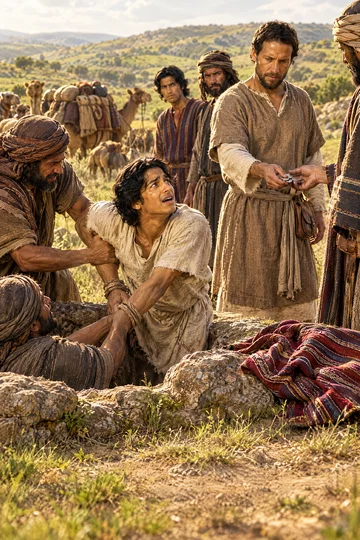
After thrusting Joseph into the pit to be left to die of hunger, his brothers sat down to eat bread while he remained trapped there, showing their callous indifference to his suffering.ST Dec 18, 1879PP 211.2 While they ate they lifted up their eyes and saw a company of Ishmaelite traders approaching with camels, traveling from Gilead beyond Jordan toward Egypt carrying spicery and balm and myrrh and other merchandise.ST Dec 18, 1879PP 211.3–4 The caravan's arrival gave Judah the chance to propose selling Joseph as a slave into Egypt rather than leaving him to die, and the brothers agreed, drew Joseph from the pit, handed him to the traders, and had him taken away from his father's home.ST Dec 18, 1879PP 211.3–4PP 213.1–2
The brothers had first purposed to kill Joseph and then settled on sale to get rid of him, intending to keep him from becoming greater than themselves, to prevent his ruling over them, and to make his dreams impossible.ST Feb 5, 1880SG3 174.2–176.1 God overruled the very course they pursued to bring about what they meant never should happen, so that by being sold into Egypt Joseph became the saviour of his father's family, and that outcome did not lessen his brothers' guilt.ST Feb 5, 1880SG3 174.2–176.1 Joseph's rejection and suffering foreshadow Christ, whose enemies likewise sought to prevent His authority, yet whose death made Him the Redeemer of the world, without excusing their crime.ST Feb 5, 1880SG3 174.2–176.1 In further parallel, Christ like Joseph was sold by one of His own disciples for a small sum into the hands of His bitterest enemies, rejected and hated because His righteous life rebuked sin, then made Redeemer of mankind, Saviour of the fallen race and ruler over the whole world, while the crime of His enemies remained just as heinous as though God's providential hand had not controlled events for His own glory and the good of man.SG3 174.2–176.1 Joseph's experience shows one maligned and persecuted despite virtue and goodness, whose suffering did not mean God had forsaken him, for God gave him victories even while he appeared to suffer for doing right.Lt 10, 1879, par. 4–9
Sources
Pioneers and periodicals
42 sources
After stripping Joseph and casting him into a waterless pit near Dothan, his brothers sat down to eat while he remained trapped, then lifted their eyes and saw Ishmaelite merchant-men, also called Midianite traders, coming from Gilead with camels bearing spices, balm and myrrh on their way down to Egypt.ST Apr 2, 1894ST Oct 27, 1898ST Oct 27, 1898ST Apr 20, 1888ST Aug 25, 1898 The sight gave Judah the thought to sell Joseph for profit as a show of leniency because he was their brother, rather than killing him or leaving him to die.ST Apr 2, 1894ST Oct 27, 1898ST Apr 20, 1888 Their envy had grown from their father's favoritism, Joseph's reports of their wrongdoing and his dreams of pre-eminence, until it became hatred and then a plot to murder, and eating with heartless satisfaction while he pleaded for his life showed their hardened indifference to his anguish.ST Mar 17, 1887STST Jun 11, 1894ST Dec 25, 1901ST Oct 2, 1901 What they did from hatred to prevent his future became the stepping-stone to that very future, for God overruled their anger, ambition and jealousy and used wicked men as instruments to bring Joseph to his appointed place, from prisoner to ruler to preserve his family and the holy Seed.ST Feb 5, 1880ST Jan 16, 1912ST Jun 11, 1894ST Jan 21, 1913ST Nov 29, 1905 So Joseph stands as a type of Christ, whose enemies likewise sought to prevent His authority, yet His death made Him the Redeemer of the world, illustrating that he that is born after the flesh persecutes him that is born after the Spirit, as Cain killed Abel though his brother had done nothing to cause it.ST Feb 5, 1880RH Jun 8, 1916ST Apr 20, 1888ST Oct 2, 1901
Scene and Setting
The verse belongs to the account in which Joseph's brothers, after first trying to kill him, sold him as a slave into Egypt, beginning his journey there.ST Jan 3, 1911ST Nov 23, 1904 In the lesson's account their envy was the cruel motive behind that act, as they sat down to eat while a company of Ishmaelites traveled from Gilead toward Egypt with trade goods.ST Dec 25, 1901 Joseph's arrival in Egypt came before Jacob's family later moved there during the famine, where they became dependent on others and eventually suffered slavery.ST Nov 23, 1904
After stripping Joseph of his coat of many colors and casting him into an empty pit with no water in it, his brothers sat down to eat bread while he remained trapped in the pit.ST Apr 2, 1894ST Oct 27, 1898ST Oct 27, 1898ST Apr 20, 1888ST Oct 2, 1901 The verse marks an interval after he was cast into the pit and before Judah proposed what to do with him.ST Oct 27, 1898ST Oct 27, 1898 Their meal while Joseph was in the pit pleading for his life showed hardened hearts and cold-heartedness, and illustrates the outcome of envy and the attempt to plot against God's providence.ST Jun 11, 1894ST Oct 2, 1901
As they ate they lifted up their eyes and saw a traveling company of Ishmaelites coming from Gilead with camels bearing spicery and balm and myrrh, to carry it down to Egypt.ST Apr 2, 1894ST Oct 27, 1898ST Apr 20, 1888 They are also called Midianite traders and Ishmaelitish merchant-men, carrying spices, going to Pharaoh's land along a lean, parched path.ST Aug 25, 1898RH Jan 27, 1916 The coming of that caravan suggested to Judah the idea and proposal to sell Joseph to the Ishmaelites for profit instead of slaying him and concealing his blood.ST Dec 18, 1879ST Apr 2, 1894ST Apr 2, 1894 It gave them the means to dispose of him by selling him to the traders rather than killing him outright, leaving him to die, leaving him to starve, or leaving him helpless in the pit, and while they ate they discussed what to do with him with heartless satisfaction at being rid of him.ST Dec 18, 1879ST Oct 27, 1898ST Apr 20, 1888ST Oct 2, 1901
The scene took place near Dothan, where the brothers were tending their flocks and herds when Joseph visited them and where they sold him to Ishmaelite traders, also called Midianite traders, who carried him to Egypt.ST Aug 25, 1898ST Oct 19, 1904 Dothan was about twelve miles north of Samaria, and its broad grazing land explains how they could see Joseph coming from a distance, while the continuing sight of camel caravans carrying goods helps picture the scene of his sale.ST Aug 25, 1898 Joseph's experience there took place more than nine hundred years before Elisha's time at Dothan. The Genesis account of Hebrew life connected with Egypt, to which the verse belongs, agrees admirably in its whole color with what is known of Egypt at that time, and Egyptian inscriptions corroborate the Pentateuch's historical record about Egypt and help explain Egyptian history.ST Jul 30, 1885ST Nov 20, 1884 Egyptian pictures, stories, and religious books illustrate the habits, customs, land, and people of the Nile behind the verse, including pictures showing slaves with Hebrew features working at brick-making as the Hebrews worked, and the store city Pithom, one of the two store cities built by the children of Israel, found bearing the name Pithom on an inscription with great brick store-houses without windows or doors for preserving grain for use in war or famine; the absence of Egyptian monument records of Bible miracles does not count against it because kings do not report their disasters.ST Nov 20, 1884
Envy and Cruelty
Joseph had listened to his father's instructions and feared the Lord, being more obedient to his father's righteous teachings than his brethren, treasuring his instructions and loving with integrity of heart to obey God while keeping the fear of God before his eyes.ST Mar 17, 1887ST Apr 20, 1888 He had done nothing wrong to create discord, and no evil is recorded of him, for his father loved him more because he was more worthy of love.ST Apr 20, 1888 Grieved at the wrong conduct of some of his brethren, he meekly entreated them to pursue a righteous course and leave off wicked acts.ST Mar 17, 1887 Because his hatred of sin could not endure seeing his brethren sin against God, he laid the matter before his father hoping his father's authority would reform them.ST Mar 17, 1887 This exposure of their wrongs enraged his brethren against him, and with their observation of their father's strong love for Joseph their envy grew into hatred and finally toward murder.ST Mar 17, 1887
The brothers' envy grew from Jacob's partiality and favoritism, Joseph's reports of their wrongdoing, and his dreams of future pre-eminence, along with low moral standards.ST Mar 17, 1887STST Oct 2, 1901 Their resentment of the dreams shows how selfish jealousy opposes the spirit of prophecy.ST Oct 2, 1901 Envy growing out of their own wicked hearts, not caused by any tale-bearing or wrongdoing by Joseph, was the cruel motive for selling him into Egypt.ST Dec 25, 1901ST Apr 20, 1888 A corrupt heart is the only soil in which envy can grow, and the same thing that moved the brothers to kill and sell him moved Cain to kill Abel, because their own works were evil while his were righteous.ST Apr 20, 1888 Their jealousy led to a sad experience for him and for the family, as part of the sad consequences of Jacob's mistakes, including partiality, jealousy, envy, low moral standards, and crime.STST Aug 1, 1916
Envy is pain felt at the sight of superior excellence or happiness, hatred is the offspring of envy, and malice is the offspring of hatred.RH Jan 9, 1855 The brothers' treatment of Joseph displays all three, with a known result.RH Jan 9, 1855 The same evil dispositions appear still more strikingly in the Jews toward Jesus Christ, in whom all excellence met.RH Jan 9, 1855 Their course marks downward steps from envy to hatred to a scheme of murder to deceit, ending in fearful expectation of wrath to be visited upon them.ST Oct 27, 1898 This shows the inevitable result of partiality in the family.STST Oct 27, 1898
Sitting down to eat bread while Joseph was in the pit pleading for his life shows their cold-heartedness, for their envy had hardened their hearts.ST Jun 11, 1894ST Oct 2, 1901 Their meal while he remained trapped, helpless, frightened, and heartbroken, shows heartless indifference to his anguish and heartless satisfaction at being rid of him.ST Feb 18, 1913ST Oct 2, 1901ST Apr 2, 1894 As they ate they discussed what to do with him.ST Oct 2, 1901 Their callousness toward their frightened, heartbroken brother is made stark by eating while he is trapped in the pit, then being taken away alongside the passing merchants on a journey marked by loneliness and separation from home.ST Feb 18, 1913
After stripping Joseph and staining his coat with ruby blood from a slaughtered throat, the brothers gloated while the money-chinking merchant band paid them a paltry price. The Ishmaelite merchant band traveling the lean, parched path from Gilead to Pharaoh's land in Egypt led Joseph away as a lagging, half-nude, lashed Hebrew slave. The cruel brothers were unaware that the same Joseph would one day furnish them with food and be the savior of their famished lives.
The verse is the climax of lovelessness between brothers. Joseph was a mere lad and young dreamer, envied and hated and hungry for the love that was his by right from all but his aged father. He took great pains to make a long obedient errand from his father from Hebron to Shechem to bring a message from home, hoping their stony hearts would melt, and wandered lost and bewildered in the fields searching for those whose superior age and strength should have made them his guardians.ST Apr 29, 1908 He undertook that errand without complaint despite his brothers' hatred and jealousy, only to receive a cruel welcome and by perfidy be sold into years of bondage and imprisonment.ST Apr 29, 1908 His brothers' hatred and persecution of him brought many years of sorrow to their father.
Providence Over Evil
The account shows God overruling human anger, ambition, and jealousy to accomplish His purposes and working out His providence for the faithful.ST Jan 16, 1912ST Jun 11, 1894 What the brothers did out of hatred to prevent Joseph's future became a stepping-stone to that very future, for in casting him into the pit they laid the first stone of the steps that led him up and up until he became ruler in Egypt.ST Nov 29, 1905ST Nov 29, 1905 Their envy had hardened their hearts as they sat down to eat while he pleaded for his life in the pit, and the scene illustrates both the outcome of envy and the attempt to plot against God's providence, while God overrules their evil for good.ST Jun 11, 1894ST Nov 29, 1905 God turns what is plotted and planned against a person to that person's best good, and this rejection and sale into Egypt became part of His providence through which Joseph later became a ruler and a means of preserving life, though Joseph could not see the purpose as events unfolded.ST Nov 29, 1905ST Nov 29, 1905ST Jul 21, 1909
The cruel treatment and the sale when the Ishmaelites came were not fortunate or unfortunate accidents but part of God's great scheme for Joseph's life.RH Jan 19, 1860ST Nov 29, 1905 God led him round about yet guided him right toward His purpose, and the arrival of the Ishmaelite company while the brothers sat down to eat bread belonged to that leading.RH Jan 19, 1860ST Nov 29, 1905 He led him there by painful, gradual steps, using wicked people as instruments to bring him to his appointed place and future work, in that sense giving him free transportation to the field of his future greatness.RH Jan 19, 1860ST Nov 29, 1905 Joseph could not see it as he went along, yet he had faith in God and knew all would come out right in the end in God's own good time.ST Nov 29, 1905ST Nov 29, 1905
God overruled the sale so that Joseph, from prisoner become ruler, would later save his family and preserve the lives of God's people.ST Feb 5, 1880RH Nov 19, 1908ST Jul 21, 1909 The Lord was preparing Joseph to preserve the holy Seed, and this rejection became part of the providence through which he became a ruler and a means of preserving life.ST Jan 21, 1913RH Nov 19, 1908ST Jul 21, 1909 This outcome did not lessen the brothers' guilt, for their act was meant to prevent him from ruling over them.ST Feb 5, 1880
Through the brothers sending Joseph to Egypt while sitting down to eat bread and giving him to the Ishmaelite company from Gilead, the divine plan concerning the children of Israel was developed, fulfilling what was foretold in Genesis 15:13.ST Oct 27, 1898 The coming of the Ishmaelites belongs to God's guiding and saving hand over Joseph in his youth and His divine preservation in time of trouble.ST Oct 27, 1898RH Nov 24, 1874 It proves that the God of Israel never changes and that the angel of the Lord encamps around those who fear Him to deliver all who put their trust in Him.RH Nov 24, 1874
The sale also overturned Joseph's own self-made plans for self-exaltation when he was about eighteen years old and making plans for his future life.RH Jan 27, 1916 After the dreams of the sheaves and the sun, moon, and stars he reasoned he must first be exalted, for tribute and homage are due to kings and governors, so that his father and mother and brothers would bow to him.RH Jan 27, 1916 His father giving him the seamless garment showed the desire for his exaltation to the sacred calling of the priesthood and fed that ambitious character.RH Jan 27, 1916 When he was sold those self-made plans for self-exaltation had to change, and when he was later cast into prison they went to pieces.RH Jan 27, 1916
Christ and Other Scriptures
The selling into Egypt as a slave was meant to keep Joseph from ruling over his brothers, but it was overruled so that he would afterward save his family, and that outcome did not lessen the guilt of those who sold him.ST Feb 5, 1880 While he lay in the pit his brothers sat down to eat, then saw the Ishmaelite caravan traveling toward Egypt and Judah turned its arrival into a proposal to sell Joseph rather than kill him, calling it leniency because he was their brother, though envy was the driving motive and the price was twenty pieces of silver.ST Oct 2, 1901 In this Joseph foreshadows Christ, for as Joseph's good qualities and prophetic spirit did not keep envious men from conspiring against him, so Christ's enemies sought to block His authority, yet His death made Him the Redeemer of the world, without excusing their crime.ST Feb 5, 1880ST Oct 2, 1901
He illustrates the rule that the man appointed to save, bless, and benefit humanity is at first unpopular and rejected.ST Nov 22, 1899 Wounded in the house of his friends, refused and put out of the way by his own, he was afterward proved to have been entrusted with a divine mission.ST Nov 22, 1899
The account displays the principle that he who is born after the flesh persecutes him who is born after the Spirit, that the wayward and envious persecute one who fears God because their own works are evil and their brother's are righteous.RH Jun 8, 1916 Joseph had done nothing wrong to create discord, no evil is recorded of him, his father loved him more because he was more worthy of love, and he kept the fear of God before his eyes, so the plan to kill him and then the sale to the Ishmaelites grew not from any tale-bearing or wrongdoing of his but from envy growing out of wicked hearts.ST Apr 20, 1888 A corrupt heart is the only soil in which envy can grow, and the same thing that moved the brothers to kill and sell him moved Cain to kill Abel.RH Jun 8, 1916ST Apr 20, 1888
Resentment of the dreams of future pre-eminence, together with favoritism and reports of wrongdoing, shows how selfish jealousy opposes the spirit of prophecy.ST Oct 2, 1901 Envy is pain felt at the sight of superior excellence or happiness, hatred is the offspring of envy, and malice is the offspring of hatred, and the brothers' conduct toward Joseph displays all three with a known result.RH Jan 9, 1855 The same evil dispositions appear still more strikingly toward Jesus Christ, in whom all excellence met.RH Jan 9, 1855
Warnings and Encouragement
What was plotted against Joseph out of hatred to block his future became the stepping-stone to that very future, for casting him into the pit laid the first stone of the steps that led him up until he became ruler in Egypt.ST Nov 29, 1905 God turns what is plotted and planned against a person to that person's best good, so anyone harboring ill-feelings or wicked designs against another should pause and reflect.ST Nov 29, 1905 Envy is pain felt at the sight of superior excellence or happiness, hatred is its offspring, and malice is the offspring of hatred, and all three are displayed in the brothers' conduct toward Joseph with a known result.RH Jan 9, 1855 Every rising of these malignant dispositions must be suppressed lest they increase by imperceptible degrees until engulfed beyond escape, and righteousness and meekness must be sought instead in order to be hid in the day of the Lord's anger.RH Jan 9, 1855
The cruel treatment and sale when the Ishmaelites came were not fortunate or unfortunate accidents but part of God's great scheme for Joseph's life, though he could not see it as he went along and yet had faith that all would come out right in the end in God's own good time.ST Nov 29, 1905 Reuben's part shows the weakness of those who fail firmly to take their stand for right when opportunity offers, for if he had firmly protested the cruel treatment he might have shared Joseph's fate and shared in the glorious vindication of right and principle afterwards brought to light in Joseph.ST Nov 29, 1905 The history shows God can be safely trusted to bring a person to whatever He has intended for them, for the arrival of the Ishmaelite company while the brothers sat down to eat bread was part of God leading Joseph round about yet guiding him right toward His purpose.RH Jan 19, 1860RH Nov 24, 1874 The coming of the Ishmaelites belongs to God's guiding and saving hand over Joseph in his youth and His divine preservation in time of trouble, proving that the God of Israel never changes and that the angel of the Lord encamps around those who fear Him to deliver all who put their trust in Him.RH Nov 24, 1874 It invites every child and youth to take the God of Israel for friend, to come to Jesus and seek Him early, with the promise that those who seek Him early shall find Him and be guarded by angels in trouble.RH Nov 24, 1874
Joseph undertook his errand from his father without complaint despite his brothers' hatred and jealousy, and his experience is the climax of lovelessness between brothers.ST Apr 29, 1908 He was a mere lad and young dreamer, envied and hated and hungry for the love that was his by right from all but his aged father, who took great pains to make a long journey from Hebron to Shechem to bring a message from home, hoping their stony hearts would melt, and wandered lost and bewildered in the fields searching for those whose superior age and strength should have made them his guardians, only to receive a cruel welcome and by perfidy be sold into years of bondage and imprisonment. His story condemns cruel, envious brothers and calls every home to manifest mutual helpfulness and to give its own the love and appreciation that is their rightful heritage.ST Apr 29, 1908 The boy Joseph, when his envying brethren sold him into Egypt, from prisoner became ruler and preserved the lives of God's people, proving God uses children in His work.RH Nov 19, 1908 The brothers' cruelty toward Joseph is later recognized by them as a wrong course when they fear becoming slaves themselves.ST Jan 22, 1880
Sources