Genesis 37:31
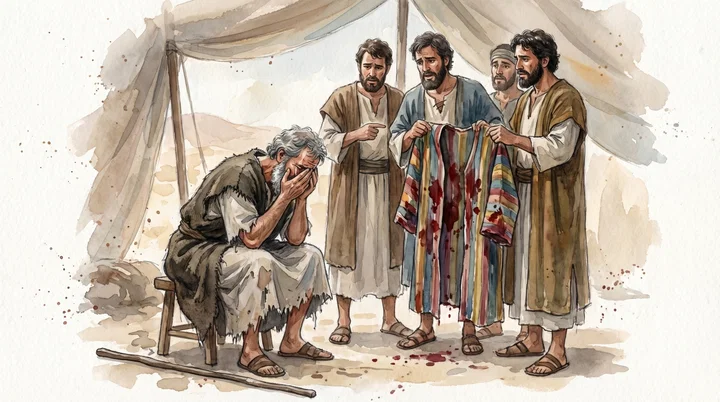
And they took Joseph’s coat, and killed a kid of the goats, and dipped the coat in the blood;
Translations
American King James Version, King James Version, KJV Cambridge Paragraph Bible
And they took Joseph’s coat, and killed a kid of the goats, and dipped the coat in the blood;
And they took Joseph's coat, and killed a kid of the goats, and dipped the coat in the blood:
Revised Version, American Standard Version
And they took Joseph’s coat, and killed a he-goat, and dipped the coat in the blood;
And they take the coat of Joseph, and slaughter a kid of the goats, and dip the coat in the blood,
And they took Joseph's vest, and slaughtered a buck of the goats, and dipped the vest in the blood;
And they took Joseph’s tunic,—and slaughtered a buck of the goats, and dipped the tunic in the blood;
Berean Standard Bible, Majority Standard Bible
Then they took Joseph’s robe, slaughtered a young goat, and dipped the robe in its blood.
They took Joseph’s tunic, and killed a male goat, and dipped the tunic in the blood.
Then they took Joseph's coat, and put on it some of the blood from a young goat which they had put to death,
And they tooke Iosephs coate, and killed a kidde of the goates, and dipped the coate in the blood.
Douay-Rheims (Challoner revision)
And they took his coat, and dipped it in the blood of a kid, which they had killed:
Pictures
Cross-references
- Genesis 50:20
But as for you, ye thought evil against me; but God meant it unto good, to bring to pass, as it is this day, to save much people alive.
God meant the brothers’ evil against Joseph for good, saving many lives.
- Acts 7:9
And the patriarchs, moved with envy, sold Joseph into Egypt: but God was with him,
Joseph’s brothers, envious of him, sold him into Egypt.
- Genesis 45:5-7
Now therefore be not grieved, nor angry with yourselves, that ye sold me hither: for God did send me before you to preserve life.
Joseph’s enslavement becomes God’s means of preserving his family from famine.
- Genesis 37:5-11
And Joseph dreamed a dream, and he told it his brethren: and they hated him yet the more.
The brothers’ envy of Joseph’s dreams leads them to plot against him.
- Genesis 42:1-3
Now when Jacob saw that there was corn in Egypt, Jacob said unto his sons, Why do ye look one upon another?
The famine sends Joseph’s brothers to Egypt, renewing Jacob’s grief and leading toward their reunion.
- Genesis 37:35
And all his sons and all his daughters rose up to comfort him; but he refused to be comforted; and he said, For I will go down into the grave unto my son mourning. Thus his father wept for him.
Jacob mourns Joseph, believing him dead.
- Genesis 42:6-9
And Joseph was the governor over the land, and he it was that sold to all the people of the land: and Joseph’s brethren came, and bowed down themselves before him with their faces to the earth.
Joseph’s brothers later bow before him, as his dreams foretold.
- Genesis 42:36
And Jacob their father said unto them, Me have ye bereaved of my children: Joseph is not, and Simeon is not, and ye will take Benjamin away: all these things are against me.
Jacob counts Joseph’s apparent loss among his troubles.
- Genesis 41:38-41
And Pharaoh said unto his servants, Can we find such a one as this is, a man in whom the Spirit of God is?
Joseph is raised to authority after his suffering.
- Genesis 45:8
So now it was not you that sent me hither, but God: and he hath made me a father to Pharaoh, and lord of all his house, and a ruler throughout all the land of Egypt.
Joseph later says God, not his brothers, sent him to Egypt.
- Genesis 27:18-24
And he came unto his father, and said, My father: and he said, Here am I; who art thou, my son?
Jacob deceived his father and was later deceived by his sons.
- Isaiah 63:3
I have trodden the winepress alone; and of the people there was none with me: for I will tread them in mine anger, and trample them in my fury; and their blood shall be sprinkled upon my garments, and I will stain all my raiment.
Uses nazah in the sense of sprinkling.
- Leviticus 14:51
And he shall take the cedar wood, and the hyssop, and the scarlet, and the living bird, and dip them in the blood of the slain bird, and in the running water, and sprinkle the house seven times:
Cited as an example of tabal meaning to dip.
- Genesis 39:19-21
And it came to pass, when his master heard the words of his wife, which she spake unto him, saying, After this manner did thy servant to me; that his wrath was kindled.
Joseph is falsely accused and imprisoned despite his integrity.
Commentary
Each commentary is drawn from primary sources: the writings of Ellen G. White and Adventist pioneers and periodicals. Each commentary is separate. Its own words are not a quotation; follow the references to read the source passages.
Ellen G. White
4 sources
The brothers killed a kid of the goats and dipped Joseph's coat in its blood.1SP 130.1–2SG3 142.1–2PP 212.1 They sent and presented the bloodied coat to Jacob to deceive him into concluding that Joseph had been killed by wild animals, by a wild beast.1SP 130.1–2SG3 142.1–2PP 212.1 They concealed their guilt by claiming they had found the coat in the fields.PP 212.1
The deception caused Jacob intense grief as he pictured his son torn apart.1SP 130.1–2SG3 142.1–2 His grief was deep and lasting, and he refused his children's comfort, saying he would mourn until he died.1SP 130.1–2PP 212.1 The brothers themselves remained troubled by what they had done.PP 212.1
The verse belongs to the account of Joseph being maligned and treated as a criminal despite his virtue, whose apparent suffering for doing right was followed by great victories that God had prepared for him.Lt 10, 1879, par. 4–9
Sources
Pioneers and periodicals
48 sources
The brothers killed a young goat and dipped Joseph's coat of many colors in its blood to make it look as though he had been killed.ST Aug 25, 1881ST Oct 6, 1881ST Sep 8, 1881ST Oct 2, 1901ST They carried the bloodied coat to Jacob and had him judge for himself whose it was, leading him to conclude that an evil beast had torn Joseph in pieces and to mourn him as dead for twenty-two years though he was alive.ST Oct 27, 1898ST Oct 2, 1901ST Apr 20, 1888ST Apr 2, 1894RH Aug 14, 1860 The deceit was meant to hide their stripping him, casting him into the pit, and selling him to the Ishmaelites for twenty pieces of silver, and it grew from envy at his favored place and righteous course that hardened into hatred and murderous intent.ST Mar 17, 1887ST Apr 2, 1894ST Oct 27, 1898ST Oct 2, 1901ST Mar 26, 1894 God overruled their wrath, ambition, and jealousy for good, turning the very cruelty meant to defeat Joseph's dreams into the roundabout way of fulfilling them and preserving Jacob's family in famine.ST Mar 17, 1887ST Apr 2, 1894ST Jan 16, 1912RH Jan 19, 1860ST Feb 7, 1911 In Jacob's grief the punishment was made to resemble his own sin against his father, showing that men reap what they sow and that the bitter fruit of cherished family jealousy cannot be undone even by later repentance.ST Jun 11, 1894ST Jun 9, 1881ST Jun 15, 1882ST Sep 28, 1904ST Nov 10, 1881
Wording and Action
The Hebrew word behind the act is tah-val or tabal, and it means to dip or immerse, not merely to sprinkle or moisten.ST Aug 25, 1881ST Oct 6, 1881ST Sep 8, 1881 In this verse it describes putting Joseph's coat into the blood of a goat.ST Aug 25, 1881ST Oct 6, 1881ST Sep 8, 1881 The coat was dipped in blood, not merely sprinkled or moistened.ST Oct 6, 1881ST Sep 8, 1881
The Greek rendering uses emolunan, meaning smeared or daubed, rather than bapto or baptizo.RH May 29, 1856 This verse is the single exception among twenty-one dip passages where bapto or baptizo is otherwise used.RH May 29, 1856 The wording is accurate because the act was smearing or daubing.RH May 29, 1856 Though the Greek translation uses a different word for dipping, it does not change the action described.ST Apr 22, 1880 By that action the coat was dipped in the kid's blood and thereby defiled.ST Apr 22, 1880
The act itself was killing a kid, he goat, or young goat and dipping or smearing Joseph's coat of many colors in its blood.RH May 29, 1856ST Apr 22, 1880ST Oct 2, 1901ST It was done with his coat to make the father believe that Joseph had been killed and to make it appear that he had been killed.ST Oct 2, 1901ST
Deception of Jacob
To hide the stripping of Joseph, the casting of him into the pit, and the selling of him to the Ishmaelites for twenty pieces of silver, his brothers killed a goat, a he goat, a young goat, and dipped his coat of many colors in its blood.ST Apr 2, 1894ST Oct 27, 1898ST Mar 26, 1894 The blood-dipped coat was used as false proof of his death to conceal guilt and make the father believe Joseph was dead.ST Oct 27, 1898ST Mar 26, 1894 They sent, carried, and brought the bloody coat to Jacob, claiming they had found it, pretending they had found it in the wilderness, and asking him to know whether it was his son's coat.ST Apr 2, 1894ST Apr 20, 1888ST Apr 2, 1894RH Aug 14, 1860
By the coat they made Jacob believe Joseph had been killed by a wild animal, a wild beast, an evil beast, and torn in pieces.ST Apr 2, 1894ST Oct 27, 1898ST Oct 2, 1901ST Apr 2, 1894 Jacob mourned for many years, though Joseph was alive and prospering.ST Jun 9, 1881RH Mar 30, 1869 The bloody appearance of the coat led him to imagine Joseph's death and to grieve as though the report were true.ST Oct 22, 1912 He trusted his sons and suffered as a result, receiving no clue of the truth while the awful secret stayed buried in his sons' hearts as family trouble.RH Aug 6, 1861ST Jan 9, 1912
He rent his garments, put sackcloth upon his loins, mourned for his son many days, refused to be comforted by his sons and daughters, and said he would go down to the grave mourning.ST Apr 2, 1894 That mourning for the blood-dipped coat stretched into days, weeks, months and years, as the long years of sorrow became the fruit of hatred turned into persecution. It is reckoned as twenty-two years of grief over Joseph as killed by wild beasts.ST Dec 14, 1915 The loss was only supposed, for Joseph had merely been taken away for a time and was alive, unlike the dead children of Job, and the mourning ended only when Jacob finally gave up his lost son as dead.ST Aug 24, 1915ST Jan 9, 1912
Motives and Background
The dipping of the coat in blood grew out of envy that deepened into hatred and finally toward murder, bound up with murderous hostility and persecution of Joseph.ST Mar 17, 1887ST Oct 2, 1901 That hatred first turned into persecution when the brothers used the blood-dipped coat to deceive their father, and those long years of sorrow it caused were part of the fruits of their hatred. The envy itself arose amid favoritism and family jealousies, fed by marked favor toward Joseph including the special coat that distinguished him from his brothers.ST Jan 3, 1911ST Oct 2, 1901 It became one of the sad fruits and crimes among the family following Jacob's mistakes.ST
Joseph had been more obedient than his brethren to his father's righteous teachings, treasuring his instructions with integrity of heart and love to obey God.ST Mar 17, 1887 He was grieved at their wrong conduct and hated sin so that he could not endure to see them sinning against God.ST Mar 17, 1887 He meekly entreated them to pursue a righteous course and leave off their wicked acts, and laid the matter before his father hoping his authority might reform them, which only embittered and enraged them against him.ST Mar 17, 1887
The brothers plotted against him, hardened their hearts to his pleas for life, first sought to kill him and cast him into a pit, and ultimately sold him as a slave into Egypt to the Ishmaelites.ST Jan 3, 1911ST Jun 11, 1894 Their envy led to that plot and sale in his early life.ST Jun 11, 1894 The deceit with the bloodied coat was one downward step after envy, hatred, and a scheme of murder, done to hide what they had done.ST Oct 27, 1898 It left a fearful expectation of wrath to be visited upon them, while the awful secret stayed buried in their hearts as family trouble.ST Oct 27, 1898ST Jan 9, 1912
Providence and Fulfillment
The evil devised against Joseph was meant by God for good, for He overrules human wrath, ambition and jealousy to accomplish His own purposes.ST Apr 2, 1894ST Jan 16, 1912 The dipping of the coat in the blood of a goat belonged to that evil, yet it became the means of preserving the father and the whole family in their time of trouble and famine.ST Apr 2, 1894ST Feb 7, 1911 Though the brothers acted to prevent Joseph's dreams from coming true, the Lord directed events so that their cruel actions helped bring those very dreams to fulfillment.ST Mar 17, 1887 Whatever God has intended a person for, He can be safely trusted to bring that person to it, leading roundabout yet guiding right.RH Jan 19, 1860
What looked like calamity against the aged father was in truth God's signal and wonderful providence, meant to teach patience and develop character.ST Jan 9, 1912 It was ordered to bring back the dearly loved Joseph in Egypt in the famine and to save the lives of many thousand people.ST Jan 9, 1912 The blood upon the coat marked the betrayal by which Joseph was sold into slavery, yet afterward Joseph provided food for those same betrayers and saved them from famine. The Lord was in this fitting Joseph to become a preserver of the holy Seed.ST Jan 21, 1913 His being guided and saved in youth and pushed by his brothers' ill-treatment toward the throne of Egypt shows that God can be safely trusted to bring a person to his appointed place.RH Jan 19, 1860RH Mar 20, 1900
The betrayal of Joseph by his brothers through envy is a type of Christ, whom His brethren delivered to death through envy.ST Dec 25, 1901
Doctrine and History
The dipping of the coat in blood belongs to the persecution of God-fearing Joseph by his wayward and envious brothers, the sons of Jacob.RH Jun 8, 1916 It proves that he that was born after the flesh persecutes him that was born after the Spirit, since the wicked persecute the righteous because their own works are evil and their brother's are righteous.RH Jun 8, 1916 Their false report with the bloodied coat after selling Joseph violated the ninth commandment, which they had known before Sinai.ST Jun 6, 1906
Genesis 37 is to be read together with Genesis 38 and Psalm 17, keeping ever in mind the Promised Seed and the channels through which that Seed should come.ST The chapter is part of the true historical record concerning Joseph in the Pentateuch, whose accuracy is fully corroborated by deciphered inscriptions on Egyptian monuments and tombs.ST Jul 30, 1885 That corroboration extends also to the exodus, showing the Pentateuch's prime historical importance as an aid to understanding Egyptian history and proving the Old Testament can be trusted.ST Jul 30, 1885
The Genesis history moving from Mesopotamia to Egypt agrees in whole color with Egypt at that time.ST Nov 20, 1884 Egyptian monuments contain no record of Bible miracles because kings do not report their disasters, and though Egyptian annals fail, Egyptian pictures, stories, and pious books illustrate habits and customs and give helps bearing on the land and people of the Nile behind the account.ST Nov 20, 1884 Egyptian pictures and accounts show slaves with Hebrew features working at brick-making as the Hebrews worked.ST Nov 20, 1884 The newly found city of Pithom, one of the two store cities built by the children of Israel, bears its name on an inscription and holds great brick store-houses without windows or doors for preserving grain for use in war or famine.ST Nov 20, 1884 The history of Joseph is also told by the Koran in story form rather than the simple Scripture narrative.RH Jan 11, 1912
Reaping and Warning
Jacob's sons killed a goat and dipped Joseph's coat in its blood and brought it to their father to make him believe Joseph had been killed by a wild animal, and Jacob mourned for many years though Joseph was alive and prospering.ST Jun 9, 1881ST Nov 10, 1881 That suffering followed Jacob's own deception of his own father, showing that punishment can resemble a person's sin and that people reap the consequences of what they sow.ST Jun 9, 1881ST Jun 15, 1882ST Nov 10, 1881 The bloodied coat thus became one of the deceptions Jacob suffered from his own sons and the beginning of his reaping deception and lies from his own family, bringing home the continuing effects of his earlier wrongdoing.ST Jul 10, 1893ST Jun 15, 1882
The consequences of deception can continue even after repentance and forgiveness, for Jacob's sorrow over the loss of his beloved son answered the sorrow his earlier deception had brought to his parents.ST Jun 9, 1881ST Apr 20, 1888 Other people may continue to remember the wrongs done to them, and the results set in motion by an evil act may not be stopped by later repentance.ST Jun 9, 1881ST Apr 20, 1888 The episode shows the wicked outcome of envy and plotting against God's providence, when the brothers' envy led them to plot against Joseph, cast him into a pit, and harden their hearts to his pleas for life.ST Jun 11, 1894 Jealousy cherished within a family and petty jealousies in the home are warned against because they can cause deep misery and bitter grief, as the sight of the bloodied coat in Genesis 37:31-35 brought Jacob to cry, All these things are against me.ST Jun 11, 1894ST Sep 28, 1904
Joseph's life provides an example for young men of righteousness made living through experience, while God overruled human wrath, ambition, and jealousy to accomplish His purposes.ST Jan 16, 1912 His submission to God's plan without complaining helped form a trustworthy character amid his brothers' cruelty that led to his being taken to Egypt.ST Nov 29, 1905 That guidance and saving of Joseph in his youth proves that God preserves those who fear and trust Him, with angels guarding them in trouble, giving every child and youth reason to seek the God of Israel early as a friend.RH Nov 24, 1874
Sources