Genesis 44:16
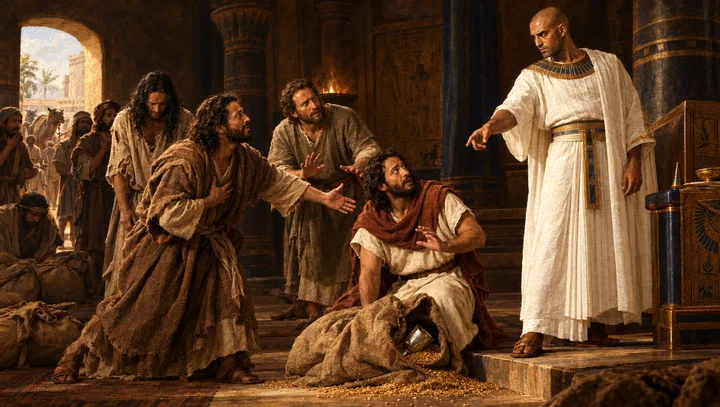
And Judah said, What shall we say unto my lord? what shall we speak? or how shall we clear ourselves? God hath found out the iniquity of thy servants: behold, we are my lord’s servants, both we, and he also with whom the cup is found.
Translations
And Judah said, What shall we say to my lord? what shall we speak? or how shall we clear ourselves? God has found out the iniquity of your servants: behold, we are my lord’s servants, both we, and he also with whom the cup is found.
King James Version, KJV Cambridge Paragraph Bible
And Judah said, What shall we say unto my lord? what shall we speak? or how shall we clear ourselves? God hath found out the iniquity of thy servants: behold, we are my lord’s servants, both we, and he also with whom the cup is found.
And Judah said, What shall we say to my lord? what shall we speak? or how shall we clear ourselves? God hath found out the iniquity of thy servants: behold we are my lord's servants, both we, and he also with whom the cup is found.
Revised Version, American Standard Version
And Judah said, What shall we say unto my lord? what shall we speak? or how shall we clear ourselves? God hath found out the iniquity of thy servants: behold, we are my lord’s bondmen, both we, and he also in whose hand the cup is found.
And Judah saith, 'What do we say to my lord? what do we speak? and what — do we justify ourselves? God hath found out the iniquity of thy servants; lo, we [are] servants to my lord, both we, and he in whose hand the cup hath been found;'
And Judah said, What shall we say to my lord? what shall we speak, and how justify ourselves? God has found out the iniquity of thy servants; behold, we are my lord's bondmen, both we, and he in whose hand the cup has been found.
Then said Judah—What shall we say to my lord, how shall we speak and how shall we justify ourselves,—when, God himself, hath found out the iniquity of thy servants? Behold us! my lord’s servants, both we, and he in whose hand the cup hath been found.
Berean Standard Bible, Majority Standard Bible
“ What can we say to my lord?” Judah replied. “ How can we plead? How can we justify ourselves? God has exposed the iniquity of your servants. We are now my lord’s slaves— both we and the one who was found with the cup.”
Judah said, “ What will we tell my lord? What will we speak? How will we clear ourselves? God has found out the iniquity of your servants. Behold, we are my lord’s slaves, both we and he also in whose hand the cup is found.”
And Judah said, What are we to say to my lord? how may we put ourselves right in his eyes? God has made clear the sin of your servants: now we are in your hands, we and the man in whose bag your cup was seen.
Then sayd Iudah, What shall we say vnto my lord? what shall we speake? and howe can we iustifie our selues? God hath found out the wickednesse of thy seruants: beholde, we are seruants to my Lord, both wee, and he, with whome the cuppe is founde.
Douay-Rheims (Challoner revision)
And Juda said to him: What shall we answer my lord? or what shall we say, or be able justly to allege? God hath found out the iniquity of thy servants: behold, we are all bondmen to my lord, both we, and he with whom the cup was found.
Pictures
Cross-references
- Genesis 44:33
Now therefore, I pray thee, let thy servant abide instead of the lad a bondman to my lord; and let the lad go up with his brethren.
Judah offers himself as a slave in Benjamin’s place.
- Genesis 37:5-11
And Joseph dreamed a dream, and he told it his brethren: and they hated him yet the more.
The brothers’ bowing before Joseph fulfills the dreams that had provoked their envy.
- Genesis 44:9
With whomsoever of thy servants it be found, both let him die, and we also will be my lord’s bondmen.
The brothers offer death and servitude if the cup is found.
- Genesis 45:1
Then Joseph could not refrain himself before all them that stood by him; and he cried, Cause every man to go out from me. And there stood no man with him, while Joseph made himself known unto his brethren.
Judah's plea leads Joseph to reveal himself.
- Genesis 37:28
Then there passed by Midianites merchantmen; and they drew and lifted up Joseph out of the pit, and sold Joseph to the Ishmeelites for twenty pieces of silver: and they brought Joseph into Egypt.
Judah confesses the brothers’ iniquity in selling Joseph.
- Genesis 42:6
And Joseph was the governor over the land, and he it was that sold to all the people of the land: and Joseph’s brethren came, and bowed down themselves before him with their faces to the earth.
The brothers bow before Joseph, recalling his dreams.
- Genesis 41:54-56
And the seven years of dearth began to come, according as Joseph had said: and the dearth was in all lands; but in all the land of Egypt there was bread.
The famine brings Jacob’s sons to Egypt to buy grain.
Commentary
Each commentary is drawn from primary sources: the writings of Ellen G. White and Adventist pioneers and periodicals. Each commentary is separate. Its own words are not a quotation; follow the references to read the source passages.
Ellen G. White
6 sources
Judah speaks for his brothers fallen to the ground before Joseph in his house after the cup is found in Benjamin's sack, admitting they have nothing to say and no way to clear themselves.1SP 148.2–149.1ST Jan 29, 1880 The iniquity he says God has exposed is their past sin of selling Joseph into Egypt.SG3 163.2–164.11SP 148.2–149.1ST Mar 31, 1887PP 229.6–230.2ST Jan 29, 1880 That confession concerns that past wrong against Joseph, not merely the missing cup.PP 229.6–230.2ST Jan 29, 1880
They understand their present danger of slavery as God allowing their past wrongdoing to return upon them by permitting them to become slaves also.SG3 163.2–164.11SP 148.2–149.1ST Mar 31, 1887SG3 163.1 They make no attempt to deny responsibility, offer no defense, or seek to clear themselves.1SP 148.2–149.1ST Mar 31, 1887PP 229.6–230.2SG3 163.1 They accept being made servants, all of them together including Benjamin with whom the cup was found.SG3 163.2–164.11SP 148.2–149.1ST Mar 31, 1887PP 229.6–230.2ST Jan 29, 1880
Joseph's test and his question about divining were meant to bring out remorse by drawing forth acknowledgment of that past wrong so their true feelings would be more fully revealed.1SP 148.2–149.1PP 229.6–230.2ST Jan 29, 1880 Joseph claimed no power of divination, but he was willing for his brothers to believe he could read the secret acts of their lives.1SP 148.2–149.1ST Jan 29, 1880
Sources
Pioneers and periodicals
9 sources
Judah's words are the brothers' surrender when the hidden cup is found in Benjamin's sack, admitting they have no defense and cannot clear themselves, declaring that God has exposed their wrongdoing and offering themselves all as servants together with Benjamin.ST Nov 24, 1898RH Aug 17, 1876ST Apr 16, 1894 Joseph had placed the cup there to test what they would do about Benjamin after they had boldly pledged servitude for whoever should have it.ST Jan 29, 1880RH Aug 17, 1876ST Apr 16, 1894 Their cry that God has found out their iniquity looks beyond the cup to their old guilt in selling Joseph, which they now feel God is bringing back upon them in their present danger.ST Mar 31, 1887ST Jan 29, 1880ST Apr 16, 1894 Years of affliction had softened them into humility and love without envy toward Benjamin, and when Judah pleaded and offered himself for the lad, Joseph saw the changed, repentant spirit he had waited for and made himself known to forgive them, turning their intent to harm into the preserving of their lives.ST Apr 16, 1894ST Jan 23, 1912
Setting and Confession
The verse stands in the part of Joseph's story when great famine possessed the land and Joseph was reunited to his father's family. Joseph tested his brothers by hiding his silver cup in Benjamin's sack in order to see what they would do about Benjamin.ST Jan 29, 1880ST Apr 16, 1894 The brothers had been so confident of their integrity that they offered that the one with whom the cup should be found should remain as servant.RH Aug 17, 1876ST Apr 16, 1894 When the cup was found in Benjamin's sack they returned to Joseph, and Judah spoke for them all.ST Jan 29, 1880ST Apr 16, 1894RH Oct 1, 1901
Judah admitted that the brothers had no defense and no way to speak or to clear themselves.ST Nov 24, 1898ST Nov 24, 1898RH Oct 1, 1901 He said that God had exposed and found out the iniquity of the servants.ST Mar 31, 1887ST Jan 29, 1880ST Nov 24, 1898RH Aug 17, 1876ST Nov 24, 1898 He offered that all of them become Joseph's servants and bondmen, both the rest and also he with whom the cup was found, including Benjamin.ST Mar 31, 1887ST Jan 29, 1880ST Nov 24, 1898RH Aug 17, 1876ST Nov 24, 1898
Joseph's question about certainly divining was put to draw forth that acknowledgment of past wrong and to reveal their true feelings more fully.ST Jan 29, 1880 He did not claim any power of divination for himself.ST Jan 29, 1880 He was willing for his brethren to believe that he could read the secret acts of their lives.ST Jan 29, 1880
Repentance and Reunion
The acknowledgment that God had found out iniquity reached beyond the charge concerning the cup to the older wrong course against Joseph in selling him.ST Mar 31, 1887ST Jan 29, 1880ST Apr 16, 1894 In the danger that now pressed upon them the brothers understood that God was permitting their own transgressions to return upon them.ST Mar 31, 1887ST Jan 29, 1880 Their inability to clear themselves was therefore confession of that past guilt, not only of the present accusation.ST Mar 31, 1887ST Jan 29, 1880ST Apr 16, 1894
That confession expressed remorse for selling Joseph and revealed hearts softened by years of affliction into humility and mutual love.ST Apr 16, 1894 The envy and jealousy once directed toward Joseph were gone, and none was now shown toward Benjamin.ST Apr 16, 1894 Judah pleaded eloquently for his brothers and offered himself in Benjamin's behalf.ST Apr 16, 1894 That changed and repentant spirit was what Joseph had waited to see, and when the plea was finished Joseph could no longer restrain himself but made himself known to his brethren to forgive them.ST Apr 16, 1894
Law and Providence
The discovery of the cup left the brothers under guilt and bondage because theft was regarded as a heinous offense in Joseph's time, which proves that the law against stealing was already in force long before Moses. Their answer to the charge shows they knew stealing was wrong, and their care to avoid even the appearance of coveting further shows they understood covetousness to be sinful.RH Aug 17, 1876
The whole account belongs to God's providential care for the family, for their intent to harm Joseph was turned to their good and Joseph's exalted position was used to preserve their lives.ST Apr 16, 1894ST Jan 23, 1912 That overruling providence preserved life through forgiveness and reunion after testing and repentance.ST Apr 16, 1894 The history of Joseph therefore shows that whatever God has intended a person for, He will safely bring him to it, and though He may lead by a roundabout way He will guide right, so He can be trusted.RH Jan 19, 1860
Sources