Genesis 44:33
Now therefore, I pray thee, let thy servant abide instead of the lad a bondman to my lord; and let the lad go up with his brethren.
Translations
Now therefore, I pray you, let your servant abide instead of the lad a slave to my lord; and let the lad go up with his brothers.
King James Version, KJV Cambridge Paragraph Bible
Now therefore, I pray thee, let thy servant abide instead of the lad a bondman to my lord; and let the lad go up with his brethren.
Now therefore, I pray thee, let thy servant abide instead of the lad, a bond-man to my lord; and let the lad return with his brethren.
Revised Version, American Standard Version
Now therefore, let thy servant, I pray thee, abide instead of the lad a bondman to my lord; and let the lad go up with his brethren.
'And now, let thy servant, I pray thee, abide instead of the youth a servant to my lord, and the youth goeth up with his brethren,
And now, let thy servant stay, I pray thee, instead of the lad a bondman to my lord, and let the lad go up with his brethren;
Now, therefore, I pray thee let thy servant remain instead of the lad, as servant to my lord,—but as for the lad, let him go up with his brethren.
Berean Standard Bible, Majority Standard Bible
Now please let your servant stay here as my lord’s slave in place of the boy. Let him return with his brothers.
Now therefore, please let your servant stay instead of the boy, my lord’s slave; and let the boy go up with his brothers.
So now let me be my lord's servant here in place of the boy, and let him go back with his brothers.
Nowe therefore, I pray thee, let me thy seruant bide for the childe, as a seruant to my Lord, and let the childe go vp with his brethren.
Douay-Rheims (Challoner revision)
Therefore I thy servant will stay instead of the boy in the service of my lord, and let the boy go up with his brethren.
Pictures
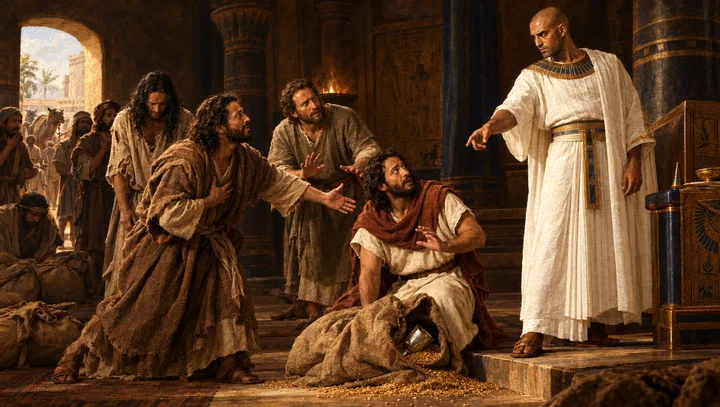
Cross-references
- Genesis 44:17
And he said, God forbid that I should do so: but the man in whose hand the cup is found, he shall be my servant; and as for you, get you up in peace unto your father.
Joseph’s decree that Benjamin remain prompts Judah’s offer to take his place.
- Genesis 44:16
And Judah said, What shall we say unto my lord? what shall we speak? or how shall we clear ourselves? God hath found out the iniquity of thy servants: behold, we are my lord’s servants, both we, and he also with whom the cup is found.
Confession of guilt precedes Judah’s offer to take Benjamin’s place.
- Genesis 45:1
Then Joseph could not refrain himself before all them that stood by him; and he cried, Cause every man to go out from me. And there stood no man with him, while Joseph made himself known unto his brethren.
Judah’s self-sacrificing plea moves Joseph to reveal himself and reassure his brothers.
- Genesis 43:9
I will be surety for him; of my hand shalt thou require him: if I bring him not unto thee, and set him before thee, then let me bear the blame for ever:
Judah pledges himself responsible for Benjamin’s safe return.
- Genesis 44:8-9
Behold, the money, which we found in our sacks’ mouths, we brought again unto thee out of the land of Canaan: how then should we steal out of thy lord’s house silver or gold?
The brothers deny stealing and offer a penalty if the cup is found.
- Genesis 37:28
Then there passed by Midianites merchantmen; and they drew and lifted up Joseph out of the pit, and sold Joseph to the Ishmeelites for twenty pieces of silver: and they brought Joseph into Egypt.
Joseph’s brothers sold him, unlike their later willingness to protect Benjamin.
Commentary
Each commentary is drawn from primary sources: the writings of Ellen G. White and Adventist pioneers and periodicals. Each commentary is separate. Its own words are not a quotation; follow the references to read the source passages.
Ellen G. White
6 sources
Judah's plea is to stay himself as bondman and slave to his lord in place of the lad, and to let the lad go up and return home to his father with his brethren.1SP 148.2–149.1SG3 163.2–164.1PP 224.3–225.1ST Jan 29, 1880ST Mar 31, 1887 The offer was made to Joseph apart from the rest of the brothers.SG3 163.2–164.1 It is noble and self-sacrificing, with Judah willing to bear the cost himself rather than let Benjamin bear it.1SP 148.2–149.1SG3 163.2–164.1PP 224.3–225.1ST Mar 31, 1887PP 229.6–230.2 The plea was made in intense distress.ST Jan 29, 1880
Judah had pledged himself as surety for Benjamin, to bring him back to his father or bear the blame forever if he did not.SG3 163.2–164.1ST Jan 29, 1880ST Mar 31, 1887 The offer was driven by love and care for his father Jacob and concern for his father's grief.PP 224.3–225.1ST Jan 29, 1880PP 229.6–230.2 Judah offered himself because he could not bear to face or meet his father without Benjamin with him, and was unwilling to see the evil that would come on his father.1SP 148.2–149.1SG3 163.2–164.1ST Jan 29, 1880ST Mar 31, 1887 He pleaded that his father's life is bound up in the lad's life, so that separation from Benjamin would kill him and he would go down with sorrow to the grave.1SP 148.2–149.1SG3 163.2–164.1ST Jan 29, 1880ST Mar 31, 1887
He pleaded his father's great grief at the loss of Joseph, and that Benjamin is all that is left of the mother his father loved.SG3 163.2–164.1ST Mar 31, 1887 The offer reveals the brothers' changed true feelings and changed character and gives the fruits of true repentance for their past wrong course, satisfying Joseph's test and recognized by Joseph as evidence of true repentance.ST Jan 29, 1880PP 229.6–230.2
Sources
Pioneers and periodicals
13 sources
Judah closes his plea for Benjamin by offering to remain in Egypt as a bondman to his lord in the lad's place, that Benjamin may go up with his brethren to their father.ST Jan 3, 1911ST Apr 16, 1894ST Nov 24, 1898 In this he fulfills the surety he had given to bring the lad back or bear the blame forever, pressed by love for his father whose life was bound up in the lad's life and who would go down with sorrow to the grave if separated from him.ST Jan 29, 1880ST Mar 31, 1887ST Nov 24, 1898ST Oct 23, 1901 The offer shows how greatly Judah and his brethren had changed since selling Joseph, for those who once abandoned their brother would not now abandon Benjamin, but were softened by affliction into self-sacrificing concern for one another.ST Oct 23, 1901ST Apr 16, 1894ST Feb 28, 1884ST Nov 24, 1898 It gives the fruits of true repentance that satisfied Joseph's test of them, humbly fulfilling the dreams that had once stirred their envy, and brought Joseph to make himself known to them in love and forgiveness.ST Jan 29, 1880ST Jan 3, 1911ST Apr 16, 1894
Setting and Plea
Genesis 44:33 belongs to Judah's plea for Benjamin in Genesis 44:18-34, a deeply moving, thrilling and eloquent passage that makes hearts grow tender.ST Nov 24, 1898ST Dec 9, 1908 It stands in the last chapters of Genesis, the Book of Beginnings, in the rest of the story of Joseph and his brethren amid the great famine and Joseph's reunion with his father's family. It belongs to the account of Joseph's silver cup hidden in Benjamin's sack and found there.RH Aug 17, 1876ST Apr 16, 1894
The verse records Judah closing his plea by offering to abide in Egypt as a bondman or slave to his lord instead of the lad, and to let the lad go up with his brethren to their father.ST Jan 3, 1911ST Apr 16, 1894ST Nov 24, 1898 The placing of the cup and its discovery was a policy to hold the brethren and try them to see what they would do in regard to Benjamin and whether they still held the same envy and jealousy toward Benjamin that they once held toward Joseph.ST Apr 16, 1894
The offer fulfilled the surety Judah had given for the lad, pledging to bring Benjamin back or bear the blame forever.ST Jan 29, 1880ST Mar 31, 1887ST Nov 24, 1898 The offer was driven by concern for their father, whose life was bound up in the lad's life.ST Jan 29, 1880ST Mar 31, 1887ST Nov 24, 1898ST Oct 23, 1901 He had grieved greatly over the loss of Joseph, for whom Benjamin was all that was left of the mother he loved, and who would die with sorrow to the grave or be killed by separation from Benjamin.ST Jan 29, 1880ST Mar 31, 1887 Judah in intense distress could not face his father without Benjamin nor see the evil that would come on him.ST Jan 29, 1880ST Mar 31, 1887
Repentance and Lessons
The brothers come humbly before Joseph, and in that humbling the dreams that had once stirred their envy are fulfilled.ST Jan 3, 1911 Those who had once sold Joseph would not now abandon Benjamin, and in Judah's offer to remain as bondman in Benjamin's place so that Benjamin might return to his father is seen how greatly he and his brethren had changed since selling Joseph.ST Oct 23, 1901ST Feb 28, 1884 Judah's willingness to be enslaved instead of his brother reveals self-sacrificing concern for his brother, and shows hearts softened by years of affliction into humility and love for one another.ST Apr 16, 1894ST Nov 24, 1898
The offer came after Joseph hid his silver cup in Benjamin's sack and the cup was found there, a policy to hold the brethren and try them to see what they would do in regard to Benjamin and whether they still held the same envy and jealousy toward Benjamin that they once held toward Joseph.ST Apr 16, 1894 It reveals the brethren's changed true feelings and gives the fruits of true repentance for their past wrong course, satisfying Joseph's test.ST Jan 29, 1880ST Apr 16, 1894 That repentance brings Joseph to make himself known to his brethren in love and forgiveness.ST Apr 16, 1894
As part of the response to the silver cup, the account shows their knowledge that stealing was wrong and suggests they understood covetousness to be sinful, for theft was treated as a heinous offense in Joseph's time.RH Aug 17, 1876 With Israel's journey to Egypt, their reception by Joseph and Pharaoh, Jacob's prophetic blessing upon Joseph's sons and his own sons, and Jacob's death and burial, the rest of the story of Joseph and his brethren shows God's care for the preservation of the progenitors of the Seed. It teaches that whatever God has intended a person for, He can be safely trusted to bring them to it, for He may lead by a roundabout way but He guides right.RH Jan 19, 1860
Sources