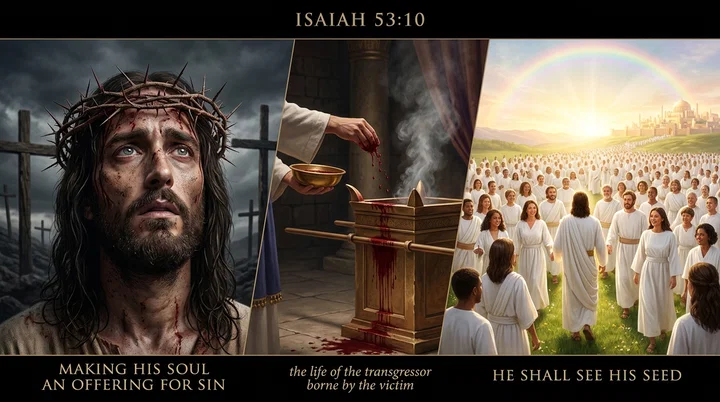
Isaiah 53:10
Yet it pleased the LORD to bruise him; he hath put him to grief: when thou shalt make his soul an offering for sin, he shall see his seed, he shall prolong his days, and the pleasure of the LORD shall prosper in his hand.
Translations
Yet it pleased the LORD to bruise him; he has put him to grief: when you shall make his soul an offering for sin, he shall see his seed, he shall prolong his days, and the pleasure of the LORD shall prosper in his hand.
King James Version, Webster Bible, Revised Version
Yet it pleased the LORD to bruise him; he hath put him to grief: when thou shalt make his soul an offering for sin, he shall see his seed, he shall prolong his days, and the pleasure of the LORD shall prosper in his hand.
Yet it pleased the Lord to bruise him; he hath put him to grief:
When thou shalt make his soul an offering for sin,
He shall see his seed, he shall prolong his days,
And the pleasure of the Lord shall prosper in his hand.Yet it pleased Jehovah to bruise him; he hath put him to grief: when thou shalt make his soul an offering for sin, he shall see his seed, he shall prolong his days, and the pleasure of Jehovah shall prosper in his hand.
And Jehovah hath delighted to bruise him, He hath made him sick, If his soul doth make an offering for guilt, He seeth seed — he prolongeth days, And the pleasure of Jehovah in his hand doth prosper.
Yet it pleased Jehovah to bruise him; he hath subjected [ him] to suffering. When thou shalt make his soul an offering for sin, he shall see a seed, he shall prolong [ his] days, and the pleasure of Jehovah shall prosper in his hand.
Yet, Yahweh, purposed to bruise him, He laid on him sickness:—If his soul become an offering for guilt, He shall see a seed, He shall prolong his days,—And the purpose of Yahweh, in his hand, shall prosper:
Berean Standard Bible, Majority Standard Bible
Yet it was the LORD’s will to crush Him
and to cause Him to suffer;
and when His soul is made a guilt offering,
He will see His offspring, He will prolong His days,
and the good pleasure of the LORD will prosper in His hand.Yet it pleased the LORD to bruise him.
He has caused him to suffer.
When you make his soul an offering for sin,
he will see his offspring.
He will prolong his days
and the LORD’s pleasure will prosper in his hand.And the Lord was pleased... see a seed, long life,... will do well in his hand....
Yet the Lord would breake him, and make him subiect to infirmities: when hee shall make his soule an offring for sinne, he shall see his seede and shall prolong his dayes, and the will of the Lord shall prosper in his hand.
Douay-Rheims (Challoner revision)
And the Lord was pleased to bruise him in infirmity: if he shall lay down his life for sin, he shall see a long-lived seed, and the will of the Lord shall be prosperous in his hand.
Pictures
Cross-references 20 of 146
- Isaiah 53:6
All we like sheep have gone astray; we have turned every one to his own way; and the LORD hath laid on him the iniquity of us all.
The Lord lays humanity’s iniquity on Christ.
- 2 Corinthians 5:21
For he hath made him to be sin for us, who knew no sin; that we might be made the righteousness of God in him.
Christ, though sinless, was made an offering for sin on behalf of others.
- 1 Peter 2:24
Who his own self bare our sins in his own body on the tree, that we, being dead to sins, should live unto righteousness: by whose stripes ye were healed.
Christ bears our sins in his suffering, and his wounds bring healing.
- Isaiah 53:5
But he was wounded for our transgressions, he was bruised for our iniquities: the chastisement of our peace was upon him; and with his stripes we are healed.
Christ is wounded and bruised for human sin, and his stripes bring healing.
- John 1:29
The next day John seeth Jesus coming unto him, and saith, Behold the Lamb of God, which taketh away the sin of the world.
Jesus is the Lamb of God offered to take away the world’s sin.
- 1 Peter 3:18
For Christ also hath once suffered for sins, the just for the unjust, that he might bring us to God, being put to death in the flesh, but quickened by the Spirit:
The just Christ suffered for the unjust, offering himself for sin to bring people to God.
- John 3:16
For God so loved the world, that he gave his only begotten Son, that whosoever believeth in him should not perish, but have everlasting life.
God gives his Son as an offering for sin so believers may have everlasting life.
- Matthew 20:28
Even as the Son of man came not to be ministered unto, but to minister, and to give his life a ransom for many.
Christ gives his life as a ransom for many.
- Hebrews 9:28
So Christ was once offered to bear the sins of many; and unto them that look for him shall he appear the second time without sin unto salvation.
Christ was offered to bear the sins of many and will appear again to save.
- Daniel 9:26
And after threescore and two weeks shall Messiah be cut off, but not for himself: and the people of the prince that shall come shall destroy the city and the sanctuary; and the end thereof shall be with a flood, and unto the end of the war desolations are determined.
The Messiah is cut off, not for himself, as an offering for sin.
- Matthew 26:38
Then saith he unto them, My soul is exceeding sorrowful, even unto death: tarry ye here, and watch with me.
Jesus describes his soul as sorrowful unto death, fulfilling the suffering described by Isaiah.
- Romans 3:25-26
Whom God hath set forth to be a propitiation through faith in his blood, to declare his righteousness for the remission of sins that are past, through the forbearance of God;
Christ’s sacrifice satisfies the law’s claims, allowing God to remain just while justifying believers.
- 1 Corinthians 15:3-4
For I delivered unto you first of all that which I also received, how that Christ died for our sins according to the scriptures;
Christ died for our sins and rose again, as Scripture foretold.
- Acts 2:31
He seeing this before spake of the resurrection of Christ, that his soul was not left in hell, neither his flesh did see corruption.
Christ’s soul was not left in the grave, and his flesh did not see corruption.
- Galatians 3:13
Christ hath redeemed us from the curse of the law, being made a curse for us: for it is written, Cursed is every one that hangeth on a tree:
Christ bears the law’s curse to redeem sinners.
- Psalms 22:16-18
For dogs have compassed me: the assembly of the wicked have inclosed me: they pierced my hands and my feet.
Both foretell Christ’s suffering and crucifixion, including pierced hands and feet.
- Psalms 16:10
For thou wilt not leave my soul in hell; neither wilt thou suffer thine Holy One to see corruption.
Both foretell Christ’s resurrection and his soul’s deliverance from the grave.
- Romans 5:8
But God commendeth his love toward us, in that, while we were yet sinners, Christ died for us.
Christ’s death for sinners shows God’s love and accomplishes atonement.
- Matthew 27:46
And about the ninth hour Jesus cried with a loud voice, saying, Eli, Eli, lama sabachthani? that is to say, My God, my God, why hast thou forsaken me?
Christ cries out in felt forsakenness while bearing sin’s penalty.
- Philippians 2:8
And being found in fashion as a man, he humbled himself, and became obedient unto death, even the death of the cross.
Christ humbled himself and became obedient unto death on the cross.
Commentary
Each commentary is drawn from primary sources: the writings of Ellen G. White and Adventist pioneers and periodicals. Each commentary is separate. Its own words are not a quotation; follow the references to read the source passages.
Ellen G. White
70 sources
It was foretold centuries beforehand that the Messiah would come not as a temporal king but as the Lamb of God to give His life as an offering for sin, and that prophecy was fulfilled in Jesus of Nazareth.AA 227.3DA 458.2–4GC 357.2–358.1SLP 103.2–104.1PK 682.2
It pleased the Lord to bruise Him and put Him to grief because the Father gave His only-begotten, sinless Son to stand in the sinner's place as substitute, bear human sin and its full penalty of curse, condemnation and wrath, and satisfy justice by perfect obedience and death on the cross.Ms 29, 1900, par. 7ST Jul 12, 1899Ms 31, 1911, par. 24–2618MR 335.2–337.3STSE 61.2–62.1
That crushing exposes how heinous sin is, for it caused the death of God's dear Son, and it meant awful darkness through withdrawal of the Father's favor while the guiltless One suffered as guilty so the guilty might be counted guiltless.Ms 29, 1900, par. 7Lt 338, 1907, par. 5–64T 374.1Ms 93, 1899, par. 23–24
Though bruised, after making His soul an offering He would live on beyond death, prolong His days, see His seed in the ransomed church who receive life through His sacrifice, and succeed in carrying out the Lord's pleasure by His hand.PK 692.1–2Ms 112, 1897, par. 20–21Ms 45, 1893, par. 2–5Lt 141, 1906, par. 5–9STE 181.1–2
By bearing iniquity He justifies many who believe, upholds and magnifies the law instead of abolishing it, secures the covenant made between Father and Son to redeem humanity, and gives believers righteousness, pardon, cleansing and power to hate sin and obey.Ms 29, 1900, par. 7Ms 31, 1911, par. 24–2618MR 335.2–337.321MR 54.3–55.1ST Feb 27, 1893
Messiah Foretold Beforehand
Isaiah 53:10 joins the sacrificial service closely to prophecy about the Messiah, foretelling centuries beforehand the scenes of the Saviour's atonement in which the Messiah as the Lamb of God would give His life to atone for sin, a truth made known to Israel through God's instruction as the means of salvation.AA 227.3PK 682.2
It is part of the prophecy fulfilled in Jesus of Nazareth that identifies Him as the Messiah and Son of God.GC 357.2–358.1
With other prophecies of His character, work, reception and death it points to Him as the one represented by the sacrificial offerings, whose death was part of His work as the world's Redeemer.SLP 103.2–104.1
The verse foretells a lowly, self-denying life of poverty and humility, rejection, suffering and death, rather than coming as a temporal king to elevate the Jewish nation, deliver from earthly oppressors, or overthrow Rome.7MR 200.1–202.1Lt 65, 1894, par. 4–6AA 227.4
His humble life and ministry were in harmony with what had been foretold, and the prophecy traced His experience with Christ revealed through humanity.DA 458.2–4Ms 64, 1895, par. 8
It points to the Messiah's suffering and death as the Lamb of God rather than to political elevation of the Jewish nation, showing He would come as a man among men to live a life of poverty and humility and at last be despised, rejected and slain.DA 78.3–5AA 227.4
He would offer Himself as a sacrifice in behalf of the fallen race, thus fulfilling every requirement of the broken law, so that in Him the sacrificial types meet their antitype and His death on the cross lends significance to the entire Jewish economy.AA 227.4
Even the manner of death was shadowed forth in plain prophecy of His sufferings and death.AA 226.3–227.1
Though He had done no violence and no deceit was in His mouth, it pleased the Lord to bruise Him and put Him to grief, with His grave made with the wicked and with the rich in His death.AA 226.3–227.1
His suffering and death as an offering for sin and ransom for guilty humanity are the crowning sacrifice ending His earthly mission, while His entry into Jerusalem draws public attention to that sacrifice and faintly prefigures His future glory as King.ST Apr 1, 1889
The people misread this testimony about the first advent because they accepted their teachers' claims and applied prophecies of the second coming to the first.7MR 200.1–202.1
Expecting the glory of the second appearing and a temporal prince who would defeat Rome and reign as an earthly prince, they failed to recognize the time and manner of His coming and did to Christ what Scripture foretold.Lt 65, 1894, par. 4–6Ms 41a, 1896, par. 33
This prophecy showed that His rejection, suffering and death were part of God's purpose, not a defeat of His mission.Lt 65, 1894, par. 4–6
All that He passed through was ordained in the councils between the Father and the Son and foretold by prophets and men inspired by the Holy Spirit, including being refused and rejected, the humiliation received, the death died, and rising again on the third day.Ms 138, 1897, par. 15–16
Every specification of the prophecies concerning Him was fulfilled, and He opened the Scriptures step by step to show this fulfillment to His disciples.Ms 138, 1897, par. 15–16
Jesus recognized Himself as its fulfillment when twelve years old on His first visit to the temple, learning from what He saw there His mission and work as the great sacrifice for sin.Ms 183, 1903, par. 1–2
He knew the prophecies of His humiliation, atonement and intercession and of His work of mediation for fallen humanity.CT 260.2FE 402.3–4
The gracious purpose of the Lord prospering in His hands was the object of His life on earth, kept ever before Him from childhood as He studied the prophecies concerning His work, and He rejoiced to think of it.CT 260.2FE 402.3–4
The promised seed and the Lord's purpose prospering through Christ describe the reward of His self-offering, that He would see the result of His suffering and His people would have life that endures.FE 402.3–4
He knowingly walked toward Gethsemane and the place of crucifixion.4SP 18.1
From Olivet He fully knew and saw lying before Him the soon-coming path through Gethsemane to Calvary under horror of great darkness and superhuman anguish as He gave His life for sin.4SP 18.1GC88 18.1
No dread for Himself or of His own suffering clouded His unselfish spirit.4SP 18.1GC88 18.1
His tears in the gladness of the triumphal entry were not for His own approaching agony but for the blindness, impenitence and coming doom of the thousands of Jerusalem whom He came to bless and save.4SP 18.1GC88 18.1
The prophecy belongs to Christ's work and continues the account of Him stricken for the transgression of God's people.Ms 126, 1909, par. 9–12Lt 21, 1905, par. 10–11
It is intended to help and bless His people and is cause to thank God as part of God's wonderful work.Ms 126, 1909, par. 9–12Lt 21, 1905, par. 10–11
What He suffered in His own person secured the salvation of the human race, so its Old Testament truths vividly representing it are to be sacredly cherished.Ms 138, 1897, par. 15–16
Bruised as Sin Offering
It pleased the Lord to bruise Him and put Him to grief by making His soul an offering for sin, the Father giving, permitting and pledging His only-begotten Son to suffer so He could bring redemption to the human race.Ms 29, 1900, par. 7Ms 31, 1911, par. 24–2618MR 335.2–337.3ST Feb 27, 1893 That permission also let Satan display his character and the principles of his rule, so that the conflict between Christ and Satan would be revealed.ST Jul 12, 1899 That crushing was willingly done and driven by how much God loved the human race, manifested at Calvary as Jesus hangs on the cross, to pay the price of redemption when no one else could ransom them.PK 692.1–2
The bruising exposes the heinous character of sin, for sin caused the death of God's dear Son, and sin is the transgression of the law and is never to be treated as small.Ms 93, 1899, par. 23–24 The Redeemer was the Just and Perfect and only sinless One who knew no sin, was holy and far above humanity, yet with perfect meekness and compassion stooped to help the weak and tempted.Ms 29, 1900, par. 7Ms 42, 1901, par. 22–25 He endured suffering and temptation without sin, took humanity upon Himself and lived among people for thirty years, clothed divinity with humanity and took His position at the head of humanity.Ms 42, 1901, par. 22–25MYP 255.2RH Jan 7, 1902Lt 12, 1901, par. 9–14 Even in laying aside royal robe and crown to become poor that men through His poverty might be made rich, He remained evidence of divine love and benevolence by which the divine image is restored.Lt 12, 1901, par. 9–14
He was made sin for humanity and became the sin-bearer with human sins transferred to Him; though guiltless He suffered as guilty and was stricken and afflicted by God in the sinner's place, bearing the blow deserved for transgression, so the guilty might be counted guiltless.Ms 29, 1900, par. 7Lt 338, 1907, par. 5–6STSE 61.2–62.14T 418.2–3ST He took the sinner's place as humanity's divine-human substitute and bore the full penalty required for transgression, the stroke of divine justice, the curse, God's condemnation and wrath, and an infinite weight of woe.Ms 31, 1911, par. 24–2618MR 335.2–337.34SP 197.2–198.2Lt 12, 1901, par. 9–14GC 313.1–315.2 Through perfect obedience and blood shed on the cross and death for those who broke it, justice was fully satisfied.Ms 31, 1911, par. 24–2618MR 335.2–337.3Lt 75, 1903, par. 5LC1 121.2 His perfect obedience and death upheld the law's claims and established its unchanging authority rather than setting it aside.Lt 75, 1903, par. 5LC1 121.2 He was crucified and buried as the sin-bearer and His grave opened a way for all who accept Him as personal Saviour, paying the redemption price for the fallen world.Ms 111, 1897, par. 35–36
That standing in the sinner's place meant awful darkness gathered about His soul through withdrawal of the Father's love and favor, the same darkness every sinner must experience, with the veil of darkness about His divine soul drawing the cry as of one smitten and forsaken.4T 374.1Ms 93, 1899, par. 23–24 God's heart yearned with greatest sorrow without vindictiveness while His guiltless Son suffered, and the bruising was a sundering of the divine powers that will never occur again through the eternal ages.Ms 93, 1899, par. 23–24 As substitute and surety He suffered under divine justice what it means for sinners to stand before God without an intercessor.PK 691.1 It was completed in His dying agony when nature sympathized with her suffering Author in darkened sun, rent rocks, earthquake and opened graves, until He cried it was finished and committed His spirit to the Father and was declared a righteous man.Ms 93, 1899, par. 23–24
In the crucifixion His face and form were marred beyond any man and He suffered humiliation, scorn, mockery and abuse to save men from everlasting disgrace and shield them.Ms 128, 1897, par. 22–234T 374.1 Even in that humiliation of stooping to take man's nature He remained the Son of the Highest, worthy of dignity and glory befitting His character, having left the glory shared with the Father before the world was.4SP 197.2–198.2GC88 313.2–314.1 His appearing was an event angels looked forward to with intense interest as greatest joy to all people, desiring it attended with dignity and glory befitting Him even in lowliness, and He bore an infinite weight of woe.4SP 197.2–198.2GC88 313.2–314.1GC 313.1–315.2 Only the Son with an infinite nature and equal standing with the Father was fully sufficient to undertake redemption, meet the conditions of salvation and magnify the law.STMs 29, 1899, par. 3Ms 48, 1893, par. 6 No angel or human being and no sacrifice angels could make could do this work.STSTMs 29, 1899, par. 3
The Lord allowed Satan to display his character and the principles of his rule so the conflict between Christ and Satan and the outcome of Satan's methods and government if he controlled the world would be revealed, showing what humanity does under Satan's control in making void God's law and bringing in Satan's government.ST Jul 12, 1899Ms 128, 1897, par. 22–23Ms 128, 1897, par. 18–21 The battle continued through resurrection and ascension, then was transferred to and carried on against His followers.ST Jul 12, 1899Ms 128, 1897, par. 18–21 That terrible scene left a lasting impression on all who saw it and revealed humanity under Satan's control.Ms 128, 1897, par. 22–23 Those who heard the report of His death, even from His enemies, were convicted, began searching the Scriptures, were converted to Christ and told many others, so His suffering sprinkled many nations.Ms 128, 1897, par. 22–23
Seed Days and Pleasure
The bruising and grief do not end the story, for after being made an offering for sin He sees His seed, prolongs His days beyond death and lives on, and the pleasure of the Lord prospers in His hand.PK 692.1–2Ms 112, 1897, par. 20–21Ms 45, 1893, par. 2–5 Though He suffers, He sees the outcome of His suffering, has enduring life, and carries out the Lord's purpose to its fulfillment.Ms 112, 1897, par. 20–21Ms 45, 1893, par. 2–5 That promise is rich even amid foretold bitter suffering and cruel death, declaring He will see the anguish of His soul and be satisfied while succeeding in God's work.PK 692.1–2
His seed are His spiritual offspring, the ransomed church, those who receive life, pardon and everlasting life through His sacrifice.Lt 141, 1906, par. 5–9STE 181.1–2ST Sep 28, 1915Ms 9, 1896, par. 16–17 Their days are prolonged forever, and their life and mission continue His work.Lt 141, 1906, par. 5–9STE 181.1–2FE 402.3–4 Those who benefit from His work share lasting life, and the promise of prolonged days is also set before children in obedience to parents, with Christ as the example and disobedience bringing the sure result of shortened days.Ms 9, 1896, par. 18Ms 9, 1896, par. 16–17
The Father's promise follows the offering: Christ gives His life as the world's propitiation, then sees His seed in the ransomed church and receives glory through them.RH Mar 4, 1909Lt 141, 1906, par. 5–9 His church is the recompense for His victory and a chief source of His glory.RH Mar 4, 1909Lt 141, 1906, par. 5–921MR 83.6–84.2 Through it God's wisdom is made known to heavenly powers.RH Mar 4, 1909Lt 141, 1906, par. 5–9
His finished work and ascension fulfill this promise, for He is glorified.Lt 141, 1906, par. 5–921MR 83.6–84.2 As the risen and ascended Saviour He guides and protects His followers and gives them guidance through the Holy Spirit.Lt 141, 1906, par. 5–921MR 83.6–84.2 In this way He continues His work through them after His suffering and sin offering.21MR 54.3–55.1Lt 141, 1906, par. 5–921MR 83.6–84.2
He looked beyond the suffering to the people who would receive pardon and everlasting life.ST Sep 28, 1915Lt 239, 1903, par. 18–22 He saw the redeemed made joyful through His humiliation, heard their praise, and was satisfied with the result of His sacrifice.ST Sep 28, 1915Lt 239, 1903, par. 18–22 For that future joy He endured the cross, and the sight of those redeemed sustained Him through betrayal and trial.ST Sep 28, 1915Lt 239, 1903, par. 18–22
This is the reward set before Him, to see the fruit and result of His travail and be satisfied as the Lord's gracious purpose prospers through His work.Ms 182, 1898, par. 62–64STE 181.1–2FE 402.3–4Ms 9, 1896, par. 18Ms 9, 1896, par. 16–17 That gracious purpose prospering in His hands was the object of His life on earth, kept ever before Him from childhood as He studied the prophecies of His humiliation, atonement, mediation and intercession, and He rejoiced to think of it.Ms 182, 1898, par. 62–64CT 260.2FE 402.3–4 Faith in these words of God's purpose succeeding through suffering makes believers earnest and sincere in faith and trust and confidence, always working on the faith side and becoming in His hands a vessel unto honor as colaborers inviting others to come, which belongs to true service, thorough consecration, and entire sanctification of soul, body and spirit.Ms 182, 1898, par. 62–64
The following verses explain the triumph after pouring out His soul unto death.Ms 29, 1900, par. 7Ms 112, 1897, par. 20–21 He is satisfied by His work, justifies many by bearing their iniquities, is numbered with transgressors, makes intercession for transgressors as priest, and receives a portion with the great.Ms 29, 1900, par. 7Ms 112, 1897, par. 20–2121MR 54.3–55.1Ms 9, 1896, par. 18 Through that sacrifice, made as the condition of the covenant to redeem people from Satan's power, He has a people, continues His work, and carries out the Lord's purpose.Ms 29, 1900, par. 721MR 54.3–55.1
Covenant Law Vindicated
The bruising and grief by which his soul was made an offering for sin was the condition of the covenant to redeem humanity from Satan's power, settled in the councils of the Godhead between the Father and the Son, and on that condition the fulfillment of God's purpose rests.21MR 54.3–55.1Lt 126, 1898, par. 15–16 Through that sacrifice he would have a people, continue his work, and cause the pleasure of the Lord to prosper in his hand, while the following verse explains that he bears their iniquities and justifies many.21MR 54.3–55.1 With Christ God gave all the resources of heaven, so nothing was wanting in the plan for man's uplifting.Lt 12, 1901, par. 9–14
In that counsel the Father purposed that the human family should be tested and proved whether they would be allured by Satan's temptations or would make Christ their righteousness, keep God's commandments, and live.Lt 126, 1898, par. 15–16 The Father gave to the Son all who would be true and loyal, and Christ covenanted to redeem them from Satan's power at the price of his own life.Lt 126, 1898, par. 15–16 That price was paid while men were yet sinners, when he laid aside his royal robe and kingly crown, clothed divinity with humanity, stooped to man's estate, became poor that men through his poverty might be made rich, took his position at the head of humanity, bore the stroke of divine justice, suffered the penalty of transgression in the transgressor's place, and died that men might live.Lt 12, 1901, par. 9–14 In the heavenly courts the Father, the Son, and the Holy Spirit pitied the fallen race and appointed him, the only-begotten Son, to give himself as unmistakable evidence of the love and benevolence by which the divine image is restored in man.Lt 12, 1901, par. 9–14
The Father pledged that if he clothed divinity with humanity and endured the test Adam failed, his obedience would be counted as righteousness to his people, conquering in their behalf and placing them on vantage ground with probation to return to loyalty by keeping God's law.Ms 128, 1897, par. 18–21 Through his sacrifice justice was satisfied and the law's authority was upheld, not abolished, for he took the sinner's place and bore the full penalty required for transgression of God's law.Ms 31, 1911, par. 24–2618MR 335.2–337.3 Not one jot or tittle of the law could be changed to meet man in his fallen condition, so by perfect obedience and death for those who broke it he vindicated its honor, elevated and ennobled it, settled its immutability forever, upheld its claims and established its unchanging authority.Ms 31, 1911, par. 24–26LC1 121.2Ms 29, 1899, par. 3 As humanity's divine-human substitute he met its perfect standard as Substitute and Surety while displaying sin's curse, and his equal standing with the Father made him fully sufficient to become the sin offering and to magnify the law and make it honorable, a work angels could not do.18MR 335.2–337.3Ms 29, 1899, par. 3Ms 48, 1893, par. 6 Through his righteousness credited to them, people can be reconciled to God and escape the punishment due for disobedience.ST Jul 24, 1884
It pleased God to lay the penalty of the human race on him so the heavenly universe could see the conditions of the covenant of redemption, so the throne of justice would be made eternally secure, so the law would be exalted and honored as unchangeable, so honor would be restored to God's government before unfallen worlds, so all doubts would be settled, and so Satan's charge about justice and mercy would be answered.Ms 128, 1897, par. 18–21 At the same time Satan's attributes, principles, government, enmity against the Commander of heaven, and cruel mercy would be seen and realized.Ms 128, 1897, par. 18–21 His death proved God's administration without flaw, and the cross is looked upon by unfallen worlds, the heavenly universe, satanic agencies, and the fallen race until every mouth is stopped and every voice in and out of heaven testifies to God's justice, mercy, and exalted attributes.Ms 128, 1897, par. 18–21
He is fallen humanity's only hope of a life that measures with the life of God, having given himself as Saviour and Mediator between God and humanity and redeemed the human family at infinite cost.Lt 180, 1902, par. 33–35 His self-offering was part of the plan of redemption, first taking humanity upon himself and living among people for thirty years, so that humanity would not be left to perish and might regain godlike manhood.MYP 255.2 By that offering he enables people to become sons and daughters of God, restores the divine image, and as the just One becomes the justifier of all who believe in him.Lt 180, 1902, par. 33–35Lt 12, 1901, par. 9–14
Salvation and Transformed Life
By bearing iniquity He justifies many, for at Calvary He bore human sin that the sinner may receive His righteousness.Ms 29, 1900, par. 7ST Feb 27, 1893 Through His death the believing, repentant sinner may stand justified before God in His righteousness, reconciled, redeemed, restored and given life.ST Jan 6, 1881ST Jan 5, 1915ST Jul 24, 1884 His perfect obedience and blood shed on the cross make this possible for repentant sinners, and through His righteousness credited to them they escape the punishment due for disobedience.Lt 75, 1903, par. 5ST Jul 24, 1884
His sacrifice reveals the Father's character that God is just while justifying those who believe, having been stricken and afflicted in humanity's place and bearing the blow deserved for transgression of the law.STSE 61.2–62.1 Through that sacrifice He can accept the humble penitent, give peace and rest, release from bondage, cleanse from guilt and moral defilement, and give power to obey the law.ST Jan 5, 1915ST Mar 3, 1881 By making His Son the sacrifice for sin and thereby condemning sin in the flesh, Christ's righteousness is given to believers so they are made the righteousness of God in Him.Lt 338, 1907, par. 5–6 Thus made sin for humanity as the sin-bearer with human sins transferred to Him though He knew no sin, they become partakers of the divine nature and escape the corruption in the world through lust.Lt 338, 1907, par. 5–6
His sacrifice rescues sinners from sin's terrible influence and makes it possible for them to hate sin and turn from sin.Ms 7, 1902, par. 16 He gave His life so people could be converted and work with God, meeting as Substitute and Surety the perfect standard of obedience while His death displayed sin's curse and upheld and honored the law rather than abolishing it.Ms 7, 1902, par. 1618MR 75.1 When the sinner realizes Christ died for him he magnifies God's love in providing salvation, for Christ died that He might impute His righteousness to him. Penitence and faith are learned at the foot of the cross, and all that is noble and generous responds to contemplating Christ there, who suffered humiliation, scorn, mockery and abuse to save men from everlasting disgrace and shield them.4T 374.1
Contemplation of this matchless love fills the soul with gratitude, cleanses it from selfishness, and leads the disciple to deny self, take up the cross and follow, restoring the divine image in man.Lt 12, 1901, par. 9–14 Faith in these words of God's purpose succeeding through suffering, with Christ seeing the result of His travail and being satisfied, makes believers earnest and sincere in faith, trust and confidence.Ms 182, 1898, par. 62–64 Always working on the faith side they become in His hands a vessel unto honor as colaborers inviting others to come, in thorough consecration and entire sanctification of soul, body and spirit.Ms 182, 1898, par. 62–64
Because He gave all as a complete sacrifice, God asks for the whole heart and accepts nothing less than undivided affections.Ms 16, 1898, par. 14–15 To serve Him in return is to resemble Him in character and imitate Him by obeying, keeping commandments, openly confessing allegiance under the bloodstained banner of Prince Emmanuel and not under the apostate's black banner, showing by zealous keeping of His Word whose army one is, and worshiping in spirit and truth.Ms 16, 1898, par. 14–15 Since sin caused all His suffering, sin is never to be treated as small, and teachers, ministers and all God's children must use all God-given power to restrain sin, depart from iniquity, reverence Christ and fellow laborers, and keep His commandments.Ms 93, 1899, par. 23–24 The promise of prolonged days also applies to children's obedience to parents: Christ set the example, His seed who benefit from His work share enduring life, and disobedience brings the sure result of shortened days.Ms 9, 1896, par. 18Ms 9, 1896, par. 16–17
Sources
Pioneers and periodicals
141 sources
It was the Lord's own will and appointment for the Messiah to be crushed to grief under His hand, bearing the burden and penalty of human sin.ST Jun 30, 1914ST Dec 3, 1885ST Jul 14, 1881ST Feb 6, 1907ST Feb 6, 1907 What He gave as an offering for sin was His very life, His soul itself poured out unto death and laid in the grave, the true sin-offering that all animal sacrifices only foreshadowed.ST Sep 5, 1900RH Jun 18, 1867ST Nov 27, 1884RH Nov 7, 1854 Though innocent and sinless, He stood in the sinner's place as substitute and surety, bearing others' iniquities, curse and wrath so the guilty could be pardoned, healed and reconciled.RH Jan 20, 1910ST Feb 14, 1906STST Nov 23, 1904RH Nov 7, 1854 He could prolong His days only by triumphing over death, rising from the tomb and ascending in glory to endless life, and He sees His seed in His spiritual offspring, the ransomed church living in Him and ever increasing.ST Mar 19, 1912RH Jan 18, 1912ST Jun 16, 1914RH Dec 11, 1855 Through Him the pleasure of the Lord prospers to full success in the conversion, justification and final gathering of many, revealing the immeasurable depth of God's love that would punish sin yet let mankind go free.ST Jan 26, 1882RH Dec 26, 1907ST Dec 11, 1884ST Jan 18, 1899
Language and Setting
The word for bruised carries the sense of being crushed to powder or dust, the same sense as contrite, and from this sacred dust comes a new creation fit to be God's dwelling.RH Apr 2, 1901 Christ bore human disease only as he bore human sin, and his suffering throughout life was a sacrifice made for the sinner.RH Apr 2, 1901
The soul made an offering for sin is his life, given as an offering for sin and poured out unto death.RH Nov 7, 1854ST Sep 21, 1904RH Sep 12, 1854 As the good shepherd gives his life for the sheep, either he or the sheep must die, and by giving his life he saved the life of his sheep, dying in their stead.RH Nov 7, 1854RH Sep 12, 1854 He truly died as the sacrifice for human sin.
Soul here also means the person himself or his own self, his own person made an offering for sin and given in death.ST Nov 9, 1882ST Oct 5, 1882 A soul can therefore die, with his soul poured out unto death.ST Nov 9, 1882ST Oct 5, 1882 His soul itself was poured out unto death and died, not merely his body.RH Nov 21, 1854ST Nov 20, 1884 His exceeding sorrow of soul even unto death in the Garden agrees with that death of the soul, and his soul suffered even to death when he bore sin under the Lord's bruising and grief.RH Nov 21, 1854ST Nov 20, 1884
The suffering and death are spoken of as already past although they lay more than five centuries in the future when spoken, since prophecy can use the present or past for events yet to come.ST May 6, 1880ST Nov 18, 1889 The prophecy was written about seven hundred years before he came, yet describes the suffering and saving work with such clarity that it reads as though the prophet had witnessed Calvary.ST Mar 19, 1912ST Apr 8, 1886 It is not to be shifted into the past as though Christ had already come, but belongs to events spoken before his coming and fulfilled afterward.RH Feb 16, 1860 It shows him as the divine substitute whom Jehovah willed to crush with affliction, whose soul makes a propitiatory sacrifice for sin, with the result that he shall see a seed which shall prolong their days and the gracious purpose of Jehovah shall prosper in his hands, and of the travail of his soul he shall see the fruit and be satisfied.ST Mar 19, 1912
It belongs to his announcement of himself as the suffering Messiah who must go to Jerusalem and suffer many things at the hands of the elders and chief priests and scribes and be killed and be raised the third day.ST Mar 24, 1898 That announcement came in the summer of A.D. 29, in the middle of the third year of his ministry, as part of the fifty-third chapter foretelling Jesus as the suffering Messiah.ST Mar 24, 1898
Father's Pleasure to Bruise
It was God's will and appointment for the Messiah to suffer and die as a sacrifice for sin, bearing sin's penalty as the innocent divine substitute so the guilty could be pardoned, healed, set at liberty and go free.ST Jun 30, 1914RH Oct 20, 1859RH Apr 24, 1879 The Father's word marked out for him a path of suffering service, sorrow, unappreciated service and shameful death, which he accepted in submission rather than seeking an easier way.ST Feb 6, 1907ST Feb 6, 1907 His death opened the way of hope and escape, because remission requires shedding of blood and God's law and justice had to be upheld, though laid in the tomb he rose as conqueror.RH Oct 20, 1859
The Lord himself bruised him, put him to grief, and laid grief and the burden of sin upon him, making his life an offering for sin as the necessary work of redemption.ST Dec 3, 1885ST Jul 14, 1881RH Dec 9, 1858 He suffered under the Lord's hand as justice laid humanity's iniquities upon him, bearing human sins and the death due to sinners and dying on their behalf in fulfillment of being cut off and pouring out his soul to death.ST Feb 6, 1907RH Nov 11, 1862ST Dec 23, 1886 His suffering involved God's righteous wrath and judgment against human guilt, not only physical agony, though he himself knew no sin.ST Jul 14, 1881RH Dec 9, 1858 The Hebrew worshipper recognizes in this the suffering Messiah who makes atonement for others' sins, yet struggles to understand him.RH Nov 11, 1862
The Lord's purpose in allowing him to suffer was not delight in his pain nor lack of sympathy for his agonizing Son, but the healing, justification, life and salvation made possible through his faithful obedience even to death.RH Dec 26, 1907ST Jul 4, 1905 His suffering and death on the cross were part of the loving Father's gift for sinners, by which the righteous servant bore the iniquities of those deserving judgment and death so they could receive life.RH Dec 26, 1907ST Sep 15, 1887 His death and passage through the tomb opened the way for believers to be raised to life, brought his numerous spiritual offspring into view, and assured the faithful of God's promises.RH Dec 26, 1907ST Jul 4, 1905
The Lord permitted his only-begotten Son to be bruised so Satan could display his character and the principles of his rule and the conflict between Christ and Satan would be revealed.ST Jul 12, 1899 That battle continued through resurrection and ascension and then carried on against his followers.ST Jul 12, 1899 The Lord did not spare him from the suffering required to bear sin, for that suffering and death were the cost of salvation and no part of that penalty could be taken away.ST Mar 19, 1885
He bore the Father's bruising and the law's full demands and penalties without complaint or impatience, trusting and willingly submitting with resignation and patience.RH Mar 17, 1863RH Feb 28, 1854RH Feb 25, 1858 This reveals that the law's requirements and sanctions are righteous and must be acknowledged as good, and provides the example for those who suffer with him.RH Mar 17, 1863RH Feb 28, 1854
The verse shows how much God loved the human race and the immeasurable depth of that love manifested at Calvary.RH Mar 9, 1905 It exposes the heinous character of sin as transgression of the law, for sin caused the death of God's dear Son, who died for the sinner that he might impute his righteousness to him. It is the wondrous plan devised and achieved by eternal, sovereign love, grace, wisdom, power and infinite mercy to punish sin yet let mankind go free.RH Mar 20, 1855 The only-begotten and well-beloved Son was made flesh and dwelt with men, interposing himself between men and the Father's justice, taking human nature, sustaining divine wrath, and in man's name, unconstrained except by boundless grace, suffering, obeying and dying the just for the unjust and innocence for guilt.RH Mar 20, 1855RH Oct 16, 1860 Moved by pity and love he came willingly, leaving the Father's presence and heaven's glory to take human form, giving his life for sin to make complete atonement to an appeased God, honoring God's insulted law and turning wrath aside from pardoned man, so that truth meets mercy and righteousness embraces peace in fellowship with love.RH Mar 20, 1855RH Oct 16, 1860 His pouring out his life unto death and bearing the curse for sinners makes the day of his death supreme above all other days in showing love for humanity, and when the sinner realizes Christ died for him he magnifies God's love in providing the plan of salvation.RH Feb 13, 1872
Soul Made Offering
What was made an offering for sin was his soul itself, poured out unto death and laid in the grave, truly dying in soul as well as body with no undying part left alive and his life wholly taken from the earth.RH Jun 18, 1867RH Dec 23, 1862RH Oct 4, 1864ST Apr 25, 1878 The soul did not survive apart to go to heaven, hell, or hades as a conscious part, nor to Paradise while the body descended, but went into the grave, into hades as the grave, without being left there to decay.RH Jun 18, 1867RH Dec 23, 1862RH Oct 4, 1864 The identical being who died was buried and raised the third day, God raising him and freeing him from the pains of death and giving back the life he had given up, proving the whole man dies and the resurrection raises the entire man.RH Jun 18, 1867RH Dec 23, 1862 This was a divine sacrifice and not merely a human one, for the Word truly became flesh and died and did not leave the body before death, and his suffering and death were not limited to his human body.RH Oct 4, 1864ST Apr 25, 1878 His death was real and complete as a ransom given for many.RH Dec 23, 1862
Though innocent, sinless and free from the sin that brought death, he lived a perfect obedient life from birth to death under the very temptations that meet humanity, the perfect obedience humanity has lost and cannot supply in itself, taking sinful flesh as a man of sorrows acquainted with grief.ST Nov 23, 1904 He stood in the sinner's place as the divine substitute and surety, the just for the unjust, the Righteous Man bearing the sins of all, their iniquities, curse and wrath and the death penalty hanging over sinners and the death that those punished for sin will receive.ST Nov 23, 1904ST May 27, 1897ST Feb 9, 1915 Because death had no rightful claim over him it could not hold him, and through his victory he frees humanity from sin and death so the guilty can be pardoned, healed, reconciled and go free, with healing to those who accept his blood.RH Jan 20, 1910STST May 27, 1897 The fall made such a Redeemer necessary, and God promised he would be provided in the Holy One of Israel, bruised and put to grief with his life given as an offering for sin, who lives on to see his seed and carry out the Lord's pleasure to success.RH Jan 20, 1910ST
His bruising and death satisfy the law's claims rather than remitting sin's penalty without reparation, demonstrating both the justice of God's holy, just and good law and God's love for sinners, through the great propitiation by which guilty men condemned by transgression can come to God and find pardon while God remains just in justifying him that believes in Jesus.ST Jul 24, 1884ST Feb 14, 1906RH Nov 7, 1854ST Mar 25, 1875 He bore the law's full demands and penalties without complaint, trusting and willingly submitting to the Father, revealing that the law's requirements and sanctions are righteous and must be acknowledged as good.RH Nov 7, 1854RH Mar 17, 1863 He did not come to destroy the Father's law, and after making the offering he returned to his Father and became a great High Priest in the heavenly sanctuary before the ark containing his Father's law, so that whoever repents of transgression and comes to God through him may find pardon for all sins, with mercy and truth meeting together and righteousness and peace kissing each other.RH Nov 7, 1854ST Mar 25, 1875 Through faith the law is established rather than made void, and through his righteousness credited to them people can be reconciled to God and escape the punishment due for disobedience.ST Jul 24, 1884RH Nov 7, 1854
His life is presented as a sin-offering and trespass-offering, the greater sacrifice fulfilling what animal offerings, the Passover lamb, the Day of Atonement and all sacrificial worship and the Jewish sin offerings only represented as types pointing forward to him.ST Nov 27, 1884ST Jul 20, 1882ST Nov 18, 1897ST Jun 3, 1897ST Dec 13, 1905 Like the Passover lamb he was sacrificed for sin, and through that offering he sees his seed, lives long, and the Lord's purpose succeeds and prospers through him, putting away sin and bringing cleansing, healing and reconciliation.ST Sep 5, 1900ST Nov 27, 1884ST Nov 18, 1897ST Jun 3, 1897 He gave his whole being, soul and body together with flesh, blood and life, his body wounded and bruised but not broken, as an equivalent price and ransom instead of many, death for death to die the dead to save, offered once for all.RH Oct 17, 1854RH Oct 14, 1852ST Jul 14, 1898ST Feb 24, 1898 His death is a divine as well as human sacrifice through which God forgives transgressors for his sake, expressly and emphatically connected with pardon and entire salvation, with sins imputed to him and conveyed by his blood in the hands of the living High Priest to the heavenly sanctuary for repentant sinners through faith, a work no other means could devise and no angel could accomplish, making redemption sure.ST Apr 14, 1914RH May 26, 1853RH Oct 17, 1854RH Oct 14, 1852ST Feb 24, 1898
His suffering involved God's judgment against human guilt and righteous wrath against sin laid upon one who knew no sin, not only the physical agony of crucifixion, but the necessary work of redemption in bearing the guilt of others.ST Jul 14, 1881RH Dec 9, 1858 He tasted the death that is alienation from God's life, which sinful humanity deserved, including a temporary withdrawal of the sustaining life of the Godhead fully felt in the anguish of the cross, so human souls could again receive God's life and bring pleasure to the loving Father.ST Mar 17, 1914 This burden of grief, not fear of death, caused his sorrow as he faced death, foreshadowed in the Garden, and his complete knowledge of human hearts through a whole life of trial, temptation and sorrow added to his suffering and made his sacrifice more perfect.RH Mar 10, 1863RH Apr 19, 1864 He remained in fellowship with God through that path of obedience and suffering until the final sorrow of death when he cried out as forsaken, an experience his followers could not share, and remembering his sorrow and death leads his followers to live as people consecrated to God's service.RH Apr 19, 1864RH Oct 18, 1870 His death died for every person and gave his life a ransom for many, pouring out his soul unto death to make reconciliation for iniquity and purge it away at the climax of sin when transgression filled up.ST Mar 26, 1912ST Mar 13, 1901 Given from the foundation of the world though manifested in the last times, bearing the sin of each individual sinner and the penalty in place of those doomed to die, his sacrifice applies to sinners of every age who receive his work by faith unto eternal life, as Priest fulfilling the promise of salvation.ST Mar 13, 1901ST Nov 19, 1894
Seed Days and Pleasure
The offering for sin is joined to continued life and success, for after the offering he sees his seed, lives on, and the purpose of the Lord succeeds in his hand in victory that brings forth a people.ST Dec 3, 1885RH Jul 6, 1916ST Nov 27, 1884 His death is the greater sacrifice fulfilling what animal offerings could only represent, yet his life and work continue beyond it.RH Jul 6, 1916ST Nov 27, 1884 It belongs to the path through which the divine purpose is fulfilled, foretelling self-sacrifice, death, resurrection and exaltation, and it is set forth as help for those who find little pleasure in this life.RH Jul 3, 1900
He shall see his seed, meaning his spiritual offspring, the ransomed church, those justified through his bearing of their sins.ST Mar 19, 1912ST Jan 26, 1882ST Dec 11, 1884ST Jan 18, 1899RH Nov 18, 1862 As seed sown produces grain of its own kind in everlasting increase, so he beholds the fruit of his anguish and is satisfied, and now lives in his people.ST Mar 19, 1912ST Jan 26, 1882ST Jan 18, 1899 Though rejected and despised during his life, his work was not in vain but bears fruit after his death, for whoever is willing may come to God through him and share in the number he saves.ST Jan 18, 1899RH Nov 18, 1862 Those who belong to him through this offering are Abraham's seed and heirs according to the promise, since his soul was made an offering to atone for human guilt.RH Apr 10, 1900
He shall prolong his days, which could not be fulfilled unless he rose from the dead.RH Jan 18, 1912 After bearing sin and pouring out his life as an offering, he triumphs over death through resurrection and ascension, rising from the tomb and conquering death and the grave.RH Dec 11, 1855ST Aug 26, 1875ST Sep 10, 1896 Because death had no rightful claim over sinless righteousness, it could not hold him when he voluntarily entered death to suffer the penalty of the broken law, and through his victory he frees humanity from sin and death. He ascended to heaven in glory and majesty attended by rejoicing seraphs over the success of his earthly mission, and his atoning work continues toward the full glory of redemption.ST Mar 27, 1884ST Sep 10, 1896 In that victory he shares the spoil with the strong, binding Satan and raising the saints from the dead while the wicked dead remain in the grave until their later destruction.RH Dec 11, 1855ST Aug 26, 1875
The pleasure of the Lord shall prosper in his hand, meaning his earthly mission succeeds after rejection.RH Nov 18, 1862ST Mar 27, 1884ST Nov 18, 1897 The Lord's joy is to see people saved through the work and suffering of his righteous servant, as many are justified by his bearing of their iniquities.ST Jan 26, 1882 Its result is conversion and salvation, the final gathering of the redeemed when those justified are brought home to everlasting joy.ST Dec 11, 1884RH Nov 18, 1862 Connected with the Jewish sin offerings which were types of his offering of himself, his death accomplishes the divine purpose for all who receive it.ST Jan 18, 1899ST Nov 18, 1897
Seeing the fruit of the travail of his soul and being satisfied, his joy in the future fellowship of his followers in glory sustained him through suffering and shame.ST Sep 28, 1915ST Jun 16, 1914ST Jun 7, 1883 He looked beyond humiliation to the redeemed made joyful through pardon and everlasting life, and for that future joy endured the cross.ST Sep 28, 1915ST Jun 16, 1914 The Lord's pleasure prospers through the servant's work as he beholds those redeemed by his blood, risen from death with prolonged days.ST Jan 26, 1882ST Jan 26, 1882ST Jun 7, 1883 While he lived he was like seed unsown, valuable in himself, but by dying his life gained the value of seed sown in everlasting increase, producing men like himself.ST Jan 28, 1897 Because he gave his life away for the good of men he continues to live forever and beholds his offspring, and the same law governs every human life, which becomes a developed plant only by being cast away and sown in the needs of others through daily self-sacrifice.ST Jan 28, 1897
By another reading held by some, his seed means children born through marriage before his crucifixion, connecting the verse to the claim that he married at Cana.RH Dec 17, 1908
Foretold and Fulfilled
Isaiah 53:10 belongs to Isaiah's vivid prophecy of Christ's life, sufferings and death as Saviour, teaching about his sufferings and work and looking toward the kingdom of glory and the triumphs of the gospel through the calling of the Gentiles to the new heavens and earth.ST Dec 3, 1885ST May 28, 1912RH Oct 1, 1914RH Oct 7, 1862 It is the first great division of prophecy concerning sufferings at his first coming, foretold by the Spirit of Christ and fulfilled by the same Christ clothed in flesh, pointing forward to his sufferings and the glory of his reign.ST May 28, 1912RH Jun 8, 1911 It presents his suffering and death as an offering for sin within the prophetic account of his first advent, essential to the Christian faith and part of his mission in which rejected and grieved he bore the world's sins and poured out his life unto death.RH Oct 1, 1914RH Oct 7, 1862
It foretells the Messiah appearing as a man and dying for the sins of the world, giving his life for lost humanity and a ruined creation as God's foreknowledge embraced his betrayal and crucifixion.ST Mar 2, 1915ST Apr 23, 1912 It shows him despised and rejected as a man of sorrows acquainted with grief, a sufferer whose very work and words were foretold, presenting the promised Seed offering himself for mankind.RH Nov 18, 1862ST Feb 18, 1913ST Sep 5, 1911 He was to be slain, denied a fair trial and rejected, condemned, crucified with criminals, buried with the rich, and cut off in the midst of the seventieth week causing sacrifice and oblation to cease.ST Mar 26, 1912
Its prophecy was literally fulfilled point by point in Jesus' experience from the manger in Bethlehem to the cross on Golgotha, fulfilled at Calvary and recorded in the closing acts of the Gospels.ST Nov 16, 1882RH Jun 8, 1911ST Jun 25, 1912ST Dec 10, 1912RH Jan 2, 1913 The disciples could understand it after his resurrection, when Jesus showed that the Scriptures centered on him and that his being delivered up and crucified as the suffering Messiah dying as an offering for sin was part of the events foretold about him.ST Jul 8, 1913ST Apr 4, 1900 Read together with the twenty-second psalm and compared with the Gospels, this distinct testimony converges in Christ as one burning focal point of dazzling glory, bringing conviction that Jesus Christ is the Son of God.ST Jan 9, 1912RH Jun 8, 1911 It sets the seal of God on him more unmistakably than his miracles, evidencing the divinity of its Author, the unfailing character of his word, his providence directing human affairs, and the sureness of his promises opening the way for the nations to come to the Lord.ST Jan 9, 1912RH Jun 8, 1911RH Nov 15, 1853 Its testimony is so distinct and powerful that unbelievers are forced to invent the impossible theory that Jesus brought on his own crucifixion by preconcerted measures merely to give his disciples after him the triumph of an appeal to the old prophecies.ST Jan 9, 1912 Isaiah is thus called the fifth evangelist and his book stands as a companion piece to the first four books of the New Testament, vividly describing the life and sufferings of Jesus Christ. It reveals the Messiah beforehand by the Spirit of Christ in the prophets as a suffering, meek and lowly Saviour, the lowly Nazarene sent from heaven to save, not a conqueror like David or Solomon who would give riches, power and popularity and subdue enemies, so that failure to heed and believe it leads to despising and rejecting the Saviour and to awful ruin.ST Mar 19, 1894
Fully understanding beforehand that prophecy revealed he would suffer and die could have kept the Jews from killing him.RH May 7, 1872 Jewish teachers, pleased by the plain predictions of Messiah coming to judge and reign in glory and holding them as literal, explained this suffering prophecy away as impersonal and figurative and applicable only to other persons and other things, though it was to be fulfilled literally in his own person and implied grievous iniquity, coming disgrace and desolation, and for that reason was mortifying and discouraging to expectant hearts.RH Nov 11, 1862 Its words about humiliation and sufferings stood as rejected evidence about Christ.RH Jun 9, 1868 Ignoring the Scriptures of humility and suffering while holding only the promises that the Seed of David would inherit the heathen and rule them with a rod of iron leads to a false measure of Christ's words and acts, and that false measure caused the crucifixion of the Son of God, with eternal life and eternal destruction bound up with receiving the whole gospel of the kingdom together with the prophecies of glory.ST Jul 10, 1901 One who did not suffer as foretold could not be the promised Christ, for the Messiah had to suffer as the sin offering in order to fulfill prophecy.ST Jul 1, 1897
The suffering servant prophecy was fulfilled on the cross, yet the chapter's promises of glory, crown and everlasting kingdom were fulfilled there only in part and will reach full realization when his glory is unveiled, his crown unveiled, and his throne established forever.ST May 15, 1884RH Mar 28, 1871 The prophecy the eunuch was reading when Philip preached Jesus means teaching baptism as necessary, so that one who believes its message about Jesus asks to be baptized when water is found, since his death, burial and resurrection together form the pattern set forth in baptism by burial in water.ST Jun 7, 1883ST Jun 7, 1883 After foretelling his oppression and affliction, his death as the antitypical lamb, and his burial with the wicked, the promise that he shall prolong his days means he rises from death, and seeing his seed with the pleasure of the Lord prospering in his hand means his joy in beholding those redeemed by his blood.ST Jun 7, 1883
Doctrine and Sanctuary
His suffering and the offering of his life for sin give validity to the new covenant, for his pouring out of his soul unto death was the sacrifice that made that covenant valid.ST Feb 22, 1883ST Jan 23, 1879 That suffering and offering accomplish the remission of sin, which is the new covenant's work of bringing God and humanity into agreement.RH Apr 12, 1860
Through his ministration the sins of the repentant who confess through him and give up sin are transferred to the heavenly sanctuary in fact, just as sins were transferred to the earthly sanctuary in figure in the former dispensation.ST Jul 11, 1911 His sacrifice was offered once for all, and through faith sinners receive its merits, their sins being imputed to him and conveyed by his blood in the hands of the living High Priest to the heavenly sanctuary.RH Oct 14, 1852 After making the offering he returned to his Father and became a great High Priest in the heavenly sanctuary before the ark containing his Father's law, where his righteousness alone makes the sinner accepted before the Father.RH Feb 19, 1901RH Nov 7, 1854 There he pleads the merits of his once-for-all sacrifice, which is the basis of his continuing work as High Priest for sinners, through which guilty men condemned by God's holy, just and good law can come to God and find pardon while God remains just in justifying him that believes in Jesus.ST Jun 19, 1907RH Nov 7, 1854 Four thousand years of sacrificial blood-shedding back to Abel's offering were typical services pointing to that offering on Calvary, presenting in figure the yielding up of the life of the Son of God, his resurrection and entrance into the heavenly sanctuary, his work in the holy places, his cleansing the sanctuary, and his laying the blotted-out sins of all God's people upon Azazel the scapegoat to finish the work of high priest.RH Jun 26, 1855 This establishes the law through faith rather than making it void or destroying it by sending his Son to destroy the Father's law, showing mercy and truth meeting together and righteousness and peace kissing each other.RH Nov 7, 1854
Redemption is the result and effect of the atonement, while the atonement itself shown in Isaiah 53:4-9 is the ground and cause shown in Isaiah 53:10-12.RH Dec 5, 1854 Redemption is not the expiation for sin but the actual deliverance of men from sin by means of that expiation, changing the relations of the guilty toward God.RH Dec 5, 1854 It is definite, personal and particular in nature, purpose and application, limited to those actually made partakers of its blessings by faith in the Redeemer's blood.RH Dec 5, 1854 It includes pardon as deliverance from punishment, sanctification as deliverance from the dominion of sin, and resurrection as deliverance of the person from the grave.RH Dec 5, 1854
The required response is for every person to make his soul his own personal offering for sin for himself, through willing cooperation with God in yielding the will so God can work.ST Jun 19, 1907ST Dec 29, 1909ST May 22, 1901 The sprinkled blood speaks for a person only when he chooses it, and the work of the atoning sacrifice is wrought out in him only by that cooperation.ST Dec 29, 1909 With that result he shall see his seed, prolong his days, and the pleasure of the Lord shall prosper in his hand.ST May 22, 1901
His promise to bear human sins and make his soul an offering for sin and make intercession for transgressors was given more than a hundred years before the conditional promise that Jerusalem would stand forever if Israel hallowed the Sabbath. He would have come as Saviour and given himself as a sacrifice even if Israel had obeyed and Jerusalem had remained, and his offering and mediation were already a surety when that conditional Sabbath promise was made. That promise would have secured Israel a national existence throughout the Christian dispensation for keeping the commandments, so his coming in fulfillment of the promise does not abolish the Sabbath commandment. His sacrifice stands as ample guarantee in his work as humanity's surety.RH Jan 13, 1859
His suffering on the cross displays the full severity of the law's penalty, for he bore the curse and wrath due to sin beyond temporal and physical suffering.RH Mar 17, 1863 The cross therefore shows the impenitent sinner the doom he will face if Christ is not his Saviour.RH Mar 17, 1863 As the promised seed and heir he bore the curse brought on the earth by human transgression, the thorns on his crown recalling the ground's curse.ST May 8, 1884 Though the crown and purple robe mocked his right to reign, his suffering became part of his triumph and vindicated God's justice in the judgment.ST May 8, 1884
His bearing of humanity's sicknesses and suffering brings healing to both body and soul.RH Jun 3, 1902 As the smitten Rock, through his suffering living waters flow to refresh the weary, while his shelter gives refuge, rest and comfort. As depicted in the chapter he embodies pure religion, his life joining doing good with being faithful to God and remaining true to his Father's commandments.
Pardon and Following
Through his death the believing repentant sinner may receive his righteousness and stand justified before God in that righteousness.ST Feb 27, 1893ST Jan 6, 1881ST Jan 5, 1915 His sacrifice as substitute bearing iniquities and penalty opens hope, cleansing from guilt and moral defilement, redeeming, restoring and giving life.ST Jan 5, 1915 He accepts the humble penitent to give peace and rest, releasing from bondage to sin and giving power to obey the law.ST Mar 3, 1881 When the sinner realizes Christ died for him to impute righteousness in the plan of salvation, he magnifies God's love in providing that plan, for sin causing the death of God's dear Son exposes its heinous character as transgression of the law.
Those who renounce sin by faith and accept him receive the benefit of his offering, the innocent having become guilty on their behalf that the guilty might be made innocent through him.ST Jul 15, 1908 Having taken flesh in likeness of sinful men as a man of sorrows acquainted with grief, subject to temptation, feeling infirmity, taking infirmities and bearing sicknesses, conquering sin and yielding his will to the Father through thirty-three years, he as Substitute and Sin-bearer on whom the iniquity of all was made to meet restores the likeness of God in all who have faith, making believers righteousness in him so they may follow his example and live the life first intended.ST Jul 7, 1909 His voluntary death as offering for sin and ransom for guilty humanity is the crowning sacrifice ending his earthly mission, making the day of his death supreme above all other days in showing love for humanity.ST Apr 1, 1889RH Feb 13, 1872 His entry into Jerusalem drew public attention to that sacrifice and faintly prefigured his future glory as King.ST Apr 1, 1889
He endured bruising, grief and death without impatience, complaint, resignation and patience providing the example for those who suffer with him.RH Feb 28, 1854RH Feb 25, 1858 His path of obedience ending with his soul made an offering remained in fellowship with God until the final sorrow of crying out as forsaken, an experience his followers could not share, and remembering his sorrow and death leads followers to live consecrated to God's service.RH Oct 18, 1870 His death was the crowning act of a life of disinterested benevolence, his spilled blood the fountain to purify the world, and his offering becomes consolation when believers fall beneath the chastening rod to die to self, after which the Father quickens the life-current and the death struggle is succeeded by subdued holy joy and a new era of life.
The chapter's own beautiful words, read to a proud passionate blaspheming sinner with kindness and short simple prayer classing reader with him as needing mercy and without added human reproach, take him by surprise, silence anger and insult, and by daily repetition break him down to grasp hands, weep, confess himself a sinner, wonder at himself, turn in conversion to beautiful devotedness, and pass through the grave crying victory through the blood of the Lamb.RH Jun 3, 1862 That portrayal of sufferings has convicting power to break down wild reckless changeable youth to give good testimony, take part in the ordinances, and live a changed life, showing the practical claims of the great offering upon Christian living.RH Apr 14, 1910RH Dec 23, 1909 The verse proves Jesus is the foretold Messiah whose fulfillment is shown in the Gospel, giving reason to receive and share its message, for he is found not in wood or stone but in the light shining in hearts and souls.RH Apr 22, 1915ST May 15, 1884
Sources