John 19:24
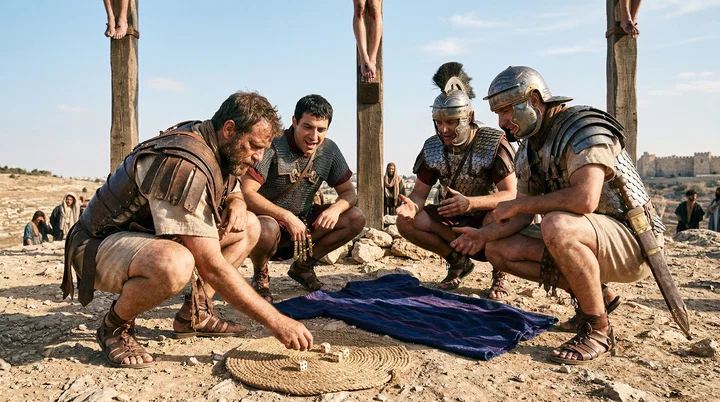
They said therefore among themselves, Let us not rend it, but cast lots for it, whose it shall be: that the scripture might be fulfilled, which saith, They parted my raiment among them, and for my vesture they did cast lots. These things therefore the soldiers did.
Translations
They said therefore among themselves, Let us not rend it, but cast lots for it, whose it shall be: that the scripture might be fulfilled, which says, They parted my raiment among them, and for my clothing they did cast lots. These things therefore the soldiers did.
They said therefore among themselves, Let us not rend it, but cast lots for it, whose it shall be: that the scripture might be fulfilled, which saith, They parted my raiment among them, and for my vesture they did cast lots. These things therefore the soldiers did.
They said therefore among themselves, Let us not rent it, but cast lots for it, whose it shall be: that the scripture might be fulfilled, which saith, They parted my raiment among them, and for my vesture they did cast lots. These things therefore the soldiers did.
They said therefore among themselves, Let us not rend it, but cast lots for it whose it shall be: that the scripture might be fulfilled, which saith, They parted my raiment among them, and for my vesture they cast lots. These things therefore the soldiers did.
They said therefore one to another, Let us not rend it, but cast lots for it, whose it shall be: that the scripture might be fulfilled, which saith, They parted my garments among them, And upon my vesture did they cast lots. These things therefore the soldiers did.
They said therefore one to another, Let us not rend it, but cast lots for it, whose it shall be: that the scripture might be fulfilled, which saith,
They parted my garments among them,
And upon my vesture did they cast lots.they said, therefore, to one another, 'We may not rend it, but cast a lot for it, whose it shall be;' that the Writing might be fulfilled, that is saying, 'They divided my garments to themselves, and upon my raiment they did cast a lot;' the soldiers, therefore, indeed, did these things.
They said therefore to one another, Let us not rend it, but let us cast lots for it, whose it shall be; that the scripture might be fulfilled which says, They parted my garments among themselves, and on my vesture they cast lots. The soldiers therefore did these things.
They said, therefore, one to another—Let us not rend it, but cast lots for it, whose, it shall be;—that, the Scripture, might be fulfilled—They parted my garments amongst them, and, for my vestment, they cast lots:—yes verily, the soldiers, these things did.
Berean Standard Bible, Majority Standard Bible
So they said to one another, “ Let us not tear it. Instead, let us cast lots to see who will get it.” This was to fulfill the Scripture:
“ They divided My garments among them,
and cast lots for My clothing.”So that is what the soldiers did.Then they said to one another, “ Let’s not tear it, but cast lots for it to decide whose it will be,” that the Scripture might be fulfilled, which says,
“ They parted my garments among them.
They cast lots for my clothing.”Therefore the soldiers did these things.So they said among themselves, Let this not be cut up, but let us put it to the decision of chance and see who gets it. ( They did this so that the Writings might come true, which say, They made a distribution of my clothing among them, and my coat they put to the decision of chance.) This was what the men of the army did.
Therefore they sayde one to another, Let vs not deuide it, but cast lots for it, whose it shall be. This was that the Scripture might be fulfilled, which sayth, They parted my garments among them, and on my coate did cast lots. So the souldiers did these things in deede.
Douay-Rheims (Challoner revision)
They said then one to another: Let us not cut it, but let us cast lots for it, whose it shall be; that the scripture might be fulfilled, saying: They have parted my garments among them, and upon my vesture they have cast lot. And the soldiers indeed did these things.
Pictures
Cross-references
- Psalms 22:18
They part my garments among them, and cast lots upon my vesture.
The soldiers’ division of Jesus’ garments and casting lots fulfills this prophecy.
- Matthew 27:35
And they crucified him, and parted his garments, casting lots: that it might be fulfilled which was spoken by the prophet, They parted my garments among them, and upon my vesture did they cast lots.
The soldiers divide Jesus’ garments by lot, fulfilling the same Scripture.
- Mark 15:24
And when they had crucified him, they parted his garments, casting lots upon them, what every man should take.
The soldiers cast lots for Jesus’ garments.
- Luke 23:34
Then said Jesus, Father, forgive them; for they know not what they do. And they parted his raiment, and cast lots.
Jesus prayed for forgiveness as the soldiers divided his garments by lot.
- Psalms 22:16
For dogs have compassed me: the assembly of the wicked have inclosed me: they pierced my hands and my feet.
It describes Jesus’ crucifixion as part of the same series of fulfilled prophecies.
- Psalms 22:1
My God, my God, why hast thou forsaken me? why art thou so far from helping me, and from the words of my roaring?
Psalm 22 foretells Jesus’ cry of forsakenness among his cross agonies.
- Genesis 37:23
And it came to pass, when Joseph was come unto his brethren, that they stript Joseph out of his coat, his coat of many colours that was on him;
Joseph’s brothers stripped him of his distinctive coat, paralleling Jesus’ coat.
- Leviticus 16:8
And Aaron shall cast lots upon the two goats; one lot for the LORD, and the other lot for the scapegoat.
Lots determine the goats’ roles in the sanctuary cleansing.
- John 19:36
For these things were done, that the scripture should be fulfilled, A bone of him shall not be broken.
Both details of Christ’s crucifixion fulfill Scripture.
- John 19:18
Where they crucified him, and two other with him, on either side one, and Jesus in the midst.
Jesus is crucified at Golgotha.
- Luke 23:35-53
And the people stood beholding. And the rulers also with them derided him, saying, He saved others; let him save himself, if he be Christ, the chosen of God.
Both texts recount events surrounding Jesus’ crucifixion and burial.
- Jonah 1:7
And they said every one to his fellow, Come, and let us cast lots, that we may know for whose cause this evil is upon us. So they cast lots, and the lot fell upon Jonah.
A lot identified Jonah before he was cast into the sea.
- Matthew 27:39-43
And they that passed by reviled him, wagging their heads,
Christ is mocked while hanging on the cross after his garments are divided.
- Isaiah 53:12
Therefore will I divide him a portion with the great, and he shall divide the spoil with the strong; because he hath poured out his soul unto death: and he was numbered with the transgressors; and he bare the sin of many, and made intercession for the transgressors.
The servant bears the sin of many and gives his life in suffering.
- John 19:28
After this, Jesus knowing that all things were now accomplished, that the scripture might be fulfilled, saith, I thirst.
Jesus’ words at the cross accompany the fulfillment of Scripture.
Commentary
Each commentary is drawn from primary sources: the writings of Ellen G. White and Adventist pioneers and periodicals. Each commentary is separate. Its own words are not a quotation; follow the references to read the source passages.
Ellen G. White
22 sources
At Calvary outside Jerusalem Christ was crucified between thieves as a bleeding victim, and the soldiers who hung Him on the cross took His clothing for themselves and quarreled over it while He heard their contention.Lt 115, 1903, par. 15–16DA 741.1–2COS 159.3–160.1ST Nov 25, 1889Ms 8, 1886, par. 8 His tunic was woven throughout without seam, so they agreed not to tear it but to cast lots to decide whose it would be.Lt 115, 1903, par. 15–16Ms 103, 1897, par. 15–16COS 159.3–160.1 This dividing of His garments and gambling for His vesture had been foretold hundreds of years earlier in Psalm 22 and was literally and exactly fulfilled by the soldiers themselves without counsel or interference from His friends or enemies.Ms 103, 1897, par. 15–16Ms 139, 1907, par. 7COS 159.3–160.13SP 160.1DA 745.5–746.1 He suffered outside Jerusalem as substitute and surety for humanity, counted as a transgressor and made a curse to redeem men from the curse of the law, and His blood shed there is the price that provides salvation and grace and power to His people.DA 741.1–2ST Nov 25, 1889Ms 8, 1886, par. 8Lt 122, 1901, par. 15 The seamless robe left whole represents the unity that must exist in His church, which must not be torn by divisions and coldness that disfigure that unity and dishonor Him.Lt 107, 1898, par. 4Ms 89, 1898, par. 345MR 371.3
The Soldiers Divide Garments
Christ was taken to Calvary outside the gate of Jerusalem, the place where felons and murderers were executed, and there crucified between two thieves as if He were the chief of sinners.Lt 115, 1903, par. 15–16DA 741.1–2 There He hung on the cross as a bleeding victim.Ms 8, 1886, par. 8 His clothing was given to the soldiers who placed Him on the cross.Lt 115, 1903, par. 15–16
Those soldiers took His clothing for themselves and disputed and quarreled over it while He hung on the cross.Lt 115, 1903, par. 15–16COS 159.3–160.1ST Nov 25, 1889 His enemies stood at the foot as they divided His garments among them.Ms 9, 1911, par. 22 He heard their contention as they divided them.Lt 115, 1903, par. 15–16
His coat or tunic was plain and woven throughout without seam.Lt 115, 1903, par. 15–16 Rather than tearing it, they said among themselves not to rend it but to cast lots to decide whose it would be.Lt 115, 1903, par. 15–16Ms 103, 1897, par. 15–16COS 159.3–160.13SP 160.1DA 745.5–746.1
The dividing of His garments belongs to the taking away of the Bridegroom and His descent into humiliation.ST Jul 7, 1898 It came with His own nation clamoring for His blood, with the crown of thorns plaited for His brow, with being clad in the purple robe and mocked by persecutors bowing before Him and striking Him with the reed placed in His hand.ST Jul 7, 1898 He was scourged as the worst of criminals though He was expected to take His place on David's throne, the murderous Barabbas was chosen in place of their Teacher, and He was lifted up on the cross dying as a malefactor.ST Jul 7, 1898 It stands among the great trials He prepared for through a night of prayer to His Father.ST Aug 31, 1915
Fulfilled Prophecy and Redemption
The dividing of His clothing and the gambling for His garment at His death had been foretold and was literally and exactly fulfilled.Ms 139, 1907, par. 7COS 159.3–160.13SP 160.11SP 157.2–158.2 What was written hundreds of years earlier in Psalm 22 was fulfilled, that they parted His raiment among them and for His vesture they did cast lots.COS 159.3–160.13SP 160.1Ms 89, 1898, par. 34ST Aug 31, 1915 This fulfillment happened without counsel or interference from His friends or enemies, for the soldiers themselves carried it out as they divided His garments.Ms 103, 1897, par. 15–16DA 745.5–746.1 It stands as one of the prophecies of His sufferings and death, along with the piercing of His hands and feet and that no bone of Him would be broken, and He Himself declared again and again that He died as it was written of Him.Ms 139, 1907, par. 7
His suffering without the boundaries of Jerusalem means He suffered as substitute for Adam and Eve banished from Eden for transgression of God's law.DA 741.1–2 He did this that He might sanctify the people with His own blood.DA 741.1–2 He bore humanity's iniquity as its substitute and surety, counted as a transgressor, to redeem people from the curse of the law by being made a curse for them.DA 741.1–2ST Nov 25, 1889 His blood at Calvary was the price paid to redeem humanity, so His death provides salvation.Lt 122, 1901, par. 15 That death as a bleeding victim made grace and power available to His people.Ms 8, 1886, par. 8Lt 122, 1901, par. 15
The executioners casting lots for His seamless coat recalls Joseph's brothers stripping him of his coat.1SP 157.2–158.2SG3 174.2–176.1 Joseph's suffering at his brothers' hands foreshadowed Jesus' rejection and suffering.1SP 157.2–158.2 Jesus' suffering resembled Joseph's, though Jesus was innocent and righteous.1SP 157.2–158.2SG3 174.2–176.1
Lessons for Christ's Followers
The unrent, seamless robe left whole when the soldiers chose to cast lots rather than tear it is the unity that should exist in His church, which must not be torn by divisions that would destroy it.Lt 107, 1898, par. 4Ms 89, 1898, par. 345MR 371.3 Divisions and coldness among believers disfigure that unity and dishonor Christ, and all must see that the seamless robe must remain undivided.Ms 89, 1898, par. 345MR 371.3 His coat was plain and seamless, and that plainness stands as a rebuke to vanity and elaborate dress and to the time and care spent on personal decoration.3T 379.2STSE 58.1
His agony and humiliation on the cross show what He endured and gave up for humanity, beside which the self-denial He asks of His followers is small.Lt 1a, 1861, par. 2–5 At Calvary His blood was the price paid to redeem humanity and provide salvation, and those bought by that price are called to surrender themselves to Him and bring their lives into conformity with His will.Lt 122, 1901, par. 15 Hanging upon the cross while His enemies stood at the foot and divided His garments among them, He did not refuse to die for men but for their sakes submitted to abuse and mockery, with His life taken away in cruelty.Ms 9, 1911, par. 22 How much He endured proves that no experience can come to believers that He does not fully understand, and it calls believers to be led by a spirit entirely opposite to that which inspired His enemies, helping and sustaining one another and thus showing that the Spirit of God is working in heart and mind and character.Ms 9, 1911, par. 22
The taking away of the Bridegroom in His approach to the cross and descent into humiliation gives the disciples cause to mourn and fast, for in Him their hopes of eternal life were centered as He was put into the hands of wicked men.ST Jul 7, 1898 His own nation clamored for His blood, Herod and his soldiers plaited the crown of thorns for His brow, He was clad in the purple robe and mocked by persecutors bowing before Him and striking Him with the reed placed in His hand, He was scourged as the worst of criminals though they had thought He was to take His place on David's throne, the murderous Barabbas was chosen in place of their Teacher, and He was lifted up on the cross dying as a malefactor.ST Jul 7, 1898 That hour when the Son of God was dying was a terrible, trying hour of gloom and darkness that brought the disciples over the ground of test and trial, in which their faith was tried and their hope and courage failed.ST Jul 7, 1898Ms 126, 1907, par. 9–10 Overcome with sleep and failing to watch and pray, they had not received the light God desired to give them in the knowledge of Christ's sufferings and the glory that should follow, and being slow of heart to believe and little appreciative of the treasure Heaven sought to enrich them with, they lost the blessings that might have been theirs by sharing His self-sacrifice, with Peter denying his Lord before His enemies.Ms 126, 1907, par. 9–10 Had they remained watching, some rays of hope from that knowledge would have lighted the darkness and sustained their faith.Ms 126, 1907, par. 9–10
Sources
Pioneers and periodicals
63 sources
The four soldiers who carried out the execution took his clothes as their rightful spoil, dividing the outer garments among themselves but casting lots for the seamless coat woven from the top throughout rather than tearing it.ST May 27, 1897ST May 20, 1897ST May 17, 1899ST Jul 14, 1881RH Dec 9, 1858 They quarreled over his possessions in his presence while he hung in torment, caring for his clothing rather than for him and not knowing they were fulfilling prophecy.ST Nov 25, 1889ST May 26, 1898RH Jan 24, 1871 In this they fulfilled to the letter what had been foretold hundreds of years before in Psalm 22:18, that his garments would be parted and lots cast for his vesture.ST Jul 25, 1878ST Dec 7, 1882RH Jun 24, 1858ST Jan 2, 1879RH Oct 25, 1870 That exact fulfillment proves Jesus of Nazareth is the true Messiah and Son of God and confirms the truthfulness of Scripture.ST Jun 7, 1899ST May 17, 1899RH Aug 21, 1866 His being stripped to die naked and poor, down to cloak and under-garments, was his sacrifice as substitute and surety bearing human iniquity to redeem from the curse of the law, revealing the greatness of his love.RH Dec 26, 1907RH Aug 20, 1908RH Jun 23, 1910RH Oct 25, 1870
Soldiers Dividing the Garments
The execution was carried out by four soldiers, each driving one of the four spikes through the hands and feet, and these four who fastened him to the cross had the right to take the condemned man's clothes as payment for performing the execution.ST Jul 14, 1881RH Dec 9, 1858RH Dec 9, 1858 They treated his clothing as their spoil and divided it among themselves in his presence while he was on the cross.RH Dec 9, 1858ST Jul 14, 1881 They divided it as their rightful share for doing the execution.ST May 26, 1898
The outer garments were divided among them, but the coat was without seam, woven from the top throughout, so they would not tear it.ST May 20, 1897ST May 26, 1898 They said among themselves not to rend it but to cast lots for it to decide whose it should be and who would have it.ST May 27, 1897ST May 17, 1899ST May 17, 1899ST May 17, 1905 The one who took the vesture allotted by lot is named as Rufus.ST Jan 24, 1911
They did this in cold-blooded indifference to his suffering, quarreling over his clothing and dividing his vesture while he hung tortured with anguish through all his frame.ST Nov 25, 1889RH Dec 9, 1858ST Jul 14, 1881 Their concern was for his possessions rather than for him, reflecting ignorance and indifference to who he was.RH Jan 24, 1871 They did it without knowing they were fulfilling prophecy.ST May 26, 1898
The stripping at Calvary was the third taking of his clothes in his suffering, after he had been stripped to be clothed in scarlet and mocked and then had his own garments put back on his wounded body for the walk to Calvary.RH Oct 25, 1870 At Calvary he was stripped of everything, first his cloak, then his coat, then even his under-dress, to die naked on the gibbet before a great multitude, while the soldiers divided his garments among them and cast lots for his cloak.RH Oct 25, 1870 At his death his remaining earthly possession was his clothing, leaving him with nothing but the seamless garment and vesture that had gathered the dust of the pathways in his mission of love, leaving the soldiers nothing else to quarrel over.RH Nov 4, 1873ST Jun 18, 1885
The scene took place on the day before the Sabbath, commonly called Friday.ST Apr 21, 1914 It illustrates the ancient custom of using lots to decide an allocation.ST Sep 3, 1896 The Greek wording for the casting of lots for the garment permits a rendering that matches Psalm 22:19, making the correspondence between the Gospel and the Old Testament source clear.RH Apr 23, 1861 The seamless garment over which lots were cast has been claimed as a relic said to be the Saviour's garment.ST Aug 28, 1898
Prophecy Literally Fulfilled
The soldiers' dividing of the outer clothing and casting of lots for the inner vesture fulfilled what was foretold in Psalm 22:18, also cited as Psalm 22:16-18, that garments would be parted and lots cast for clothing.ST Dec 7, 1882RH Jun 24, 1858ST Jan 2, 1879RH Dec 26, 1907ST May 17, 1899 The seamless robe could not readily be divided, so they would not tear it but cast lots to decide who would have it, and they did this without knowing they were fulfilling prophecy.ST Dec 7, 1882ST May 26, 1898RH Dec 26, 1865 The fulfillment was literal, exact and to the letter, an example of first-advent prophecies coming to pass as stated.ST Jan 2, 1879ST May 26, 1898RH Dec 26, 1865 It identifies Jesus as the righteous one foretold in Scripture, who suffered and died to bear the sins of others so that they could receive life.RH Dec 26, 1907
The Scripture fulfilled had described this event hundreds of years beforehand, indeed announced a thousand years in advance in David's song.ST Jul 25, 1878RH Oct 25, 1870 That same song also foretold pierced hands and feet and looking and staring upon the sufferer alongside the parting of garments and casting of lots on the vesture.RH Oct 25, 1870 The fulfillment occurred literally within twenty-four hours on the day of the crucifixion.ST Oct 21, 1930 It was one of at least twenty-four Old Testament prophecies bearing on the betrayal, trial, death and burial of Jesus Christ, uttered by several different prophets at different times during the five centuries from about 1000 to about 500 B.C., all literally fulfilled in one single day, marking Calvary as a wonderful climax and crisis and a great and decisive day when things moved rapidly.ST Oct 21, 1930
The precise fulfillment testifies that Jesus of Nazareth is the true Messiah and the Son of God and confirms the truthfulness of Scripture.ST Jun 7, 1899ST May 17, 1899 Israel's learned teachers failed to recognize this evidence in the dividing of the clothing and casting of lots for the vesture.ST Jun 7, 1899 The agreement between the prophetic Scriptures and the later Gospel account is itself evidence.RH Aug 21, 1866 Its exact match of Old Testament prediction with New Testament event makes comparing fulfilled predictions with their fulfillments the surest guide to understanding unfulfilled prophecy.RH Jun 24, 1858 The dividing of the garments among the executioners at the crucifixion is one of the signs of the times connected with the first advent of Christ.
John 18-19 shows Christ our Passover sacrificed on the fourteenth day of the first month, fulfilling exactly as to time the type of the Passover lamb killed on that day.RH Oct 30, 1855ST Aug 13, 1874 His death as the Lamb of God thus met the Passover-lamb type on the very day the Passover lamb was slain.ST Aug 13, 1874 This proves that mere preliminary and circumstantial burnt offerings on a typical day do not prevent the grand event of the day from meeting its antitype on the very day pointed out in the type.RH Oct 30, 1855
Sacrifice and Suffering Revealed
The verse belongs to the account of Jesus crucified and buried in John 19:16-42, parallel to Luke 23:35-53, under the truth that Christ died for our sins according to the Scriptures.ST Mar 20, 1901 The whole history in John is of one and the same person, the Word who was God in the beginning, with God, by whom all things were made, made flesh and dwelling among men, come from the Father and returned to Him, teaching and working miracles, falsely accused by the Jews, put to death on the cross with shedding of blood, buried, and risen again, with no other person introduced.RH Apr 14, 1874
The parting of the vesture belongs with the heavy cross He bore, the piercing crown of thorns He wore, the nails, the spear and the blood, the cruel mockery and terrible scenes of Calvary, the wilderness of temptation, the days of patient toil and nights of prayer, and Gethsemane.RH Oct 13, 1874RH Feb 4, 1904ST Feb 16, 1882 On Mount Calvary the innocent Jesus, crucified and pierced and derided and hailed as Jewish King, had His vesture parted here and there among those who clamored for a share, taking it as recompense.RH Oct 13, 1874 His journey to the cross and His crucifixion and death were steps in the divine sacrifice made on behalf of fallen humanity.
His death on the cross was a sacrifice for humanity, suffering and dying to bear the sins of others so that they could receive life, revealing God's suffering for human sin.RH Dec 26, 1907RH Aug 20, 1908RH Jun 23, 1910 He bore humanity's iniquity as its substitute and surety, counted as a transgressor so that people might be redeemed from the curse of the law, while hardened men quarreled over His clothing and divided His vesture as He hung on the cross.ST Nov 25, 1889 He is the righteous one foretold in Scripture in Psalm 22:16-18, whose garments were divided and for whose vesture lots were cast.RH Dec 26, 1907 He who had lived poorer than birds and foxes died still poorer, deprived of all down to cloak and under-garments with arms extended and nailed to the wood, revealing the greatness of His love.RH Oct 25, 1870 The detail is not trivial or vulgar but touching, sublime and inimitable, displaying the majesty and simplicity of Scripture and showing His death was the death of God.RH Oct 25, 1870
The verse stands at the place where divine sacrificial love for the world reached its climax, where Jesus endured agony and soul distress burdened by the world's woe while the Father beheld Him from above.RH Jan 16, 1908ST Sep 10, 1902 The Son of God truly died for sinners, the soldiers casting lots for His garment as Scripture was fulfilled.RH Nov 10, 1863 He hung dead upon a Roman cross and lay dead within the tomb seen by His crucifiers, yet power still remained in His Name to hold a large number of His followers and to win believers to the truth, to the astonishment of His crucifiers.ST May 25, 1904
The verse is included among the great trials that Jesus prepared for through a night of prayer to His Father, when the soldiers casting lots for His garment carried out His crucifixion in fulfillment of the foretold dividing of His clothes.ST Aug 31, 1915 His ignominious death on the cross took place amid circumstances that appeared gloomy and foreboding as the Christian church began. John 19:16-30 shows the taking away of the Bridegroom from the disciples in His approach to the cross and descent into humiliation, put in the hands of wicked men with His own nation clamoring for His blood, mocked in purple with thorn crown and reed, scourged as the worst of criminals, rejected for the murderous Barabbas, and lifted up as a malefactor, so that the disciples mourn and fast with tried faith and failing hope and courage.ST Jul 7, 1898
Seamless Coat Doctrinal Lessons
Whether the seamless coat carries a spiritual meaning is a question that can be asked without being resolved.ST May 20, 1897 Knowing the true history of the garments he wore is not essential to knowing him.ST May 14, 1902 The seamless coat is an image of the unity of God's doctrine from Paradise lost to Paradise restored.ST Nov 4, 1897
Jesus wore a plain seamless coat in which there was no pride, revealing his humility.RH Jul 10, 1856RH Aug 7, 1900 Those looking for him at his coming must imitate that example and let his character be seen in their own life all the way through.RH Jul 10, 1856 This means putting away pride of dress and self and becoming meek and humble, pure and holy in conduct, and doing his work.RH Jul 10, 1856RH Aug 7, 1900 His garment and suffering call attention away from personal adornment and ornament and display toward humility over sin.RH Aug 7, 1900RH Apr 8, 1873
The garment's association with healing presents Christ as a present help who heals those who reach out to him in faith. When sorrow and defeat crush the lonely, tempted spirit in darkness, God's Word brings hope and joy and healing balm, binds the breaking heart and awakens hope.RH Nov 5, 1908 Then the sufferer hears the rustle of that seamless dress as Christ draws near to comfort.RH Nov 5, 1908 The removal and tearing of the seamless coat pictures the fourth commandment being separated from the Lord's rest day and attached to Sunday observance, transferred to the papal Sunday.RH May 20, 1862ST Nov 30, 1882
The verse connects with Christ's complete self-giving in the sacrifice of Calvary like the burnt-offering.ST Sep 12, 1900 An offering stood for the one who offered it, and a sacrifice merely bruised and released could not represent willingness to go all the way to death.ST Sep 12, 1900 The shedding of blood meant the giving of life, while the flowing blood and consecrated flesh consumed on the altar represented complete consecration.ST Sep 12, 1900 Along with his words It is finished, the casting of lots for his garment belongs to his death in which his sacrificial work reached its culmination and the price was paid, and this did not abolish God's moral law.ST Dec 16, 1908 The verse shows the Father's will that of all given to Christ he should lose nothing but raise it up at the last day, so that because of this promise death could not hold Christ, and the plan and purpose of grace deals with the members the same as with the Head.RH Aug 14, 1900
Practical Warnings and Comfort
The casting of lots for the vesture was gambling from a purely selfish purpose by coarse men in the Saviour's hour of agony, with no clear conception of his divine character and mission.ST Apr 1, 1880ST Apr 1, 1880 The agreement may have been made while the clothes were still upon him, just after the garments were stripped from the Redeemer, and the lot gave the garment by mere chance to the lucky one.ST Apr 1, 1880 It was the first raffle on record, indescribably revolting and heartless to the last degree.ST Apr 1, 1880 The same principle of gambling is involved when Christians gamble in the name of religion to support preaching, to adorn a church, to buy a communion set, or to make money for the gospel by grab-bags, cakes with rings hidden in them, bed-quilts, arm-chairs and other goods sold by drawing-tickets.ST Apr 1, 1880ST Apr 1, 1880 With the light of almost nineteen Christian centuries his followers ought to know better than to join that selfish act to his cause, for a church raffle puts the gambling for his garments beside sacred things like the communion without any sense of how incongruous the association is, and few who enliven such scenes with their sunny presence notice the connection or ask which of the two is worse.ST Apr 1, 1880ST Apr 1, 1880 The soldiers gambling at the foot of the cross while he suffered were callous and unfeeling, and Christians who gamble for sacred objects such as a picture of Jesus repeat that disrespect.RH Jan 24, 1871
The verse stands as the greatest example against covetousness, for he was stripped of everything except the seamless garment and vesture that had gathered dust in his mission of love, leaving the soldiers nothing else to quarrel over.RH Nov 4, 1873 He lived and died in utter poverty and destitution, owning no home, no money, no beast, no room and no tomb of his own, proving that he practiced his own command to take heed and beware of covetousness.RH Nov 4, 1873 Reading his sufferings in John 19 can subdue pride and drive out discontent in a fretful or gloomy Christian.ST Apr 17, 1879 Those sufferings belong with the heavy cross he bore, the piercing crown of thorns he wore, the nails, the spear and the blood, leaving no room to murmur or complain in grief and pain and no room to ask for a life of ease or to live to please self. Since Jesus suffered, pain becomes sweet, bringing the sufferer lower at his feet in closer sympathy with him. No one can rightly appreciate his glory and a seat with him on his throne who fails to see that suffering between, for the loved Commander of heaven goes to the throne for a redeemed world with hands and feet pierced and brow scarred with a crown of thorns, and the only way to the throne of God is by the way of Calvary, by denying self and taking up the cross daily and following him and drinking his cup and sharing his baptism.RH Feb 4, 1904
The seamless garment that was not torn but assigned by lot recalls his suffering and sacrifice, which believers should consider as they resist harmful habits and submit to God's will.RH May 19, 1859 The soldiers' decision not to tear the garment but to cast lots for it fulfilled Scripture, showing that God's Word from Genesis to Revelation was given so people may know that God created heaven and earth and has given humanity one Guide to follow.ST Feb 17, 1904
Sources