Translations
American King James Version, Webster Bible, Douay-Rheims (Challoner revision)
This man went to Pilate, and begged the body of Jesus.
King James Version, KJV Cambridge Paragraph Bible
This man went unto Pilate, and begged the body of Jesus.
Revised Version, American Standard Version
this man went to Pilate, and asked for the body of Jesus.
he, having gone near to Pilate, asked the body of Jesus,
— he having gone to Pilate begged the body of Jesus;
the same, going unto Pilate, claimed the body of Jesus.
Berean Standard Bible, Majority Standard Bible
He went to Pilate to ask for the body of Jesus.
This man went to Pilate, and asked for Jesus’ body.
This man went to Pilate and made a request for the body of Jesus.
He went vnto Pilate, and asked the body of Iesus,
Pictures
Cross-references
- John 19:38-42
And after this Joseph of Arimathaea, being a disciple of Jesus, but secretly for fear of the Jews, besought Pilate that he might take away the body of Jesus: and Pilate gave him leave. He came therefore, and took the body of Jesus.
Joseph obtains Jesus’ body, and Nicodemus joins him in preparing and burying it.
- Luke 24:1
Now upon the first day of the week, very early in the morning, they came unto the sepulchre, bringing the spices which they had prepared, and certain others with them.
The women visit Jesus’ tomb early on the first day, after the Sabbath.
- Matthew 27:57-60
When the even was come, there came a rich man of Arimathæa, named Joseph, who also himself was Jesus’ disciple:
Joseph asks Pilate for Jesus’ body and lays it in his tomb.
- Mark 15:43
Joseph of Arimathaea, an honourable counsellor, which also waited for the kingdom of God, came, and went in boldly unto Pilate, and craved the body of Jesus.
Joseph asks Pilate for Jesus’ body.
- Matthew 27:62-66
Now the next day, that followed the day of the preparation, the chief priests and Pharisees came together unto Pilate,
The leaders ask Pilate to secure Jesus’ tomb until the third day.
- Matthew 28:1-6
In the end of the sabbath, as it began to dawn toward the first day of the week, came Mary Magdalene and the other Mary to see the sepulchre.
Continues Jesus’ burial account through the discovery that he has risen.
- Mark 16:1-2
And when the sabbath was past, Mary Magdalene, and Mary the mother of James, and Salome, had bought sweet spices, that they might come and anoint him.
The women waited until after the Sabbath to visit the tomb.
- Luke 23:56
And they returned, and prepared spices and ointments; and rested the sabbath day according to the commandment.
The women rested on the Sabbath after witnessing Jesus’ burial.
- John 20:1
The first day of the week cometh Mary Magdalene early, when it was yet dark, unto the sepulchre, and seeth the stone taken away from the sepulchre.
Both describe the first-day visit to Jesus’ tomb.
- John 19:38
And after this Joseph of Arimathaea, being a disciple of Jesus, but secretly for fear of the Jews, besought Pilate that he might take away the body of Jesus: and Pilate gave him leave. He came therefore, and took the body of Jesus.
John likewise records Joseph asking Pilate for Jesus’ body.
- John 19:31
The Jews therefore, because it was the preparation, that the bodies should not remain upon the cross on the sabbath day, ( for that sabbath day was an high day,) besought Pilate that their legs might be broken, and that they might be taken away.
Both describe the preparation day before the Sabbath.
- Isaiah 53:9
And he made his grave with the wicked, and with the rich in his death; because he had done no violence, neither was any deceit in his mouth.
Jesus’ burial in a rich man’s tomb fulfills the prophecy.
- Luke 23:46
And when Jesus had cried with a loud voice, he said, Father, into thy hands I commend my spirit: and having said thus, he gave up the ghost.
Jesus gives up his life before Joseph requests his body.
- Mark 15:47
And Mary Magdalene and Mary the mother of Joses beheld where he was laid.
names same women watching burial place
- John 19:30
When Jesus therefore had received the vinegar, he said, It is finished: and he bowed his head, and gave up the ghost.
finished work leads into Sabbath rest in tomb
- John 19:42
There laid they Jesus therefore because of the Jews’ preparation day; for the sepulchre was nigh at hand.
gives same preparation-before-Sabbath order
- Mark 15:42
And now when the even was come, because it was the preparation, that is, the day before the sabbath,
gives same preparation-before-Sabbath order
- 1 Corinthians 15:4
And that he was buried, and that he rose again the third day according to the scriptures:
Jesus’ body was buried before he rose again on the third day.
- John 20:11
But Mary stood without at the sepulchre weeping: and as she wept, she stooped down, and looked into the sepulchre,
Mary weeping seeking her Lord
- John 7:50-52
Nicodemus saith unto them, (he that came to Jesus by night, being one of them,)
Nicodemus had earlier tried to defend Jesus
Commentary
Each commentary is drawn from primary sources: the writings of Ellen G. White and Adventist pioneers and periodicals. Each commentary is separate. Its own words are not a quotation; follow the references to read the source passages.
Ellen G. White
14 sources
This man was Joseph of Arimathea, a rich, honorable counsellor of the Sanhedrin who had not consented to condemn Jesus, waited for the kingdom of God, and was His true but formerly secret disciple for fear of the Jews.Ms 111, 1897, par. 59–62SG1 64.1EW 148.2 Though fearful before, he now went privately yet boldly to Pilate to beg the body because the disciples longed to honor it but could obtain nothing from the Jews, and without haste it would have been cast with the thieves into the criminals' burial ground as one executed for treason against Rome.Ms 111, 1897, par. 59–62SG1 64.1EW 148.2ST Aug 1, 1878COS 166.1–2 Pilate had been kept from knowing Jesus was truly dead and had been warned against deception over the body, so he withheld consent until he summoned the centurion at the cross and learned for certain that Jesus was dead.DA 773.2COS 166.3–5ST Aug 1, 1878 By official order he then gave the body to Joseph, whose standing with the governor secured the grant.Ms 111, 1897, par. 59–62SG1 64.1EW 148.2 That grant enabled Joseph with Nicodemus, who brought about a hundred pounds of myrrh and aloes, to take Jesus from the cross and lay Him with highest honor in Joseph's new tomb near Calvary.ST Aug 1, 18785RED 95.2ST Aug 1, 1878DA 773.3–4
Joseph and His Request
The man who went to Pilate was Joseph of Arimathea, a counsellor and member of the Sanhedrin who was good and just and waited for the kingdom of God, who had not consented to the counsel and deed of the others in condemning Jesus.Ms 111, 1897, par. 59–62 He was honorable, wealthy and influential, acquainted with Pilate, and a true disciple of Christ.SG1 64.1EW 148.2ST Aug 1, 1878 His richness, wealth and influence gave him standing with the governor to make the request.Ms 111, 1897, par. 59–62ST Aug 1, 1878
Though in the past he had not openly identified himself with Christ for fear of the Jews, after the crucifixion he went to Pilate to ask for the body of Jesus.Ms 111, 1897, par. 59–62 That going was both private, because he feared Jewish hostility, and yet bold.SG1 64.1EW 148.2 He went boldly to Pilate and asked for the body, and with Nicodemus stepped forward to secure it.Ms 111, 1897, par. 59–62DA 773.2ST Aug 1, 1878DA 773.3–4COS 166.3–5
He acted because the followers of Jesus wanted to honor His body but feared that the Jews would prevent Him from receiving an honored burial.SG1 64.1EW 148.2 John was anxious and troubled about the sacred remains of his Master, shuddered at the thought of their being handled by rough and unfeeling soldiers and placed in a dishonored burial place.ST Aug 1, 1878ST Aug 1, 1878 John did not know what measures to take, and could obtain no favors from the Jewish authorities and little hope from Pilate, so in that emergency Joseph and Nicodemus came to the front, determined that the body of Jesus should have an honorable burial that John himself could not obtain.ST Aug 1, 1878COS 166.1–2
The need was urgent because Jesus had been executed on the alleged charge of treason against the Roman government.ST Aug 1, 1878 Those put to death for that offense were taken down by common soldiers and consigned to a burial ground reserved exclusively for that class of criminals.ST Aug 1, 1878 Had Joseph delayed, the body of the Saviour would have been placed with the bodies of the thieves in a dishonored grave instead of receiving an honorable burial.Ms 111, 1897, par. 59–62COS 166.1–2
The request came after the death of Jesus.12MR 418.2–419.1DA 773.3–4 It took place as people were making inquiries about His death and many were becoming convinced that Scripture had been fulfilled.12MR 418.2–419.1
Pilate Verifies and Grants
Joseph's request brought Pilate his first certain knowledge that Jesus was really dead, for conflicting reports about the crucifixion had reached him and knowledge of Christ's death had been purposely kept from him.DA 773.2 The priests and rulers had warned Pilate and his officers to guard against any deception by Christ's disciples concerning His body and the body of their Master.DA 773.2ST Aug 1, 1878
For that reason Pilate did not grant Joseph's request at once but first sent for the centurion in charge and in command of the soldiers at the cross.DA 773.2ST Aug 1, 1878 From that centurion's lips he heard and learned for certain that Jesus was dead.DA 773.2ST Aug 1, 1878 Then at his earnest request Pilate drew from the centurion a recounting of the fearful scenes at Calvary, which corroborated and confirmed Joseph's testimony.DA 773.2ST Aug 1, 1878
Only after confirming that Jesus was dead did Pilate grant the request.COS 166.3–5 He granted it by an official order that the body of Jesus should be given to Joseph.ST Aug 1, 1878 With that commission from the governor Joseph returned.ST Aug 1, 1878 Joseph was a rich, wealthy and influential man, an honorable councilor acquainted with Pilate, and this richness and influence gave him standing with the governor to make the request.Ms 111, 1897, par. 59–62EW 148.2ST Aug 1, 1878 That wealth and influence also enabled Joseph and Nicodemus to provide for their dead Master and helped shield them from the priests' hostility, so that Pilate's grant allowed the disciples to give Jesus an honored burial.SG1 64.1EW 148.2DA 773.3–4
Honorable Burial Secured
The grant made it possible for Joseph and Nicodemus to step forward in the emergency and secure an honorable burial for Jesus.5RED 95.2ST Aug 1, 1878DA 773.3–4 Both were members of the Sanhedrin acquainted with Pilate and both men of wealth and influence, determined that His body should have an honorable burial.ST Aug 1, 1878DA 773.3–4 John did not know what measures to take for the body of his Master, shuddered at the thought of its being handled by rough and unfeeling soldiers and placed in a dishonored burial place, and could obtain no favors from the Jewish authorities and little hope from Pilate.ST Aug 1, 1878 This was urgent because Jesus had been executed on the alleged charge of treason against the Roman government, and those put to death for that offense were taken down by common soldiers and consigned to a burial ground reserved exclusively for that class of criminals.ST Aug 1, 1878 Their wealth and influence enabled them to provide for their dead Master and helped shield them from the priests' hostility.DA 773.3–4
Once the request was granted they openly showed their attachment to Jesus by helping with His burial, removing Him from the cross, preparing His body with spices, and laying Him in Joseph's new tomb near Calvary.5RED 95.2ST Aug 1, 1878DA 773.3–4 Nicodemus, anticipating the result of Joseph's interview with Pilate, came with a costly mixture of myrrh and aloes of about one hundred pounds weight.ST Aug 1, 1878 The respect shown to Jesus in death was as great as could have been shown to the most honored in all Jerusalem.ST Aug 1, 1878 The women's preparation to anoint that body and their visit to the tomb came after this burial.ST Aug 22, 1878
Jesus of Nazareth the Saviour and Healer was thus laid in state in Joseph's tomb and lay dead there during the memorable Passover, absent from the feast.ST Nov 8, 1883 Hundreds had brought afflicted relatives and friends expecting healing and salvation from His touch.ST Nov 8, 1883 They were left disappointed, mourning, and dying for want of Him, because no physician had skill like His.ST Nov 8, 1883
Sources
Pioneers and periodicals
44 sources
Joseph of Arimathea, a wealthy, honorable councilor and member of the Sanhedrim who looked for the kingdom of God, went boldly to Pilate in the darkest hour to beg for the body of Jesus.ST Mar 20, 1901ST Oct 28, 1913ST Feb 1, 1899ST Mar 12, 1894
Pilate granted it by official order only after sending for the centurion and learning for certain that Jesus was dead, and this gift to a friend for burial spared Him from being cast by soldiers into the criminals' ground in the Valley of Hinnom.ST Aug 1, 1878ST Aug 1, 1878ST Aug 1, 1878RH Oct 29, 1914
With Nicodemus he took the body down with tender reverence, wrapped it in linen with about a hundred pounds of myrrh and aloes, and laid it in Joseph's own new rock-hewn tomb, fulfilling the prophecy of Isaiah 53:9 that His grave would be with the rich.ST Aug 17, 1904RH Nov 21, 1854ST Aug 1, 1878RH Oct 29, 1914
This asking and burial took place on the preparation day, Friday, in hurried hours as the Sabbath drew on at sunset, with the Sabbath standing between burial and the resurrection on the first day of the week.ST Apr 21, 1914ST Aug 17, 1904ST May 11, 1904ST Oct 7, 1930ST Jun 3, 1908
Having seen how the body was laid, the disciples suspended their work and rested the Sabbath day according to the commandment, while Jesus Himself rested in the tomb from the work of redemption, making the seventh day a memorial of redemption as of creation and proving its unbroken identity from Creation to the cross and beyond.ST Oct 20, 1914ST Sep 20, 1899ST May 13, 1908ST Mar 4, 1889ST Feb 1, 1905
Request and Burial Details
The man was Joseph of Arimathea, a counselor of the Jews, good and righteous, of honorable estate, wealthy, a member of the Sanhedrim acquainted with Pilate, who was looking for the kingdom of God.ST Mar 20, 1901ST Mar 12, 1894ST Jan 31, 1911 He went boldly to Pilate's court in the darkest time of Christ's cause on earth to beg and ask for the body of Jesus.ST Oct 28, 1913ST May 27, 1897ST Mar 12, 1894 The request is singled out as more than ordinary, and those who hold one detail add that he possibly procured it by offering money for it.ST Feb 1, 1899ST May 27, 1897 Pilate granted the request by an official order giving the body to Joseph.ST Aug 1, 1878 He did not grant it at once, for at the warning of the priests and rulers to guard against any deception by the disciples about the body of their Master, he first sent for the centurion in command of the soldiers at the cross, heard for certain from his lips that Jesus was dead, and at his earnest request had the fearful scenes of Calvary recounted and corroborated.ST Aug 1, 1878
Roman governors customarily allowed friends to bury a criminal unless he was infamous, so the body was given over for burial after a friend requested it.RH Feb 11, 1862 Joseph's action, joined by Nicodemus, prevented the intended treatment of Jesus as a treasonous criminal denied honorable burial.ST Aug 1, 1878RH Oct 29, 1914 Those executed on the alleged charge of treason against the Roman government were to be taken down by common soldiers and consigned to a burial ground reserved exclusively for that class of criminals, and Jewish criminals were not laid in the common burial place but buried in the Valley of Hinnom among the unclean dust heaps of Jerusalem and the ashes of burned temple offal.ST Aug 1, 1878ST Feb 1, 1899 In that emergency Joseph and Nicodemus came to the front to secure an honorable burial, both being members of the Sanhedrim acquainted with Pilate and both men of wealth and influence.ST Aug 1, 1878 At that time John was anxious and troubled about the sacred remains of his Master, shuddered at the thought of its being handled by rough and unfeeling soldiers and placed in a dishonored burial place, and could obtain no favors from the Jewish authorities and little hope from Pilate.ST Aug 1, 1878ST Aug 1, 1878
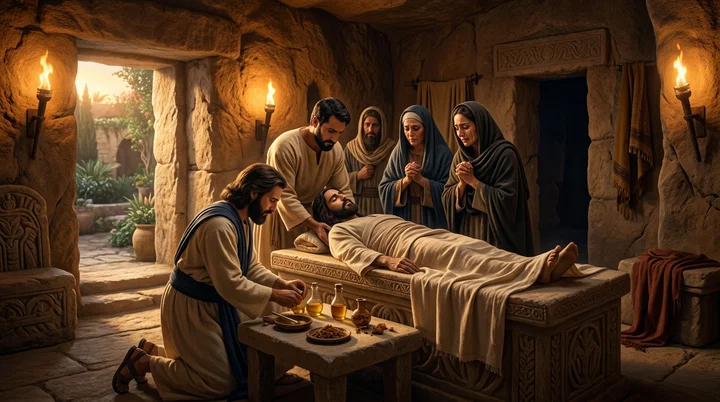
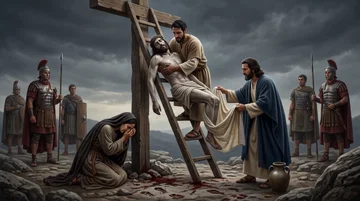
The body was taken down from the cross with tender reverence.ST Aug 1, 1878 The nails were removed from the hands, the cords loosened, the rough crown taken from the pale bleeding temple, the dark stains washed from the head, and the wounds bathed with weeping; the form was straightened, the hands that healed the woes of mankind were folded over the pulseless, still heart, and the form was wrapped in soft pure linen with spices.ST Aug 1, 1878 Nicodemus, anticipating the result of Joseph's interview with Pilate, came with a costly mixture of myrrh and aloes of about one hundred pounds weight for the wrapping.ST Aug 1, 1878 A few near friends then tenderly bore the hallowed burden a short distance from Calvary's hill and laid it in Joseph's own new tomb cut out of rock wherein never man was laid, which was closed with a stone and sealed.ST Aug 17, 1904RH Nov 21, 1854ST Apr 8, 1903ST Feb 1, 1899 The respect shown to Jesus in death was as great as could have been shown to the most honored in all Jerusalem.ST Aug 1, 1878 It was a tender act of love and reverence by devoted disciples who loved Him and cared for Him in death, toward Him who died for the world, and they are honored for caring for Him when others had denied Him a decent burial.RH Oct 4, 1870
The body laid in the tomb was the very same Jesus the Jews crucified, Jesus of Nazareth the Saviour and Healer, the body of the same Jesus who rose from the dead.RH Nov 21, 1854RH Dec 5, 1865 It remained there after the crucifixion and lay dead in state in Joseph's tomb during the memorable Passover, absent from the feast while hundreds who had brought afflicted relatives and friends expecting healing and salvation from His touch were left disappointed, mourning, and dying for want of Him, because no physician had skill like His.ST Nov 8, 1883ST Jan 31, 1911 The grave could not hold Him because He was the Son of God, the same Jesus who rose and went to Heaven in a cloud.RH Dec 5, 1865
Friday Preparation Timing
This request and burial stand in Luke's closing account of suffering, crucifixion, burial and resurrection, opening the burial account that the women witnessed.ST Aug 22, 1878ST Jul 11, 1916ST Sep 3, 1902 Joseph asked for and took down the body on the preparation day, the sixth day of the week, Friday.ST Apr 21, 1914ST Aug 17, 1904ST Oct 7, 1930ST Apr 21, 1914 As the Sabbath drew on and its deepening shadows fell, burial had to be hurried before the Sabbath began at sunset.ST Apr 21, 1914ST Aug 17, 1904ST Mar 16, 1904 This fixes the crucifixion to the day before the Sabbath, not to Wednesday.ST Oct 7, 1930ST Apr 21, 1914
The order of days is fixed as preparation day before the Sabbath and the first day of the week after the Sabbath.ST May 11, 1904ST Jun 3, 1908RH Dec 8, 1874 The Sabbath thus stands between burial and resurrection.ST Jun 3, 1908ST Mar 4, 1889RH Dec 8, 1874 Jesus rose from the dead on the first day of the week.ST Jun 3, 1908RH May 13, 1873
The women who had come from Galilee followed after and beheld the sepulcher and how the body was laid.ST Oct 20, 1914 On the way home they stopped in the city and bought sweet spices, then returned and prepared spices and ointments.ST Oct 20, 1914 The embalming was work that could not be done on the Sabbath, so it was deferred until the next convenient day, Sunday.ST Oct 20, 1914ST Jan 31, 1911 Very early on that first day they came to the sepulcher bringing the prepared spices and expecting to anoint Him, but found the stone rolled away and Jesus risen.ST Oct 20, 1914
Jesus died the day before the Sabbath and was buried before the Sabbath began.ST Sep 23, 1913RH Sep 16, 1902 He was raised the day after the Sabbath, fulfilling the prophecy that He would rise on the third day.RH Sep 16, 1902 His death on Friday sealed the new covenant with His blood.ST Sep 23, 1913
Sabbath Keeping Confirmed
Joseph, a councilor of the Jews, went to Pilate and begged the body of Jesus after Christ expired on the cross, took it down, wrapped it in linen, and laid it in a sepulcher hewn in stone wherein never man before was laid.ST Oct 20, 1914 That day was the preparation and the Sabbath drew on, and the women who came with Him from Galilee followed after and beheld the sepulcher and how His body was laid.ST Oct 20, 1914 They returned and prepared spices and ointments and rested the Sabbath day according to the commandment, then upon the first day of the week very early in the morning came unto the sepulcher bringing the spices which they had prepared, having planned their work with the first day of the week.ST Oct 20, 1914ST Sep 20, 1899 Having seen how the body was laid, the disciples suspended the work of preparing the body when the Sabbath began and rested in their homes on the Sabbath day according to the commandment.ST Oct 20, 1914ST May 13, 1908 This shows the attitude of Christ's disciples toward the Sabbath after the crucifixion.ST Oct 20, 1914ST Sep 20, 1899
They knew which day it was and kept it willingly in harmony with God's law.ST Oct 20, 1914 The holy women observed the seventh-day Sabbath after Jesus' death, even after the new covenant was sealed by His blood, showing that it remained observed at the burial.ST Jul 8, 1930ST Oct 15, 1902 The seventh-day Sabbath according to the commandment remained unchanged at the time of Jesus' burial.ST Jul 8, 1930 The Sabbath they observed immediately preceded the first day of the week and was the seventh day of the weekly cycle. The apostles' truthful record places the Sabbath day before the first day of the week, proving the seventh day is the Sabbath and the first day is not the Sabbath.RH Dec 8, 1874
While Jesus lay in Joseph's new tomb He rested the Sabbath day from the work of redemption after saying It is finished.ST May 13, 1908 While He lay there there was grief among those who loved Him on earth but joy in heaven, because Satan's fate was sealed, the promise of a restored creation was secured beyond doubt, and the salvation of a redeemed race was eternally secured.ST May 13, 1908 God and angels saw this, and these events were ever after to be linked with Sabbath observance, making the seventh day a memorial of redemption as it was of creation.ST May 13, 1908 So God, Christ, angels and the disciples were in harmony in keeping the Sabbath while their Lord rested in the tomb.ST May 13, 1908
The record of the crucifixion and resurrection names the seventh day and the first day in immediate connection, with the Sabbath placed between burial and resurrection.ST Mar 4, 1889ST Feb 1, 1905 That record proves the seventh day kept at the cross is the true seventh day in true succession from Creation, because Christ Himself, the Author of the Sabbath, kept it with the Jews in His custom.ST Feb 1, 1905 The Sabbath did not disappear from the week or go uncounted, but was kept by the faithful from Moses to the cross.ST Mar 4, 1889ST Oct 21, 1889 The first day and the seventh day have traveled side by side ever since the cross without break in the reckoning of Jews, Christians, and others, so if Sunday is kept in true succession from the cross the seventh day is also kept in true succession, and its identity has not been lost from the crucifixion to the present.ST Feb 1, 1905
Prophecy Doctrine and Example
Joseph went to Pilate to ask for the body of Jesus so that it could receive honorable burial.RH Oct 29, 1914 That asking prevented what enemies intended, to treat Jesus as a criminal denied burial.RH Oct 29, 1914 The body was then laid in a new tomb hewn out of rock and belonging to a wealthy ruler, fulfilling the prophecy of Isaiah 53:9 that the Servant's grave would be with the rich.RH Oct 29, 1914 In this Jesus was honored in burial, as Stephen was afterward honored when devout men carried him to his burial.ST Feb 19, 1902
Joseph of Arimathea's conduct stands as an example of clear faith, bold conviction, and fidelity.RH Jul 1, 1902 It stands in contrast with his earlier caution and concern for his standing.RH Jul 1, 1902 As such it is a model for believers to follow.RH Jul 1, 1902
Joseph with Nicodemus, two rich and honorable men, braved public sentiment to give the Lord a decent burial and spare Him ignominy.ST Feb 1, 1899RH Oct 4, 1870 They procured the body from Pilate, possibly by offering money for it, so it could be taken down from the cross and buried as a tender act of love and reverence toward Him who died for the world.ST Feb 1, 1899RH Oct 4, 1870 This spared Him the ignominy appointed for Jewish criminals, who were not laid in the common burial place but buried in the Valley of Hinnom among the unclean dust heaps of Jerusalem and the ashes of burned temple offal.ST Feb 1, 1899 A few near friends then tenderly bore the hallowed burden a short distance to Joseph's new tomb cut out of rock that had never been used.ST Feb 1, 1899RH Oct 4, 1870 The burial was hurried because the deepening shadows of the Sabbath were drawing on, and Joseph and Nicodemus are honored for caring for Him in His death when others had denied Him a decent burial.ST Feb 1, 1899RH Oct 4, 1870 After mourners lingered until Sabbath requirements drew them home, Jesus was left to sleep through God's appointed rest after winning for the world the way into eternal joy through unfathomable love.ST Feb 1, 1899
Sources