Translations
They part my garments among them, and cast lots on my clothing.
King James Version, Webster Bible, Darby Translation
They part my garments among them, and cast lots upon my vesture.
They part my garments among them,
And cast lots upon my vesture.They part my garments among them, and upon my vesture do they cast lots.
They part my garments among them,
And upon my vesture do they cast lots.They apportion my garments to themselves, And for my clothing they cause a lot to fall.
They part my garments among them, and, for my vestment, they cast lots.
Berean Standard Bible, Majority Standard Bible
They divide my garments among them
and cast lots for my clothing.They divide my garments among them.
They cast lots for my clothing.They make a division of my robes among them, by the decision of chance they take my clothing.
They part my garments among them, and cast lottes vpon my vesture.
Douay-Rheims (Challoner revision)
They parted my garments amongst them; and upon my vesture they cast lots.
Pictures
Cross-references
- John 19:23-24
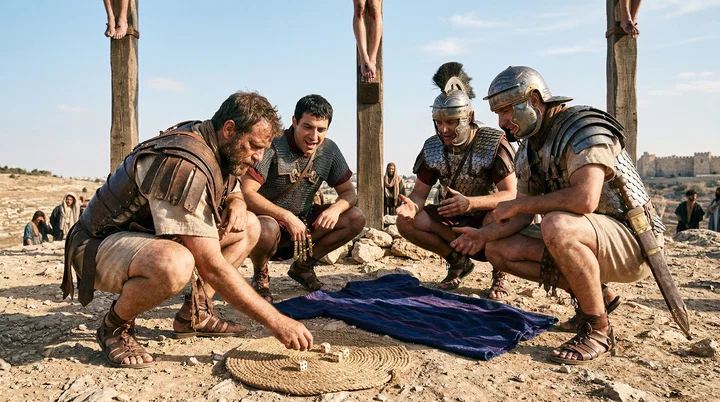
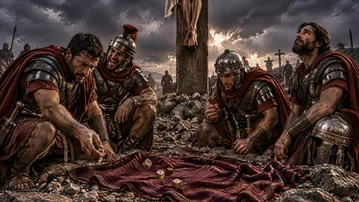
Then the soldiers, when they had crucified Jesus, took his garments, and made four parts, to every soldier a part; and also his coat: now the coat was without seam, woven from the top throughout.
The soldiers divide Jesus’ garments and cast lots for his seamless coat, fulfilling the prediction.
- Matthew 27:35
And they crucified him, and parted his garments, casting lots: that it might be fulfilled which was spoken by the prophet, They parted my garments among them, and upon my vesture did they cast lots.
Soldiers divide Jesus’ garments and cast lots, fulfilling the words about his vesture.
- Isaiah 53:12
Therefore will I divide him a portion with the great, and he shall divide the spoil with the strong; because he hath poured out his soul unto death: and he was numbered with the transgressors; and he bare the sin of many, and made intercession for the transgressors.
The servant is numbered with transgressors and bears the sin of many in his death.
- Mark 15:24
And when they had crucified him, they parted his garments, casting lots upon them, what every man should take.
Soldiers divide Jesus’ garments and cast lots, fulfilling the prophecy.
- Luke 23:34
Then said Jesus, Father, forgive them; for they know not what they do. And they parted his raiment, and cast lots.
The soldiers divide Jesus’ garments by casting lots at the crucifixion.
- Proverbs 16:33
The lot is cast into the lap; but the whole disposing thereof is of the LORD.
Both texts connect the casting of lots with divine determination.
- Leviticus 16:8
And Aaron shall cast lots upon the two goats; one lot for the LORD, and the other lot for the scapegoat.
Both texts describe lots being cast.
- Jonah 1:7
And they said every one to his fellow, Come, and let us cast lots, that we may know for whose cause this evil is upon us. So they cast lots, and the lot fell upon Jonah.
Both texts describe casting lots.
- Psalms 22:1
My God, my God, why hast thou forsaken me? why art thou so far from helping me, and from the words of my roaring?
The psalm expresses the agony echoed in Jesus’ cry from the cross.
- Isaiah 53:7-9
He was oppressed, and he was afflicted, yet he opened not his mouth: he is brought as a lamb to the slaughter, and as a sheep before her shearers is dumb, so he openeth not his mouth.
Both texts foretell Christ’s suffering and crucifixion.
- John 19:28-30
After this, Jesus knowing that all things were now accomplished, that the scripture might be fulfilled, saith, I thirst.
Jesus’ crucifixion fulfills the prophecy.
- Acts 1:26
And they gave forth their lots; and the lot fell upon Matthias; and he was numbered with the eleven apostles.
the practice being explained
- Matthew 27:46
And about the ninth hour Jesus cried with a loud voice, saying, Eli, Eli, lama sabachthani? that is to say, My God, my God, why hast thou forsaken me?
Jesus speaks the same psalm’s cry from the cross.
- Psalms 22:7-8
All they that see me laugh me to scorn: they shoot out the lip, they shake the head, saying,
Both foretell the mocking and humiliation of Christ at the cross.
- Isaiah 53:3
He is despised and rejected of men; a man of sorrows, and acquainted with grief: and we hid as it were our faces from him; he was despised, and we esteemed him not.
The despised and rejected servant’s suffering fulfills the prophecy of Christ’s humiliation.
- Hebrews 13:12
Wherefore Jesus also, that he might sanctify the people with his own blood, suffered without the gate.
Jesus suffered outside the gate, fulfilling the cross sufferings.
- Esther 3:7
In the first month, that is, the month Nisan, in the twelfth year of king Ahasuerus, they cast Pur, that is, the lot, before Haman from day to day, and from month to month, to the twelfth month, that is, the month Adar.
Is listed as another occurrence of the word.
- Luke 24:26
Ought not Christ to have suffered these things, and to enter into his glory?
Christ’s sufferings precede his entry into glory.
Commentary
Each commentary is drawn from primary sources: the writings of Ellen G. White and Adventist pioneers and periodicals. Each commentary is separate. Its own words are not a quotation; follow the references to read the source passages.
Ellen G. White
13 sources
Hundreds of years beforehand it was foretold that those who put Him to death would divide His garments among them and cast lots for His seamless tunic.COS 159.3–160.1Ms 103, 1897, par. 15–16DA 745.5–746.1 This was carried out exactly while He hung on the cross at Calvary by heathen soldiers, without counsel or interference from His friends or enemies.COS 159.3–160.1Ms 103, 1897, par. 15–16DA 745.5–746.1 The dividing and casting of lots belongs to His foretold sufferings and cruel death, alongside the piercing of His hands and feet and onlookers staring at Him.AA 225.1PK 691.2–3Ms 73, 1910, par. 21–22 He endured that quarreling, cruelty, and mockery over His vesture as humanity's substitute, bearing human sin to redeem people from the curse of the law for their salvation.ST Nov 25, 1889Ms 9, 1911, par. 22Ms 73, 1910, par. 21–22 His submission to such humiliation shows how much He endured and assures believers that no human experience is beyond His understanding.Ms 9, 1911, par. 22
Fulfillment at the Crucifixion
The verse foretells that those who put Christ to death would divide His garments among themselves at His crucifixion.COS 159.3–160.1Ms 103, 1897, par. 15–16DA 745.5–746.1AA 225.15RED 80.1 The dividing was done by the soldiers, His persecutors and executioners, who shared His clothing among them.COS 159.3–160.1Ms 103, 1897, par. 15–16DA 745.5–746.1AA 225.1PK 691.2–3 It foretells further that lots would be cast for His vesture, His seamless garment, tunic, or coat.COS 159.3–160.1Ms 103, 1897, par. 15–16DA 745.5–746.15RED 80.1ST Oct 7, 1886 The soldiers disputed over the seamless garment and then cast lots to decide who should have it.COS 159.3–160.1Ms 103, 1897, par. 15–16DA 745.5–746.15RED 80.1ST Oct 7, 1886
What had been foretold hundreds of years beforehand was carried out exactly while He hung on the cross at Calvary.COS 159.3–160.1Ms 103, 1897, par. 15–16DA 745.5–746.15RED 80.1ST Oct 7, 1886 The scene at the crucifixion fulfilled the description, as the soldiers divided His clothes and decided His vesture by lot.COS 159.3–160.1DA 745.5–746.15RED 80.1ST Oct 7, 1886Ms 52, 1897, par. 4–6 The fulfillment was done by heathen soldiers, without counsel or interference from His friends or enemies.Ms 103, 1897, par. 15–16DA 745.5–746.1
The dividing of the garments and the casting of lots belongs to the foretold sufferings and cruel death at Calvary.AA 225.1PK 691.2–3Ms 73, 1910, par. 21–22 It stands alongside the piercing of His hands and feet and the staring of onlookers at Him as part of the treatment He would receive.AA 225.1PK 691.2–3 It is part of the prophecy of His humiliation on the cross, where He endured suffering.AA 225.1PK 691.2–3Ms 73, 1910, par. 21–22
Hardness Endured for Salvation
At the cross there was disputing and quarreling over His garments, with angry voices raised while He suffered in dividing His clothing and casting lots for His vesture.COS 159.3–160.1ST Nov 25, 1889DA 750.4Ms 52, 1897, par. 26–27 That quarrel over His vesture showed how hardened were the hearts of the men toward the world's Redeemer.ST Nov 25, 1889 It expressed personal enmity and blasphemy and inhumanity toward Him even as He hung there.Ms 52, 1897, par. 26–27 When the dying thief appealed to Jesus as Lord in hope and trust and love, those who had been dividing His garments and casting lots stopped and listened, and their voices were hushed.DA 750.4Ms 52, 1897, par. 26–27
He endured this humiliation and cruelty and mockery on the cross as humanity's substitute, bearing human sin.ST Nov 25, 1889Ms 9, 1911, par. 22Ms 73, 1910, par. 21–22 In that suffering He was redeeming people from the curse of the law for their salvation.ST Nov 25, 1889 His submission to such treatment shows how much He endured, and assures believers that no human experience is beyond His understanding.Ms 9, 1911, par. 22
Sources
Pioneers and periodicals
60 sources
The verse foretells that the sufferer's clothing would be shared out among his enemies, with the outer garments divided in portions and lots cast to decide who would keep his seamless woven coat whole rather than tear it.ST Oct 7, 1886RH Apr 17, 1855ST Jan 9, 1879ST Jan 8, 1880 This was fulfilled exactly and literally at the crucifixion, when the soldiers who put Jesus to death took his garments as their perquisites, making four parts and casting lots for his vesture without knowing they were carrying out Scripture.RH Apr 17, 1855ST Jan 9, 1879ST Jan 8, 1880ST May 26, 1898 Its exact match between prediction and event identifies Jesus of Nazareth as the true Messiah and promised one, and with other minute prophecies of his betrayal, mocking, piercing, and suffering gives mighty evidence for faith in him as the Son of God.ST May 17, 1899ST May 17, 1905RH Jan 11, 1870ST Sep 3, 1896 It belongs to a psalm prophetic of Christ's sufferings in human flesh that was partly David's own experience, but whose full agony was realized in Christ when the sins of the world were laid upon him.ST Mar 14, 1911ST Mar 15, 1910ST Mar 26, 1912RH Sep 17, 1872 It pictures the great sin-bearer stripped of everything to the last piece of clothing and put to death naked as a common felon, paying the penalty for violated law that those deserving death might be justified and live.ST Nov 25, 1889ST Jun 30, 1914RH Dec 26, 1907RH Oct 25, 1870RH Sep 4, 1900
Language and Immediate Scene
The word rendered lot is the Hebrew goh-rahl, one of the Old Testament occurrences of that word in contexts involving lots.RH May 26, 1859 It belongs to the same range of uses as the word in Daniel 12:13.RH Jan 29, 1857 Here it denotes a portion determined by lot rather than an inherited territory.ST Jul 22, 1880
The sufferer is pictured grown gaunt and wasted while haughty evil crowds gather around and stare at him. In that condition his clothing is shared out among themselves by lot. The taking of his raiment by the soldiers at the crucifixion, dividing it among themselves while he was present, answers to this scene.RH Dec 9, 1858
A distinction is made between garments divided and shared in portions and the vesture decided by lot.ST Oct 7, 1886 The vesture was a seamless coat, without seam and woven from the top throughout, which could not readily be divided and so was kept whole for the lot instead of being torn.ST Dec 7, 1882ST May 26, 1898 At the crucifixion the soldiers who stretched Jesus upon the cross divided his clothing among themselves, making four parts of the garments, and contending over the woven seamless garment decided the matter by casting lots for it.ST Jul 25, 1878ST May 17, 1905 They took the garments as their perquisites, parting them among themselves and casting lots upon the vesture, without knowing they were fulfilling Scripture to the letter.ST May 26, 1898
Jesus was stripped of everything at Calvary and put to death naked on the cross before a great multitude.RH Oct 25, 1870 This was sung on David's harp about a thousand years in advance, at the time of the Trojan war, foretelling that his garments would be taken and shared out and his cloak kept whole for a lot.RH Oct 25, 1870 It shows one who lived on earth poorer than birds and foxes willing to die still poorer, deprived of cloak and coat and under-dress, with arms extended and nailed to the wood.RH Oct 25, 1870 The stripping happened three times: first to put on a scarlet robe with mock worship and spitting, then to replace his own clothes on his wounded body for the walk to Calvary, then to take them away again for the execution.RH Oct 25, 1870
David's Psalm of Christ
Psalm 22 is a prophetic utterance given through David about the sufferings and experience of Jesus Christ in human flesh, and this dividing of garments and casting of lots for clothing belongs to that prophecy of His betrayal, condemnation and crucifixion.ST Mar 14, 1911ST Mar 15, 1910ST Mar 26, 1912ST Nov 16, 1882 It foretells details of the Messiah's life and suffering surrounding His death that were fulfilled in Jesus.ST Mar 14, 1911ST Nov 16, 1882ST Jul 8, 1913 The psalm was also partly David's own experience and has a primary reference to David, but it typified the experience of David's greater Son.ST Mar 15, 1910ST Mar 26, 1912RH Sep 17, 1872 Some of its experiences were reflected in David's life, yet their full agony and sacrifice were realized in Christ when the sins of the world were laid upon Him, in antitypical fulfillment, with parts of the psalm quoted in the New Testament as fulfilled in Him.ST Mar 15, 1910ST Mar 26, 1912RH Sep 17, 1872
The psalm is prophetic of Christ in His humanity, showing His human heart and human feelings trembling in the balance over the consummation, efficiency and success of the plan of salvation.ST Sep 29, 1914 That trembling questioned not God but whether He Himself was sufficient for the work, coming to the place where human limitations shut from Him the knowledge of His triumph so that all He could do was leave His case in the hand of God.ST Sep 29, 1914 In this He suffered temptation and doubt without sin and without distrust of God.ST Sep 29, 1914 As David's prophetic words, the verse expresses Christ's inner experience during His suffering and helps reveal the depth of what He endured beyond the outward events recorded in the Gospels.RH Jun 6, 1912
The verse sets forth part of the experience of Jesus Christ, who met in Himself all human experiences, trials and conflicts.ST Jan 28, 1897 In it He stands as Fellow-sufferer, Fellow-sympathizer and Fellow-helper, as well as mighty Saviour all the journey through.ST Jan 28, 1897 That experience must also become the experience of His followers so that the faith of Jesus may be developed in them.ST Jan 28, 1897
Foretold Death Accomplished
The verse foretells the manner and circumstances of Christ's death in the disposition of his garments, that they would be divided among those present and lots cast for his vesture, down to the minute circumstance of gambling for his seamless outer garment which could not readily be divided.RH Apr 17, 1855ST Jan 9, 1879ST Jan 8, 1880RH Jan 11, 1870ST Dec 7, 1882 That prediction was fulfilled exactly and literally at the crucifixion of Christ in the sight of the Jews, as recorded in John 19:23-24 and in the Gospel accounts of Jesus' final acts.RH Apr 17, 1855ST Jan 9, 1879ST Jan 8, 1880RH Jan 11, 1870RH Jun 8, 1911 The fulfillment before the eyes of the Jews made it a sign of the first advent.
At the crucifixion the soldiers who crucified Jesus took his garments as their perquisites and divided them among themselves, making four parts, and cast lots for his seamless woven coat instead of tearing it.ST May 26, 1898ST May 26, 1898ST May 17, 1905ST May 20, 1897 The coat was without seam, woven from the top throughout, so they said let them not rend it but cast lots for it to decide whose it would be.ST Jul 25, 1878ST May 26, 1898ST May 26, 1898 The unfeeling soldiers who stretched Jesus upon the cross contended over that garment woven without seam and decided the matter by casting lots for it, fulfilling the prophecy in detail and to the letter without knowing they were fulfilling Scripture.ST Jul 25, 1878ST May 26, 1898ST May 26, 1898ST May 17, 1905
At the crucifixion of Jesus of Nazareth, the King of the Jews, under the inscription placed above his brow, Pilate's soldiers sat by the cross and parted his garments among them and cast lots upon them, fulfilling in his suffering what was written.ST Jan 24, 1911ST Jan 24, 1911 The seamless vesture was taken by Rufus, the guardsman of Herod Antipas, the son of Varro who had beheaded John the Baptizer and who kept the garment despite his father's pleading.ST Jan 24, 1911 The verse was fulfilled when Jesus hung on the cruel cross of shame and his enemies divided his clothing and cast lots for it as though he were a common felon and malefactor.ST Apr 25, 1900 It belongs to the darkness of that day when rulers derided and mocked his dying agonies, darkness reigned abroad, the Father seemed to turn his face away, and everything seemed to give the lie to his claim to be King, so that to believe on him in that hour required remarkable faith.ST Apr 25, 1900
Evidence for the Messiah
The dividing of the garments and the casting of lots for the vesture foretold the disposition of Christ's clothing at his death, and its exact and literal fulfillment at the crucifixion identifies Jesus of Nazareth as the true Messiah and promised one.ST May 17, 1899ST May 17, 1905RH Jan 11, 1870RH Aug 11, 1853RH Sep 16, 1902 It stands as a prophetic mark and sign of the first advent, accomplished before the eyes of the Jews when the soldiers who crucified him took his garments as their perquisites and cast lots, with the piercing of his hands and feet pointing to the same crucifixion and to the sacrifice by which those deserving death are justified and receive life.ST May 17, 1905RH Aug 11, 1853RH Sep 16, 1902RH Dec 26, 1907 With the other detailed ancient prophecies of his betrayal, piercing, mocking, suffering, and unbroken bones, this minute circumstance at Golgotha gives mighty evidence that Jesus is the Messiah and the Son of God, proves divine love, and strengthens faith in him for salvation and eternal life.ST Sep 3, 1896 Its exact fulfillment, together with his humble entry into Jerusalem, his rejection by his own people, the treachery of Judas, the small price paid for his betrayal, the bitter drink offered in his dying agony, his resurrection from death on the third day, and his exaltation to the right hand of God, proves Jesus is Christ and requires accepting him, as even Jewish teachers themselves applied such prophecies to Christ.
The match between prediction and event supports the truthfulness of Scripture, the reliability of prophecy, the divine authority of God's word, and God's full and accurate foreknowledge true in every detail.ST May 17, 1899RH Jun 8, 1911ST Jun 1, 1904 The Gospel accounts of Jesus' final acts record the fulfillment of what Psalm 22 foretold of his sufferings at his first coming, including details surrounding his death, his lowly life, his rejection by his people, the injustice of his trial, his death with malefactors, his burial with the rich, the agony of bearing the sins of men, and his very words upon the cross.RH Jun 8, 1911ST Jul 8, 1913ST Jul 8, 1913 God predicted the life of Christ beforehand and Christ lived it out, bearing witness that the Father sent him.ST Jul 8, 1913 Fulfilled Old Testament prophecy of this kind, recorded as fulfilled in John 19:23-24, guides understanding of unfulfilled prophecy.RH Jun 24, 1858 It proves suffering had to come before his entering into his glory, supplied all the light needed for instruction and reproof and for the awakening of hope, and shows that Christ died for sins according to the Scriptures.ST Apr 17, 1901ST Apr 10, 1884ST May 26, 1898
The humiliation and crucifixion were portrayed very plainly through David, yet the Jews overlooked prophecies of humiliation while taking notice only of prophecies of his glorious appearing, so they rejected Jesus because he did not come in the manner they expected the Messiah to come.ST Mar 20, 1901 Though they greatly revered David they disbelieved the word spoken through him, and that unbelief from ignorance stands written for learning as a warning, even as the learned teachers of Israel could not see him as the promised one though he bore his cross with being numbered with transgressors and suffering outside the gate as the Scriptures said.ST Mar 20, 1901ST Jun 7, 1899 The dividing of the clothing belongs to prophecy that God foresaw Jesus would be betrayed, condemned, and crucified, revealing beforehand specific circumstances of the first advent to be read in connection with those events.ST Apr 23, 1912ST Nov 16, 1882RH Aug 11, 1853 It is one of the prophecies that enabled Nicodemus to understand that Jews and Gentiles together would take part in the Messiah's terrible suffering and that Christ's death on the cross was the great sacrifice for the world.ST Jul 8, 1913
Meaning of His Suffering
Together with dried strength and thirst and pierced hands and feet and bones laid bare, the dividing of garments and casting of lots for clothing gives a plain picture of a Roman crucifixion.ST Jun 30, 1914 It belongs to the prophetic description of the death of the great sin-bearer who paid the penalty in behalf of men over God's violated law and was cursed for their sake.ST Jun 30, 1914 It describes the righteous One whose garments were divided and whose vesture was allotted by lot, and with the piercing of His hands and feet this identifies Him as Jesus Christ at His crucifixion.RH Dec 26, 1907 His suffering was the sacrifice through which those deserving death could be justified and receive life.RH Dec 26, 1907 Those sufferings show the eternal justice and holiness of God, and the unchangeable excellence and binding obligation of His law, and the hatefulness and guilt of sin.ST Mar 31, 1881 In suffering Christ honored the divine law, and He did not suffer to purchase liberty to despise and disobey it.ST Mar 31, 1881
The psalm is filled with Jesus' experience as He stood in the sinner's place on earth.ST Dec 5, 1911 For our sake He passed through what a repentant sinner must pass through, even what the lost must pass through, as He gave Himself to die on the cross.ST Dec 5, 1911 His agony in bearing humanity's sins was real, and His earnest prayers arose from the depth of His desire, with prayers of agony offered vicariously on behalf of humanity as He represented people in His suffering.ST Jul 16, 1912 The verse shows His poverty and humiliation at the crucifixion, that even His garments were taken from Him and divided among others with lots cast for His vesture.RH Oct 25, 1870RH Sep 4, 1900 It illustrates that He gave up everything to the last piece of clothing for the benefit of sinners, showing the love that gave up all.RH Oct 25, 1870RH Sep 4, 1900 Such small details were not thought too low or useless to be told long before, proving that inspiration reaches even to a cloak.RH Oct 25, 1870
The men at the cross dividing His garments while He hung there and quarreling over His vesture show how hardened their hearts were toward the world's Redeemer.ST Nov 25, 1889 This was even as He suffered as humanity's substitute, bearing human sin to redeem people from the curse of the law.ST Nov 25, 1889 The passage pictures the crucifixion in all its details, including the cry of agony over being forsaken by God.RH Sep 25, 1900 That prediction is confirmed by Christ and His apostles and fulfilled by the gospel and the kingdom of God, pointing to the cross and the kingdom of Christ with meaning glowing clearly under gospel light.RH Sep 25, 1900 It shows the depth of suffering and struggle through which Jesus came as conqueror.RH Aug 11, 1903RH Sep 25, 1900
Application and Moral Use
The suffering set forth in the verse is not left as Christ's alone but must also become the experience of his followers, so that the faith of Jesus may be developed in them.ST Jan 28, 1897 In him are met all human experiences, trials and conflicts, and here he stands as Fellow-sufferer, Fellow-sympathizer and Fellow-helper as well as mighty Saviour all the journey through.ST Jan 28, 1897 The psalm lays open the depth of struggle through which he passed and came through as conqueror, and it offers comfort that those facing temptation and doubt are not alone.RH Aug 11, 1903
The men who gambled for the Saviour's clothing at his death acted for selfish reasons with no clear conception of his divine character and mission, and their heartlessness in casting lots for his garments stands condemned.ST Apr 1, 1880 That same unfeeling division of his garments by lot at the cross illustrates the dishonor he suffered.RH Jan 24, 1871 The example forbids gambling even when it is presented as a way to support preaching or a church, and it serves as a comparison for the irreverence of gambling for anything sacred.ST Apr 1, 1880RH Jan 24, 1871
The plain meaning of the verse was fulfilled literally and not spiritually at Christ's first advent, when his garment was divided among soldiers and lots were cast for it.RH Apr 25, 1854RH Dec 26, 1865RH Aug 12, 1862 The language of prophecy therefore means what it says, and this fulfillment stands as an example of prophecy fulfilled literally.RH Apr 25, 1854RH Aug 12, 1862
The same imagery of garments divided and lots cast for a garment applies to the Pope's political dispossession, in which his worldly dignity is stripped away.RH Jul 23, 1861 Political opponents cast lots over his seamless robe of state and over the possession of Rome.RH Jul 23, 1861
Sources