John 19:38
And after this Joseph of Arimathaea, being a disciple of Jesus, but secretly for fear of the Jews, besought Pilate that he might take away the body of Jesus: and Pilate gave him leave. He came therefore, and took the body of Jesus.
Translations
And after this Joseph of Arimathaea, being a disciple of Jesus, but secretly for fear of the Jews, sought Pilate that he might take away the body of Jesus: and Pilate gave him leave. He came therefore, and took the body of Jesus.
And after this Joseph of Arimathaea, being a disciple of Jesus, but secretly for fear of the Jews, besought Pilate that he might take away the body of Jesus: and Pilate gave him leave. He came therefore, and took the body of Jesus.
And after this Joseph of Arimathea, being a disciple of Jesus, but secretly for fear of the Jews, besought Pilate that he might take away the body of Jesus: and Pilate gave him leave. He came therefore, and took the body of Jesus.
And after this, Joseph of Arimathea (being a disciple of Jesus, but secretly for fear of the Jews) besought Pilate that he might take away the body of Jesus: and Pilate gave him leave. He came therefore and took the body of Jesus.
And after these things Joseph of Arimathaea, being a disciple of Jesus, but secretly for fear of the Jews, asked of Pilate that he might take away the body of Jesus: and Pilate gave him leave. He came therefore, and took away his body.
And after these things Joseph of Arimathæa, being a disciple of Jesus, but secretly for fear of the Jews, asked of Pilate that he might take away the body of Jesus: and Pilate gave him leave. He came therefore, and took away his body.
And after these things did Joseph of Arimathea — being a disciple of Jesus, but concealed, through the fear of the Jews — ask of Pilate, that he may take away the body of Jesus, and Pilate gave leave; he came, therefore, and took away the body of Jesus,
And after these things Joseph of Arimathaea, who was a disciple of Jesus, but secretly through fear of the Jews, demanded of Pilate that he might take the body of Jesus: and Pilate allowed it. He came therefore and took away the body of Jesus.
But, after these things, Joseph from Arimathaea, being a disciple of Jesus, but having kept it secret for fear of the Jews, requested Pilate, that he might take away the body of Jesus; and Pilate gave permission. He came, therefore, and took away his body.
Afterward, Joseph of Arimathea, who was a disciple of Jesus ( but secretly for fear of the Jews), asked Pilate to let him remove the body of Jesus. Pilate gave him permission, so he came and removed His body.
Afterward, Joseph of Arimathea, who was a disciple of Jesus ( but secretly for fear of the Jews), asked Pilate to let him remove the body of Jesus. Pilate gave him permission, so he came and removed the body of Jesus.
After these things, Joseph of Arimathaea, being a disciple of Jesus, but secretly for fear of the Jews, asked of Pilate that he might take away Jesus’ body. Pilate gave him permission. He came therefore and took away his body.
After these things, Joseph of Arimathaea, who was a disciple of Jesus, but secretly for fear of the Jews, made a request to Pilate to let him take away the body of Jesus: and Pilate said he might do so. So he went and took away his body.
And after these things, Ioseph of Arimathea (who was a disciple of Iesus, but secretly for feare of the Iewes) besought Pilate that he might take downe the bodie of Iesus. And Pilate gaue him licence. He came then and tooke Iesus body.
Douay-Rheims (Challoner revision)
And after these things, Joseph of Arimathea ( because he was a disciple of Jesus, but secretly for fear of the Jews) besought Pilate that he might take away the body of Jesus. And Pilate gave leave. He came therefore, and took the body of Jesus.
Pictures
Cross-references 20 of 28
- Matthew 27:57-60
When the even was come, there came a rich man of Arimathæa, named Joseph, who also himself was Jesus’ disciple:
Joseph obtains Jesus’ body and lays it in a new tomb.
- Luke 23:50-53
And, behold, there was a man named Joseph, a counsellor; and he was a good man, and a just:
Joseph receives Jesus’ body and places it in a new tomb.
- Mark 15:43-46
Joseph of Arimathaea, an honourable counsellor, which also waited for the kingdom of God, came, and went in boldly unto Pilate, and craved the body of Jesus.
Joseph obtains Jesus’ body from Pilate and lays it in a tomb.
- Luke 23:52-56
This man went unto Pilate, and begged the body of Jesus.
Describes Jesus’ burial and the Sabbath rest that followed.
- Isaiah 53:9
And he made his grave with the wicked, and with the rich in his death; because he had done no violence, neither was any deceit in his mouth.
Jesus’ burial in a rich man’s tomb fulfills the prophecy of a grave with the rich.
- John 20:5-7
And he stooping down, and looking in, saw the linen clothes lying; yet went he not in.
The linen cloths and napkin were left in the tomb after Jesus’ burial.
- Matthew 27:59-60
And when Joseph had taken the body, he wrapped it in a clean linen cloth,
Joseph wraps Jesus’ body in linen and places it in his own tomb.
- Matthew 27:66
So they went, and made the sepulchre sure, sealing the stone, and setting a watch.
The tomb is secured and guarded after Jesus is buried.
- Mark 15:45-46
And when he knew it of the centurion, he gave the body to Joseph.
Describes Pilate releasing the body and Joseph wrapping and burying it.
- Luke 23:53
And he took it down, and wrapped it in linen, and laid it in a sepulchre that was hewn in stone, wherein never man before was laid.
Describes Jesus being wrapped in linen and laid in a tomb.
- Exodus 12
And the LORD spake unto Moses and Aaron in the land of Egypt, saying,
The Passover lamb’s death prefigured Jesus’ death.
- John 7:50-51
Nicodemus saith unto them, (he that came to Jesus by night, being one of them,)
Nicodemus challenged the council’s treatment of Jesus before Joseph openly honored him.
- Mark 16:1
And when the sabbath was past, Mary Magdalene, and Mary the mother of James, and Salome, had bought sweet spices, that they might come and anoint him.
The women prepared spices for Jesus’ body.
- Luke 23:51
(The same had not consented to the counsel and deed of them;) he was of Arimathæa, a city of the Jews: who also himself waited for the kingdom of God.
Joseph did not consent to the council’s decision.
- John 20:1-2
The first day of the week cometh Mary Magdalene early, when it was yet dark, unto the sepulchre, and seeth the stone taken away from the sepulchre.
Mary Magdalene first announces that Jesus is risen.
- Psalms 22:16-18
For dogs have compassed me: the assembly of the wicked have inclosed me: they pierced my hands and my feet.
It foretold details of the Messiah’s suffering at the cross.
- Luke 23:54
And that day was the preparation, and the sabbath drew on.
Places Jesus’ burial on the preparation day as the Sabbath drew near.
- Matthew 27:63-64
Saying, Sir, we remember that that deceiver said, while he was yet alive, After three days I will rise again.
Priests seek a guard after Jesus is buried.
- Mark 14:8
She hath done what she could: she is come aforehand to anoint my body to the burying.
Both concern preparing Jesus’ body for burial.
- John 19:34
But one of the soldiers with a spear pierced his side, and forthwith came there out blood and water.
Records the piercing of Jesus’ side and the flow of blood and water.
Commentary
Each commentary is drawn from primary sources: the writings of Ellen G. White and Adventist pioneers and periodicals. Each commentary is separate. Its own words are not a quotation; follow the references to read the source passages.
Ellen G. White
29 sources
Joseph of Arimathea was a wealthy, honored and influential member of the Sanhedrin and a true disciple of Jesus who had kept his discipleship secret for fear of the Jews, lest he lose his place and influence.DA 773.3–4ST Aug 1, 1878COS 166.3–5 After Jesus died his fear was overcome, and while the other disciples were scattered, disheartened and too intimidated to act openly, he boldly and openly came forward with Nicodemus to take charge of the body.DA 773.3–4ST Aug 1, 18783SP 175.1–2 He went privately yet boldly to Pilate to beseech leave to take away the body, and Pilate, after questioning the centurion at the cross and learning with surprise that Jesus had died so soon, gave him leave with an official order.COS 166.3–5SG1 64.1EW 148.2DA 773.23SP 173.3–174.2 Without this intervention the body was at risk of rough handling by soldiers and a dishonored burial with criminals, which John and the disciples had no favor or influence to prevent, but Joseph and Nicodemus by wealth and standing with Pilate secured an honorable burial and shielded the disciples.DA 773.3–4ST Aug 1, 1878ST Aug 1, 1878DA 772.4–773.1SG1 64.1 The body was therefore gently taken down, cleansed and wrapped with honor in fine linen with costly spices, and laid in Joseph's own new rock-hewn unused tomb near Calvary.ST Aug 1, 18783SP 176.1SG1 64.1
Joseph and His Request
Joseph of Arimathea was a wealthy, honored and influential member of the Sanhedrin council and a true disciple of Jesus who kept his discipleship secret for fear of the Jews, fearing that open following would cost him his place in the council and his influence and ability to help Jesus.DA 773.3–4ST Aug 1, 1878COS 166.3–5ST Aug 1, 1878EW 148.2 He acted privately because of the hatred of the Jews, while the disciples feared Jesus would be denied an honored burial.SG1 64.1EW 148.2 Joseph and Nicodemus had challenged the grounds for Jesus' condemnation and protested His arrest, and without their unanimous consent condemnation could not be secured through ordinary proceedings.ST Aug 1, 18783SP 175.1–25RED 94.3–95.1 The priests therefore secured it by a secret council that did not summon them, keeping them away with apparently important work so they could not be present to oppose what was done.ST Aug 1, 18783SP 175.1–25RED 94.3–95.1ST Jul 18, 1878Ms 26, 1899, par. 20–21 Though Joseph and Nicodemus were present at the crucifixion, they could not change or lessen His sentence.5RED 69.1ST Jul 18, 1878
After Jesus died Joseph's fear was overcome, and at a time of danger when the other disciples were poor, scattered, disheartened, discouraged and too intimidated to act openly, he no longer concealed his loyalty but openly and boldly came forward with Nicodemus to take charge of the body and perform the burial rites.DA 773.3–4ST Aug 1, 18783SP 175.1–24RED 18.3–19.2ST Apr 15, 1886 The events that shook others confirmed to them that He was the Messiah, so they openly stood as believers.COS 167.1–168.4 Joseph went privately but boldly to Pilate to beseech permission to take away the body for burial, and Pilate gave him leave with an official order releasing the body to him.COS 166.3–5SG1 64.1EW 148.23SP 173.3–174.25RED 94.1 Joseph's return with the governor's commission allowed the burial preparations to proceed.5RED 94.1
Pilate had not known Jesus was dead, because reports about the crucifixion conflicted and the priests had warned him that the disciples might deceive him about the body.DA 773.2ST Aug 1, 1878 He therefore questioned the centurion in charge at the cross who commanded the soldiers there, whose account of Calvary corroborated Joseph's testimony and confirmed the death.DA 773.23SP 173.3–174.2ST Aug 1, 1878 He learned for the first time from Joseph that Jesus was dead, and that He died soon after the crucifixion began just as the mysterious darkness over the earth passed away, when crucified men often lived for days.3SP 173.3–174.2ST Aug 1, 1878 His early death surprised Pilate and strengthened his belief that Jesus was innocent and no ordinary man, and Pilate was deeply troubled and regretted his part in condemning Him.DA 773.23SP 173.3–174.2ST Aug 1, 1878
Honorable Burial Secured
Without such intervention the body faced rough handling by unfeeling soldiers and a dishonored burial in ground set apart for criminals executed for treason against Rome.ST Aug 1, 1878DA 772.4–773.1COS 166.1–2 It would have been taken down by common soldiers and placed with the thieves.DA 772.4–773.1 John and the disciples treasured the body and lingered unwilling to leave it, yet they had no favor with the authorities and no influence with Pilate to prevent this.DA 772.4–773.13SP 173.2COS 166.1–2 John feared the soldiers would handle it without care, and the disciples feared hatred would deny Jesus an honored burial.SG1 64.1EW 148.23SP 173.2COS 166.1–2
Joseph, joined by Nicodemus, both members of the Sanhedrin acquainted with Pilate and men of wealth and influence, were determined to secure an honorable burial.ST Aug 1, 1878DA 772.4–773.1COS 166.3–5 They supplied what the disciples lacked, for the other disciples were poor, scattered, disheartened and too intimidated to act openly.DA 773.3–4ST Aug 1, 1878DA 772.4–773.13SP 175.1–2 They acted promptly to keep the body from the thieves' grave.DA 772.4–773.1 By their standing they also helped shield the poor disciples from priestly hostility and censure.DA 773.3–43SP 175.1–2
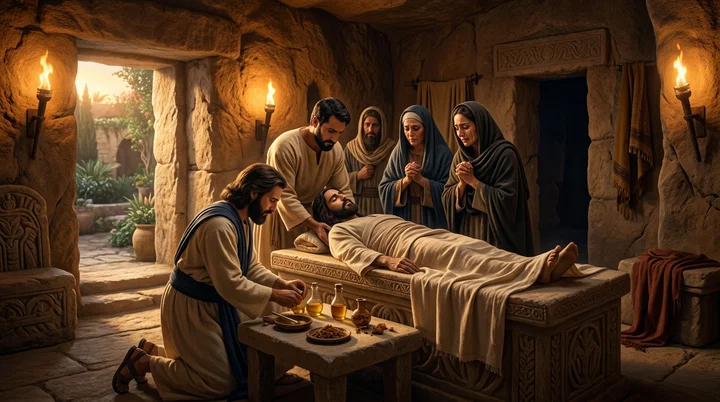
The body was gently taken down, cleansed, wrapped in fine linen with a costly mixture of myrrh and aloes brought by Nicodemus and treated with exceptional honor.ST Aug 1, 18783SP 176.1EW 148.2 It was then carried and laid in Joseph's own new, rock-hewn, unused tomb near Calvary where no one had been laid.ST Aug 1, 18783SP 176.15RED 95.2COS 167.1–168.4 The Galilean women and other disciples watched until the burial was completed and the entrance closed with a heavy stone.ST Aug 1, 18783SP 176.1SG1 64.15RED 95.2 Angelic hosts watched over the tomb.SG1 64.1 Joseph and Nicodemus wept over the body as the disciples' grief over lost hopes returned.SG1 64.13SP 174.3
Joseph and Nicodemus had remembered Jesus' predictions of His death, searched the Scriptures and recognized fulfilled prophetic details.COS 167.1–168.4Ms 103, 1897, par. 19 The events that shook others confirmed to them He was the Messiah, so they openly stood as believers.COS 167.1–168.4 They wrapped His body with spices though it was not to decay, and laid Him in a new unused tomb for clear evidence, in which Christ was laid with the rich.Ms 103, 1897, par. 19 His death left the people without the healer whose touch and words had brought relief.3SP 188.3–190.1
Sources
Pioneers and periodicals
56 sources
After his death on the cross, Joseph of Arimathea, a wealthy and honored member of the council who had followed Jesus secretly for fear of losing his place and influence, came openly and boldly to Pilate to ask leave to take away the body, and Pilate granted it.ST Aug 1, 1878ST Apr 15, 1886ST Mar 20, 1901ST May 27, 1897RH Oct 29, 1914 With Nicodemus, likewise a timid secret believer of learning and influence, he took the body down and gave it tender, reverent and costly burial in Joseph's own new rock-hewn tomb near Calvary, with about a hundred pounds of myrrh and aloes wrapped in clean linen.ST Aug 1, 1878RH May 5, 1874ST Aug 1, 1878ST Oct 25, 1910 By being laid among the rich instead of being left to the dishonored burial of criminals, he fulfilled Isaiah's prophecy of the Servant's grave with the rich.ST Sep 10, 1896RH Oct 29, 1914 He was truly dead and rested in the tomb through the Sabbath before rising on the first day, so his burial does not bury the Sabbath itself.RH Jul 16, 1861ST Aug 8, 1878ST Sep 12, 1900ST Mar 4, 1889ST Nov 12, 1885 His example shows secret conviction becoming open courage at the darkest hour, when the other disciples had fled, calling fearful believers today to step forward boldly and use their means for Christ's cause.ST Aug 1, 1878ST Aug 27, 1894RH Sep 1, 1863RH Jun 15, 1905RH Jul 1, 1902
Joseph, Nicodemus, and Pilate
Joseph of Arimathea was a disciple of Jesus but kept his discipleship secret for fear of the Jews, fearing to lose his place and influence in the Sanhedrin or council.ST Aug 1, 1878ST Aug 1, 1878ST May 27, 1897ST Feb 26, 1885 He was a wealthy, honored and influential member of that council who retained his high office while keeping his belief silent, watching the truth and hoping his position might help its cause, yet his taking of Jesus' body showed his discipleship was real despite his silence.ST Aug 1, 1878ST Aug 1, 1878ST May 27, 1897ST Feb 26, 1885 Nicodemus was likewise a timid secret believer and member of the Sanhedrin, a man of influence and riches and vast learning who loved his church and was proud of her past history, associations, institutions and influence in the world.ST Oct 25, 1910 He favored Jesus in his heart but feared ridicule and loss of influence among the leaders of the nation.ST Oct 25, 1910
Joseph and Nicodemus as wealthy, influential council members had challenged the grounds for Jesus' condemnation and protested his arrest.ST Aug 1, 1878ST May 27, 1897 Without their unanimous consent the council could not secure condemnation by ordinary proceedings, so the priests accomplished their purpose by holding a secret council that excluded them.ST Aug 1, 1878ST Jul 18, 1878 They were present at the crucifixion but could not change or lessen the sentence.ST Jul 18, 1878
When Jesus was dying no friend dared to show himself, for all the other disciples had forsaken him and fled.ST Aug 27, 1894ST Jul 1, 1880 The poorer, disheartened disciples could only mourn and were too intimidated and too poor to act openly.ST Aug 1, 1878RH Aug 27, 1901 Joseph's wealth, honored standing and influence allowed him to help when they could not, and together with Nicodemus he was filled with holy courage at the death to come forward and perform the last sacred rites, to the credit of the human race.ST Aug 1, 1878ST Jan 11, 1877ST Jul 1, 1880RH Aug 27, 1901
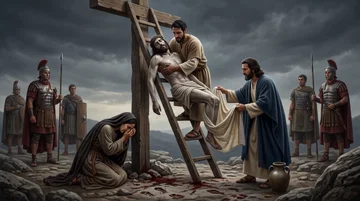
After the crucifixion Joseph openly and boldly asked Pilate for permission to take away the body of Jesus, and Pilate gave him leave.ST Apr 15, 1886ST Mar 20, 1901RH Oct 29, 1914ST Jan 31, 1911 He came therefore and took the body down from the cross, stepping forward as the man who secured and buried Jesus.ST Mar 20, 1901RH Oct 29, 1914 Pilate first confirmed that Jesus was dead by questioning the centurion who commanded the soldiers at the cross, whose account of Calvary corroborated Joseph's testimony.ST Aug 1, 1878 He learned from Joseph for the first time that Jesus was dead, having previously heard conflicting reports, and learned that Jesus died just as the mysterious darkness over the earth passed away.ST Aug 1, 1878 The early death surprised Pilate because crucified people often lived for days.ST Aug 1, 1878 Pilate believed Jesus innocent and no ordinary man, was strengthened in that belief by the early death, and was deeply troubled and regretful over his part in condemning him.ST Aug 1, 1878
Time and Manner of Burial
Jesus was nailed to the cross at the third hour, darkness covered the land from the sixth hour to the ninth hour, he breathed his last at the ninth hour, and those crucified with him also died that same day.RH Mar 10, 1859 Joseph took the body down that same day, the day just before the Sabbath commonly called Friday.RH Mar 10, 1859ST Apr 21, 1914
The taking and laying in the tomb were done in haste because the Sabbath was drawing near, on the day before the Sabbath, and the body remained there through the Sabbath.ST Feb 1, 1899ST Sep 12, 1900ST Nov 15, 1910ST Jan 31, 1911 A great stone was rolled to the door so the sepulcher was closed.ST Apr 8, 1903ST Nov 15, 1910 That following Sabbath was unique, when the Creator rested after His earthly work was finished.ST Sep 12, 1900ST Jan 31, 1911
Joseph provided his own new rock-hewn tomb near Calvary outside Jerusalem, where no one had previously been laid, so Jesus was its first occupant.ST Aug 1, 1878RH Jul 1, 1902ST Feb 26, 1885 The Galilean women watched the burial and remained at the tomb in grief.ST Aug 1, 1878 The body was taken down, carried away, bathed, the nails tenderly drawn from hands and feet, the drooping head lifted, the bloody forehead bathed, the still hands folded over the breast, wrapped with spices in clean snow-white fine linen with a linen napkin and shroud around the head, and lowered into the tomb with reverent tenderness.ST Aug 1, 1878RH Oct 4, 1870ST Aug 21, 1907 His rest there was brief, for the heavenly Watcher would call Him back to life, and hope remained that He would be called back to life.ST Aug 1, 1878ST Aug 21, 1907
The preparations were costly and fragrant, about one hundred pounds of myrrh, aloes, and other aromatic substances bought and wrapped in linen with the body, providing a tender, costly, adequate, and decent burial before the Sabbath.RH May 5, 1874ST Feb 16, 1882ST Apr 8, 1903ST Feb 14, 1911 The women's later wish to give further loving attention was an act of love and honor, not necessary for decency, which they set aside when the Sabbath began.RH May 5, 1874ST Feb 16, 1882 Without this prompt action the body was at risk of the dishonored burial reserved for those executed for crimes against Rome.ST Aug 1, 1878RH Oct 29, 1914ST Feb 1, 1899 Criminals were refused burial and burned in the Valley of Hinnom, and His enemies intended that ignominious treatment for Him.RH Oct 29, 1914
By Joseph and Nicodemus promptly taking the body with Pilate's leave, that murderous design was frustrated, an honorable burial was secured, and God the Father carefully protected the sacred body of His Son.ST Aug 1, 1878RH Oct 29, 1914ST Feb 1, 1899RH Oct 29, 1914 Devoted disciples cared for the body with loving hands, some of them unknown until that darkest hour.RH Oct 4, 1870 Joseph with Nicodemus received the holy task as a high honor of love, finding Him a grave when others denied Him decent burial.RH Oct 4, 1870RH Oct 4, 1870
Prophecy and Typology Fulfilled
John 19 belongs to the sacrifice of Christ our Passover on the fourteenth day of the first month.RH Oct 30, 1855ST Aug 13, 1874RH Dec 15, 1868 As the Passover lamb was killed on that day, Christ fulfilled that type exactly as to time on that very day.RH Oct 30, 1855ST Aug 13, 1874 Mere preliminary and circumstantial offerings on the typical day did not prevent the grand event of the day from meeting its antitype at the time pointed out in the type.RH Oct 30, 1855 The verse itself recounts Joseph taking Jesus' body after His death as the antitype of the paschal lamb slain on its appointed day.ST Aug 13, 1874RH Dec 15, 1868
Joseph of Arimathea had been a disciple who kept his faith secret for fear of the Jews, but he stepped forward to ask Pilate for Jesus' body, and Pilate granted permission and Joseph took it.ST Sep 10, 1896RH Oct 29, 1914 By respectfully taking the body from the cross for burial, he with Nicodemus and the holy women prepared the body and placed it in a costly new tomb among the rich.ST Sep 10, 1896RH Oct 29, 1914 That honorable burial was in the new rock-hewn tomb of a wealthy ruler, Joseph's own tomb, preventing Jesus from being left without burial among criminals.ST Sep 10, 1896RH Oct 29, 1914 In this manner of burial was fulfilled Isaiah's prophecy that the Servant's grave would be with the rich.ST Sep 10, 1896RH Oct 29, 1914
Nicodemus came forward boldly with Joseph late on the day Jesus died to receive His body from Pilate so they could embalm and bury Him, honoring the body after His death on the cross when all His disciples had forsaken Him and fled.ST Aug 27, 1894ST Jul 8, 1913 This proves the lasting effect of Christ's night conversation with him, for in the darkest hour of Christ's mission he became a firm disciple of the lowly Nazarene.ST Aug 27, 1894 He saw fulfilled in the crucified Jesus Christ's word spoken to him by night that as Moses lifted up the serpent in the wilderness even so must the Son of man be lifted up.ST Aug 27, 1894 After observing Jesus for at least three years and learning from the prophecies, he understood that Jesus' death fulfilled the great sacrifice made for the world.ST Jul 8, 1913
The body of Jesus was laid in Joseph's new tomb outside Jerusalem, the burial following the crucifixion and taking place before the Sabbath.ST Jan 31, 1911 That following Sabbath was unique.ST Jan 31, 1911 The timing fulfilled the prophecy that the Messiah, the Shiloh of Jacob foretold by the prophets, would be cut off in the midst of the week.ST Jan 31, 1911
After Jesus died, Joseph of Arimathaea went to Pilate and asked permission to take Jesus' body, and with Nicodemus's help buried Jesus in his own new tomb. That burial followed the end of the typical system that had pointed forward to Christ's death.
Doctrinal Witness to Death
Jesus was truly dead on the cross, his death confirmed when a soldier pierced his side and blood and water flowed, after which his body was taken down and laid in the tomb for humanity.ST Aug 8, 1878 Soldiers supervised the burial, the tomb was found empty a few days later, and the disciples proclaimed that he had risen as he foretold.RH Jul 16, 1861 The taking of the body with Pilate's leave does not mean Jesus only fell into a deep swoon and was resuscitated by friends, hidden by disciples, and left to live in retirement and die six months later from wounds and broken hopes, nor that he was a member of the Essenes or of an order of Essers; that he truly died and rose is demonstrated by nearly nineteen centuries of work in his name.ST Jun 3, 1908
His rest in the tomb was brief, for the heavenly Watcher would call him back to life.ST Aug 1, 1878 After the Sabbath on first-day morning the sleeper was called forth by God's messenger as Conqueror over sin and death.ST Apr 8, 1903 For the moment death was lord, but Almighty Love held the sleeper till God's summons to ascend and sit on the throne.RH Oct 4, 1870
The Sabbath during which he lay in the tomb was a real, counted day, not a day omitted from the week.ST Mar 4, 1889 His being buried and resting there on Saturday does not mean the Sabbath's day or its character was buried with him, and Scripture does not separate the Sabbath from its day or identify different Jewish, Gentile, or Christian Sabbaths.ST Nov 12, 1885 Jesus owned nothing even in death, having no grave prepared for him, and Joseph won immortal honor not for riches or for being an honorable counselor but for begging the body and giving it room in his own new tomb.RH Nov 4, 1873 This completes the earthly poverty of him who was rich yet for our sakes became poor that we through his poverty might be rich.RH Nov 4, 1873
Bold Faith Applied Today
Joseph had at first kept his discipleship secret for fear of the Jews, wishing to retain his high office and hoping his position might help the cause of truth, and he was cautious and concerned for his reputation.RH Sep 1, 1863ST Feb 26, 1885RH Jul 1, 1902 His asking Pilate for the body of Jesus marked his coming out openly on Christ's side, taking the body from the cross after receiving leave and giving it honorable burial in his own unused family tomb as its first occupant.RH Sep 1, 1863RH Jul 1, 1902RH Jul 1, 1902 Though formerly secret, he showed clear faith, bold conviction, and fidelity before the end of his life, proving his discipleship real despite silence.ST Feb 26, 1885RH Jul 1, 1902 Walking according to light already received can lead to courageous acts of love for the Saviour, even amid the contempt surrounding Jesus' death.RH Jul 1, 1902 His faith was not weakened by Jesus' suffering and shame, but love gave him courage to claim the body and care for it tenderly as a final kindness.RH Jul 1, 1902
At Jesus' death, when no friend dared show himself while Jesus was dying, Joseph together with Nicodemus was filled with holy courage to come forward and perform the last sacred rites of burial when hope seemed gone.ST Jul 1, 1880 In doing so the two men showed a little sympathy and courage to the credit of the human race.ST Jul 1, 1880 Love for the Lord gave Joseph courage to claim the body and care for it with tenderness as a final act of kindness, his faith unweakened by suffering and shame.RH Jul 1, 1902
Nicodemus proves the lasting effect of Christ's night conversation with him, for he saw fulfilled in the crucified Jesus the word that as Moses lifted up the serpent in the wilderness even so must the Son of man be lifted up, and in the darkest hour of Christ's mission he became a firm disciple of the lowly Nazarene.ST Aug 27, 1894 After being born again he too would come by day in the time of danger and mourn beside the wounded body, helping prepare it for burial with myrrh.ST Mar 11, 1913 When the disciples were scattered and discouraged, both Jewish rulers who had followed Jesus cautiously publicly served Him, Joseph obtaining the body from Pilate and Nicodemus helping prepare it for burial.ST Jan 11, 1877
Fear of strong ministerial opposition can keep convicted souls from following truth for a time, but like Joseph and Nicodemus they will take courage to step forward openly and hold up the banner of truth.RH Jun 15, 1905 Even when Jesus hung dead upon a Roman cross and lay dead within the tomb, power remained in His name to wield mighty influence over many followers.ST May 25, 1904 His faithful ones heard again His gracious words, and the power of that name kept winning believers to the truth.ST May 25, 1904
Joseph is an example of a man of means who gave heart and resources to God and came forward at an important crisis in the cause of Christ to help provide the burial Jesus deserved.RH Aug 27, 1901ST Mar 24, 1887 At the crucifixion, when defeat seemed inevitable and followers were scattered with blasted hopes and, because of poverty, with little or no influence to turn the tide, Joseph with Nicodemus as men of wealth and influence came boldly to the front and used talents and means to sustain the cause and tide it over a crisis enemies hoped would prove fatal.RH Feb 26, 1901 The poor disciples could only mourn but lacked means to act, while Joseph and Nicodemus used their resources in that emergency, pleasing Heaven and glorifying God.RH Aug 27, 1901 Such experience tests character to prove loyalty and develop what is real, so present financial distress is the same test for individuals, churches, and institutions.RH Feb 26, 1901 Those who have means today must come forward as Joseph and Nicodemus did to wipe out debts and place money in authorized hands to carry the work forward in strength and power, instead of turning a deaf ear and hoarding or investing in houses and lands or worldly enterprises the money entrusted to them as stewards.RH Feb 26, 1901
Receiving leave from Pilate to take the body from the cross was a holy task and high honor of love, as with tears they drew the nails from hands and feet, lifted the drooping head, bore the precious burden, bathed the bloody forehead, folded the still hands over the breast, wrapped the form with spices in snow-white linen with napkin and shroud, and lowered Him into the tomb.RH Oct 4, 1870 That act is richer than silver and gold or position as a master in Israel, and greater than burying soldiers who die for country, because this is God's only begotten Son who died for the world.RH Oct 4, 1870 Death is lord for the moment, but Almighty Love holds the sleeper till God's summons breaks His slumber to ascend and sit on the throne.RH Oct 4, 1870 He who loves and honors the dead King in His shame will be remembered by that King when He comes again in glory, receive a crown that fades not away, and stand face to face with the risen Jesus.RH Oct 4, 1870
Those who wish they had been there to anoint the Saviour for burial or to take Him down from the cross cannot bury the dead Christ but can live for the living Christ by believing, serving, loving, obeying, laboring for souls, and caring for the needy.RH Oct 4, 1870 Whatever is done to the least of His brethren is done unto Him, for head and body are one as Christ and the church are one, so comforting, caring for, blessing, and burying His poor friends is doing kind deeds to the Lord Himself.RH Oct 4, 1870 The King who notes every act of love will remember Joseph and Nicodemus at His soon coming and kingdom and glory, just as He will remember the dying thief and all who now serve Him and His people.RH Oct 4, 1870
Reading Christ's sufferings in this chapter can subdue pride and cast out discontent in a fretful or gloomy Christian.ST Apr 17, 1879 The very precious burial ointment, like that Mary used, with its costly fragrant spices illustrates the value and preparation of a good name.RH Dec 1, 1868 Before the truth of the Son's first coming all earthly glories of past history, associations, institutions, organizations, schools, hospitals, great men, wealth, and influence pale into insignificance. Neither the greatness, glory, or past history of a church or creed nor what God once wrought through it despite its errors matters, and the only great question is whether all things loved religiously and the person himself are now in harmony with God.
Sources