Translations
And the Jews’ passover was at hand, and Jesus went up to Jerusalem.
King James Version, KJV Cambridge Paragraph Bible
And the Jews’ passover was at hand, and Jesus went up to Jerusalem,
And the Jews' passover was at hand, and Jesus went up to Jerusalem,
Revised Version, American Standard Version
And the passover of the Jews was at hand, and Jesus went up to Jerusalem.
And the passover of the Jews was nigh, and Jesus went up to Jerusalem,
And the passover of the Jews was near, and Jesus went up to Jerusalem.
And, near, was the passover of the Jews; and, Jesus, went up unto Jerusalem.
Berean Standard Bible, Majority Standard Bible
When the Jewish Passover was near, Jesus went up to Jerusalem.
The Passover of the Jews was at hand, and Jesus went up to Jerusalem.
The time of the Passover of the Jews was near and Jesus went up to Jerusalem.
For the Iewes Passeouer was at hande. Therefore Iesus went vp to Hierusalem.
Douay-Rheims (Challoner revision)
And the pasch of the Jews was at hand, and Jesus went up to Jerusalem.
Pictures
Cross-references
- John 6:4
And the passover, a feast of the Jews, was nigh.
Both identify a Passover during Jesus’ ministry, helping establish its chronology.
- John 5:1
After this there was a feast of the Jews; and Jesus went up to Jerusalem.
The feast is counted as another Passover in Jesus’ ministry.
- Matthew 21:12-13
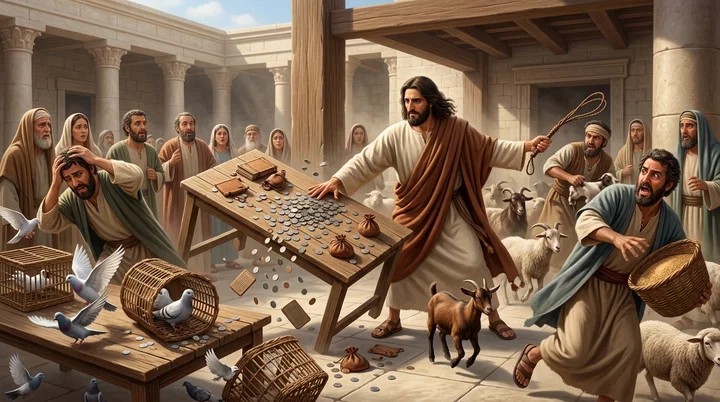
And Jesus went into the temple of God, and cast out all them that sold and bought in the temple, and overthrew the tables of the moneychangers, and the seats of them that sold doves,
Jesus drives traders from the temple in a parallel account of the cleansing.
- John 13:1
Now before the feast of the passover, when Jesus knew that his hour was come that he should depart out of this world unto the Father, having loved his own which were in the world, he loved them unto the end.
Marks the final Passover, when Jesus’ crucifixion was near.
- Luke 19:45-46
And he went into the temple, and began to cast out them that sold therein, and them that bought;
Jesus drives out the temple sellers and rebukes its misuse.
- Mark 11:15-17
And they come to Jerusalem: and Jesus went into the temple, and began to cast out them that sold and bought in the temple, and overthrew the tables of the moneychangers, and the seats of them that sold doves;
A parallel account of Jesus driving traders out.
- Jeremiah 7:11
Is this house, which is called by my name, become a den of robbers in your eyes? Behold, even I have seen it, saith the LORD.
Calls the temple a den of robbers, language used in Jesus’ temple rebuke.
- John 12:1
Then Jesus six days before the passover came to Bethany, where Lazarus was which had been dead, whom he raised from the dead.
Marks the final Passover in Jesus’ ministry chronology, when he was crucified.
- Exodus 12:2-14
This month shall be unto you the beginning of months: it shall be the first month of the year to you.
Describes the Passover’s institution in Egypt.
- Deuteronomy 16:1-6
Observe the month of Abib, and keep the passover unto the LORD thy God: for in the month of Abib the LORD thy God brought thee forth out of Egypt by night.
Commands Israel to keep Passover at the appointed place and time.
- John 11:55
And the Jews’ passover was nigh at hand: and many went out of the country up to Jerusalem before the passover, to purify themselves.
Both describe the Jews’ Passover approaching and people going to Jerusalem.
- John 2:23
Now when he was in Jerusalem at the passover, in the feast day, many believed in his name, when they saw the miracles which he did.
Jesus was in Jerusalem for Passover, where many believed after seeing his miracles.
- John 2:20
Then said the Jews, Forty and six years was this temple in building, and wilt thou rear it up in three days?
The temple’s forty-six-year building period is placed at this Passover.
- 1 Corinthians 5:7
Purge out therefore the old leaven, that ye may be a new lump, as ye are unleavened. For even Christ our passover is sacrificed for us:
Christ is identified as the Passover sacrifice.
- John 11:56
Then sought they for Jesus, and spake among themselves, as they stood in the temple, What think ye, that he will not come to the feast?
Both texts refer to the Passover near the end of Jesus’ ministry.
- Matthew 26:2
Ye know that after two days is the feast of the passover, and the Son of man is betrayed to be crucified.
Both texts place Jesus’ final Passover near his crucifixion.
- Jeremiah 7:4
Trust ye not in lying words, saying, The temple of the LORD, The temple of the LORD, The temple of the LORD, are these.
Both rebuke claiming temple status while defiling it.
- Psalms 69:9
For the zeal of thine house hath eaten me up; and the reproaches of them that reproached thee are fallen upon me.
Zeal for God’s house is fulfilled in Jesus’ cleansing of the temple.
- Isaiah 56:7
Even them will I bring to my holy mountain, and make them joyful in my house of prayer: their burnt offerings and their sacrifices shall be accepted upon mine altar; for mine house shall be called an house of prayer for all people.
God’s house is called a house of prayer.
- John 7:2
Now the Jews’ feast of tabernacles was at hand.
Describes the later festival visit after Jesus did not go to the Passover.
Commentary
Each commentary is drawn from primary sources: the writings of Ellen G. White and Adventist pioneers and periodicals. Each commentary is separate. Its own words are not a quotation; follow the references to read the source passages.
Ellen G. White
57 sources
Jesus went up to Jerusalem with His disciples for the Passover after a short stay in Capernaum, joining the great throng coming from throughout Palestine and distant lands for the most important feast of the year.DA 154.1–218MR 90.3–5ST Sep 16, 1897ST Jul 28, 1909Ms 60, 1902, par. 48 The visit marks the beginning of His public ministry and His entry upon His work as the Messiah.STMW7 54.1–2STA 39.1STOM 31.1 The weight of the passages holds it to be the first cleansing of the temple early in His ministry, three years before His return near its close when the defilement was greater, while those who held the differing position treat the cleansing connected with it as the second cleansing near the close of His mission.1RED 73.3ST Mar 28, 18783SP 23.1–24.1COS 99.1ST Mar 28, 1878 He found the sacred outer courts turned into a noisy marketplace of cattle, sheep, doves and money-changers, carried on as a profitable business of fraud, extortion and robbery by arrangement of the chief priests and rulers.18MR 90.3–5ST Sep 16, 1897DA 154.3–155.12SP 115.1–116.2ST Jan 4, 1877 With divine and kingly authority as founder of the sacrificial system and the great Offering Himself, He drove out the traders, overthrew the tables and cleansed the temple, confronting selfishness, hypocrisy and merely formal religion and foreshadowing the final purification of His church before His second advent.LC1 73.3LC1 79.2–80.22SP 129.2–130.2Lt 78, 1903, par. 5–8ST Aug 4, 1909
Journey to Passover Feast
Jesus went up to Jerusalem for the Passover after a short stay in Capernaum with His mother, His brothers, and His disciples, traveling with His disciples in a large company and mingling unnoticed with the gathering throng.DA 154.1–2ST Jul 28, 1909Ms 60, 1902, par. 48 He arrived when the city was crowded with people who had come from a distance for the great annual festival, and early in the morning large crowds were already repairing to the temple and its courts were already busy and crowded with worshipers.LC1 74.1–2ST Jan 4, 18771RED 74.1–2 He had not yet publicly announced His mission, so He joined the crowd without drawing attention.DA 154.1–2ST Jul 28, 1909
The Passover was the most important Jewish feast, and the leaders directed the people to worship God at Jerusalem.18MR 90.3–5 During the festival week large crowds came from throughout Palestine and from distant lands to worship and offer sacrifices, with large numbers of Jews gathering there for that purpose.18MR 90.3–5ST Sep 16, 1897DA 154.3–155.1 Jerusalem was crowded with those who had come for the annual festival.2SP 115.1–116.21RED 73.3
As He traveled, the people often discussed the coming of the Messiah and hoped for national greatness, but that hope rested on a misreading of Scripture.DA 154.1–2ST Jul 28, 1909 Jesus explained the prophecies to them and urged them to study God's word more closely.DA 154.1–2ST Jul 28, 1909
Many pilgrims could not bring sacrificial animals with them, so animals and doves were sold in the temple's outer courts and foreign money was exchanged for sanctuary coin.18MR 90.3–5ST Sep 16, 1897DA 154.3–155.1 The animals served as symbols of the one great Sacrifice, while the yearly half-shekel payment was collected as a ransom for each person's soul and used to support the temple.DA 154.3–155.1 This visit marks the beginning of His public ministry and His entry into His work with the announcement of His mission as the Messiah, introducing the temple cleansing at the beginning of His ministry.STMW7 54.1–2STA 39.1STOM 31.1ST Jul 28, 19094MR 242.1 It was an act of purification that is paired with and contrasted with His cleansing of the temple near the close of His life, almost at the close of His ministry.STA 39.1STOM 31.19T 228.2
The visit is the first cleansing of the temple early in His ministry, three years before His return near the close of His mission.1RED 73.33SP 23.1–24.1ST Mar 28, 1878 He then stood as a youthful, humble, single man and by His command drove the buyers and sellers, cattle and merchandise from the courts with less manifested authority than at the second cleansing, when divinity flashing through humanity invested Him with the majesty of Heaven's King.3SP 23.1–24.1 At the later cleansing the courts were defiled to a greater degree.ST Mar 28, 1878 In a differing position held by some, the cleansing connected with this going up is treated as a second cleansing near the close of His earthly mission, three years after He had first driven traders from the temple, after He had driven sellers from the court earlier in His ministry.ST Mar 28, 1878COS 99.1ST Mar 28, 1878 On that view He acted after the people had proclaimed Him Israel's King, accepting their homage and His kingly and priestly office.ST Mar 28, 1878
Temple Trade and Corruption
The temple was intended as a holy place of worship, prayer, and thanksgiving for the ransom God had provided, but its sacred outer courts had been turned into a noisy marketplace.ST Sep 16, 18972SP 115.1–116.2ST Mar 28, 1878 The buying and selling there disturbed worship and contradicted the holiness of the temple.2SP 115.1–116.2ST Jan 4, 1877 Because many who came from across Palestine and distant lands for Passover week could not bring sacrificial animals with them, they bought their offerings in the temple courts and exchanged foreign money for sanctuary coin.18MR 90.3–5ST Sep 16, 1897ST Jan 4, 1877 What began as provision for worshipers had become a profitable and extortionate business carried on in the courts already crowded with worshipers.ST Sep 16, 1897ST Jan 4, 1877
The traffic filled the courts with sellers and money-changers, with cattle, sheep, oxen, and doves.ST Jan 4, 1877ST Mar 28, 1878Lt 78, 1903, par. 5–8 There was the lowing of cattle, the bleating of sheep, the cooing of doves, and the clinking of coin.Lt 78, 1903, par. 5–8 Sharp bargaining and angry disputation filled the outer court with unholy noise.ST Mar 28, 1878Lt 78, 1903, par. 5–8 Even temple dignitaries took part in the trade, with animals, money-changing, and angry disputes crowding the place meant for devotion.ST Jan 4, 1877ST Mar 28, 1878
The sale of offerings and exchange of coins had become a source of fraud, extortion, robbery, and revenue for the priests.18MR 90.3–5DA 154.3–155.1COS 99.1 Priests and rulers bought cattle and other animals at very low cost and sold them at exorbitant prices to worshipers, sharing the profits among themselves.Lt 78, 1903, par. 5–8ST Jul 28, 1909 Foreign money was exchanged for sanctuary coin, and animals and doves were sold in the outer courts, while the yearly half-shekel was collected as a ransom for each soul to support the temple.18MR 90.3–5DA 154.3–155.1ST Jul 28, 1909 The animals themselves served as symbols of the one great Sacrifice, yet the noise of the same traffic returning disturbed worshipers.DA 154.3–155.1COS 99.1 Leaders exploited the worshipers by charging excessive prices and dividing the gain with priests and rulers.Lt 78, 1903, par. 5–8ST Jul 28, 1909
The market existed by arrangement of the chief temple authorities, so the great sin of desecration lay upon the priesthood who had perverted and disgraced their sacred office.LC1 79.2–80.2ST Mar 28, 18781RED 79.2–80.2 Their greed had overcome religious scruples, making them thieves in God's sight and desecrating the holy place.ST Mar 28, 1878 The crowd using the court for its appointed purpose was comparatively innocent beside those who had turned it into a marketplace.LC1 79.2–80.2 While some hold that this visit came near the close of His earthly mission after He had driven traders out earlier, the weight of testimony places this arrangement and desecration at the Passover when He went up to Jerusalem at the opening of His work.LC1 79.2–80.2ST Mar 28, 18781RED 79.2–80.2
Those who had traveled far felt compelled to buy rather than go home without completing the devotion that had brought them to Jerusalem.Lt 78, 1903, par. 5–8ST Jul 28, 1909 They were distressed by teaching that there would be no remission of sins without shedding of blood.Lt 78, 1903, par. 5–8 They had also been taught that without an offering God would withhold blessing from their children and lands.ST Jul 28, 1909 In that distress the poor saw no way but to submit to unfair transactions, robbery, and oppression in order to offer sacrifice.Lt 78, 1903, par. 5–8ST Jul 28, 1909
Cleansing Act and Authority
At the Passover Jesus cleansed the temple of buying and selling and merchandise, for the courts had become a place of dishonoring traffic that oppressed the people.Ms 37, 1894, par. 1–2Lt 78, 1903, par. 5–8ST Feb 3, 1881 On entering the enclosure He gathered a scourge of small cords, bade the bargaining company depart, overthrew the tables of the money-changers so that coin fell ringing on the pavement, and drove out temple officers, speculating priests, brokers and cattle traders with their sheep and oxen.Ms 37, 1894, par. 1–2Lt 78, 1903, par. 5–8ST Feb 3, 1881 None dared question His authority or stop to gather ill-gotten gain, and though He struck no one with the whip the simple scourge in His hand seemed terrible as a flaming sword, so that they fled before Him as though pursued by armed soldiers.Lt 78, 1903, par. 5–8EW 139.3 The outer court was filled with sharp bargaining, the lowing of cattle, bleating of sheep, cooing of doves, clinking of coin and angry disputation, and He saw the unfair transactions and robbery and oppression with a zeal and severity never before manifested.Lt 78, 1903, par. 5–8
The act was not an exhibition of human power but of divine and kingly authority that lifted Him above humanity and openly assumed authority greater than the chief priests and elders.LC1 79.2–80.2Lt 78, 1903, par. 5–8ST Aug 4, 1909 He was the originator and founder of the whole Jewish sacrificial system, and all the sacrifices were types of Himself as the great Offering now standing in His temple.Lt 78, 1903, par. 5–8 In exercising that authority He drove out the priests and rulers and condemned their sacrilegious practices.LC1 79.2–80.2ST Aug 4, 1909
The dignitaries of the temple fled precipitously before Him in fear and unquestioning obedience.EW 139.33SP 23.1–24.1ST Mar 28, 1878 This was the first cleansing at the Passover, three years before the final cleansing, when He stood as a youthful, humble, single man and by His command drove buyers and sellers, cattle and merchandise from the courts.3SP 23.1–24.1ST Mar 28, 1878 Afterward they were ashamed of their surrender and wondered at their own fears, judging such a surrender impossible to repeat, yet at the second cleansing three years after the first they obeyed again in greater terror and haste, when divinity flashing through humanity invested Him with less manifested authority at first than afterward with the majesty of Heaven's King whose indignation quenched all opposition.3SP 23.1–24.1ST Mar 28, 1878
His appearance, voice and power over the crowd led many people to believe that He was the Messiah they had long expected and long awaited.4RED 8.12SP 124.1ST Mar 28, 1878 His disciples remembered this display of power and hoped He would again disperse His enemies and show Himself to be the King of Israel.EW 139.3 The cleansing condemned sacrilegious practices and reproved the Pharisees, whose religion consisted of forms and ceremonies, whose rigorous exactions showed no reverence for the true requirements of God but trampled them daily, and whose hypocritical lives stirred their bitter hatred.LC1 73.3LC1 79.2–80.2DA 167.2–168.1 The Jews felt and realized that divine authority and should have been brought by it as worshipers at His feet, but they hated and scorned Him and questioned what right a youthful Galilean had to interfere with the dignitaries of the temple.LC1 79.2–80.2DA 167.2–168.1 They were determined to disbelieve Him from fear that this humble Galilean teaching humility and love would take from them their power over the people by His greater works and superhuman authority, and because their haughty spirits looked for a king who would come with great pomp and heraldry to subdue nations and raise them to loftier station.LC1 79.2–80.2
News of that act, along with His healings, reached Galilee with the returning Passover pilgrims who had come from the feast.3RED 14.2–15.12SP 151.2ST Feb 1, 1877ST Feb 3, 18813RED 15.2–16.1 The people's disapproval of the temple rulers and hope that Jesus might be the Deliverer helped prepare them to receive Him.3RED 14.2–15.12SP 151.23RED 15.2–16.1 That report encouraged the Capernaum nobleman to believe Jesus could heal his dying son even from the brink of the grave.2SP 152.1–153.1 Nicodemus witnessed the temple scene and then sought Jesus at night on the Mount of Olives, and on the day after the cleansing Jesus healed the sick and taught the people.4RED 8.13RED 14.2–15.12SP 151.2
Spiritual Meaning and Doctrine
Going up to Jerusalem for the Passover at the start of His public work, Jesus began that work by confronting selfishness, hypocrisy, and merely formal religion among professed worshipers who neglected inward holiness.LC1 73.32SP 129.2–130.2 His cleansing condemned sacrilegious traffic and reproved the Pharisees, whose religion consisted of forms and ceremonies, whose rigorous exactions showed no reverence for God's true requirements but trampled them daily, and whose hypocritical lives were rebuked by His teaching.LC1 73.3 Their retreat from His presence showed they were not fitted by His grace for sacred service, for though they claimed to be Abraham's children and guarded outward forms, they neglected holiness of heart and violated the spirit of the law.LC1 73.3DA 173.2–174.1
Mere profession of religion has no value before God, who values a pure, holy character maintained with strict integrity.Ms 27, 1900, par. 5–7 What was needed was new birth, cleansing from sin, and renewal in holiness for eternal life.2SP 129.2–130.2DA 173.2–174.1 His holy wrath against the Jewish leaders arose because they taught human commandments as doctrines and practiced deceit.ST Apr 5, 1905 That driving out of pollution from the temple also shows His desire to cleanse hearts of everything resembling fraud.2SP 129.2–130.2ST Apr 5, 1905
In the temple He exercised great authority in condemning the leaders' practices, and His appearance, voice, and power over the crowd led many to believe He was the long-expected Messiah.4RED 8.12SP 124.1 The Passover cleansing thus revealed His divinity and, together with His healing and teaching in Judea, proclaimed His Sonship to God.4RED 8.12SP 124.1DA 231.2 The temple purified at the beginning of His ministry was purified again at its close, illustrating that God purifies His church through trials for its present and eternal good to strengthen it to carry the message of the cross throughout the world.Ms 34, 1900, par. 47 In this way truth confronts religious leaders and rulers whose conduct needs to be corrected and purified.Ms 178, 1899, par. 1–5
Prophetic Foreshadowing of End
The Passover journey to Jerusalem marks the beginning of public ministry with a first cleansing of the temple from sacrilegious trade and profanation, when a sacred institution had been turned into means of profit and worship of mammon.STMW7 54.1–2STA 39.1STOM 31.1STBk 39.1–40.19T 228.2 That act of purification at the opening of ministry is paired with a second cleansing almost at its close, nearly the last act of ministry, three years after the return to the temple near the close of the earthly mission.STMW7 54.1–2STA 39.1STBk 39.1–40.19T 228.2ST Mar 28, 1878 The two are repeated acts of purification standing together as first and second.STA 39.1STOM 31.1STBk 39.1–40.19T 228.2ST Mar 28, 1878
At the first cleansing He stood as a youthful, humble, single man and by command drove buyers and sellers, cattle and merchandise from the courts.3SP 23.1–24.1 It was wrought with less manifested authority than the second, when divinity flashing through humanity invested Him with the majesty of Heaven's King and His indignation quenched all opposition.3SP 23.1–24.1 The dignitaries fled precipitously before Him in fear and unquestioning obedience, afterward ashamed of their surrender and judging repetition impossible, yet at the second cleansing they obeyed again in greater terror and haste.3SP 23.1–24.1
Together the two cleansings foreshadow the last work for the warning of the world, in which two distinct calls are made to the churches.STA 39.1STOM 31.1STBk 39.1–40.1 They picture the second angel's message and the voice from heaven calling God's people to come out of Babylon because her sins have reached unto heaven and God has remembered her iniquities.STOM 31.1STBk 39.1–40.1 The temple scene at that Passover visit showed Christ exercising kingly authority as He drove out the priests and rulers, and their flight symbolized the later dispersion of the Jewish nation for its wickedness and impenitence.ST Aug 4, 1909
That first cleansing, when He came to Jerusalem at His first advent because commercial work had been brought in and God had been forgotten, will be repeated prior to His second advent.Ms 11, 1903, par. 15–17 Then God in displeasure will cleanse and purify His temple.Ms 11, 1903, par. 15–17 In that cleansing the principles of God's law were presented with the question how much of the law had been obeyed, amid hurry here and hurry there and hurry somewhere else leaving no time to think of heaven.Ms 11, 1903, par. 15–17
Present Practical Application
The going up to Jerusalem at the Jews' passover establishes the duty to practice true health reform and temperance and to preserve the physical powers in the best possible condition in order to render acceptable service to God.STA 127.1STA 127.2 That preservation keeps a person susceptible to the sanctifying influence of truth, and the light and knowledge of the laws of health are granted to promote spiritual as well as physical life.STA 127.1STA 127.2 Instruction in this duty is to be given by precept and by quiet, consistent example, and then followed up with publications.STA 127.1
As He drove the money-changers from the temple at that Passover, so He would likewise drive out those who desecrate churches through feasting and unholy trade conducted in the name of religion.GC88 474.2 The cleansing is a call for Him to remove fraud and injustice from religious institutions and to cleanse a workplace of concealed wrongdoing.Lt 62, 1900, par. 1–2Ms 81, 1901, par. 33 He who came to Jerusalem to cleanse defilement from God's work when He was upon the earth will just as surely cleanse the publishing office, the Review and Herald Office, from its defilement if there is not a change.Ms 240, 1902, par. 2–4 That cleansing is required because the men in office are not under control to God, are not walking in the light, and do not sense the difference between handling the sacred and the common fire.Ms 240, 1902, par. 2–4
The temple had been set apart for God but had been turned to common commercial use displeasing to God, and that desecration exerted a corrupting, poisoning influence on minds through blindness and lack of spiritual discernment.Lt 46, 1903, par. 9–10 The same desecration takes place when an institution dedicated to God's pure truth is used for God-displeasing commercial work.Lt 46, 1903, par. 9–10 It likewise takes place when such an institution is used for matter containing principles that lead to false doctrine.Lt 46, 1903, par. 9–10
Sources
Pioneers and periodicals
67 sources
Jesus went up to Jerusalem to observe the Passover at its appointed season, when worshipers gathered from near and far to offer sacrifices in the temple.ST Sep 16, 1897ST Feb 22, 1899ST Feb 22, 1899ST Sep 17, 1894 It was the first Passover after His baptism and entrance upon public ministry, the first of the four Passovers named in John that measure about three and one-half years to His crucifixion.ST Dec 18, 1907RH Dec 5, 1907RH Sep 20, 1870RH Apr 2, 1872 That ministry from autumn A.D. 27 to spring A.D. 31 fulfills the first half of the seventieth week of Daniel 9:24-27, when Messiah was cut off in the midst of the week and by offering Himself caused sacrifice and oblation to cease.ST Dec 18, 1907STST Jul 17, 1901ST Jul 18, 1911RH Apr 4, 1854 At this Passover He entered upon His work as Messiah and with kingly authority cleansed the temple for the first time, driving the merchants and money-changers from its courts at the beginning of His ministry, distinct from His second cleansing just before the crucifixion.ST Aug 4, 1909ST Jul 28, 1909RH Apr 24, 1879ST Jan 21, 1889 The act that cleansed the temple of stone shows He is almighty to cleanse the soul-temple from sin and yearns to cleanse hearts thoroughly, the one great lesson for all time.ST Apr 5, 1905ST Nov 3, 1898ST Mar 26, 1902
Passover Journey to Jerusalem
The Jews' Passover was at hand, and Jesus went up to Jerusalem to observe the feast.ST Feb 22, 1899ST Feb 22, 1899ST Sep 17, 1894ST Jul 9, 1896 It was the annual gathering kept at its appointed season, first instituted for Israel in Egypt and afterward observed under temple-era instruction.ST Feb 22, 1899ST Feb 22, 1899 The nearness of the Passover sets both the time and the place for what follows in the temple.ST Sep 17, 1894
The journey came after a short stay following the move from Cana to Capernaum.ST Jul 9, 1896RH Dec 19, 1907 He traveled from Galilee to Judea, to Jerusalem, during the active ministry of John the Baptist.ST Feb 3, 1881ST Jul 8, 1913 He went with a large company and mingled unnoticed among the people because He had not yet publicly announced His mission.ST Jul 28, 1909
Passover week brought together crowds from across Palestine and from distant lands to worship and offer sacrifices.ST Sep 16, 1897ST Jan 4, 1877ST Jul 28, 1909 Many could not bring sacrificial animals with them, so they bought their offerings in the temple courts.ST Sep 16, 1897ST Jul 28, 1909 There foreign money was exchanged for sanctuary coin, while sellers and money-changers crowded the courts with worshipers and animals for sacrifice.ST Jan 4, 1877ST Jul 28, 1909
The sale of offerings and exchange of coins had become a profitable and extortionate business that disrupted worship.ST Jan 4, 1877 The leaders charged excessive prices and shared the profits with priests and rulers.ST Jul 28, 1909 The people had been taught that without offering a sacrifice God would withhold blessing from their children and lands, so those who had traveled far felt compelled to buy rather than go home without completing the devotion that had brought them to Jerusalem.ST Jul 28, 1909
Temple Trade Exposed
What Jesus found when He went up to Jerusalem was that the pilgrims' need to exchange foreign money and to buy animals for offerings had gradually drawn commerce into the temple courts under the appearance of serving religion.RH Sep 16, 1902 The outer court had thus been turned into a crowded, noisy marketplace, filled with worshipers, cattle, sheep, doves, sellers and money-changers, with lowing cattle, cooing doves, clink of gold, greedy cries and angry disputes in wild rude discord.ST Jan 4, 1877ST Mar 28, 1878 Crowds had gathered from distant places for the annual festival, and because many could not bring animals with them they bought their offerings on the spot.ST Sep 16, 1897ST Jan 4, 1877
That sale of offerings and exchange of coins had become a profitable and extortionate business that disrupted worship.ST Jan 4, 1877 Even temple dignitaries took part in the trade, until greed overcame religious scruples, making them thieves in God's sight and desecrating the holy place.ST Mar 28, 1878ST Nov 3, 1898
The temple was God's dwelling among His people, set apart for worship and made holy by His presence.ST Nov 3, 1898 It was meant to be a holy place of worship, prayer, praise and thanksgiving for the ransom God had provided, not a place for trade.ST Sep 16, 1897ST Nov 3, 1898 Turning its courts into a noisy marketplace violated the sacredness of God's house, treating sacred things as common and making the courts a den of thieves.RH Sep 16, 1902ST Jan 2, 1901ST Nov 3, 1898
In zeal for the Lord's house Jesus rejected this use of the temple.RH Sep 9, 1902 With a scourge of cords in His hand, by Godlike presence alone and exercising kingly authority, He commanded, Take these things hence, and drove merchants, money-changers, animals and their owners from the courts in one vast rushing tide fleeing in dismay.ST Aug 4, 1909RH Sep 9, 1902 During that Passover visit He drove out the money-changers, animal sellers, priests, rulers and desecrators, purifying the holy house before healing many sick who came to Him.ST Aug 4, 1909ST Aug 9, 1910ST Aug 16, 1910ST May 6, 1886
First Cleansing Distinguished
The Passover being at hand when Jesus went up to Jerusalem introduces the first recorded cleansing of the temple at the beginning of His ministry.RH Apr 24, 1879ST Apr 14, 1898ST Apr 14, 1898 It belongs to His first full year of ministry, about A.D. 28.ST Aug 20, 1894 It is distinct from the second cleansing shortly before the crucifixion described in Matthew, Mark and Luke, with John 2:13-22 being the other, earlier cleansing before the later cleansing at the triumphal entry.RH Apr 24, 1879ST Apr 14, 1898
That first visit came three years before His return to the temple near the close of His earthly mission, when He cleansed again.ST Mar 28, 1878ST Mar 28, 1878ST Mar 28, 1878 At that later time He acted after the people had proclaimed Him Israel's King, accepting their homage and His kingly and priestly office.ST Mar 28, 1878 By then the courts were defiled to a greater degree than at the first visit.ST Mar 28, 1878 The dignitaries who had been ashamed of fleeing at His earlier command again obeyed in greater terror and haste, while after the buyers and sellers were driven out many watched in hope that He was the long-awaited Messiah.ST Mar 28, 1878ST Mar 28, 1878
The early cleansing alongside the late cleansing forms a pattern for two distinct calls to the churches in the final warning to the world, the first cleansing standing at the time He began His public ministry and the second near the end of His ministry.ST Feb 13, 1893
Ministry Length Measured
The verse marks the first Passover Jesus attended after His baptism and after several months of ministry, including forty days in the wilderness and time spent ministering and choosing disciples, and He customarily went up to Jerusalem each year for the feast.ST Dec 18, 1907RH Dec 5, 1907ST Jan 25, 1910ST Mar 2, 1882RH Apr 16, 1908 Counted with John 5:1, John 6:4, and John 13:1 at the crucifixion, it is the first of four Passovers in John, measuring about three and one-half years, or half a week of years, from baptism to death, with the last Passover being the one at which He was crucified.ST Dec 18, 1907RH Sep 20, 1870RH Apr 2, 1872RH Jan 10, 1854 The additional Passover notices confirm the same span, placing the crucifixion no later than A.D. 31 and limiting the whole time of His teaching to three and one-half years between baptism and death.RH Sep 20, 1870RH Apr 2, 1872RH Jan 7, 1858RH Jan 10, 1854
In the common reckoning this first Passover fell in spring, in late March or April in Abib, in A.D. 28, about six months after the ministry began in autumn A.D. 27.RH May 16, 1912ST Dec 19, 1892ST Mar 2, 1882STST Jul 17, 1901 The second followed in the spring of 29, the third in the spring of 30, and the fourth in the spring of 31, at which He was crucified, together measuring a three-and-one-half-year ministry to His crucifixion.RH May 16, 1912ST Dec 19, 1892STST Jul 17, 1901RH Jul 28, 1863 Reckoned from His baptism and anointing as Messiah in autumn A.D. 27 at the end of the sixty-nine weeks, the three and one-half years bring the crucifixion to the spring of A.D. 31.RH May 16, 1912ST Dec 19, 1892RH Jul 28, 1863 On that reckoning the ministry began about six months before this spring Passover when Jesus was about thirty, the age required for the Jewish priesthood, placing its beginning around September in the month Tisri and leaving three years between this first Passover and the last Passover.ST Dec 18, 1907ST Dec 23, 1897 Since the ministry lasted three and one-half years and ended at Passover, it began about six months before this first Passover, with the Passover probably near the end of March in Abib.ST Dec 18, 1907ST Dec 23, 1897
If the feast in John 5:1 was another Passover, the three Passovers John names establish a ministry of more than three years, lasting three and one-half years.RH Dec 5, 1907RH Apr 2, 1908 Other reckonings place this first Passover about three months after His baptism, probably in A.D. 27, marking the beginning of the chronology used to estimate the length of His ministry.RH Dec 5, 1907RH Apr 16, 1908 The same visit is dated evidently in A.D. 28, at the beginning of the first full year of His ministry and about A.D. 28 for the cleansing of the temple.ST Aug 20, 1894RH Dec 19, 1907ST Aug 20, 1894 The temple's forty-six years of building are used to date this visit, counting from Herod's preparations begun two years before construction started in B.C. 19, and because that Passover was not long after the baptism it supports dating the baptism near the beginning of the year.RH Dec 19, 1907RH Apr 16, 1908 One reading counts from baptism in autumn A.D. 27 to identify this Passover notice with the fourth Passover in spring A.D. 31 when He was crucified, still showing with the other Passover notices that His ministry lasted three and one-half years.RH Nov 12, 1901
Seventieth Week Fulfilled
This Passover is the first of four Passovers attended during the public ministry, the others being John 5:1, John 6:4, and John 13:1 at the crucifixion.ST Dec 18, 1907RH Apr 4, 1854RH Jul 28, 1863 It falls within the seventieth week of Daniel 9:24-27, which began with baptism and anointing as Messiah in autumn A.D. 27 at the end of the sixty-nine weeks and closed with the exclusive ministry of the disciples to the Jews.ST Dec 18, 1907RH Apr 4, 1854RH Jul 28, 1863 Christ was to be cut off in the midst of that week, and the four Passovers span about three and a half years to place the cross in the spring of A.D. 31 in the middle of the week.ST Dec 18, 1907RH Apr 4, 1854RH Jul 28, 1863
The three-and-one-half-year ministry from autumn A.D. 27 to crucifixion at the fourth Passover in spring A.D. 31 fulfills the first half of the seventieth week.STST Jul 17, 1901ST Jul 18, 1911 The reckoning runs from this first Passover in the spring of A.D. 28, with the second in the spring of 29, the third in the spring of 30, and the fourth in the spring of 31 at the crucifixion.STST Jul 17, 1901 In the midst, meaning the middle, of the week Messiah was cut off, and by death confirmed the new covenant with the Jews and caused sacrifice and oblation to cease by offering Himself as the great antitype.STST Jul 17, 1901ST Jul 18, 1911RH Apr 4, 1854RH Jul 28, 1863
During that half-week He taught the principles of His covenant and confirmed the covenant of promise to the Hebrews.STST Jul 17, 1901 His disciples then continued that work among the Hebrews for three and one-half years more until A.D. 34.STST Jul 17, 1901 At that point the gospel began to go to the Gentiles.STST Jul 17, 1901
Christ Revealed and Foretold
The Passover journey to Jerusalem marked His entrance into His work and His announcement of His mission as the Messiah, exercising kingly authority in the temple as He drove out the priests and rulers.ST Aug 4, 1909ST Jul 28, 1909 Though He passed among the people as an ordinary mortal, His divinity flashed through in that cleansing.ST Jan 21, 1889 Their flight before Him symbolized the later dispersion of the Jewish nation for its wickedness and impenitence.ST Aug 4, 1909
The driving out points forward to the day when He comes to judge the sons of men in robes of vengeance with scales of justice, the crown of thorns exchanged for regal glory. Then the mocking, clamoring throng will bid the mountains fall and hide them, yet He will still stand as Advocate with pierced side and bleeding hands, calling the heavy-laden to come to Him. With a scourge of cords in His hand and by Godlike presence alone He drove the surging mass of drivers, cattle, sheep, birds, and money-changers with their gold in one vast rushing tide fleeing in dismay as from the Avenger's sword, a wonderful result that might almost be called a miracle amid the lowing cattle, cooing doves, clink of gold and greedy cry in wild rude discord.
His holy wrath against the Jewish leaders arose because they taught human commandments as doctrines and practiced deceit.ST Apr 5, 1905 His driving out the traders was a rebuke for the common and profane use to which they had put the house where God had chosen to place His name, for their failure to let light into their own souls had left them in darkness and taken sacredness from sacred things.ST Nov 3, 1898 It directly implied they were not right in the sight of a holy God, and was meant to lead them to see their spiritual barrenness and need of a Saviour.ST Nov 3, 1898 His cleansing of the holy house was a sign of His authority and zeal for its sacred purpose, and was cited as evidence of the miracles and works being done through Him.ST Aug 16, 1910
With power more convincing than argument the cleansing showed that the One able to cleanse a temple of stone is almighty to cleanse the soul-temple of its pollutions and defilements, and that He yearns with infinite love to do that work, a truth eternal as the ages and the one great lesson for all time.ST Nov 3, 1898 It shows His desire to cleanse hearts of everything resembling fraud and to cleanse people thoroughly from sin.ST Apr 5, 1905ST Mar 26, 1902 The report of this act, along with reports of His miracles of healing, spread among the people returning from the feast and helped prepare for His welcome in Galilee.ST Feb 1, 1877ST Feb 3, 1881ST May 6, 1886 That driving out was a miraculous display of power which, joined with changing water into wine, convinced a nobleman father that Jesus could raise his dying son to health even from the brink of the grave.ST Feb 1, 1877
At that Passover He entered the temple and drove out the money-changers and animal sellers, purifying the holy house before healing many sick people who came to Him.ST Aug 9, 1910ST Apr 23, 1896 After He cleansed the temple courts, He spent the following day healing the sick, relieving the afflicted, and teaching the people.ST Apr 15, 1886 He traveled with the large company explaining the prophecies and urging them to study God's word more closely, because the people's talk of the Messiah's coming and hope of national greatness rested on a misreading of Scripture.ST Jul 28, 1909
This was the first of four Passovers He attended during His public ministry, the others being John 5:1, John 6:4, and John 13:1 at His crucifixion, falling within the seventieth week of Daniel 9:24-27 which began with His baptism in A.D. 27, when He was cut off in the midst of the week.ST Dec 18, 1907 It came about six months after His baptism at about thirty years of age, the age required for the Jewish priesthood, after forty days in the wilderness and time spent ministering and choosing disciples, leaving three years between this first Passover and the last.ST Dec 18, 1907 Since the Passover came in spring, around late March or April, and His three-and-one-half-year ministry ended at Passover, counting back six months from spring places His birth in autumn, probably late September or early October, and certainly not in December.ST Dec 18, 1907ST Feb 20, 1907 Its exact date is unrevealed and no day is appointed for celebrating it, for the whole life of Christ is what matters.
Reverent Worship Applied
As the Passover drew near Jesus went up to Jerusalem and entered the temple courts, where He found trade had displaced sacred work and turned the outer court into a crowded, noisy marketplace.ST Jan 2, 1901RH Sep 16, 1902ST Nov 3, 1898 The temple was God's dwelling among His people, set apart for worship and made holy by His presence, with its courts meant for prayer, praise and thanksgiving rather than buying and selling.ST Jan 2, 1901ST Nov 3, 1898 Clearing those courts showed that sacred things must not be treated as common, and that commerce for gain must not take the place of devotion.ST Jan 2, 1901RH Sep 16, 1902ST Nov 3, 1898
That setting stands as a warning against allowing commercial concerns to take over the mission of the church.RH Sep 16, 1902 His example in cleansing the court twice condemns raising money by turning religious activity into worldly attractions.RH Sep 16, 1902ST Nov 19, 1894 In the same context, His action against traffic for gain upholds the principle that the Sabbath must not be profaned by buying and selling.ST Mar 13, 1879
Driving the money-changers and other tricksters from the temple shows that divine power is needed to confront and overcome such corruption. His use of force removed those who defiled the sanctuary rather than compelling anyone to worship.RH Dec 31, 1914RH Sep 24, 1914 That driving of unworthy men out, instead of forcing people in, stands opposed to making religion or attendance at church a punishment imposed by civil authority.RH Dec 31, 1914RH Sep 24, 1914
The same cleansing shows the temple is in need of cleansing when Protestant churches unite to observe Holy Week and thereby perpetuate and glorify an institution of the Roman Church.RH May 23, 1912
Sources