John 5:7
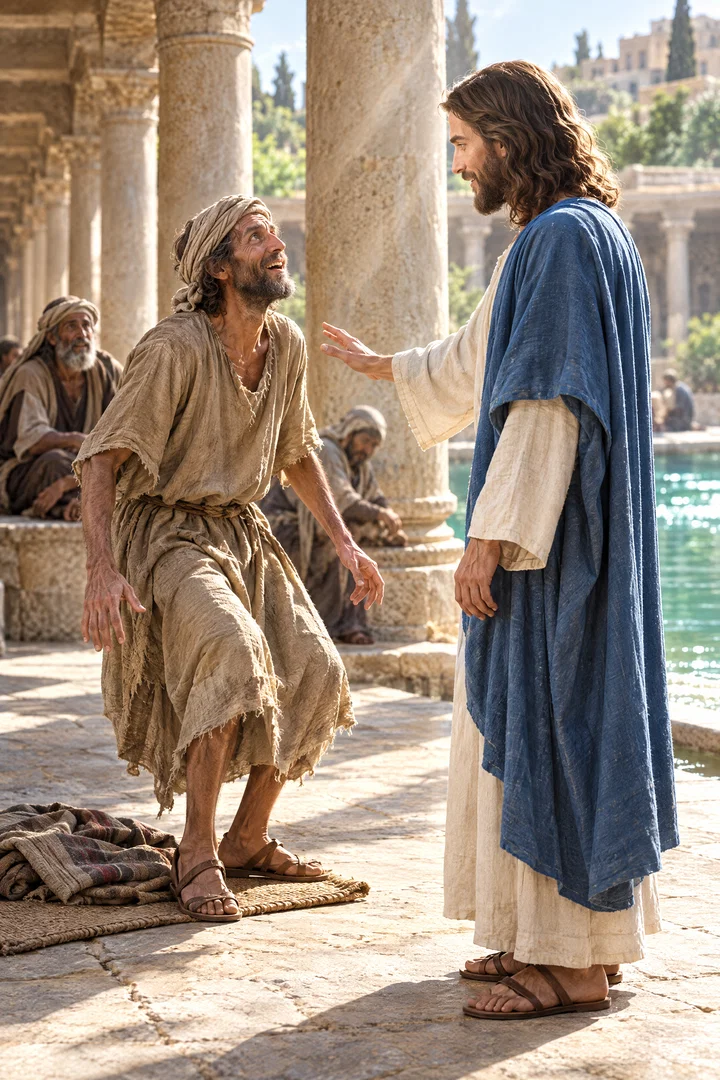
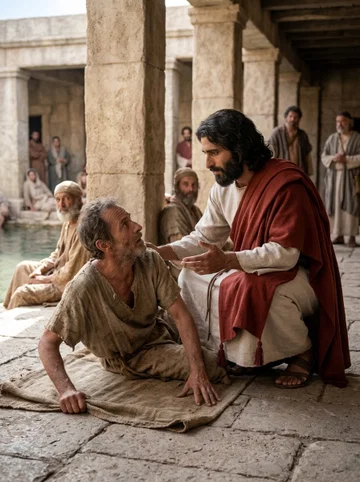
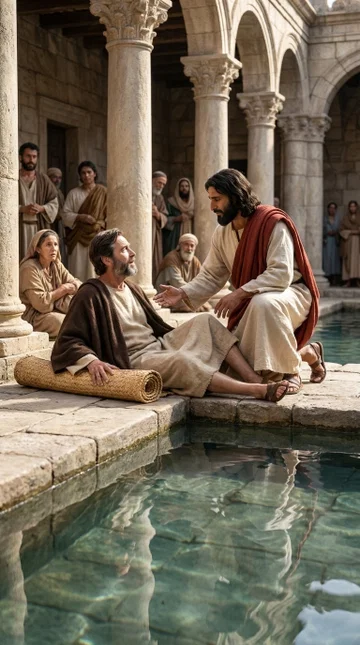
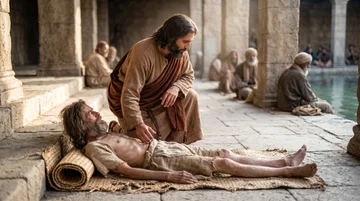
The impotent man answered him, Sir, I have no man, when the water is troubled, to put me into the pool: but while I am coming, another steppeth down before me.
Translations
The weak man answered him, Sir, I have no man, when the water is troubled, to put me into the pool: but while I am coming, another steps down before me.
King James Version, KJV Cambridge Paragraph Bible
The impotent man answered him, Sir, I have no man, when the water is troubled, to put me into the pool: but while I am coming, another steppeth down before me.
The impotent man answered him, Sir, I have no man, when the water is agitated, to put me into the pool: but while I am coming, another steppeth down before me.
Revised Version, American Standard Version
The sick man answered him, Sir, I have no man, when the water is troubled, to put me into the pool: but while I am coming, another steppeth down before me.
The ailing man answered him, 'Sir, I have no man, that, when the water may be troubled, he may put me into the pool, and while I am coming, another doth go down before me.'
The infirm [ man] answered him, Sir, I have not a man, in order, when the water has been troubled, to cast me into the pool; but while I am coming another descends before me.
The sick man answered him—Sir! I have, no man, that, as soon as the water hath been troubled, might thrust me into the pool; but, while, I, am coming, another, before me, goeth down.
Berean Standard Bible, Majority Standard Bible
“ Sir,” the invalid replied, “ I have no one to help me into the pool when the water is stirred. While I am on my way, someone else goes in before me.”
The sick man answered him, “ Sir, I have no one to put me into the pool when the water is stirred up, but while I’m coming, another steps down before me.”
The ill man said in answer, Sir, I have nobody to put me into the bath when the water is moving; and while I am on the way down some other person gets in before me.
The sicke man answered him, Sir, I haue no man, when the water is troubled, to put me into the poole: but while I am comming, another steppeth downe before me.
Douay-Rheims (Challoner revision)
The infirm man answered him: Sir, I have no man, when the water is troubled, to put me into the pond. For whilst I am coming, another goeth down before me.
Pictures

Cross-references
- John 5:16-18
And therefore did the Jews persecute Jesus, and sought to slay him, because he had done these things on the sabbath day.
The healing at Bethesda prompted opposition to Jesus’ Sabbath work and his claim of equality with God.
- John 7:23
If a man on the sabbath day receive circumcision, that the law of Moses should not be broken; are ye angry at me, because I have made a man every whit whole on the sabbath day?
defends making whole on Sabbath
- John 5:17-18
But Jesus answered them, My Father worketh hitherto, and I work.
Jesus’ Sabbath healing at Bethesda leads to the Jews’ accusations.
- John 5:2-3
Now there is at Jerusalem by the sheep market a pool, which is called in the Hebrew tongue Bethesda, having five porches.
Describes the pool and the sick people waiting there.
- Acts 3:2-10
And a certain man lame from his mother’s womb was carried, whom they laid daily at the gate of the temple which is called Beautiful, to ask alms of them that entered into the temple;
Both accounts describe a lame man healed and enabled to walk.
- Acts 4:10
Be it known unto you all, and to all the people of Israel, that by the name of Jesus Christ of Nazareth, whom ye crucified, whom God raised from the dead, even by him doth this man stand here before you whole.
A disabled man is made whole through Jesus Christ.
- John 5:13-14
And he that was healed wist not who it was: for Jesus had conveyed himself away, a multitude being in that place.
Jesus withdrew from crowd, later met man in temple
- Luke 13:11-16
And, behold, there was a woman which had a spirit of infirmity eighteen years, and was bowed together, and could in no wise lift up herself.
Jesus heals on the Sabbath, prompting a controversy over Sabbath observance.
- John 9:1-7
And as Jesus passed by, he saw a man which was blind from his birth.
Both texts describe a healing associated with water and a work of mercy on the Sabbath.
- Matthew 8:5-13
And when Jesus was entered into Capernaum, there came unto him a centurion, beseeching him,
Both accounts describe Jesus healing someone who is gravely ill.
Commentary
Each commentary is drawn from primary sources: the writings of Ellen G. White and Adventist pioneers and periodicals. Each commentary is separate. Its own words are not a quotation; follow the references to read the source passages.
Ellen G. White
42 sources
The sufferer explains that he has no one to carry him into the pool when the water is stirred, and that while he is struggling toward it someone stronger always steps down ahead of him.COS 77.2–78.5DA 201.3–4DA 201.1–2 He still believes that being put into the troubled water first is his only chance of cure, and does not yet know that Christ standing beside him can heal him.COS 77.2–78.5DA 201ST Jul 15, 1886 His answer expresses the helplessness of thirty-eight years of affliction, long waiting and repeated failure, for he is alone and friendless and unable to compete with the crowding sufferers.DA 201.3–4Ms 191, 1897, par. 5–6ST2SP 158.1–23RED 21.1–2 Repeated disappointment has worn down his strength and hope until he is weary, almost hopeless, and near despair of ever being healed.DA 201.3–4ST Jul 15, 18862SP 158.1–2 His inability to reach the pool illustrates that those severed from God by sin cannot make themselves holy by their own striving, but as he trusted Christ's word and acted on it he was made whole by God's power, showing Christ as the great Physician able and willing to heal body and soul.MH 84.1–2MH 84.3SC 50.1–51.1DA 203.1Ms 191, 1897, par. 10–11
Pool Setting and Belief
The water when troubled or stirred was believed to heal whoever entered it first, and the sufferers waiting there held those waters to be their only chance of cure.DA 201.1–2DA 201ST Jul 7, 1914 The sick crowded around the pool and rushed toward it as soon as the water was moved, so stronger people reached it first while weaker ones could not get in in time.DA 201.1–2ST Mar 31, 1881MH 81.1–83.1 That selfish competition kept the weaker sufferers from the healing they sought, and some even died beside the pool without obtaining it.DA 201.1–2MH 81.1–83.1
The man at the pool had been helpless and afflicted for thirty-eight years and could not walk.SC 50.1–51.13RED 28.2–29.13RED 20.1–32SP 165.2–166.1 He was a palsied, paralytic, impotent sufferer, the worst or most afflicted case among those at Bethesda.2SP 161.3–162.1DA 203.13RED 20.1–3
The healing took place on the Sabbath, and the man's carrying his bed made the cure public and brought attention to Jesus.2SP 161.3–162.13RED 24.3–25.1DA 206.1–2 This raised the question of what the Sabbath law permitted.2SP 161.3–162.13RED 24.3–25.1DA 206.1–2ST Apr 7, 1881 Jesus saw the misery of the sufferers and longed to heal them, but He knew that healing on the Sabbath would stir Jewish prejudice and cut short His work.ST Jul 7, 1914
Helpless Answer Explained
When asked, the man explains that he has no one, no man or friend, to carry him and put him into the pool when the water is troubled or stirred.COS 77.2–78.5DA 201.3–4DA 201.1–2ST Mar 31, 1881DA 201 While he is coming, while he is struggling toward it, another steps down before him, others reach it before he can, and people stronger than he always get there first.COS 77.2–78.5DA 201.3–4DA 201.1–2ST Mar 31, 1881DA 201 This lays bare his helplessness and isolation and his inability to reach the pool in time.DA 201.3–4DA 201.1–2ST Mar 31, 1881MH 84.1–2ST He does not yet know that Christ standing beside him can heal him.COS 77.2–78.5
He believes healing can come only through being put into the pool after it is stirred, and he depends on the pool for healing until Jesus restores him.DA 201ST Jul 15, 1886 Though unable to reach the water in time, he keeps struggling toward it and repeatedly comes to the pool seeking the healing he has not obtained.ST Mar 31, 1881STST Jul 7, 1914 Though he keeps trying he cannot overcome the crowd or reach the pool in time, and the crowded rush leaves him unable to obtain what he seeks.ST Mar 31, 1881STST Jul 7, 1914
Worn Down Without Help
He was alone, isolated and friendless, without help or support to carry him or put him into the pool when the water was troubled or stirred.DA 201.3–4STST Jul 15, 1886ST May 13, 1886 He was weak and unable to compete with the crowd around the water, unable to overcome the others, so while he struggled toward the pool someone else, someone stronger, stepped down before him and reached it first.STST Jul 15, 1886ST May 13, 1886MH 81.1–83.1 The selfish competition of the crowd kept him from the healing he hoped to receive, and he could not reach the pool in time.2SP 158.1–2MH 81.1–83.13RED 20.1–3
His answer expresses the helplessness and disappointment of years of illness, long waiting, and repeated failure to be healed at the pool.Ms 191, 1897, par. 5–62SP 158.1–23RED 21.1–2ST May 13, 1886ST Jun 8, 1882 After thirty-eight years of affliction this explains why he had not been healed there, for he had no one to help him and another always got there before him while he was coming.Ms 191, 1897, par. 5–63RED 21.1–2ST Jun 8, 18823RED 20.1–3 His long disappointment and lack of support left him in helplessness and despair after years of hoping in vain.2SP 158.1–23RED 21.1–2ST Jun 8, 18823RED 20.1–3
Repeated failure and disappointment had worn down what strength and hope remained, leaving him weary and exhausted.DA 201.3–4ST Jul 7, 1914 He had almost lost hope of ever being healed, grown anxious and near despair.ST Jul 15, 18862SP 158.1–23RED 21.1–23RED 20.1–3 He felt his hoped-for chance had passed, saw little chance of reaching the pool in time before it was troubled again, and feared he might not live to try again.ST Jul 7, 1914ST Mar 31, 1881ST May 13, 1886
Sabbath Dispute and Flight
The healing was a display of divine power and evidence that Jesus was the promised Messiah, yet His opponents seized on the fact that it was done on the Sabbath as a pretext to condemn Him.ST Jul 15, 1886 It taught the sanctity of God's law and statutes freed from senseless human restrictions.DA 206.1–2LC1 86.11RED 86.1–87.12SP 340.1–2 Jesus chose the occasion to challenge restrictive Jewish traditions and to show that acts of mercy honor the Sabbath, in contrast to the Pharisees who were strict for the exactions of the law yet failed to carry out its principles.DA 206.1–2LC1 86.12SP 340.1–2
The act was in accordance with the Sabbath law, for if it is lawful to circumcise on the Sabbath it is certainly right to relieve the afflicted and to make a man every whit whole on the Sabbath day.1RED 86.1–87.1LC1 87.1 It is to be judged not according to appearance but by righteous judgment that interprets the spirit of the law.LC1 87.1 The healing was right and justified, and the common people candidly listened to Jesus and justified Him in it, putting the rulers to shame.3RED 28.2–29.12SP 165.2–166.1 The rulers could offer no argument against it, but evaded His teaching concerning the Sabbath and in hatred sought to stir up anger against Him because He had made Himself equal with God.2SP 165.2–166.1
Because Jesus healed on the Sabbath the Pharisees and leading Jews persecuted Him with a determined purpose to compass His death and plotted against His life, eagerly watching for opportunity to accomplish it.LC1 86.11RED 86.1–87.13RED 36.12SP 340.1–22SP 173.1–174.2 That Sabbath healing at the Pool of Bethesda so kindled their malice that it was no longer safe for Him to remain in Jerusalem, so He left for Galilee and made Capernaum the scene and place of His labors and work.3RED 36.12SP 173.1–174.2ST Feb 22, 1877 The account of the paralytic miraculously healed on the Sabbath led to a dispute over the Sabbath law after the Jews accused Jesus of Sabbath breaking.Ms 2, 1874, par. 23ST Apr 7, 1881Lt 1, 1876, par. 67MR 278.1–3 It is a great subject that leads into Christ's discourse following that accusation.Lt 1, 1876, par. 67MR 278.1–3
Healing by Faith Today
No promise of cure was given to him before he was told to rise, yet the moment the command was spoken he trusted the word spoken to him and moved without delay or questioning.MH 84.1–2MH 84.3SC 50.1–51.1 He acted on that word before he had strength to walk, believing it and at once attempting to do what he had been unable to do for thirty-eight years.MH 84.1–2MH 84.3SC 50.1–51.1 As he set his will to walk in obedience to that word, divine power supplied what he lacked and enabled his limbs to move.MH 84.3SC 50.1–51.1 It was in that act of trusting and obeying that he was made whole, healed not by his own effort but by God's power working through his faith in Christ's word.MH 84.1–2MH 84.3SC 50.1–51.1
That healing reveals a work of compassion toward those who are friendless and suffering and who have lost hope.Ms 191, 1897, par. 10–11 Christ stands forth in it as the great Physician, both able and willing to restore the sick.Ms 191, 1897, par. 10–11 His healing reaches both body and soul, bringing wholeness to the whole person.Ms 191, 1897, par. 10–11 He also sets free those who are held captive, whether by bodily weakness or by enslaving evil habits and passions.Ms 191, 1897, par. 10–11
The man's inability to walk is a picture of the condition of those cut off from God by sin, who cannot by themselves produce a holy life.DA 203.1 Those who hunger for spiritual life cannot obtain it by their own striving, any more than he could reach the pool in time by his own effort.SC 50.1–51.1DA 203.1 No sinner can atone for past sins or by his own power change the heart from evil to good.SC 50.1–51.1 What he can do is trust God's promise of pardon and cleansing, confess his sins, and choose to serve God, believing that God will do what He has promised.SC 50.1–51.1 As he trusts and acts upon the word of Christ, Christ delivers him from sin's bondage and imparts the strength to live in obedience, just as power was given to the paralytic when he willed to walk.SC 50.1–51.1DA 203.1
Sources
Pioneers and periodicals
70 sources
The man explains that he has no one to carry him into Bethesda when the water is stirred, and that while he is trying to get there someone else always steps in ahead of him.ST Mar 31, 1881ST Nov 11, 1897RH Jan 13, 1863ST Mar 15, 1905ST Apr 19, 1883 He has been paralyzed and unable to walk for thirty-eight years, tortured in body and soul and beyond human help.ST Nov 11, 1897ST Nov 14, 1900ST Feb 11, 1886 Jesus makes him whole at once by His own word and power, without using the pool or its troubled water.ST Jun 21, 1905RH Oct 3, 1912ST Aug 28, 1898 That Sabbath healing is a lawful act of necessity and mercy, showing the Sabbath as a day for doing good.ST Nov 11, 1897ST Dec 4, 1884RH May 5, 1874ST Sep 15, 1909 His helplessness pictures the sinner who cannot save himself, who is restored by believing Christ's word, willing to obey, and receiving power to walk.ST Aug 20, 1896ST Aug 20, 1896ST Oct 25, 1910RH Sep 28, 1905ST Sep 8, 1898
Pool and Troubled Waters
At Bethesda the sick waited for the moving of the waters, for at a certain season an angel troubled the waters and the one who first stepped in after the troubling was made whole, so they waited until the waters were troubled before they moved at all.RH Jan 13, 1863 True moving of the waters must be done by the angels of God and not by human beings swayed by disaffection, prejudice and passion, and impatient human stirring of the waters brings no healing benefit.RH Jan 13, 1863 The man believed healing required being put into the pool when its water was stirred or troubled, and before Jesus restored him he depended on the pool for healing.ST Jul 15, 1886ST Aug 20, 1896ST Aug 20, 1896 He had no one to help, carry or put him in, and while he struggled toward it and was coming or trying to get there, another stepped down or reached it before him.ST Jul 15, 1886ST Aug 20, 1896ST Aug 20, 1896
People in Jerusalem went to the pool of Bethesda and entered its water, or were carried into it, when it was troubled.ST Apr 19, 1883 The pool was a place open to hopeless invalids, where the withered and lame, the halt and the blind lay in misery's school, tortured in body and soul.RH Oct 3, 1912ST Mar 20, 1901 The sufferers waiting there believed its troubled waters were their only chance of cure, and the poor impotent man waited there in vain for thirty-eight years to be put into the health-giving pool.ST Jul 7, 1914ST Mar 20, 1901 The word for coming describes the act of coming or going, and the surrounding words give the particular meaning that as the sick man is coming toward the pool someone else gets there first.ST Mar 10, 1890
The pool of Bethesda lies a short distance inside the Sheep Gate on the right of the well-paved street running west, with the square formerly occupied by Solomon's Temple on the left.ST Nov 10, 1898 It now lies considerably beneath the present surface, approached through ruins of an ancient church, and is so covered with ruins and changed by later buildings that its appearance in the time of Christ can hardly be pictured.ST Nov 10, 1898 In a dramatized retelling the speaker identifies himself as the helpless man at Bethesda, whose illness rendered him unable to walk and who received no comfort while suffering. He says he spent many months by the pool.
Helpless Man's Condition
The man had no one to put him, carry him, or help him into the pool when its water was troubled or stirred, and while he was coming or trying to get there another stepped down or reached it before him.ST Mar 31, 1881ST Nov 11, 1897ST Mar 15, 1905ST Nov 14, 1900ST Aug 2, 1910 His reply lays bare long-standing helplessness and lack of assistance, for he believed healing required entering the pool when its water was stirred yet could not reach it in time.ST Nov 11, 1897ST Mar 15, 1905ST Aug 20, 1896 Jesus helps when every other source of help fails.ST Mar 15, 1905
He had been infirm, paralyzed, and unable to walk for thirty-eight years, unable even to attempt the supposed remedy on his own.ST Nov 11, 1897ST Nov 14, 1900ST Feb 11, 1886ST Jun 21, 1905 He was a poor impotent man tortured in body and soul, lying with the withered and lame, the halt and the blind in misery, and his case was beyond the reach of human skill.ST Feb 11, 1886ST Mar 20, 1901 His case was not necessarily an immediate danger to life.ST Nov 11, 1897
He repeatedly came, struggled, and tried to reach the pool, but the crowded rush left him unable to obtain the healing he sought.ST Mar 31, 1881ST Aug 2, 1910ST Aug 28, 1898 As he struggled toward it someone stronger reached it first, for people stronger than he entered first and he could not overcome the crowd or reach the pool in time.ST Mar 31, 1881ST When the waters stirred he tried to reach the pool, but his paralysis made him too slow, and a younger, stronger man pushed past him and entered first, so each time he tried someone else got there first and his repeated failure left him unable to receive the healing he hoped for.ST Aug 2, 1910ST Aug 28, 1898 His words express repeated hope of healing and inability to obtain it by himself.ST Aug 28, 1898
He was helpless, lonely, and isolated, with no friend to carry him to the pool when the water was troubled.ST Jul 15, 1886ST May 13, 1886ST Aug 28, 1898 He kept asking passersby to help him reach the water after seeing others apparently healed, yet remained without assistance and was passed by as hopeless.ST Mar 15, 1899 His own efforts to reach the healing pool were thwarted because no one helped him and others got there first, and he had received no comfort while suffering, his illness having rendered him unable to walk.ST Mar 15, 1899
He waited for years at the pool without being able to receive its hoped-for healing.ST Jul 15, 1886ST Jul 7, 1914ST Aug 2, 1910 Repeated failure, efforts, and disappointment wore down what strength and hope remained, leaving him in near despair with strength worn down by repeated disappointment.ST Jul 15, 1886ST Jul 7, 1914ST He believed his chance for healing had passed, saw little chance of reaching the pool before it was troubled again, and feared he might not live to try again, his isolation, weakness, and fading hope showing after years of illness.ST Jul 7, 1914ST May 13, 1886 After long suffering he had become bitter and feared reproach, believing his sins had brought his infirmity upon him.ST May 13, 1886ST Aug 2, 1910
His helplessness and lack of support help explain why Jesus chose his case, and his lack of help was one reason Jesus selected him.ST Feb 8, 1905ST Feb 8, 1905 At Bethesda Jesus found the person most in need of help and healed him.ST Mar 8, 1899 The sick waited until the waters were troubled before they moved at all, for at a certain season an angel troubled the waters and he that first stepped in after the troubling was made whole.RH Jan 13, 1863 True moving of the waters must be done by the angels of God, not by human beings swayed by disaffection, prejudice, and passion, and impatient human stirring of the waters brings no healing benefit.RH Jan 13, 1863
Sabbath Healing and Opposition
In answer to his helpless account of having no one to put him in when the water was troubled and of another stepping down before him while he was coming, Jesus told him to rise, take up his bed, mat or pallet and walk, supplying the power he lacked, and he immediately obeyed and was made whole, going forth with joy in the Saviour's strength, and the healing took place on the Sabbath at the pool of Bethesda in Jerusalem.ST Nov 14, 1900ST Dec 4, 1884ST Mar 15, 1899ST Jun 21, 1905ST Jul 21, 1909 After thirty-eight years of infirmity he was thus made whole by the word of command, and after curing him Jesus hurried away from the pool to avoid exciting the multitude, so the man did not then know his benefactor's name.ST Nov 14, 1900ST Mar 31, 1881ST Jun 21, 1905 When met carrying his pallet he was reprimanded for doing what was contrary to the law and defended himself by the command of the one who had miraculously cured him, learning who Jesus was only afterward when Jesus found him in the temple.ST Mar 31, 1881
The healing was a good act of necessity and mercy that was lawful and did not violate or relax God's Sabbath law, showing the Sabbath's nature as a day for doing good and benefiting people while leaving the seventh day's sanctity unchanged, and showing the Sabbath honored by many of his miracles.ST Nov 11, 1897ST Dec 4, 1884RH Apr 7, 1851ST Nov 17, 1909 Jesus kept God's commandments according to God's intent rather than the Pharisees' interpretation, for he deliberately healed on the Sabbath to correct the burdensome Jewish tradition that every act of healing the sick was unlawful on that day and to show that deeds of mercy to the afflicted exactly accord with the design of the Sabbath.ST Aug 20, 1896RH May 5, 1874ST Sep 15, 1909ST Nov 17, 1881 He thereby challenged restrictive human rules and taught that doing good, relieving suffering, and doing God's work are fitting and lawful Sabbath work, joining Sabbath worship with helpful ministry by healing the man.ST Aug 20, 1896ST Sep 15, 1909ST Jun 20, 1911ST Nov 17, 1881 The healing by Jesus' word was an act of mercy like the Father's continuing work of providence, not a violation of God's Sabbath law, and Christ defended his action before the people on that ground.RH Sep 1, 1859RH Sep 17, 1861ST Nov 17, 1881
The command to the healed man to take up his bed and walk and his carrying it home was not selfish work, a burden forbidden by the Sabbath law, or a violation of the fourth commandment.ST Dec 4, 1884RH May 5, 1874RH May 19, 1851ST Mar 31, 1881RH Apr 28, 1863 The bed was nothing more than a blanket, rug or sleeping-mat on which he lay by the pool, not a bed as now meant, and the act was done for God's glory with the relief of suffering and the honor of God in view, not in a careless or irreverent manner, for the Sabbath commandment forbids secular work, not work done in God's service for his glory.ST Dec 4, 1884RH May 5, 1874RH May 19, 1851ST Mar 31, 1881RH Apr 28, 1863 Yet the Sabbath healing became the occasion for accusations that Jesus had violated the law, for the Jews opposed him, sought to kill him and plotted against his life, and the rulers accused him of breaking the law on the grounds of the healing and the command to carry the bed.ST Jul 15, 1886ST Nov 14, 1900ST Apr 26, 1905ST Oct 25, 1910 The healing displayed divine power and was evidence he was the promised Messiah, but his opponents used the Sabbath healing as a pretext to condemn him, showing they would not allow proper care for the sick on the Sabbath.ST Jul 15, 1886ST Apr 26, 1905RH Sep 1, 1859
Jesus relieved suffering at once even though the man's case was not necessarily an immediate danger to life and he knew healing could bring opposition, for he saw the misery of the sufferers and longed to heal them, but knew that healing on the Sabbath would stir Jewish prejudice and cut short his work.ST Jul 7, 1914ST Nov 11, 1897 That Sabbath healing kindled the malice of the leading Jews so that they plotted against his life and it was no longer safe for him to remain in Jerusalem, therefore he left for Galilee and made Capernaum the scene of his labors.ST Feb 22, 1877 The cure took place on the Sabbath during his second visit to Jerusalem and is presented as one of seven recorded Sabbath miracles and a conspicuous act of healing on that day.ST Mar 31, 1881ST Apr 14, 1881 When Christ came the Jews were strict and particular in keeping the Sabbath, and this account is used as evidence that the Sabbath had not been lost.
Healing by Christ's Power
Christ made the man whole without using his access to the pool, without requiring him to enter the water and without troubling the pool.ST Jun 21, 1905RH Oct 3, 1912ST Aug 28, 1898RH Jun 16, 1903 The healing power was in Christ and in his presence, not in the pool, and did not depend on the water.RH Oct 3, 1912RH Jun 16, 1903 It came in the Lord's way, which may differ from human expectations.ST Jun 21, 1905
He made the most hopeless of the sick people whole in a moment, showing power and willingness to save.ST Oct 25, 1910 The healing displayed divine power and was evidence that he was the promised Messiah.ST Jul 15, 1886 It was a miracle wrought by the Spirit of God through Jesus.ST Feb 21, 1906
When Jesus spoke and the man received his words, those words gave him power to obey.ST Sep 10, 1896 Jesus can also speak through his Word to a sinful, tempted person, and his promised power is received by believing.ST Nov 1, 1910 The man's faith met the Saviour's command, and he made the effort as though he could do it himself while power from God enabled him, so that people must put forth earnest effort while trusting God to supply the power to obey and overcome.ST Jul 8, 1889 This shows that God requires of sinful man what sinful man cannot do of himself, yet makes provision in the very requirement itself, so that whoever receives God's word with all the heart is recreated, made spiritual, and made able by grace to be obedient in all things.ST Sep 10, 1896
Restoration came through believing Christ's word and acting on it: the man willed to walk, made the effort, and walked.RH Sep 28, 1905 The same principle applies to salvation and spiritual healing, for sin separates people from the life of God and only Christ's grace can restore them.ST Aug 20, 1896 Sinners cannot atone for past sins or make themselves holy, but are to confess their sins, give themselves to God, choose to serve him, trust his promise, and believe, whereupon God fulfills his word and gives power to keep them in the chosen way.RH Sep 28, 1905 By his Spirit Jesus restores spiritually helpless, despairing people, calling them to rise from spiritual lethargy to become lights reflecting his love and glory.ST Jul 21, 1909
The Great Physician who healed him is just as willing and able to heal today.RH Jul 4, 1907 He quickly answers the request of the afflicted and hears every call of suffering and sorrow, answering with healing when it is for the best. True healing power must come from God, whether secured through the ordinary channel of physical law or through extraordinary miraculous working, because healing is re-creation and only divine power can create. Whether sick with palsy or suffering any other affliction of human flesh, relief and healing come through the reward of obedience to the God-ordained laws regulating being or through the gracious working of God's mighty miraculous power.
Healing virtue is in him and is received through living faith.ST Feb 13, 1912 The sight of Bethesda can give an invalid hope in a real, present, personal Christ, depending on the measure of faith.ST Mar 15, 1899 A case is not hopeless even when a person remains desperately ill after learning and following what is right, for Jesus is still the healer, working through ordinary means and practical faith.ST Mar 15, 1899
Jesus the physician speaks the word that makes the captive whole and sets him free, and his word makes the afflicted man whole.RH Aug 4, 1859 That word is connected with the joy, inward peace, and light that come from being alone with God.
The impotent man at the pool received personal attention from Jesus.RH Dec 26, 1907 Christ gave special attention to people in such need, including those others had passed by as hopeless, showing compassion by helping them and bringing hope.RH Nov 23, 1911 Jesus still seeks and helps people in seemingly hopeless conditions, having compassion for a helpless man who appeared to have no hope of recovery.ST Dec 19, 1916
Spiritual Meaning for Sinners
The pool of Bethesda is a type of Christ, who heals all who come to him.RH Oct 3, 1912 The sick man waiting for a chance to reach its healing water while others went before him mirrors the crowds watching and waiting for Jesus, the Great Healer, to come among them, and Jesus healed the man completely without troubling the pool, showing that healing power lay in his presence and not in the water.RH Oct 3, 1912
The impotent man stands for people who are powerless and need life in Christ.ST Aug 20, 1896 His helplessness shows the sinner's inability to save himself, for forgiveness and eternal life do not depend on personal worth or human help, and as sin cripples people so Christ can heal them.ST Oct 25, 1910ST Sep 8, 1898 His own efforts to reach the healing pool were thwarted because no one helped him and others got there first, illustrating how a person may remain desperately ill even after learning and following what is right, yet his case was not hopeless because Jesus is still the healer, working through ordinary means and practical faith.ST Mar 15, 1899 That setting teaches confidence in Christ and that people need not wait for better opportunities or dispositions before coming to him.ST Oct 25, 1910
The question put to the poor impotent man, tortured in body and soul and waiting in vain for thirty-eight years to be put into the health-giving pool while lying with the withered and lame, the halt and the blind in misery's school, is still put as both question and promise to every person now traveling the highway to death, whether long begun or only started, to give wholeness to whoever will take it.ST Mar 20, 1901 For all who rise up and walk on God's promise and confess Jesus, sin-bred disease departs in both body and soul and God's law is written in the heart.ST Mar 20, 1901 The chapter shows Jesus as willing to heal, urging people to come to him in faith and leave their sin and sickness with him, since he had compassion on the helpless man who had no one to put him into the pool when its water was stirred and whom others always outran.RH Jan 24, 1907 The pool cannot compare with Jesus' blood, which cleanses guilt and sin, and the wounded and afflicted are urged to come to that fountain and remain there.RH Jan 21, 1858
The healing by Jesus' word that made the afflicted man whole belongs with the joy, inward peace, and light that come from being alone with God. The picture of Bethesda's troubled waters in John 5:2-9 supplies the picture of the Spanish-speaking people's time of spiritual opportunity and call, as they respond to the work of sharing religious books.RH Jan 2, 1913 The powerless, helpless man had in himself no power to rise and walk, but when Jesus spoke and the man received his words, those words gave him power to obey, illustrating that God requires of sinful man what sinful man cannot do of himself, yet makes provision in the very requirement itself, so that whoever receives God's word with all the heart is recreated, made spiritual, and made able by grace to be obedient in all things.ST Sep 10, 1896
Sources