Jonah 1:11
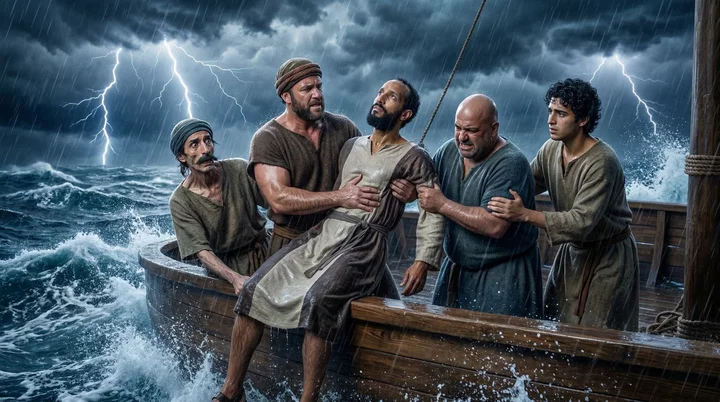
Then said they unto him, What shall we do unto thee, that the sea may be calm unto us? for the sea wrought, and was tempestuous.
Translations
Then said they to him, What shall we do to you, that the sea may be calm to us? for the sea worked, and was tempestuous.
King James Version, KJV Cambridge Paragraph Bible
Then said they unto him, What shall we do unto thee, that the sea may be calm unto us? for the sea wrought, and was tempestuous.
Then said they to him, What shall we do to thee, that the sea may be calm to us? for the sea wrought, and was tempestuous.
Revised Version, American Standard Version
Then said they unto him, What shall we do unto thee, that the sea may be calm unto us? for the sea grew more and more tempestuous.
And they say unto him, 'What do we do to thee that the sea may cease from us, for the sea is more and more tempestuous?'
And they said unto him, What shall we do unto thee, that the sea may be calm unto us? for the sea grew more and more tempestuous.
Then said they unto him, What shall we de to thee, that the sea may cease raging over us? For, the sea, was raging more and more.
Berean Standard Bible, Majority Standard Bible
Now the sea was growing worse and worse, so they said to Jonah, “ What must we do to you to calm this sea for us?”
Then they said to him, “ What shall we do to you, that the sea may be calm to us?” For the sea grew more and more stormy.
And they said to him, What are we to do to you so that the sea may become calm for us? For the sea was getting rougher and rougher.
Then saide they vnto him, What shall we doe vnto thee, that the sea may be calme vnto vs? (for the sea wrought and was troublous)
Douay-Rheims (Challoner revision)
And they said to him: What shall we do to thee, that the sea may be calm to us? for the sea flowed and swelled.
Pictures
Cross-references
- Jonah 1:15
So they took up Jonah, and cast him forth into the sea: and the sea ceased from her raging.
The sailors cast Jonah into the sea, and the storm ceases.
- Jonah 1:4
But the LORD sent out a great wind into the sea, and there was a mighty tempest in the sea, so that the ship was like to be broken.
The divinely sent storm threatens the ship and prompts the question.
- Jonah 1:7
And they said every one to his fellow, Come, and let us cast lots, that we may know for whose cause this evil is upon us. So they cast lots, and the lot fell upon Jonah.
Casting lots exposes Jonah as the cause of the calamity.
- Jonah 1:5
Then the mariners were afraid, and cried every man unto his god, and cast forth the wares that were in the ship into the sea, to lighten it of them. But Jonah was gone down into the sides of the ship; and he lay, and was fast asleep.
The sailors’ fear and jettisoned cargo precede their question.
- Matthew 8:24-27
And, behold, there arose a great tempest in the sea, insomuch that the ship was covered with the waves: but he was asleep.
Both describe sudden storms at sea and the sea becoming calm.
- Jonah 1:6
So the shipmaster came to him, and said unto him, What meanest thou, O sleeper? arise, call upon thy God, if so be that God will think upon us, that we perish not.
captain wakes Jonah to call on his God
- Jonah 2:6
I went down to the bottoms of the mountains; the earth with her bars was about me for ever: yet hast thou brought up my life from corruption, O LORD my God.
Jonah describes descending to the depths before being delivered.
Commentary
Each commentary is drawn from primary sources: the writings of Ellen G. White and Adventist pioneers and periodicals. Each commentary is separate. Its own words are not a quotation; follow the references to read the source passages.
Ellen G. White
3 sources
The violence of the storm drove those aboard to search out the reason for the peril threatening them.PK 267.3–268.4 Their inquiry to Jonah came only after they had found out that he was running away from the Lord.RH Dec 4, 1913 Even then the sea kept working and growing more tempestuous, and it was because that raging continued that they pressed him for an answer.RH Dec 4, 1913RH Dec 4, 1913
They turned directly to Jonah himself to learn what ought to be done to him in order that the sea might grow calm on their behalf.RH Dec 4, 1913RH Dec 4, 1913PK 267.3–268.4 In reply he told them to lift him up and hurl him into the sea, assuring them that the sea would then become calm.RH Dec 4, 1913RH Dec 4, 1913PK 267.3–268.4 Once he was cast in, the sea stopped its raging.RH Dec 4, 1913
Sources
Pioneers and periodicals
19 sources
The sailors ask Jonah what they should do to him so that the sea, still raging and growing more tempestuous, may become calm for them, because they believe the storm has come through someone's wrongdoing and the lot has fallen on him.RH Dec 4, 1913RH Dec 4, 1913STST Mar 23, 1904ST Feb 2, 1915 They press the question upon him after learning he is fleeing from the presence of the Lord toward Tarshish, away from the warning to Nineveh he was commanded to carry, and they crowd anxiously trembling around him for direction.RH Dec 4, 1913ST Mar 18, 1913 He acknowledges he is at fault and tells them to cast him overboard, facing what looks like certain death bravely and nobly, and when they do the raging sea ceases.RH Dec 4, 1913ST Sep 9, 1913ST Though he had refused God's command and run away, he did not deny Him, and in coming forward to take the blame his heart proved true toward God, who looked on his inward motives and preserved His servant alive from the depths of the raging sea.RH Mar 28, 1865ST Feb 4, 1903ST Aug 27, 1896 His being swallowed by the fish and cast out again alive is a true miracle to be believed, revealing a God altogether unlike man who alone can save, while his flight stands as a warning that to choose one's own course instead of obeying God brings trouble and overboard at last, and that difficulties in the post assigned by providence are to be manfully met rather than fled.RH Dec 3, 1867RH Feb 10, 1903ST May 6, 1897RH Jan 27, 1874
Storm and Sailors' Question
The sailors ask Jonah what they should do to him so that the storm-tossed sea may become calm for them, because the sea is still raging and growing more tempestuous around them.RH Dec 4, 1913RH Dec 4, 1913STST Dec 11, 1901 They put the question to him because they recognize his connection to the danger, believing the storm has come because of someone's wrongdoing.ST Mar 23, 1904ST Feb 2, 1915ST Sep 3, 1896 They have prayed and cast lots to find who is responsible for the peril threatening their lives, and the lot has fallen on Jonah.ST Mar 23, 1904ST Feb 2, 1915 In this way they seek his direction about ending the danger that has come upon them on his account.ST Mar 23, 1904ST Feb 2, 1915ST Sep 3, 1896
Their question comes after they discover he is fleeing from the Lord.RH Dec 4, 1913 He has confessed that he took ship to flee from the presence of the God of Israel, who had commanded him to carry a warning message to Nineveh, while he sailed in the opposite direction toward Tarshish.ST Mar 18, 1913 The rough sailors anxiously crowd around trembling Jonah and seek what should be done to him so the raging sea will become calm again.ST Mar 18, 1913
He is Jonah the son of Amittai, a prophet of God, tested in the storm at sea after he refused to obey God and go to Nineveh.ST Sep 9, 1913 His name means dove though his disposition was fiery, and he had predicted to Jeroboam II his victories over the Assyrians.ST Dec 15, 1909 God had given him the hard mission to go to a strange people in Nineveh, the greatest city on earth at that time, and rebuke them for their sins, which he petulantly refused in a time of trial involving great moral principles.ST Dec 15, 1909ST Feb 4, 1903
The tempest is the mighty tempest off the coast of Joppa during his flight, when the Lord sent a great wind upon the sea.RH Aug 29, 1871 Tempests of that kind still arise there today, and like the Dead Sea and the sudden storms of wind on the Sea of Galilee the sea at Joppa booms forth its testimony to divine truth.RH Aug 29, 1871 Jonah acknowledges he is at fault and tells them to cast him overboard, facing what to him means certain death bravely and nobly.RH Dec 4, 1913ST Sep 9, 1913STST Feb 4, 1903 They then throw him overboard and the raging sea ceases its raging.RH Dec 4, 1913 Their effort to save him shows the impression his willingness to accept blame and face the consequences made on them.ST Dec 11, 1901
Character, Miracle and Warning
Though Jonah had petulantly refused God's command to go to Nineveh and sought to run away from God, he did not deny Him in the time of trial where great moral principles were involved.ST Feb 4, 1903 When the ship was imperiled on his account he came forward nobly, acknowledged his fault, and told the shipmen to cast him overboard to calm the sea, facing what to him meant certain death bravely.ST Feb 4, 1903 This coming forward to take the blame proves his heart was true and perfect toward God, who looks on the heart and knows inward motives and showed Himself strong on his behalf.ST Feb 4, 1903 He was thus preserved as God's servant from the danger of the raging sea in its depths.ST Feb 4, 1903ST Aug 27, 1896
The tempestuous sea into which he was cast belongs to the account of his descent into sheol, for while inside the great fish in the whale's belly he had descended into the depths of the sea, a place associated with the realm of the dead beneath the earth.RH Mar 28, 1865 He was truly cast into the sea and truly taken into the whale's belly when the sea was tempestuous.RH Jan 10, 1871 Into means inside, not close by or near to, for he was put inside the great fish, not left outside to swim onto its back and ride ashore.RH Jan 10, 1871
It is part of the true, miraculous narrative in which Jonah was swallowed by a fish and cast out again alive, which is to be believed.RH Feb 10, 1903ST May 6, 1897 To dismiss it as absurd and idiotic puts man himself on the throne as possessing all needful knowledge and wisdom, exalting self and not God, which is heathenism and false religion.ST May 6, 1897 That miracle reveals a God altogether unlike man, and it must be believed because only a God who can perform miracles can save.RH Feb 10, 1903 There can be no salvation without a miracle, for no miracle is greater than the miracle of the new birth, and every true prayer for salvation is a prayer for God to perform a miracle.RH Feb 10, 1903
It is also part of Jonah's experiment in trying to escape trouble by running away from duty on a self-chosen course, an attempt that brought him into trouble and into the raging sea and overboard, where all who imitate him will in the end find themselves.RH Dec 3, 1867RH Jan 27, 1874 His experience shows the danger of choosing one's own way instead of obeying God, whereas when he afterward followed God's direction he went to Nineveh on a mission of love.RH Jan 27, 1874 The lesson is to manfully meet and overcome the difficulties and trials to which the post assigned by God's providence exposes a person instead of fleeing them.RH Dec 3, 1867
Sources