Leviticus 19:36
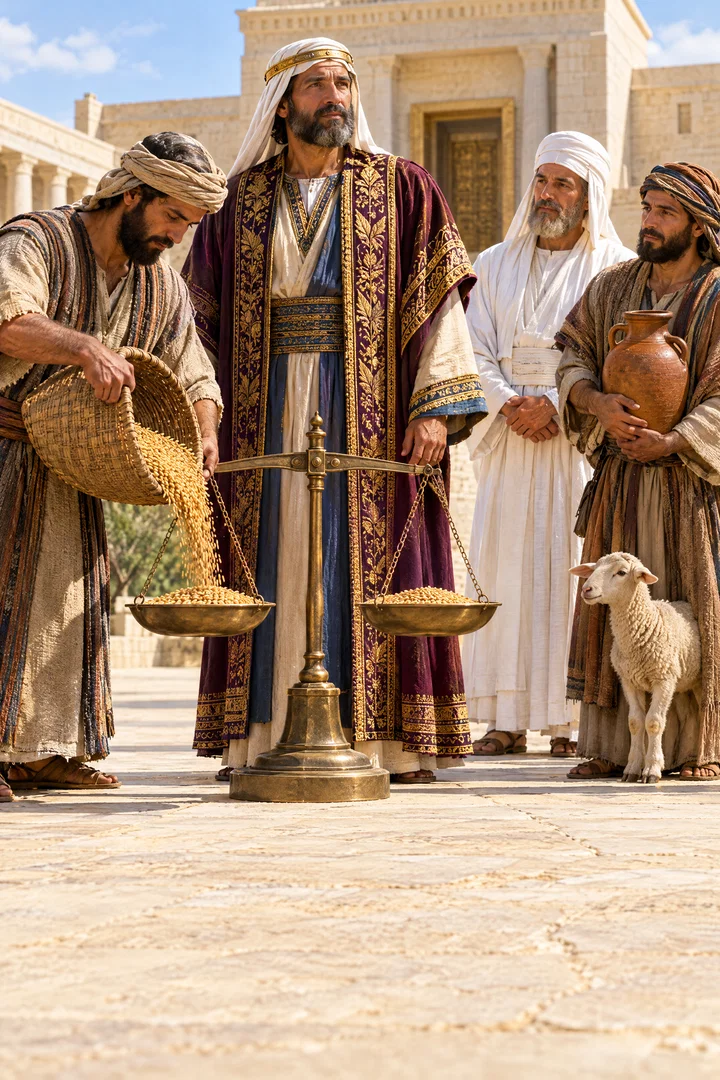
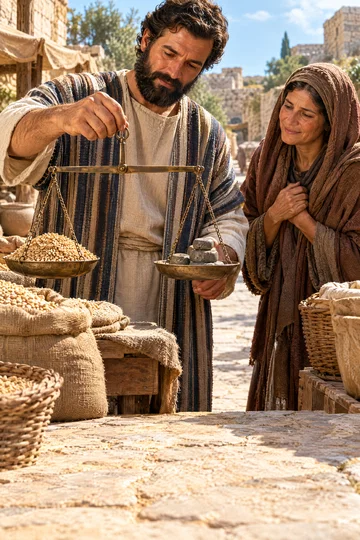
Just balances, just weights, a just ephah, and a just hin, shall ye have: I am the LORD your God, which brought you out of the land of Egypt.
Translations
Just balances, just weights, a just ephah, and a just hin, shall you have: I am the LORD your God, which brought you out of the land of Egypt.
King James Version, Revised Version
Just balances, just weights, a just ephah, and a just hin, shall ye have: I am the LORD your God, which brought you out of the land of Egypt.
Just balances, just weights, a just ephah, and a just hin, shall ye have: I am the Lord your God, which brought you out of the land of Egypt.
Just balances, just weights, a just ephah, and a just hin shall ye have: I am the LORD your God, who brought you out of the land of Egypt.
Just balances, just weights, a just ephah, and a just hin, shall ye have: I am Jehovah your God, who brought you out of the land of Egypt.
righteous balances, righteous weights, a righteous ephah, and a righteous hin ye have; I [am] Jehovah your God, who hath brought you out from the land of Egypt;
just balances, just weights, a just ephah, and a just hin shall ye have: I am Jehovah your God, who brought you out of the land of Egypt.
Just balances, just weights, a just ephah and a just hin, shall ye have,—I—Yahweh, am your God, who brought you forth out of the land of Egypt.
Berean Standard Bible, Majority Standard Bible
You shall maintain honest scales and weights, an honest ephah, and an honest hin. I am the LORD your God, who brought you out of the land of Egypt.
You shall have just balances, just weights, a just ephah, and a just hin. I am the LORD your God, who brought you out of the land of Egypt.
Have true scales, true weights and measures for all things: I am the Lord your God, who took you out of the land of Egypt;
You shall haue iust ballances, true weightes, a true Ephah, and a true Hin. I am the Lord your God, which haue brought you out of the lande of Egypt.
Douay-Rheims (Challoner revision)
Let the balance be just and the weights equal, the bushel just, and the sextary equal. I am the Lord your God, that brought you out of the land of Egypt.
Pictures
Cross-references
- Deuteronomy 24:17-18
Thou shalt not pervert the judgment of the stranger, nor of the fatherless; nor take a widow’s raiment to pledge:
Justice toward others is linked to Israel’s deliverance from Egypt.
- Deuteronomy 25:13-16
Thou shalt not have in thy bag divers weights, a great and a small.
Both command just weights and measures and forbid dishonest ones.
- Proverbs 20:23
Divers weights are an abomination unto the LORD; and a false balance is not good.
Both condemn dishonest weights as an abomination.
- Deuteronomy 5:15
And remember that thou wast a servant in the land of Egypt, and that the LORD thy God brought thee out thence through a mighty hand and by a stretched out arm: therefore the LORD thy God commanded thee to keep the sabbath day.
Both commandments ground their obligation in Israel’s deliverance from Egypt.
- Proverbs 11:1
A false balance is abomination to the LORD: but a just weight is his delight.
Condemns a false balance and commends a just weight.
- Amos 8:5
Saying, When will the new moon be gone, that we may sell corn? and the sabbath, that we may set forth wheat, making the ephah small, and the shekel great, and falsifying the balances by deceit?
Condemns shrinking measures and falsifying weights for profit.
- Leviticus 19:13-18
Thou shalt not defraud thy neighbour, neither rob him: the wages of him that is hired shall not abide with thee all night until the morning.
Both forbid defrauding a neighbor in business and uphold fair treatment.
- Leviticus 19:11
Ye shall not steal, neither deal falsely, neither lie one to another.
Both forbid stealing, false dealing, and lying.
- Ezekiel 45:10
Ye shall have just balances, and a just ephah, and a just bath.
repeats the same command not to falsify measure
- Deuteronomy 25:15
But thou shalt have a perfect and just weight, a perfect and just measure shalt thou have: that thy days may be lengthened in the land which the LORD thy God giveth thee.
Just weights and measures are linked to prolonged days.
- Exodus 20:2
I am the LORD thy God, which have brought thee out of the land of Egypt, out of the house of bondage.
Both identify the Lord as the one who brought Israel out of Egypt.
- Leviticus 11:45
For I am the LORD that bringeth you up out of the land of Egypt, to be your God: ye shall therefore be holy, for I am holy.
Deliverance from Egypt grounds the call to holiness.
- Deuteronomy 15:15
And thou shalt remember that thou wast a bondman in the land of Egypt, and the LORD thy God redeemed thee: therefore I command thee this thing to day.
Israel’s deliverance from Egypt is given as a reason to obey God.
Commentary
Each commentary is drawn from primary sources: the writings of Ellen G. White and Adventist pioneers and periodicals. Each commentary is separate. Its own words are not a quotation; follow the references to read the source passages.
Ellen G. White
12 sources
Just balances, just weights, a just ephah and a just hin are commanded, forbidding all unrighteousness in judgment, in length, in weight and in measure, so that every weighing and measuring in trade is accurate and fair with no cheating by false or differing measures.Ms 60, 1902, par. 36Ms 86, 1905, par. 9–14Lt 41a, 1888, par. 8–11Ms 115, 1905, par. 12–13MH 188.1 The command rests on the authority of the speaker as the LORD God who brought Israel out of the land of Egypt, and therefore requires observance and doing of all His statutes and judgments governing how people treat one another.Ms 60, 1902, par. 36Ms 86, 1905, par. 9–14Lt 41a, 1888, par. 8–11Ms 115, 1905, par. 12–1313MR 234.2–5 Fair dealing is presented as part of keeping those statutes, with honest measures and weights grounded in the Lord's deliverance of Israel from Egypt.Ms 26, 1896, par. 9
The chapter gives a lesson for future generations, with Christ Himself speaking the same high standard found in His New Testament teachings.Lt 42, 1894, par. 16–19 Just dealing belongs to keeping His commandments for good, fearing God, loving Him with all heart and soul, loving the neighbor as self, and being holy as God is holy.Lt 4, 1895, par. 16–1918MR 87.3–4
The verse means strict, unimpeachable honesty in every business transaction and in making money, especially in buying and selling real estate, with no stealing, false dealing, lying to one another, defrauding a neighbor, taking advantage of occasions and circumstances, exaggerating benefits, hiding defects to make a sale, or using differing weights to deceive for gain.Lt 41a, 1888, par. 8–1113MR 234.2–5Lt 41, 1888, par. 7–11 In real estate this forbids setting forth the benefits of property in a strong light, praising it extravagantly, keeping back unfavorable facts, or asserting that it will rise or double in value to deceive the purchaser.Lt 41, 1888, par. 7–11 That false dealing marks nearly all real estate buying and selling and must be cut loose from before one can be considered a healthy branch of the church.Lt 41, 1888, par. 7–11
Business must be done on principles of justice and equity without partiality, hypocrisy, fraud or oppression, especially in relieving the poor brother, the stranger and sojourner, taking no usury or increase, not ruling with rigor, and paying what is due.Lt 4, 1895, par. 16–19 Oppression of the poor is actual robbery, an abhorred practice heaven marks that God will in no case tolerate and condemns whenever manifested by whoever and in whatever business, even when not punishable by human courts except in extreme cases.Lt 4, 1895, par. 16–19 Wherever schemes withhold money from those to whom it is due or deprive any person of right, God's disapproval rests, because He regards not persons nor takes rewards but executes judgment for the fatherless and widow and loves the stranger.Lt 4, 1895, par. 16–19
Just dealing belongs to God's instruction to remember that His gifts are to be shared, leaving the gleanings of harvest-field, orchard and vineyard as the Lord's portion to relieve the necessities of the poor and the stranger, with fairness in trade and no oppression of brethren in any way.18MR 87.3–4 The requirement of just weights and honest measure applies in every line of work and every business transaction, forbidding all unfair dealing, and means doing to others as one would be done by and carrying out the principles of Christ.16MR 186.1 Those professing present truth must still carry out what was given through Moses to Israel, as representatives of truth and righteousness and as sons and daughters of God living the Christ-life.16MR 186.1
Sources
Pioneers and periodicals
38 sources
Leviticus 19:36 commands honest and exact balances, weights and measures in all buying and selling, giving full fair quantity without short weight, false measure, adulterated goods or deceit about quality or kind.ST May 3, 1910RH Dec 6, 1864ST Oct 25, 1899ST Mar 9, 1888 It requires justice, mercy and compassion toward the neighbor, treating him as one would wish to be treated, which forbids tricks of trade, taking unfair advantage, failing to repay debts as promised, and all sharp dealing in work, business and home life.ST Mar 31, 1914ST Mar 23, 1882RH Jun 12, 1855ST May 20, 1908RH Jun 24, 1873 This duty of honest weights and measures belongs to the moral law binding from creation and always binding, obligating Jew and Gentile alike and not only Israel.ST Oct 14, 1889ST Nov 4, 1889ST Apr 30, 1894RH Jul 30, 1861ST Dec 27, 1905 Israel's deliverance from Egypt did not create the duty or limit it to those delivered, but gave the redeemed people an added reason for gratitude and obedience and renewed obligation to keep what was already in force.ST Oct 14, 1889ST Aug 13, 1885RH Sep 24, 1872ST Nov 4, 1889ST Jun 26, 1893 By the same reasoning, the Sabbath's connection with the Exodus does not make the Exodus its origin or foundation, for its institution rests on God's creation work, and duties urged in view of the deliverance are not proved to be merely ceremonial, Jewish-only, or memorials of the Exodus.ST May 28, 1885ST May 31, 1905RH Aug 6, 1872ST Jun 14, 1877
Terms and Historical Setting
The ephah was the common Jewish measure of quantity, holding about one bushel or thirty-five litres.ST May 24, 1883 The ephah and the hin named in the command were measures of capacity.ST Mar 13, 1893 The ephah held seven gallons and five pints and the hin held one gallon and two pints.ST Mar 13, 1893
The chapter belongs to the law given at Sinai, spoken less than one year after Israel left Egypt and before Israel left Sinai.RH Aug 2, 1870 It is not a later law given nearly forty years afterward distinct from that given at Sinai.RH Aug 2, 1870 The command requires just weights and just measures in all business, with prolonged days on the land God gave for obedience.ST May 24, 1883 Breaking it by making the ephah small for selling and making the shekel great for receiving pay is covetousness and double fraud in every transaction, and this was the condition of prophet, priest, and common people when they were about to be carried to Babylon.ST May 24, 1883
Justice Commanded in Trade
The command is for justice in weights and righteousness in judgment, forbidding all unrighteousness in judgment in yard, in weight, or in measure, and requiring just balances, just weights, a just ephah and a just hin, together with observance of all statutes and judgments.ST Apr 7, 1914ST Jun 14, 1877 It belongs to duty toward fellow men, demanding justice, mercy and compassion that considers the trying, unfortunate position of the neighbor and treats him as one would wish to be treated in his place, which is loving the neighbor as oneself and doing to others whatever one would have them do.ST Mar 31, 1914
Trade must therefore employ honest, accurate balances, weights and measures, giving full, fair measure and weighing goods accurately, while skimping in weight or measure or otherwise cheating in buying and selling breaks the command.ST May 3, 1910ST Mar 9, 1888RH Sep 25, 1860 That standard rules out giving short weight when selling and taking excess when buying, and condemns short measure, adulterated goods, false quantities, selling inferior materials as though better, and misleading customers about width, quality, quantity or kind.ST May 3, 1910RH Dec 6, 1864ST Oct 25, 1899ST Mar 23, 1882RH Jun 24, 1873 The same honesty treats failure to repay a debt as promised as dishonesty.RH Jun 24, 1873ST Jul 23, 1874 It forbids tricks of trade and taking unfair advantage, requiring Christians to act as examples of fairness in every business transaction.RH Jun 12, 1855
The rule reaches ordinary work and dealings such as counting yarn, measuring goods, and weighing or packing produce, and even small sales such as milk or butter.ST Feb 15, 1899RH Sep 25, 1860 It extends to home life as a ban on sharp dealing, deceit, extortion and injustice, where having Christ as Master means acting honestly in business and daily conduct.ST May 20, 1908 Honesty must thus govern both what is sold and the work undertaken.ST Mar 23, 1882 Giving more than the required measure exemplifies upright dealing, since life allows only one journey and one cannot return to correct mistakes.ST Jun 5, 1884 Fairness matters even in ordinary dealings because no dishonesty must be carried into the judgment before God.
Honest conduct of this kind is a fruit of repentance, and correcting small dishonest practices can ease troubles that empty expressions of sorrow do not.ST Feb 15, 1899
Universal Moral Obligation
The demand for honest weights and measures belongs to the moral law, binding from creation and always binding, not created by the deliverance from Egypt or limited to those delivered.ST Oct 14, 1889 Though set within Israel's national code, just measures belong to enduring moral principles inseparably related to primary law and remain binding beyond the temporary circumstances of that code.ST Oct 14, 1889RH Jul 30, 1861
The chapter exemplifies laws that governed Israel according to God's moral standard, including commands for just measures and weights, set alongside special rules addressing customs that could not immediately be corrected.ST May 20, 1875 In this way moral principles could be given in the law as if they were positive or circumstantial duties.RH May 6, 1873ST May 20, 1875 Honest measures and weights belong with the commandments against coveting, showing that these moral requirements applied to the nations as well as Israel.ST Dec 27, 1905 Everyone, Jew and Gentile, is obligated to act justly in judgment and in measures and weights, and the moral instruction can be followed by people who are not ethnic Israelites.ST Nov 4, 1889ST Apr 30, 1894 Deliverance from Egypt is an appeal to gratitude for obedience, not a reason limiting justice to Israel nor a memorial limiting the duty to them.ST Nov 4, 1889ST Apr 30, 1894 The accompanying therefore places the moral obligation on a concrete, legal basis for Israel without making the obligation commemorative.RH Oct 29, 1872
Exodus Motive Not Origin
The demand for honest weights and measures was not created by Israel's deliverance from Egypt nor limited to those delivered, but belonged to the moral law binding from creation and always binding, with the deliverance giving the liberated people an added reason for gratitude and obedience which explains the therefore and the appeal to the Lord who brought them out.ST Oct 14, 1889RH Sep 24, 1872ST Nov 4, 1889RH May 13, 1873ST Jun 14, 1877 That reason for enforcing the command does not mean honesty and righteousness became obligatory only after the exodus or only for Israel, for everyone Jew and Gentile is obligated to act justly in judgment and in measures and weights.RH Sep 24, 1872ST Nov 4, 1889RH May 13, 1873ST Jun 14, 1877ST Mar 23, 1915 The reminder that God brought Israel out urges obedience and appeals to gratitude for freedom, not proof that the duty to deal justly began then or was meant only for Israel or only for those delivered to become holy.ST Nov 4, 1889RH May 13, 1873ST Jun 14, 1877ST Mar 23, 1915 Applying the opposite logic would wrongly make every moral duty dependent on Israel's deliverance.RH Sep 24, 1872
The appeal to the exodus does not mean God's statutes apply only to those who were delivered from Egypt, otherwise people outside Israel could dismiss them for the same reason.RH Jul 2, 1861RH Sep 24, 1872 The exodus does not make those duties new or merely ceremonial, but gives reason to renew and enforce obligations already in force.ST Aug 13, 1885ST Jun 26, 1893ST May 28, 1885 Being redeemed placed Israel under renewed obligation to keep all His requirements, since they could not observe them under their former servitude, so deliverance is a local reason for obedience and for enforcing the duties, not the foundation of the requirements.ST Aug 13, 1885ST Jun 26, 1893ST May 28, 1885
Using deliverance from Egyptian bondage as a motive does not make the command itself begin there or belong only to Israel, so honesty in business and justice in judgment did not begin at the Exodus but were binding before it.ST Jan 17, 1884 This establishes the pattern by which a universal obligation of honest balances, weights and measures can be urged with a particular history and local reason for enforcement.ST Jan 17, 1884 The reference to the Exodus does not make honest dealing merely a memorial of that deliverance, for the duties existed before the deliverance and a command can be grounded in God's rescue without being only a memorial.RH Mar 1, 1864ST May 31, 1905 The following call to observe all God's statutes and judgments makes the same point about the law generally, that duties urged in view of deliverance from Egypt are not thereby made memorials of the Exodus.RH Mar 1, 1864ST May 31, 1905
Sabbath and Law Confirmed
The command for honest balances, weights, ephah and hin is joined to divine authority as the Lord who brought Israel out of Egypt and to the call to observe all His statutes and judgments, showing the same point about the law generally as part of keeping all of His statutes.RH Jul 2, 1861RH Mar 1, 1864ST May 28, 1885 The appeal to the exodus does not confine the statutes to those who were delivered, for otherwise those outside Israel could dismiss them on the same ground.RH Jul 2, 1861 A command can be grounded in God's rescue of Israel without being only a memorial of that deliverance.RH Mar 1, 1864 Israel's deliverance is given as a local reason for enforcing duties that could not be observed under former servitude, not as the foundation of the requirements.ST May 28, 1885 The duty is grounded in the Lord's authority and His deliverance, requiring fair balances, weights and measures and full weight and measure in everyday dealings, even in small sales such as milk or butter.RH Sep 25, 1860
By the same reasoning the Sabbath's connection with the Exodus does not make the Exodus its origin or foundation, just as honesty in business did not begin at the Exodus.ST May 28, 1885 Deliverance from Egypt is the motive given for commanding the duty, not the origin of the duty itself, so honest dealing was not binding only on those brought out, just as the Sabbath command given with the same motive did not originate in the Exodus. Local reasons for enforcing duties such as keeping just measures and weights do not establish the Sabbath or explain why the seventh day was made holy.RH Aug 6, 1872 The Sabbath's institution rests on God's creation work, not on a later local command or circumstance.RH Aug 6, 1872
The reminder that God brought Israel out of Egypt appeals to gratitude for deliverance and does not show that these commandments were given only for Israel or only because of the Exodus.ST Jun 14, 1877 The same appeal accompanies the duty to keep the Sabbath and other commandments.ST Jun 14, 1877 The verse stands among duties God urged Israel to keep in view of their deliverance from Egypt, and that appeal does not make honest measures or the other duties named alongside it memorials of the Exodus, since they existed before the deliverance.ST May 31, 1905 Duties urged in view of the deliverance are therefore not proved to be merely ceremonial, Jewish-only, or memorials of the Exodus.ST May 31, 1905ST Jun 14, 1877
Sources