Leviticus 23:27
Also on the tenth day of this seventh month there shall be a day of atonement: it shall be an holy convocation unto you; and ye shall afflict your souls, and offer an offering made by fire unto the LORD.
Translations
Also on the tenth day of this seventh month there shall be a day of atonement: it shall be an holy convocation to you; and you shall afflict your souls, and offer an offering made by fire to the LORD.
Also on the tenth day of this seventh month there shall be a day of atonement: it shall be an holy convocation unto you; and ye shall afflict your souls, and offer an offering made by fire unto the LORD.
Also on the tenth day of this seventh month there shall be a day of atonement: it shall be a holy convocation unto you; and ye shall afflict your souls, and offer an offering made by fire unto the Lord.
Also on the tenth day of this seventh month there shall be a day of atonement; it shall be a holy convocation to you, and ye shall afflict your souls, and offer an offering made by fire to the LORD.
Howbeit on the tenth day of this seventh month is the day of atonement: it shall be an holy convocation unto you, and ye shall afflict your souls; and ye shall offer an offering made by fire unto the LORD.
Howbeit on the tenth day of this seventh month is the day of atonement: it shall be a holy convocation unto you, and ye shall afflict your souls; and ye shall offer an offering made by fire unto Jehovah.
'Only — on the tenth of this seventh month is a day of atonements; ye have a holy convocation, and ye have humbled yourselves, and have brought near a fire-offering to Jehovah;
Also on the tenth of this seventh month is the day of the atonement: a holy convocation shall it be unto you; and ye shall afflict your souls, and present an offering by fire to Jehovah.
Surely on the tenth of this seventh month, is, the Day of Propitiation, a holy convocation, shall it be to you, therefore shall ye humble your souls,—and bring near an altar-flame unto Yahweh.
“ The tenth day of this seventh month is the Day of Atonement. You shall hold a sacred assembly and humble yourselves, and present an offering made by fire to the LORD.
“ The tenth day of this seventh month is the Day of Atonement. You shall hold a sacred assembly and humble yourselves, and present a food offering to the LORD.
“However on the tenth day of this seventh month is the day of atonement. It shall be a holy convocation to you. You shall afflict yourselves and you shall offer an offering made by fire to the LORD.
The tenth day of this seventh month is the day for the taking away of sin; let it be a holy day of worship; you are to keep from pleasure, and give to the Lord an offering made by fire.
The tenth also of this seuenth moneth shalbe a day of reconciliation: it shalbe an holie conuocation vnto you, and yee shall humble your soules, and offer sacrifice made by fire vnto the Lord.
Douay-Rheims (Challoner revision)
Upon the tenth day of this seventh month shall be the day of atonement, it shall be most solemn, and shall be called holy: and you shall afflict your souls on that day, and shall offer a holocaust to the Lord.
Pictures
Cross-references 20 of 59
- Colossians 2:16-17
Let no man therefore judge you in meat, or in drink, or in respect of an holyday, or of the new moon, or of the sabbath days:
The Day of Atonement is an annual observance whose shadow finds its substance in Christ.
- Leviticus 16:29-30
And this shall be a statute for ever unto you: that in the seventh month, on the tenth day of the month, ye shall afflict your souls, and do no work at all, whether it be one of your own country, or a stranger that sojourneth among you:
Describes the Day of Atonement and the people’s required response.
- Hebrews 9:23-28
It was therefore necessary that the patterns of things in the heavens should be purified with these; but the heavenly things themselves with better sacrifices than these.
Christ’s once-for-all sacrifice and heavenly ministry fulfill the Day of Atonement.
- Hebrews 9:7
But into the second went the high priest alone once every year, not without blood, which he offered for himself, and for the errors of the people:
The high priest entered the inner sanctuary once a year with blood.
- Leviticus 16:21-22
And Aaron shall lay both his hands upon the head of the live goat, and confess over him all the iniquities of the children of Israel, and all their transgressions in all their sins, putting them upon the head of the goat, and shall send him away by the hand of a fit man into the wilderness:
Israel’s sins are confessed over the scapegoat, which carries them away.
- Leviticus 23:38
Beside the sabbaths of the LORD, and beside your gifts, and beside all your vows, and beside all your freewill offerings, which ye give unto the LORD.
Distinguishes the appointed feast observances from the Lord’s Sabbaths.
- Leviticus 23:32
It shall be unto you a sabbath of rest, and ye shall afflict your souls: in the ninth day of the month at even, from even unto even, shall ye celebrate your sabbath.
Defines the Day of Atonement as a Sabbath of rest observed from evening to evening.
- Hebrews 10:1-3
For the law having a shadow of good things to come, and not the very image of the things, can never with those sacrifices which they offered year by year continually make the comers thereunto perfect.
Yearly sacrifices remembered sins but were only a shadow, not their final removal.
- Numbers 29:7-11
And ye shall have on the tenth day of this seventh month an holy convocation; and ye shall afflict your souls: ye shall not do any work therein:
It commands afflicting the soul and lists additional offerings for the tenth day.
- Leviticus 16:7-10
And he shall take the two goats, and present them before the LORD at the door of the tabernacle of the congregation.
Describes the two-goat ritual commanded for the Day of Atonement.
- Hebrews 9:23
It was therefore necessary that the patterns of things in the heavens should be purified with these; but the heavenly things themselves with better sacrifices than these.
The heavenly sanctuary’s cleansing fulfills the earthly atonement pattern.
- Leviticus 16:15-16
Then shall he kill the goat of the sin offering, that is for the people, and bring his blood within the vail, and do with that blood as he did with the blood of the bullock, and sprinkle it upon the mercy seat, and before the mercy seat:
The priest uses the goat’s blood to make atonement and cleanse the sanctuary.
- Hebrews 8:1-5
Now of the things which we have spoken this is the sum: We have such an high priest, who is set on the right hand of the throne of the Majesty in the heavens;
Earthly priestly service is a pattern of Christ’s heavenly ministry.
- Hebrews 9:9-10
Which was a figure for the time then present, in which were offered both gifts and sacrifices, that could not make him that did the service perfect, as pertaining to the conscience;
The Day of Atonement belongs to the temporary ceremonial ordinances, which could not perfect the conscience.
- Hebrews 9:11-12
But Christ being come an high priest of good things to come, by a greater and more perfect tabernacle, not made with hands, that is to say, not of this building;
Christ’s once-for-all priestly work fulfills the Day of Atonement service.
- Leviticus 23:3
Six days shall work be done: but the seventh day is the sabbath of rest, an holy convocation; ye shall do no work therein: it is the sabbath of the LORD in all your dwellings.
Contrasts the weekly Sabbath with the appointed annual Sabbaths.
- Colossians 2:17
Which are a shadow of things to come; but the body is of Christ.
The annual ceremonial Sabbath is a shadow of things to come, with Christ as its reality.
- Leviticus 16:29
And this shall be a statute for ever unto you: that in the seventh month, on the tenth day of the month, ye shall afflict your souls, and do no work at all, whether it be one of your own country, or a stranger that sojourneth among you:
Both require the people to afflict their souls on the Day of Atonement.
- Hebrews 10:3
But in those sacrifices there is a remembrance again made of sins every year.
The yearly sacrifices brought sins to remembrance.
- Hebrews 9:25-26
Nor yet that he should offer himself often, as the high priest entereth into the holy place every year with blood of others;
Christ’s once-for-all sacrifice contrasts with the yearly sanctuary offerings.
Commentary part 1 of 2
Each commentary is drawn from primary sources: the writings of Ellen G. White and Adventist pioneers and periodicals. Each commentary is separate. Its own words are not a quotation; follow the references to read the source passages.
Ellen G. White
24 sources
Also on the tenth day of the seventh month God appointed the yearly Day of Atonement, an autumnal service of the sanctuary.LS 110.2Ms 187, 1905, par. 31GW92 436.2 It was to be a holy convocation, with all Israel laying aside common work to gather in solemn humiliation, prayer, fasting and searching of heart.GC 430.2–34SP 270.1RH Nov 8, 1915 To afflict the soul was to humble oneself before God in remembrance of sin, with confession, repentance, seeking of pardon and reverent keeping of every part of the service, while whoever refused was to be cut off from the people.GC 430.2–315MR 21.44SP 270.1HSFM 213.2–3 That service was a type of the work of Christ as High Priest, fulfilled when at the close of the 2300 days in 1844 He entered the most holy place of the heavenly sanctuary to make a special atonement and cleanse it by His own blood, which is the investigative judgment now in progress when every case is decided and confessed and repented sins are blotted out.ST May 17, 1883GC 430.2–3LS 110.24SP 270.1 Its call to afflict the soul therefore rests upon the living today, requiring individual and thorough heart-searching, confession and forsaking of sins, humbling of self, reconciliation between brethren, and earnest seeking of God in order to stand in the judgment and be saved.ST May 17, 188315MR 21.4Lt 37, 1887, par. 8–11HSFM 213.2–3STB 58.3
The Appointed Service
The tenth day of the seventh month is appointed as the yearly Day of Atonement, an autumnal service.LS 110.2Ms 187, 1905, par. 31Ms 38, 1903, par. 475MR 97.3RH Dec 31, 1901 It was to be a holy convocation, a holy gathering and holy assembly of all Israel around the sanctuary.GC 430.2–3RH Nov 8, 1915Ms 187, 1905, par. 31GC88 419.3RH Dec 31, 1901 Ordinary business was to be set aside, and the day spent in solemn humiliation before God, with prayer, fasting, and deep searching of heart.GC 430.2–34SP 270.1RH Nov 8, 1915GC88 419.3 Every person was to humble himself while the work of atonement was taking place, seeking pardon for sins.GC 430.2–34SP 270.1RH Nov 8, 1915GC88 419.3
To afflict the soul meant to humble oneself before God, to remember sins, and to confess and repent of them.GC 430.2–315MR 21.44SP 270.1Lt 37, 1887, par. 8–11HSFM 213.2–3 It meant heart-searching and self-examination, humbling the heart, seeking pardon individually, and observing every part of the service with reverence.15MR 21.4Lt 37, 1887, par. 8–11HSFM 213.2–3RH Nov 8, 1915GW92 436.2 Anyone who refused on that day to humble himself and afflict his soul was to be cut off from the congregation and cut off from the people.GC 430.2–34SP 270.1HSFM 213.2–3 The ceremony impressed upon Israel that God is holy and abhors sin, and that contact with sin pollutes.RH Nov 8, 1915GC88 419.3 An offering made by fire was to be offered to the Lord.Ms 187, 1905, par. 31
The Heavenly Fulfillment
The autumnal service of the tenth day of the seventh month was a type of the work of Christ as High Priest, fulfilled when at the close of the 2300 days in 1844 He entered the most holy place of the heavenly sanctuary to make a special atonement and to cleanse it by His own blood.LS 110.2 Its antitype is the investigative judgment now in progress, when each person's case is judged according to deeds and a final decision is made.ST May 17, 1883GC 430.2–34SP 270.1 In that fulfillment confessed and repented sins are atoned for and blotted out while Christ ministers as the great High Priest, and understanding His work and the duties required is essential so that pardon is sought and none are cut off.ST May 17, 1883GC 430.2–34SP 270.1
The tenth day of the seventh month was at one time held to be the appointed day for the personal advent of Jesus in the clouds of heaven to deliver His people, expected within a few days as an awful moment to the unprepared and glorious to the ready.LS 97.2–100.25MR 97.3 The type pointed instead to entering the most holy place, not to coming out of heaven that day to bless the waiting people.LS 110.2 What was shown was rising from the mediatorial throne and going into the Most Holy Place as Bridegroom to receive the kingdom.5MR 97.3
As the type of the present atonement in heaven, the day with its holy convocation, humiliation, reverence, and careful observance of every part of the service calls those who minister in sacred things to be holy and to guard their lives from contamination.5MR 5.2Ms 3, 1885, par. 23 Its atonement is received by trusting the efficacy of the sacrifice, humbling the heart before God, repenting of sin, seeking pardon for sins and transgressions, and accepting justifying grace.Lt 22, 1892, par. 115MR 446.2–3 That justifying work is joined to the sanctifying work of the Holy Spirit in implanting a new nature, clothing the believer with righteousness, and transforming the carnal nature into holiness.Lt 22, 1892, par. 11
The Present Call
The call to afflict the soul belongs to the present, for the solemn hour of judgment is now and the great conflict is at hand.ST May 17, 188315MR 21.4Lt 37, 1887, par. 8–11GW92 436.2Ms 38, 1903, par. 47 While Christ as great High Priest ministers in the heavenly sanctuary, sins are to be atoned for and blotted out, and each person's case is judged according to deeds with a final decision made, so confession and repentance cannot be delayed.ST May 17, 1883 Each one is to humble the heart before God, seek pardon for sins and transgressions, confess and forsake them, take the proper spiritual position, and prepare to meet God's standard in order to be saved and to have a living experience with God.15MR 21.4Lt 37, 1887, par. 8–11Lt 22, 1892, par. 11Ms 38, 1903, par. 4715MR 81.2 Accepting justifying grace is joined to the sanctifying work of the Holy Spirit in implanting a new nature, clothing with righteousness, and transforming the carnal nature into holiness.Lt 22, 1892, par. 11 Confession of errors, repentance of sins, and praying for one another belong to this hour.GW92 436.2
The searching must be individual and thorough.HSFM 213.2–3STB 58.32T 124.1 Each person must examine the heart for sins that shut out Jesus, putting away every wrong, confessing even secret sins, and examining motives under God's searching eye.HSFM 213.2–32T 124.1 This is done with entire consecration and surrender to God, with self-abasement and seeking pardon individually before Him.HSFM 213.2–32T 124.1 Each is to confess his own sins and humble his own heart, rather than focus on what others should confess.STB 58.3
Wrongs between brothers and sisters are to be removed rather than allowed to remain, as part of examining the heart and preparing to meet God's standard.Ms 187, 1905, par. 31 Afflicting the soul means laboring and agonizing, feeling weakness, and zealously repenting while there is still opportunity, for it must be done now or there will be going down.Ms 1, 1857, par. 8 It is the way to obtain the gold, white raiment, and eyesalve that must be possessed for eternal life.Ms 1, 1857, par. 8
Afflicting the soul is abasing self and exalting Jesus, stirred by the sight of Calvary to love and good works.Ms 54, 1886, par. 19–20 It calls for giving God the whole heart and undivided affection, rising to a noble, elevated, sanctified standard, growing in grace, and seeking God most earnestly.Ms 54, 1886, par. 19–20 It is serving actively in God's strength rather than one's own, using every precious moment with none unemployed, and doing all work carefully to God's glory, because the great day of atonement is now present.Ms 54, 1886, par. 19–20 This preparation calls for self-humbling and mourning rather than strife, rivalry, seeking the highest place, contention, distraction, or confusion.15MR 21.415MR 81.2RH Dec 31, 1901
Sources
Pioneers and periodicals
227 sources
Also on the tenth day of the seventh month there shall be a day of atonement, a holy convocation on which the people are to afflict their souls and offer an offering made by fire to the Lord.LDT 35.1RH Oct 15, 1903ST Dec 13, 1905 It belongs to the yearly feasts and annual ceremonial sabbaths of the ceremonial law, distinct from the weekly Sabbath introduced earlier in the chapter.ST Jun 4, 1902ST Jun 10, 1886RH Dec 29, 1859 Its earthly service was the final closing work of the yearly round, when the high priest alone entered the most holy place once a year to cleanse the sanctuary of the sins transferred into it all year and to make reconciliation for all Israel.ST May 7, 1912ST Oct 25, 1905ST Jun 19, 1907ST Jan 17, 1884RH Jul 29, 1858 That day and its service are a type and prophecy of Christ's work as priest and sacrifice, fulfilled in His ministration in the most holy place of the heavenly sanctuary beginning October 22, 1844 at the close of the 2300 days.ST May 27, 1908ST Dec 13, 1905RH May 13, 1862ST Jun 17, 1903ST Jan 24, 1900 In the antitype God's people must now afflict the soul by fasting, humbling themselves, confessing every sin, praying and searching the heart while Christ ministers for the blotting out of sin in the investigative judgment.ST May 17, 1883RH Oct 10, 1912ST Apr 8, 1913
Date and Required Observance
Also on the tenth day of the seventh month there is the Day of Atonement, a holy convocation on which souls are to be afflicted and an offering made by fire presented to the Lord.LDT 35.1RH Oct 15, 1903ST Dec 13, 1905ST May 7, 1912 It is a decisive and solemn yearly day for Israel that closes the religious year, explained more fully in Leviticus 16, for making atonement before God through earnest repentance, confession, and seeking God.LDT 35.1RH Oct 15, 1903 The people waited with penitence and prayer while the high priest made atonement and the accumulated sins were transferred, and acceptance of his final act showed God's favor toward them.ST Sep 11, 1884 Those who repented and sought atonement through the sacrifice remained among God's chosen people and shared their privileges, while the indifferent who refused to humble themselves or who did work were to be cut off or destroyed from among the people.RH Oct 15, 1903ST Dec 13, 1905ST May 7, 1912ST Sep 11, 1884
It belongs to the law of sacred festivals where the Sabbath has first place and the other observances are dated from it, as part of the instruction concerning Israel's yearly feasts.ST Mar 18, 1913 It was kept as a statute forever throughout generations in all dwellings, celebrated from evening of the ninth day of the month to evening of the tenth, observed on the tenth not the ninth.RH Jan 14, 1862ST Nov 25, 1886RH Apr 7, 1851 Together with the command that the observance run from evening to evening this shows a biblical day begins at evening with night as its first part, otherwise the Day of Atonement would cover parts of two calendar days rather than the commanded tenth day.ST Nov 25, 1886RH Dec 15, 1863RH Feb 28, 1871 In this usage even means the late hours of the day before evening began rather than the beginning of the night, and the practice is traced back to creation-week.RH Apr 7, 1851RH Dec 15, 1863 The tenth is counted as a feast day not a weekday, and there is nothing about reckoning days of the week in the chapter.RH Apr 19, 1870
It was the fifth of the seven annual sabbaths of the Hebrews, ordaining a holy convocation with no manner of work done, a sabbath of rest in which souls are to be afflicted.RH Jan 14, 1862 That holy convocation could fall on a day other than the seventh day proves holy convocations were held for ages on days besides the seventh-day Sabbath, so meeting together for worship on a certain day does not make that day the rest-day or Sabbath.RH Mar 18, 1862 To take the eighth day spoken of in the chapter to mean Sunday and argue for Sunday-keeping from it assumes what is not there, and without that assumption the argument falls to the ground.RH Apr 19, 1870 It was a twenty-four hour fast beginning the previous evening, called the White Fast in contrast with the Black Fast on Ab 9, and the first ten days of the year form a penitential period.RH Jan 2, 1908 Observance beginning at sunset on the preceding day also governed leave granted to Jewish soldiers from military duties for the religious holidays.RH Mar 25, 1909
The day fell on the tenth day of the seventh month of the civil year and on the last day of the sacred year, marking the end of the offerings and the summing up of the sanctuary's work.ST Jun 18, 1912 The seventh month corresponds nearly with October.ST Nov 26, 1894 In one year the tenth day fell on September 28, while by Karaite reckoning in 1844 it fell on October 22 and by astronomical lunar tables in 1904 it fell on October 19.ST Nov 30, 1904 The day required rest and abstaining from work and labor, gathering at the sanctuary in holy assembly, when all the people were to abstain from work, afflict their souls, and have their cases determined, with refusal ending probation.ST Oct 25, 1905RH Aug 21, 1860 Every person was to set aside business and spend the day in solemn humiliation, prayer, fasting, searching of heart, and self-humbling and mourning rather than strife, rivalry, or seeking the highest place.RH Nov 8, 1915RH Dec 31, 1901
The appointed yearly gatherings were times when the people brought offerings from the land and their labor, along with vows and freewill gifts, the feast of tabernacles being held at the harvest ingathering around the middle of the seventh month.RH Oct 2, 1913 The prescribed forms mattered in that ordered yearly series instituted to bring the people nearer to God and make them a people of praise, so that departing from even a small particular was blameworthy.ST Mar 24, 1887 The commanded offering made by fire includes sacrifices, burnt offerings and other offerings set apart as special offerings to the Lord, recorded together with Leviticus 16.RH Jan 22, 1914ST Feb 25, 1913 Israelites and resident foreigners alike were to observe it with rest from all work and abstaining from food under penalty of death, for on it Israel's sins were blotted out and the people cleansed and justified.ST May 27, 1897
The name is Yom Hakkippurim, a plural form related to a Hebrew root meaning to cover, the plural representing the whole work done for the people.ST Oct 18, 1883 The name kippur or chippur means pardon or expiation, for the year's faults were expiated through the day's ceremonies.RH Aug 1, 1854 These included the high priest's offerings for his own sins and those of the priests and offerings for the nation, blood brought into the sanctuary and sprinkled, purification of sanctuary, court and altar, confession of the people's sins over the goat sent to the wilderness, and burnt offerings.RH Aug 1, 1854 Anciently there was one appointed day of fasting among God's people every year.ST May 21, 1896 On that day Jewish business houses were closed and people abstained from food, still reflected in closing businesses, fasting, praying and confessing from evening of the ninth until sunset on the tenth, showing its enduring solemn significance as the year's most solemn and decisive day when each accountable Israelite decided for cleansing and a clean record or for being cut off.ST Sep 6, 1910ST Oct 18, 1883
The belief that fasting and penance remit individual sins is comparatively modern, did not come from the Scriptures, and arose after the destruction of the Jerusalem temple when there was no sanctuary in which to present offerings.ST Oct 18, 1883 Although the Bible records observances of the other seventh-month festivals before and after it, it records no specific instance of the Day of Atonement being observed, yet that silence does not show it was never observed.RH Oct 31, 1854 It was the central observance with the most important service connected with the earthly sanctuary performed in the holy places, closely connected with one festival preceding it by ten days and another following it by five.RH Oct 31, 1854 An Old Testament commemorative institution's appointed day of observance is separate from the day it was instituted, proving the time of instituting does not fix the time of observing.RH Jun 17, 1873 The feast rests on direct statement and precept fixing the Day of Atonement on the tenth day of the seventh month, not on inference, unlike the Lord's supper for which no such stated time is given.RH Jun 17, 1873
Earthly Sanctuary Service
The tenth day of the seventh month was the final closing service of the yearly round that cleansed the sanctuary by removing the sins transferred into it all year through daily ministration, confession and sacrifice.ST May 7, 1912ST Jun 19, 1907ST Sep 16, 1886ST Oct 25, 1905ST Apr 8, 1913 Through the daily ministration in the first apartment all year the sins of the people were borne into the sanctuary, making necessary their removal, and the closing work blotted out what the earlier service had concerned so that no sign of sin would be seen for the time.ST Jun 19, 1907ST Sep 16, 1886ST Apr 8, 1913 It was the yearly judgment day of Israel when the sanctuary was cleansed, followed by the feast of ingathering.ST May 7, 1912ST Oct 25, 1905ST Oct 25, 1905
The service was performed by the high priest alone entering the most holy place only once a year to intercede for all Israel.RH Feb 2, 1911ST Apr 26, 1883ST There the Lord met with him above the mercy-seat between the cherubim to commune commandments, distinct from meeting at the door of the tabernacle where the continual daily offering was made.ST Jan 17, 1884RH Nov 17, 1863 At that meeting the claims of the law were satisfied and reconciliation was made.RH Jul 29, 1858
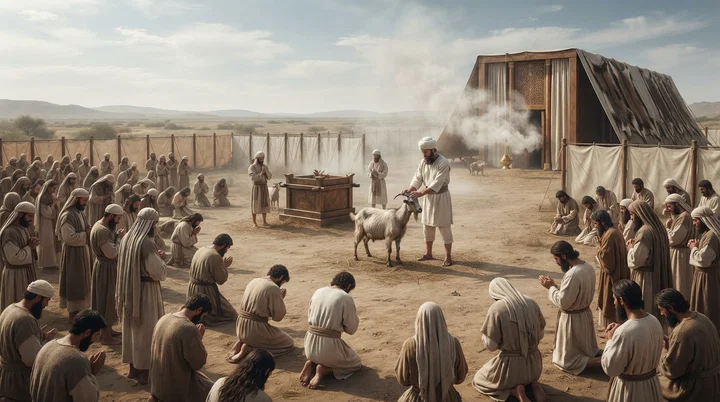
On the morning a trumpet called the people to gather around the sanctuary while the high priest girded on the breastplate of judgment and cast lots for the two goats.RH Feb 2, 1911 He carried the blood of the Lord's goat on which the Lord's lot fell inside the veil to sprinkle upon the mercy-seat beneath the transgressed law and upon the horns of the altar, to make atonement and cleanse the sanctuary from uncleanness and transgression.ST Mar 23, 1904ST Apr 2, 1912ST Jul 11, 1911ST Jun 19, 1907ST Feb 7, 1906 He then confessed all iniquities over the scapegoat and sent it by a fit man into a desolate wilderness to perish and never return to the camp, after which separation the people were free from sin.ST Mar 23, 1904ST Jun 19, 1907 Then he came out to bless those who had afflicted themselves and waited in the court with penitence and prayer; it was a short appointed national work distinct from continual daily holy-place intercession.ST Mar 23, 1904ST Sep 11, 1884
Azazel represents Satan, who receives just punishment but is reserved for destruction in his proper time as the antitypical scapegoat, while the verse shows the divine plan of the just suffering for the unjust, He who knew no sin made sin suffering death for the guilty race.ST Apr 20, 1904ST Feb 7, 1906 Those who held the other view taught that the scapegoat bearing Israel's sins and led into the wilderness is a type of Christ bearing sins and sorrows, with the sanctuary cleansed by the blood of a sin-offering.RH Aug 27, 1857
The day was a day of judgment, test and final reckoning of who were faithful, the yearly decisive final judgment when every case was brought in review and decided forever.ST Oct 18, 1883ST Oct 25, 1905ST Oct 25, 1905RH Aug 10, 1916 The acceptance of the high priest's final act showed whether God was favorable toward them, and the day therefore called for solemn self-examination.ST Sep 11, 1884RH Aug 10, 1916
Those who did not afflict their souls and cease from work were to be cut off or destroyed from among the people, expelled, put to death and left bearing iniquity with no more mercy, banished like the living goat in perpetual separation.RH Oct 15, 1903ST May 7, 1912ST Dec 12, 1916 The penitent who confessed and put away sin stood clear outside confessing to receive blessing and benefits and remained among God's chosen people sharing their privileges.ST May 7, 1912 Resident foreigners were likewise required to observe it under penalty of death.ST
The tenth-day cleansing was preceded ten days earlier by trumpet announcement on the first day, forewarning preparation of heart and consecration.ST Jun 22, 1915RH Nov 7, 1912RH Jan 27, 1916 In the type priests blew trumpets ten days before to announce the definite time, and by the day-for-a-year rule those ten days mean ten years before the heavenly cleansing judgment.ST Apr 28, 1914 That ten-year warning was given on schedule by the falling of the stars over the Western Hemisphere on the night of November 13, 1833, just ten years before the heavenly cleansing judgment begins.ST Apr 28, 1914
The day falls within ten penitential days beginning with the Jewish New Year on the first day of the seventh month.ST Sep 9, 1880RH Jan 2, 1908RH Jan 22, 1914 The Shofar was blown every morning from the first to the tenth to summon preparation for the memorial and final judgment, with a ten-day delay granted for repentance.LDT 35.2GSAM 91.1RH Jan 22, 1914 On New Year's Day three books are opened, of life for the good, of death for the thoroughly evil, and an intermediate book whose cases are decided on the Day of Atonement, after which those names are finally entered in life or death.RH Jan 22, 1914 The sixth month is Ellul, the tenth of Tishri is Yom Kippur still understood by scattered Jews as a day of judgment without the ancient service.GSAM 91.1
The Day of Atonement is the most important of the annual sabbaths and was regarded as more sacred than any other day in the yearly cycle, a sacred fast and the former dispensation's most important day to which the other days' ceremonies pointed.RH Feb 19, 1914RH Oct 10, 1912ST May 10, 1883 It was so solemn that Jews regarded it as the Day of Judgment and even one who worked every Sabbath would not work that day.LDT 34.2 When it falls on the seventh day of the week that Sabbath becomes a high day, being both the Sabbath of Jehovah and the day of atonement.ST Oct 2, 1879
In every fiftieth year that day ushered in the Jubilee.ST Feb 10, 1914 Five days later the Feast of Tabernacles portrays the final harvest reunion after intercession closes when He takes universal rule, its joyful celebration marking the new year and deliverance from bondage of sin.ST Sep 11, 1884RH May 27, 1915
Ceremonial Sabbaths Unlike Weekly
The verse belongs to the yearly feasts, the annual ceremonial sabbaths and holy convocations of the ceremonial law, part of the appointed annual feasts distinct from the weekly Sabbath introduced earlier in the chapter and not to be confused with it.ST Jun 4, 1902ST Jun 10, 1886RH Dec 29, 1859ST Dec 13, 1905RH Aug 24, 1905 Its day of atonement with convocation, soul-affliction and offering by fire was an annual observance, one of the special appointed sabbaths distinct from the regular weekly Sabbaths called the Sabbaths of the Lord.ST Jun 4, 1902ST Jun 10, 1886RH Aug 24, 1905RH Aug 31, 1905 It was a typical sabbath day whose primary and exclusive significance was to foreshadow things to come, distinct from the seventh-day Sabbath of the Ten Commandments, receiving its force from the law of commandments in ordinances.ST Dec 13, 1905RH Aug 31, 1905
The Day of Atonement fell on a fixed calendar date each year regardless of the day of the week, unlike the weekly Sabbath that recurs every seven days in constant succession.ST Dec 13, 1905ST Jul 29, 1875ST Jun 17, 1903ST Jul 17, 1879 Its sabbath rest was a yearly ceremonial sabbath because it fell on a set date in the month rather than recurring every seven days, and like the other yearly observances it came in consequence of sin as a type and prophecy pointing forward to Christ and meeting fulfillment in Him.ST Jul 29, 1875ST Jun 17, 1903 It was yearly, typical and shadowy, falling on a certain day of a certain month and feast and therefore able to fall on any day of the week, and feast dates may change the day of the week on which they fall but they do not change which day is the seventh day.
It is the fifth of seven annual sabbaths, kept as a statute forever from evening of the ninth to evening of the tenth with no manner of work done, a sabbath of rest in which souls are to be afflicted, observed once a year at its appointed point throughout generations in all dwellings.ST Jul 3, 1879RH Jan 14, 1862 The annual sabbaths were observed once a year on fixed days including the first, tenth, fifteenth and twenty-second days of the seventh month, sometimes nine days apart and sometimes only four days between.RH Jan 14, 1862ST Sep 9, 1913 They are called your sabbaths and her sabbaths beside but distinguished from the Sabbaths of the Lord, and distinct from the Sabbath of the land and the Decalogue Sabbath, belonging to the system of feasts, new moons and annual sabbaths distinct from the weekly Sabbath of the Lord.RH Jan 14, 1862ST Aug 10, 1882RH May 5, 1851ST Sep 9, 1913 The word Sabbath is applied to great festivals as well as the seventh day, and like the other feast holy days it shadowed forth Christ or some part of His work.ST Sep 9, 1913RH Sep 24, 1872
The yearly sabbaths were local and ceremonial, instituted in the wilderness and belonging to the Jewish feasts and ceremonial ordinances, unlike the weekly Sabbath of the Lord.RH Dec 29, 1859RH Oct 31, 1854 They came in consequence of sin after sin entered the world, and like all the yearly sabbaths connected with the great feasts they are a type, symbol and shadow of better things to come centering in Christ, while the weekly seventh-day Sabbath originated before sin entered and is therefore not a type or shadow of things to come.ST They were part of the law of Moses with feasts, foods and drinks, called Israel's sabbaths, and could be taken away as a judicial punishment.RH May 3, 1860ST Nov 16, 1876
As shadows of things to come whose body is Christ, part of the typical system with meat and drink offerings and Levitical priesthood to deal with sin, the ceremonial observance expired by limitation when substance came.ST Oct 2, 1884ST Sep 21, 1876 It was abolished, blotted out and nailed to the cross with the sacrificial law when Christ, the reality foreshadowed, came and died, ceasing to be obligatory when the sacrificial system ended at the cross.RH Feb 19, 1914ST Oct 2, 1884ST Sep 21, 1876RH Aug 31, 1905RH Oct 31, 1854 The commanded day rested on its own injunctions not the Fourth Commandment and was reduced to common days at the cross, while the weekly Sabbath fixed always on the seventh day, ordained before sin from creation for all mankind as God's memorial, embodied in the moral law written on stone, remains binding forever even in the new earth.ST Oct 2, 1884ST Sep 21, 1876
The sabbaths of Colossians 2:16 and Hosea 2:11 are these ceremonial sabbaths. They were a shadow of good things to come, while the weekly Sabbath was never a shadow of anything to come but is a memorial to keep the Creator in memory and remains forever a sign between God and spiritual Israel, those who are heirs by faith in Christ. The feast days and fast days connected with eating and fasting, including the Day of Atonement on the tenth day as a holy convocation for afflicting the soul by fasting and offering by fire, are matters of doubtful disputation where every man is left to be fully persuaded in his own mind, distinct from the weekly seventh-day Sabbath guarded by one of the Ten Commandments that remains holy and binding.RH Apr 1, 1873 They are classed as positive institutions of the old economy and as Jewish days Gentile Christians were not required to keep, and because the day had lost its former significance a Christian could regard it or disregard it without sin, with neither believer to judge the other for that choice.RH Apr 15, 1873ST Dec 13, 1905
Except for these ceremonial sabbaths, the Sabbath of the Lord is the only Sabbath in Scripture, giving no basis for a separate Jewish Sabbath and Christian Sabbath since Scripture contains no such distinction.ST Feb 27, 1893 Israel's special Sabbath laws governing the nation's worship are not binding today as laws, though their underlying principles remain, and Scripture describing the sanctuary service is profitable for doctrine and instruction and was written for learning to give hope.ST Jun 19, 1907RH Nov 12, 1908 The days of the Jewish ritual system of feasts and feast-days with distinctions of meats and drinks and carnal ordinances belong to an entirely different system from the seventh-day Sabbath that God spoke with His own voice and wrote on tables of stone, and keeping them is a matter of indifference so long as men do not seek justification through them and so reject the Saviour's sacrifice.ST Sep 16, 1875 Its observance is now indifferent and not binding, and those who observe an annual holy day because of old associations and those who treat it like an ordinary day should not judge one another.ST Feb 7, 1911ST Oct 19, 1888
The Greek genitive plural form for sabbath can refer to a sabbath other than the weekly seventh-day Sabbath, as shown by the Septuagint form in Leviticus 23:32.ST Jul 15, 1880 The law expressly makes the tenth day a Sabbath of rest, so afflicting souls does not mean that it is not a Sabbath, and its wording is indefinite, a day of atonement and a Sabbath of rest with no definite article the, marking the first institution of a new observance in the same indefinite way the weekly Sabbath is first named in Exodus 16.ST Jul 17, 1879RH Sep 24, 1872 Israel held holy convocations on days besides the Lord's Sabbaths, and these gatherings could involve refraining from ordinary work without violating the command to work six days and rest on the seventh.RH Dec 17, 1857 The yearly feast days and fast days do not identify a day of the weekly cycle, so they do not establish Sunday as a weekly Sabbath and give no argument for Sunday-keeping.RH Nov 8, 1853ST Sep 24, 1894
The chapter fixes feasts to definite days in the first and seventh months, unlike Pentecost which is counted fifty days from the Passover Sabbath and determined by the barley harvest seven weeks from the sickle when the sickle is put to the corn, so it can fall on the first or any other day of the week.RH Nov 1850ST Jul 3, 1879ST Jul 3, 1879 The descent of the Holy Spirit at Pentecost therefore gives no special honor to the first day of the week.RH Nov 1850 The eighth day connected with fixed-date feasts belongs to feasts that begin on fixed days of fixed months, so it falls on a different day of the week in different years like New Year's Day and the Fourth of July, and does not prefigure exalting the first day of every week as the Sabbath under the gospel.RH Jan 13, 1874 One annual holy day could have fallen between the Sabbath of the meeting at Antioch and the next seventh-day Sabbath.RH Dec 5, 1871
The chapter classifies the seventh-day Sabbath among feast days and holy convocations, with the Sabbath coming first, and the feasts are treated as abolished together.RH Mar 8, 1864 The yearly sabbaths connected with the feasts stand in the same chapter with the weekly Sabbaths with no moral difference between them, both belonging to positive typical institutions rather than moral institutions, for moral institutions are not typical and typical institutions are not moral, as held by those who so classed them.RH Oct 29, 1872 The verse lists annual sabbaths appointed by God on days other than the seventh day, proving as held by those who so argued that any day of the week may be a Sabbath if God chooses to make it one.RH Apr 24, 1879
The ceremonial features were misused when people trusted their own observance as a means of salvation, but those ceremonies cannot save and believers are to trust in Christ alone.ST Jun 8, 1915 The day required rest from all work and abstaining from food, with Israelites and resident foreigners alike to observe it under penalty of death, and its prescribed observance depended on the sanctuary services including the high priest's atonement for the people and sanctuary.ST May 27, 1897 After the Jerusalem temple was destroyed those sacrifices and the high-priestly service could no longer be performed, with Christians recognizing Christ as High Priest and earthly sacrifices as no longer effective while the Jewish community continued observing the day through substitute practices.ST May 27, 1897 It belongs to the law of sacrifice and offering and burnt offerings and offering for sin and of the Levitical priesthood, the middle wall of partition, the law of commandments contained in ordinances that was abolished, a shadow under the old covenant taken away with the sacrifice and ministration of Christ established in its place, with Jesus Christ as the only true priest and high priest over the house of God in the new covenant.ST Apr 15, 1880
The tenth day is an annual sabbath ordained by God, and treating it as no sabbath while assigning that status to the eighth day changes the law.ST Jul 17, 1879 It is a yearly Sabbath kept with holy services, preaching and worship, and as held by those who so maintained it is as sacred as the weekly Sabbath and ought to be observed equally with it.ST Oct 2, 1879 The passage has also been mentioned in connection with a claim that this day should be kept as a fast day and Sabbath.RH Dec 19, 1907
Sources