Leviticus 1:9
But his inwards and his legs shall he wash in water: and the priest shall burn all on the altar, to be a burnt sacrifice, an offering made by fire, of a sweet savour unto the LORD.
Translations
But his inwards and his legs shall he wash in water: and the priest shall burn all on the altar, to be a burnt sacrifice, an offering made by fire, of a sweet smell to the LORD.
But his inwards and his legs shall he wash in water: and the priest shall burn all on the altar, to be a burnt sacrifice, an offering made by fire, of a sweet savour unto the LORD.
but his inwards and his legs shall he wash in water: and the priest shall burn all on the altar, to be a burnt sacrifice, an offering made by fire, of a sweet savour unto the Lord.
But his inwards and his legs shall he wash in water: and the priest shall burn all on the altar, to be a burnt-sacrifice, an offering made by fire, of a sweet savor to the LORD.
but its inwards and its legs shall he wash with water: and the priest shall burn the whole on the altar, for a burnt offering, an offering made by fire, of a sweet savour unto the LORD.
but its inwards and its legs shall he wash with water. And the priest shall burn the whole on the altar, for a burnt-offering, an offering made by fire, of a sweet savor unto Jehovah.
and its inwards and its legs he doth wash with water; and the priest hath made perfume with the whole on the altar, a burnt-offering, a fire-offering of sweet fragrance to Jehovah.
but its inwards and its legs shall he wash in water; and the priest shall burn all on the altar, a burnt-offering, an offering by fire to Jehovah of a sweet odour.
But its inwards and its legs, shall they bathe with water,—then shall the priest make, of the whole, a perfume at the altar, an ascending-sacrifice an altar-flame of a satisfying odour unto Yahweh.
The entrails and legs must be washed with water, and the priest shall burn all of it on the altar as a burnt offering, an offering made by fire, a pleasing aroma to the LORD.
The entrails and legs must be washed with water, and the priest shall burn all of it on the altar as a burnt offering, a food offering, a pleasing aroma to the LORD.
but he shall wash its innards and its legs with water. The priest shall burn all of it on the altar, for a burnt offering, an offering made by fire, of a pleasant aroma to the LORD.
But its inside parts and its legs are to be washed with water, and it will all be burned on the altar by the priest for a burned offering, an offering made by fire, for a sweet smell to the Lord.
But the inwardes thereof and the legges thereof he shall wash in water, and the Priest shall burne all on the altar: for it is a burnt offering, an oblation made by fire, for a sweete sauour vnto the Lord.
Douay-Rheims (Challoner revision)
The entrails and feet being washed with water: and the priest shall burn them upon the altar for a holocaust, and a sweet savour to the Lord.
Pictures
Cross-references
- Numbers 28:3-4
And thou shalt say unto them, This is the offering made by fire which ye shall offer unto the LORD; two lambs of the first year without spot day by day, for a continual burnt offering.
Prescribes the daily burnt offering, including its accompanying grain offering.
- Leviticus 1:3-4
If his offering be a burnt sacrifice of the herd, let him offer a male without blemish: he shall offer it of his own voluntary will at the door of the tabernacle of the congregation before the LORD.
The offering is presented and accepted as the worshiper’s substitute.
- 1 Kings 18:38
Then the fire of the LORD fell, and consumed the burnt sacrifice, and the wood, and the stones, and the dust, and licked up the water that was in the trench.
Fire from the Lord consumes the burnt offering, showing divine acceptance.
- Exodus 29:38-43
Now this is that which thou shalt offer upon the altar; two lambs of the first year day by day continually.
Both describe burnt offerings made continually as a sweet savour unto the LORD.
- Hebrews 8:4-5
For if he were on earth, he should not be a priest, seeing that there are priests that offer gifts according to the law:
The earthly priests’ ministry is described as a pattern of heavenly things.
- Psalms 20:3
Remember all thy offerings, and accept thy burnt sacrifice; Selah.
It refers to God remembering and accepting offerings.
- John 1:29
The next day John seeth Jesus coming unto him, and saith, Behold the Lamb of God, which taketh away the sin of the world.
Jesus is identified as the Lamb offered for the world’s sin.
- Leviticus 1:17
And he shall cleave it with the wings thereof, but shall not divide it asunder: and the priest shall burn it upon the altar, upon the wood that is upon the fire: it is a burnt sacrifice, an offering made by fire, of a sweet savour unto the LORD.
It specifies that the bird is not divided.
- Leviticus 9:24
And there came a fire out from before the LORD, and consumed upon the altar the burnt offering and the fat: which when all the people saw, they shouted, and fell on their faces.
God first kindled the sacred fire.
- Leviticus 1:4
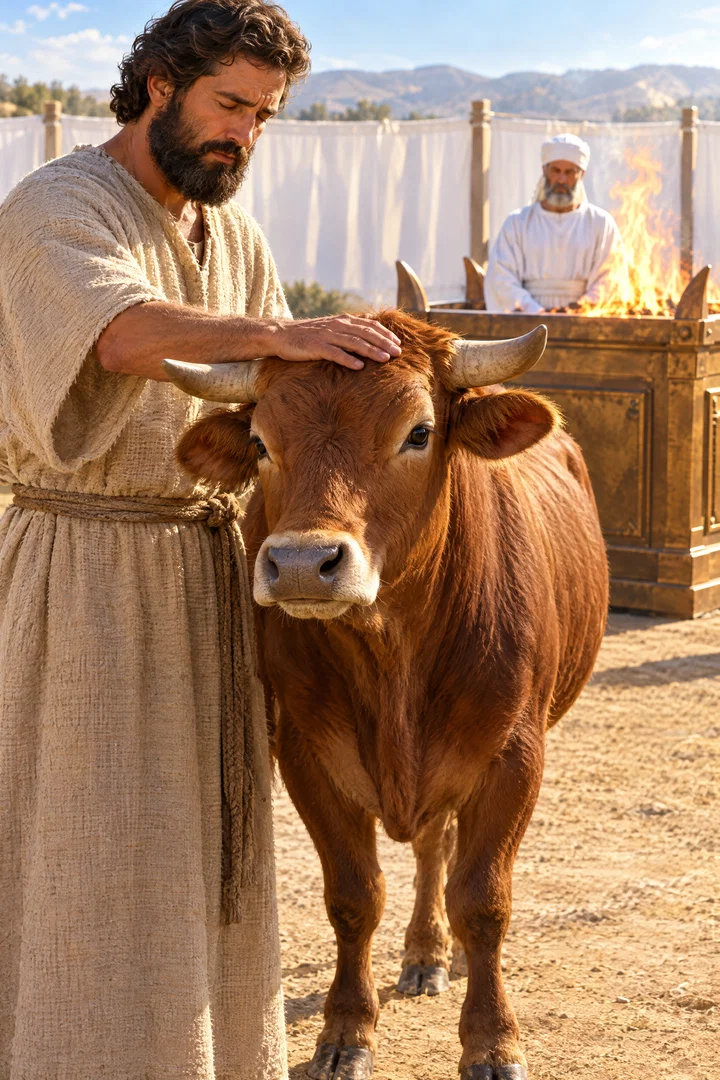
And he shall put his hand upon the head of the burnt offering; and it shall be accepted for him to make atonement for him.
The offering is accepted as the sinner’s substitute for atonement.
- Isaiah 53:6
All we like sheep have gone astray; we have turned every one to his own way; and the LORD hath laid on him the iniquity of us all.
Christ bears the iniquity that the sacrificial victim typified.
- Hebrews 10:4
For it is not possible that the blood of bulls and of goats should take away sins.
Animal blood cannot take away sin.
- Leviticus 2:9
And the priest shall take from the meat offering a memorial thereof, and shall burn it upon the altar: it is an offering made by fire, of a sweet savour unto the LORD.
The meat offering follows the burnt offering, and both are offerings made by fire.
- Hebrews 9:12
Neither by the blood of goats and calves, but by his own blood he entered in once into the holy place, having obtained eternal redemption for us.
Contrasts the yearly service with Christ’s once-for-all ministry.
- Hebrews 9:22
And almost all things are by the law purged with blood; and without shedding of blood is no remission.
Blood is shed in sacrifice for remission.
- Hebrews 9:23-24
It was therefore necessary that the patterns of things in the heavens should be purified with these; but the heavenly things themselves with better sacrifices than these.
Earthly sanctuary service prefigures heavenly realities.
- 1 Peter 2:24
Who his own self bare our sins in his own body on the tree, that we, being dead to sins, should live unto righteousness: by whose stripes ye were healed.
Christ bears sins in his body, fulfilling the offering’s symbolism.
- Leviticus 3
And if his oblation be a sacrifice of peace offering, if he offer it of the herd; whether it be a male or female, he shall offer it without blemish before the LORD.
Both describe sacrificial offerings that represent Christ.
Commentary
Each commentary is drawn from primary sources: the writings of Ellen G. White and Adventist pioneers and periodicals. Each commentary is separate. Its own words are not a quotation; follow the references to read the source passages.
Ellen G. White
1 source
The instructions were given by Christ through Moses as part of the directions for the sacrificial service.ST Jul 15, 1880 They required the inwards and the legs of the offering to be washed in water, after which the priest was to burn the whole offering on the altar.ST Jul 15, 1880 These outward acts were not meaningless forms, for the sacrificial system represented Christ's ministry and His death.ST Jul 15, 1880 The offering pointed to the Saviour who would bear the sins of the world and die for its redemption.ST Jul 15, 1880
Sources
Pioneers and periodicals
29 sources
The verse requires the inwards and legs to be washed in water and the whole animal to be burned on the altar as a burnt sacrifice, clean and sound and wholly given to the Lord as an offering by fire of sweet savour to Him.ST Jul 15, 1880ST Jan 20, 1914 The sinner who brought it laid a hand on its head to transfer sin with confession, slew it as bearing death's penalty, and the priests ministered its blood to carry that sin in figure into the sanctuary.ST May 29, 1901 It sets forth atonement by life given in the sinner's behalf, picturing pardon and restoration to favor through bloody sacrifice, and with all the types it is a shadow whose substance is Jesus Christ bearing the world's sins and dying for redemption.ST Jul 15, 1880ST May 29, 1901ST Feb 3, 1909ST Feb 8, 1883 It is the sacrifice of consecration, picturing surrender of all the powers of being to God alone after confession and acceptance in Christ's merit, with the flesh crucified and the life renewed for His use.ST Jan 20, 1914ST Jun 5, 1901ST Sep 12, 1900 The inwards stand for the heart and the legs for the hands and feet, washed to show they must be cleansed to be acceptable in service, and the flesh wholly consumed means giving the whole life even unto death with undivided heart, consumed by sacred love-fire only God can kindle, as most fully illustrated in the daily poured-out life of Jesus.ST Sep 12, 1900ST Sep 12, 1900ST Jan 20, 1914ST Sep 12, 1900
Burnt Offering Procedure
The inwards and legs were to be washed in water, and the priest was to burn all on the altar as a burnt sacrifice, an offering made by fire of a sweet savour to the Lord, whole, clean, sound, and wholly the Lord's.ST Jul 15, 1880ST Jan 20, 1914ST Feb 17, 1890ST Jun 5, 1901 The washing of the entrails and legs completed the sacrifice described as a sweet savour, picturing a condemned sinner restored to divine favor and pardon through a bloody sacrifice.ST Jan 20, 1914ST Feb 8, 1883 These outward acts belonged to the sacrificial directions given through Moses for individual sins, in which the clean unblemished animal served as substitute and its death acknowledged the sinner's guilt.ST Jul 15, 1880ST Feb 17, 1890
The accepted animal substitute was killed, skinned, and cut into parts by the sinner it represented, and the priests arranged the parts on the altar for consumption by fire, thus setting forth the giving up of life in the sinner's behalf as an atonement for sin.ST May 29, 1901 The individual who sinned brought a victim, laid a hand on its head to signify transfer of sin and confessed over it, and had it slain as substitute paying death's penalty.RH Mar 28, 1854ST May 17, 1877 The priest's work began with its blood, carrying some of it into the sanctuary and sprinkling it before the Lord, so sin was transferred from the sinner through the victim's blood to the sanctuary.RH Mar 28, 1854ST May 17, 1877RH Sep 16, 1852
The verse belongs to Leviticus 1 to 7, the especial work for individuals presenting their particular offerings during the year, cited as an example of offerings brought by individuals.RH Feb 25, 1858RH Mar 8, 1870RH Feb 3, 1853 That work is the first grand division of the ministration of the earthly sanctuary, the daily service in the holy place with the regular morning and evening burnt offering, the burning of sweet incense on the golden altar, and the special work on the Lord's Sabbaths, annual sabbaths, new moons and feasts.RH Mar 8, 1870RH Feb 3, 1853 It is distinct from the second division, the yearly work in the most holy place for the sins of the people and the cleansing of the sanctuary.RH Feb 25, 1858RH Mar 8, 1870 Individual offerings made in faith, like the daily offering, left forgiven sins there in figure through the year amid constant remembrance of sin made by offering of beasts, until the yearly cleansing closed the entire yearly round looking forward to the future antitype.RH Mar 8, 1870STST Apr 2, 1912
If the animal was not too large to burn whole upon the altar it must not be divided, and if too large to be thus burned it might be cut up for convenience, but it must all be burned as a whole burnt offering.ST Sep 12, 1900 Animals that move on the ground were divided while birds were not divided, a prescribed difference carrying significance in the covenant symbolism.ST Feb 9, 1915ST Sep 12, 1900
The fire igniting the sacrifice was sacred fire first kindled by God Himself and ever since carefully and constantly kept burning, usually taken from the altar of incense.ST Sep 12, 1900 On special occasions, as with Elijah upon Mount Carmel, God kindled the sacrifice directly by a flash from on high.ST Sep 12, 1900 No other fire than this consecrated fire must be used, for Nadab and Abihu offering strange fire were themselves consumed by the Lord's displeasure.ST Sep 12, 1900
The instructions for burnt offerings were given to Adam's family immediately after the fall before being given again to Israel, so that Abel's offering matched them in all respects while Cain's offering of the fruit of the ground did not because God had not commanded it.ST Jul 16, 1894 God accepted Abel and rejected Cain for that reason, since God accepts nothing but obedience and rejects only disobedience, and sin which is transgression of the law barred Cain from acceptance.ST Jul 16, 1894 Leviticus 1:3-10 is the law against which the sacrifice of cows in Samuel's time is judged contrary.RH Apr 3, 1900
The burnt offering is distinguished from the sin offering and the trespass offering used for sins and forgiveness.ST Jan 31, 1911RH Sep 16, 1852 In the Lord's order the sequence begins with the burnt offering and ends with the sin offering, while people coming to Him begin with the sin offering and end with the burnt offering.ST Jan 31, 1911RH Sep 16, 1852
Offerings were within reach of the poor, for those unable to bring a costly animal could bring a less costly one, and in extreme poverty even a small amount of meal was accepted.RH Jan 20, 1859 Everyone was to bring something because everyone had sinned.RH Jan 20, 1859
Atonement and Heavenly Ministry
The washing of the inwards and legs and the burning of all on the altar set forth the giving up of life in the sinner's behalf as an atonement for sin.ST May 29, 1901 The completed burning, described as a sweet savour to the Lord, pictures a condemned sinner restored to divine favor and pardon through a bloody sacrifice.ST Feb 8, 1883
These outward acts were not meaningless forms but represented the ministry and death of the Saviour who would bear the world's sins and die for its redemption.ST Jul 15, 1880 Like all the offerings and types, the burnt sacrifice is a shadow of the great substance found in Jesus Christ.ST Feb 3, 1909 He is the great Sacrifice who frees people from the bondage of sin, and the prescribed difference between animals that move on the ground, which were divided, and birds, which were not divided, carries significance in the covenant symbolism.ST Feb 9, 1915 The instructions for sacrifices have typological significance concerning the work of Jesus Christ.ST Feb 13, 1912
The yearly round of Levitical sanctuary appointments and services typified Christ and His priesthood in the heavenly sanctuary, with the annual service typifying His once-for-all service.ST Nov 28, 1895 The individual offerings of Leviticus 1 to 7 belong to the first grand division of the ministration of the earthly sanctuary, the daily service in the holy place, alongside the regular morning and evening burnt offering, the burning of sweet incense on the golden altar, and the special work on the Lord's Sabbaths, annual sabbaths, new moons and feasts, distinct from the second division, the yearly work in the most holy place for the sins of the people and the cleansing of the sanctuary.RH Mar 8, 1870 That whole earthly ministration is the example and shadow of Christ's more excellent ministry in the true tabernacle.RH Mar 8, 1870 It is a pattern and shadow or type and impressive object-lesson of the temple of God in heaven and Christ's priestly service therein as High Priest and Minister of the heavenly sanctuary, revealing God's way, power, and glory and giving enlightenment concerning God's dealings with men.ST Jun 19, 1907 It was the first general ministry in which burdened individuals brought their offerings with faith in the Redeemer to come, part of one entire yearly round of worship in which remembrance of sin was constantly made by the offering of beasts, joined with the daily ministration for the nation and closed by the cleansing of the sanctuary, all looking forward to the future antitype.ST Apr 2, 1912
As Scripture, the description of the main features of the sanctuary service in Leviticus 1-7 is profitable for doctrine, for reproof, for correction, for instruction in righteousness that the man of God may be perfect, and was written for learning that through patience and comfort of the Scriptures hope may be gained.ST Jun 19, 1907 Studying it gives understanding of the heavenly sanctuary and clearer views of the Saviour and His work in behalf of men.ST Jun 19, 1907
The verse belongs to the regulation of the tribe of Levi and its priesthood and to the special instructions about the various offerings in Leviticus 1 to 7, given as levitical law to the children of Israel.ST Feb 3, 1909RH Aug 20, 1872 That levitical law is distinct from the law of God, which is absolute and perpetual, holy, just, and good, and it was abolished by Christ.RH Aug 20, 1872 It shows God's hatred of sin and that sin demanded its penalty.ST Feb 3, 1909
Consecration and Acceptance Demanded
The burnt offering is the sacrifice of consecration, picturing the surrender of all the powers of one's being to God after confessing sin and being accepted in Christ's merit, with the flesh crucified and the life renewed, and that consecration must be given to God alone to be used as He alone directs.ST Jan 20, 1914ST Jun 5, 1901ST Sep 12, 1900 The inwards represent the heart and the legs represent the offerer's hands and feet, and their washing in water shows they must be cleansed before they can be acceptable in the Lord's service.ST Jan 20, 1914ST Jan 20, 1914 This teaches complete surrender in which a person places weaknesses and every part of life in Christ's hands as High Priest, and He lays them upon the altar.ST Jan 20, 1914
The offering stands for the one who brings it, and its killing and its flesh wholly consumed on the altar mean the giving of the whole life even unto death, voluntarily presenting the renewed being to be consumed on God's altar by the sacred love-fire which only God can kindle in the soul.ST Sep 12, 1900ST Sep 12, 1900 It must be a whole burnt offering with undivided heart, and if the animal was not too large to burn whole it was not to be divided, while if too large it might be cut up for convenience but all had to be burned.ST Sep 12, 1900ST Sep 12, 1900 An animal merely bruised and let go alive would speak only of partial consecration, of going with Christ to Gethsemane and to Pilate's hall but not to Calvary, whereas only flowing blood and flesh wholly consumed speak of willingness to go with Him in His strength even to Calvary, without which there is no forgiveness, and woe to him who brings a divided heart.ST Sep 12, 1900ST Sep 12, 1900 Its truest and fullest illustration is the life of Jesus, whose whole life was given to be consumed in daily service under divine love constantly burning on the altar of His heart, not only when His blood flowed on Calvary but constantly day by day when poured out to be ignored, despised and received ungratefully, with only one returning to give thanks where ten were healed, and in the end to be hated, mocked, spit upon and crucified.ST Sep 12, 1900
The essential element of true religion is the spirit of disinterested sacrifice, yielding what is precious for the good of others after the pattern of Christ giving up His glory and humbling Himself to death to save others.ST Feb 8, 1892 From the first offering onward human sacrifices prefigure the death of Christ, and under Moses animal sacrifices and firstfruits required giving the best, not merely formal labor and service.ST Feb 8, 1892 An acceptable sacrifice is wholly consumed on the altar, and being consumed is the evidence that God has accepted it, while offerings without giving the best are unacceptable and estrange the heart from God.ST Feb 8, 1892
Sources