Luke 19:44
And shall lay thee even with the ground, and thy children within thee; and they shall not leave in thee one stone upon another; because thou knewest not the time of thy visitation.
Translations
And shall lay you even with the ground, and your children within you; and they shall not leave in you one stone on another; because you knew not the time of your visitation.
And shall lay thee even with the ground, and thy children within thee; and they shall not leave in thee one stone upon another; because thou knewest not the time of thy visitation.
and shall lay thee even with the ground, and thy children within thee: and they shall not leave in thee one stone upon another; because thou knewest not the time of thy visitation.
And shall lay thee even with the ground, and thy children within thee: and they shall not leave in thee one stone upon another: because thou knewest not the time of thy visitation.
Revised Version, American Standard Version
and shall dash thee to the ground, and thy children within thee; and they shall not leave in thee one stone upon another; because thou knewest not the time of thy visitation.
and lay thee low, and thy children within thee, and they shall not leave in thee a stone upon a stone, because thou didst not know the time of thy inspection.'
and shall lay thee even with the ground, and thy children in thee; and shall not leave in thee a stone upon a stone: because thou knewest not the season of thy visitation.
And will level thee with the ground, and thy children within thee, and will not leave, stone on stone, within thee: because thou didst not get to know the season of thy visitation.
Berean Standard Bible, Majority Standard Bible
They will level you to the ground— you and the children within your walls. They will not leave one stone on another, because you did not recognize the time of your visitation from God.”
and will dash you and your children within you to the ground. They will not leave in you one stone on another, because you didn’ t know the time of your visitation.”
And will make you level with the earth, and your children with you; and there will not be one stone resting on another in you, because you did not see that it was your day of mercy.
And shall make thee euen with ye ground, and thy children which are in thee, and they shall not leaue in thee a stone vpon a stone, because thou knewest not that season of thy visitation.
Douay-Rheims (Challoner revision)
And beat thee flat to the ground, and thy children who are in thee: and they shall not leave in thee a stone upon a stone: because thou hast not known the time of thy visitation.
Pictures


Cross-references 20 of 32
- Matthew 23:37-38
O Jerusalem, Jerusalem, thou that killest the prophets, and stonest them which are sent unto thee, how often would I have gathered thy children together, even as a hen gathereth her chickens under her wings, and ye would not!
Jesus laments Jerusalem’s refusal and declares its house desolate.
- Luke 21:20-21
And when ye shall see Jerusalem compassed with armies, then know that the desolation thereof is nigh.
Jerusalem’s encirclement signals its desolation and tells Judeans to flee.
- Daniel 9:26
And after threescore and two weeks shall Messiah be cut off, but not for himself: and the people of the prince that shall come shall destroy the city and the sanctuary; and the end thereof shall be with a flood, and unto the end of the war desolations are determined.
Foretells Jerusalem’s destruction after the Messiah is cut off.
- Matthew 24:2
And Jesus said unto them, See ye not all these things? verily I say unto you, There shall not be left here one stone upon another, that shall not be thrown down.
Jesus foretells that the temple will be demolished, with no stone left upon another.
- Luke 13:35
Behold, your house is left unto you desolate: and verily I say unto you, Ye shall not see me, until the time come when ye shall say, Blessed is he that cometh in the name of the Lord.
Jesus declares Jerusalem’s house desolate for rejecting him.
- Matthew 24:15
When ye therefore shall see the abomination of desolation, spoken of by Daniel the prophet, stand in the holy place, ( whoso readeth, let him understand:)
The sign of desolation warns of Jerusalem’s coming destruction and prompts escape.
- Matthew 23:38
Behold, your house is left unto you desolate.
Jerusalem’s house is left desolate after rejecting Christ.
- Acts 13:27
For they that dwell at Jerusalem, and their rulers, because they knew him not, nor yet the voices of the prophets which are read every sabbath day, they have fulfilled them in condemning him.
Jerusalem’s rulers failed to recognize Christ and fulfilled the prophets’ words by condemning him.
- Deuteronomy 28:53-57
And thou shalt eat the fruit of thine own body, the flesh of thy sons and of thy daughters, which the LORD thy God hath given thee, in the siege, and in the straitness, wherewith thine enemies shall distress thee:
Siege famine would become so severe that people ate their children.
- Matthew 22:7
But when the king heard thereof, he was wroth: and he sent forth his armies, and destroyed those murderers, and burned up their city.
The king’s punishment of those who rejected his invitation connects with Jerusalem’s destruction.
- Mark 13:2
And Jesus answering said unto him, Seest thou these great buildings? there shall not be left one stone upon another, that shall not be thrown down.
Both texts foretell Jerusalem’s temple being thrown down, with no stone left upon another.
- Mark 13:14-15
But when ye shall see the abomination of desolation, spoken of by Daniel the prophet, standing where it ought not, ( let him that readeth understand,) then let them that be in Judæa flee to the mountains:
Jesus warns of Jerusalem’s coming desolation and tells his followers to flee.
- Matthew 21:37-39
But last of all he sent unto them his son, saying, They will reverence my son.
The son’s killing portrays the final rejection that led to judgment.
- Luke 19:14
But his citizens hated him, and sent a message after him, saying, We will not have this man to reign over us.
The people refused to have Christ reign over them.
- Luke 13:34
O Jerusalem, Jerusalem, which killest the prophets, and stonest them that are sent unto thee; how often would I have gathered thy children together, as a hen doth gather her brood under her wings, and ye would not!
Jesus laments that Jerusalem rejected his repeated care.
- Micah 3:12
Therefore shall Zion for your sake be plowed as a field, and Jerusalem shall become heaps, and the mountain of the house as the high places of the forest.
city plowed like a field
- 2 Chronicles 36:17-19
Therefore he brought upon them the king of the Chaldees, who slew their young men with the sword in the house of their sanctuary, and had no compassion upon young man or maiden, old man, or him that stooped for age: he gave them all into his hand.
Jerusalem’s destruction for sin foreshadows its later destruction.
- 2 Chronicles 36:15-16
And the LORD God of their fathers sent to them by his messengers, rising up betimes, and sending; because he had compassion on his people, and on his dwelling place:
Judah rejected God’s messengers before its ruin.
- Zechariah 14:1-2
Behold, the day of the LORD cometh, and thy spoil shall be divided in the midst of thee.
Predicts devastation of the land and city by invading forces.
- Psalms 48:2
Beautiful for situation, the joy of the whole earth, is mount Zion, on the sides of the north, the city of the great King.
Describes Zion’s beauty, contrasted with its coming ruin.
Commentary part 1 of 2
Each commentary is drawn from primary sources: the writings of Ellen G. White and Adventist pioneers and periodicals. Each commentary is separate. Its own words are not a quotation; follow the references to read the source passages.
Ellen G. White
135 sources
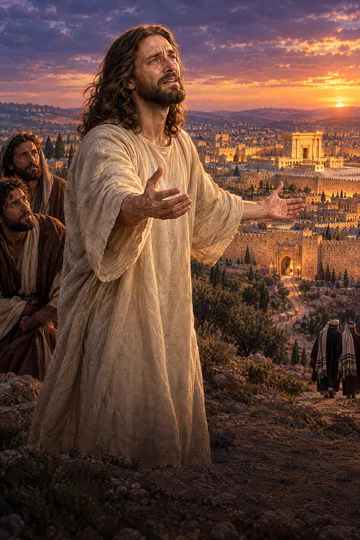
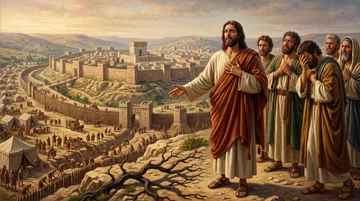
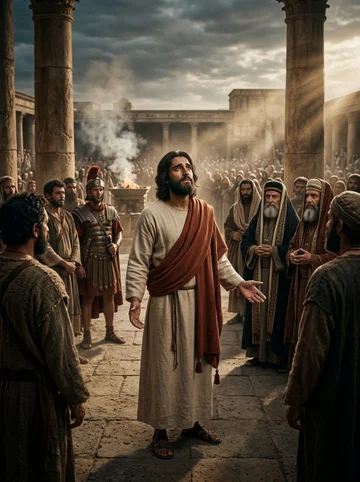
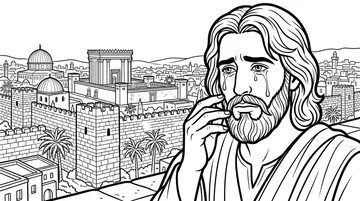
Jesus halted on Olivet overlooking Jerusalem during His triumphal entry wept aloud over the doomed city even while the crowd rejoiced around Him.4SP 17.1–2Ms 49, 1890, par. 12ST Jul 22, 18864RED 122.2–123.23SP 20.1 His tears were not for His own coming suffering and death at Calvary in sight before Him, but for the city He had loved and cared for and for a whole nation about to be lost.Ms 102, 1897, par. 18–20DA 575.3–576.1ST Dec 22, 1887ST Jun 8, 18822SP 393.2–395.1 The time of visitation was God's visit to the city in Jesus with mercy, truth, light, peace and salvation, the precious last years of grace in the ministry of Christ and His apostles.2SP 392.1–393.1DA 569.3–4Ms 13, 1892, par. 26–28DA 235.1 Because its people failed to know that day and persistently rejected light, warnings, miracles and the Messiah Himself who alone could heal and save them, retributive justice would lay the city even with the ground with her children, leaving not one stone upon another and the temple in ruins.2SP 392.1–393.14RED 124.1–125.1GC 17.1Ms 134, 1902, par. 2–3Lt 11, 1883, par. 18–21 Had Jerusalem repented and accepted Him the ruin could have been averted and she might have stood forever as queen of kingdoms, free from Rome and a center of peace to all nations, and the same warning now reaches all who scorn great light with judgment proportionate to light refused.2SP 392.1–393.1DA 577.1–3COS 95.3–64RED 125.2–127.1RH Jul 6, 1911
Scene and Sorrow
Jesus spoke these words while looking over Jerusalem and weeping during His triumphal entry, halted on the crest of Olivet with the Kidron below and Calvary in sight, at sunset as the western sun gilded its towers.4SP 17.1–2Ms 7a, 1886, par. 5Ms 7a, 1886, par. 3 He entered as the prophesied Messiah and King, hailed by crowds as their King, while the city's outward beauty and confidence stood in contrast to the destruction He foresaw.4SP 17.1–2DA 570.1–571.1 His tears amid the rejoicing at that entry were His final pleadings of love and compassion, rejected by its people, with His triumphal entrance, the cleansing of the temple, and the blighting of the barren fig tree also pointing to the city's destruction.3SP 20.1ST Jan 10, 1878 His mercy and love in riding in and weeping over the city reveal His mercy and love in dying for sinful people so they would not perish in their sins.Ms 54, 1886, par. 4–7Ms 62, 1886, par. 19–23
Amid triumphal rejoicing and shouts over His mighty works, His body rocked and wails and groans of insuppressible agony burst from quivering lips, and the palm branches strewn in the way were wet with His tears.4RED 122.2–123.2Ms 7a, 1886, par. 3 The multitude shouted in triumph while He stood in an agony of pitying tears on the crest of Olivet with Jerusalem in glory before Him, grieving amid rejoicing because He saw what they could not see.ST Jul 22, 1886Ms 7a, 1886, par. 3 The crowd saw His tears and heard His groans but did not understand the meaning of His lamentation over the fate of the city He loved.ST Jul 22, 1886ST Jul 22, 1886 He foresaw what would happen to Jerusalem and wept in anguish over it from deep love and yearning for Israel even as the people resisted mercy and faced destruction.ST Dec 22, 1887ST Feb 27, 1896
His tears were not silent tears of gladness and not anticipation of physical suffering and death, though Gethsemane and Calvary and the sheep gate of sacrifice lay in sight, and His sorrow was no selfish fear of pain.DA 575.3–576.14RED 122.2–123.2 His rocking body and tears were not from the thought of His own coming agony, suffering, humiliation and shame, betrayal, trial, cross and death, which He knew from the beginning, including His own cross on Calvary.Ms 102, 1897, par. 18–20Ms 7a, 1886, par. 5 His grief was for the doomed people facing judgment, not for Himself, for the city and what it might have become if it had accepted Him, not fear of His own coming physical suffering.Ms 102, 1897, par. 18–20ST Jun 8, 18824SP 18.1 He saw both what she was in her guilt in rejecting her Redeemer and what she might have been had she accepted Him who alone could heal her wound.DA 575.3–576.14RED 122.2–123.2
He grieved because Jerusalem had been the child of His care for more than a thousand years, with His temple as His habitation, beautiful for situation and the joy of the whole earth, and as a tender father mourns a wayward son He mourned her loss.2SP 393.2–395.1 His days of personal work for men on earth were ending and He knew comparatively few would accept Him as Redeemer and acknowledge they were lost without His divine aid, while the Jews were rejecting the help God sent to save them from utter ruin, spurning His love that would shelter them and His mercy that would save them from retribution.ST Dec 22, 1887 The whole history and coming doom of the city was distinctly before Him, with centuries of grace resisted, privileges abused, opportunities slighted, and warnings and reproofs of prophets unheeded, with ingratitude, formalism, hypocritical insincerity, Pharisaic pride and national apostasy, yet though the guilty were His property and offended Him, He did nothing to cut them off but bore long with them.Lt 20, 1892, par. 31–3219MR 97.2–99.2 The giving up is terrible because one soul is worth more with God than all the world beside, and here a whole nation was to be given up to destruction and lost.2SP 393.2–395.1Ms 7a, 1886, par. 5 His truthful rebuke came with sorrow, not harshness, from deep sorrow and tenderness toward the city He loved, because its people refused to receive Him as Saviour and their rejection broke His heart.Lt 44, 1908, par. 3–5
His tears as He looked over the city were His last pleadings of love and compassion, and His sorrowful sacrifice for their salvation stands as the pattern to rebuke self-seeking pleasure and call to self-denial.3SP 20.1ST Jan 10, 18781T 504.2–505.2 He wept from tenderness and longing love, grieved because He gave His life for its people yet they refused to answer His voice and come to Him that they might live, and He weeps in the same way over individuals now who refuse His counsel and wander from duty.Lt 34, 1898, par. 16–18 His tears show the compassion believers should feel for people in spiritual peril, which those who have received great light and gifts should share for those in darkness who will not weep for themselves.Lt 173, 1902, par. 17
Meaning of Visitation
The time of visitation was Jerusalem's privilege to know and act on the light God gave in the gift of His beloved Son, her Redeemer who alone could heal her grievous malady, liberate her from bondage, and save her.2SP 392.1–393.1DA 569.3–4 It was God visiting the city in Jesus with mercy and truth, with light and opportunity, and with what would bring peace and salvation.Ms 13, 1892, par. 26–28Lt 72, 1890, par. 21–22GC88 316.1 Jesus foresaw its ruin and wept over those who refused His mercy, still longing for the city to repent before its final opportunity passed, but its continued rejection meant probation was ending and mercy was withdrawing.Ms 13, 1892, par. 26–28ST Feb 27, 1896 Because she refused that help she would be surrounded and destroyed, her people killed and her buildings completely thrown down, left under the oppressive Roman yoke, bearing the frown of God and doomed to His retributive justice.2SP 392.1–393.1ST Feb 27, 1896Lt 72, 1890, par. 21–22
The visitation was the years of the ministry of Christ and His apostles, the precious last years of grace and day of privilege to the chosen people.DA 235.1 Absorbed in earthly ambitions, they misinterpreted and misapplied the word of God, rejected the offer of the spiritual kingdom, and spent those years plotting the destruction of the Lord's messengers.DA 235.1 The same failure is repeated today when the kingdom of this world absorbs men's thoughts so they take no note of rapidly fulfilling prophecies and the tokens of the swift-coming kingdom of God.DA 235.1
It was a limited day of mercy and opportunity that could be abused and refused and taken from sight, becoming a day of irreversible judgment when they would not repent.DA 587.1–321MR 166.3–5COL 302.3–6 He had repeatedly offered mercy and withheld no needed blessing and sought repeatedly to turn the people from their course, but they spurned His appeals and rejected the warnings of God's Spirit, which were their only means of help, so they could no longer be delivered.Lt 11, 1883, par. 18–2121MR 166.3–5ST Jul 21, 1909 When they refused to be saved retributive justice took the place of mercy, and as that period neared its close rejection of God's grace brought swift, irreversible ruin with judgment awaiting.Lt 11, 1883, par. 18–21DA 587.1–3COL 302.3–6 As mercy withdrew, the Angel of Mercy folded her wings to give place to Justice, probation ending and mercy’s final plea rejected though Jesus grieved over the doomed city.ST Feb 27, 1896ST Jul 21, 1909
Not knowing the visitation means having no living connection with God, no appreciation of the Spirit's working, no power to distinguish between the sacred and the common, and no obedience to God's voice.STMW10 37.3Ms 22, 1897, par. 21 The time of visitation is God speaking by the manifestation of the Holy Spirit and by the voice of duty, and by mercy’s appeal and the warnings of God’s Word and by light and truth and messages brought to believers and unbelievers.STMW10 37.3Lt 147, 1903, par. 11–1418MR 378.4–379.1 Refusing divine counsel and choosing the way best pleasing to self makes the eyes, the ears, and the heart unimpressible and unable to respond, so that there is no help for them while they will not hear and obey.STMW10 37.3Ms 22, 1897, par. 21 Those who do not know it are not cured but remain selfish, covetous and idolatrous, misapplying resources, defiling God's sacred place, and handling holy things with uncleansed hearts and hands as common things, unable to distinguish between honor and rectitude and dishonor and fraud, with Satan ruling their minds and hearts.Ms 107, 1899, par. 7 Knowing the day requires being cleansed by the renewing of the mind, seeing what wrong action has resulted in, fearing and trembling at standing before God, repenting with a repentance that needs not to be repented of, and refusing obedience and self-denial no longer lest everlasting life be lost and entrance to the holy city denied.Lt 147, 1903, par. 11–14Ms 107, 1899, par. 7
The time of visitation now is the present time of divine forbearance and mercy before the end, when God is holding back judgment while angels hold back the winds that they shall not blow, but that restraint will not continue long or indefinitely.6T 426.2Ms 13, 1892, par. 4Ms 151, 1897, par. 1–2 To know it means to understand the signs of the times and what must be experienced before the end, yet few know it even among those who claim to believe present truth, because of blindness of mind and hardness of heart despite inexpressible mercy, leaving them asleep and unprepared for the closing scenes of earth's history.Lt 54, 1906, par. 13–14Ms 13, 1892, par. 4Ms 151, 1897, par. 1–2 It is now in these last days, when the last message of mercy is to be given to prepare a people to stand while everything that can be shaken is shaken so that only what cannot be shaken remains.Lt 54, 1906, par. 13–14 It is the near opportunity for unwarned cities, villages, and neighborhoods and for a dying world to hear the truth and be warned and saved before it is everlastingly too late, missed because nobody is there to tell them.Ms 188, 1905, par. 16–18Ms 23, 1910, par. 15–16 Those converted to the truth are converted in order to become God's messengers, warning one and another they know and those they do not know, doing house-to-house evangelistic labor and carrying and distributing publications on the right hand and on the left, putting on the whole armor of God because the war is not against flesh and blood but against principalities and powers in high places, loving every soul purchased with His blood and trying to save all who can be reached lest the unwarned confront the negligent in the judgment.Ms 188, 1905, par. 16–18Ms 23, 1910, par. 15–16 To know the visitation requires turning from unimportant things and giving self to God, humbling self before Him and seeking Him with the whole heart, being transformed in character from grace to grace and reconverted from lethargy in order to discern the needs of those perishing around them.Lt 54, 1906, par. 13–14Ms 23, 1910, par. 15–16
Rejection Brings Ruin
Jerusalem was to be destroyed because its people failed to recognize the time of their visitation and rejected the Messiah, the Son of God and world's Redeemer who alone could heal, liberate, and save.4RED 124.1–125.1GC 17.1Ms 102, 1897, par. 18–20DA 569.1–22SP 390.2–391.2 That visitation was God visiting the city in Christ with light and salvation, and refusal of it brought judgment in which enemies would surround the city, lay it level with the ground with its children within, and leave not one stone upon another.4RED 124.1–125.1GC 17.1Ms 134, 1902, par. 2–3Ms 102, 1897, par. 18–202SP 390.2–391.2 The warning concerned the generation that had Christ among them and possessed God's Word, whose rejection made it responsible for the coming ruin, and Jesus wept for the people facing this judgment, not for Himself.Ms 102, 1897, par. 18–20DA 569.1–22SP 390.2–391.2 That temporal destruction foreshadowed the destruction of the world at Christ's second advent.Ms 134, 1902, par. 2–3
The judgment followed persistent rejection of the light, mercy, warnings, reproofs, and miracles sent to the city through prophets and through Christ.Ms 13, 1892, par. 26–2821MR 166.3–5ST Nov 6, 1893Lt 20, 1892, par. 31–32Ms 13, 1892, par. 29–31 He had repeatedly offered mercy and sought to turn the people from their course, withholding no needed blessing and giving every means to convince them, with miracles and the power of His ministry giving clear evidence.Lt 11, 1883, par. 18–2121MR 166.3–5ST Nov 6, 1893 Yet centuries of grace were resisted, privileges abused, opportunities slighted, and warnings and reproofs unheeded, with ingratitude, formalism, hypocritical insincerity, pharisaic pride and national apostasy, putting prophets to death, abusing servants, and treading His vineyard under foot.Lt 20, 1892, par. 31–32 Prejudice and unbelief led the people to reject Him, so the responsibility and guilt for refusing His mercy rested with them, and when they refused to be saved retributive justice took the place of mercy and their refusal sealed their doom.Lt 11, 1883, par. 18–2121MR 166.3–5ST Nov 6, 1893 Jesus foresaw this ruin as He approached Jerusalem for the last time and wept in agony over those who refused His mercy, bearing long with them though they were His property and offended Him, doing nothing to cut them off while a cloud of vengeance loading for a thousand years was about to burst in destruction.Ms 13, 1892, par. 26–28Lt 20, 1892, par. 31–32Ms 13, 1892, par. 29–31
Their guilt culminated in scorning His love, refusing the evidence of His miracles, and being about to take His life, and the nation's rejection would culminate in putting Him to death.ST Feb 27, 1896DA 575.3–576.1 His sorrow was for the city, not for His own coming suffering, betrayal, trial, or death, as He saw both what Jerusalem had become through rejecting its Redeemer and what it could have been had it accepted Him.DA 575.3–576.1Ms 65, 1912, par. 29–30 The whole nation was to be given up to destruction, its probation passed when it crucified the Son of God, with the crucifixion as the final act that brought the nation's downfall and placed it beyond God's patient mercy.Ms 7a, 1886, par. 5Ms 65, 1912, par. 29–30 That judgment fell on His own nation who crucified the Son of God and cried for His blood to be on them and their children, fulfilled forty years later at the destruction of Jerusalem which no human power could stop even when Titus tried to save the temple, while Christians escaped without one perishing because they heeded His instruction to flee to the mountains when Jerusalem was compassed with armies, for whom God had prepared a refuge.7RED 51.3Ms 7a, 1886, par. 17–18
The ruin was retributive justice exactly according to the light turned away from, leaving the city under the oppressive Roman yoke, bearing the frown of God and doomed to His retributive justice.2SP 392.1–393.1Ms 7a, 1886, par. 5 Their rejection of Christ made them responsible for their ruin, and their disobedience in rejecting God's Word and Christ, the provision God had made to save them, brought ruin upon themselves and their children, whereas obedience to God's laws would have put them in right relation to Him and He would have protected them.GC88 21.3Ms 119, 1898, par. 6–7 People who reject Christ's messengers and counsel are accountable for refusing the light and privileges given to them, and the city's temporal destruction was only the first measure of judgment, pointing to the final judgment.Lt 11, 1883, par. 18–21GC88 21.3 Jesus' tears over Jerusalem's impenitence show the sorrow caused by rejecting God, and a God-fearing mother's tears over a child likewise stand as a witness that will condemn the child in the day of judgment.Lt 58, 1880, par. 4
The disaster was not yet unavoidable while Jesus pleaded with the city; repentance could still avert its doom before its day of grace ended.DA 577.1–34RED 125.2–127.1 Had they accepted His teaching and repented, the calamity that laid their proud city in ruins with its inhabitants suffering starvation and death and its buildings and temple ruined could have been averted.DA 577.1–3RH Jul 6, 1911DA 241.4 Their prejudice, narrow hopes for national power, bigotry, and refusal to test their expectations by Scripture kept them from accepting the evidence of His Messiahship plainly stated in every detail in the Old Testament and declared fulfilled in their hearing, and because His lessons exposed deficient character and demanded repentance, change of practices, relinquishing of cherished hopes, and sacrifice of human honor, they clung to creed and useless ceremonies instead of accepting the truth of Heaven.RH Jul 6, 1911DA 241.4 Therefore their house was left desolate, though rescue was still possible while the city's day lasted.4RED 125.2–127.1DA 241.4
Destruction Foretold Fulfilled
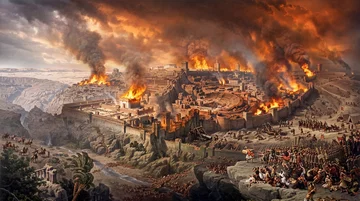
Enemies would throw up a trench around Jerusalem, surround her, hold her in on every side and shut her in.2SP 392.1–393.14RED 124.1–125.1GC 17.14SP 17.1–22SP 393.2–395.1 They would level her even with the ground with her children inside her and leave not one stone upon another.2SP 392.1–393.1DA 569.3–44RED 124.1–125.1GC 17.14SP 17.1–2 The laying level would mean Roman armies encompassing the city and closing it in on every side.2SP 393.2–395.1
Beautiful palaces would be destroyed, and the temple where divine glory was revealed above the mercy-seat would be left in ruins with not one of its walls, lofty pillars and gilded devices left upon another, and the city plowed like a field.ST Feb 15, 18992SP 393.2–395.1ST Feb 15, 1899 Its stones would be thrown down and its inhabitants, including its children, would suffer in its overthrow, its buildings reduced to ruins.DA 569.3–4COS 95.3–6Ms 32, 1898, par. 4–8 The fruitless fig tree represented this destruction of Jerusalem and its temple, whose outward show concealed lack of piety and good works.Ms 32, 1898, par. 4–8
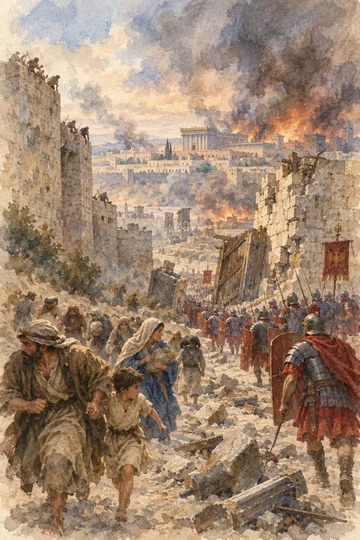
The besieged would be driven to starvation and death, enduring terrible suffering.DA 577.1–3ST Feb 15, 18992SP 393.2–395.1 Natural affection would be destroyed by hunger so that mothers fed on their own children and parents and children snatched the last morsel from one another, with torture on the rack and crucifixion.DA 577.1–32SP 393.2–395.1 The same stubbornness that rejected salvation would lead to refusing the only remaining safety in submission to the invading armies.2SP 393.2–395.1
The doom was sealed that night, and about forty years later the Roman army utterly destroyed and burned the city.COS 95.3–6COS 96.1Ms 7a, 1886, par. 17–18 No human power could stop it even when Titus tried to save the temple, and the temple was completely destroyed with not one stone left upon another.Ms 7a, 1886, par. 17–18 Christians escaped without one perishing because they heeded the instruction to flee to the mountains when Jerusalem was compassed with armies, for whom God had prepared a refuge.Ms 7a, 1886, par. 17–18
Jerusalem's temporal destruction was only the first measure of judgment, pointing to the final judgment.Ms 134, 1902, par. 2–3GC88 21.3COL 302.3–6 It foreshadowed the destruction of the world at Christ's second advent.Ms 134, 1902, par. 2–3COL 302.3–6Ms 134, 1902, par. 10 It also stands as a symbol of a world that rejects truth, where those who refuse Christ's offer of life remain in bondage to sin and face the second death, as transgression of divine law brings destruction as with the antediluvian world and Sodom.Ms 134, 1902, par. 104SP 22.1–2 Bible history is to be repeated in transgressing cities destroyed by earthquake, fire and flood through unseen agencies, when one touch of the rightful Ruler brings idolatrous possessions and accumulated riches to nothingness despite scientific safeguarding of buildings, because injustice, grasped masterly power, oppressive man-made unions bringing confusion, violence and strife, and manipulation of power to rule men and acquire means by underhand deception cannot be passed by in silence, for every lie framed is strictly accounted and every transgressor rewarded according to works, though if warnings are heeded and churches repent and return to allegiance other cities may be spared for a time, while those continuing in deception, disregarding divine law and presenting falsehoods are allowed to suffer calamity that their senses may be awakened.4MR 90.5–91.3
What Acceptance Offered
Had Jerusalem accepted Christ, she could have been healed of her grievous malady, freed from bondage, and saved from utter ruin, for He alone could heal, liberate, and save her.2SP 392.1–393.14RED 124.1–125.1ST Jun 8, 1882Lt 16, 1895, par. 12 Refusing to come to Him for life left her unsaved, though He had come among her to heal and save from destruction.ST Mar 15, 18831T 504.2–505.2Lt 16, 1895, par. 12 The same refusal that rejected truth and followed its own ways is what puts others in danger of ruin.Lt 16, 1895, par. 12
Instead of ruin she might have stood in prosperity as queen of kingdoms, free in God-given power, with no armed soldiers at her gates and no Roman banners on her walls.2SP 392.1–393.1COS 95.3–6 She could have been established as the mighty metropolis of the earth, the world's diadem of glory, from which peace would go to all nations, and could have stood forever.2SP 392.1–393.1COS 95.3–6 Had they heeded His teaching and accepted Him, the calamity of Roman destruction and burning about forty years later need not have come.COS 95.3–6ST Feb 15, 1899
She would have been exalted as a center of truth and peace, glorifying God above other nations by obedience to His commandments and laws.ST Feb 15, 1899Ms 119, 1898, par. 6–7Lt 195, 1899, par. 6 Obedience would have put the nation in right relation to Him, and He would have protected them.Ms 119, 1898, par. 6–7Lt 195, 1899, par. 6 Disobedience and disregard of His Word and of Christ as God's provision to save brought ruin upon themselves and their children.Ms 119, 1898, par. 6–7Lt 195, 1899, par. 6
Christ came as the only One who could heal her wound, break the yoke from their necks, and give peace, hope, rest, triumph and victory.Ms 123, 1909, par. 21–224RED 122.2–123.2Ms 7a, 1886, par. 3 He came to clothe the people with His righteousness, but they rejected Him and put that blessing away.Ms 7a, 1886, par. 3ST Jul 26, 1899 Their guilt in rejecting their Redeemer was matched by what they might have been had they accepted Him, and pronouncing the sentence of coming destruction was an agony to Him.4RED 122.2–123.2ST Jul 26, 1899
Had the Jews been loyal to God, heaven would have shielded them.RH Nov 13, 1900 Instead, because they abused privileges and mercies and let the day of grace pass in rebellion, the temple would be burned, the nation dispersed, and its descendants left without a sure home.RH Nov 13, 1900
Why They Missed
They did not know the time of their visitation because pride, unbelief, self-sufficiency, indifference, and sinful neglect of light and signs already given blinded them, so the Lord passed them by and revealed truth to humble people who welcomed the light they had. GC88 316.1GC 315.3–316.14SP 200.1–2GC88 314.2GC 313.1–315.2
They had prophecies identifying the Messiah's birthplace and the time of His advent, yet they did not prepare for Him or proclaim His arrival. GC 313.1–315.2
The humble shepherds and the Gentile magi, who heeded the light they had received, were ready to welcome Him while the leaders were left unaware. GC 315.3–316.14SP 200.1–2GC 313.1–315.2
The same pride, ambition, and neglect that kept them from discerning the signs of the times threatens to repeat the failure again. GC88 316.1GC88 314.2GC 313.1–315.2
They misinterpreted and misapplied the word of God, and therefore knew not the time and manner of Christ's first appearing. DA 235.1Ms 112, 1897, par. 9–10Ms 41a, 1896, par. 33
They had the testimony of Daniel, the testimony of Isaiah and other prophets, the teaching of Moses, and Christ Himself in their midst declaring the fulfillment of every detail of His ministry in their hearing, yet they searched the Scriptures for evidence of His coming while blind to Him and to what they were doing to Him. Ms 112, 1897, par. 9–10Ms 41a, 1896, par. 33DA 241.4
They ascribed the glories of the second appearing to His first advent, and in that blindness did to Christ the very things prophesied they would do, thus fulfilling Scripture. Ms 41a, 1896, par. 33
The visitation was the years of the ministry of Christ and His apostles, the precious last years of grace and day of privilege to the chosen people, but absorbed in earthly ambitions they rejected the offer of the spiritual kingdom and spent those years plotting the destruction of the Lord's messengers. DA 235.1
Honest, earnest, prayerful, humble searching of God's word to test their theories would have made them acquainted with the evidence of His Messiahship, and the same misreading and misinterpreting continues in the present day when the kingdom of this world absorbs thoughts so men take no note of rapidly fulfilling prophecies and tokens of the swift-coming kingdom of God. DA 235.1Ms 41a, 1896, par. 33DA 241.4
Absorbed in earthly ambitions, they longed for a conqueror who would give temporal power, free them from the Roman yoke, and give health, strength, riches, power and honor. 4RED 98.12SP 283.3–285.1Ms 32, 1898, par. 9–10
Their enthusiasm cooled when they saw that becoming His disciples meant living righteous lives, denying self and suffering humiliation, and their carnal hearts would not receive His pure and exalted doctrine that He is the bread come down from heaven. 4RED 98.12SP 283.3–285.1
They wanted the food, the meat, that perishes and not that which endures to everlasting life, seeking earthly riches and glory, and they had no relish for words that taught personal purity and thorough reformation of life. 4RED 98.12SP 283.3–285.1
When the promised One, the fulfillment of their sacred types and ceremonies, came among them, ambition and mistaken expectations about His advent, along with human traditions that obscured God's law, blinded them to who He was. Ms 32, 1898, par. 9–10
Israel was first offered the opportunity to receive Christ and become a messenger of the gospel to the world, but the leaders' jealousy and distrust became hatred, and the people turned away from Jesus so that He left Jerusalem to proclaim His message to others who would carry it to all nations. DA 231.3–232.1
They closed their eyes and ears to the divine evidences set before them in Jesus' teaching with divine authority and His miracles, and did not recognize the time when God visited them. 3RED 40.1–2ST Mar 10, 18812SP 177.2–179.1ST Feb 22, 1877
While He freed the demon-possessed in their synagogue, even devils believed and trembled and confessed Him as the Holy One of God, but Israel refused to see and hear the truth brought before them. 3RED 40.1–2ST Mar 10, 18812SP 177.2–179.1ST Feb 22, 1877
Their prejudice, narrow hopes for national power, and refusal to test their expectations by Scripture kept them from accepting the evidence of His Messiahship. RH Jul 6, 1911
Their minds were narrowed by bigotry, and because Christ's lessons exposed deficient character and demanded repentance, change of practices, relinquishing of cherished hopes, and sacrifice of human honor, they clung to creed and useless ceremonies instead of accepting the truth of Heaven. DA 241.4
The Jewish leaders rejected Jesus because accepting Him would have required them to give up pride and admit they were wrong, and they also turned others away from Him, rejecting the light because it came in an unwelcome way and hindering others from accepting it. DA 231.3–232.15T 728.1
Not knowing the visitation means having no living connection with God, no appreciation of the Spirit's working, no power to distinguish between the sacred and the common, and no obedience to God's voice in duty, warnings, and messages of grace. STMW10 37.3Ms 22, 1897, par. 21Ms 107, 1899, par. 7
The voice of duty is God's voice, and refusing divine counsel and choosing the way best pleasing to self makes the eyes, the ears, and the heart unimpressible and unable to respond. STMW10 37.3Ms 22, 1897, par. 21
Those who profess to follow Christ can be so affected by Satan's influence and by teachings that obscure Christ's value that they do not recognize when Christ visits them and remain blind to the treasure of truth in Christ. Ms 21, 1890, par. 10–13Lt 4, 1889, par. 44–47
Christ, sent to reveal the Father, brought truth and blessing with enough light to recognize the visitation, but they rejected the light so that what could have been their greatest blessing became a stumbling block and the things belonging to their peace were hidden from their eyes. Ms 107, 1899, par. 7Lt 4, 1889, par. 44–47
Those who do not know it are not cured but remain selfish, covetous and idolatrous, misapplying resources, defiling God's sacred place, and handling holy things with uncleansed hearts and hands as common things, unable to distinguish between honor and rectitude and dishonor and fraud while Satan rules their minds and hearts. Ms 107, 1899, par. 7
Knowing the day requires being cleansed by the renewing of the mind, seeing what wrong action has resulted in, and fearing and trembling at standing before God, for unbelief brings spiritual darkness and the ignorance caused by rejecting light does not excuse. Ms 107, 1899, par. 7Lt 4, 1889, par. 44–47
Warning Beyond Jerusalem
The grief over Jerusalem reaches beyond the Jews to the close of time, addressing all through the centuries who repay love and admonitions with selfishness, neglect and unconsecrated lives.4T 187.24T 191.3–192.1ST Aug 15, 1878ST Mar 9, 1876ST Jan 10, 1878 Failing to recognize the time of divine visitation brings retribution proportionate to light, for those who have had years of light, privileges, warnings, correction and opportunities to develop Christian character yet remain hardened and unworthy of their profession are accountable for gifts entrusted to them.Lt 11, 1883, par. 18–214T 187.25T 258.1ST Jan 10, 1878 When mercy repeatedly offered with no needed blessing withheld is spurned and salvation refused, retributive justice takes the place of mercy, and continued disobedience desecrates the soul and brings judgment.Lt 11, 1883, par. 18–21ST Aug 15, 1878ST Mar 9, 1876 Those who neglect mercies and blessings in the day of opportunity, scorn counsels and love and despise servants, draw judgments upon themselves and become candidates for wrath, with a retribution more fearful than that of Sodom and Gomorrah or of sinners who never had the light of the gospel.4T 191.3–192.1ST Mar 9, 1876
The Jewish nation in rejection is a symbol of people of all ages who scorn the pleadings of infinite love, and the tears over the city were for the sins of all time and for present impenitence.3SP 9.23SP 12.1 The denunciation of self-righteous Jews contains the condemnation of those who profess to be representatives on earth while their lives continually deny Him, allowing selfishness and love of money and worldly honor to possess the temple of the heart.3SP 9.23SP 12.1Lt 244, 1906, par. 9–10Ms 63a, 1906, par. 13–16 As unholy traffic then desecrated the temple courts, so selfishness, love of the world, malice, envy and unholy passions now defile the temple of the heart where Christ should dwell.3SP 12.1 Great light, reproofs, entreaties, warnings and yearning love once given to the Jews are now given in the same way, yet messages sent to warn sinners of danger and rouse them to repentance are received as idle tales, many professing godliness remain as unsanctified as the Pharisees, and thousands reject the light of truth because it involves a cross and does not harmonize with their practices and natural inclinations.3SP 12.1
Churches and individuals repeat Jerusalem's mistake when despite years of warnings, correction and instruction they remain hardened by unbelief, unconsecrated, unholy and at ease, disregarding truth and special directions given.5T 258.15T 72.2TBC1882 54.2–3 The great sin of neglecting and rejecting present opportunity, with impenitence, ingratitude and rejection of love, mercies, warnings and messengers, is seen among professed followers through the end of time, for whom grace resisted, privileges abused and opportunities slighted treasure up wrath against the day of wrath.5T 72.2TBC1882 54.2–3Lt 125, 1886, par. 3 Jerusalem stands as a warning to churches and to Battle Creek, for a long departure from just and righteous principles in unjust and selfish ways repeats Jerusalem's sin and can leave people unable to discern light, truth, justice or mercy or feel repentance, moving toward an outcome God sees even when they do not.8T 68.1STGC 38.2–39.1 Where earnest, vital piety should be expected there is insincerity, hollow formalism and pharisaic pride, and ingratitude for mercies and abuse of blood-bought privileges by those entrusted with great and solemn truths stand registered against many in the books of heaven, with vengeance surely visited upon those who have so great light yet are so cold and unimpressible that no light shines from them to the world.Lt 125, 1886, par. 3
The churches now do not know the time of their visitation, being asleep to danger and in darkness and error, and exposed to destruction.AAC 2.2MC 7.46T 315.3CEv 8.1 They must be awakened by watchmen ringing the warning bell, for a large work of warning messengers is to be done to awake sleepers to a sense of danger.MC 7.4RH Jan 1, 1901CEv 8.1Lt 3, 1913, par. 3 Canvassers going forth in the name of the Lord are those messengers, and the churches can often best learn the truth through their efforts.MC 7.46T 315.3RH Jan 1, 1901 They bring reading matter with truth to those who otherwise would never hear it, giving to multitudes in darkness and error the glad tidings of salvation through Christ in obeying the law of God, and all who consecrate themselves to work as canvassers assist in giving the last message of warning to the world.AAC 2.2RH Jan 1, 1901CEv 8.1Lt 3, 1913, par. 3
The phrase time of visitation applies to the present warning of the soon approach, when the last message of mercy is to be given to prepare a people to stand while everything that can be shaken is shaken so that only what cannot be shaken remains.Ms 47, 1906, par. 19Lt 54, 1906, par. 13–14 Fires, floods and earthquakes warn the inhabitants of the earth that the Lord's coming and the day of judgment are near, and the destruction of San Francisco with other calamities calls people to recognize their visitation and prepare.ACSMHFP 6.6LSEGW 412.3Ms 47, 1906, par. 19Lt 115, 1903, par. 7 God's forbearance holds back judgment while the warning message is given, and this period of restraint calls for urgent efforts to help people recognize the approaching day and prepare.ACSMHFP 6.6 To know the visitation requires turning from unimportant things and giving self to God, humbling self before Him and seeking Him with the whole heart, and those who do so will find Him.Lt 54, 1906, par. 13–14
Paris, like Jerusalem, had a chance to receive the gospel when it was preached there for two years as an offered message of peace.GC88 222.2–223.1GC 222.2–223.1 Most people rejected it, the opportunity passed, the churches were closed and the stake was set up.GC88 222.2–223.1GC 222.2–223.1 Failing to recognize that time of divine visitation meant the loss of peace with judgment and persecution following.GC88 222.2–223.1GC 222.2–223.1
The same failure is seen in refusing present truth at Minneapolis despite clear warnings, with perceptions growing confused so that further privileges may not come.Lt 8, 1898, par. 22–27 Those settling at Mountain View are under a spell that must be broken, with a great work to be done among them in the home church, and God calls them to awake and recognize their visitation.Ms 173, 1905, par. 17 Not knowing the day of visitation means making and continuing to make large human calculations after message after message has not been received and believed, instead of being humble enough to repent and find one's true position, as seen when continued human calculations persist even though the Lord still has His hand stretched out to save if there is humbling and repentance.STB 385.2–3Ms 9, 1906, par. 2MWISDAP 42.4–5 Dishonest business and selfish use of time show failure to respond, neglecting the chance to work for cities given over to idolatry brings accountability in the final reckoning, and gathering too many interests at Battle Creek like Jerusalem while neglecting other cities and unwarned places repeats the neglect.Ms 150, 1902, par. 18–19Lt 8, 1898, par. 22–27
Failing to recognize God's time of visitation when He sends a message of mercy brings calamity and destruction, while accepting His guidance would bring protection and salvation, and refusing it in pride leaves people to follow their own plans and reap what they have sown.HSFM 206.5Ms 85, 1893, par. 39T 97.26T 426.2 The destruction foretold points beyond Jerusalem itself to an impenitent world doomed to destruction, a solemn warning of final judgment in the last great day upon people unaware of what is ahead.Ms 122, 1909, par. 24–26Ms 85, 1893, par. 3 The time of destructive judgments is also a time of mercy for people who have had no opportunity to learn the truth, upon whom God looks tenderly and still offers salvation, while the door is closed to those who refused to enter.9T 97.2 God is presently exercising forbearance with angels holding back the winds, but this restraint will not last indefinitely.6T 426.2 Not knowing the time brings loss, withheld blessings and salvation, blunted perception mistaking good for evil, and being left unprepared when the day of God comes unexpectedly as a snare upon those engrossed in business like Lot's family at Sodom.Lt 8, 1898, par. 22–27 Knowing it requires cleansing, repentance not to be repented of, fearing before God, loving every soul purchased with blood, and coming to Jesus who gave His life and warning one another house to house with publications on the right hand and on the left, putting on the whole armor and standing because the war is not against flesh and blood but against principalities and powers in high places.Ms 122, 1909, par. 24–26Ms 188, 1905, par. 16–18
The same sorrowful lament applies to a professed Christian church joined to the world and the papacy, for those who have received great light may reach a point when the things belonging to their peace are hidden from them after the opportunity has passed.RH Oct 8, 1901 Judgment is coming when that opportunity has passed, yet Christ is still pleading with sinners.RH Oct 8, 1901
Sources