Luke 22:23
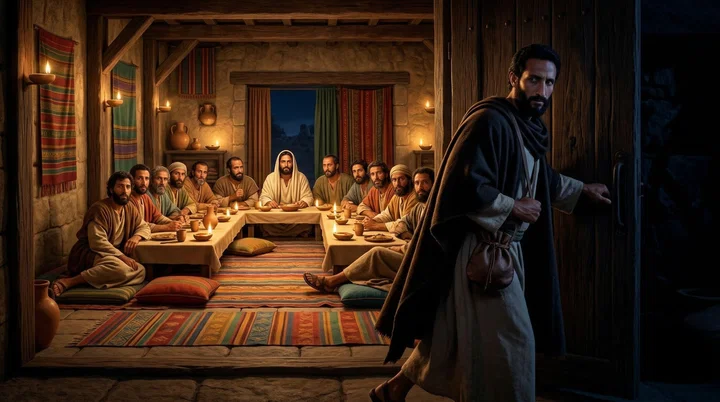
And they began to enquire among themselves, which of them it was that should do this thing.
Translations
American King James Version, KJV Cambridge Paragraph Bible, Webster Bible, Douay-Rheims (Challoner revision)
And they began to inquire among themselves, which of them it was that should do this thing.
And they began to enquire among themselves, which of them it was that should do this thing.
Revised Version, American Standard Version
And they began to question among themselves, which of them it was that should do this thing.
And they began to reason among themselves, who then of them it may be, who is about to do this thing.
And they began to question together among themselves who then it could be of them who was about to do this.
And, they, began to be enquiring together, among themselves, as to which, then, it could be, from among them, who, this thing, was about to perpetrate!
Berean Standard Bible, Majority Standard Bible
Then they began to question among themselves which of them was going to do this.
They began to question among themselves which of them it was who would do this thing.
And they were wondering among themselves which of them it was who would do this thing.
Then they began to enquire among themselues which of them it should be, that should do that.
Pictures
Cross-references
- Matthew 26:21-25
And as they did eat, he said, Verily I say unto you, that one of you shall betray me.
The disciples ask which of them will betray Jesus, and Judas responds.
- Mark 14:18-21
And as they sat and did eat, Jesus said, Verily I say unto you, One of you which eateth with me shall betray me.
Jesus announces a coming betrayal, and the disciples question who will do it.
- John 13:21-30
When Jesus had thus said, he was troubled in spirit, and testified, and said, Verily, verily, I say unto you, that one of you shall betray me.
Describes the disciples’ questions, Judas receiving the sop, and his departure.
- John 13:18
I speak not of you all: I know whom I have chosen: but that the scripture may be fulfilled, He that eateth bread with me hath lifted up his heel against me.
Judas’s betrayal fulfills the prophecy about one who ate bread with him.
- Psalms 41:9
Yea, mine own familiar friend, in whom I trusted, which did eat of my bread, hath lifted up his heel against me.
The verse foretells betrayal by a trusted companion, fulfilled by Judas.
- John 13:30
He then having received the sop went immediately out: and it was night.
Says Judas left immediately after receiving the sop.
Commentary
Each commentary is drawn from primary sources: the writings of Ellen G. White and Adventist pioneers and periodicals. Each commentary is separate. Its own words are not a quotation; follow the references to read the source passages.
Ellen G. White
3 sources
The inquiry began after Jesus announced that one of His own disciples would betray Him, declaring that the hand of His betrayer was with Him on the table and pronouncing woe upon that man.Lt 195, 1903, par. 3–7Ms 19, 1897, par. 30–33DA 654.1–2 In response the disciples began to ask and dispute among themselves which of them it was that would do this thing.Lt 195, 1903, par. 3–7Ms 19, 1897, par. 30–33DA 654.1–2 This occurred on the last evening Jesus spent with them, after the last Passover supper, as they were preparing to share the Passover and to establish the ordinance of foot washing.Lt 195, 1903, par. 3–7Ms 19, 1897, par. 30–33 At that same time they were also disputing over who should be accounted greatest, comparing their own abilities and qualifications for advancing the kingdom.Ms 19, 1897, par. 30–33
Their questioning arose not from suspicion of one another but from searching their own hearts in fear and self-distrust, each wondering whether he himself might prove to be the betrayer.DA 654.1–2 The very fact that they inquired among themselves in this way shows that they did not suspect Judas.DA 654.1–2 The record stands as one that those who are full of assurance and self-confidence that their course is right should study carefully.Lt 195, 1903, par. 3–7 It warns against presumptuous self-confidence such as Peter's, which led to his fall, and teaches the need for strong, persevering faith and entire trust in Christ as Leader, for strength lies not in what poor finite beings suppose they can do but in what Christ will do for them.Lt 195, 1903, par. 3–7
Sources
Pioneers and periodicals
9 sources
The setting is the Passover supper on the evening of the betrayal, the night before the crucifixion, in the room where the Passover was celebrated.ST Oct 29, 1894ST Nov 22, 1883ST May 28, 1896 At the table Jesus told the disciples that the hand of His betrayer was with Him on the table and that one of them would turn against Him.ST Oct 29, 1894 The verse records that they then began to enquire among themselves which of them it was that should do this thing.ST Oct 29, 1894RH Jul 6, 1868ST Nov 22, 1883
The full record of that table conversation is found by reading Luke 22:21-23 together with Matthew 26:21-25 and Mark 14:18-21. Settling the relative time when the Passover was eaten and the memorial was instituted requires careful comparison of the united testimony of Matthew, Mark, Luke and John.RH Jul 29, 1873 Their inquiry was accompanied by a dispute over who should be accounted greatest, revealing pride and self-interest while they still failed to grasp the lesson on conversion and humility.RH Jul 6, 1868 They compared their gifts and works to exalt themselves rather than to serve.RH Jul 6, 1868
Humble self-examination, awareness of weakness, and watchfulness against temptation would have exposed their need of conversion.RH Jul 6, 1868 By showing that He knew Judas's thoughts and purpose, Jesus gave him convincing evidence of His divinity and one final chance to repent. Judas was alarmed but did not repent, and became more firmly set on carrying out the betrayal.
The betrayal was Judas's: he received the dipped sop and left before Jesus instituted the Lord's Supper, so he was not present for that memorial supper.ST Nov 22, 1883ST The others remained and joined in the solemn hymn.ST A casual reading of Luke 22:14-23 places Judas present and partaking when Christ instituted the memorial of His death, so the verse bears on whether Judas was present at the institution and had part in the divine memorial, a point that bears on close communion.RH Jul 29, 1873RH Jul 29, 1873RH Nov 4, 1873
Those who pressed the communion question held that the decisive question is not whether Judas was present, but whether Christ or His apostles drove him away rather than letting him examine himself and so eat, and whether any man or set of men has power and right to call this and that one unworthy and drive them away from the Lord's table.RH Nov 4, 1873 The verse stands at the beginning of the chain after the supper in which Jesus and His disciples went to the Garden of Gethsemane, where He prayed in agony and where Judas betrayed Him.ST May 28, 1896 This was followed by the hearing at the house of Caiaphas, Peter's denial, the mock trial before the Sanhedrin, the visits to Pilate and Herod after daybreak Friday morning, the release of Barabbas, the condemnation of Jesus, and the carrying of the cross by Simon the Cyrenian to Calvary.ST May 28, 1896
This happened in the spring of A.D. 31, when Tiberius Caesar was ruler of the Roman Empire, Herod was tetrarch of Galilee, and Pontius Pilate was governor of Judea.ST May 28, 1896 In that chain Jesus was seized and taken first to one place, then to another, then sent before another, then sent back to Pilate.ST Nov 19, 1894 Pilate spoke to the priests and rulers, bore witness that he found no fault in Jesus, yet proposed to chastise Him, was answered by the cry to release Barabbas in His stead and to crucify Jesus, yielded and gave sentence as they required, released Barabbas and delivered Jesus to their will.ST Nov 19, 1894 Jesus was then led away with Simon compelled to bear His cross, followed by mourners, whom Jesus told to weep for themselves and their children.ST Nov 19, 1894
Sources