Mark 14:18
And as they sat and did eat, Jesus said, Verily I say unto you, One of you which eateth with me shall betray me.
Translations
And as they sat and did eat, Jesus said, Truly I say to you, One of you which eats with me shall betray me.
King James Version, KJV Cambridge Paragraph Bible
And as they sat and did eat, Jesus said, Verily I say unto you, One of you which eateth with me shall betray me.
And as they sat, and were eating, Jesus said, Verily I say to you, One of you who eateth with me, will betray me.
Revised Version, American Standard Version
And as they sat and were eating, Jesus said, Verily I say unto you, One of you shall betray me, even he that eateth with me.
and as they are reclining, and eating, Jesus said, 'Verily I say to you — one of you, who is eating with me — shall deliver me up.'
And as they lay at table and were eating, Jesus said, Verily I say to you, One of you shall deliver me up; he who is eating with me.
And, as they were reclining and eating, Jesus said—Verily, I say unto you—One from among you, will deliver me up, he that is eating with me.
Berean Standard Bible, Majority Standard Bible
And while they were reclining and eating, Jesus said, “Truly I tell you, one of you who is eating with Me will betray Me.”
As they sat and were eating, Jesus said, “ Most certainly I tell you, one of you will betray me— he who eats with me.”
And while they were seated taking food, Jesus said, Truly I say to you, One of you will be false to me, one who is taking food with me.
And as they sate at table and did eate, Iesus said, Verely I say vnto you, that one of you shall betray me, which eateth with me.
Douay-Rheims (Challoner revision)
And when they were at table and eating, Jesus saith: Amen I say to you, one of you that eateth with me shall betray me.
Pictures
Cross-references
- Matthew 26:21
And as they did eat, he said, Verily I say unto you, that one of you shall betray me.
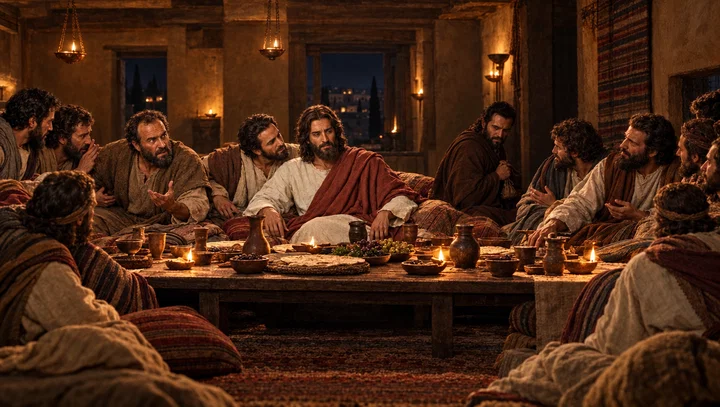
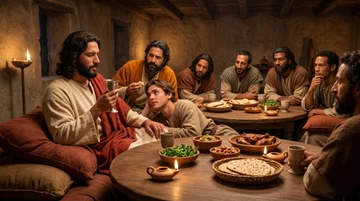
Jesus announces during the meal that one of the disciples will betray him.
- Luke 22:21
But, behold, the hand of him that betrayeth me is with me on the table.
Jesus announces the betrayer’s presence at the supper.
- John 13:21-30
When Jesus had thus said, he was troubled in spirit, and testified, and said, Verily, verily, I say unto you, that one of you shall betray me.
Jesus identifies the betrayer through the shared dish, and Judas leaves the supper.
- Psalms 41:9
Yea, mine own familiar friend, in whom I trusted, which did eat of my bread, hath lifted up his heel against me.
A close companion who shared Jesus’ meal turned against him, fulfilling the prophecy.
- John 13:18
I speak not of you all: I know whom I have chosen: but that the scripture may be fulfilled, He that eateth bread with me hath lifted up his heel against me.
Jesus links betrayal by a table companion with Scripture.
- John 13:30
He then having received the sop went immediately out: and it was night.
Judas leaves the supper immediately after receiving the sop, before the memorial is instituted.
- Luke 22:14-15
And when the hour was come, he sat down, and the twelve apostles with him.
Places Jesus’ Passover meal with the twelve before his suffering.
- 1 Corinthians 11:23
For I have received of the Lord that which also I delivered unto you, That the Lord Jesus the same night in which he was betrayed took bread:
The Supper was instituted on the night Jesus was betrayed.
- Matthew 26:25
Then Judas, which betrayed him, answered and said, Master, is it I? He said unto him, Thou hast said.
Identifies Judas as the disciple who would betray Jesus.
- John 13:26
Jesus answered, He it is, to whom I shall give a sop, when I have dipped it. And when he had dipped the sop, he gave it to Judas Iscariot, the son of Simon.
The sop identifies Judas as Jesus’ betrayer during the meal.
- John 6:70
Jesus answered them, Have not I chosen you twelve, and one of you is a devil?
Jesus had earlier identified one of the Twelve as a devil.
- Mark 14:12
And the first day of unleavened bread, when they killed the passover, his disciples said unto him, Where wilt thou that we go and prepare that thou mayest eat the passover?
Identifies the meal’s day as the day the Passover was killed.
- Matthew 26:17
Now the first day of the feast of unleavened bread the disciples came to Jesus, saying unto him, Where wilt thou that we prepare for thee to eat the passover?
Both place the disciples’ Passover preparations on the same day.
- Exodus 12:6
And ye shall keep it up until the fourteenth day of the same month: and the whole assembly of the congregation of Israel shall kill it in the evening.
Gives the appointed time for slaying the Passover lamb.
- Exodus 12:14
And this day shall be unto you for a memorial; and ye shall keep it a feast to the LORD throughout your generations; ye shall keep it a feast by an ordinance for ever.
The Passover commemorated Israel’s deliverance from Egypt.
- Numbers 28:16
And in the fourteenth day of the first month is the passover of the LORD.
Names the fourteenth day of the first month as the Lord’s Passover.
Commentary
Each commentary is drawn from primary sources: the writings of Ellen G. White and Adventist pioneers and periodicals. Each commentary is separate. Its own words are not a quotation; follow the references to read the source passages.
Ellen G. White
5 sources
The announcement was made at the Passover meal on the night of the betrayal, as Jesus stood at the transition from the Passover to the Lord's Supper, the memorial of His coming sacrifice.DA 652.1–2 During the meal He declared that one of the Twelve eating with Him, one of His fellow diners, would betray Him.DA 652.1–2DA 654.1–23SP 85.1–25RED 6.1ST May 23, 1878 He knew beforehand of the hidden betrayal, showing divine foresight.ST May 23, 1878 He spoke while deeply and visibly troubled.3SP 85.1–25RED 6.1
The disciples were astonished and filled with amazement and alarm at the warning.DA 654.1–23SP 85.1–25RED 6.1 Their alarm came because they could not imagine that one who had heard His teaching, experienced His love, and shared close fellowship with Him could act treacherously.5RED 6.1 Each disciple examined his own heart and asked whether he himself was the betrayer.DA 654.1–23SP 85.1–2ST May 23, 1878 Jesus identified the betrayer as the one sharing the dish with Him.DA 654.1–23SP 85.1–2
He said His death would happen as Scripture had foretold.DA 654.1–2 He pronounced woe on the betrayer and warned of the terrible outcome of betraying the Son of man.DA 654.1–23SP 85.1–2 Judas remained silent, and his silence drew the disciples' attention and, with his continued resolve, exposed his guilt.DA 654.1–23SP 85.1–2ST May 23, 1878 When Judas asked whether he was the one, Jesus confirmed it.DA 654.1–2 His knowledge of the betrayal beforehand strengthened the faith of the other disciples when the betrayal came.ST May 23, 1878 The warning also gave Judas a final chance to turn back before carrying out his plan.ST May 23, 1878
Sources
Pioneers and periodicals
20 sources
As they sat eating the Passover together on the evening before his death, Jesus told the Twelve that one of them sharing the meal with him would betray him.RH Dec 10, 1867RH Feb 5, 1914ST Jan 10, 1911 The saying startled and grieved them, and each anxiously examined himself and asked whether he himself was the one.ST May 23, 1878RH Dec 10, 1867 He spoke with foreknowledge of Judas's hidden purpose, giving him a final call to turn back and strengthening the faith of the others when it came to pass, in fulfillment of Psalm 41:9.ST May 23, 1878ST Nov 22, 1883 Judas was pointed out by the dipped sop, refused to repent, and went out at once, so he shared the Passover meal but had no part in the memorial supper Jesus then instituted.ST Nov 22, 1883RH Jul 14, 1863ST The Passover thus pointed beyond deliverance from Egypt to the greater deliverance from sin through his approaching death.ST May 13, 1889ST Nov 15, 1883
Passover Setting and Sequence
The saying belongs to the last Passover before Jesus' death, as He prepared the disciples for what was soon to come, and to the closing events of His earthly life in the last hours leading to His crucifixion and resurrection.ST May 13, 1889ST Mar 10, 1909 Mark's account of those hours gives clear, definite particulars not given by the other evangelists.ST Mar 10, 1909 Jesus and the Twelve were sitting and eating together in the evening after sunset, in the first part of the night.RH Feb 5, 1914RH Mar 20, 1879 That evening meal was on the night the Lord's Supper was instituted, and in the setting where the disciple whom Jesus loved leaned on His breast.RH Aug 19, 1858RH Mar 17, 1874
The meal was eaten on the day the Passover was prepared, when the paschal lamb was killed on the fourteenth day of the first month, at its appointed season.RH Feb 5, 1914RH Jun 24, 1873 In the argument that fixes the date, that day is identified with the first day of Unleavened Bread and with the fourteenth of Abib, which fell on Thursday that year.RH Feb 5, 1914 It took place a few hours before the regular Passover observance, but on the same day, with Jesus' death following at the time marked for the Passover sacrifice between the two evenings.ST Jun 20, 1911
The announcement came after sitting down to supper and after the foot-washing, but before the institution of the Lord's Supper, and studying that order helps reveal the full significance of what Jesus did.ST Nov 22, 1883ST Nov 15, 1883ST Nov 15, 1883 Matthew and Mark give almost precisely the same account in the same proper order, with the sitting down to supper, then the designation of the betrayer, then the Lord's Supper.ST Nov 15, 1883 Luke does not follow the same order and alone mentions the strife among the disciples, while John says nothing about the Lord's Supper and alone gives the detailed foot-washing.ST Nov 15, 1883 John's account is the most complete in details and the basis for arranging the events.ST Nov 15, 1883
Betrayal Announced and Answered
During the shared meal Jesus, appearing troubled, announces that one of his table companions eating with him, one of the Twelve, will betray him, making betrayal by a close companion the sorrowful setting for his warning.RH Dec 10, 1867ST Jan 10, 1911 The announcement startles the disciples and fills them with sorrow, amazement, and consternation, since they cannot imagine that one so closely sharing his teaching and love would act treacherously.RH Dec 10, 1867 They anxiously examine their own hearts and each asks whether he himself is the one, showing their confidence in one another and their unwillingness to suspect another as much as themselves.ST May 23, 1878RH Dec 10, 1867ST Aug 12, 1886ST Jan 10, 1911ST
While the others ask, Judas remains silent, and his silence with continued resolve exposes his guilt.ST May 23, 1878ST Aug 12, 1886 Those who held the other account have it that Judas also asked whether he was the one, though he was the betrayer.ST Jan 10, 1911 Jesus designates the betrayer by giving him a dipped sop.ST Nov 22, 1883 Judas is surprised and alarmed by being exposed but does not repent, and becomes more firmly set on his plan.
Having received the sop he goes immediately out to carry it through, so although he shares the Passover meal he does not stay to sing the solemn hymn with the others.ST Nov 22, 1883RH Jul 14, 1863ST Jesus foreknew the hidden betrayal and knew Judas's thoughts and purposes, showing divine foresight and evidence of his divinity, which strengthened the other disciples' faith when the betrayal came.ST May 23, 1878 His warning and dealings with Judas gave him a final chance to turn back and repent before carrying out his plan.ST May 23, 1878
Prophecy Doctrine and Practice
The announcement that one eating with him would betray him fulfills Psalm 41:9 concerning a familiar companion who shared his food turning against him.ST Nov 22, 1883 The Passover in which it was spoken points beyond deliverance from Egypt to the greater deliverance from sin through the Messiah, and the words belong to his explanation of his approaching death and of the memorial that would proclaim it until he comes again.ST May 13, 1889 The events surrounding his death are of the greatest importance because Christian hope depends on them, and studying their order helps reveal the full significance of what he did.ST Nov 15, 1883
The statement was made in the evening after sunset, in the first part of the night, at the beginning of the day in which Peter would deny him three times before the cock crowed just before daylight, proving that the day begins with sunset with the evening first, not at midnight or morning.RH Mar 20, 1879 Judas was exposed while they were eating the Passover and left immediately after receiving the dipped sop by which the betrayer was designated, so he did not remain to sing the solemn hymn with the others.ST Nov 22, 1883ST He was therefore not present when the memorial supper was instituted and had no part in the divine memorial.ST Nov 22, 1883RH Jul 14, 1863RH Jul 29, 1873
A casual reading of Matthew, Mark, and Luke appears to show Judas present and sharing in the Lord's Supper, but the question depends on the order of the Passover meal and the supper's institution.RH Jul 29, 1873 No final conclusion on his presence is given on that ground alone, and his presence or absence is said to bear on but not decide whether Christians may restrict participation.RH Jul 29, 1873RH Nov 4, 1873 The point about his absence is raised as an objection sometimes urged against close communion.RH Jul 29, 1873
Sources