Luke 22:26
But ye shall not be so: but he that is greatest among you, let him be as the younger; and he that is chief, as he that doth serve.
Translations
But you shall not be so: but he that is greatest among you, let him be as the younger; and he that is chief, as he that does serve.
King James Version, KJV Cambridge Paragraph Bible, Webster Bible
But ye shall not be so: but he that is greatest among you, let him be as the younger; and he that is chief, as he that doth serve.
Revised Version, American Standard Version
But ye shall not be so: but he that is the greater among you, let him become as the younger; and he that is chief, as he that doth serve.
but ye [are] not so, but he who is greater among you — let him be as the younger; and he who is leading, as he who is ministering;
But ye [ shall] not [ be] thus; but let the greater among you be as the younger, and the leader as he that serves.
But, ye, not so! On the contrary—the greater among you, Let him become as, the younger, and, he that governeth, as, he that ministereth,
Berean Standard Bible, Majority Standard Bible
But you shall not be like them. Instead, the greatest among you should be like the youngest, and the one who leads like the one who serves.
But not so with you. Rather, the one who is greater among you, let him become as the younger, and one who is governing, as one who serves.
But let it not be so with you; but he who is greater, let him become like the younger; and he who is chief, like a servant.
But yee shall not be so: but let the greatest among you be as the least: and the chiefest as he that serueth.
Douay-Rheims (Challoner revision)
But you not so: but he that is the greater among you, let him become as the younger; and he that is the leader, as he that serveth.
Pictures
Cross-references 20 of 26
- John 13:14-15
If I then, your Lord and Master, have washed your feet; ye also ought to wash one another’s feet.
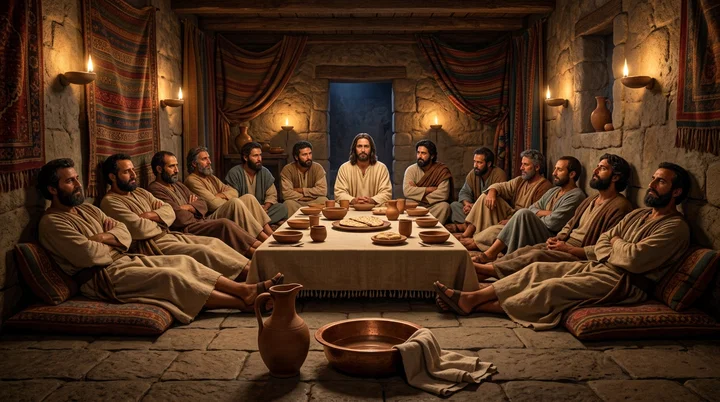
Jesus washes his disciples’ feet as an example of humble service.
- Matthew 20:25-28
But Jesus called them unto him, and said, Ye know that the princes of the Gentiles exercise dominion over them, and they that are great exercise authority upon them.
Jesus contrasts worldly authority with serving and giving his life.
- Mark 10:42-45
But Jesus called them to him, and saith unto them, Ye know that they which are accounted to rule over the Gentiles exercise lordship over them; and their great ones exercise authority upon them.
Jesus teaches the same contrast between greatness and service.
- Philippians 2:3
Let nothing be done through strife or vainglory; but in lowliness of mind let each esteem other better than themselves.
Both urge believers to regard others as greater than themselves.
- Mark 10:43-45
But so shall it not be among you: but whosoever will be great among you, shall be your minister:
Jesus contrasts greatness with ruling and points to serving others, exemplified in his own service.
- Mark 9:35
And he sat down, and called the twelve, and saith unto them, If any man desire to be first, the same shall be last of all, and servant of all.
The first must become last and servant of all.
- Matthew 20:28
Even as the Son of man came not to be ministered unto, but to minister, and to give his life a ransom for many.
Christ’s service to others is the pattern for greatness.
- Luke 9:46-48
Then there arose a reasoning among them, which of them should be greatest.
Both texts contrast the disciples’ pursuit of greatness with Jesus’ teaching on humility.
- Philippians 2:7
But made himself of no reputation, and took upon him the form of a servant, and was made in the likeness of men:
Christ takes the form of a servant and humbles himself.
- Matthew 23:6
And love the uppermost rooms at feasts, and the chief seats in the synagogues,
Both texts condemn seeking chief places and honor.
- Luke 14:7-11
And he put forth a parable to those which were bidden, when he marked how they chose out the chief rooms; saying unto them,
Christ teaches against seeking chief places and urges humility.
- Philippians 2:5
Let this mind be in you, which was also in Christ Jesus:
Christ’s unselfish mind is the example for his followers.
- Matthew 23:8
But be not ye called Rabbi: for one is your Master, even Christ; and all ye are brethren.
Christ is the one Master, and his followers are brethren.
- Mark 12:38-39
And he said unto them in his doctrine, Beware of the scribes, which love to go in long clothing, and love salutations in the marketplaces,
Both condemn seeking prominent places and honor.
- Matthew 23:12
And whosoever shall exalt himself shall be abased; and he that shall humble himself shall be exalted.
Both condemn self-exaltation in leaders.
- John 13:16
Verily, verily, I say unto you, The servant is not greater than his lord; neither he that is sent greater than he that sent him.
Christ teaches that his followers should serve humbly, as he did.
- Matthew 18:1-4
At the same time came the disciples unto Jesus, saying, Who is the greatest in the kingdom of heaven?
Both guide responsible men to serve humbly.
- 1 Corinthians 9:19
For though I be free from all men, yet have I made myself servant unto all, that I might gain the more.
made self servant unto all
- 1 Peter 5:3
Neither as being lords over God’s heritage, but being ensamples to the flock.
Leaders are warned not to domineer over God’s people.
- 1 Peter 4:10
As every man hath received the gift, even so minister the same one to another, as good stewards of the manifold grace of God.
It calls each person to minister to others.
Commentary
Each commentary is drawn from primary sources: the writings of Ellen G. White and Adventist pioneers and periodicals. Each commentary is separate. Its own words are not a quotation; follow the references to read the source passages.
Ellen G. White
21 sources
Spoken to His disciples at their last supper together before His death, when they were disputing over who should be counted greatest, the verse forbids among His followers the lordship exercised by the kings of the world, where position means self-exaltation and control of others for the leaders' benefit.Ms 115, 1902, par. 1–4Lt 195, 1903, par. 3–7COS 107.1–36MR 24.2–3DA 550.1 In its place it requires that he who is greatest be as the younger and he who is chief as he who serves, making true greatness the taking of the lowest place in humble, mutual service rather than the seeking of honor, rank or supremacy.ED 268.1–3Ms 115, 1902, par. 1–4Lt 195, 1903, par. 3–75RED 5.2–33SP 84.2–4 Jesus enforced this by His own example among them as one who serves, laying aside His garment and washing their feet, even the betrayer’s, as a token of love that exposed their selfish ambition and filled them with shame.Ms 115, 1902, par. 1–4Lt 195, 1903, par. 3–76MR 24.2–3Ms 43, 1897, par. 24Ms 54, 1897, par. 7 There must therefore be no contention for first place and no cherishing of envy and jealousy in striving for supremacy, for such selfish love of dignity and position has no place where Christ dwells in the heart.Lt 50, 1908, par. 27–29STMW7 51.1Lt 55, 1886, par. 23 Those standing in positions of responsibility and trust must not rule as kings or bear rule over their fellow men, but take the humble, serving place, giving wise and unselfish counsel and a safe example without overbearing words or acts.Ms 183, 1898, par. 49–50Lt 290, 1907, par. 5Ms 165, 1902, par. 36–37
Context and Meaning
The words were spoken to the disciples at the last Passover supper held with Him, on the last evening spent with them in the last hours before He offered Himself as a sacrifice, at the last gathering before the crucifixion.Ms 115, 1902, par. 1–4Lt 195, 1903, par. 3–76MR 24.2–3 Their contention over who should be accounted greatest marred that last evening, which heavenly angels witnessed with regret.Ms 115, 1902, par. 1–4Lt 195, 1903, par. 3–7Ms 47, 1897, par. 18–2020MR 149.2–4 At that time Satan made a determined effort to arouse contention among them, and with hearts filled with selfishness and tempers heated by contention they yielded to strife and whisperings, when in a right frame of mind they would have received great blessing.Ms 115, 1902, par. 1–4 Each in wounded pride refused the servant's work of washing feet, and their flushed faces and jealous anger showed ambition opposing humble service.Ms 115, 1902, par. 1–4Ms 54, 1897, par. 7
The dispute was over who would hold the highest place and be most honored in His kingdom, for their desire for rank and honor showed they were not ready to hear what He wanted to teach them before His death.COS 107.1–35RED 5.2–33SP 84.2–4 Despite repeated instruction to the contrary they still expected Him soon to become king and establish a temporal kingdom in Jerusalem, a belief revived by His reception entering the city.5RED 5.2–33SP 84.2–4 The verse forbids among His followers the lordship of the kings of the Gentiles who exercise authority and are called benefactors.Ms 115, 1902, par. 1–4Lt 195, 1903, par. 3–7DA 550.1 It forbids the whole order of the kingdoms of the world, where position means self-aggrandizement, the people are supposed to exist for the benefit of the ruling classes, and influence, wealth and education are means of gaining control of the masses for the use of the leaders.DA 550.1 There the higher classes think, decide, enjoy and rule while the lower obey and serve, religion is a matter of authority with the people expected to believe and practise as their superiors direct, and the right of man as man to think and act for himself is wholly unrecognized.DA 550.1
Instead, he that is greatest among them must be as the younger, and he that is chief as he that serves, so that true greatness is taking the lowest place and doing a servant's work in humility rather than seeking honor, rank, place or self-exaltation.ED 268.1–35RED 5.2–33SP 84.2–4Lt 92, 1900, par. 21–22 This requires mutual obligation and service, that instead of quarreling for place each count the others better than himself, and seeking one's own preference at others' expense is contrary to Christ's example.5RED 5.2–33SP 84.2–4Lt 92, 1900, par. 21–22 Jesus enforced this by His own example among them as he that serves, though exalted and honored and called Lord.Ms 115, 1902, par. 1–4Lt 195, 1903, par. 3–7Ms 43, 1897, par. 24Lt 92, 1900, par. 21–22 Without a word He laid aside His outer garment and girded Himself with a towel as a servant to wash their feet as a last token of love, extending that service even to the disciple who would betray Him.Ms 115, 1902, par. 1–43SP 84.2–4Ms 47, 1897, par. 18–20 The foot-washing ordinance illustrates true humility and calls His followers in every country and age to repeat His act through unselfish ministry.Ms 43, 1897, par. 24
He heard their whisperings and saw their flushed faces, and His action opened their eyes and exposed their selfishness, filling them with shame and humiliation so they saw themselves in a new light they would remember as long as life lasted.Ms 115, 1902, par. 1–46MR 24.2–3 As Christians become more like Jesus and grow in character, they become less eager to honor or exalt themselves.
Humble Service in Practice
There must be no contention over who shall be accounted greatest, no competing for rank, no striving for supremacy, and no struggling to be first and have the supremacy.Lt 50, 1908, par. 27–29Ms 25, 1892, par. 16–1721MR 304.4 Cherishing envy and jealousy is forbidden, for where envy and jealousy are permitted Christ is not in the heart.Lt 55, 1886, par. 23 The thought of seeking to become the greatest must never come into the mind, for selfish principles and love of dignity and position are forbidden.STMW7 51.1 Life is to be lived in Christian fellowship rather than in competition for place.21MR 304.4
Keeping this word means loving the law of God and having the love of Jesus Christ in the heart, and loving one another as Christ loved, loving one's neighbor as oneself.Lt 55, 1886, par. 23 That love prepares for the blessed heaven of peace and rest, where there is no striving for first place or supremacy.Lt 55, 1886, par. 23
It is to be studied carefully by those who are full of assurance and self-confidence that their course is right, as a lesson against presumption and self-trust like that of Peter.Lt 195, 1903, par. 3–7 Strength lies not in what poor finite beings suppose they are able to do, but in what Christ will do for them through strong persevering faith and entire trust in Him as Leader.Lt 195, 1903, par. 3–7 Because growth, development, and success depend wholly on Jesus, no one has grounds to boast of superiority.Ms 25, 1892, par. 16–17
Men standing in positions of responsibility and trust must not be lords and must not rule as kings.Ms 165, 1902, par. 36–37 God will have nothing to do with methods of work where finite men are allowed to bear rule over their fellow men.Lt 290, 1907, par. 5 Those who lead or are considered greatest should take the humble place of the younger and the serving position, not managing matters as though their wisdom were superior to that of their associates, nor claiming unlimited power and authority for themselves.Ms 183, 1898, par. 49–50Lt 290, 1907, par. 5Ms 25, 1892, par. 16–17
A decided change is demanded, so that the voice of command is no longer heard.Lt 290, 1907, par. 5 Those who lead must be men of humility and discretion who conduct the work in the fear of God, acting in submission to God as the chief Director above human minds.Lt 290, 1907, par. 5 The greatest and the chief must serve by giving wise counsel that protects and strengthens God's people, hating every vestige of selfishness, showing they are not narrow-minded, and setting an example that may be safely followed.Ms 165, 1902, par. 36–37 Position gives no liberty to speak impatiently or boastfully or to act in an overbearing manner, scolding and fretting like spoiled children, which dishonors Christ and trails His uplifted standard in the dust.Ms 165, 1902, par. 36–37 Failing here sets a misleading example before all within their influence and imperils the progress of the cause.Ms 165, 1902, par. 36–37
The intelligent, God-fearing, truth-loving canvasser is made equal in position to the gospel minister.STMW7 51.1 Canvassing work is to be done as missionary work from a missionary standpoint, without unfaithfulness or selfish motives such as selling only the cheapest and easiest books for greater earnings instead of placing before the people the books that give most light.STMW7 51.1 Ministers themselves are called to do this most precious ministry of canvassing, to obtain a varied experience in the very house-to-house work Paul did.STMW7 51.1 Christian physicians show the same rule by recognizing one another as fellow workers and members of the same household of faith, with no selfish barriers or rivalry.Ms 25, 1892, par. 16–17
Love and loyalty to Christ are the source of all true service, creating in the heart a desire to work for Him that should be encouraged and rightly guided.ED 268.1–3 In the home, the neighborhood, and the school, the poor, the afflicted, the ignorant, and the unfortunate are not a misfortune but a precious opportunity for service.ED 268.1–3 Skill in this service is gained only by doing it, through training in the common duties of life and in ministry to the needy and suffering, and without that practical training even the best-meant efforts are useless and harmful.ED 268.1–3
Sources
Pioneers and periodicals
49 sources
Spoken while the disciples were disputing which of them should be counted greatest, it rebukes the desire for pre-eminence and rank above one another.ST Mar 23, 1888ST Jan 10, 1911ST May 8, 1884 In contrast to the kings of the Gentiles who exercise lordship and authority over one another, it shall not be so among Christ's followers, but he that is greatest must take the place of the younger and he that is chief must act as he that serves.ST Oct 29, 1894ST Sep 27, 1910ST Mar 23, 1888ST May 21, 1896ST Jun 26, 1901 Jesus himself was among them as one who served, and he strengthened the teaching by washing their feet, making self-forgetting service rather than being served the pattern of true greatness.ST May 21, 1896ST Apr 19, 1905ST Nov 15, 1883RH Aug 31, 1911ST Oct 5, 1882 This is the true principle of the heavenly kingdom, the reverse of the rule of this world, where greatness is measured not by lordship or amassing property but by lowliness and seeking to serve others and make them happy.ST Oct 14, 1913RH Oct 15, 1901ST Mar 25, 1903 There is therefore to be no lordship in the church of Christ, for believers are brethren under one Master to minister to one another, and the apostles are forbidden to assume rank over one another in lordly manner, so Peter is not presented as a prince ruling over the others.ST Nov 30, 1904ST Nov 20, 1901ST May 8, 1884ST Oct 29, 1894ST Mar 30, 1904
Setting and Occasion
The saying was given when the disciples were disputing which of them should be counted greatest, to rebuke their desire for pre-eminence and rank above one another.ST Mar 23, 1888ST Jan 10, 1911ST May 8, 1884RH Jan 27, 1916RH Jun 4, 1914 Their repeated quarrels over who should be considered greatest revealed ambition and unworthiness, with self-esteem and selfishness still governing them and confidence in their own fitness to lead.RH Jan 27, 1916RH Jun 4, 1914 Even boasting to be more faithful than the others belonged to the pride thus rebuked, yet love remained faithful to them through the coming crisis.ST Jan 10, 1911RH Jun 4, 1914
The dispute took place before the supper and the washing of the feet, which occurred near the beginning of the meal.ST Nov 15, 1883ST Jul 30, 1885 The instruction on humility was therefore given in connection with the foot washing, as a reproof for their contention over precedence and as a lesson that greatness is shown by taking the lower place and serving.ST Nov 15, 1883ST Jul 30, 1885
It belongs to the night of the Passover supper in the spring of A.D. 31, in Luke's account of the institution of the Lord's Supper.STST May 28, 1896 It was taught at the Last Supper, at the last gathering before the crucifixion, and was repeated there while the disciples were still disputing which of them was greatest.ST Dec 30, 1889RH Feb 10, 1916 The lesson was illustrated by washing their feet, making humble, loving service their memorial.RH Feb 10, 1916
That night led to going to Gethsemane where prayer was offered in agony, then to betrayal by Judas, transfer to the house of Caiaphas, Peter's denial, and mock trial before the Sanhedrin.ST May 28, 1896 After daybreak Friday came visits to Pilate and to Herod and back, release of Barabbas the robber, condemnation to the cross, and Simon the Cyrenian carrying the cross to Calvary.ST May 28, 1896 This was when Tiberius Caesar ruled the Roman Empire, Herod was tetrarch of Galilee, and Pontius Pilate was governor of Judea.ST May 28, 1896
Luke 22 records the breaking of bread with the disciples on Thursday evening, showing that breaking of bread was not restricted to the first day of the week and was not required to be done on that day.ST Jan 13, 1881
They quarreled because they still expected a temporal political kingdom to be established in Jerusalem, each wanting dignity and rank in it.ST Feb 11, 1897ST Jul 30, 1885ST Jan 22, 1902ST Jul 21, 1898 That belief was revived by the crowds at the entry into the city and their reception, persisting despite repeated contrary instruction.ST Feb 11, 1897 Their struggle over the place of honor and over who would be most honored reflected a mistaken understanding of a lowly, self-sacrificing mission, like desire for dignity in a political organization and the present-day pursuit of political power by religious leaders.ST Feb 11, 1897ST Jul 30, 1885ST Jan 22, 1902ST Jul 21, 1898
What the saying requires is illustrated by what is said about him that sits at meat and him that serves, showing how it should be among disciples in contrast to lords and masters.ST May 21, 1896 It is linked with words and actions toward little children, that those who are greatest should take the place of the younger and those who lead should serve.
Greatness Through Lowly Service
Greatness among Christ's disciples is not expressed through lordship, status, rank, or self-importance, but in the greatest taking the place of the younger and the chief acting as one who serves.ST Oct 29, 1894ST Sep 27, 1910ST Jun 11, 1896ST Nov 5, 1894ST May 12, 1898 Followers of Jesus must not imitate worldly greatness nor seek status or rule over one another, but must take the low place and serve others.ST May 21, 1896ST Apr 19, 1905ST Jun 11, 1896ST Nov 5, 1894ST May 12, 1898 Leadership among them is shown by serving, with each accepting the place assigned for the greater glory in unselfish devotion to others after the pattern of Jesus, who became a servant.ST Apr 19, 1905ST Jun 11, 1896 That lesson was made a continual memorial by the washing of the disciples' feet, showing that their Lord lived among people as one who served.ST May 21, 1896ST Apr 19, 1905
In contrast to the kings of the Gentiles, who exercise lordship and authority and rule over one another as lords and masters, it shall not be so among Christ's followers.ST Mar 23, 1888ST May 21, 1896ST Jun 26, 1901RH Aug 4, 1910ST Nov 14, 1895 Greatness and leadership among disciples are not to follow the Gentile pattern of ruling over others or exercising dominion, but require the greatest to become as the younger and the chief as he that serves.ST Mar 23, 1888ST May 21, 1896ST Jun 26, 1901RH Aug 4, 1910ST Nov 14, 1895 This principle can prevail only under Christ's leadership, and greatness in his community is expressed through service rather than domination.ST Jun 26, 1901ST Nov 14, 1895
The verse states the true principle of the heavenly kingdom, which is the reverse of the rule of this world.RH Oct 15, 1901ST Mar 25, 1903 Where the world makes self the chief object of thought and effort, anxious about food and drink and clothing and property, and counts great those who amass large property or exercise lordship over others, greatness is measured by lowliness and service.RH Oct 15, 1901ST Mar 25, 1903 True equality and love are practical only in God's kingdom, where none encroaches on the weak for selfish gain, whereas human governments even professing equal rights cannot live by love of neighbor as self but exercise dominion and oppression.RH Oct 15, 1901ST Mar 25, 1903 A life lived on this principle reveals to the world the condescending grace and character of Christ.RH Oct 15, 1901
The kingdom's principle is that each person seeks to serve others and make them happy, so that reigning with Christ is joyful ministry rather than ruling over or tyrannizing others.ST Oct 14, 1913 Being given someone into one's care means serving that person and not lording it over them, for Christian greatness is not authority used to rule over another.RH Jan 2, 1900 No one rules safely unless he has learned to obey gladly.
Christ's Servant Example
Though Lord, Jesus lived among his disciples as one who serves, and so gave dignity to service rendered to God.RH Aug 31, 1911ST Oct 5, 1882 True greatness among his followers is therefore patterned not on being served but on self-forgetting service.RH Aug 31, 1911ST Feb 6, 1901 He was willing to take the lowest place rather than seek rank, coming to serve rather than to be served.ST Oct 5, 1882ST Feb 6, 1901
In the upper room he joined this instruction to the rite of foot washing and to his own example of humility.ST May 21, 1896ST Apr 19, 1905 The washing taught humility by example in reproof of the dispute over who should be counted greatest.ST Nov 15, 1883ST Jul 30, 1885 That dispute came before the supper, with the washing near the beginning of the meal, and at the Last Supper he repeated the lesson on humility and illustrated it by washing their feet.ST Nov 15, 1883ST Jul 30, 1885RH Feb 10, 1916 The struggle over the place of honor reflected expectation of positions in a coming earthly kingdom, which he answered by washing their feet.ST Jul 30, 1885 That washing made the lesson a continual memorial that their Lord had lived among people as one who served.ST Apr 19, 1905
Christ is greatest in the kingdom of God because he has performed the most and the lowest service, and exaltation is found only in serving.ST Oct 29, 1894 Humility is the ground and only ground of preferment in his kingdom.ST Nov 15, 1883ST Jul 30, 1885 Service is the divine test of greatness, so that those who serve most are honored.ST Apr 11, 1911 Humble service and self-abasement are the true title to pre-eminence, in contrast to religious dignitaries who seek honor and deference.ST Feb 6, 1901
His own mind was wholly unselfish and devoted to others in becoming a servant.ST Jun 11, 1896 His disciples are to follow his example in ministry for the greater glory, accepting the place assigned to them.ST Jan 15, 1885ST Jun 11, 1896 No disciple is to seek dominion over fellow believers or lord it over God's people, for his kingdom differs from worldly kingdoms where rulers seek authority and position.ST Jan 15, 1885
Promise of the Kingdom
The saying was spoken to settle a dispute among the disciples over which of them should be counted greatest.ST Mar 23, 1888 It draws a contrast between those who presently possess this world and those to whom it is promised as a future inheritance.ST Mar 23, 1888 The kings of the Gentiles now exercise lordship and authority, but among the disciples it shall not be so.ST Mar 23, 1888 Among them the greatest must become as the younger, and the chief as one who serves.ST Mar 23, 1888 That lowly service now is joined to appointment to a kingdom, to eating and drinking at Christ's table in his kingdom and to sitting on thrones judging the twelve tribes of Israel.ST Mar 23, 1888
Order in the Church
In the church of Christ there is to be no lordship, for lordship is left for the world.ST Jan 15, 1885ST Oct 29, 1894ST Mar 30, 1904 Believers are brethren under one Master and Head, to minister to one another rather than seek dominion or lord it over God's people.ST Jan 15, 1885ST May 8, 1884ST Mar 30, 1904 Modeling the church after the fashion of the world and bringing worldly methods into it breaks this order.ST Oct 29, 1894 Christ came as a servant, and his kingdom differs from worldly kingdoms where rulers seek authority and position, so greatness and leadership among his followers are not measured by power or rank but by taking the humble place of the younger and serving as the chief who serves.ST Jan 15, 1885ST Oct 29, 1894ST Mar 30, 1904
In the church authority is mutual and exercised in love, not in imitation of rulers who lord authority over others.RH Jul 3, 1856 The elder leads, teaches, and keeps order in church business, overseeing and judging disputes by the Bible rather than ruling arbitrarily.RH Jul 3, 1856 The church itself carries out discipline according to the Bible.RH Jul 3, 1856
The saying forever settles the question of supremacy by forbidding the apostles to exercise authority in the lordly manner of Gentile rulers or kings or to assume rank over one another.ST Nov 30, 1904ST Nov 20, 1901ST May 8, 1884 The greatest must take the low place of the younger and the leader must take the place of a servant.ST Nov 30, 1904ST Nov 20, 1901ST Apr 13, 1915 Peter therefore is not presented as a prince or pope ruling over the other apostles, and disciples must not compete to be first or head over one another or claim supremacy over one another.ST Nov 30, 1904ST May 8, 1884ST Apr 13, 1915 This condemns the exaltation of the pope, before whom even an emperor must come in abject humility, under the rule that whoever exalts himself will be abased.ST Nov 20, 1901
While it is divinely willed that worldly princes rule and the mighty have power in secular arrangement, Christ commands it shall not be so among his followers, and worldly ruling power is forbidden in the church.ST Mar 25, 1889 In the life of the church not ruling but serving gives pre-eminence, and not worldly position but living faith is held in esteem.ST Mar 25, 1889 Scripture gives no recognition to church members simply because they are prominent in worldly positions, and for anyone to be granted a pre-eminent place in the church simply because he is a distinguished person apart from faith and walk, including vesting ecclesiastical power in a head of state as a personal matter, violates the letter as well as the spirit of the Bible.ST Mar 25, 1889 The disciples' desire for dignity in a political organization is contrary to this teaching, for Christ's followers must not seek political rank or supremacy.ST Jan 22, 1902 Church politics that becomes a struggle over who will be greatest and who will hold status or office runs contrary to the teaching that the greatest should take the place of the younger and the chief should serve.ST Jan 18, 1899
Kingdom Not Civil Rule
Luke 22:25-27 sets the rulers who dominate others over against Christ's way, in which the greatest takes the place of the younger and the chief serves as Christ himself came to serve.ST Feb 7, 1900 These principles of humble service and nonresistance belong to Christ's kingdom of love and cannot sustain a civil government, which in a sinful world must rely on force to maintain order.ST Feb 7, 1900 True equality and love are practical only in the kingdom of God, where lordship after the manner of the Gentiles is forbidden and greatness takes the lowest place and leadership means serving others so that none encroaches on the weak for selfish gain.ST Mar 25, 1903 Human governments, even those professing equal rights, do not live by the law of loving neighbor as self but exercise dominion and oppression.ST Mar 25, 1903
For gospel work this forbids among disciples the course of the kings of the Gentiles who exercise lordship and authority over others.RH Aug 4, 1910ST Nov 14, 1895 The greatest must be as the younger and the chief as he that serves, so greatness in Christ's community is expressed through service and not domination.RH Aug 4, 1910ST Nov 14, 1895 This rules out force, coercion, and dominion over conscience, and rules out compelling people to submit to church teaching by human laws.RH Aug 4, 1910ST Nov 14, 1895 Disciples are to lead by service, preaching, persuasion, entreaty, and invitation rather than by compulsion or force.RH Aug 4, 1910ST Nov 14, 1895
Christ's followers are not to seek or exercise worldly rule over others, for the one who is greatest is to take the place of the youngest and the chief is to serve.ST Aug 3, 1904 They are to rely on God's government for themselves and not establish an earthly government to rule others.ST Aug 3, 1904 The disciples' struggle over who would be greatest came from wrongly seeking rank and honor in the kingdom they expected Christ to establish on earth, reflecting a mistaken understanding of his mission. That same mistake is repeated in the present-day pursuit of political power by religious leaders.
Humility in Christian Life
Greatness is becoming as the younger and as one who serves, not grasping for place or seeking status and control, with each counting others better than himself and recognizing obligation to one another.ST Feb 11, 1897RH Jan 27, 1916 At the Passover supper the disciples argued over who would be greatest and who would be most honored in the kingdom, because despite repeated contrary instruction they still expected a temporal kingdom in Jerusalem, a belief revived by the crowds at his entry into the city and his reception of them.ST Feb 11, 1897RH Jan 27, 1916 Their confidence in their own fitness to lead showed self-esteem and selfishness still governing them and that they had not grasped the principle modeled in his life, which he strengthened by an act of humility and love.ST Feb 11, 1897RH Jan 27, 1916 Self-love, self-exaltation and pride are weakness, while humility is strength.ST Feb 11, 1897
True dignity is kept not by thinking most of self but by having God in all thoughts with hearts aglow with love for the Redeemer and for fellow men.ST Feb 11, 1897 Learning to think less of self and more of making others happy brings divine strength.ST Feb 11, 1897 Simplicity of character and lowliness of heart bring happiness, while self-conceit brings discontent, repining and continual disappointment.ST Feb 11, 1897
The true principle of the heavenly kingdom is the reverse of the rule of this world, where self is made the chief object of thought and effort in anxiety over what to eat and drink and wear, and those are counted great who amass large property or exercise lordship over others; here greatness is measured by lowliness and service, the greatest becoming as the younger and the chief as one who serves.RH Oct 15, 1901 A life lived on this principle reveals to the world the condescending grace and character of Christ.RH Oct 15, 1901 At the last gathering before the crucifixion the disciples argued over who was greatest while he washed their feet, making humble, loving service their lesson, and as Christians become more like Jesus and grow in character they become less eager to honor or exalt themselves.
The lesson at the Last Supper was taught to the disciples, especially to James and John, the sons of Zebedee.ST Aug 8, 1906ST Dec 30, 1889 Peter had not yet learned it, for his later confidence that he would follow even to prison and death still reflected failure to recognize his own selfish motives and moral weakness.ST Aug 8, 1906 The pride rebuked included the boast to be more faithful than the others and repeated quarrels over who should be considered greatest, revealing ambition and unworthiness, yet through the coming crisis he remained faithful and loved them unto the end.ST Jan 10, 1911RH Jun 4, 1914
Sources