Luke 22:27
For whether is greater, he that sitteth at meat, or he that serveth? is not he that sitteth at meat? but I am among you as he that serveth.
Translations
For whether is greater, he that sits at meat, or he that serves? is not he that sits at meat? but I am among you as he that serves.
King James Version, KJV Cambridge Paragraph Bible
For whether is greater, he that sitteth at meat, or he that serveth? is not he that sitteth at meat? but I am among you as he that serveth.
For which is greater, he that sitteth at table, or he that serveth? is not he that sitteth at table? but I am among you as he that serveth.
For whether is greater, he that sitteth at meat, or he that serveth? is not he that sitteth at meat? but I am in the midst of you as he that serveth.
For which is greater, he that sitteth at meat, or he that serveth? is not he that sitteth at meat? but I am in the midst of you as he that serveth.
for who is greater? he who is reclining (at meat), or he who is ministering? is it not he who is reclining (at meat)? and I — I am in your midst as he who is ministering.
For which [ is] greater, he that is at table or he that serves? [ Is] not he that is at table? But I am in the midst of you as the one that serves.
For which is greater—he that reclineth? or he that ministereth? Is not he that reclineth? But, I, am, in your midst, as he that ministereth,
Berean Standard Bible, Majority Standard Bible
For who is greater, the one who reclines at the table or the one who serves? Is it not the one who reclines? But I am among you as one who serves.
For who is greater, one who sits at the table, or one who serves? Isn’ t it he who sits at the table? But I am among you as one who serves.
For which is greater, the guest who is seated at a meal or the servant who is waiting on him? is it not the guest? but I am among you as a servant.
For who is greater, he that sitteth at table, or he that serueth? Is not he that sitteth at table? And I am among you as he that serueth.
Douay-Rheims (Challoner revision)
For which is greater, he that sitteth at table, or he that serveth? Is it not he that sitteth at table? But I am in the midst of you, as he that serveth:
Pictures
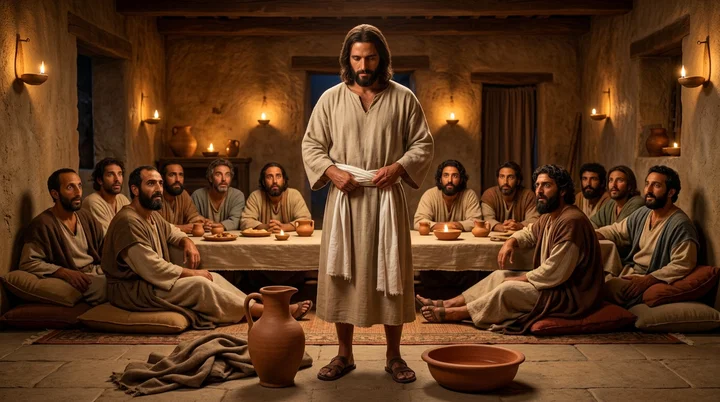
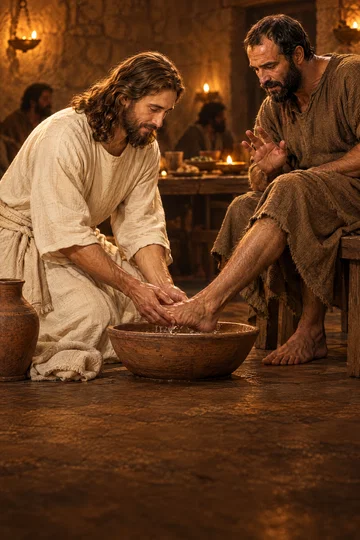
Cross-references 20 of 24
- John 13:14-15
If I then, your Lord and Master, have washed your feet; ye also ought to wash one another’s feet.
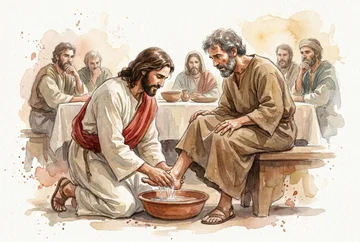
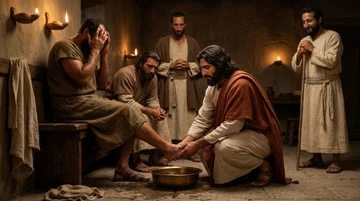
Jesus, their Lord and Master, washes the disciples’ feet as an example of serving.
- Matthew 20:25-28
But Jesus called them unto him, and said, Ye know that the princes of the Gentiles exercise dominion over them, and they that are great exercise authority upon them.
Jesus teaches that greatness means serving, as he came to minister.
- Philippians 2:7
But made himself of no reputation, and took upon him the form of a servant, and was made in the likeness of men:
Christ took the form of a servant.
- Mark 10:45
For even the Son of man came not to be ministered unto, but to minister, and to give his life a ransom for many.
A parallel saying presents Jesus as serving others.
- John 13:4-5
He riseth from supper, and laid aside his garments; and took a towel, and girded himself.
Jesus washes the disciples’ feet to teach humility by example.
- Philippians 2:3
Let nothing be done through strife or vainglory; but in lowliness of mind let each esteem other better than themselves.
Both urge esteeming others above oneself.
- Mark 9:35
And he sat down, and called the twelve, and saith unto them, If any man desire to be first, the same shall be last of all, and servant of all.
Jesus teaches that the greatest is to be last and servant of all.
- Luke 9:46-48
Then there arose a reasoning among them, which of them should be greatest.
Jesus teaches humility after the disciples argue over who is greatest.
- Luke 14:7-11
And he put forth a parable to those which were bidden, when he marked how they chose out the chief rooms; saying unto them,
Christ teaches humility rather than seeking the honored place at a meal.
- Philippians 2:5
Let this mind be in you, which was also in Christ Jesus:
Christ’s servant example models the mind believers are called to have.
- John 13:1
Now before the feast of the passover, when Jesus knew that his hour was come that he should depart out of this world unto the Father, having loved his own which were in the world, he loved them unto the end.
Jesus’ enduring love for his disciples accompanies his humble service at the close of his ministry.
- Matthew 20:27
And whosoever will be chief among you, let him be your servant:
True greatness means serving others, as Christ did.
- John 13:16
Verily, verily, I say unto you, The servant is not greater than his lord; neither he that is sent greater than he that sent him.
Both teach that the master serves and that a servant is not greater than his lord.
- Matthew 23:6
And love the uppermost rooms at feasts, and the chief seats in the synagogues,
Christ reproves seeking the most honored places.
- Philippians 2:8
And being found in fashion as a man, he humbled himself, and became obedient unto death, even the death of the cross.
Christ’s humility came before his obedience unto death.
- 1 Corinthians 9:19
For though I be free from all men, yet have I made myself servant unto all, that I might gain the more.
Paul makes himself a servant to all to win more people.
- Luke 22:21-23
But, behold, the hand of him that betrayeth me is with me on the table.
Both occur in the same last-evening setting.
- 2 Corinthians 8:9
For ye know the grace of our Lord Jesus Christ, that, though he was rich, yet for your sakes he became poor, that ye through his poverty might be rich.
Christ became poor for others’ sake.
- Mark 14
After two days was the feast of the passover, and of unleavened bread: and the chief priests and the scribes sought how they might take him by craft, and put him to death.
named as parallel account of institution
- Mark 12:38-39
And he said unto them in his doctrine, Beware of the scribes, which love to go in long clothing, and love salutations in the marketplaces,
Both texts contrast seeking prominent places with humble service.
Commentary
Each commentary is drawn from primary sources: the writings of Ellen G. White and Adventist pioneers and periodicals. Each commentary is separate. Its own words are not a quotation; follow the references to read the source passages.
Ellen G. White
23 sources
Spoken at the last supper while the disciples were heatedly contending over who should be accounted greatest and still expecting a temporal kingdom, it answered their selfish strife for first place.Lt 195, 1903, par. 3–7Ms 115, 1902, par. 1–4COS 107.1–3 It contrasts the kings of the Gentiles who exercise lordship with the rule that among His own it shall not be so, but the greatest must be as the younger and the chief as one who serves, declaring that He Himself is among them as one who serves.Lt 195, 1903, par. 3–7Ms 115, 1902, par. 1–4 Without a word He proved it by laying aside His outer garment, girding Himself as a servant, and in solemn tenderness washing their feet though Lord and Master.Ms 115, 1902, par. 1–46MR 24.2–35RED 5.2–3 Greatness is thus not lordship but lowly humble service, the law of life in heaven and earth by which the Father and angels minister, and which is written upon all nature where every living and lifeless thing takes in order to give.Ms 115, 1902, par. 1–4ED 103.2Lt 58, 1906, par. 14–15ST Nov 30, 1915ST Feb 3, 1904 His followers are therefore to have no contention for honor or position but to count others better than self, wash one another's feet, and find highest joy in ministering with burning love to the hungry, thirsty, homeless, naked, sick and imprisoned as done to Him Himself.ED 268.1–3Ms 115, 1902, par. 1–4Lt 181, 1903, par. 15–165RED 5.2–33SP 84.2–4
Setting and Meaning
Jesus spoke these words on the last evening He spent with His disciples after the last Passover supper, in the last hours before He offered Himself as a sacrifice for the world.Lt 195, 1903, par. 3–7Ms 115, 1902, par. 1–46MR 24.2–3 It was the disciples' last meeting with Him before His death, at the last sacred gathering before the crucifixion, near the hour of ascending to the Father.COS 107.1–3 He hoped then to speak words that would stay their hearts for the time when He would walk no more with them and they would be left to struggle in the world after His suffering was over.COS 107.1–3 But they were not ready to listen.COS 107.1–3
At that supper there was strife among them over which should be accounted the greatest, stirred even then while the shadow of death was upon Him.Lt 195, 1903, par. 3–7Ms 115, 1902, par. 1–4 They came with selfish hearts and tempers heated by strife, filled with jealous and angry feelings toward one another.Ms 115, 1902, par. 1–4COS 107.1–3 Each refused to take the servant's place and serve the others, held back by wounded pride.Ms 54, 1897, par. 7 They still thought He was soon to be made king and each wanted the highest place in His kingdom, still clinging to the idea of a soon temporal kingdom in Jerusalem, revived by the demonstrations at His entry into the city despite repeated instruction to the contrary.COS 107.1–33SP 84.2–4 Seeking to be first was their great error, bringing sorrow to Him and losing the blessing they would have received in a right frame of mind.Ms 115, 1902, par. 1–4
To meet this He set His followers over against the kings of the Gentiles who exercise lordship and are called benefactors, commanding that it shall not be so among them.Lt 195, 1903, par. 3–7 Among them he that is greatest must be as the younger, and he that is chief as he that serves.Lt 195, 1903, par. 3–7Ms 115, 1902, par. 1–4 He put the question whether he that sits at meat or he that serves is greater, affirming that in common reckoning it is he that sits, yet declaring that He Himself is among them as he that serves.Lt 195, 1903, par. 3–7Ms 115, 1902, par. 1–4
Without a word beyond the declaration He proved it by laying aside His outer garment, girding Himself with a towel as a servant, and washing the disciples' feet.Ms 115, 1902, par. 1–4 He who did this was their Lord and Master, the most exalted and honored, the spotless Son of God, and He did it in solemn tenderness as one of the last tokens of His love for them.5RED 5.2–3Ms 43, 1897, par. 243SP 84.2–4 Though greater, He took the place as one that serves, and His condescension and humility appeared most conspicuous at that hour in menial work as a lesson of humility and loving ministration. The act in astonished shame opened their eyes to their selfishness and contention, exposed their condition and filled them with shame, a lesson they remembered for the rest of their lives.Ms 115, 1902, par. 1–46MR 24.2–3
Law and Work of Service
Greatness is not lordship like the kings of the Gentiles but lowly humble service, for the greatest must be as the younger and the chief as one who serves.Ms 115, 1902, par. 1–4Ms 54, 1897, par. 7Ms 183, 1898, par. 49–50 The King of glory placed Himself among His own as one who serves, making humble service the pattern and measure of true greatness rather than seeking to be served or claiming the highest place.Lt 58, 1906, par. 14–15Ms 54, 1897, par. 7Ms 183, 1898, par. 49–50 That refusal of the servant's place from wounded pride and seeking to be first was the great error, and His taking the servant's role gave the example to be followed.Ms 115, 1902, par. 1–4Ms 54, 1897, par. 7Ms 183, 1898, par. 49–50 His service was deliberate and free from selfishness, undertaken to save a lost world.Lt 58, 1906, par. 14–15 It expressed the law of God and the law of heaven's kingdom.Lt 58, 1906, par. 14–15
It is the great law of life in heaven and in earth, a law of service seen in Christ who came to the earth to serve.ED 103.2ST Nov 30, 1915ST Feb 3, 1904 By that same service the infinite Father ministers to the life of every living thing, and the angels minister to the heirs of salvation.ED 103.2ST Feb 3, 1904 The same law governs all things and is shared throughout creation.ST Nov 30, 1915ST Feb 3, 1904 It is written upon all nature, where birds, beasts, trees, leaves, grass, flowers, sun, stars, lake, ocean, river and spring each have their ministry and each takes in order to give.ED 103.2ST Feb 3, 1904 Each thing ministers to the life of others.ED 103.2ST Nov 30, 1915
His serving life was devoted to meeting human need.ST Jun 9, 1914MH 17.1 He bore people's infirmities and sicknesses and came to remove sickness, misery, disease, wretchedness and sin.ST Jun 9, 1914MH 17.1 He brought complete restoration, health, peace and perfection of character.ST Jun 9, 1914MH 17.1 His service made people whole in body, mind and soul.ST Jun 9, 1914
Following the Serving Lord
There is to be no contention over who will be accounted greatest and no competing for honor or position, for the greatest is to be as the younger and the chief as one who serves.Ms 115, 1902, par. 1–45RED 5.2–33SP 84.2–4Lt 50, 1908, par. 27–29 Instead of quarreling for place, each is to count others better than self and to serve one another as he was served.Ms 115, 1902, par. 1–45RED 5.2–33SP 84.2–4 He proved this without a word by laying aside the outer garment, girding Himself with a towel as a servant, and in solemn tenderness washing the disciples' feet, though Lord and Master, which opened their eyes in astonished shame.Ms 115, 1902, par. 1–43SP 84.2–4 They are to follow that example and wash one another's feet and find happiness in doing it.Ms 115, 1902, par. 1–43SP 84.2–4 He is to be taken as instructor, and His words in Scripture, spoken from lips that never err and from a heart that answers every sincere desire, are to be taken with gladness and courage.Lt 50, 1908, par. 27–29
The same meekness and humility seen in Him when He took the place as one who serves will be seen in His followers. They must become humble and teachable, improving their own talents to the utmost to honor God. They are to work in dependence and harmony with others as members of one body, neither despising the gifts of others nor depreciating the work of others nor looking with envy on superior talents or achievements. Like grain bending under full ripe ears when ripening for harvest, the more closely they resemble Him and the richer their character, the less disposition they will have to honor or exalt self, saying not unto us but unto His name give glory. Seeking one's own preference at the expense of others is contrary to His humble service, though He as the most exalted and honored humbled Himself to minister even when they had just disputed over who would be greatest, and such choices will be exposed when lives are truthfully reviewed.Lt 92, 1900, par. 21–22
The declaration that He is among His own as one who serves rebukes the selfish human desire to be served rather than to serve.Lt 195, 1903, par. 3–7ST Aug 26, 1897 It rebukes assurance and self-confidence in one's own right course.Lt 195, 1903, par. 3–7 Love and loyalty to Him are the spring of all true service, creating the desire to work for Him.ED 268.1–3 Strength lies not in what poor finite beings suppose they are able to do but in what will be done for them, calling for strong persevering faith and entire trust in the Leader.Lt 195, 1903, par. 3–7 Those bought with the price of His precious blood as ransom for eternal life are to cling to the Mighty One and be true to Him, letting no one come between them and their Redeemer or discourage them.Lt 50, 1908, par. 27–29
That service finds its highest joy in serving the Lord with all humility of mind, doing appointed work to accomplish appointed purposes and not personal ends.ED 268.1–3Lt 181, 1903, par. 15–16 The desire to work is to be encouraged and rightly guided in the home, the neighborhood, and the school.ED 268.1–3 There the poor, the afflicted, the ignorant, and the unfortunate are to be regarded not as a misfortune but as precious opportunity for service, and skill and efficiency are gained only by training in the common duties of life and in ministry to the needy and suffering.ED 268.1–3 The love in the heart makes a person an example to others and gives everyone met a correct conception of His love, His kindness, His self-denial, and the greatness of His mission.Lt 181, 1903, par. 15–16
The clear duty is to minister to fellow beings in hunger, thirst, homelessness, nakedness, sickness, and imprisonment, with the love of God burning in the heart, which is counted as ministry done to Himself.ST Aug 26, 1897 Those who so minister inherit the kingdom prepared from the foundation of the world and are received to the place He prepares where He is.ST Aug 26, 1897 Those with no sense of the blessing of ministry fail to do the will of God in this life, follow inclination, and will not appreciate heaven.ST Aug 26, 1897
The thought of seeking to become greatest should never enter the mind, and selfish principles and love of dignity and position should not be once named among workers, but labor is to be from a missionary standpoint and not from selfish motives.STMW7 51.1 A truth-loving canvasser occupies a position equal to that of the gospel minister, and it does not belittle a minister to canvass.STMW7 51.1 Faithfulness requires placing before the people the books that will give most light rather than selling only the cheapest and easiest books to earn more money for self, and by this canvassing work ministers obtain varied experience and do the very work Paul did.STMW7 51.1
He washed the feet of all the disciples, including the one who would betray Him, and welcomed him to share in the sacrament.20MR 149.2–4Ms 47, 1897, par. 18–20 His example supports allowing all who wish to take part in the service and ordinances.20MR 149.2–4Ms 47, 1897, par. 18–20 No one can read hearts or reliably distinguish the faithful from the unfaithful.20MR 149.2–4Ms 47, 1897, par. 18–20
Sources
Pioneers and periodicals
57 sources
By ordinary reckoning the one seated at a meal is counted greater than the one who serves.ST May 21, 1896ST Oct 14, 1913ST Apr 19, 1905 In his kingdom it is not so, for the greatest must become as the younger and the chief as he who serves, seeking the happiness of others rather than exercising lordship like the kings of the Gentiles.ST Oct 29, 1894ST Mar 23, 1888ST May 21, 1896 Though rightly Lord and Master and worthy of the place of honor, Jesus was among his disciples as one who serves, taking the place of a servant.ST Jun 11, 1896ST Oct 15, 1894ST Nov 15, 1883 He laid aside heavenly glory to take the form of a servant in mortal human life, living in submission to the will of the Father who sent him.RH Jul 21, 1868RH Jan 30, 1879ST Dec 21, 1882 True greatness is therefore found only in humble service rather than in being served or seeking honor, and all rule in his church must be service after his example without lording power over others.ST Jan 15, 1885ST Sep 27, 1910RH Jul 3, 1856RH Aug 31, 1911RH Mar 12, 1901
Words and Setting
By ordinary reckoning the one seated at a meal is counted greater than the one who serves.ST May 21, 1896ST Oct 14, 1913ST Apr 19, 1905ST Jun 11, 1896RH Jul 3, 1856 Although the one served at table is counted greater, Jesus was among his disciples as the one who serves.ST May 21, 1896ST Apr 19, 1905ST Jun 11, 1896RH Jul 3, 1856ST May 12, 1898
The saying was spoken in the upper room in Jerusalem on Thursday evening before the crucifixion, at the Passover when Jesus and the disciples assembled and the Lord's Supper was instituted.ST Oct 29, 1894ST May 21, 1896STST May 28, 1896 It stands in Luke's account of the institution of the Lord's Supper and was spoken to the disciples on the evening of the betrayal in the room where the Passover was celebrated, at the last sacred gathering before the crucifixion when a contention arose over which of them was greatest.ST Oct 29, 1894ST Mar 23, 1888ST May 21, 1896ST That evening the twelve ate the Passover with Jesus only hours before Peter's denial.ST Jan 10, 1911 From that Passover supper Jesus went with his disciples to the Garden of Gethsemane where he prayed in agony, at the start of the final sequence running through betrayal by Judas, hearings at the house of Caiaphas before the Sanhedrin, Pilate and Herod, release of Barabbas the robber, and the carrying of the cross by Simon the Cyrenian to Calvary.ST May 28, 1896 That sequence ended in the crucifixion on Friday in the spring of A.D. 31, when Tiberius Caesar was ruler of the Roman Empire, Herod was tetrarch of Galilee, and Pontius Pilate was governor of Judea.ST May 28, 1896
The dispute came because the disciples still clung to the idea that he would establish a temporal kingdom in Jerusalem, a belief revived by his reception on entering the city, despite repeated instruction to the contrary.ST Feb 11, 1897ST Jul 30, 1885 They thought the kingdom would soon be set up and each sought the highest place and honor in it.ST Jan 10, 1911ST Jan 22, 1902ST Jul 21, 1898 At the supper he was the host and held the first place, while the disciples disputed who should have the place of honor, likely the one nearest him.ST Nov 15, 1883ST Jul 30, 1885 The request for the highest positions by the sons of Zebedee reflects the same desire for rank and worldly power.
The reproof and instruction in Luke 22:25-27 give the same humility lesson he gave in connection with washing the disciples' feet.ST Jul 30, 1885ST Nov 15, 1883 The disciples' argument over who was greatest most naturally came before that act, since the foot washing took place during or near the beginning of the Passover meal, so Luke records the dispute and instruction out of chronological order.ST Jul 30, 1885ST Nov 15, 1883 Those who held it was spoken on another occasion from the foot washing taught that there was separate strife over which should be greatest, with some wanting to rule and have others serve them.ST Mar 30, 1904
At that Passover the Lord's Supper and the washing of feet were instituted to be observed until his personal return at the close of the Gospel age.ST May 21, 1896 They remain as continual memorials of his humiliation in taking human nature, his life of humility in the work of salvation, his broken body and spilled blood freely given for the world, and his service to others.ST May 21, 1896ST Apr 19, 1905 His service and condescension are a memorial of his love and of the cost of giving humanity life, calling followers to remember their obligation to him.RH Jul 21, 1868 At the Passover meal he demonstrated this humility by washing their feet, giving an example to follow and an ordinance meant to help prevent strife and keep them mindful of their Lord.ST Apr 19, 1905ST Oct 5, 1882 Luke 22 records Jesus celebrating the breaking of bread on Thursday evening, proving there was no requirement to break bread on the first day of the week and that breaking of bread was not a mark of Sunday sacredness.ST Jan 13, 1881
Humility Defines Greatness
Greatness in the kingdom is not sitting at meat but serving, for although the one seated is ordinarily counted greater than the one who serves, the chief among disciples is he who serves.ST Oct 29, 1894ST May 21, 1896ST May 21, 1896ST Oct 14, 1913 The kings of the Gentiles exercise lordship over them and those exercising authority are called benefactors, but it shall not be so among followers, among whom the greatest must become as the younger and the chief as he that serveth.ST Oct 29, 1894ST Mar 23, 1888ST May 21, 1896ST Feb 7, 1900 His example defines greatness as serving others and seeking their happiness rather than exercising tyranny or ruling over others.ST Oct 14, 1913ST Feb 7, 1900 The contention over which should be counted greatest arose on the evening of the betrayal in the room where the Passover was celebrated, in the upper room in Jerusalem on Thursday evening before the crucifixion when Jesus and the disciples assembled.ST Oct 29, 1894ST May 21, 1896 There the Lord's Supper and the washing of feet were instituted to be observed until his personal return at the close of the Gospel age as reminders of his humiliation in taking human nature, his life of humility in the work of salvation, and his broken body and spilled blood freely given for the world.ST May 21, 1896 These principles of humble service and nonresistance cannot govern civil government, which uses force to restrain wrongdoing in a sinful world, and a government based on them could exist only if universal, which Christ will establish at his coming when sin and sinners are destroyed and civil government is no longer needed.ST Feb 7, 1900
True greatness is serving rather than being served or seeking honor, overturning the world's measure that counts command over many servants as honor.ST Jan 15, 1885RH Aug 31, 1911ST Feb 6, 1901 Exaltation is found only in serving, and humble service and self-abasement are the path to pre-eminence.ST Oct 29, 1894ST Feb 6, 1901 Jesus, though Master and Lord, lived among his disciples as a servant, caring for others and ministering to those in need, and his example was to guide their ministry and dignifies service rendered to God.ST Jan 15, 1885ST Sep 27, 1910RH Aug 31, 1911 In the church there is to be no lordship, for lordship belongs to the world, and to copy the fashion of the world and bring worldly methods into the church is contrary to Christ.ST Oct 29, 1894 The greatest in the kingdom of God will be Christ because he will have performed the most and the lowest service.ST Oct 29, 1894
Humility, not claim to rank or honor, is the ground of preferment in his kingdom.ST Nov 15, 1883ST Jul 30, 1885 At the supper he was the host and held the first place and could have claimed the place of honor, while the disciples disputed who should have the place of honor, likely the one nearest him.ST Nov 15, 1883ST Jul 30, 1885 Their struggle over the honored place reflected their expectation that rank there would determine rank in the earthly kingdom they thought he would soon establish, and he checked their aspirations for honor and reproved their strife over who should be greatest and first and head of the others.ST Nov 15, 1883ST Jul 30, 1885RH Feb 10, 1916ST Apr 13, 1915 His teaching opposed seeking prominence and the first place as the scribes and Pharisees did, for Christ alone is Master and they are brethren.ST Apr 13, 1915 He rebuked their strife by washing their feet to reinforce the lesson, then resumed his place at the meal.ST Nov 15, 1883ST Jul 30, 1885RH Feb 10, 1916
In love's kingdom the greatest does the most and best service, and the lowliest service too if called for.ST Mar 30, 1904ST Mar 30, 1904 Jesus the Master became the lowliest of servants, taking the place of a servant though he was Master.ST Mar 30, 1904ST Mar 30, 1904 This was spoken when there was strife over which should be greatest, with some wanting to rule and have others serve them, on another occasion from the foot washing.ST Mar 30, 1904 It teaches absolute equality as brethren, as sons of a common Father and servants of a common Master, to serve one another as equals without pride or desire to rule, which is the spirit expressed in the ordinance of foot washing.ST Mar 30, 1904ST Mar 30, 1904ST Apr 13, 1915
Those who have continued with him in his temptations will be appointed a kingdom as the Father appointed to him, to eat and drink at his table in his kingdom and to sit on thrones judging the twelve tribes of Israel.ST Mar 23, 1888 This draws the difference between those who possess this world now and those to whom it is promised as a future inheritance.ST Mar 23, 1888
Christ the Servant
Though rightly counted greater, as Lord and Master and as host worthy of the place of honor and the first place, Jesus was among his disciples as one who serves, taking the place of a servant and living among them as a servant.ST Jun 11, 1896ST Oct 15, 1894ST Nov 15, 1883ST Jul 30, 1885ST Oct 5, 1882 At the supper he held the first place as host while the disciples disputed who should have the place of honor, likely the one nearest him, and their struggle over that honored place reflected expectation that rank there would fix rank in the earthly kingdom they thought would soon be set up.ST Nov 15, 1883ST Jul 30, 1885 He checked their rivalry over rank and honor by washing their feet and then resumed his place at the meal, teaching that humility and willingly taking the lowest place to serve others, not claim to rank or honor, is the ground of preferment and the meaning of greatness in his kingdom.ST Nov 15, 1883ST Jul 30, 1885ST Oct 5, 1882 His example teaches unselfish devotion to others, to follow his mind rather than seek greatness and to serve faithfully wherever he places them, and the foot-washing he gave them is an example to follow and an ordinance to help prevent strife and keep them mindful of their Lord.ST Jun 11, 1896ST Oct 5, 1882
He laid aside heavenly glory, took the form of a servant, and accepted the humiliation of mortal human life, though he came from heaven and was their Lord.RH Jul 21, 1868RH Jan 30, 1879ST Dec 21, 1882ST Jun 17, 1886 His service and condescension are a memorial of his love and of the cost of giving humanity life, calling his followers to remember their obligation to him and giving them an example of humble service.RH Jul 21, 1868RH Jan 30, 1879ST Dec 21, 1882 His serving went with submission to the will of the Father who sent him rather than his own will, and even in his deepest trial he submitted to that will.RH Jan 30, 1879ST Dec 21, 1882ST Jun 17, 1886
His serving on earth was not new, for in reality he already was a servant in heaven and at his coming took only the outward form of a servant.ST Nov 19, 1902 The title Servant of God is the highest any creature can bear because Christ bears it, his greatness is due to willingly performing the greatest service which men regard as the lowest, and the highest place any man or angel can occupy is servant of the Most High God.ST Nov 19, 1902 He is among them as a servant, serving those who would ordinarily be served, the servant of all whose humility in labor is illustrated by the ox or calf as the symbol of a servant's labor.ST Nov 19, 1902RH Nov 6, 1900
His life was devoted to meeting human need, removing sickness, misery and sin and bringing complete restoration, health, peace and perfected character, so that people are made whole in body, mind and soul.ST Jun 9, 1914 He went about doing good and healing all who were oppressed of the devil, caring for others and ministering to those in need, and his example was to guide their own ministry, for true greatness is found in serving and not in being served or seeking honor.ST Jun 9, 1914ST Jan 15, 1885RH Oct 15, 1901 Worship of God and the service of love are the same, not merely singing hymns, listening to eloquent sermons, and performing elaborate ritual on stated occasions, and his being among his followers as one who serves defines what serving God means.RH Oct 15, 1901
He came among people to serve under a great law of service that governs all things, revealing that service is a law of life shared throughout creation where each thing ministers to the life of others.ST Nov 30, 1915ST Feb 3, 1904RH May 4, 1905 Although the one seated at the meal is ordinarily counted greater than the one who serves, Christ is among his disciples as a servant.RH May 4, 1905 The same law is kept by the angels who minister for the heirs of salvation and is written upon nature, where birds, beasts, trees, leaves, grass, flowers, sun, stars, lake, ocean, river and spring each have their ministry and each takes in order to give.ST Feb 3, 1904 At his first coming he took the place of a servant among his disciples, while at his second personal coming he will appear as King of kings and Lord of lords.ST Feb 3, 1887
Church Rule Contrasted
In church leadership greatness and authority do not mean exercising lordship over others, for though the one seated at a meal is normally counted greater than the one who serves, Jesus was among his disciples as a servant.RH Jul 3, 1856RH Mar 12, 1901RH Jan 27, 1916 The chief is therefore to serve, and leadership is to work through mutual submission in love for the good of the church.RH Jul 3, 1856 Worldly rank alone gives no prominence in the church, but living faith rather than civil position is what is esteemed, and the greatest position and work in God's service are those of a servant.RH Mar 12, 1901ST Mar 25, 1889 True leadership is humble service after Christ's example as Master who served, while ambition to be greatest and confidence in fitness for leadership reveal the self-esteem and selfishness opposed to it.RH Jan 27, 1916 The greatest should make himself least and serve others, not rigidly demanding the respect believed due to age or position, but being lowly, patient and free of conceit or self-will.RH Dec 19, 1865
In the church of Christ there is to be no lordship, for lordship belongs to the world.ST Oct 29, 1894 The apostate church copied the fashion of the world and brought worldly methods into the church, which is contrary to Christ who came as a servant.ST Oct 29, 1894 The greatest in the kingdom of God will be Christ because he will have performed the most and the lowest service, and exaltation is found only in serving.ST Oct 29, 1894 His being among his disciples as one who served rather than as one who ruled stands in direct contrast to the Papacy's rise to become chief and masterful.ST Feb 13, 1912ST Nov 13, 1901 Its self-assumed authority to rule was contrary to the Gospel and opposite to his lowly ministering work and position as servant, and its masterful look more stout than its fellows marks it as one that ruled rather than served.ST Feb 13, 1912ST Nov 13, 1901
The disciples' demand for dignity and rank came from expecting a political organization, but Christ set servanthood instead of political supremacy as the law for his followers and laid spiritual aggressiveness to win others upon their conscience.ST Jan 22, 1902 The Eastern hierarchy inherits that mistaken demand, claiming universal supremacy as a political power and consenting to remain a political organization without spiritual aggressiveness, surrendering liberty of propaganda for political standing under Islam.ST Jan 22, 1902 The principles of humble service and nonresistance taught when Jesus called the greatest to serve cannot govern civil government, which uses force to restrain wrongdoing in a sinful world.ST Feb 7, 1900 A Christian government based on Christ's principles could exist only if universal, and Christ will establish such a kingdom at his coming, when sin and sinners are destroyed and civil government is no longer needed.ST Feb 7, 1900
Jesus was among his disciples as one who served, not as a ruler demanding that a nation acknowledge his authority, which contradicts the claim that he required national recognition of his righteous authority.RH May 12, 1910 Seeking influence through church politics is a contest over who will be greatest, contrary to his example of serving.ST Jan 18, 1899 No one rules safely unless he has first learned to obey gladly, making glad obedience the necessary preparation for safe rule.
Serving Others in Practice
Christ among his own as one who serves rebukes the selfish human desire to be served rather than to serve, showing that human nature needs a divine teacher in practical godliness.ST Aug 26, 1897 His followers are therefore to be humble and teachable, to improve their own talents to the utmost to honor God, and to work in dependence and harmony with others as members of one body. They are neither to despise the gifts of others nor to depreciate the work of others nor to look with envy on superior talents or achievements.
True dignity and strength are found not in self-love, self-exaltation and pride, which bring weakness, discontent, repining and continual disappointment, but in humility, simplicity of character and lowliness of heart.ST Feb 11, 1897 The humble think less of self and more of making others happy, with God in all the thoughts and the heart aglow with love for the Redeemer and love for fellow men, which gives happiness and brings divine strength.ST Feb 11, 1897 The more closely followers resemble Jesus and the richer their Christian character, like grain bending under full ripe ears when ripening for harvest, the less disposition they will have to honor or exalt self.
The clear duty is to minister to fellow beings in hunger, thirst, homelessness, nakedness, sickness and imprisonment, with the love of God burning in the heart, and such ministry is counted as ministry done to Christ himself.ST Aug 26, 1897 Those who so minister inherit the kingdom prepared from the foundation of the world and are received to the place Christ prepares where he is.ST Aug 26, 1897 Those with no sense of the blessing of ministry fail to do the will of God in this life, follow inclination, and will not appreciate heaven.ST Aug 26, 1897
Service is the pattern for life in which everyone has work to do and each person's gifts and calling meet the needs of others.RH Jun 13, 1912 Receiving greater truth reveals and removes faults through Christ's grace, bringing full maturity in ministering to others and making them freer and more effective in service. His example of serving rather than seeking to be served is reflected in treating others, including the humblest, with kindness and as equals.RH May 27, 1875
His example calls the missionary nurse to serve all people without weariness, making their eternal interests the chief aim.RH Dec 30, 1909 That service goes beyond professional duties to help and reach them, while not sacrificing principle.RH Dec 30, 1909 Worship of God and the service of love are the same, not merely singing hymns, listening to eloquent sermons, and performing elaborate ritual on stated occasions.RH Oct 15, 1901 Christ being among his followers as one who serves defines what serving God means, as shown when his life went about doing good and healing all who were oppressed of the devil.RH Oct 15, 1901RH Jun 4, 1914
His menial work of washing feet teaches loving ministration as an example to copy more perfectly in serving one another as equals, without pride or desire to rule.ST Mar 30, 1904 Unselfish devotion to others means following his mind rather than seeking greatness and serving faithfully wherever he places them.ST Jun 11, 1896 Servants should yield even to harsh masters, and teachers should be lowly, patient and free of conceit or self-will, not rigidly demanding the respect believed due to age or position.RH Dec 19, 1865
Sources