Luke 22:49
When they which were about him saw what would follow, they said unto him, Lord, shall we smite with the sword?
Translations
When they which were about him saw what would follow, they said to him, Lord, shall we smite with the sword?
King James Version, KJV Cambridge Paragraph Bible
When they which were about him saw what would follow, they said unto him, Lord, shall we smite with the sword?
When they who were about him, saw what would follow, they said to him, Lord, shall we smite with the sword?
Revised Version, American Standard Version
And when they that were about him saw what would follow, they said, Lord, shall we smite with the sword?
And those about him, having seen what was about to be, said to him, 'Sir, shall we smite with a sword?'
And they who were around him, seeing what was going to follow, said [ to him], Lord, shall we smite with [ the] sword?
And they who were about him, seeing what would be, said—Lord! shall we smite with the sword?
Those around Jesus saw what was about to happen and said, “ Lord, should we strike with our swords?”
Those around Jesus saw what was about to happen and said to Him, “ Lord, should we strike with our swords?”
When those who were around him saw what was about to happen, they said to him, “ Lord, shall we strike with the sword?”
And when those who were with him saw what was coming, they said, Lord, may we not make use of our swords?
Now when they which were about him, saw what would follow, they said vnto him, Lord, shall we smite with sworde?
Douay-Rheims (Challoner revision)
And they that were about him, seeing what would follow, said to him: Lord, shall we strike with the sword?
Pictures
Cross-references
- Matthew 26:51-52
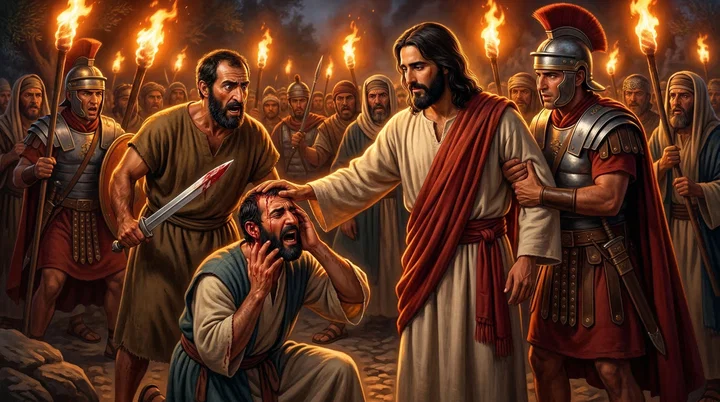
And, behold, one of them which were with Jesus stretched out his hand, and drew his sword, and struck a servant of the high priest’s, and smote off his ear.
Peter strikes with a sword, and Jesus tells him to put it away.
- John 18:10
Then Simon Peter having a sword drew it, and smote the high priest’s servant, and cut off his right ear. The servant’s name was Malchus.
Peter draws his sword after the question, and Jesus tells him to put it away.
- Mark 14:46-47
And they laid their hands on him, and took him.
The arrest scene includes a disciple striking the high priest’s servant.
- John 18:11
Then said Jesus unto Peter, Put up thy sword into the sheath: the cup which my Father hath given me, shall I not drink it?
Jesus accepts the Father’s cup as reason not to fight.
- Matthew 26:53
Thinkest thou that I can not now pray to my Father, and he shall presently give me more than twelve legions of angels?
Jesus needed no sword defense, for his Father could send him more than twelve legions of angels.
- John 18:36
Jesus answered, My kingdom is not of this world: if my kingdom were of this world, then would my servants fight, that I should not be delivered to the Jews: but now is my kingdom not from hence.
Jesus explains that his kingdom is not advanced by fighting.
- Matthew 26:56
But all this was done, that the scriptures of the prophets might be fulfilled. Then all the disciples forsook him, and fled.
The disciples forsake Jesus and flee.
- John 18:6
As soon then as he had said unto them, I am he, they went backward, and fell to the ground.
captors fall to ground before Jesus
- John 18:15
And Simon Peter followed Jesus, and so did another disciple: that disciple was known unto the high priest, and went in with Jesus into the palace of the high priest.
A disciple follows Jesus into the high priest’s palace, identifying himself with Christ.
- Luke 22:33
And he said unto him, Lord, I am ready to go with thee, both into prison, and to death.
Peter's boast to suffer and die first
Commentary
Each commentary is drawn from primary sources: the writings of Ellen G. White and Adventist pioneers and periodicals. Each commentary is separate. Its own words are not a quotation; follow the references to read the source passages.
Ellen G. White
4 sources
The question was asked in Gethsemane on the night of final agony when Jesus was bearing the guilt of human sin.DA 685.2 It belongs to the great trial of betrayal, agony in Gethsemane, and crucifixion.4RED 102.2–103.1 More precisely, it belongs to the arrest after the agony, when Judas betrayed Jesus and a band of men and soldiers came to seize Him.Ms 107, 1893, par. 2 Jesus knew beforehand that this ordeal would come and knew which of His followers were unbelieving and weak in faith.4RED 102.2–103.1
He therefore brought about an earlier crisis that removed those weak in character and undecided while He was still present to comfort and strengthen His chosen, in order to prepare their minds for His betrayal and death.4RED 102.2–103.1 He did this so that when He was betrayed and condemned in the judgment hall, humiliated and reviled by the multitude that had hailed Him as king, and when the cruel jeering crowd demanded His crucifixion, the faithful few would not be overwhelmed with surprise, sink beneath fear and disappointment, or be carried away by the apostasy of professed followers turning from Him in His trouble.4RED 102.2–103.1 Having already seen the fickleness of those who once followed Him, they would remember that the same turning away had happened before for less reason, had tested the inconstant favor of the world, and would not hang their faith on the opinions of others.4RED 102.2–103.1
The question about striking with the sword came from Peter and expressed an ardent, quick, zealous temper, not a converted heart.Lt 12, 1861, par. 12–14 That same zeal led him in Gethsemane to raise the sword and cut off the ear of the high priest's servant, yet soon afterward to deny his Lord with cursing and swearing.Lt 12, 1861, par. 12–14 True conversion came only afterward, when the sad and grieving look of Jesus broke his heart to repentance and prepared him to strengthen his brethren.Lt 12, 1861, par. 12–14 The lesson is that hasty passionate temper brings trouble and destroys peace, while the sanctifying influence of truth makes a patient person who restrains speech and overcomes through persevering prayer and lifelong effort.Lt 12, 1861, par. 12–14
Sources
Pioneers and periodicals
8 sources
The question belongs to the midnight arrest, when Judas, who knew the place where Jesus often resorted with His disciples, led thither a band of soldiers and officers from the chief priests, Pharisees, elders and captains of the temple with lanterns and torches and swords and staves, identified Jesus with a kiss, and the captors laid hands on Him and took Him.ST Jun 11, 1896 The traitor and the priests had fallen to the ground like dead men under heavenly light, then revived to seize Jesus.ST Jan 10, 1911 It was at that sight of His seizure that those about Him asked leave to smite with the sword.ST Jun 11, 1896
Those about Jesus were His companions and followers, and when they saw what would follow they recognized the situation as critical.ST Nov 5, 1894ST Feb 7, 1900ST Jun 11, 1896 They asked His leave whether they should strike to fight and defend Him with the sword.ST Nov 5, 1894ST Feb 7, 1900ST Mar 19, 1896ST Jun 11, 1896ST Nov 5, 1894 Their readiness showed followers prepared to use the sword to defend Him.ST Feb 27, 1901
The question comes after Judas points out Jesus and after Jesus exposes Judas betraying the Son of Man with a kiss.ST Nov 5, 1894ST Nov 5, 1894 It comes after Judas draws near to kiss Him and when they saw the arrest about to follow.ST Nov 5, 1894ST Mar 19, 1896 It is immediately followed by one disciple striking with the sword and by Jesus healing His wounded enemy.ST Nov 5, 1894ST Nov 5, 1894
Peter's question at once turned into action when he saw Jesus about to be taken.ST Jun 11, 1896ST Jan 10, 1911 He grasped his sword and struck the nearest and foremost man, Malchus the servant of the high priest.ST Jun 11, 1896ST Jan 10, 1911ST Aug 8, 1906 He meant a mortal blow, but the sword glanced and cut off his right ear, leaving it hanging down upon his shoulder.ST Jan 10, 1911 Simon Peter at once drew his sword and cut off the right ear of Malchus, in an act of physical bravery.ST Jun 11, 1896ST Aug 8, 1906
Jesus stopped the resistance by saying Suffer ye thus far and by commanding Put up the sword into the sheath, bidding him put his sword again into its place.ST Nov 5, 1894ST Jun 11, 1896ST Jan 10, 1911ST Aug 8, 1906 He touched the severed ear and made it whole by touch.ST Nov 5, 1894ST Jun 11, 1896ST Jan 10, 1911ST Aug 8, 1906 Malchus turned astonished eyes toward Peter without speaking.ST Jan 10, 1911 At the same time He charged the chief priests and captains of the temple and elders with coming out against Him with swords and staves as against a robber.ST Nov 5, 1894
He let the arrest proceed without resistance, although He had no real cause to be arrested.ST Mar 19, 1896 He must drink the cup the Father had given Him.ST Jun 11, 1896 He would do nothing to defend Himself and would not be defended by the sword when He could call more than twelve legions of angels.ST Jun 11, 1896ST Jan 10, 1911
He thereby rejected Peter's hasty, cruel human effort of physical bravery to defend His cause.ST Aug 8, 1906ST Feb 27, 1901 Peter was not yet converted.ST Feb 27, 1901 His action was not God's way.ST Aug 8, 1906 His work is not to be advanced by physical force or weapons.ST Feb 27, 1901
The verse illustrates that Christians should recognize civil authority and submit to its officers even when they act wrongly.ST Mar 19, 1896 They are not to obey civil laws that conflict with God's law.ST Mar 19, 1896 It also allows submission when someone is arrested for violating a civil statute for conscience' sake.ST Mar 19, 1896
The healing proved Jesus would not be defended, and that filled Peter with craven fear so he urged his companions to save themselves.ST Jan 10, 1911 Despite Christ's admonitions Peter was offended and at first abandoned his Lord.ST Aug 8, 1906 They all forsook Jesus and fled.ST Jan 10, 1911
Sources