Luke 22:48
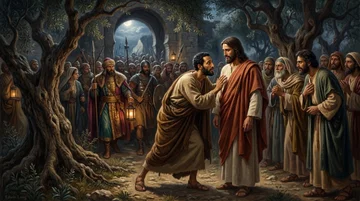
But Jesus said unto him, Judas, betrayest thou the Son of man with a kiss?
Translations
But Jesus said to him, Judas, betray you the Son of man with a kiss?
King James Version, KJV Cambridge Paragraph Bible, Revised Version, American Standard Version
But Jesus said unto him, Judas, betrayest thou the Son of man with a kiss?
But Jesus said to him, Judas, betrayest thou the Son of man with a kiss?
and Jesus said to him, 'Judas, with a kiss the Son of Man dost thou deliver up?'
And Jesus said to him, Judas, deliverest thou up the Son of man with a kiss?
But, Jesus, said to him—Judas! with a kiss, the Son of Man, dost thou deliver up?
Berean Standard Bible, Majority Standard Bible
But Jesus asked him, “ Judas, are you betraying the Son of Man with a kiss?”
But Jesus said to him, “ Judas, do you betray the Son of Man with a kiss?”
But Jesus said to him, Judas, will you be false to the Son of man with a kiss?
And Iesus saide vnto him, Iudas, betrayest thou the Sonne of man with a kisse?
Douay-Rheims (Challoner revision)
And Jesus said to him: Judas, dost thou betray the Son of man with a kiss?
Pictures
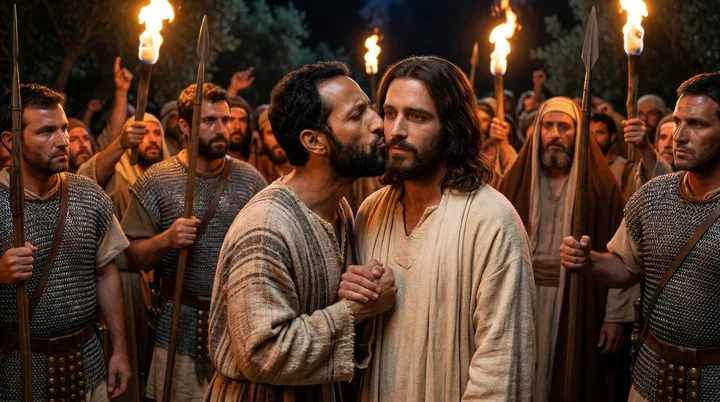
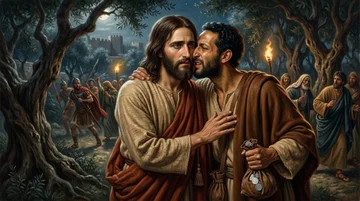
Cross-references
- Matthew 26:48-49
Now he that betrayed him gave them a sign, saying, Whomsoever I shall kiss, that same is he: hold him fast.
Judas identifies Jesus with a kiss, and Jesus addresses him.
- Mark 14:44-45
And he that betrayed him had given them a token, saying, Whomsoever I shall kiss, that same is he; take him, and lead him away safely.
Judas identifies Jesus to the arresting party with the agreed kiss.
- John 18:4-6
Jesus therefore, knowing all things that should come upon him, went forth, and said unto them, Whom seek ye?
Jesus identifies himself to the arresting mob, whose response displays his glory before the betrayal.
- Matthew 26:50
And Jesus said unto him, Friend, wherefore art thou come? Then came they, and laid hands on Jesus, and took him.
Jesus addresses Judas as a friend during the betrayal.
- Matthew 26:48
Now he that betrayed him gave them a sign, saying, Whomsoever I shall kiss, that same is he: hold him fast.
Judas uses a kiss to identify Jesus for arrest.
- Luke 22:3
Then entered Satan into Judas surnamed Iscariot, being of the number of the twelve.
Satan’s influence is linked to Judas’s betrayal.
- Matthew 27:4
Saying, I have sinned in that I have betrayed the innocent blood. And they said, What is that to us? see thou to that.
Judas confesses that he betrayed innocent blood.
- John 18:8
Jesus answered, I have told you that I am he: if therefore ye seek me, let these go their way:
Jesus surrenders while protecting his disciples during his betrayal.
- John 18:2-3
And Judas also, which betrayed him, knew the place: for Jesus ofttimes resorted thither with his disciples.
Judas leads armed band to known resort
- Matthew 26:24
The Son of man goeth as it is written of him: but woe unto that man by whom the Son of man is betrayed! it had been good for that man if he had not been born.
Jesus had warned Judas of judgment for betraying him.
- Matthew 26:46
Rise, let us be going: behold, he is at hand that doth betray me.
Jesus announces that his betrayer is at hand.
- John 18:10
Then Simon Peter having a sword drew it, and smote the high priest’s servant, and cut off his right ear. The servant’s name was Malchus.
same arrest, names Peter as swordsman
- Matthew 26:52
Then said Jesus unto him, Put up again thy sword into his place: for all they that take the sword shall perish with the sword.
same arrest, gives Jesus rebuke to Peter
- John 13
Now before the feast of the passover, when Jesus knew that his hour was come that he should depart out of this world unto the Father, having loved his own which were in the world, he loved them unto the end.
parallel accounts of institution
- Luke 6:16
And Judas the brother of James, and Judas Iscariot, which also was the traitor.
both call Judas a traitor
- Matthew 27:5
And he cast down the pieces of silver in the temple, and departed, and went and hanged himself.
Judas throws down the silver and hangs himself.
- Matthew 26:53
Thinkest thou that I can not now pray to my Father, and he shall presently give me more than twelve legions of angels?
Jesus could call twelve legions of angels.
- Luke 22:44
And being in an agony he prayed more earnestly: and his sweat was as it were great drops of blood falling down to the ground.
describes bloody-sweat agony before betrayal
Commentary
Each commentary is drawn from primary sources: the writings of Ellen G. White and Adventist pioneers and periodicals. Each commentary is separate. Its own words are not a quotation; follow the references to read the source passages.
Ellen G. White
22 sources
In the garden at the moment of arrest, one of the twelve came straight to Jesus with an armed multitude from the rulers, giving the prearranged token by which the one he kissed would be seized and held fast.ST Dec 9, 1897Ms 149, 1904, par. 11–12Ms 107, 1893, par. 2 He used a familiar sign of affection and friendship to identify the Son of man and hand Him over to His enemies and into the hands of sinners.Ms 185, 1901, par. 5–6Ms 42, 1897, par. 23–27Ms 45, 1892, par. 22–273SP 103.2GC88 263.2 Jesus met His betrayer with calm dignity, naming him and exposing the act, yet His question was spoken with sorrowful gentleness to appeal to conscience and awaken the stubborn heart.COS 121.4–122.4Ms 185, 1901, par. 5–6Ms 149, 1904, par. 13–15ST Dec 9, 1897ST May 20, 1889 Even then there was hope that if Judas would confess his traitor work he would have been freely forgiven, for Jesus did not retaliate or refuse the salutation but bore it with unequaled forbearance, love and pity, thinking not for Himself but for others.COS 121.4–122.4Ms 45, 1892, par. 22–27Ms 149, 1904, par. 13–153SP 103.2 That same betrayal is repeated whenever professed loyalty covers disloyalty, whether by setting aside God's law while claiming to advance the gospel or by undermining confidence in His appointed testimonies and leadings.GC88 263.2GC 263.2Lt 332, 1908, par. 5–8Ms 149, 1904, par. 11–12
Betrayal in the Garden
The words were spoken in the garden at the moment of arrest, after the agony in Gethsemane, immediately after Judas came straight to him saying Master, Master and kissed him.ST Dec 9, 1897Ms 107, 1893, par. 2 Judas was one of the twelve and a professed disciple, yet he came with a great multitude with swords and staves from the chief priests and the scribes and the elders.ST Dec 9, 1897Ms 107, 1893, par. 2 He had given them the prearranged token that whomever he kissed was Jesus, to be taken and led away safely and held fast.ST Dec 9, 1897Ms 149, 1904, par. 11–12
The kiss was a sign of affection, friendship, and greeting, and the question exposes the contradiction of using that familiar gesture to identify and hand over the Son of man to his enemies and into the hands of sinners.Ms 185, 1901, par. 5–6Ms 42, 1897, par. 23–27Ms 45, 1892, par. 22–27DA 685.1DA 685 Judas approached as a familiar friend, came close, took his hand and gave the traitor's kiss, while outwardly greeting him yet concealing betrayal.3SP 103.2GC88 263.2ST May 20, 1889GC 263.2 He did this because he believed Christ would not permit himself to be taken, after he had fallen helpless backward with the mob when Christ stood transfigured before them with angels in companionship.ST Dec 9, 1897Ms 149, 1904, par. 11–12
He remained bold and defiant with no disposition to relent or remorse, because he had yielded himself to Satan's control with no power to resist, and honor, fidelity, and human tenderness had utterly forsaken him.COS 121.4–122.4Ms 185, 1901, par. 5–63SP 103.2ST Jun 6, 1878ST May 20, 1889 His betrayal with a treacherous kiss was the end of a gradual fall in which, when tempted and tried, he did not rise above temptation but lost ground.Lt 332, 1908, par. 5–8 He often manifested a spirit of superiority on evangelistic tours with the other disciples and sought to exercise authority over his brethren, and that unchecked spirit opened his mind and heart for the enemy to work.Lt 332, 1908, par. 5–8
After the kiss Jesus was handed over to his enemies and taken to an earthly court, where sinful people mocked and condemned him to death, and he suffered for human transgressions and iniquities.2T 206.2–207.1
Jesus' Sorrowful Appeal
Jesus stepped forth with calm dignity to meet His betrayer, confronting him with full knowledge of what he was doing, a knowledge already made plain at the supper table.Ms 149, 1904, par. 13–15ST Dec 9, 1897ST May 20, 1889 He called him by name and laid bare the act, that with a kiss he was betraying the Son of man, his Master who had borne so much from his false unfaithfulness, handing Him over into the hands of sinners.Ms 149, 1904, par. 13–15ST Dec 9, 1897DA 695.1–696.2ST Sep 23, 1886 The kiss that pretended friendship was thus exposed as the very means of treachery.ST May 20, 1889DA 695.1–696.2ST Sep 23, 1886
The question was spoken with sorrowful gentleness, in a voice trembling with sorrow and full of pathos.Ms 45, 1892, par. 22–27Ms 149, 1904, par. 13–15ST May 20, 1889 It was a most touching appeal meant to rouse Judas' conscience, to speak to his sense of righteousness and to touch his stubborn heart, that it might awaken him and break his heart.Ms 185, 1901, par. 5–6Ms 149, 1904, par. 13–153SP 103.2ST Jun 6, 1878ST May 20, 1889 That gentle word should have touched him and awakened him, yet it did not relent him.COS 121.4–122.43SP 103.2ST Jun 6, 1878
Even in that very moment the words carried a final offer of hope, that if Judas would even then honor his Lord by confession of his traitor work and yield, Jesus would have saved him and freely forgiven him just as He afterward saved the thief on the cross, and history would have been different.Ms 149, 1904, par. 13–15 Judas acted knowing the earlier word that it would have been better for the betrayer of the Son of man never to have been born.Ms 149, 1904, par. 13–15
He did not turn upon the traitor with righteous indignation, did not resist and did not refuse the salutation and the kiss.3SP 103.2ST Jun 6, 1878ST May 20, 1889ST Aug 21, 1879DA 695.1–696.2 He rose far above human retaliation in gentleness, forbearance, longsuffering, love and pity without parallel, longing even to the last moment to save Judas from working out his own ruin.3SP 103.2ST Jun 6, 1878ST May 20, 1889ST Aug 21, 1879ST Sep 23, 1886 In that hour of humiliation He thought not for Himself but for others and for all beholders.ST May 20, 1889 In receiving the kiss He gives His disciples an example, that they are to treat even their enemies with the same spirit of forbearance, love and pity.COS 121.4–122.4Ms 45, 1892, par. 22–27
Later Betrayals Foretold
To betray with a kiss is to profess loyalty while handing over, and setting aside any part of God's law under the pretense of advancing the gospel does just that while claiming to honor Christ and promote his cause.GC88 263.2GC 263.2 Those who claim to honor Christ yet set aside his law repeat the contradiction of greeting with affection while opposing what was taught.GC88 263.2GC 263.2 Among professed people of God, those who seek to undermine confidence in the testimonies given for their benefit and in the leadings of Providence in the work act a part similar to Judas, and unless converted will be revealed and numbered among the open enemies of God's work for this time.Lt 332, 1908, par. 5–8 The same spirit and action is repeated in the last days by those who virtually press themselves close to Christ while betraying him, attending the Passover supper and the feet washing as Judas did when Jesus served him first.Ms 149, 1904, par. 11–12
As Judas betrayed with a kiss, nominal churches and nominal Adventists will betray the Sabbath-keeping saints to the Catholics to obtain Catholic influence against them.Ms 15, 1850, par. 5–7 The saints will be obscure and little known to the Catholics, but the betrayers will know them by faith and customs and will report them as those who disregard the pope's institution by keeping the Sabbath and disregarding Sunday.Ms 15, 1850, par. 5–7 That betrayal brings Catholic and Protestant cooperation in a decree that all who will not observe the first day of the week instead of the seventh shall be slain.Ms 15, 1850, par. 5–7 In that union Catholics give power to the image of the beast and Protestants destroy the saints as their mother did, but before the decrees bear fruit the saints will be delivered by the voice of God.Ms 15, 1850, par. 5–7
The betrayal and death, joined to the agony in Gethsemane, the condemnation in the Judgment Hall, the humiliation, and the rejection by the multitude that had hailed him as king but then reviled and cried Crucify him, was foreseen.4RED 102.2–103.1 While still present to comfort and strengthen his chosen, he deliberately brought on an earlier crisis that drove away the faint-hearted.4RED 102.2–103.1 That sifting removed weak and undecided followers who in the hour of betrayal would have sunk under fear and disappointment and whose apostasy would have overwhelmed the twelve and carried the rest away.4RED 102.2–103.1 Having seen the fickleness of followers, the faithful few learned the inconstant favor of the world and not to hang faith on others' opinions, and when professed lovers turned from him in trouble they were not overwhelmed with surprise and were prepared to endure his betrayal and death.4RED 102.2–103.1
Sources
Pioneers and periodicals
26 sources
At the midnight arrest in the garden Judas, one of the twelve, came at the head of a multitude of soldiers and officers with lanterns and swords, and gave them the prearranged token that the one he greeted and kissed was Jesus to be taken.ST Dec 9, 1897ST Nov 5, 1894ST Jun 11, 1896ST Nov 5, 1894ST Jesus answered him by name as the Son of man and confronted him with turning the kiss, the customary sign of affection and honor, into the means of betrayal, speaking with a voice trembling with sorrow to rouse his conscience.ST Dec 9, 1897ST Jun 6, 1878ST Feb 7, 1900ST Nov 5, 1894ST Feb 27, 1901 He did not reject the kiss or resist arrest but received it and gave Himself up to suffer, showing forbearance, love and pity without parallel toward one who stood bold and defiant under Satan's control.ST Jun 6, 1878ST May 20, 1889ST Aug 21, 1879ST Jun 11, 1896RH Aug 2, 1906 To claim to honor Christ while setting aside His teaching and treating any of God's commandments as insignificant is to repeat that act under pretense of advancing the gospel.RH Jan 13, 1859RH Dec 3, 1861ST Jul 3, 1884RH Oct 13, 1874 The same betrayal is repeated when professed believers and religious leaders profess love and loyalty to the Bible in order to gain confidence and then pervert its teachings and undermine faith in it from within.ST Feb 24, 1887ST May 17, 1910
Betrayal in the Garden
The words were spoken at the midnight arrest in the garden where Jesus often resorted with His disciples, while He was still speaking to them after the supper.ST Nov 5, 1894ST Jun 11, 1896ST Nov 5, 1894 Judas, one of the twelve, came at the head of a great multitude to seize Jesus in Gethsemane, a place he knew, after selling his Lord.ST Dec 9, 1897ST Nov 5, 1894ST Jun 11, 1896ST That company was a band of soldiers and officers from the chief priests and scribes and Pharisees and elders, with lanterns and torches and swords and staves.ST Dec 9, 1897ST Jun 11, 1896 The kiss was the prearranged token Judas had given them, that whomever he kissed and greeted was Jesus to be taken and led away safely.ST Dec 9, 1897ST Jun 11, 1896ST
A kiss was customarily a sign of affection and friendship and greeting and honor, and Judas came straight to Jesus saying Master, Master and Hail, Rabbi, drawing near to kiss Him and taking His hand.ST Dec 9, 1897ST Jun 6, 1878ST Feb 7, 1900RH Jan 13, 1859ST Feb 27, 1901 He used that sign of recognition and affection to identify Jesus to the crowd that came to seize Him.ST Feb 7, 1900ST Feb 27, 1901ST Feb 7, 1900 Jesus answered Judas by name, called Himself the Son of man, and directly confronted him with the contradiction of making that affectionate sign the means of betrayal and identification.ST Feb 7, 1900ST Nov 5, 1894ST Feb 27, 1901ST Feb 7, 1900RH Aug 2, 1906 He thus exposed the kiss as the act that betrayed Him into the hands of sinners and handed Him over to His enemies.ST Dec 9, 1897RH Nov 17, 1910
The words come immediately before the disciples ask about striking with the sword and the armed arrest proceeds, when one struck and Jesus healed His wounded enemy.ST Nov 5, 1894ST Nov 5, 1894 The identification was unnecessary because Jesus knew all things coming upon Him, went forth calmly to meet them, gave Himself up, and allowed Himself to be laid hold of and taken to suffer for humanity.ST Jun 11, 1896RH Aug 2, 1906ST Judas did this because he believed Christ would not permit Himself to be taken.ST Dec 9, 1897 The betrayal handed Jesus over to His enemies to die, leading to His crucifixion and the perishing of His followers' hope, and carries guilt and shame.RH Mar 14, 1865ST Jan 31, 1911 When Judas later saw Jesus in His enemies' hands, Jesus' words returned to him as his conscience revived and he knew he had betrayed the Son of God.ST Dec 24, 1894ST Dec 17, 1912
Christ's Sorrowful Forbearance
Jesus stepped forth with calm dignity to meet His betrayer, thinking in that hour of humiliation not for Himself but for others.ST May 20, 1889ST Jun 11, 1896 His question to Judas was spoken with a voice trembling with sorrow, a most touching appeal meant to rouse the conscience and touch the stubborn heart.ST Jun 6, 1878ST May 20, 1889ST Aug 21, 1879ST Sep 23, 1886 By it He exposed the kiss as the act that betrayed Him into the hands of sinners.ST Dec 9, 1897ST May 20, 1889ST Sep 23, 1886
He did not reject the kiss or resist it, but received it and allowed Himself to be taken.ST Jun 6, 1878ST May 20, 1889ST Aug 21, 1879ST Sep 23, 1886 In receiving it He gives an example of forbearance, love and pity without parallel.ST Jun 6, 1878ST May 20, 1889ST Aug 21, 1879ST Sep 23, 1886 That forbearance was shown toward one who came close as a familiar friend yet used a sign of friendship for treachery.ST Jun 6, 1878ST May 20, 1889ST Aug 21, 1879ST Sep 23, 1886
Judas stood bold and defiant with no disposition to relent.ST Jun 6, 1878ST May 20, 1889ST Aug 21, 1879ST Sep 23, 1886 Honor, fidelity and human tenderness had utterly forsaken him.ST May 20, 1889 He had given himself up to Satan's control, with no power to resist evil and no willingness to resist it.ST Jun 6, 1878ST May 20, 1889ST Aug 21, 1879ST Sep 23, 1886
Betrayal Repeated Today
Judas honored Christ outwardly with a kiss, a sign of greeting and honor, while handing Him over, and the same contradiction stands exposed when Christ is claimed as honored while His teaching is undermined and His law is set aside.RH Jan 13, 1859RH Dec 3, 1861ST Jul 3, 1884RH Oct 13, 1874RH Oct 14, 1852 To treat any part of God's law as insignificant under pretense of advancing the gospel, to speak of His blood and gospel while taking away His crown and rejecting His authority and doctrine, is to betray Him with a kiss under a show of devotion.RH Jan 13, 1859RH Dec 3, 1861ST Jul 3, 1884RH Oct 13, 1874RH Oct 14, 1852 That betrayal can be disguised as an act of honor, greeting Christ while setting aside His commandments.RH Oct 13, 1874RH Oct 14, 1852ST Jul 9, 1874 The question put to Judas is put to everyone who preaches faith so as to directly or indirectly set aside any branch of obedience, and to everyone who preaches Christ so as to disannul or weaken in any way even the least of the commandments of God.RH Dec 3, 1861ST Jul 3, 1884RH Oct 13, 1874RH Oct 14, 1852 Those who think they honor Christ by destroying His doctrine, who claim to magnify His office while setting light by any part of His law, who talk of His blood while taking away His crown, are betraying Him.RH Dec 3, 1861ST Jul 3, 1884RH Oct 13, 1874RH Oct 14, 1852
The same betrayal is repeated when men profess to accept the historical narrative or a portion of the Bible in order to gain confidence and then pervert its teachings to undermine faith in it.ST Feb 24, 1887ST May 17, 1910 Such concealed infidelity, professing love and loyalty while handing over the truth to its enemies, is an aggravated case of the act of Judas and more dangerous than open denial of the whole Bible.ST Feb 24, 1887ST May 17, 1910 The attack on the Bible and on faith pictured here comes not from open and avowed enemies but from within, by renowned professed believers and religious leaders.ST Feb 24, 1887ST May 17, 1910 It is the work of theological professors and modern divines who declare the divine stories false in every particular, who undermine faith in the Old Testament, belief in the New Testament, and firm reliance upon the infallibility of Christ, and who ridicule simple childlike faith in the Bible as it reads, while blandly claiming to do it all for the good of Christianity.ST May 17, 1910
That treachery against the Word of God, joined with denial and desertion, cannot extinguish Scripture. Every threat only aids it, and the least word God has spoken endures while human empires and monuments perish. Sin itself, like Judas, approaches as though it were a friend while acting as an enemy. It presents itself as a reformer and benefactor, but its true character is exposed by the ruin and misery it produces.
Sources