John 18:10
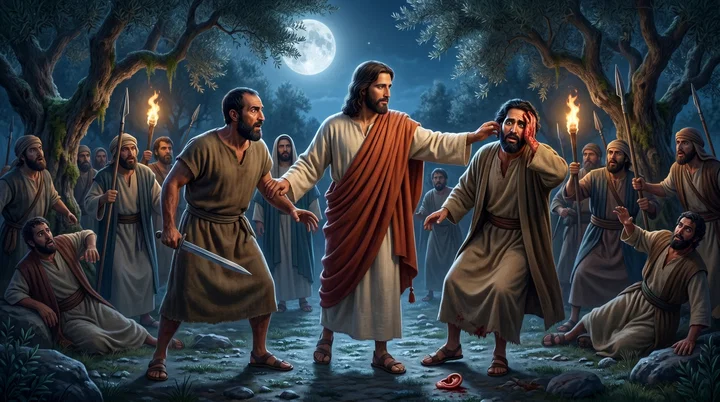
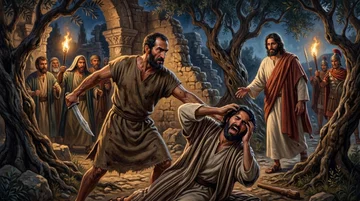
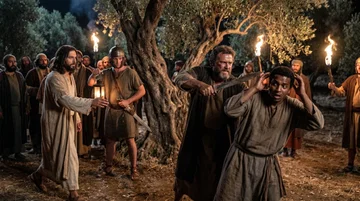
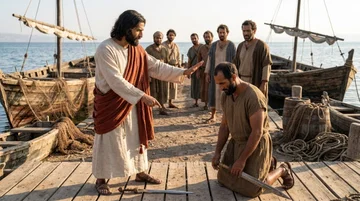
Then Simon Peter having a sword drew it, and smote the high priest’s servant, and cut off his right ear. The servant’s name was Malchus.
Translations
American King James Version, King James Version, KJV Cambridge Paragraph Bible
Then Simon Peter having a sword drew it, and smote the high priest’s servant, and cut off his right ear. The servant’s name was Malchus.
Then Simon Peter, having a sword, drew it, and smote the servant of the high priest, and cut off his right ear. The servant's name was Malchus.
Revised Version, American Standard Version
Simon Peter therefore having a sword drew it, and struck the high priest’ s servant, and cut off his right ear. Now the servant’ s name was Malchus.
Simon Peter, therefore, having a sword, drew it, and struck the chief priest's servant, and cut off his right ear — and the name of the servant was Malchus —
Simon Peter therefore, having a sword, drew it, and smote the bondman of the high priest and cut off his right ear; and the bondman's name was Malchus.
Simon Peter, therefore, having a sword, drew it, and smote the High-priest’s servant, and cut off his right ear. Now the name of the servant was Malchus.
Berean Standard Bible, Majority Standard Bible
Then Simon Peter drew his sword and struck the servant of the high priest, cutting off his right ear. The servant’ s name was Malchus.
Simon Peter therefore, having a sword, drew it, struck the high priest’ s servant, and cut off his right ear. The servant’ s name was Malchus.
Then Simon Peter, who had a sword, took it out and gave the high priest's servant a blow, cutting off his right ear. The servant's name was Malchus.
Then Simon Peter hauing a sword, drewe it, and smote the hie Priests seruant, and cut off his right eare. Nowe the seruants name was Malchus.
Douay-Rheims (Challoner revision)
Then Simon Peter, having a sword, drew it, and struck the servant of the high priest, and cut off his right ear. And the name of the servant was Malchus.
Pictures
Cross-references 20 of 27
- Matthew 26:51-54
And, behold, one of them which were with Jesus stretched out his hand, and drew his sword, and struck a servant of the high priest’s, and smote off his ear.
Peter strikes the servant; Jesus rebukes the sword and submits to Scripture’s fulfillment.
- Luke 22:50-51
And one of them smote the servant of the high priest, and cut off his right ear.
Jesus heals the servant’s ear Peter cut off.
- Mark 14:47
And one of them that stood by drew a sword, and smote a servant of the high priest, and cut off his ear.
A disciple strikes the high priest’s servant and cuts off his ear.
- John 18:15-27
And Simon Peter followed Jesus, and so did another disciple: that disciple was known unto the high priest, and went in with Jesus into the palace of the high priest.
Peter follows Jesus into the high priest’s palace, then denies knowing him.
- John 18:6
As soon then as he had said unto them, I am he, they went backward, and fell to the ground.
Jesus’ power makes the armed men fall, showing he could have delivered himself.
- John 18:26
One of the servants of the high priest, being his kinsman whose ear Peter cut off, saith, Did not I see thee in the garden with him?
The injured servant’s kinsman recognizes Peter from the garden and challenges him at the trial.
- John 18:36
Jesus answered, My kingdom is not of this world: if my kingdom were of this world, then would my servants fight, that I should not be delivered to the Jews: but now is my kingdom not from hence.
Jesus says his servants would fight only if his kingdom were of this world.
- Matthew 26:69-75
Now Peter sat without in the palace: and a damsel came unto him, saying, Thou also wast with Jesus of Galilee.
Both recount Peter’s failure during Jesus’ trial and his bitter response.
- Matthew 26:51
And, behold, one of them which were with Jesus stretched out his hand, and drew his sword, and struck a servant of the high priest’s, and smote off his ear.
Parallel account of Peter striking the high priest’s servant with a sword.
- Luke 22:38
And they said, Lord, behold, here are two swords. And he said unto them, It is enough.
The disciples’ swords are recorded before Jesus’ arrest.
- John 18:1
When Jesus had spoken these words, he went forth with his disciples over the brook Cedron, where was a garden, into the which he entered, and his disciples.
Both texts place Jesus’ arrest in the setting by the brook Cedron.
- Mark 14:50
And they all forsook him, and fled.
After Jesus is seized, the disciples forsake him and flee.
- Matthew 26:56
But all this was done, that the scriptures of the prophets might be fulfilled. Then all the disciples forsook him, and fled.
Peter’s offense led the disciples to forsake their Lord.
- Mark 14:43-45
And immediately, while he yet spake, cometh Judas, one of the twelve, and with him a great multitude with swords and staves, from the chief priests and the scribes and the elders.
Parallel account of the arrest scene
- Luke 22:49
When they which were about him saw what would follow, they said unto him, Lord, shall we smite with the sword?
The disciples ask whether to strike with the sword.
- Luke 22:52-53
Then Jesus said unto the chief priests, and captains of the temple, and the elders, which were come to him, Be ye come out, as against a thief, with swords and staves?
Jesus challenges the leaders for arresting him as a criminal after teaching publicly among them.
- John 18:3
Judas then, having received a band of men and officers from the chief priests and Pharisees, cometh thither with lanterns and torches and weapons.
Describes the armed party that came to arrest Jesus.
- Revelation 13:10
He that leadeth into captivity shall go into captivity: he that killeth with the sword must be killed with the sword. Here is the patience and the faith of the saints.
Peter’s sword violence invokes the warning that those who kill with the sword will be killed with the sword.
- Luke 22:31-32
And the Lord said, Simon, Simon, behold, Satan hath desired to have you, that he may sift you as wheat:
Jesus pities weakness and prays for conversion
- Mark 14:37-38
And he cometh, and findeth them sleeping, and saith unto Peter, Simon, sleepest thou? couldest not thou watch one hour?
Peter failed to watch and pray before acting rashly.
Commentary
Each commentary is drawn from primary sources: the writings of Ellen G. White and Adventist pioneers and periodicals. Each commentary is separate. Its own words are not a quotation; follow the references to read the source passages.
Ellen G. White
17 sources
In the Garden after His agony, when Jesus was seized and bound, Peter in vehement anger drew his sword to defend Him and cut off the right ear of Malchus, the high priest's servant.5RED 24.2–3Ms 42, 1897, par. 23–27Ms 91, 1909, par. 11–15 Jesus touched the wounded ear and instantly healed it, showing He still had power to act even while allowing Himself to be taken.5RED 24.2–3ST May 20, 1889ST Sep 23, 1886 He stopped Peter and commanded him to put up his sword into the sheath and accept arrest rather than resist by violence.5RED 24.2–3Ms 42, 1897, par. 23–27Ms 91, 1909, par. 11–15 He could have escaped or asked the Father for more than twelve legions of angels, but He voluntarily submitted to drink the cup His Father had given Him so the Scriptures would be fulfilled and He could bear the sins of the world.5RED 24.2–3Ms 91, 1909, par. 11–15ST May 20, 1889DA 696.3ST Sep 23, 1886 Yet Peter, who was ready to fight for Christ with a weapon, lacked courage to acknowledge Him under scorn, and the disciples who knew He could deliver Himself were offended and fled when He chose not to.3SP 105.1RH Feb 6, 1913
Arrest in the Garden
John 18:10 belongs to the arrest of Jesus after His agony in the Garden of Gethsemane following the betrayal by Judas.4RED 102.2–103.1Ms 107, 1893, par. 2 It forms part of the great trial of betrayal, humiliation and death that awaited Him and for which He had prepared His disciples.4RED 102.2–103.1
When the armed band fell prostrate and helpless to the ground, the disciples thought their Master would not suffer Himself to be taken and began to hope.ST Jun 6, 1878EW 137.1 They believed the same power that had prostrated the mob could keep them helpless until Jesus and His companions passed unharmed beyond reach.ST Jun 6, 1878 They were disappointed and indignant when the murderous throng regained assurance and laid violent hands on Jesus, and when cords were brought forward to bind the precious hands that had ever been employed only in doing good.ST Jun 6, 1878
In vehement anger and rash indignation at seeing Him whom they loved seized and bound, Simon Peter drew his sword to defend Him.Ms 42, 1897, par. 23–27ST May 20, 1889DA 696.3ST Sep 23, 1886ST Jun 6, 1878 He smote Malchus, the servant of the high priest, and cut off his right ear.5RED 24.2–3Ms 42, 1897, par. 23–27Ms 91, 1909, par. 11–15ST May 20, 1889DA 696.3 Jesus touched the wounded ear and healed it instantly, at once.5RED 24.2–3ST May 20, 1889ST Sep 23, 18863SP 104.2–33SP 105.1 By this He showed He still had power to act even while allowing Himself to be arrested.3SP 105.1
Why Jesus Refused Rescue
Jesus at once stopped Peter and ordered him to put his sword back into its sheath, refusing to allow violent resistance to His capture and accepting what must take place instead.5RED 24.2–3Ms 42, 1897, par. 23–27Ms 91, 1909, par. 11–15ST May 20, 1889DA 696.3 He would not be defended by force, but willingly yielded to arrest and binding.Ms 91, 1909, par. 11–15ST May 20, 1889DA 696.3ST Sep 23, 1886
He had full power to escape, for He could have asked His Father and received more than twelve legions of angels for His deliverance.5RED 24.2–3DA 696.3ST Sep 23, 1886SG1 48.13SP 104.2–3 Yet He chose not to call them, but voluntarily submitted in order to drink the cup His Father had given Him.5RED 24.2–3Ms 42, 1897, par. 23–27Ms 91, 1909, par. 11–15DA 696.3ST Sep 23, 1886 He did this so that the Scriptures might be fulfilled.5RED 24.2–3ST May 20, 1889DA 696.3ST Sep 23, 1886SG1 48.1 His submission was necessary because He was sent to bear the sins of the world and must pay the penalty of man's transgression, even though He had power to deliver Himself.Ms 91, 1909, par. 11–15
The disciples knew He could deliver Himself, but when He chose not to they were offended and frightened, and they fled.3SP 105.1 The servant who had been wounded was afterward identified through a near kinsman, who used Peter's presence in the garden to charge him with being a follower of Jesus.ST Oct 19, 18823SP 109.1 Peter's readiness to take up arms for Christ did not give him courage to acknowledge Him under scorn and reproach, for he who would fight with a weapon could yet deny knowing Him when He was mocked.RH Feb 6, 1913 As part of the chapter standing just before the account of Christ's suffering and death, this record is meant to strengthen believers who suffer for their faith and help them hold fast to it.Lt 100, 1910, par. 16
Sources
Pioneers and periodicals
61 sources
In the garden of Gethsemane at His betrayal and arrest, Simon Peter rashly drew a sword and cut off the right ear of Malchus, a servant of the high priest, meaning to strike a mortal blow.ST Sep 24, 1912ST Jun 7, 1899ST Nov 5, 1894ST Feb 7, 1900ST Jan 10, 1911 He acted in impetuous, self-confident anger yet from ardent love and physical bravery, willing to fight the whole arresting band and die defending his Lord.ST May 20, 1889ST Sep 23, 1886ST Feb 27, 1901ST Oct 19, 1882ST Aug 8, 1906 Jesus at once stopped him, commanded him to put the sword back into its sheath, and healed the severed ear, protecting His disciples even amid His own anguish.ST Feb 7, 1900ST Feb 27, 1901ST May 26, 1898STST Oct 20, 1914 He willingly refused rescue by force, though He could have called more than twelve legions of angels, and submitted to capture and drink the cup the Father had given Him so the Scriptures would be fulfilled.ST May 20, 1889ST Jun 7, 1899ST Aug 13, 1896ST Jun 11, 1896 His rebuke shows His kingdom is not of this world and is never to be advanced by carnal weapons, bloodshed, intolerance, or civil power, and Peter's fleeting boldness with the sword, soon followed by forsaking and denying his Lord, proves such force gives no spiritual strength.ST Mar 14, 1906ST Feb 27, 1901ST Apr 23, 1902ST Mar 19, 1896RH Jan 6, 1910
Arrest Setting and Details
The one who drew the sword was Simon Peter, also called Bar-jona.ST Nov 5, 1894ST Jan 10, 1911ST Feb 7, 1911 The man he struck was Malchus, a servant of the high priest.ST Oct 19, 1882ST Nov 5, 1894ST Feb 7, 1911 The blow cut off the servant's right ear.ST Nov 5, 1894ST Feb 7, 1900RH Nov 19, 1903 Peter meant the stroke to be mortal, and the soldier he aimed at would have been killed had the blow landed as intended.ST Jan 10, 1911RH Nov 19, 1903
It took place at the betrayal and arrest in the garden of Gethsemane, by the brook Kidron, beneath the olive trees.RH Jun 25, 1901ST Apr 8, 1903ST Apr 30, 1902ST Jan 8, 1902 Judas brought there a mob with swords and staves and torches to seize Jesus and bind Him and lead Him away to die.RH Jun 25, 1901ST Apr 8, 1903ST Apr 30, 1902 For that hour the power of darkness temporarily prevailed, with a professed friend helping to bring about the arrest.ST Jun 7, 1899 This was the beginning of His trials and persecution before the high priest and Pilate.ST Sep 24, 1912
The disciples had just seen the arresting band fall prostrate and helpless to the ground, and they thought their Master would not suffer Himself to be taken.ST Jun 6, 1878 They expected the same power that had prostrated the mob to keep them helpless until Jesus and His companions passed unharmed beyond reach.ST Jun 6, 1878 They were disappointed and indignant when cords were brought forward to bind the hands that had always been employed in doing good.ST Jun 6, 1878ST Aug 8, 1906 When the murderous throng regained assurance and laid violent hands on Him, the disciples asked about using swords, and in vehement anger and rash indignation Peter struck the foremost man.ST Jun 6, 1878ST Feb 7, 1900ST Aug 8, 1906
Peter's Zeal and Weakness
Peter struck in vehement anger, rashly, hastily and impetuously drawing his sword and cutting off the servant's ear.ST May 20, 1889ST Sep 23, 1886ST Feb 27, 1901ST Oct 6, 1887RH Jul 6, 1869 The blow revealed his quick, impulsive, self-confident character and his readiness to speak and act not only for himself but for his fellows in defense of his Master.RH Dec 2, 1909
His act showed ardent and impetuous love for his Lord, physical bravery even to rashness.ST Oct 19, 1882ST Aug 8, 1906ST Aug 8, 1906ST Dec 30, 1889 He was willing to give his life in defense of his Master, ready to fight the whole arresting band and die defending Him.ST Oct 19, 1882ST Aug 8, 1906ST Aug 8, 1906ST Dec 30, 1889
He did so because he still hoped for opportunity to fight and thought Jesus might yet assert His power.ST Mar 14, 1906 He was ready to defend by physical force what he thought was Christ's kingdom, zealous to shed blood in its support.ST Mar 14, 1906ST Dec 16, 1886ST May 24, 1883 He still clung to the traditional Jewish expectation that the Redeemer would come as king to free the nation from Roman bondage, set up an earthly kingdom, give it a high place in the world and give places of authority, quarreling over future positions, thinking Him slow to advance His claims, seeking to induce Him to accept public leadership and vainly hoping He would soon assert Himself as a world leader, and he could not understand that His kingdom was not of this world.ST Oct 21, 1930
He had not yet learned the spirit of Jesus or the principles of His kingdom, and his resort to force was man's way instead of God's way.ST Mar 14, 1906ST Aug 8, 1906ST Dec 30, 1889ST Aug 8, 1906 He had not accepted Christ's admonitions with all his heart, and his experience was still immature and pre-conversion.ST Aug 8, 1906ST Dec 30, 1889ST Aug 8, 1906 That impulsive armed defense is not the character needed in God's cause, which requires willingness to be crucified while feeling unworthy to suffer as his Lord suffered, bearing with patience and laboring without fainting, not counting life dear and not loving life unto death.
His boldness with a weapon gave him no spiritual support to acknowledge Jesus when doing so meant facing scorn and reproach.RH Feb 6, 1913 When Jesus allowed Himself to be surrounded and made prisoner and led away amid ridicule and scorning, Peter's courage fled and his hope nearly left him.RH Dec 2, 1909 Denied his own way he became offended, and with the other disciples forsook his Lord, following afar off.ST Apr 23, 1902ST Aug 8, 1906ST Dec 30, 1889ST Aug 8, 1906RH Dec 2, 1909 When danger appeared he denied Him rather than die with Him, though his zeal in fighting had not meant readiness to suffer shame for His sake.RH Feb 6, 1913RH Jul 6, 1869
Christ's Submission and Mercy
Jesus stopped Peter, rebuked him, and commanded him to put the sword back into its place and into its sheath.ST Feb 7, 1900ST Feb 27, 1901ST May 26, 1898ST Jul 14, 1898 That order to put away the sword was never revoked.ST Feb 27, 1901 His response showed He did not teach war and bloodshed. The Christian's armor therefore does not include a carnal sword.ST Jul 14, 1898
He instantly touched and healed the severed ear, undoing the effect of Peter's act.ST Feb 7, 1900ST Feb 27, 1901STST Oct 20, 1914ST Oct 7, 1886 The healing took place even amid the arrest, when urgent circumstances did not make Him act with needless haste or neglect someone in need.ST May 20, 1897 By undoing the act He removed what might otherwise have brought Peter into danger.ST Oct 7, 1886 Even amid His own anguish and danger He acted to protect His disciples and showed concern for their safety.ST Oct 7, 1886 His example teaches seeking to save lives rather than using weapons of human conflict, opposing sin through God's power.ST Oct 20, 1914
He willingly refused rescue by force and submitted to capture, accepting the suffering the Father had given Him.ST May 20, 1889ST Sep 23, 1886ST Aug 13, 1896ST Jun 11, 1896 He would not resist capture by violence and would not resist civil authority by force.ST May 20, 1889ST Aug 13, 1896 He could have called on more than twelve legions of angels to escape, but willingly accepted what must happen so the Scriptures would be fulfilled.ST May 20, 1889ST Sep 23, 1886 Accepting rescue even by angels would have prevented that fulfillment.
Beneath the olive trees by the brook Kidron, amid swords and staves and torches and clamoring men of death come to bind Him and lead Him to die, He looked with pitying eyes and spoke calm and kinglike with loving word and patient breath.RH Jun 25, 1901ST Apr 8, 1903ST Apr 30, 1902 Vengeance waited only on His word, yet He refused it and commanded the sword back into its sheath.RH Jun 25, 1901ST Apr 8, 1903ST Apr 30, 1902 In daring a criminal's grave and bearing scorn while refusing force, He proved Himself the bravest hero ever born.ST Apr 8, 1903 Against the thought that something physical must be done, that noise is music and tumult is power, His submission shows what can be done by passiveness, silence, and non-resistance.ST Feb 27, 1901 There is force in passiveness, energy in silence, and a magnificent retort in non-resistance, the very mystery of heroism.ST Feb 27, 1901
Kingdom Without the Sword
Christ's cause and kingdom are not to be advanced by force, bloodshed, or other worldly, carnal means, and reliance on such means weakens its divine power.ST Mar 14, 1906ST Jan 24, 1900ST Dec 16, 1886 Peter still hoped for opportunity to fight and thought Jesus might assert His power, and in mistaken zeal he drew his sword to defend Christ's kingdom and cut off the high priest's servant's right ear.ST Mar 14, 1906ST Apr 23, 1902ST Dec 16, 1886 That rash use of a carnal weapon was not the way to defend the gospel or its ministry, for Christ would not allow blood to be shed in support of His kingdom.ST Feb 27, 1901ST Apr 23, 1902ST Dec 16, 1886 Jesus healed the wound, stopped Peter, and commanded him to put away the sword into its place and sheath, an order that was never revoked, and those who take the sword will perish by the sword.ST Mar 14, 1906ST Feb 27, 1901ST Apr 23, 1902ST Dec 16, 1886 Peter had not yet learned the spirit of Jesus or the principles of His kingdom, and learning submission to God's will in the garden would have spared him this rash act, whose humiliation after the rebuke contributed to his leaving with the others.ST Mar 14, 1906ST Apr 23, 1902 To brandish the sword in that hour was a denial of His divinity, while His gospel persuades and entreats rather than compelling people to believe or worship.ST Jan 24, 1900ST Feb 6, 1893
Religious zeal does not justify harming others, for Christ rejected violence and healed the injury Peter caused.ST Mar 19, 1896 The incident rebukes intolerance and the use of physical force in religious matters, for Christ restored the servant's ear and commanded Peter to put away his sword.RH Jan 6, 1910 Christ's followers must not resist civil authority with force but commit themselves to God while suffering, following Him who did not resist those who came to arrest Him but stopped Peter and submitted to what was happening.ST Aug 13, 1896 Peter's act reflects the impulse of a sympathetic friend to defend someone innocent from abuse, yet Christians must bear mistreatment patiently and answer enemies with kindness rather than retaliation.ST May 19, 1881
The church must not use civil power to defend or spread Christianity or to punish those who reject it.RH Jan 6, 1910 The sword unsheathed again symbolizes religious bigotry and murderous hate, as a church uses force against conscience and liberty.ST Dec 7, 1915 Jesus did not teach war and bloodshed, and when Peter cut off the high priest's servant's right ear Christ told him to put his sword away. His command to put back the sword into its sheath was His last command before His death, and it binds all Christian kings and people to live no lie of prayer with bloody sword in hand, to sheathe the sword, to end war, and to dare to live and die as He commanded beneath the peaceful olive boughs.RH Jun 25, 1901ST Apr 8, 1903ST Apr 30, 1902
That refusal of vengeance took place by Kidron's brook beneath the olive trees, amid swords and staves and torches and clamoring, stormy men of death come to bind Him and lead Him forth to die.RH Jun 25, 1901ST Apr 8, 1903ST Apr 30, 1902 Vengeance waited only on His word, yet with pitying eyes, calm and kinglike, with loving word and patient breath, He forbade violence while braving a felon's grave and bearing scorn.RH Jun 25, 1901ST Apr 8, 1903ST Apr 30, 1902 In daring a criminal's grave and bearing the scorn of scorn while refusing force, He proves Himself the bravest hero ever born, showing true bravery that calls all, especially kings, czars, queens and rulers, to bravely do and say the same.RH Jun 25, 1901ST Apr 8, 1903ST Apr 30, 1902 If even one king, czar, or queen obeyed it today there would be an end of war.ST Apr 8, 1903 The Christian's armor does not include a carnal sword, for Jesus immediately commanded Peter to put his sword away and restored the servant's ear.ST Jul 14, 1898 His example in not resisting capture with violence teaches Christians not to use weapons of human conflict but to oppose sin through God's power and seek to save lives.ST Oct 20, 1914
Peter, the alleged head of the Catholic Church, was the disciple who drew his sword and struck off the high priest's servant's ear, and Jesus rebuked him and commanded him to put his sword back into its place, for all who take the sword will perish with the sword.ST May 26, 1898 The verse means the Christian in time of war must not use force but must love enemies, pray for persecutors and for kings and all in high place, that a tranquil and quiet life may be led.ST May 26, 1898 Peter's use of the sword to strike the servant during the arrest was violence on a public occasion, and Jesus' rebuke makes it an enduring lesson against Christians using the sword.RH Dec 16, 1862
Prophecy and Passover Fulfillment
The cutting off of the servant's ear belongs to the sacrifice that fulfills the Passover type, occurring on the fourteenth day of the first month, the day marked out by the type.RH Dec 15, 1868 He was taken at Gethsemane directly after the Passover supper by the mob brought by Judas.ST Mar 11, 1886 After mistreatment by the priests and Pharisees and soldiers He was crucified in the afternoon of the same day, which was the fifteenth day of the month, the first day of the feast of unleavened bread, a Friday.ST Mar 11, 1886 The morrow after that day began the fifty days reaching to Pentecost.ST Mar 11, 1886
The arrest was the hour when the power of darkness temporarily prevailed and a professed friend helped bring about the seizure.ST Jun 7, 1899 Peter in vehement anger rashly drew his sword to defend Jesus and cut off the high priest's servant's ear.ST May 20, 1889ST Sep 23, 1886 Jesus instantly healed the wounded ear and commanded Peter to put his sword away, showing He would not resist capture by violence.ST May 20, 1889ST Sep 23, 1886 He could have called more than twelve legions of angels to escape, but willingly accepted what the Father had given Him.ST Sep 23, 1886 He refused rescue neither by sword nor by angels so the Scriptures would be fulfilled, willingly suffering the apparent victory of His human foes and the disgrace of being bound so that Scripture would be fulfilled in Him and they might be convinced He was the Son of God.ST May 20, 1889ST Sep 23, 1886ST Jun 7, 1899
Warning and Growth for Believers
To begin as Peter began with the sword brings danger of continuing in the failing course he pursued the rest of that night, for he used a carnal weapon to defend a spiritual cause with mistaken zeal.ST Apr 23, 1902ST Apr 29, 1897 Learning submission to God's will in the garden would have spared him this rash act, and his humiliation after Jesus healed the wound, rebuked him, and allowed Himself to be taken contributed to his leaving with the others.ST Apr 23, 1902 The deed was known in the high priest's hall that night and was used to prove Peter was a disciple while he stood and warmed himself by the fire among Christ's enemies.ST Aug 12, 1880 Malchus's near kinsman recognized him by his presence in the garden, and the woman keeping the door pressed the proof that he belonged to Christ, while he denied with angry oaths and then broke in remorse and shame.ST Oct 19, 1882ST Aug 12, 1880 Zeal in fighting for Jesus did not mean readiness to suffer shame for Him, for Peter's rash fighting in the garden brought a rebuke from the loving King.ST May 1, 1901RH Jul 6, 1869 He lost an opportunity to offer himself and go with his Master to death, later expressing the self-surrender he had failed to show by saying he was crucified with Christ.ST May 1, 1901
The sword reveals the wrong spirit possessing the disciples before Pentecost, the same spirit that disputed about greatness and sought honor and reward and called for fire from heaven on sinners.RH Mar 19, 1914 It proves loss of first love and no longer working in the glory of God and the mercy and compassion of Christ, showing need for conversion and change of heart by being emptied of self and filled with the Holy Spirit.RH Mar 19, 1914 Peter's courage with the sword was worldly heroism based on himself before conversion, when with immature experience he drew his sword and cut off the right ear of a man he intended to kill, unlike the courage he later showed when relying on the Lord and acting for God's glory.RH Nov 19, 1903 Such impulsive armed defense is not the character needed in God's cause, which requires an experience beyond that act, willing to be crucified while feeling unworthy to suffer as the Lord suffered, bearing with patience and laboring for Christ's name without fainting, not counting life dear to self and not loving life unto death in fierce conflicts ahead. His change from hasty, impetuous zeal and violent defense with denial and even cursing, which drew Jesus' pity and prayer that his faith fail not and that when converted he would strengthen his brethren, to a softened, refined, compassionate, courteous gentleman proves that by grace widely differing temperaments can be brought to oneness of sentiment and spirit.ST Oct 6, 1887ST Jun 25, 1874
Acting for a cause rather than from pure love for people creates wounds Christ must heal, for Peter cut off the servant's ear and left Christ to repair the harm.RH Nov 5, 1901 Working for humanity from any other motive likewise breeds prejudice and wounds people, and scars may remain.RH Nov 5, 1901 Reacting to disrespect toward Jesus with a touchy, provoked spirit by striking the servant was not commended by Jesus, warning Christians not to become upset over what others do.ST Dec 14, 1915 Even among twelve close followers there will be a rash Peter who draws his sword and a Judas who betrays, and the same proportion is to be expected among later believers even when they are the pure, conscientious, believing, confiding cream of the churches.RH May 12, 1863 Peter's ardent and impetuous love and willingness to give his life in defense of his Master when Jesus was apprehended displays the instability of human resolution and determination, since even bold Peter acting impulsively and aggressively could later be shaken by ridicule and social pressure.ST Aug 8, 1906ST May 26, 1909 His smiting with the sword was a fault to be repented of, standing with struggling with the waves and forsaking and denying the Lord, met by returning, falling on the Rock and being broken, and yielding the life to God in loving, loyal service as he himself did.RH Mar 18, 1915
Sources