John 18:11
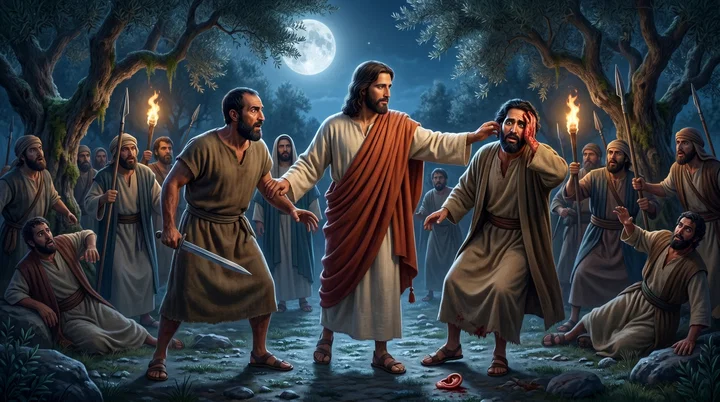
Then said Jesus unto Peter, Put up thy sword into the sheath: the cup which my Father hath given me, shall I not drink it?
Translations
Then said Jesus to Peter, Put up your sword into the sheath: the cup which my Father has given me, shall I not drink it?
King James Version, KJV Cambridge Paragraph Bible
Then said Jesus unto Peter, Put up thy sword into the sheath: the cup which my Father hath given me, shall I not drink it?
Then said Jesus to Peter, Put up thy sword into the sheath: the cup which my Father hath given me, shall I not drink it?
Revised Version, American Standard Version
Jesus therefore said unto Peter, Put up the sword into the sheath: the cup which the Father hath given me, shall I not drink it?
Jesus, therefore, said to Peter, 'Put the sword into the sheath; the cup that the Father hath given to me, may I not drink it?'
Jesus therefore said to Peter, Put the sword into the sheath; the cup which the Father has given me, shall I not drink it?
Jesus, therefore, said unto Peter—Thrust the sword into its sheath:—The cup which the Father hath given me, shall I in anywise not drink it?
Berean Standard Bible, Majority Standard Bible
“ Put your sword back in its sheath!” Jesus said to Peter. “ Shall I not drink the cup the Father has given Me?”
Jesus therefore said to Peter, “ Put the sword into its sheath. The cup which the Father has given me, shall I not surely drink it?”
Then Jesus said to Peter, Put back your sword: am I not to take the cup which my Father has given to me?
Then sayde Iesus vnto Peter, Put vp thy sworde into the sheath: shall I not drinke of the cuppe which my Father hath giuen me?
Douay-Rheims (Challoner revision)
Jesus therefore said to Peter: Put up thy sword into the scabbard. The chalice which my Father hath given me, shall I not drink it?
Pictures
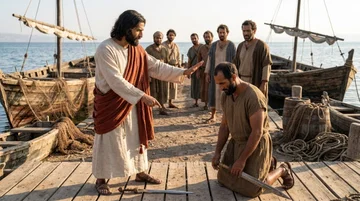
Cross-references 20 of 40
- Matthew 26:52
Then said Jesus unto him, Put up again thy sword into his place: for all they that take the sword shall perish with the sword.
Jesus orders Peter to put away his sword and warns against taking the sword.
- Luke 22:51
And Jesus answered and said, Suffer ye thus far. And he touched his ear, and healed him.
Jesus stops the violence during his arrest.
- Matthew 26:39
And he went a little further, and fell on his face, and prayed, saying, O my Father, if it be possible, let this cup pass from me: nevertheless not as I will, but as thou wilt.
Jesus submits to the cup given by his Father.
- John 18:36
Jesus answered, My kingdom is not of this world: if my kingdom were of this world, then would my servants fight, that I should not be delivered to the Jews: but now is my kingdom not from hence.
Jesus says his kingdom is not worldly and is not defended by fighting.
- Matthew 26:53
Thinkest thou that I can not now pray to my Father, and he shall presently give me more than twelve legions of angels?
Jesus could summon angelic help but chose to accept the cup.
- Mark 14:48-49
And Jesus answered and said unto them, Are ye come out, as against a thief, with swords and with staves to take me?
Jesus accepts his arrest, noting that Scripture must be fulfilled.
- Matthew 20:22
But Jesus answered and said, Ye know not what ye ask. Are ye able to drink of the cup that I shall drink of, and to be baptized with the baptism that I am baptized with? They say unto him, We are able.
Jesus asks whether his disciples can share the cup of his suffering.
- Luke 9:55-56
But he turned, and rebuked them, and said, Ye know not what manner of spirit ye are of.
Jesus rejects force against those who reject him, for he came to save, not destroy.
- Mark 14:36
And he said, Abba, Father, all things are possible unto thee; take away this cup from me: nevertheless not what I will, but what thou wilt.
Jesus accepts the cup given by his Father and submits to his will.
- John 19:16-18
Then delivered he him therefore unto them to be crucified. And they took Jesus, and led him away.
Jesus accepts the Father’s given cup and proceeds to crucifixion.
- Luke 22:42
Saying, Father, if thou be willing, remove this cup from me: nevertheless not my will, but thine, be done.
Jesus accepts the Father’s will and the cup of suffering.
- Mark 10:38-39
But Jesus said unto them, Ye know not what ye ask: can ye drink of the cup that I drink of? and be baptized with the baptism that I am baptized with?
Jesus speaks of his cup of suffering, which his followers will also share.
- Matthew 26:54
But how then shall the scriptures be fulfilled, that thus it must be?
Jesus must drink the cup so Scripture will be fulfilled.
- John 18:1-6
When Jesus had spoken these words, he went forth with his disciples over the brook Cedron, where was a garden, into the which he entered, and his disciples.
Jesus enters the garden where he is betrayed and arrested, displaying power he chooses not to use.
- John 18:15
And Simon Peter followed Jesus, and so did another disciple: that disciple was known unto the high priest, and went in with Jesus into the palace of the high priest.
John enters the high priest’s palace with Jesus after Peter’s sword incident.
- Isaiah 53:5
But he was wounded for our transgressions, he was bruised for our iniquities: the chastisement of our peace was upon him; and with his stripes we are healed.
The servant suffers and is wounded for others’ transgressions.
- John 12:27
Now is my soul troubled; and what shall I say? Father, save me from this hour: but for this cause came I unto this hour.
Jesus accepts the suffering appointed for him to fulfill his mission.
- Mark 14:43-45
And immediately, while he yet spake, cometh Judas, one of the twelve, and with him a great multitude with swords and staves, from the chief priests and the scribes and the elders.
Both texts describe Jesus’ betrayal and arrest.
- Luke 22:52-53
Then Jesus said unto the chief priests, and captains of the temple, and the elders, which were come to him, Be ye come out, as against a thief, with swords and staves?
Jesus submits to arrest as the appointed hour of darkness arrives.
- Psalms 75:8
For in the hand of the LORD there is a cup, and the wine is red; it is full of mixture; and he poureth out of the same: but the dregs thereof, all the wicked of the earth shall wring them out, and drink them.
The cup is associated with God's wrath, which Jesus bears.
Commentary
Each commentary is drawn from primary sources: the writings of Ellen G. White and Adventist pioneers and periodicals. Each commentary is separate. Its own words are not a quotation; follow the references to read the source passages.
Ellen G. White
17 sources
When Jesus told Peter to put up his sword, He was forbidding violent resistance and refusing to be defended or rescued by force.ST Aug 21, 1879Ms 42, 1897, par. 23–27Ms 91, 1909, par. 11–15 The cup the Father had given Him was the suffering and death appointed by the Father, and to drink it meant willingly accepting that suffering in submission to the Father's will.ST Aug 21, 18795RED 24.2–3Ms 42, 1897, par. 23–27 That cup embraced His betrayal, His agony in Gethsemane under the weight of humanity's guilt and God's wrath against sin, His condemnation, humiliation and rejection, and His crucifixion and death.DA 685.24RED 102.2–103.1 His submission was deliberate, not inability to escape, for the same power that struck the mob prostrate could have kept them helpless, and He could have called for more than twelve legions of angels to deliver Him.ST Aug 21, 18795RED 24.2–3Ms 91, 1909, par. 11–15 He freed His own bound hands to heal the servant's severed ear, showing He needed no defense, and He permitted Himself to be bound and taken so the Scriptures would be fulfilled and He would bear the penalty for man's transgression.ST Aug 21, 18795RED 24.2–3COS 123.2DA 696.3ST Jun 6, 1878
Setting and Meaning
The saying belongs to the arrest after the agony in Gethsemane on the night of the Passover, and it began the train of events that led to trial and condemnation.DA 685.1Ms 107, 1893, par. 2 Jesus and His disciples were making their way to Gethsemane while the city of pilgrims' tents lay quiet beneath a full moon.DA 685.1
The cup the Father has given is the suffering and death appointed by the Father, and to drink it is to accept that suffering willingly and submit to the Father's will rather than resist arrest or seek rescue.ST Aug 21, 18795RED 24.2–3Ms 42, 1897, par. 23–27Ms 91, 1909, par. 11–15COS 123.2 It is the suffering He had to endure, which He would not turn aside from, and His telling Peter to put away the sword is His refusal to be defended by force.ST Aug 21, 1879Ms 42, 1897, par. 23–27DA 685
That cup embraces His betrayal, His agony in Gethsemane, His condemnation in the judgment hall, His humiliation and rejection when the multitude that had hailed Him reviled Him and cried for His crucifixion, and His crucifixion and death.4RED 102.2–103.1 In the agony leading to the arrest He bore humanity's guilt and was counted among transgressors.DA 685.2 The weight of sin and of God's wrath against it brought Him sorrow unto death and made Him fear being shut out from His Father's love.DA 685.2
The command to put the sword into its sheath means Peter must stop violent resistance, since Jesus refuses to be defended by the sword or rescued by force.ST Aug 21, 1879Ms 42, 1897, par. 23–27Ms 91, 1909, par. 11–15ST Sep 23, 1886DA 696.3 His submission to the mob was deliberate and not inability to escape, and the disciples did not understand it.COS 123.3–4
Willing Submission and Purpose
His submission was deliberate and not from inability to escape, for the same power that struck the mob prostrate could have kept them helpless and let Him pass on unharmed, and He could have prayed for more than twelve legions of angels to deliver Him had He chosen.ST Aug 21, 18795RED 24.2–3COS 123.3–4ST May 20, 1889ST Sep 23, 1886 He refused to be defended by force or rescued by violence, accepting suffering and death as what the Father had given Him.ST Aug 21, 1879Ms 91, 1909, par. 11–15COS 123.3–4ST May 20, 1889ST Sep 23, 1886
At His arrest He freed His own bound hands to heal the wounded servant's cut-off ear, giving proof of divine power and showing He did not need Peter to defend Him.ST Aug 21, 1879DA 696.3ST Jun 6, 1878 He rebuked Peter and commanded the sword put away, permitting Himself to be bound and taken.ST Aug 21, 1879Ms 91, 1909, par. 11–15COS 123.3–4DA 696.3ST Jun 6, 1878 He did this so that the Scriptures that thus it must be would be fulfilled, for His arrest and suffering had to take place.ST Aug 21, 18795RED 24.2–3ST May 20, 1889ST Sep 23, 1886DA 696.3 He had taught openly in the temple, yet the authorities came to seize Him as though He were a criminal.COS 123.2
The disciples did not understand His deliberate submission, so their hope faded and they were disappointed and forsook Him and fled when He allowed Himself to be led away.ST Aug 21, 1879COS 123.3–4SG1 48.1 He knew beforehand that this trying ordeal awaited Him and knew which followers were unbelieving and of weak, inconstant faith.4RED 102.2–103.1 He deliberately brought a testing crisis while still present to comfort and strengthen His chosen and prepare His faithful few for His betrayal and death, sifting away faint-hearted followers beforehand.4RED 102.2–103.1 So when professed lovers turned from Him in His trouble the Twelve would not be overwhelmed with surprise and grief, sink beneath fear and disappointment, be carried away by apostasy, or hang their faith on the fickle favor and opinions of the world.4RED 102.2–103.1
He was sent to bear the sins of the world and must pay the penalty for man's transgression, and He could have delivered Himself from His enemies had He chosen to do so.Ms 91, 1909, par. 11–15 As part of the account of Christ's suffering and death, the verse strengthens those who suffer for their faith.Lt 100, 1910, par. 16
Sources
Pioneers and periodicals
80 sources
In the garden after the supper, when Peter drew his sword to defend him by force and cut off the servant's ear, Jesus told him to put the sword back into its sheath and willingly accepted the suffering before him.ST Feb 27, 1901ST Apr 29, 1897ST Aug 8, 1906ST Jan 8, 1902ST Aug 8, 1906 The cup is the bitter suffering and death appointed by his Father, to be drunk fully even to its dregs on the cross for the redemption of sinners.RH Sep 26, 1865RH Apr 2, 1861 Though he had power to call more than twelve legions of angels and escape arrest, he refused force or supernatural deliverance and let himself be bound and taken so the Scriptures would be fulfilled.ST Aug 21, 1879ST May 20, 1889ST Jan 23, 1893RH Jul 17, 1866 His rebuke teaches non-resistance, for his kingdom is spiritual and is not to be advanced or defended by earthly weapons, coercion, or war, but by submission, love, and spiritual power.ST Feb 7, 1900ST Apr 29, 1897ST Aug 21, 1893ST Mar 14, 1906ST Feb 7, 1900 His followers too are given a cup of affliction, sorrow, and loss by their Father, which they are to receive with patient resignation in hope of sharing his kingdom.RH Sep 26, 1865RH Dec 12, 1854ST Sep 20, 1883
Arrest Setting and Details
The words were spoken in the garden over the brook Kidron, also called Cedron and Gethsemane, where Jesus had gone with His disciples after the Passover supper.ST Feb 27, 1901ST Mar 11, 1886 There Judas came with a band of soldiers and officers from the chief priests and Pharisees with lanterns and torches and weapons to take Him.ST Feb 27, 1901 To that command was joined the declaration that He would drink the cup which the Father had given Him.ST Feb 27, 1901 The scene belongs to Gethsemane, where arrest is faced and suffering leading to the cross is accepted, and Gethsemane's shadow with the cross marks the way shown to heaven.ST Jan 8, 1902
Simon Peter drew his sword and struck Malchus, the high priest's servant, and cut off his right ear.ST Feb 27, 1901 He attempted in physical bravery to defend Jesus by force and wounded a man, showing readiness to lay down his own life for his Master.ST Apr 29, 1897ST Aug 8, 1906 The act proved ardent and impetuous love for Christ and boldness, like his confessions of Jesus as the Christ, while also displaying the instability of human resolution and determination.ST Aug 8, 1906 In striking the foremost man he reacted to disrespect toward Jesus by giving in to provocation, and he was not commended for becoming upset over how others act.ST Aug 8, 1906ST Dec 14, 1915
Jesus rebuked Peter and refused to be defended by force or rescued by force, commanding him to put up the sword into its sheath and to put it away because Peter's way was not yet God's way.ST Aug 21, 1879ST Jun 6, 1878ST Aug 8, 1906 He freed His own bound hands to heal the servant's cut-off ear and to heal the wounded enemy as proof of divine power, reversing the danger caused by the rash attack.ST Aug 21, 1879ST Jun 6, 1878ST Dec 30, 1889 By that healing He would not allow blood to be shed in support of His kingdom and would not let His followers fight to save Him.ST Dec 16, 1886ST Jan 10, 1911 The act protected Peter and the other disciples from being endangered too, yet offended by the admonition and disappointed by submission they forsook Him and fled.ST Aug 21, 1879ST Aug 8, 1906
The verse is part of the account of the beginning of Jesus' trials and persecution and of His arrest and suffering before the high priest and Pilate.ST Sep 24, 1912ST Oct 18, 1905 As part of the account of Jesus' death it shows Christ, the Passover sacrifice, sacrificed on the fourteenth day of the first month in exact fulfillment of the Passover type at its appointed time.RH Oct 30, 1855RH Dec 15, 1868 Those who placed the events after the Passover supper in Gethsemane held that Judas brought a mob that seized Him, that He was treated shamefully, and that He was crucified that same day, identified as Friday, the fifteenth day of the month.ST Mar 11, 1886
Cup Meaning and Acceptance
The cup is unwelcome, bitter suffering and death that must nevertheless be received, embracing trial, sorrow, grief and agony, even the ordeal on the night of betrayal in Gethsemane through which life was about to be given.STST Oct 21, 1930 It is the suffering appointed by the Father, accepted instead of resistance by the sword.STST Oct 21, 1930ST Mar 19, 1896 It was filled with sorrow and agony, with bloody sweat falling from the brow, leading on to the cross.RH Sep 26, 1865ST Oct 10, 1906ST Apr 20, 1915 It must be drunk fully to its bitter dregs, including hate and malice, with its dregs completed on the cross after arrest, trial, abuse and wounding.RH Sep 26, 1865ST Oct 10, 1906RH Apr 2, 1861ST Apr 20, 1915
The cup was given and appointed by the Father, and the question whether it shall not be drunk expresses calm, willing, cheerful submission, resignation and obedience to the Father's disposing will from first to last.RH Feb 25, 1915RH Jul 17, 1866 It is the pattern of patiently bearing hardship without complaint.RH Feb 25, 1915RH Jul 17, 1866 Though the cup was very bitter, because the Father put it into the hand it was willingly taken, following the startled feeling of sense that asked for the cup to pass, corrected by settled submission.RH Jul 17, 1866
The cup was the Father's wrath borne through shameful death on the cross to redeem sinners, bearing the wrath due to those whose suffering was taken so that no drop remained for them and making entrance into heaven possible.RH Apr 2, 1861RH Feb 15, 1870 It also recalls the earlier question whether the disciples could share it, though they did not yet understand the depth of the suffering.
Submission Fulfilling Scripture
He had power to summon heaven's armies and more than twelve legions of angels to rescue him, and the same power that struck the mob prostrate could have kept them helpless and let him pass on unharmed, yet he would not use force or supernatural power to avoid suffering or escape arrest.ST Aug 21, 1879ST May 20, 1889ST Sep 23, 1886ST Jun 6, 1878 He rebuked Peter and refused to be defended by the sword or delivered by angels, choosing instead to accept the suffering and death given him by his Father rather than resist capture with violence.ST Aug 21, 1879ST May 20, 1889ST Sep 23, 1886ST Jun 6, 1878ST Jan 23, 1893 His kingdom was not to be advanced by fighting, and he stopped Peter's violent resistance to explain that his arrest and suffering had to take place.ST May 20, 1889ST Sep 23, 1886ST Jan 23, 1893
He permitted himself to be bound and taken so that the Scriptures that thus it must be would be fulfilled, for doing otherwise would have prevented the Scriptures from being fulfilled.ST Aug 21, 1879ST May 20, 1889ST Sep 23, 1886ST Jun 6, 1878 His sufferings fulfilled what the prophets had spoken, whose appointed course had an end.RH Sep 21, 1869 His willingness to face this suffering was part of the solemn compact between God and his Son, which required him to give his life. He knew that going to Gethsemane meant meeting betrayal and facing contempt, abuse, crucifixion, and death, but he did not try to escape or shrink from duty and went forward to fulfill the divine plan.RH Nov 6, 1860
His obedience to the Father's will, grounded in God's word, was how he overcame Satan, relying on divine truth rather than supernatural power or other compulsion.ST Jul 2, 1894 His submission allowed his enemies' apparent victory and gave them opportunity to recognize from Scripture that he was the Son of God.ST Jun 7, 1899 While he faced his ordeal, his disciples were spared for future work until their faith was strong enough to face martyrdom.ST Feb 27, 1901 Disappointed by his submission, they forsook him and fled.ST Aug 21, 1879
Sword Rebuke and Nonresistance
Jesus rebuked Peter for drawing his sword and ordered him to put it back into its sheath, stopping him from using force and accepting instead the suffering that lay before him as the cup given by his Father, from which he would not turn aside or resist arrest.ST Feb 7, 1900ST Apr 29, 1897ST Feb 7, 1900 That rebuke condemned carnal doing and chose submission, and that submission itself is true power, force and energy, a magnificent retort and the mystery of heroism found in passiveness, silence and non-resistance rather than violent action, though it puzzles common minds that mistake noise for music and tumult for power.ST Feb 27, 1901 In the same rebuke he accepted the suffering and death appointed for him rather than resisting them.ST May 1, 1901
That order to return the sword to its sheath was given calmly and kinglike, with pity, with loving word and patient breath toward his enemies, even though vengeance waited only for his word.RH Jun 25, 1901ST Apr 8, 1903ST Apr 30, 1902 It was his last command before he was led away to die, and it was never withdrawn, binding all who follow him to live and die as he commanded, without the sword.ST Feb 27, 1901RH Jun 25, 1901ST Apr 30, 1902 A disciple must not use a carnal weapon to defend the gospel or its ministry.ST Feb 27, 1901
Peter's use of the sword showed that he had not yet learned the spirit of Jesus or the principles of his kingdom, for carnal means cannot advance Christ's kingdom.ST Mar 14, 1906 His rash attack on the arresting party and his reliance on physical bravery and carnal doing was not yet God's way.ST Aug 8, 1906ST Dec 30, 1889ST Aug 8, 1906 That admonition calls to be accepted with all the heart, yet because he would not let Jesus have his way he became offended and forsook his Lord with the others.ST Aug 8, 1906ST Aug 8, 1906
His action proved ardent and impetuous love, boldness and human resolution, like his confessions of Jesus as the Christ, while also displaying the instability of human determination.ST Aug 8, 1906 He was ready to lay down his own life for his Master, yet he missed the opportunity to offer himself to die with him.ST Aug 8, 1906ST May 1, 1901 Able to fight for Christ with the sword, he was unable to suffer shame for his sake, and Christ has no use and no place for rash and headstrong followers of that kind who can fight for him yet cannot suffer for him.RH Jul 6, 1869 Offended by the admonition, he joined the other disciples in forsaking his Lord.ST Aug 8, 1906
Christ had to follow Peter's violent act for a cause and heal the harm Peter caused, for work for people driven by motives other than pure love creates prejudice and wounds that may leave lasting scars.RH Nov 5, 1901 He did not resist or retaliate, but healed the wound Peter had made.ST Oct 20, 1914 His example shows that Christians' weapons are not earthly weapons used to kill, but are mighty through God against sin in the heart.ST Oct 20, 1914
Spiritual Kingdom Not Forced
The rebuke to put away the sword shows willing acceptance of the suffering the Father had given rather than avoidance of it by force, and the kingdom is not to be advanced by earthly weapons, power, fighting or coercion.ST Aug 21, 1893ST Mar 14, 1906ST Jan 23, 1893 Though power to summon heaven's armies was at hand, violence was not used, for carnal means cannot advance Christ's kingdom because Peter had not yet learned its spirit and principles.ST Mar 14, 1906ST Jan 23, 1893 The true course is the example of putting away the sword rather than resisting by force, for the struggle is spiritual rather than a fight for an earthly kingdom, carried on with spiritual weapons made mighty through God to overcome opposition to the knowledge of God and bring thoughts into obedience to Christ.ST Aug 21, 1893ST Oct 23, 1893ST Mar 19, 1894 No retaliation or resistance was offered, and the wound Peter caused was healed, showing that Christian weapons are not earthly weapons used to kill but are mighty through God against sin in the heart.ST Mar 19, 1894ST Oct 20, 1914
His kingdom is distinct from civil affairs and spiritual in nature, and it is not to be advanced by carnal weapons.ST Jun 23, 1914ST Dec 16, 1886 Blood was not allowed to be shed in its support, and it is neither established nor defended by military force or physical force.ST Dec 16, 1886RH Apr 3, 1913 The kingdom of God is established within people, not by civil government imposing religious or moral laws.ST Jun 23, 1914RH Apr 3, 1913 The church therefore must not unite with or use the power of the state, and Christ forbids defending his cause by force, so that believers when assailed with carnal weapons must not retaliate with carnal weapons but accept suffering as the Father's will.ST Apr 29, 1897 His work and commandments are not to be advanced by force or civil law but by the gospel and the spirit of love.ST Mar 20, 1893 His gospel does not force belief or worship by carnal weapons or coercion but calls and persuades, a changed spirit later reflected in Peter's own counsel to abstain from fleshly desires.ST Mar 20, 1893ST Feb 6, 1893
Use of the sword to defend him denied his divinity, for his cause is not advanced by carnal force.ST Dec 10, 1902ST Jan 24, 1900 This exposes the contradiction of a church claiming to follow the Prince of Peace while using civil power and violence to coerce people.ST Dec 10, 1902ST Jan 24, 1900 Beside this stands the teaching held by others that the command did not deny Peter the temporal sword but only ordered its return to the scabbard, so that both swords belong to the jurisdiction of the church under one fold and one Shepherd.ST Jan 9, 1879 In that teaching the spiritual sword is wielded by the church and the temporal sword is wielded for the church, the one being the sword of the priest and the other the hand of the monarch at the command and sufferance of the priest, with temporal authority subject to spiritual power.ST Jan 9, 1879 The apostles did not need to buy swords because they already had enough, and the occasion was used to give lasting instruction that those who take the sword will perish by the sword.ST Jul 27, 1915
Believers Sharing the Cup
The Lord gives a cup to each follower that must not be refused but taken with resignation.RH Sep 26, 1865RH Dec 12, 1854RH Jan 19, 1869 That cup is the appointed cross, the heavy burden, degradation, scoff, frown, sorrow, grief, disappointment, want, and loss, a rough, dreary, thorny pathway through sin and Satan's power.RH Sep 26, 1865RH Jan 19, 1869 It is shared with Christ who first meekly bore crushing, bleeding, bruised suffering, drinking to the full the bitter cup the Father gave Him even to its dregs of hate and malice.RH Sep 26, 1865 The question, Shall we not drink it, applies Jesus' cup to believers, asking whether they too should accept and share in such suffering.ST Sep 20, 1883 Sharing in suffering in this way is a privilege, with hope of sharing His kingdom if faithful.ST Sep 20, 1883
The cup of affliction can be received as something a believer's Father has permitted and ordered, and even when bitter it is not poison to ruin them.RH Nov 6, 1856 Remembering God's loving, tender care and fatherly relationship keeps the heart from sinking under affliction and guards against suspecting His purpose is harmful.RH Nov 6, 1856 The verse is an example of patiently bearing hardship without complaint.RH Feb 25, 1915RH Sep 5, 1907 Welcomed willingly, the cross proves a blessing, and enduring it without diminishing anything keeps a crown reserved when life's race is finished, with the bitterness of suffering for faith one day lost in His presence.RH Sep 26, 1865ST Sep 18, 1893 Through suffering people are made perfect, and His people too must endure suffering, but their sorrow will end and they will enter their Lord's joy never to suffer again.RH Sep 5, 1907RH Sep 21, 1869
A bitter trial that a person cannot bear by her own strength can be entrusted to God to bring help and faith.RH Jul 8, 1858 The Spirit can make even a small share of suffering for Christ welcome.RH Apr 2, 1861 His submission, even when condemned for political reasons, is an example for followers not to use force to resist civil authority but to commit themselves to God.ST Aug 13, 1896 A minister must not take up carnal weapons against foes but leave the outcome to God.ST Aug 4, 1898 The Christian's power is not in carnal weapons but in simplicity, humiliation, and yielding of personal honor, glory, and selfish comfort.ST May 13, 1880 In taking human nature with mortal frailties and voluntarily laying down His life instead of fighting, Jesus became victor over the world, the flesh, and the devil and rose a triumphant conqueror.ST May 13, 1880 His submission expresses the principle, Not my will, but thine, be done, rather than turning aside from His saving mission and the sacrifice He must undergo.RH Aug 5, 1902
Peace Without War Coercion
The verse teaches Christians to oppose war, strife, and bloodshed and to love and promote peace.ST Feb 28, 1911 Its words to Peter apply to nations as well as individuals.ST Feb 28, 1911 It is a plea for Christians to call for an end to violence and war.ST Nov 23, 1915 It displays a spirit opposed to armed force.RH Oct 27, 1910
His command to put the sword away is a model for Christians, including rulers, to follow rather than pray in his name while waging war.ST Jun 4, 1894 When armed men came to arrest him beneath the olive trees by the brook Cedron, he calmly and compassionately forbade the use of the sword.ST Jun 4, 1894 He accepted his path to death without calling for vengeance or force.ST Jun 4, 1894 He is the bravest hero ever born because he braved a criminal's grave and bore scorn and refused to be defended by violence.RH Jun 25, 1901ST Apr 8, 1903ST Apr 30, 1902 When the sword had been drawn and an armed crowd with swords and clubs and torches had come to bind him and lead him away to die, with vengeance waiting only for his word, he looked on the scene with pity and calmly and kinglike, with loving word and patient breath, ordered the sword returned to its sheath.RH Jun 25, 1901ST Apr 8, 1903ST Apr 30, 1902 That order was his last command before he was led to death, and it binds all who follow him to live and die as he commanded, without the sword.RH Jun 25, 1901 It charges Christian kings and czars and queens and rulers in Christ's name to stop the lie of calling on Christ in prayer while holding a bloody sword.RH Jun 25, 1901ST Apr 8, 1903 If even one czar or king or queen would bravely obey and renounce war, there would be an end of war beneath the peaceful olive boughs.RH Jun 25, 1901ST Apr 8, 1903ST Apr 30, 1902
He did not teach war and bloodshed. He would not allow blood to be shed in support of his kingdom, and he even healed the man Peter wounded.ST Dec 16, 1886 He forbade defending him with a sword because he accepted the suffering given by his Father.ST Dec 16, 1886ST Mar 19, 1894 His kingdom is spiritual and is not to be established or defended by military force.ST Dec 16, 1886 His kingdom is not advanced by force, and his servants' weapons are spiritual, used in a spiritual struggle rather than a fight for an earthly kingdom.ST Mar 19, 1894
Zeal for God does not justify violence or oppression.ST Mar 19, 1896 Those who harm others in religious zeal should learn from his rebuke and his care for the injured.ST Mar 19, 1896 Though innocent, he chose to suffer wrong even to the taking of his life without violence, anger, or vindictiveness on his part.ST May 13, 1903 He would not allow his followers to use force to prevent the wrong done to him, forbidding violent means to stop the unjust suffering and death brought upon him.ST May 13, 1903 It is better to suffer wrong than to do wrong, and better to stay at peace in the midst of wrong than to try to bring justice by anger and violence, since using evil to right evil only makes two wrongs where one had been.ST May 13, 1903
He endured reviling without retaliation or threats and entrusted himself to God, who judges righteously. He stopped Peter from using his sword and accepted what his Father had given him to face, showing non-resistance rather than punishing those who offend him.ST Apr 9, 1894 He rebuked Peter for trying to defend him with a sword and directed him away from earthly force. The unsheathed sword means the church's use of coercive power, where religious persecution and the denial of civil and religious liberty repeat Peter's action, expressing religious bigotry and murderous hate.ST Dec 7, 1915 He did not commend Peter for giving in to provocation by striking off a man's ear over disrespect toward him, which shows that people should not become upset over how others act.ST Dec 14, 1915
The verse is an example of Christ's non-resistance.ST Apr 9, 1894 His followers are not to use physical weapons to advance or defend his cause, for their weapons are spiritual and their calling is to make peace.ST Aug 8, 1916 He regarded the suffering awaiting him as the cup his Father had appointed, and willingly accepted it rather than resist arrest or let Peter fight with the sword.ST Jun 11, 1896
Sources